


Uncategorized
When Rabin was assassinated, Israel changed before my eyes
The minibus was crammed with Jordanians making their way from the south of the country to Amman. I couldn’t help but wonder why everyone looked so grim. We had departed at dawn, and throughout the three-hour drive, the radio had been dominated by somber discussion. I hadn’t studied any Arabic yet so I couldn’t make out the conversation beyond a smattering of place names: Tel Aviv, Washington, Amman, Al Quds — the Arabic name for Jerusalem.
No one in the minibus said a word, and I didn’t want to break the silence. So I listened to the radio, keeping my ears open for more proper nouns. Peres. Clinton. Hussein. Rabin.
It wasn’t until I walked into the lobby of my hotel in Amman and saw a TV screen showing a photo of Israeli Prime Minister Yitzhak Rabin, along with the text “1922-1995,” that I realized something terrible had happened.
My mind raced through worst-case scenarios — a political assassination by a Palestinian group, a countdown to war, retaliation and counter-retaliation, an inexorable spiral of violence. But when I asked the man behind the check-in counter what had happened, he sounded almost relieved.
“Another Jew” did it, he said, before adding, “So there probably won’t be a war this week.”
I was fresh out of college and had never traveled to the region before. My then-girlfriend (now wife) and I had decided to backpack around Egypt, Jordan and Israel, as the overall political situation had seemed positive — at least when viewed from a distance back home in the United States. The previous year, Rabin, Foreign Minister Shimon Peres and Palestinian President Yasser Arafat had shared the Nobel Peace Prize for the Oslo Accords. Efforts to achieve a two-state solution were moving forward, albeit at a measured pace. It seemed the ideal time to go on a bit of an adventure, and perhaps to feel the hope in the air.
All of those hopes became a blur as we stood in the hotel lobby, trying to figure out what to do next. “There probably won’t be a war this week,” I thought: Instead, an entire country would be sitting shiva, not to mention planning a state funeral for the following day. We made arrangements to go to Jerusalem the next morning.
The road from Amman to Jerusalem by way of the West Bank was nearly deserted. No one spoke a word the entire time, lost in thought, pondering the what-ifs and what-nexts. I expected Israel to be many things, but silent was not one of them.
We arrived ahead of schedule, well before the start of the funeral. As we checked into our new hotel, I asked if it would still be possible to attend the funeral procession, which would begin a few hours later.
“You’re too late,” the clerk told me. “The entire country is already lined up along the route. You might as well watch it on TV at this point.”
I couldn’t just sit there, though. So we left the hotel and began to make our way to the Western Wall.
I’d always imagined my first encounter with Jerusalem’s Old Town would be awash with activity, filled with encounters with street vendors, pilgrims and tourists. Instead the area was nearly deserted. Many shops remained shuttered, save a handful that kept their doors open because they happened to have a TV inside. We stood for a while in one such shop, its owner fidgeting with prayer beads as a small crowd of Palestinian men watched the televised funeral procession in silence.
As we reached the Western Wall, almost no one was present: a smattering of soldiers, a handful of tourists, a davening Haredi man. I ripped two pages from my guidebook and scrawled a pair of prayers on them to tuck between the stones of the wall — one for my grandfather, who had passed away a few years earlier, and one for Rabin. I wish I could remember what I wrote.
After I approached the wall, sirens marking the start of the two minutes of silence began to wail from every direction. The world stopped for two minutes. I stared at the ancient stones, mere inches from my face. Everyone was silent, except for the Haredi man, who continued to quietly pray.
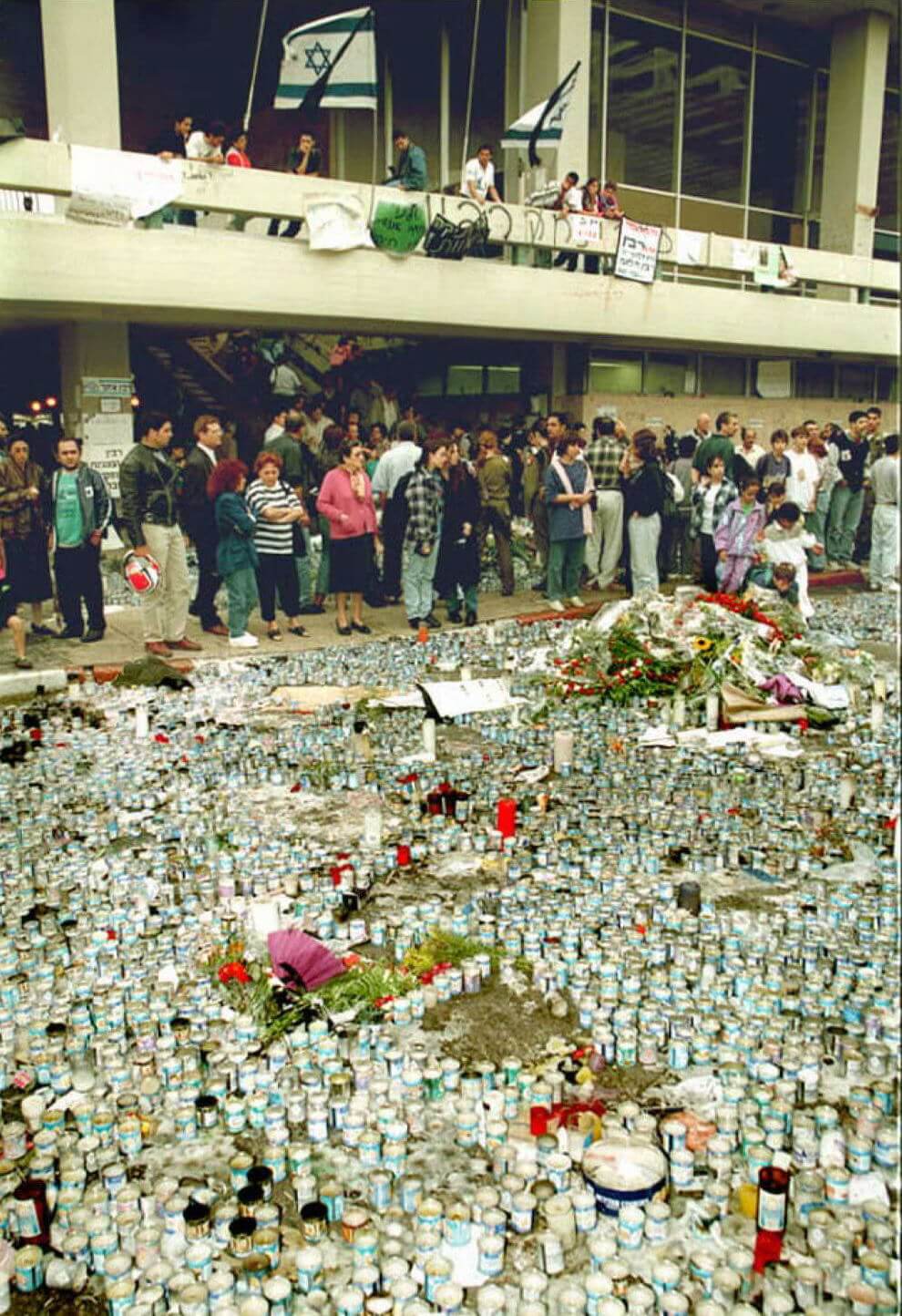
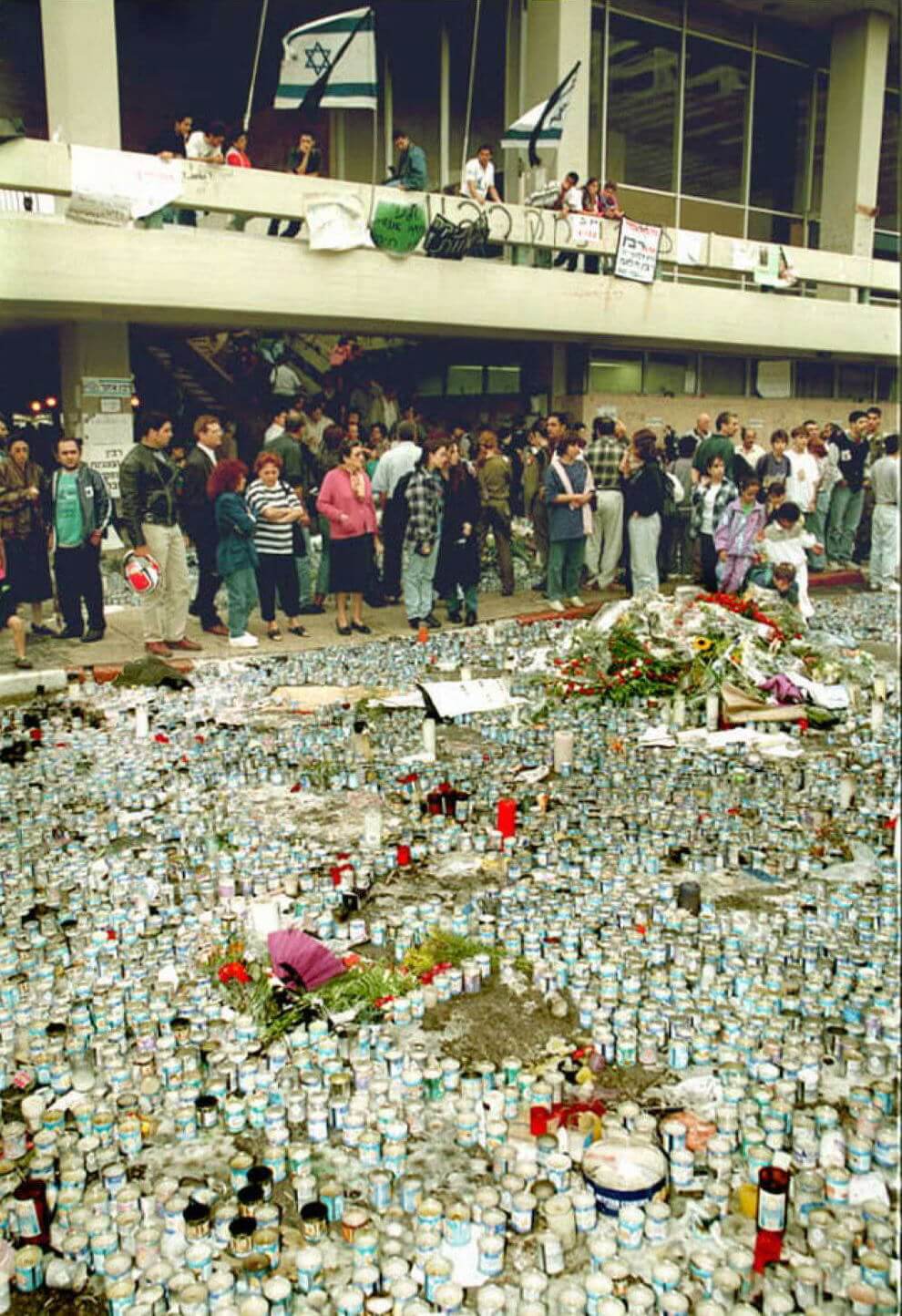
By the time we made it to Tel Aviv several days later, the illusion of normality had returned. People walked along the beach and crowded the outdoor cafes, bundled up in sweaters amid an unseasonal chill in the air, until a downpour sent people scattering. As the weather cleared, I decided to visit Kikar Malchei Yisrael, the square where Rabin had just been murdered.
I had expected the crowds of mourners. But it was the thousands of yahrzeit candles that broke my heart. In some places they were laid out in neat rows, surrounded by drenched flowers; volunteers were drying out each candle and attempting to re-light them.
People had formed some batches of the candles into Stars of David, doves and peace signs. Around them stood children, families, soldiers, most of them quietly grieving. A pair of students sat cross-legged on the wet pavement, engaged in a passionate debate. I couldn’t understand what they said, but the heightened tone of their exchange carried the weight of their worries about the future.
At some point I began reciting Kaddish to myself. People began photographing me, which struck me as odd, until I recalled that I had been doing exactly the same thing to others just a few minutes earlier. I then collected some candles and reassembled them in the form of chai, the Hebrew word for “life.”
I lingered for a while before departing, but returned later that afternoon. The two students were still there.
In the 30 years since that awful week, I’ve thought about them periodically. At the time, they seemed painfully aware their lives had been irrevocably altered by what had transpired, that their hopes and dreams had died alongside Rabin himself.
They must be approaching 50 years old. Have the intervening years been kind to them? Have they prospered, or wasted the decades embittered by the consequences of that seminal moment of their lives, and the life of their country? Have they served in wars, protested against them, or both?
Assuming they are even still alive, do they think about that day each year and feel their heart break all over again like mine does?
And will they, too, light a yahrzeit candle tonight in Rabin’s memory, and for the lost promise of what could have been?
The post When Rabin was assassinated, Israel changed before my eyes appeared first on The Forward.
Uncategorized
UK adopts sweeping measures against antisemitism in schools
(JTA) — The U.K. has adopted sweeping measures to combat antisemitism in English schools, prompting pushback from the country’s largest teachers’ union.
The move came after a new government-commissioned review found that three in five Jewish students reported experiencing antisemitism in English schools. The most common incidents were jokes, stereotypes and comments about Jewish people. About half of respondents who witnessed or experienced antisemitism said the incidents were not reported, most often because they did not think they would be taken seriously.
The government on Wednesday accepted 27 recommendations from the report, including dedicated antisemitism training for leaders and staff, improved recording of antisemitic incidents and moves to build a better understanding of Jewish life, identity and contemporary antisemitism.
The government commissioned the report following a spate of high-profile attacks on Jews in Britain, including an attack on a synagogue in Manchester last year that left two men dead.
The report’s author, Sir David Bell, the vice chancellor of the University of Sunderland and former chief inspector of schools in England, recommended addressing antisemitism distinctly from other forms of racism. He argued that antisemitism was a “uniquely complex” problem because of intertwined racial and religious dimensions, since Jewish identity can encompass both an ethnicity and a religion, along with expressions of prejudice that hold all Jews responsible for the actions of Israel.
The government will also encourage English schools to adopt the International Holocaust Remembrance Alliance (IHRA) working definition of antisemitism. The definition is supported by many mainstream Jewish organizations and has been adopted by 47 countries, including the U.K., but critics say that it conflates some forms of antisemitism with criticism of Israel.
British Education Secretary Lucy Powell called Bell’s review a “generational moment” and said that “implementation is now my priority.”
However, the National Education Union, the largest union representing teachers, lecturers, teaching assistants and support staff in the United Kingdom and Europe, raised concerns on Wednesday about recommending the IHRA definition for schools. NEU general secretary Daniel Kebede said in a statement that the definition “risks deepening the problem rather than tackling it, and actively undermining efforts to confront antisemitism.”
“The IHRA’s contested framing risks blurring the line between antisemitism and legitimate criticism of the Israeli government and the genocide in Gaza, leaving teachers with uncertainty when they need clarity,” said Kebede. He cited a risk that “children who cannot critically explore issues through classroom discussion will instead seek their answers in online and unsafe groups.”
Kebede also encouraged Britain’s Department for Education to strengthen guidance on all forms of racism, not only antisemitism, saying that 65% of teachers report they have not received any antiracism training in the past year.
The Board of Deputies of British Jews, an umbrella organization for British Jewish communities, celebrated the antisemitism report and the government’s adoption of its proposed measures. The group specifically praised the report’s “clear recommendations that schools and local authorities follow government guidelines by adopting the IHRA Working Definition of Antisemitism as a tool to deepen understanding of contemporary antisemitism.”
“We remain concerned about undue external influence on schools driven by narrow political agendas, and tendentious materials seeping into schools and increasing disharmony, and we will continue to press for vigilance against this,” said the Board of Deputies.
The post UK adopts sweeping measures against antisemitism in schools appeared first on The Forward.
Uncategorized
Orthodox Jewish man stabbed in midtown Manhattan
(New York Jewish Week) — An Orthodox Jewish man is in stable condition after being stabbed on Wednesday evening in the Diamond District of midtown Manhattan. Police are investigating the attack as a possible hate crime.
Police told the Jewish Telegraphic Agency that the NYPD’s Hate Crimes Task Force is investigating the incident as a possible antisemitic attack, and Manhattan Shomrim — the Jewish community watch group — has asked people to share footage as police search for the suspect. No arrests have been made.
The victim was identified by police as a 26-year-old man, and Orthodox Jewish outlet COLLive identified him as a resident of Crown Heights, the neighborhood that is home to the Chabad-Lubavitch Hasidic movement’s headquarters.
He was taken to Bellevue Hospital in stable condition. Police said they were called at about 5:50 p.m. on Wednesday after the man was stabbed in the back with “an unknown sharp object” on 47th Street near Fifth Avenue. ABC7 reported that the victim told investigators he believed he was stabbed with a needle or syringe.
According to the Chabad website, which published an interview with the victim, he is a recently ordained Hasidic rabbi named Joseph, who commutes to Midtown each day to wrap tefillin with Jewish merchants. The attacker, Joseph told the website, was a woman who seemed to be following him prior to the stabbing.
The attack comes as Jewish New Yorkers have been targeted in more than half of the hate crimes committed in New York City this year, despite making up about 12% of the city’s population.
In July, an assailant stabbed two men on the Upper West Side, including one who was leaving a synagogue, while yelling “Allahu akbar,” and was charged with committing hate crimes.
Louis Keene contributed reporting.
The post Orthodox Jewish man stabbed in midtown Manhattan appeared first on The Forward.
Uncategorized
VIDEO: A Hasid gives us a tour of Morocco in Yiddish
דער ירושלימער יוטוב־שטערן וועלוול קירשנבוים האָט לעצטנס אַרויסגעשטעלט אַ ווידעאָ אויף ייִדיש פֿון אַ פּרעכטיקן וויזיט, וואָס ער האָט געמאַכט אין מאַראָקאָ. עס באַגלייט אים זײַן חבֿר אַבֿרהם פּרץ.
אינעם ווידעאָ זעט מען ווי קירשנבוים דאַוונט שחרית מיט די אָרטיקע ייִדן און באַזוכט אַ גוט אָפּגעהיטענעם בית־עולם, וווּ עס ליגן באַערדיקט גרויסע צדיקים ווי למשל הרבֿ חיים בן עתר (1696–1743), באַקאַנט ווי דער „אור החיים“. „מענטשן מיינען, אַז נאָר אין אייראָפּע זענען דאָ קבֿרים פֿון צדיקים!“ זאָגט קירשנבוים.
מיר זעען אַ גרויסע, שיינע שיל מיט אַ פֿײַנער אַרכיטעקטור אין קאַזאַבלאַנקאַ; דעם גרויסן אַראַבישן שוק, וווּ קירשנבוים קויפֿט זיך אײַן מלבושים פּונקט ווי די מאַראָקאַנער גייען אָנגעטאָן. ער באַוווּנדערט אויך די שיינע טיי־גלעזער און טשײַניקן, וואָס מע פֿאַרקויפֿט דאָרט, און באַקענט זיך מיט אַ ייִדישן סוחר וואָס האַנדלט מיט זילבער און גאָלד, פּונקט אַזוי ווי זײַן טאַטע און זיידע האָבן געטאָן פֿאַר דור־דורות.
The post VIDEO: A Hasid gives us a tour of Morocco in Yiddish appeared first on The Forward.
