



Uncategorized
Why Evangelical Christians are hell-bent on finding Noah’s Ark

As Jews in synagogues around the world read the story of Noah’s ark this week. a team of Biblical archeologists funded by Christian groups will be working to excavate it.
For the last three months, the group has been surveying a boat-shaped geological formation in eastern Turkey that has tantalized explorers for decades. They’re hoping that buried underneath the mound — named Durupinar after a Turkish army captain who found it — is evidence of the ship that helped Noah, his family and a zoo’s worth of wildlife survive the flood in the book of Genesis.
The dig is the latest project in a centuries-long history of people searching for Noah’s ark. For many years, those efforts centered around Turkey’s Mount Ararat — named back in the Middle Ages for the Biblical mountain range where Noah’s ark finally comes to rest. Durupinar, located about 20 miles south of Ararat, makes a more compelling argument to these history hunters: At about 540 feet long by 85 feet wide and 50 feet tall, it’s roughly the same dimensions — or at least proportions — as the Torah’s ark (300 by 50 by 30 in cubits).
That was enough for Andrew Jones, founder of Noah’s Ark Scans, the group organizing the private expedition. Raising money through church groups, Christian foundations and private donors, Jones — who lives in Turkey, where he runs a Biblical tour company — recruited an international team of researchers to scan and sample the soil with the help of a Turkish archaeology professor. Their preliminary results, Jones said, will be available in coming weeks.
“Everything we’ve done so far keeps pointing back to, this can’t be a rock formation,” Jones told the Forward. “If we get to the point we can say with full confidence that this is a man-made object, then you’re left with, what other object is it?”
The search for Noah’s ark dates back centuries, and has been met with skepticism for nearly as long. Most historians regard the story of Noah’s ark as myth, pointing to similar narratives in other religious traditions as well as internal inconsistencies in the Biblical text. (There’s also the technical challenge of putting two of every land animal on a single boat and living to tell the tale.) Archaeologists have also cast doubt on the Jones’ methods — likening his team more to Indiana Jones cosplayers than academic researchers.
Nevertheless, Jones’ project has sparked fascination in both scientific and religious spaces. The excavation — so far, it’s more like a series of small holes drilled in the ground for samples — has been featured by the History channel and the Sunday Times, general-interest creators like Bear Grylls and Jewish community publications like the Haredi Orthodox outlet Mishpacha. (Some of the social media coverage has exaggerated the findings, which Jones described as a double-edged sword — overstating hype but also attracting donors.)
While the flood story is found in the Hebrew Bible, Jewish leaders don’t seem inclined to participate in the search efforts. “There’s no reason to believe it’s true,” Rabbi Natan Slifkin, director of the Biblical Museum of Natural History in Be’er Sheva, Israel, wrote of the claim. Instead, the hunt for Noah’s ark is deeply Christian — beginning with Jones himself, who identifies as Evangelical, and has dreamed of finding his the ark in these mountains since he learned about Durupinar as a teenager.
“Faith is great,” Jones said, “but if you have something to back it up, and you’re talking to an atheist, for example, then you can say, ‘Hey, look, my faith is not just some invisible thing.’”

Digging deep
Durupinar has been the subject of archaeological speculation — and plenty of skepticism — since 1959, when İlhan Durupınar identified it in aerial photos taken during a NATO mapping mission. He and others returned to the spot soon after, dug around and lit some dynamite, only to find soil and rocks. In the late 1980s, an amateur archaeologist named Ron Wyatt, using radar, claimed he had found proof of iron grids — potentially indicating a manmade structure — under the ground using radar.
In 1996, a pair of archaeologists — including one who had previously promoted the iron grid discovery with Wyatt — rejected claims that Durupinar was anything other than a natural geological structure. At that point, the theories seemed fully debunked.
Jones resurrected the search, he told the Forward, because he didn’t believe all methods had been exhausted. He arranged his first imaging of the site in 2019. He founded Noah’s Ark Scans to spread the word about their findings and raise money for further research. This year’s expedition, he said, cost some $700,000, about one-third of which was covered by a Christian foundation (which he declined to name).
This year’s team, led by a Turkish professor and including scientists from Slovakia, Brazil, Australia, started in July with topography work and eventually moved to core drilling — 12 holes spread across the site ranging in diameter from 2.5 to 8 inches, pulling soil samples from as deep as 60 meters.
They won’t have the soil results for a few weeks, but radar tests, Jones said, showed “anomalies that are not geological, not natural.” He added that the radar confirmed that what lies beneath the surface is not a rock layer — and in some of the holes, they found rich sediment.
“It’s like garden soil you find in Home Depot or Lowe’s for your potted plants,” Jones said. “I’m not going to say it’s the decayed remains of a boat, but it’s something we tested.”
They hated on Noah, too

The reasons for skepticism about the existence of an ark at this location are many, and begin with the story itself. Historians place the writing of the Noah’s ark narrative at around the 8th or 9th century B.C.E., centuries after other, similar flood stories like the Epic of Gilgamesh. The earlier stories put the ark in a completely different place, and don’t have a character named Noah at all.
“If the earlier versions have different protagonists’ names — and they do — then why are we even looking for a Noah?” said Jodi Magness, a professor of archaeology at University of North Carolina. “We don’t have any evidence that there actually was a man named Noah.”
And without knowing Noah, it would be impossible, Magness said, to date any finding to Noah’s era.
Magness, who in recent years has been excavating an ancient synagogue in the Galilee, was critical of the approach taken by Jones’ team. Typically, she said, archaeologists are trying to answer a research question before they choose a site — in her case, the fate of Jews after Christianity became the official religion of the Roman empire.
“Searching for Noah’s ark is not a research question,” she said. “Archeologists are not treasure hunters. So the goal is not to go and find something like Raiders of the Lost Ark kind of a thing.”
Slifkin, the Biblical museum director, also discounted the preliminary findings on a scientific level.
“Finding straight lines and right-angles is not evidence of a man-made structure,” he wrote in his newsletter, Rationalist Judaism. “Just check out the minerals on exhibit at the Biblical Museum of Natural History. Likewise, hitting a hard layer or finding organic-rich soil does not equal proof of a man-made structure. And even proof of a man-made structure is not necessarily the ark!”
In the Torah narrative, only Noah believed God’s vow to destroy the world. In real life, Jones has many believers in his vision — hundreds of thousands of dollars, he said, have poured in from small donors, many of them who he believes are fellow Christians.
Still, he said, the religious stakes felt personal. He believed a variety of miracles described in the Hebrew Bible, including the splitting of the Red Sea and the giving of the Ten Commandments, even without scientific evidence. But the lack of discovered evidence was not proof it wasn’t out there.
“Since the ship is real, by my faith, I believe that it existed,” he said. The remaining question, then, was, “What can you physically find today of that event?”
The post Why Evangelical Christians are hell-bent on finding Noah’s Ark appeared first on The Forward.
Uncategorized
The first bible published in North America had one goal: Converting Native Americans

In 1663, colonial printers in New England produced a translation of the Bible into Wampanoag, an Algonquian language spoken in southern New England. Also known as Wôpanâak or Massachusett, it was one of several Native American languages in the region.
Printing the book would be an important story on its own. But it is even more remarkable because it was the first Bible that English colonists published in North America.
As a historian of early America, I believe this Bible sheds important light on relations between New England’s Native peoples and English immigrants, who saw themselves as crucial players in the spread of Protestant Christianity. Consumed with the idea that their culture was superior, many English Protestants believed they could conquer North America without much bloodshed: that Indigenous peoples would voluntarily abandon their cultures and embrace the faith of the newcomers.
The historical record is more complex. My 2026 book, “Contested Continent,” details the struggle to control North America in the generations after Christopher Columbus crossed the Atlantic Ocean. There were many moments, including the fabled first Thanksgiving of 1621, when Indigenous peoples and colonists coexisted. But there was brutal violence as well, such as English colonists’ efforts to destroy the Pequot of southern New England in 1637.
In the aftermath of early warfare, some Puritan clerics looked for new ways to convert Native Americans – and decided religious texts were the answer.
Puritans and print
During the Protestant Reformation, Martin Luther argued that the only infallible source of religious understanding was the Bible, a doctrine known as “sola scriptura.” Protestants believed the laity needed to become literate, in order to read Scripture for themselves.
The Puritans embraced this teaching, and in 1638, the Rev. Joseph Glover paid to transport a printing press to Cambridge, Massachusetts. Two years later, that press published the Bay Psalm Book, a collection of songs for worship – the first book printed in English North America.
In the years that followed, printers offered many religious tracts, often based on sermons. They believed that print would bring Protestant Christianity to a widening audience and provide guidance for existing believers.
John Eliot and Cockenoe
A Puritan minister named John Eliot sailed from England to Boston in 1631 and soon took a leading role in the church at Roxbury, just south of the city. Eliot was so devoted to books that he purportedly brought 23 barrels of them with him from England.
By the 1640s, he began trying to spread his faith among Native residents of the region. To do so, he needed to be able to communicate with those he hoped to convert, and he understood that books could advance his cause.
Other colonists also hoped that print could foster good relations with the Native residents of New England. The most famous was Roger Williams, founder of Rhode Island. “A Key into the Language of America,” a book he published in London in 1643, provided phrases in Narragsansett, another Algonquian language. Such efforts were crucial to Europeans eager to trade with Native peoples – and to those, like Williams, who wanted to spread their culture without violence.
Eliot was intent on translating the Bible. He did not know Wampanoag, but he met an interpreter who impressed him: Cockenoe, a Montauk man from Long Island who had been taken captive during the Anglo-Pequot War in 1637. He became crucial to the Cambridge-educated cleric’s cause.
Eliot was unstinting in his praise of Cockenoe, whom he called a “pregnant witted young man.” He pronounced words clearly, which was crucial for Eliot: Like almost all Native languages in North America at the time, Wanpanoak did not have a writing system, so Eliot needed to transcribe what he heard.
The ‘Eliot’ Bible
Cockenoe’s instruction enabled Eliot to produce religious works in Wampanoag, including the Ten Commandments and the Lord’s Prayer. In 1663, printers Samuel Green and Marmaduke Johnson published “Mamusse Wunneetupanatamwe Up-Biblum God,” Eliot and Cockenoe’s full translation of the Bible.
Their Bible included some lines in English so that a literate person could recite the Native words out loud to others, even if they did not know the meaning. Green ordered enough paper to produce 1,000 copies of the book, although it is difficult to know how many existed.
Cockenoe was not the only Indigenous resident who worked on the Bible. Wawaus, a Nipmuc man from what is now central Massachusetts, helped set type for the book. Also known as James Printer, he was studying at Harvard’s Indian College, which had been established in 1655 to spread Christianity among Native peoples.
Growing pressure
Eliot’s efforts to convert Indigenous peoples extended beyond translation, giving him the sobriquet “apostle to the Indians.”
He also worked with a missionary society to establish new towns where Algonquian-speaking peoples would abandon their traditional practices and live like colonists. Residents were to halt seasonal migrations, which had been crucial to their economies, and instead live year-round in houses. They were to dress like colonists, follow colonial laws and embrace Protestant religious practices.
Meanwhile, the growth of the colonial population was putting added pressure on Indigenous peoples who lived nearby. By the mid-1670s, any remaining goodwill between many Indigenous peoples and English colonists faded in a contest over limited resources, which was particularly difficult for Native Americans not living in the missionary communities.
In 1675, tensions erupted into what was called Metacom’s or King Philip’s War, named after the Wampanoag leader who led a widespread rebellion against colonists. The two-year conflict spread across southern New England and reached the shores of Casco Bay in present-day Maine. According to historian Jill Lepore, it was the deadliest war in American history, in proportion to the population.
Among the victims were the Native converts in the towns Eliot helped to establish, including Natick, a community west of Boston. Colonial authorities rounded them up, transported them to an island in Boston harbor and sold many into slavery. Even those who escaped the ravages of war found themselves struggling to maintain their shrinking lands.
A complicated legacy
Eliot believed that literacy was crucial for spreading his faith. In Cockenoe he found a talented partner. But mastering literacy could be a double-edged sword.
In 1676, in the midst of Metacom’s War, soldiers came across a note in English in the smoldering ruins of Medfield, a colonial town destroyed by Native Americans. Possibly written by Wawaus, the brief message warned that Indigenous residents would fight for years to maintain their lands.
Some colonizers, including Eliot, hoped to avoid using guns and bloodshed to advance their faith. But their goal was still destruction: to eliminate Algonquian cultures. As Wawaus’ note and Algonquian-speaking peoples’ presence in New England today reveal, those efforts failed.
This article is republished from The Conversation under a Creative Commons license. Read the original article.
The post The first bible published in North America had one goal: Converting Native Americans appeared first on The Forward.
Uncategorized
Why I go to shul on Shabbat — and church on Sunday
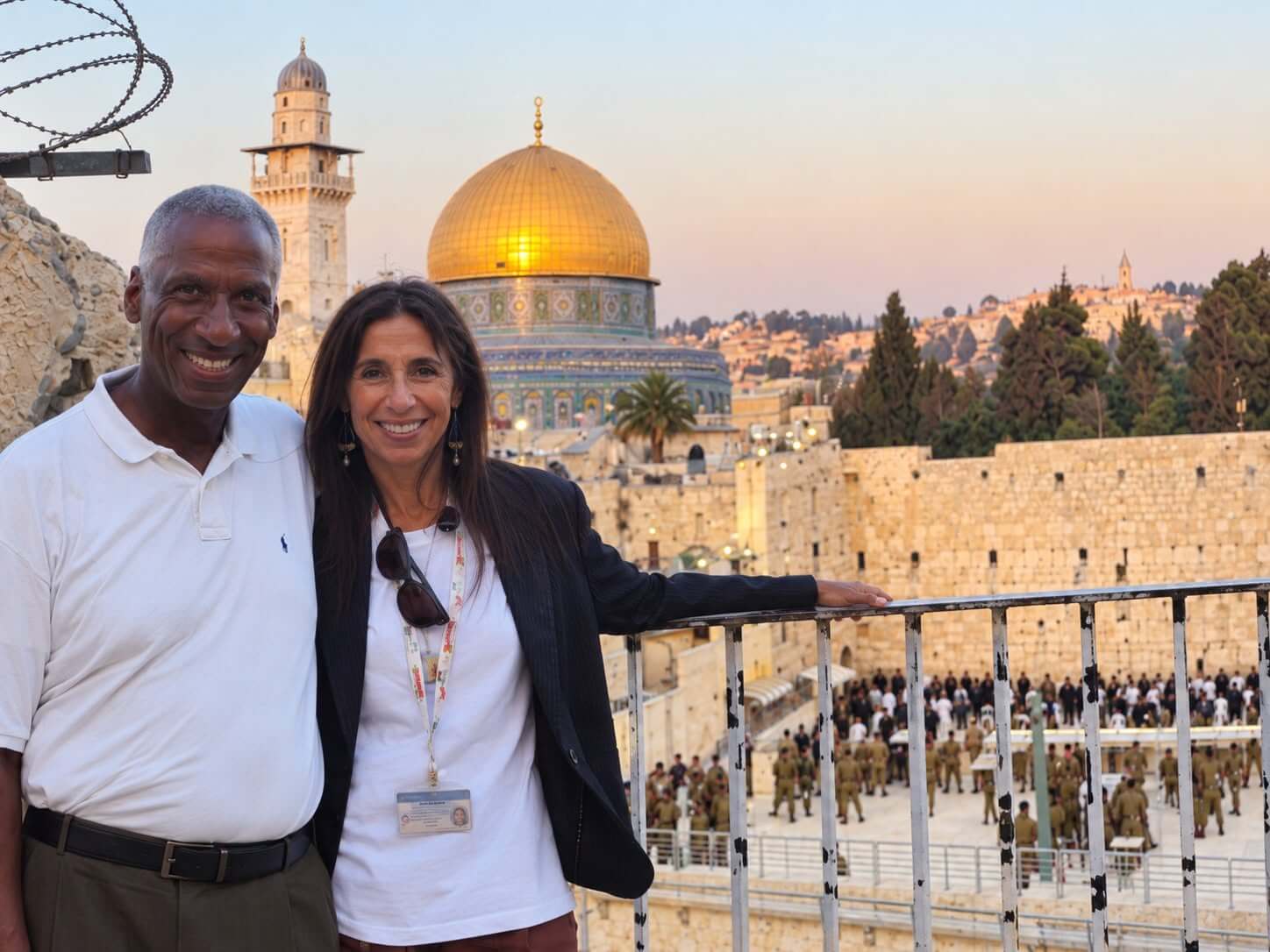
Violence at a house of worship is not an abstraction to me. Black churches have been bombed, burned, and attacked, from Birmingham to Charleston. So when 11 Jews were murdered at Pittsburgh’s Tree of Life synagogue eight years ago, I knew something about what it meant for a sacred place to become a place of terror.
I did the only thing I could think to do: I looked for a Shabbat service I could attend. I did not know of a nearby synagogue to go to, even though I’ve since discovered they are all around me in the Boston area. Where I grew up in Cassopolis, Michigan, a rural town of about 1,700, there were no synagogues within 45 minutes of my house. I grew up knowing nothing about Jews, went to my first Jewish service in college, and discovered that much of what I thought I knew was wrong.
When I first went to a Shabbat service following the Tree of Life shooting, I was not sure they would let me in. But they did. I was surprised to agree with everything I heard sung, prayed or preached. I thought Jews, like anyone else who died without Christ, were going to hell, or at least that is what I was taught. But I felt the presence of God there.
I enjoyed the service, went home and posted on my Facebook page, “I am a Jew,” in reference to John F. Kennedy’s “Ich bin ein Berliner.”
That explains why I went once. It does not explain why I went back and attended something like 52 Shabbat services in a year. People sometimes assumed that I was continuing an extended act of solidarity or that I was embedded like a news reporter.
The truth was much simpler: I liked it.
I liked the sermons, the worship, the music, the community and the spirit of tikkun olam. I liked hearing the Torah and hearing Scripture taught by clergy who knew Hebrew. I enjoyed growing in my knowledge of what Christians call the Old Testament. I also learned an entirely new hermeneutic, a Jewish one: the Living Torah, disagreement for the sake of heaven, presenting an opposing interpretation fairly, preserving minority opinions, and studying with a partner who challenges your reading.
Eventually, I became a member of Temple Beth Elohim in Wellesley.
At the same time, I kept going to church. I used to joke with friends that I got the Old Testament on Friday night and the New Testament on Sunday. I felt no urgency to choose between the two houses of worship. I was more than a member; I was part of a community. When I was asked to serve on committees, I served. When the synagogue asked me to participate in diversity, interfaith, or racial justice events, I said yes. Over time, that participation widened beyond my temple. I gave Shavuot talks over the last two years at Temple Emanuel in Newton. I participated more than once in the Boston Jewish Film Festival, serving as a moderator or panelist. I served on the advisory group for Intentional Beauty: Jewish Ritual Art from the Collection at the Museum of Fine Arts and currently serve on the Advisory Council for the Holocaust Museum Boston. The response of Jews to my involvement seemed appreciative, grateful for any help they could get.

The first time I traveled to Israel was with members of Temple Beth Elohim, the second with the Consulate General of Israel to New England and just this month went with the Black Christian Leadership Council on Israel Relations as part of their Unfinished Business Holy Land Tour.
These parallel paths led me to examine Christian hostility toward Jews over centuries and across the world. As a Black American familiar with racism who had traveled in the West Bank, I felt compelled to explore the traumas of Jews and Palestinians from a civil rights perspective.
In addition, I am troubled by fractures in the relationship between Blacks and Jews, though I prefer to think of it as a quiet estrangement, an unspoken tension, and a mutual uneasiness. Both sides are often too polite to address it. Blacks do not want to raise certain issues for fear of being called antisemitic. Jews do not want to raise others for fear of being called racist. So we never deal with the tough, hard, and honest questions that exist between us.
My goal for all this? It’s to educate my fellow Christians and Black non-Jews about antisemitism — vital in stopping the harassment, discrimination, persecution and killing of Jews. I support the Jewish community because I simply feel it’s the right thing to do.
There is a joke that goes: If you want to hear God laugh, tell God your plan.
This was not my plan.
It was God’s.
The post Why I go to shul on Shabbat — and church on Sunday appeared first on The Forward.
Uncategorized
I wanted a Jewish future that didn’t force me to choose between Zionism and anti-Zionism. Here’s how I found it.
Like many people I know, I found myself after Oct. 7 observing my communities splintering before my eyes.
The Jewish institutions I once loved dug their heels deeper into Zionism, affirming it as the key to a unified Jewish future and castigating those who were less certain. The secular leftist spaces that had nurtured my political values demanded proof of anti-Zionism, rejecting Zionist Jews and insisting they had no future in their movements.
Suddenly, I was confronted with opposing visions of the future so narrow I would have to contort myself and cut myself off from one or the other to fit in. I began searching for places where leftist politics and Jewish tradition could coexist, rather than being seen as mutually exclusive categories. Three and a half years later, I found the Judeofuturism Project, which uses art as a creative launch pad to unite Jews across differences and explore how we can employ ancient wisdom to prepare for and respond to modern-day issues.
Drawing on her experience in democracy work and her formal liturgical training at the Harvard Divinity School, founder Becca Leviss also began exploring Jewish futures after Oct. 7.
“October 7 happened, and all the questions I was wrestling with … in my own studies became really proximate to my own life,” Leviss told the Forward.
She had previously worked for Democracy 2067, an organization that uses long-term thinking and strategy to protect democracy from authoritarianism and move people to action.
“I had learned about the ways that long-term thinking can bring people who are very disparate towards articulating some kind of shared vision, and also the ways that communities who have faced what seems like insurmountable amounts of violence and oppression have been able to envision different worlds,” Leviss told the Forward.
Seeing parallels between Democracy 2067’s goals and her own aspirations for her Jewish communities and institutions, Leviss mapped Democracy 2067’s work onto the Judeofuturism Project with hopes that she could move Jews to demand more than the Zionist or anti-Zionist futures being presented to them.
She quickly connected with Aimee Rubensteen, a curator and artist with an archivist background who had been grappling with many of the same questions.
The pair understood that art could provide the perfect entry point for the tough conversations that were yet to come.
“Art is a rare platform for people to learn something new without feeling threatened,” Rubensteen said.
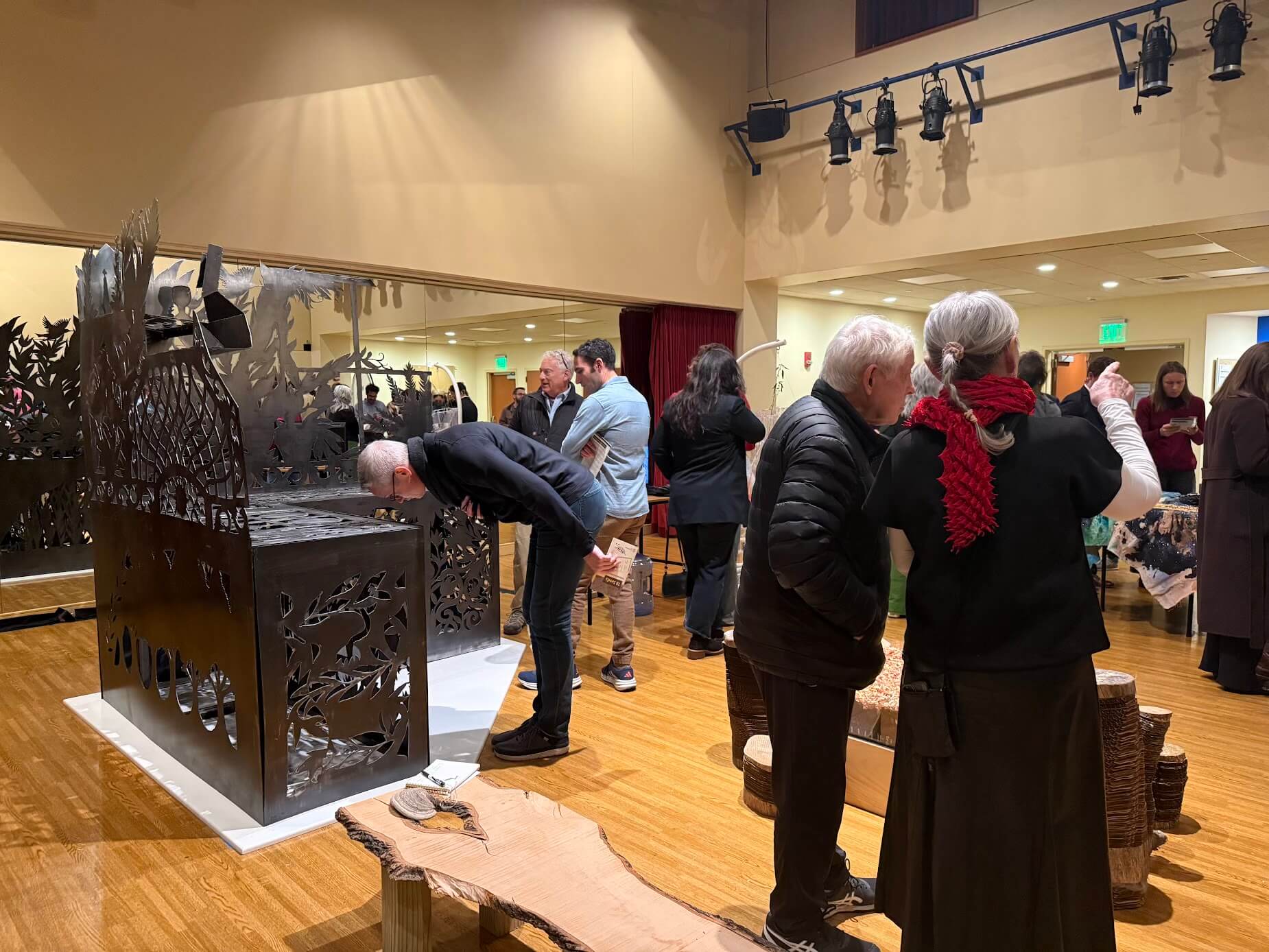
Leviss and Rubensteen launched the 70 Seeds exhibition in Boston’s South End. The exhibition ran from Oct. 27 to Nov. 8, and integrated panel discussions, immersive Shabbat rituals, theater performances, and artist workshops to engage community members and place them at the center of imagining a shared Jewish future beyond a Zionist/anti-Zionist binary.
The 70 Seeds opening was the first Judeofuturism event I attended, and it quickly became clear to me that this project was more than a typical Boston art opening: It was a newly emerging movement that encouraged collective visioning rather than the top-down compliance I’d seen controlling my communities since Oct. 7.
That night, I came upon Nicki Green’s soft-sided pickle fermentation jar, which offered a future where, regardless of belonging to a specific nation-state, Jews can continue to prepare the iconic diasporic food and transport it with them.

I sat on the wooden bench next to Beverly Sky’s reimagined genizah (sacred repository for old texts containing the word God), and was pushed to consider what traditions will continue to fuel Jewish culture and what no longer serve us.
As I moved from installation to installation, among about 100 attendees on opening night, the work created a balm for the festering wound of disconnection and division brought on by increased global turmoil.
These approaches to Jewish futures stood in stark contrast to the binary futures I had previously felt forced to choose between. Their grounding in Jewish ritual and history brought me closer to Jewish culture and to my own identity.
As the night drew on, Rubensteen and Leviss posed the same question to attendees as they had to the show’s artists: “What is your dreamed future of American Jewish life in 2070?”
The date marks two thousand years since the fall of the Second Temple, an event that prompted Jews to radically reimagine Jewish life.
At a moment today when our world is shifting dramatically, Rubensteen and Leviss’ question prompted me and my peers to consider how we might respond to growing pressures using Jewish knowledge. I parsed through the proposed futures laid before me by the exhibition’s artists, and, over the next week and a half, I participated with dozens of people in workshops and panels to see what other possible futures we had not yet considered.
The following night, at a workshop titled “Schism or Realignment? Emerging Identities in Jewish Life,” we negotiated our beliefs about Jewish life and spirituality by placing ourselves along a continuum, engaging with disagreement head-on.

Leviss posed questions to us, debating how open or closed Jewish practice should be to non-Jews, or what role Jewish institutions should play in attending to the needs of their communities. In hearing my peers’ perspectives, I found my own beliefs shifting and observed other participants experiencing the same changes. Rubensteen and her husband, Dr. Josh Eisenberg, even found themselves on opposite sides of the spectrum at times, demonstrating how, even in our most intimate relationships, we see the fractures of our increasingly polarized world emerging.
And yet, while disagreement occurred, our conversations seemed to bring us closer to one another, and closer to a shared vision of what Jewish life can look like outside of the narrow Zionist/anti-Zionist futures that are so well represented.
I realized that, at its core, the Judeofuturism Project was answering the call for a newly emerging Jewish identity, one defined by leftist politics and invested in reimagining ancient Jewish ritual to meet the present moment.
Isabel Mattia — whose work, “Amulet far der Kikh,” examines the kitchen as a site of solidarity, diversity, and potential intercultural connection — encapsulates this growing religious political moment. Drawing on ancient amulets that Jews used for protection and prayer, she examines how, when we turn our prayer towards our families and communities, we might recognize that the source of Jewish life is already within our own ovens and mixing bowls, rather than in a far-away place.
“In my conversations with others, I see a trend that we are sometimes made to feel that to oppose [Palestinian destruction] is somehow radical within Jewish culture. I don’t believe that it is radical at all. My opposition to this has brought me so much more deeply connected to my identity and values as a Jew and to my commitment to keeping Judaism alive and rich for my daughter,” Mattia told the Forward.
As I immersed myself in the Judeofuturism Project’s programs, I began to see Mattia’s sentiment reflected in my experience as well.
While the leftist spaces I previously frequented encouraged me to cut myself off from Judaism in order to access progressive theologies, and the Jewish institutions demanded that I couldn’t access Judaism without identifying as a Zionist, the Judeofuturism Project carved out a path for me and my peers where Jewish values could inform our politics and connect us more deeply to Jewish ritual and culture in the process.
And so, I returned, night after night, along with a handful of community members, to continue down this path.
“The Judeofuturism Project is really vital because it’s something that feels distinctly helpful right now,” Miriam Pellegrino, a design researcher and strategist, told the Forward. “It’s rooted in tradition, but also very imaginative … We’re in a kind of polycrisis, and I think people are hungry for community that helps them collectively parse out how to live a good life.”

And although the Judeofuturism Project’s November programming by no means provided a clear-cut answer to what a “good life” looks like, it placed the power to define a “good life” into the hands of community members, empowering them to build a dynamic, culturally responsive definition together. And, more than anything, it gave me and my fellow attendees the reassurance that we aren’t alone in wanting more than the two options currently on the table.
While the 70 Seeds exhibition concluded on Nov. 8, a digital version of the exhibition is now available for anyone to access and take the work of imagining new Jewish futures into their own hands.
Along with traditional installation photos of each artist’s work, Eisenberg has configured the site with additional resources and commentary, Talmudic-like, to welcome viewers into conversation with each artwork, rather than remaining passive onlookers.
Renderings of each artist’s workspace transport you into the artist’s shoes. Accompanying text offers each artist’s vision of American Jewish life in 2027. An attached workbook invites communities to utilize the exhibition as a tool and framework for their own future-visioning needs.
For Leviss’ part, she already has plans to present on the Judeofuturism Project at the upcoming annual Association for Jewish Studies conference, with the goal of bringing a multi-week exhibition with programming to other cities in the future.
And she’s sure to find more artists to imagine the futures that prompt these important conversations. Already the structures that Leviss and Rubensteen have provided are fueling future work.
“We’re navigating turbulent times, and I feel like we are all grasping for a way through it,” said artist Amalya Megerman, whose imaginative challah amulets draw on ancient Jewish challah rituals for contemporary use as protection against global crises. Finding the Judeofuturism Project was a turning point for Megerman and her creative process.
“The Judeofuturism Project gives me a guiding light to keep the work moving.”
The post I wanted a Jewish future that didn’t force me to choose between Zionism and anti-Zionism. Here’s how I found it. appeared first on The Forward.
