


Uncategorized
Why Josh Shapiro’s memoir could complicate a presidential run

When politicians publish memoirs, the goal is usually clear: introduce themselves to voters beyond their home state, often ahead of an expected national run, and present the version of their story that makes them most appealing to the broadest base. That’s what makes Josh Shapiro’s new memoir potentially counterintuitive.
In Where We Keep the Light, set to be published on Tuesday, Pennsylvania’s Jewish governor does not sidestep the parts of his biography and political record that could complicate a 2028 presidential bid.
Instead, he leans into them. Most notably, in a passage that made headlines earlier this week, Shapiro reveals that during his vetting as a potential vice presidential nominee in 2024, he was questioned so aggressively about Israel — including being asked whether he had ever been an Israeli agent — that he felt singled out because he is Jewish.
Shapiro, who has been mentioned as a potential first Jewish president since his gubernatorial campaign in 2022, was one of six finalists who conducted interviews with the campaign of then-Vice President Kamala Harris, a group that included Illinois Gov. J.B. Pritzker, who is also Jewish. Shapiro’s popularity as a governor from a key battleground state, strong oratory skills and reputation as a moderate made him a formidable choice for many Democrats.
But Shapiro’s staunch defense of Israel and criticism of the pro-Palestinian protests after the Oct. 7, 2023 Hamas attacks made him a more complicated choice at a moment of deep polarization within the Democratic Party. Shapiro refused to call for a unilateral ceasefire in Gaza, he highlighted expressions of antisemitism at pro-Palestinian protests, and he criticized a “culture” at the University of Pennsylvania which he said did not take antisemitism seriously enough.
In his interview with Harris before she ultimately selected Minnesota Gov. Tim Walz as her running mate, Shapiro writes that he was urged to apologize for some of his comments about the protests to avoid alienating younger, more progressive voters and the Muslim-American electorate in Michigan. “‘No,’ I said flatly,” Shapiro writes.
Embracing a position that could complicate a campaign rather than smoothing away rough edges is not without precedent. In New York City, Mayor Zohran Mamdani sustained criticism during his campaign for his refusal to soften his stance on Israel, which alienated Jewish voters, long considered one of the most influential blocs in citywide races. But he defied expectations, scoring a surprise primary victory in a city with the largest Jewish community outside Israel and winning the mayoralty with a majority of the vote.
But Mamdani’s political focus was local, driven by social media and grassroots organizing, and the response was immediate, not years away. His stance on the Israeli-Palestinian conflict actually attracted new voters.
For Shapiro, the stakes are national and long-term — and the benefits are far less certain. Palestinian rights and the Gaza war have increasingly become a litmus test for Democrats, many of whom want sharper opposition to Israel. Polls show that Democratic voters are increasingly sympathetic to Palestinians. Even national Jewish Democrats, like Pritzker and former Chicago mayor Rahm Emanuel — both considered possible presidential candidates in 2028 — have publicly challenged Israeli policy. In July, a record 27 Senate Democrats, a majority of the caucus, supported a pair of resolutions calling for the blocking of weapons transfers to Israel.
“People have grown frustrated with some of their elected leaders who just blow with the wind and take a poll instead of finding their pulse,” Shapiro writes. “I try to stay true to what I believe is right regardless of what others think.”
In the book, Shapiro focuses on humanizing moments, detailing experiences shaped by and tied closely to his Jewish identity.
Passover arson attack

The book opens with a harrowing account of the Passover arson attack on the Pennsylvania governor’s residence, hours after his family’s Seder, by an intruder who said he wanted to beat the governor with a sledgehammer over what he claimed was a lack of empathy towards Palestinians.
Shapiro recounts how the attack rattled his children and sharpened his sense that antisemitic violence is a lived reality — even for a governor with a police detail. “I have hardly been shy about my beliefs and my faith, all of which have put a target on my back over the last half decade,” he writes. “The vitriol only intensified after the October 7 attacks on Israel, as I continued to live my Judaism out loud.”
Still, he continues, until that moment, he felt safe. “The bubble burst that morning,” Shapiro writes. “People did want to kill me. They were hoping to, and willing to try.”
The Pennsylvania governor said this sentiment was shared by many American Jews who felt frightened after learning of the attack. But they were also comforted by his response and his refusal to be deterred from openly practicing his religion.
Tree of Life massacre

Shapiro devotes a chapter to the 2018 massacre at the Tree of Life Congregation in Pittsburgh that killed 11 people, describing his role as attorney general at the time and the emotional toll of repeatedly standing with a community shattered by the deadliest antisemitic attack in American history. Shapiro was sworn in as the state’s 48th governor on a stack of three Bibles, including one that was rescued from the synagogue.
The episode, he writes, reinforced his belief that political leadership must be rooted in moral clarity. “It has only made me more proud to be Jewish, more willing and able to use my voice and whatever platform I do have in my position to speak out.”
Shapiro faced criticism for switching his position on the death penalty, after initially favoring it for the killer, Robert Bowers. In the book, he defends his evolution on the issue, after meeting with some of the families of those slain in the shooting attack and a conversation with his son Max. “I went the opposite way of what would be politically popular for me,” he writes. “But it was a matter of principle for me, not politics. I wasn’t about playing a game or pleasing a constituency.”
Alliance with Barack Obama
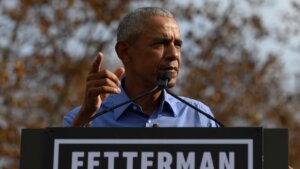
The memoir also revisits an earlier chapter in Shapiro’s political life: his defense of former President Barack Obama during the 2008 campaign, when Obama faced skepticism in the Jewish community over his associations with Chicago pastor Jeremiah Wright and his positions on Israel. Shapiro’s oratory skills are often compared to Obama’s.
Shapiro, who was at the time a state representative, writes that he was criticized within his own community for vouching for Obama, who went on to win the White House. Shapiro said a private conversation with the then-candidate convinced him that Obama’s commitment to the Jewish community was genuine.
“I felt comfortable defending his beliefs,” Shapiro writes. “I thought the attacks were unfair.”
Shapiro recalls that Obama invited him to attend the first-ever Seder he hosted with several Jewish aides as he campaigned throughout the state during the Democratic primary. “I politely declined and explained I needed to be home with my family,” he writes. “He totally understood.” Obama went on to lose Pennsylvania to Hillary Clinton.
A semester in Israel
Shapiro also recounts his early relationship with Israel, including a trip he took as a teenager with his classmates from Akiba Hebrew Academy — around the time he met his wife Lori — and how those experiences shaped his views on the Jewish state.
Shapiro spent four months living in a dorm, taking classes and touring the country. Jerusalem, he writes, felt entirely different from home, where his faith had largely been contained within the walls of his synagogue on Saturday mornings or at the family table on Friday nights. Shapiro and his family are practicing Conservative Jews who keep kosher and gather for Shabbat dinners, joined by Shapiro’s parents and in-laws.
“There was something foundational about being in Israel that really connected me more to my faith,” he writes. “In Israel, it was just everywhere. It was the first time I could feel faith. I could see it and touch it, and it wasn’t abstract.”
On Saturday nights after Shabbat ended, he and his friends would wander Ben-Yehuda Street, watching crowds spill out of cafes and bars. Every time, he would run into someone with a connection to Pennsylvania or to his family. It was a reminder, he writes, of the bonds tying Jews together around the world.
Shapiro proposed to his wife in 1997 under the 19th-century Montefiore Windmill in the Yemin Moshe neighborhood of Jerusalem, during one of more than a dozen trips to Israel.
Vetting as vice president
The final chapter of the book recounts former President Joe Biden’s decision to step aside and Shapiro’s willingness to be considered as a vice presidential nominee. Shapiro writes that while he was publicly praised, there was also what he describes as a coordinated effort to derail his candidacy, including “ugly antisemitic rhetoric.” He recalls praying frequently during that period, hoping the process would go smoothly. “I said the Shema more times during that week than maybe I had in my whole life before,” he writes.
When he first met with the vetting team over Zoom, Shapiro says the panel “spent a lot of time asking me about Israel.” He began to wonder, he writes, “whether these questions were being posed to just me — the only Jewish guy in the running — or if everyone who had not held federal office was being grilled about Israel in the same way.”
Ahead of his consequential meeting with Vice President Kamala Harris at the Naval Observatory, Shapiro writes, members of the vetting team asked whether he had “ever been an agent of the Israeli government” or had “ever communicated with an undercover agent of Israel.” Early in his career, Shapiro briefly worked in the Israeli Embassy’s public affairs division in Washington. He says he told Dana Remus, a former White House counsel under Biden and a senior member of Harris’ vetting team, “how offensive the question was.”
The Gaza war loomed over the campaign even before Biden withdrew from the race. Anxious Democrats pressed Biden to take a tougher stance on Israel as a way to recover from his disastrous debate performance in June 2024. Some urged an arms embargo to appeal to disaffected progressives and Michigan voters who had cast “uncommitted” ballots in the primary. Harris took a more forceful public position in calling for an immediate ceasefire to address the humanitarian crisis.
According to Harris’ own memoir, 107 Days, in her private conversation with Shapiro, she discussed how his selection might affect the campaign, including the risk of protests tied to Gaza at the Democratic National Convention and “what effect it might have on the enthusiasm we were trying to build.” Harris wrote that Shapiro responded by saying he had clarified that earlier views he held were misguided and that he was firmly committed to a two-state solution.
Shapiro’s account of that exchange is very different. He writes that Harris pressed him to apologize for criticizing pro-Palestinian campus protests, which he refused to do. “There wasn’t much more issue-based conversation before we moved on to what the [role of] vice president would look like in her administration,” he writes.
After leaving that meeting, Shapiro writes he considered publicly withdrawing his name from consideration. Instead, he privately informed the Harris team that he no longer wanted the job. “I had prayed for clarity,” he writes. “And now I was nothing but clear.”
Shapiro’s memoir will be released on Jan. 27.
The post Why Josh Shapiro’s memoir could complicate a presidential run appeared first on The Forward.
Uncategorized
Somerville councilors to discuss Israel divestment proposal
(JTA) — SOMERVILLE, Mass. — The issue of divestment from Israel returns to the Somerville City Council in Massachusetts on Tuesday night as lawmakers plan to discuss how to implement a nonbinding ballot question on the matter that passed last year.
The divestment push has divided the city of more than 84,000 residents, which has a long-standing Jewish population. It is located between Cambridge, home to Harvard University, and Medford, a city with which it shares the Tufts University campus.
After Question 3 passed with 55.7% of the residents’ vote in November 2025, the City Council that same month passed a resolution committing to work toward an ordinance within a year to enact the ballot’s goals.
The measure to that effect, introduced in June, would bar the city from investing in or procuring labor, services or goods from companies that support entities identified by the ordinance as violating international law, including Israel.
Unlike the divestment proposal awaiting a November ballot vote in Providence or the binding human rights divestment ordinance passed by Medford’s city council in 2025, the Somerville ordinance specifically mentions Israel and Palestine.
In response to the push for a binding ordinance, 74 registered voters in Somerville submitted a petition for a hearing, which was held in September, before final action is taken, citing concerns about its impact on the city. The issue has now moved to the city’s Legislative Matters Committee, which is meeting Tuesday night.
Among the groups opposing divestment is Shalom Somerville, which submitted the September petition stating that “the sense of belonging and safety experienced by Jewish, Israeli and other residents of diverse backgrounds” is at risk as a result of the ordinance.
Sam Gechter, co-founder and president of Shalom Somerville, said that the ordinance singles out Jews who support Israel, which makes it antisemitic. Deputy City Solicitor David Shapiro also advised in November 2024 that such an ordinance would be “likely invalid,” according to a letter from the Anti-Defamation League and the Louis D. Brandeis Center for Human Rights Under Law.
“I think it’s incredibly irresponsible,” Gechter said, suggesting that the ordinance would slow down governmental action. “But the biggest thing for me is that it makes Jews feel unwelcome in Somerville.”
A local organization, Somerville for Palestine (S4P), has been a driving force behind both the ballot question and the ordinance, which the group developed in collaboration with sponsoring city councilors Ben Ewen-Campen, Ben Wheeler, Wilfred N. Mbah and Jon Link. “It’s what people voted for,” said Mo Katz-Christy, a member of S4P’s leadership and Jewish Caucus. “We want to follow the will of the people.”
The ADL issued a statement condemning the ordinance in June. It also joined the Brandeis Center in issuing a letter calling the proposal an unconstitutional intrusion into foreign affairs.
Other Jewish organizations disagree. Jewish Voice for Peace Boston has worked closely with S4P to back the measures. “I don’t think that those objections have validity,” said Eli Gerzon, a longtime member of JVP. “As a Jewish organization, we are especially concerned that ‘never again’ really means what it says: never again, that we never let a Holocaust, a genocide happen.”
This article originally appeared on JTA.org.
The post Somerville councilors to discuss Israel divestment proposal appeared first on The Forward.
Uncategorized
A major Jewish museum hopes to join the Smithsonian – at a difficult moment for the storied institution
(JTA) — Philadelphia’s Weitzman National Museum of American Jewish History is moving closer to becoming part of the Smithsonian Institution at a moment of significant upheaval for the storied museum network.
A new congressional commission will study whether to make the museum part of the Smithsonian. Its members were sworn in Tuesday, when they also held their first meeting.
In an exclusive interview with the Jewish Telegraphic Agency, the commission’s new chair Philip Darivoff, a former longtime chair of the Weitzman, and vice chair Dara Horn, a New York Times bestselling author, said that the Weitzman joining the Smithsonian would send a powerful message that Jews are a crucial component of the history of the country.
“It’s a different statement that our country makes when it says that the study of Jewish American history and culture is important to this nation,” Darivoff said. Both he and Horn also hope that a boost in the Weitzman’s profile could combat what they called an “epidemic of ignorance” among Americans when it comes to knowledge of Jewish history and culture.
“This really would be an elevation of the Jewish community,” Horn, author of “People Love Dead Jews” and “The Final Solution to the Jewish Question,” told JTA. “The place that Jews show up in a school curriculum is typically more about the Holocaust” — an area that the author has written critically about in the past as too limiting a view of Jewish life.
Horn believes in the Weitzman project, she said, because she hopes to emphasize the ways that Jews have contributed to American founding ideals such as religious pluralism.
“I’m really interested in the connections between the Jewish story and a lot of our foundational ideas in this country,” she said. Jewish ideas such as the Exodus from Egypt in the Passover story “were inspiring to Americans,” she added.
The wheels for the Weitzman joining the Smithsonian began turning in 2024, when Congress passed legislation in 2024, then signed by President Biden, to establish the commission. The group spent the next two years putting the commission together, and has two years from its first meeting to research and publish a report on the feasibility of such a move — though Darivoff said he hopes to finish the work well before the deadline.
Adding a new member to the Smithsonian has been known to take years, if not decades. The two most recent additions, the National Museum of the American Latino and the American Women’s History Museum, were both long in the works.
Founded in 1976, the Weitzman is already an existing, fully functioning institution — and also already a Smithsonian affiliate, meaning it can share resources with other museums in the system. Unlike a museum being built from scratch, the Weitzman already has a building and collection, which proponents hope could speed the process.”
Dan Tadmor, the Weitzman’s CEO, told JTA that joining the Smithsonian would improve their educational mission.
“We have a national footprint for our educational programming, but of course we’d like to widen it,” he said. “Who would say no to a curriculum that’s been developed by a Smithsonian museum?”
The Weitzman’s bid for increased prominence within the Smithsonian comes as the Trump administration has sought to exert greater control over the latter — home to such storied institutions as the National Museum of American History, the National Portrait Gallery and the National Zoo.
This summer the White House issued a report alleging “radical ideology” in the museums’ content, and Interior Secretary Doug Burgum recently announced plans for signs accusing Smithsonian leaders of ideological bias. Observers say such signs are indicative of larger administration priorities opposing the teaching of historical subjects such as slavery. Smithsonian Secretary Lonnie Bunch III is stepping down at the end of the year.
A representative from the Smithsonian declined to comment to JTA on the Weitzman’s bid, or on its current political conditions.
The commission’s chair and vice chair of the new Weitzman said that the current political upheaval shouldn’t affect their work. The Smithsonian, Horn said, “has lasted through many political winds.”
“I think we see this as a long-term project that’s about the place of Jewish Americans in this country’s history,” Darivoff said. “The Smithsonian is a really important institution for this country, and it is the great museum complex of our nation. God willing, it will be flourishing for centuries to come. It’d be an honor to be included in the Smithsonian.”
This article originally appeared on JTA.org.
The post A major Jewish museum hopes to join the Smithsonian – at a difficult moment for the storied institution appeared first on The Forward.
Uncategorized
Two deaths in Manchester synagogue attack last year will be probed through public inquiry, Britain says
(JTA) — The deaths of two Jewish men in an attack on a synagogue in Manchester last year will be examined through a public inquiry, the British home secretary announced on Monday, a necessary step to include sensitive information in the investigation.
Melvin Cravitz and Adrian Daulby were killed during the attack on Yom Kippur on Oct. 2, 2025, when Jihad Al-Shamie rammed a car into a group of worshippers outside the Heaton Park Hebrew Congregation in Manchester and stabbed two people. Cravitz died from stab wounds and another man, Andrew Franks, was seriously injured but survived. Daulby was shot by police while blocking the synagogue doors to stop Al-Shamie from entering. Two other people were seriously injured.
Al-Shamie, a Syrian-born British citizen, said he was acting for the Islamic State, also known as ISIS, before police shot him dead.
Home Secretary Shabana Mahmood announced the public inquiry in a statement about national security at the House of Commons, saying that “what happened that day must be fully understood.”
“This will ensure that all evidence can be heard, including any sensitive national security material that could not otherwise be fully heard in the coroner’s court,” said Mahmood.
Judge Alexia Durran, the chief coroner of England and Wales, was overseeing inquests into the deaths of Cravitz and Daulby. Durran last month recommended that Mahmood convert the inquests into a public inquiry, following statements from Home Office lawyers that some information from MI5 would be withheld from open court due to national security concerns. A full investigation that involves hearing sensitive material in private requires a public inquiry.
Earlier this year, Greater Manchester Police’s chief constable Stephen Watson said he was “deeply sorry” for a “missed opportunity” to uncover the plot against the Heaton Park synagogue. Watson made the apology after prosecutors revealed that Al-Shamie had two prior arrests for allegedly breaching a non-molestation order and alleged rape, and his mobile devices were not examined until after the synagogue attack.
Mahmood listed “a series of attacks on our Jewish community” in the year since the synagogue attack, including the stabbing of two Jewish men in the London neighborhood of Golders Green, a spate of arson attacks and a “foiled but potentially lethal plot” against Jews in Manchester on the eve of Yom Kippur last month. In the last case, two Iranian men have been charged with terrorism offenses.
“Faced with the threat posed to our Jewish community, we have increased funding to the police by an additional £250 million to boost police presence in key Jewish areas and to tackle antisemitism on our streets,” said Mahmood.
She added, “I know we cannot simply build higher walls around our Jewish community and expect them to live in fear. So we must root out the evil of antisemitism wherever it lurks in society, and this government is committed to that effort.”
Mahmood’s announcement comes days after the Home Office released data showing that hate crimes against Jewish people in England and Wales rose 10% in the year ending in March.
Mahmood said the United Kingdom was aware that “the Iranian state is targeting our Jewish community,” adding that the threat posed to Jews demonstrated “how the lines are increasingly blurring between extremism and state threats.”
The post Two deaths in Manchester synagogue attack last year will be probed through public inquiry, Britain says appeared first on The Forward.
