Local News
14th annual Cancercare Manitoba Foundation Challenge for Life returning on August 5
 By MYRON LOVE The 14th annual Cancercare Manitoba Foundation Challenge for Life 20KM walk (or 200-minute workout) is back again at its new time – as a result of Covid 19 – with several members of our Jewish community once more playing an active role.
As with last year, participants this year are walking in small groups covering the same distance over two weeks from August 5-17.

“Nineteen people are diagnosed with cancer every day,’ says participant Jason Gisser. “Fifty percent of Manitobans will be touched by cancer at some point in their lives.”
Gisser has experienced a more intimate and longer-lasting relationship with cancer than many of the other Challenge for Life participants. The son of David Gisser and Freda Steel was first diagnosed with cancer when he was 18. The still young lawyer has been fighting cancer for half his life now. Happily, an oral chemotherapy pill he has been taking for the past two years has controlled his cancer and allowed him to return to living a normal life.
He first took up the Challenge in 2019 as a way to give back for all the help that he has received over the years from CancerCare Manitoba staff. This year, thus far, he has personally brought in over $4,000 while his team – also consisting of Debbie Abraham, Nora Fien, Marcia Knight, Lois Tessier and Candace Weselowski – has raised about $5,600 – good for fifth place overall.
On Saturday, August 8, Gisser will be fulfilling his Challenge obligations with a 20 km walk encompassing Fort Whyte, Assiniboine Forest and Assiniboine Park. He says that he will be keeping supporters up to date as to his and his team’s progress.
Several other members of our Jewish community are also making their presence felt.
“Once again this year’s top-ranked “Jewish” team is Nancy’s Nightingales with about $10,000 raised as of mid-July. “We were pleasantly surprised that many people donated more this year,” says team captain Louise Raber. “We were a little concerned that some of our past contributors may have been inversely affected financially by the pandemic.”
For 2021, long time team members Connie Botelho, Joanne Katz, Harriet Lyons and Louise Raber and third year member Rhonda Youell have been joined by original team members Heather Cram and Susan Lipnowski.
The“Nightingales” were named after a nurse – a cancer survivor – who is a friend of Louise Raber – and have been part of the Challenge for Life since the beginning 14 years ago.
Close behind Nancy’s Nightingales – in third place in funds raised thus far is Team Schvesters. So far, the “Shvesters” have raised about $8,000 – as of mid-July – and team captain Benji Harvey herself has brought in $4,500 in donations –9th most among individual participants.
Since the beginning of the Challenge for Life, Team Schvesters has raised a total of $246,060 with Benjii Harvey accounting for just under $55,000 (including donations received as of mid-July this year.
The team was founded by the “Greenfeld girls”, Harvey and her sisters, Lesly Katz and Debby Lewis. Two of the sisters had been diagnosed with breast cancer.
This year, Harvey notes, the team members are Benji, Lesly and Deb, Kim Gray and Jody van de Vijsel.
Team Shvesters members focus on the 200 plus minute workout as much as the 20km walk. As with last year, the team members will combine a 15 km walk with a 30 minute upper body core workout and 30 minute yoga stretch.
“We are a small but heartfelt team,” Harvey says. “Even though COVID has changed the event there are still lots of teams participating in their own way – which is fantastic.”
Perennial fundraising dynamo Serratus Superstars have also been walking the Challenge for Life since the Challenge inception in 2008. Team captain Cathy Moser reported in an interview with the JP&N last year that the group had raised over $450,000.00 in those years – through donations, garage sales, concerts, and bake sales.
This year’s team makeup however is much reduced from previous years. Two years ago, there were 25 walkers under the Serratus Superstars banner. This year, the team numbers eight – Moser and her husband, Jeff Itzkow, Faren Bernstein, Sharon Goszer-Tritt, Steve Moscovitch, Monica Newman, Bernie Rubenstein and Harriet Zimmer.
Moser however remains undaunted. She has raised over $2,500 thus far and the team as a whole has brought in just under $5,400 – good for 7th place among teams.
“We have raised over $425,000.00 over the past 11 years – and hope to make it to at least $450,000.00 this year,” she says.
She adds that “we are looking for team members – if you want to invest in your future, email Cathy Moser at cathy.g.moser@gmail.com..
Rocky Pollack’s wife, Sharon, fought cancer for 14 years before her passing in 2012. During that time, both Sharon and Rocky came to appreciate the care that she received from Cancercare Manitoba and they both became actively involved in the organization and the foundation. Rocky has served in a number of positions with the organization over the years and has participated in the Challenge for Life for the last several years as well.
Last year, the retired Provincial Court Judge and his Team No Judgment (which included 12 of his colleagues) raised just under $6000. “We are going to be doing a number of mini competitions to provide our team members with additional motivation,” he says. “Our goal is to raise more money than last year.”
Sister Act’s team once again this year is composed of Pearl Rosenberg and her daughters, Cindy Yusim and Brenda Dahle.
Pearl Rosenberg, 87 is most likely the Challenge for Life’s oldest participant. She lost two daughters to cancer within about a year of each other. Naomi Palansky passed away in 2010 and Michelle Moyer in 2011. Brenda Dahle notes that Naomi walked with her family in the first Challenge For Life Walk.
(And, readers may recall that Naomi’s children, Noah and Lexi, started their own team of walkers, “Kids Count”, shortly after their mother received her cancer diagnosis.)
“I started taking part in the Challenge for Life on Team Chai in 2008,” Dahle says. “I continue to take part in the 20 k walk with my mom and sister Cindy Yusim, in memory of our sisters whose love, strength, and courage continue to inspire us.”With the Challenge due to Covid restrictions again being an individual rather than a group effort, Dahle reports that she and her mother will be walking a little bit every day between August 5 and 17th in Kildonan Park while her sister will be meeting her obligations through cycling.
“Our goal this year is to raise $3,000,” Dahle says. “My mother has already raised more than $1,000 herself (as of mid July).”
Readers can make donations to their preferred team by going online to CancerCarefdn.mb.ca and clicking on Challengeforlife.ca.
Local News
Incident at Asper Campus Sept. 23 leads me to wonder: Are members of Winnipeg Police Service overreacting to threats of antisemitism?

By BERNIE BELLAN (Posted Sept. 23, 8:49 pm) I was coming out of the Asper Campus today around 5:30 pm when I saw a familiar figure – my second cousin Marty Green (son of the late Sid Green) standing on the sidewalk. Marty was walking around quietly. He seemed to be holding some kind of papers in his hand.

The leaflet that Marty Green was handing out
I called out to him, he came over and handed me a purple leaflet that had a drawing and some printing on it. I read what was on the leaflet and thought: “Okay, this is reasonable enough. Surely he’s entitled to express his opinion.”
Boy, was I wrong! In short order three police cars arrived on the scene. There must have been at least eight police there at one point, along with two cadets. Wow! All this for distributing leaflets?
I continued watching what ensued – but I’m not exactly sure what happened. All that I know is that at one point Marty was handcuffed with his hands behind his back and put into a police car. What the hell was going on? I wondered.
Had Marty said something to the police? I should note that, in all fairness, Marty has a track record of getting himself into trouble with the law.
But still, is it now a crime to hand out leaflets in a public space? I again wondered. I stayed around for about 1/2 hour, but I had to go somewhere else for a while. I did return though about 1/2 hour later and there was still one police car there. I saw two policemen engaged in conversation with Ruth Ashrafi, who’s Regional Director for B’nai Brith in Manitoba. I asked one of the policemen whether Marty had broken any laws.
His response was: “Read Section 319 of the Criminal Code, Subsection 2.”
I waited unit I got home to look up Section 319 of the Criminal Code, Subsection 2. Here’s the Google description of what that section of the criminal code is about: “Section 319(2) of the Canadian Criminal Code governs the wilful promotion of hatred. It is a criminal offence to intentionally promote hatred against an identifiable group through statements made outside of private conversation. [1, 2, 3]”
”You’ve got to be kidding,” I thought. A Jew handing out a leaflet that’s critical of what fanatic settlers are doing on the West Bank is guilty of a hate crime?
Surely there must be more to this than that.
So I called WPS and asked whether there was a report of an incident outside the Asper Campus between 5:30 and 6:30 this evening? The person answering the phone said there was an incident, but said they couldn’t provide any further information.
I did call the media line and left a message, asking someone to call me because I was interested in learning more about what had happened – and why so many police were at the scene for what, for all intents and purposes, seemed nothing more than one person handing out leaflets.
I was so perplexed by what I had seen that I also posed this question to Google: “Is it against the law to hand out leaflets outside the Asper Campus?” (I thought that maybe there was some new kind of bylaw that had been passed of which I was unaware.) Here’s the answer I got:
No, it is not against the law to hand out leaflets on a public sidewalk outside the Asper Campus. Under Canadian law, peaceful distribution of leaflets on public property is a constitutionally protected right under Section 2(b) of the Canadian Charter of Rights and Freedoms, which guarantees freedom of expression. [1]
However, the legal landscape shifts significantly based on exactly where you are standing, what your leaflets say, and how you behave.
Where You Stand Matters
I • Public Sidewalks: If you are on the public city sidewalk outside the perimeter of the campus, you have the legal right to distribute pamphlets peacefully. A City of Winnipeg proposal in early 2026 (the Safe Access to Vulnerable Infrastructure Bylaw) attempted to ban “nuisance demonstrations” within 100 metres of community and cultural hubs, but after a major public outcry regarding Charter rights, the city councillor withdrew the proposed law. No such buffer zone exists today.
[1, 2, 3]
• Inside the Campus Property: The Asper Jewish Community Campus in Winnipeg’s Old Tuxedo neighbourhood is private property. Private property owners have the legal right to control or ban the distribution of materials on their premises. If you step onto campus property (such as their courtyard, parking lot, or inside buildings) to pass out leaflets, campus security can legally ask you to stop or leave. Refusing to do so can result in a fine under provincial trespassing laws. [1, 2]
Legal Limitations on Leafleting
While you can hand out leaflets on the public sidewalk, you must follow general laws regarding your conduct and the content of your message:
• No Obstruction: You cannot physically block or trap people, prevent them from entering the building, or obstruct pedestrian or vehicle traffic. [1]
• No Harassment or Intimidation: Leafleting must be peaceful. Loudly shouting, using unauthorized megaphones, or intimidating visitors can lead to police intervention or local noise violations. [1]
• Hate Speech Laws: The content of your leaflets cannot cross into criminal territory. Under Canada’s Criminal Code, distributing materials that promote hatred or contain antisemitic or defamatory statements against individuals can trigger police investigations and criminal charges. [1, 2]
Okay, with all that in mind, you be the judge. Do you think the leaflet Marty was handing out would constitute “hate speech?”
I’ve placed a call to Marty, asking him to call me to let me know what actually happened once the police came over to talk to him. At this point I know nothing more about the matter, but gee, is this what it’s come to: A citizen quietly handing out leaflets that I dare suggest have nothing at all to do with hate speech is apprehended by WPS?
And sure, I got an earful from one of the police who said to me that after what happened in Belleville you can’t be too careful these days, but come on, show a little common sense fellas – (and they were all men except for one female cadet).
(Updated Sept. 23 10:54 pm and amended Sept. 24 5:02 pm) I just got off the phone with Marty Green. He gave me a further clarification of what happened. Apparently he had been at the Campus on several other occasions – handing out the same leaflet. Marty said that he had received a lot of angry comments, but it wasn’t going to dissuade him from handing out the same leaflet as you’ve already seen. Until today though, the police hadn’t shown up.
This time they told him he was going to be charged with a hate crime and disturbing the peace. It was at that point he was handcuffed and put into a police car, he told me.
It seems though that, after some discussion among various officers who were there – and from what I could see it was two older, grey-haired police who seemed to be the ones in charge (Correction Sept. 24: Marty says it was two younger officers who arrested him, not the older guys) – the decision was taken to release Marty (Correction Sept. 24: Marty says: “They released me on an “‘undertaking’ that I wouldn’t go within 200m of 123 Doncaster, but I refused to sign the undertaking. So I didn’t agree to it. But I would be arrested immediately if I violated it. I’ll have to talk to my lawyer to see if I can challenge the undertaking (that’s why I refused to sign it). I was unable to contact a lawyer while I was in custody and was told that the hate crime charge would be dropped.”
The disturbing the peace charge, however, Marty was told, will still stand, and he can expect to have to make a court appearance at some point in the future. (He guessed it would be some time in December.)
Marty said that he thought there had been strong pressure put on the police to do something about his handing out leaflets, although when I asked him if he could give any specific names as to who might have exerted that pressure, he said he didn’t know.
I’ve deliberately avoided editorializing as I’ve been writing this, but my last word on what happened today is that if we can’t allow peaceful criticism of some aspects of Israeli policy – and I’m not talking about the kind of sloganeering we’re all so used to hearing and seeing from true haters of Israel, such as condemnation of Israeli “genocide,” “settler colonialism,” “apartheid”, and similar epithets, then we’re not the democratic Jewish community Winnipeg used to be.
I hope to have more on this story – which to me represents the kind of fissure that has developed within Jewish communities in so many parts of the world. So, keep checking back (and it’s not so that I can make any money by having you read this story. If you haven’t noticed yet, there are only two ads on this website. I maintain this website to provide an alternative point of view from the kind you’re going to get from all our established community organizations in Winnipeg.)
(Added Sept. 24): I have phoned the WPS media line twice now trying to get some understanding how an individual walking on a public sidewalk in front of the Asper Campus, handing out leaflets to anyone who was willing to take them – and not confronting or yelling at anyone, can be charged with “disturbing the peace,” let alone a “hate crime.” (At least the WPS officers who were going to charge Marty with a hate crime came to their senses on that one and dropped that charge.)
Look, I can understand people being on edge – especially with what happened in Belleville. I’m not naive or deliberately trying to downplay people’s nervousness. But heck, are we now at a point where anyone handing out leaflets in front of the Campus can be arrested? I realize members of the WPS are under tremendous pressure to “do something,” and I could tell by that comment from the young officer who told me to go read Section 319 Subsection 2 of the Criminal Code that members of the WPS have been given lessons about “hate crimes” and particular instruction to be on the watch for anything that might look like a potentially dangerous situation for members of the Jewish community, but come on fellas – use some common sense. Is that all it takes to get someone arrested: An individual or individuals say that they don’t feel “safe” – simply because someone is exercising his lawful right to hand out leaflets in front of the Campus?
If you want to comment on this story, I can withhold your name if you don’t want it published. Simply click on the button below that says : “Click to comment”
Comment received Sept. 26 from “Vika”: “You know too many fanatics like Marty Green coming to the Asper Campus. If you don’t know there is kids, our kids! And we want to keep them safe from the people like him. So we’re glad police was there very quick and they will continue to do this good job to protect Asper Campus from this crazy people.
Local News
Brian Glow: magician on a mission

By MYRON LOVE Anyone who has been to a sporting event in recent years is sure to be familiar with the hot dog and t-shirt launchers that propel hot dogs and t-shirts into crowds. What you probably don‘t know is that the launcher was invented right here in Winnipeg – by Brian Glow.
“I have always been an inventor,” says the son of Freda and the late Syd Glow. “I came up with the concept for the launcher in the early 1980s. It has many other uses in addition to sporting events. It can be used to spew out streamers or confetti. It can shoot out a guide rope from a ship to tie the vessel to a dock and fire out life-saving vests to swimmers or boaters in trouble.”
While few probably know about Glow’s avocation as an inventor, people all over the world will know him from his “day job” as one of North America’s most in-demand magicians.
Brian Glow has been making magic for almost all of his life. His resumé includes more than 10,000 corporate shows under his belt, including sales meetings, trade shows, banquets, annual general meetings, and award ceremonies. He has also performed and produced shows for the 1988 Calgary Winter Olympics and the Pan American Games.
Glow’s multi-award winning one-man “Comedy, Magic and Mindreading” production has become one of the favourite touring magical shows in North America. He has entertained in casinos, on television and film, and for corporate events and public spectacles in over 45 countries worldwide.
In a recent interview with Glow in his West St. Paul home, he recalled his first performance. “I was the entertainer for my eighth birthday party,” he recounts. “I have been in demand ever since.”
It was from the old Ed Sullivan show – which those of us of a certain age will well remember – that Glow was introduced to magic. “My family and I never missed an Ed Sullivan broadcast,” he says. “It was like a religion.”
As a magician, Glow was self-taught. “I learned my first magic tricks from reading books at the West Kildonan Library,” he recalls. “There were two books about magic at the library. One was called ‘Magic of the World,’ which was published in 1965. The other was Houdini’s ‘Biography of Magic for Kids.’ Those books were amazing teachers. I still use some of those same tricks today.”
“In our corporate shows,” he continues, ”we incorporate our sponsors’ products in the production. For example, if we are doing a show for an auto dealership or manufacturer, I make a car magically appear.”
Glow points out that while many people can do simple magic tricks, the key to taking it to the next level is the presentation.”That takes skill,” he says. “The presentation is what makes an act magical, amazing, fun.”
While Brian Glow truly is an amazing magician, what really separates him from his brethren is that he is also a man on a mission. That mission is to build his magic act as a framework around which he teaches children and teenagers how to counter bullying. And, over the past 40 years, he has brought his anti-bullying training to tens of thousands of children primarily living in remote – largely Indigenous – communities across the north – from Nunavut to Alaska, also northern Manitoba, Saskatchewan, and Northwestern Ontario.
Why does he focus on those regions? He explains that in larger, more easily accessible centres, there are professionals – doctors, psychologists, social workers – who can provide counselilng for individuals who are being victimized by bullies. That help is simply not available in large swaths of our country.
When it comes to surviving bullying, Brian Glow speaks from his own personal experiences growing up. He notes that he has lost some friends to suicide because of the torments they suffered from bullies.
In his shows focusing around countering bullying, he intersperses magic with his own stories about experiencing bullying. Glow tries to provide strategies for standing down bullies and working on creating more positive self-images for victims of bullying, that include calling up audience members to engage in role playing among other techniques.
“Bullying involves an imbalance of power,” he explains. “One of the more effective ways of disarming a bully is to refuse to react to the insults. You have to try to keep calm and respond in an even voice. The bully wants to humiliate you. If he can’t, he will lose interest.”
Glow concedes that is not easy when someone is telling you that you are fat or ugly. “You have to keep at it to a make a difference,” he says.
He further points out that the exponential growth in social media over the past 25 years has made the bullying problem much worse. Social media can amplify your public humiliation,” Glow observes. “You can be left with a sense of worthlessness and really spiral down.”
He notes that he continues to stay abreast of the latest research related to bullying and learn new techniques in countering this pernicious practice.
Brian Glow may now be past what is still generally considered retirement age, but he has no intention currently of slowing down. In fact, he recently left on another two-month round of anti-bullying performances in the north – starting with northern Saskatchewan.
“I am a lucky man,” he concludes. “I have been able to spend my life doing what I love, also using magic to help others. And, I am still learning.”
One can certainly say that Brian Glow has lived a magical life.
Local News
Group of crocheters create a sea of anemones as part of third annual community commemoration of October 7
By MYRON LOVE On Wednesday, October 7, we will be commemorating the third anniversary of the horrific events of October 7, 2023 – when an estimated 1,200 of our Israeli brothers and sisters were slaughtered in a Hamas-led attack on southern Israel – with the third annual Walk for Israel.
The estimated 50-minute walk is scheduled to start at 5:30.
“Last year, we had about 2,000 members of the community and supporters turn out,” reports Judi Shuster, one of the walk organizers. “We would like to see as many or more people this year. It is such as empowering feeling, participating in this walk.”
She notes that the International Fellowship of Christians and Jews is contributing a large number of Israeli flags.
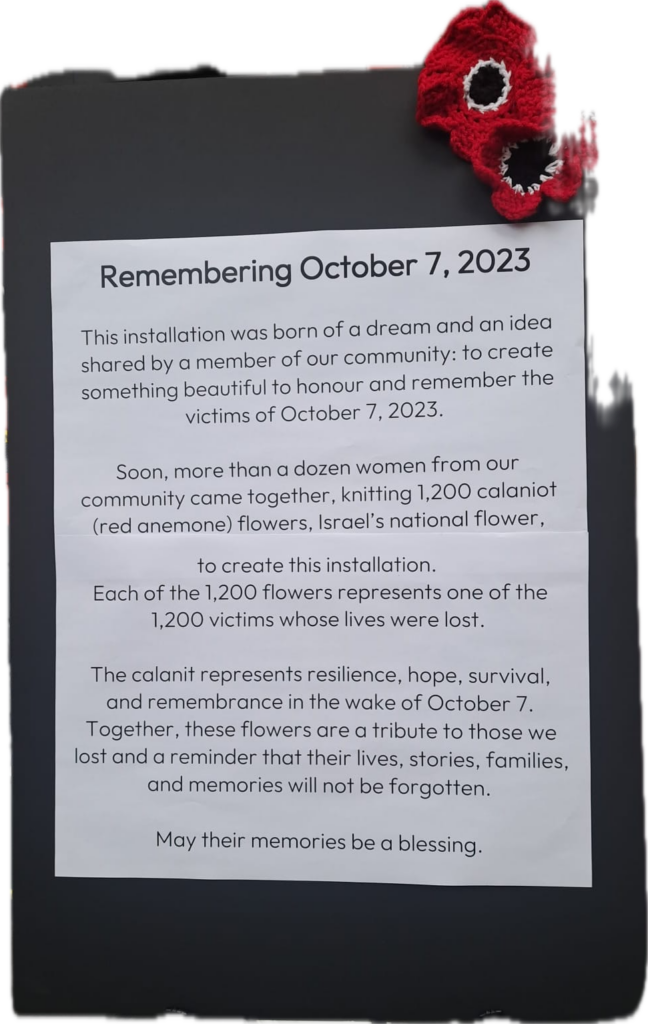
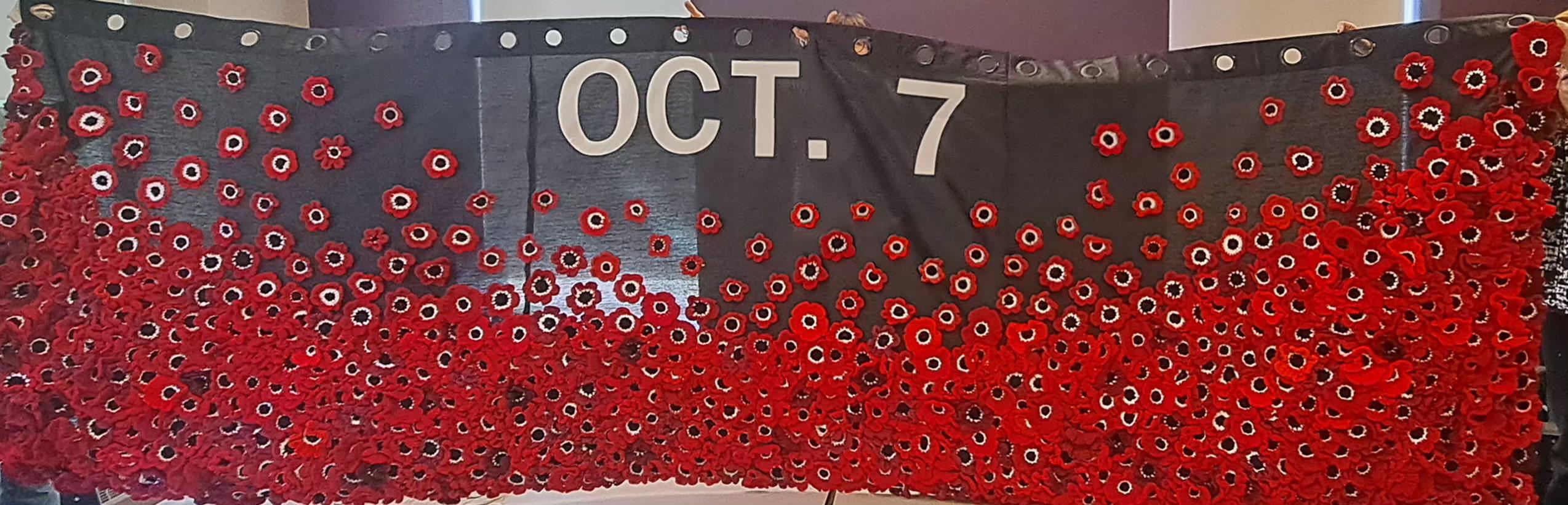
Shuster is also one of a group of 17 women who are adding something new to the commemoration. Over the past few months, the group members – including -Vanesa Harari, Tanya Chanas, Florencia Katz, Francyn Martini, Gail and Clara Garland, Claudia Griner, Faye Rosenberg Cohen, Judi Shuster, Patricia Lempert, Adriana Josebachvili, Valeria Senderowich, Tali Hassan, Orit Reuter, Kristin Gislason, Karyn Glass, and Michaela Kaplan – have crocheted 1,400 anemones (the original goal was 1,200) – to attach to a creative display that will be displayed throughout the month of October at the entrance to the Asper Campus.
Why anemones (kalaniot in Hebrew)? Florencia Katz, a member of the commemoration organizing committee, explains that kalaniot grow extensively throughout southern Israel and are the country’s national flower. During her visit to the site of the ill-fated Nova Festival in May, 2024, Katz notes that pictures of the victims with kalaniot in the background had been put up in the field.
Katz points out that it was Judi Shuster’s idea for the banner. Shuster had also seen the pictures at the Nova festival location.
“I contacted Florencia about this idea for crocheting the Kalaniot for the display and she was enthusiastic about it,” she says. “Originally, eight of us got together to plan this. We recruited a cross section of crocheters – Jewish and non-Jewish.”
“We had our first creative meeting on February 5,” Katz reports..
“We had the help of some other creative people with the background and design.”
She further points out that the October 7 date was ironed onto the piece of art.
The commemoration will conclude with a short gathering with anthems and prayers.
Readers who may want to participate in the Walk for Israel can register at www.jewishwinnipeg.org/october7.