


Uncategorized
As Greenpoint’s Jewish community grows, so does this shul’s Hebrew school
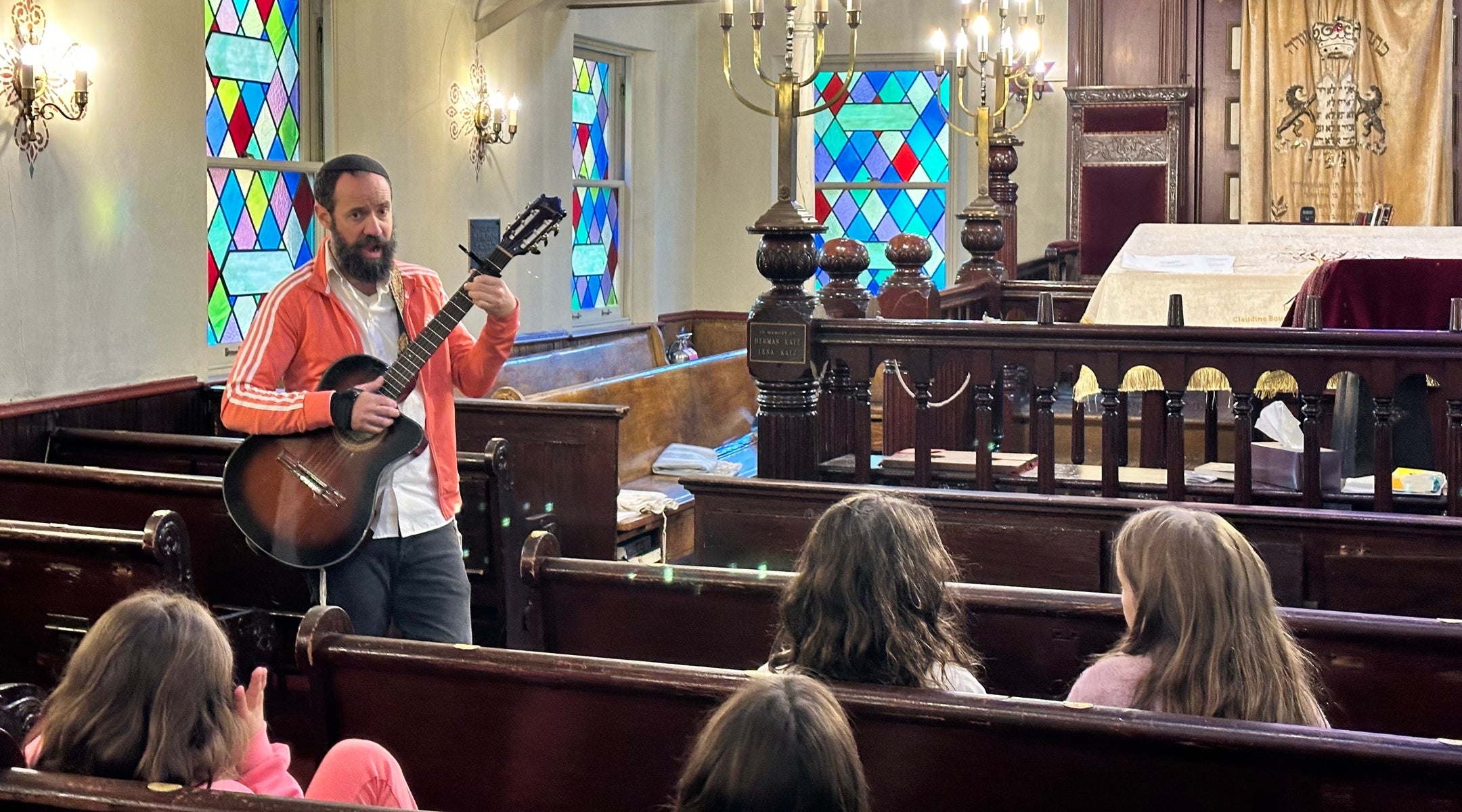
(New York Jewish Week) — Greenpoint, Brooklyn is known for many things: its extensive waterfront, a tight-knit Polish community and a vibrant arts scene.
One thing it’s not known for: a thriving Jewish community. But that’s rapidly changing.
The Greenpoint Shul — North Brooklyn’s only non-Haredi, brick-and-mortar synagogue — is today home to some 100 member families. That’s twice as many members as just 16 months ago, according to Rabbi Isaiah Rothstein, who has led the community since August 2024.
The congregation is looking to future generations, too: This school year, the Orthodox congregation officially added a Hebrew school serving some 30 children in grades kindergarten through 8. The school provides Jewish families an alternative to the only other option in the area, the Hebrew school that’s run by Chabad of North Brooklyn in nearby Williamsburg.
“I know the power and importance of having a youth department and it being a core pillar of building a thriving and growing community,” said Rothstein, who was previously the youth director at Young Israel of Stamford, Connecticut before assuming the helm of the Greenpoint Shul.
The Hebrew school was initially founded in 2019 by Yoni Kretzmer and his wife, artist Avital Burg, who are members of the synagogue and the parents of three children ages 8, 4 and 2. For five years, the school operated independently but borrowed the space inside the synagogue. As of this academic year, the school was officially “adopted” by the shul, which did not have a Hebrew school of its own.
“We saw that there’s nothing happening in North Brooklyn,” Yoni Kretzmer, who moved to Greenpoint from Israel with his wife in 2015, said of the local Jewish education scene. “So that was basically it — we started because we thought it was possible.”
Six years later, Kretzmer is now employed by the Greenpoint Shul, where one benefit he has seen so far is getting to exchange ideas with the rabbinic leadership team. He no longer has to independently collect tuition from parents, and he can provide students with supplies and snacks directly purchased from the synagogue budget.
“The way that we can present it now is as part of a much larger structure,” Kretzmer said. “When people [are] joining, they’re not only feeling that we’re using the shul, but that they’re part of a community center in the fullest meaning of the word.”
He added, “Now I can really be a teacher and the organizer, but I don’t have to be the accountant.”
With a focus on Torah and art, the school opened with about a dozen students — split into two groups, with Kretzmer teaching the older students, and Burg teaching the younger students — and grew via word of mouth. “It was mainly parents who brought other parents,” Kretzmer said. “So the connections were kind of within the neighborhood, of people who knew each other.”
The new school bucks multiple trends. Across the country, supplementary Jewish school enrollment is down by nearly half over the last two decades, a recent study found, and many of those that remain have reduced the number of days they operate. The Greenpoint Shul’s school holds classes on Tuesdays and Thursdays, though different children attend each day.
While enrollment declined early in the pandemic, “once it was deemed safe to return, then it really started growing,” said Kretzmer, who is now the youth director at Greenpoint Shul.
One recent arrival is Andrew Altfest, who moved to nearby Williamsburg in 2014 and enrolled his 5-year-old son, Alden, last year.
“We really like the values that are being taught,” said Altfest, a financial advisor who grew up Reform. “Those values, they range from everything: learning Torah stories, Jewish culture, ethics. And we value the diversity of the families of the kids that are there.”
Like so many parts of Brooklyn, Greenpoint has seen a wave of gentrification and development in recent decades. In Greenpoint, this change was spurred, in part, by a massive rezoning along the neighborhood’s once-derelict waterfront in 2005. While there is no reliable data on the neighborhood’s Jewish population — studies often lump Greenpoint with Williamsburg, which is home to a sizable Hasidic community — locals believe the number of Jews in Greenpoint has grown in recent years.
“Greenpoint is not a famously Jewish neighborhood in New York City,” said Greenpoint Shul president Daphne Lasky. “I think there are other things other than Jewish community that sometimes draw people to Greenpoint: the waterfront location, the scale of the buildings. There’s so much creative energy in the neighborhood. But then you end up with Jewish families who have those interests and they also want to come together around their Jewish life as well.”
As such, other Jewish institutions have grown to meet the needs of the area’s Jewish community. The Neighborhood: An Urban Center for Jewish Life, a Jewish cultural and events hub funded by UJA-Federartion of New York, was founded in 2022 expressly to serve Jews in both central and northern Brooklyn.
“We feel there’s a really significant demand,” said Neighborhood director Rebecca Guber. “Part of it, which is kind of hard to wrap your head around, is that in North Brooklyn, the only Jewish infrastructure is Orthodox and ultra-Orthodox, and that’s just not serving all members of the community.”
For now, at least, The Neighborhood does not have a physical space.
The Greenpoint Shul, meanwhile, has a long history in the neighborhood. Founded at the turn of the last century by German-Jewish immigrants as Congregation Ahavas Israel, the synagogue is in a landmarked Romanesque Revival building at 108 Noble Street whose cornerstone was laid in 1903. Today’s Greenpoint Shul is the result of multiple mergers between two neighboring Reform congregations and one Orthodox synagogue. Its prayer service is Orthodox; women sit upstairs in the balcony while men sit downstairs for prayer services. But the community is multicultural, multiracial and welcoming of all backgrounds, including many members who have recently converted to Judaism. While Orthodox families are likely to send their children to day schools and yeshivas, the Hebrew school is geared toward “children of all ages and backgrounds,” according to its web site.
“The congregation has gone through a lot of changes and growth — and shrinking and growing again — over the last 140 years,” Lasky said. “In particular, in the last 25 years or so, as Greenpoint has had its own renaissance as a neighborhood, there’s been more and more families moving into the neighborhood that need Jewish education for their children and Jewish connection for their children.”
Because of the new, formal relationship between the school and the shul, Rothstein said he’s already seen interest from prospective parents who would like to enroll their kids in the program next year. But the growth of a community isn’t just measured in sheer numbers — Rothstein added that, as a result of the Hebrew school, youth attendance at recent Sukkot and holiday events increased this year.
“We’ve seen, already, crossover, where it’s a pipeline to deeper engagement,” Rothstein said.
The post As Greenpoint’s Jewish community grows, so does this shul’s Hebrew school appeared first on The Forward.
Uncategorized
Netanyahu’s Torah exemption pledge highlights election stakes
Sometimes a statement can contain multitudes, or at least provide a crystallizing moment in an election campaign. So it was when Benjamin Netanyahu, while criticizing the detention of about 40 Haredi draft evaders by military police at Ben-Gurion Airport this week, declared in a radio interview: “We need to protect the world of the Torah … But whoever doesn’t study must serve in the military.”
Netanyahu was effectively saying that yeshiva study should continue to be, as it has been under an informal arrangement, a free pass out of military service – and he went on to repeat a pledge to turn this into law. It is a position opposed by the overwhelming majority of Israelis.
The statement came amid such a calamitous two-week stretch for Netanyahu’s campaign leading up to the Oct. 27 election that it has some people joking that agents of the opposition might have infiltrated Likud headquarters and taken charge.
In a tragicomic episode, one of Netanyahu’s chief propagandists called leading opposition candidate Gadi Eisenkot – a former military chief who is of Moroccan Jewish background – a “monkey” who is under the control of Ashkenazi elites.
Yinon Magal, who has described himself as a vessel for Netanyahu’s messaging, made the comments on Channel 14, the pro-Netanyahu propaganda TV channel where he is the leading host. He later filmed himself explaining that the simian reference, in Israel’s mafia parlance, merely refers to a junior criminal who is a puppet of more heavyweight mafiosi. His clarification did little to stem the tide of criticism.
As Netanyahu awkwardly tried to distance himself, he also charged that opposition figures had used racist slurs, referring to a recent podcast interview with businesswoman Galia Albin in which she said his supporters are Mizrahis who plan to vote for him mindlessly.
Then came leaked comments (made last year) by Haredi Rabbi Dov Lando, leading spiritual leader of the Netanyahu-allied United Torah Judaism party – proclaiming that Zionism had brought disasters upon the Jewish people, that life under Arab rule would have been preferable and that religious Zionist soldiers were being killed because their rabbis taught them “distorted Torah.” Once again, outrage boiled over, and received mostly silence from the Likud.
Donald Trump’s enthusiastic endorsement of Netanyahu might have qualified as good news – but the U.S. president seemed to connect a Bibi reelection to a renewed assault against Iran. That rests on the dubious assumption that Israelis are eager for another few weeks (or more) in bomb shelters.
A punctuation mark arrived a few days later with reports, albeit unverified, that Netanyahu actually had planned to attack Iran earlier this month but was blocked by Trump. Many expected that scenario, which would have been interpreted as a gambit to delay, by dint of national emergency, an election in which he’s badly trailing in credible polls.
Polling is not available on every such twist and turn of the campaign, but decades of studying Israel and a nose to the ground tell me none of this is popular. And there is no question that most Israelis want to end the draft evasion by Haredim. Recent polls put support for that at 85 percent, which essentially means all non-Haredim.
The issue, as I have said before, is easily the most effective axe for the opposition to grind – because the current situation with the Haredim is utterly untenable.
Tens of thousands of Haredi men of military age remain outside the draft system, while soldiers and reservists from other communities carry an increasingly intolerable burden that has ,in many cases, reached hundreds of days a year.
Whether all those registered as yeshiva students genuinely study – a central question for some people – should be beside the point. Why should Torah study confer a privilege unavailable to Israelis studying physics, medicine, engineering or law? Why should one form of education exempt citizens from defending the country while every other form does not?
The consequences of the Haredi parties’ extortion extend far beyond the army. Israel has created an incentive system in which prolonged religious study preserves military exemptions, public subsidies and a way of life often characterized by economic dependence. Many Haredi educational institutions reject the core curriculum essential for participation in a modern workforce, even as the state helps finance them.
This is an extraordinary arrangement for a country whose security depends on its economic strength, and whose economic strength depends on scientific education, technological innovation and a highly skilled workforce.
Demography makes the issue existential. Haredim already account for roughly one-sixth of Israel’s population, and their exceptionally high birth rates – almost seven children per family on average – mean their share will continue to skyrocket. Unless patterns of education, employment and military participation change dramatically, Israel faces the prospect of an ever-smaller proportion of its citizens supporting and defending an ever-larger population.
The danger is compounded by the mobility of the people on whom Israel’s prosperity depends. Engineers, scientists, entrepreneurs and physicians have opportunities elsewhere. If enough conclude that the country’s trajectory has become irreversible, the resulting brain drain could be catastrophic.
Earlier this year, my friend Rabbi Hershel Grossman arranged for me to meet senior rabbis associated with the Mir and Hebron yeshivot. They were gracious and pleasant, but strikingly candid about their opposition to compulsory core education, military service and ordinary employment whenever these conflicted with Torah study. More troubling was their confidence that demographic change would eventually give their community decisive political power.
The necessary alternative is a comprehensive overhaul of the incentives governing Haredi education, military service and employment. Every child should receive a core curriculum. Young adults should perform military or meaningful national service, with appropriate accommodations for religious observance. Public funding should encourage economic participation rather than prolonged dependence.
Opposition parties promise various versions of such plans. None of this will be easy, and it will not be accomplished by dialogue alone. But the alternative is a version of national suicide. There is no question that – alongside accountability for Oct. 7 and the demand for an independent state commission of inquiry – the future of Haredi military service, education and economic participation belongs at the center of this election.
So why would Netanyahu effectively say that studying Torah should entitle an able-bodied young man to exemption from military service?
There are several possible explanations for this – and the rest of the parade of seeming political misjudgments.
One might be a calculated strategy of mobilizing the base through fear and resentment rather than persuading the center. This might be useful in various scenarios involving a messy outcome of the election.
The others might be overpowering hubris, a toxic contempt for the public or the myriad other pathologies that often accompany too long a time in power.
The post Netanyahu’s Torah exemption pledge highlights election stakes appeared first on The Forward.
Uncategorized
Tidbits: A publishing firm for Jewish writers excluded by mainstream publishers
Tidbits is a Forverts feature of easy news briefs in Yiddish that you can listen to or read, or both! If you read the article and don’t know a word, just click on it and the translation appears. Listen to the report here:
אין ניו־יאָרק איז די וואָך געגרינדט געוואָרן אַ פֿאַרלאַג פֿאַר ייִדישע און ישׂראלדיקע שרײַבער וואָס זאָרגן זיך, אַז זייער אָפּשטאַם אָדער מיינונגען קאָנען שטערן צום פּובליקירן זייערע ביכער.
לויט אַ סטאַטיסטיק פֿונעם מחבר מעג קין, איז בײַ די הויפּט־פֿאַרלאַגן, צווישן 2023 און 2024, געפֿאַלן מיט 76% די צאָל בעלעטריסטישע ביכער, וואָס דערמאָנען ייִדן, ייִדישקייט אָדער ישׂראל.
„הײַלײַן פּאָבלישינג סטודיאָ“, וואָס האָט דעביוטיִרט אין ענגלאַנד מיט אַ חודש צוריק, האָט געעפֿנט אַן אַמעריקאַנער צווײַג אין מאַנהעטן בײַ „פּאָרט סאַיִד“, דעם רעסטאָראַן פֿונעם וועלטבאַרימטן קוכער איל שני (עיאַל שאַני).
„הײַלײַן“ איז לאַנצירט געוואָרן דורך ניל בלער, דעם לאַנגיאָריקן ליטעראַרישן אַגענט פֿון דזשיי קיי ראָלינגס — דער שרײַבערין פֿון די האַרי־פּאָטער ביכער.
„איך האָב שוין פֿון לאַנג באַמערקט, אַז אַ צאָל שרײַבער קענען נישט געפֿינען קיין פֿאַרלאַג,“ האָט בלער געזאָגט. „נישט צוליב דער קוואַליטעט פֿון זייער שרײַבן אָדער אַ דוחק פֿון אָריגינעלע געדאַנקען, נאָר ווײַל זייער וועלטבאַנעם שטימט נישט מיטן קוקווינקל פֿון די פֿאַרלאַגן — אָדער אפֿשר ווײַל זייער משפּחה־נאָמען איז אַ ייִדישער אָדער ישׂראלדיקער.“
די פּראָבלעם, זאָגט ער, איז געוואָרן נאָך ערגער נאָך די טעראָריסטישע אַטאַקן פֿונעם זיבעטן אָקטאָבער, האָט בלער געזאָגט. ער האָט למשל דערמאָנט די שוועריקייטן בײַם געפֿינען אַ הויפּטשטראָמיקן בריטישן פֿאַרלאַג פֿאַר אַ בוך פֿון אלי שרבי (עלי שאַראַבי) וועגן זײַנע איבערלעבונגען ווי אַן ערובֿניק אין עזה — נישט געקוקט אויף דעם וואָס אין אַמעריקע האָט מען שוין געהאַט פֿאַרקויפֿט הונדערטער טויזנטער עקזעמפּלאַרן דערפֿון. צום סוף האָט זײַן בוך אַרויסגעגעבן אַ קליינער בריטישער פֿאַרלאַג, „סוויפֿט בוקס“.
„הײַלײַן“ וועט באַשטיין פֿון צוויי אימפּרעזומס: „אָדעסאַ עדישאָנס“ און „אַנטידאָט בוקס“. „אָדעסאַ עדישאָנס“, אָנגעפֿירט פֿונעם רעדאַקטאָר דזשעקי קלײַן, וועט דרוקן ייִדישע און ישׂראלדיקע בעלעטריסטיק און פֿאַקטפּראָזע אויף טעמעס פֿאַרבונדן מיט דער ייִדישער געשיכטע, אַנטיסעמיטיזם, פֿילאָסאָפֿיע, עסן און קולטור.
„אַנטידאָט בוקס“ וועט דרוקן פֿאַקטפּראָזע מיט אַ שייכות צו טעכנאָלאָגיע, עטיק, דעמאָקראַטיע, אידענטיטעט און מאַכט.
קלײַן האָט געזאָגט, אַז מע וועט אויך באַטראַכטן מאַנוסקריפּטן פֿון אַראַביש־ישׂראלדיקע און נישט־ייִדישע שרײַבער, וואָס זייער אַרבעט פֿאַרנעמט זיך מיט דער ייִדישער קולטור, געשיכטע אָדער געדאַנקען.
צו לייענען וועגן דעם אויף ענגליש גיט אַ קוועטש דאָ.
To read about this in English click here.
The post Tidbits: A publishing firm for Jewish writers excluded by mainstream publishers appeared first on The Forward.
Uncategorized
In ‘Fatherland,’ Thomas Mann finds a Germany divided
Speaking at the Library of Congress, just before the end of World War II, Thomas Mann insisted “that there are not two Germanies, a bad and a good one, but only one whose best qualities were perverted by devilish cunning into evil.”
Two years later, in 1947, he would publish Doctor Faustus, a meditation on his homeland’s slide into fascism in the idiom of Germanic legend. Two years after that, accepting the prize named for Goethe, the Faust legend’s greatest chronicler, he would return to Germany, which, by then, had split in two.
Paweł Pawlikowski’s Fatherland, is about the 1949 trip Mann took with his daughter Erika from American-administered Frankfurt to East German Weimar, then in the grips of Soviet control. They glide through bombed-out streetscapes in a black, all-American Buick. During the tour, dignitaries try to win Mann over to one of two ideologies vying to replace the fascist model: that of the free market, or that of Communism.
By the time the film takes place, Mann was an American citizen who had lived outside of Germany for over a decade. He railed against the Nazis and appealed to the conscience of his countrymen in radio broadcasts from exile in California. He had married into a Jewish family, and his anti-Nazi credentials were beyond reproach. But at a press conference in Frankfurt, when an AP reporter asks “where is home,” he responds in English with a German word that English can only approximate.
“I am an American citizen,” Mann, played by Hanns Zischler, answers. “I am also a German writer. Where my heimat is, where I belong, is a much more difficult question.”
His country no longer exists.
Pawlikowski, a Polish director whose silken, black-and-white films excel in painting the surreality of the Iron Curtain, plucked this compelling episode from Colm Tóibín novel of Mann’s life, The Magician. Zeroing in on the 1949 tour, he’s crafted an intimate story of a father and daughter navigating a new political order where one’s allegiance, as summed up by Mann’s son Klaus, is either to “Stalin or Mickey Mouse.”
When Klaus (August Diehl) dies by suicide while Erika and Mann are in the middle of the excursion, and Mann insists on sticking to the itinerary, the Great Man’s faults are blown open: He believes his lecture tour, and the power of words, can improve conditions for a nation, but he had long ago declared his son a lost cause.
Zischler’s performance is at once understated and monumental. His response to Richard Wagner’s glad-handing grandchildren, who want him to put in a good word for reviving his festival in Bayreuth, is a punchy quotable: “The opera should be razed to the ground and your mother should be put on trial.” His mystified look when a Soviet colonel asks him to discuss “Mephistophelian dialectics,” is better than any bon mot.
Hüller is dependably excellent, glowering at the supposedly de-Nazified guests at a banquet and musing to a former war correspondent comrade about “what they were up four years ago.”
Mann’s controversial visit to Weimar is marked by a perfunctory pilgrimage to Goethe’s final home for a photo op. Among the effects are Goethe’s death mask, a blunt-force metaphor following Mann’s speeches, to East and West Germans, extolling how the great poet “rejected the German Romantic death cult.”
When Goethe’s dead, can the winner of his eponymous prize make the rejection last?
History has a verdict. While Mann rejects his own Faustian bargains — the invitation to put in a good word for Wagner or take a job as president of the Arts Academy in East Germany — his fate is teased when Erika sees a catalogue of “Fifth Columnists,” which has his headshot near Einstein and Arthur Miller.
Mann was a victim of McCarthyism, and left his adopted country in 1952 to settle — and die — in the neutral environs of Switzerland.
The film has enough restraint to spare us this epilogue. It ends with a father, a daughter and a sublime expression of grief and untainted German art. (Fitting for Pawlikowski, whose films so often center music, it is a Bach composition that delivers the final beat.)
Mann never did make his homecoming permanent, but on this score, he had a properly self-aggrandizing, if apt credo: “Where I am, there is Germany.”
The post In ‘Fatherland,’ Thomas Mann finds a Germany divided appeared first on The Forward.
