


Uncategorized
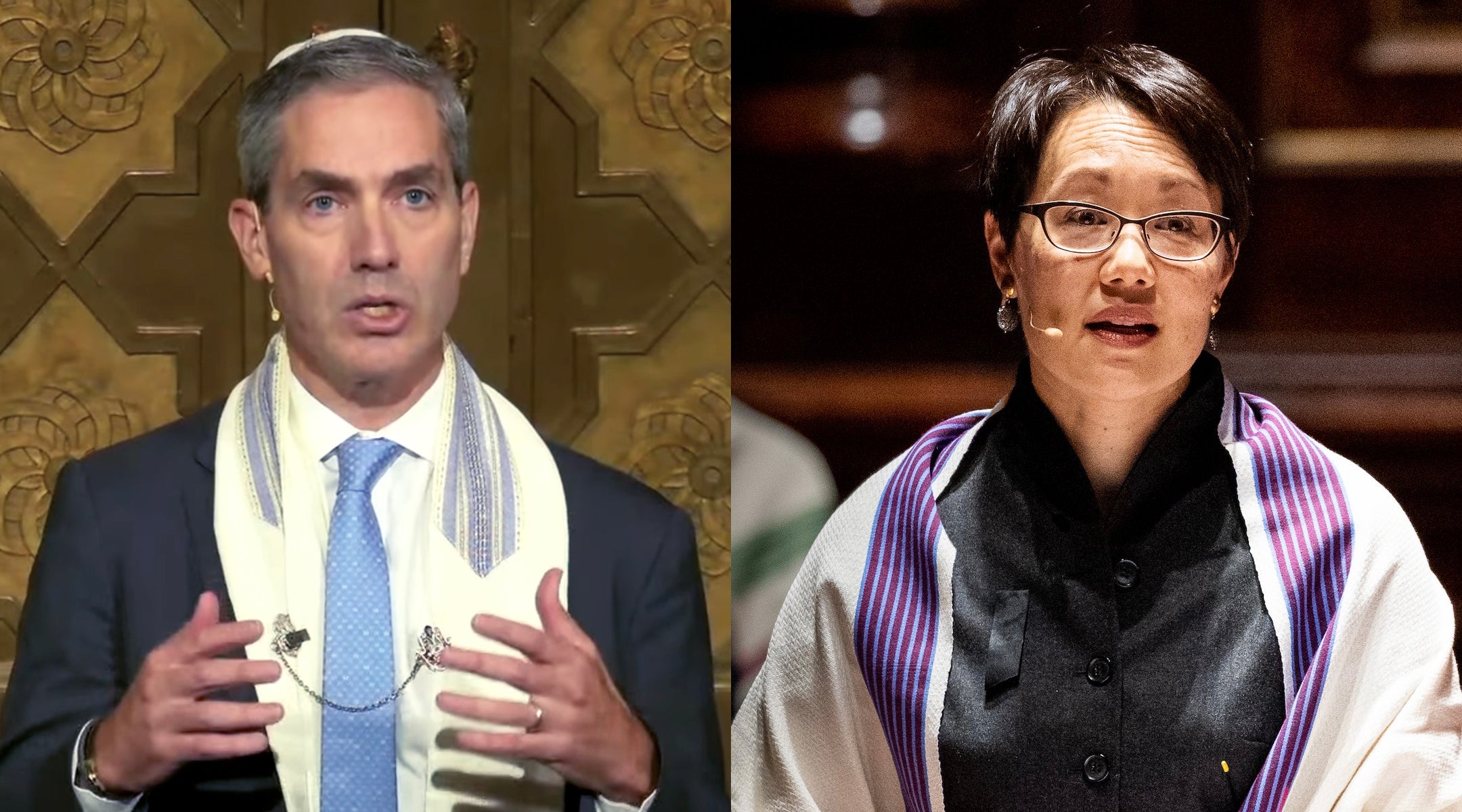
Rabbis Angela Buchdahl and Elliot Cosgrove show the split in the pulpit over political endorsements
Go figure: A non-Jewish, non-Zionist politician has sparked a national Jewish conversation about the role of the rabbi.
If elected next week, the 34-year-old progressive Zohran Mamdani would be the first mayor of New York City who came up through the trenches of pro-Palestinian activism, and the first to reject the idea that being mayor to a city with 1 million Jews means being a supporter of Israel.
The prospect has shaken a Jewish mainstream that has long taken that support for granted, considers Zionism a pillar of its Jewish identity and sees Mamdani as an enabler of the kind of strident anti-Israel protests that make them feel unsafe.
In turn, that has put pressure on rabbis throughout the five boroughs and beyond to take a stand — not just by defending Zionism and Jewish security but by denouncing Mamdani and endorsing his rivals. With the IRS in July having lifted the 60+-year-old ban that prevented houses of worship from endorsing or opposing candidates, rabbis who would prefer to stay above the fray have lost their cover.
Also gone are the days when the decision to use the bimah as a bully pulpit was between a rabbi and his or her congregation. Non-Orthodox synagogues regularly post their rabbis’ Shabbat sermons to YouTube. A petition signed by over 1,100 rabbis calling on voters to reject anti-Zionist candidates like Mamdani has become a very public roll call of rabbis who are willing to engage directly in electoral politics.
The inescapably public profile of being a rabbi amid a high-stakes election was seen in the contrasting positions taken by leaders of two influential and prosperous Manhattan congregations. In a sermon shared on YouTube and the synagogue’s web site, Rabbi Elliot Cosgrove of Park Avenue Synagogue made his position clear from his very first sentence: “I believe Zohran Mamdani poses a danger to the security of New York’s Jewish community.” He not only urged members of his Conservative shul to vote for Mamdani’s leading rival, former New York Gov. Andrew Cuomo, but laid out a specific strategy for convincing undecided and Mamdani-curious Jewish voters to do the same.
About 30 blocks south, Rabbi Angela Buchdahl of Central Synagogue, whose recent sermon on the Gaza war drew over 120,000 views on YouTube, wrote a letter to her Reform congregation about the mayoral race. Without naming Mamdani, she insisted that elected leaders “must reject the idea that Jewish self-determination is up for negotiation,” while reaffirming her synagogue’s policy “of not endorsing or publicly opposing political candidates.”
Some might find that coy — a rabbinic version of the New York Times’ controversial “non-endorsement” endorsement of Cuomo. But Buchdahl has become one of the country’s best-known rabbis in part on her ability to articulate Jewish concerns in a way that embraces and respects those who might disagree with her. Her Gaza sermon deftly conveyed Jewish dismay over the scale of the killings and hunger in Gaza while sympathizing with the fears and dilemmas of average Israelis.

Former N.Y. Gov. Andrew Cuomo, Democratic candidate Zohran Mamdani and Republican candidate Curtis Sliwa participate in the second New York City mayoral debate at LaGuardia Community College in Queens, New York, Oct. 22, 2025. (Hiroko Masuike/Pool/AFP)
The letter makes clear where she and her team stand on Zionism and fighting antisemitism: “We have spoken from the pulpit in multiple past sermons and will continue to take a clear, unambiguous position on antisemitism, on anti-Zionist rhetoric, and on sharing our deep support for Israel.” Mamdani was unmistakably the subject when she added, “I hope and expect anyone who becomes mayor of our amazing city — home to the largest Jewish population outside of Israel — will take very seriously the expressed concerns (made directly and publicly) of so many of us in the Jewish community.”
She also explains why the synagogue considers nonpartisanship a practical and spiritual value. “It remains our conviction that political endorsements of candidates are not in the best interest of our congregation, community, or country,” she writes, adding, “Our role is not to enter political campaigns or to endorse or speak out against candidates, but to provide moral and spiritual clarity on important public issues.”
Cosgrove doesn’t explicitly address the debate over whether a rabbi should endorse a political candidate, but writes that the stakes of the mayoral race are too high for him not to weigh in on the candidates.
“I wish it were otherwise,” he said. “I wish we had two candidates with equal interest, or better yet, equal disinterest in the Jewish community…. But this election cycle, that is simply not the case. We can only play the cards we are dealt. And in this hand, I choose to play the one that safeguards the Jewish people, protects our community, and ensures that our seat at the table remains secure.”
He also defends his public political stand in spiritual terms.
“Self-preservation and self-interest are not only legitimate, but essential to sustaining an ethical life,” he said, citing the Talmudic sage Hillel.
While both rabbis have ranged widely in their sermons and activism, their messages on the mayor’s race offer two different models for leadership. Cosgrove spoke in the voice of a political strategist and community organizer; Buchdahl’s letter was about protecting the integrity of her institution and the diverse individuals it serves.
By dint of their influential congregations, media savvy and charisma, Cosgrove and Buchdahl are rabbis with citywide and, especially in Buchdahl’s case, national stature. The rabbis’ petition quoted Cosgrove, although he did not sign it; Buchdahl recently promoted her memoir about growing up Korean-American, and her unasked for role as a hostage negotiator, on CBS Mornings. Their positions have weight in a debate that has dogged rabbis ever since the pulpit became a place not just for parsing fine points of Jewish law or offering homilies, but commenting on current events.
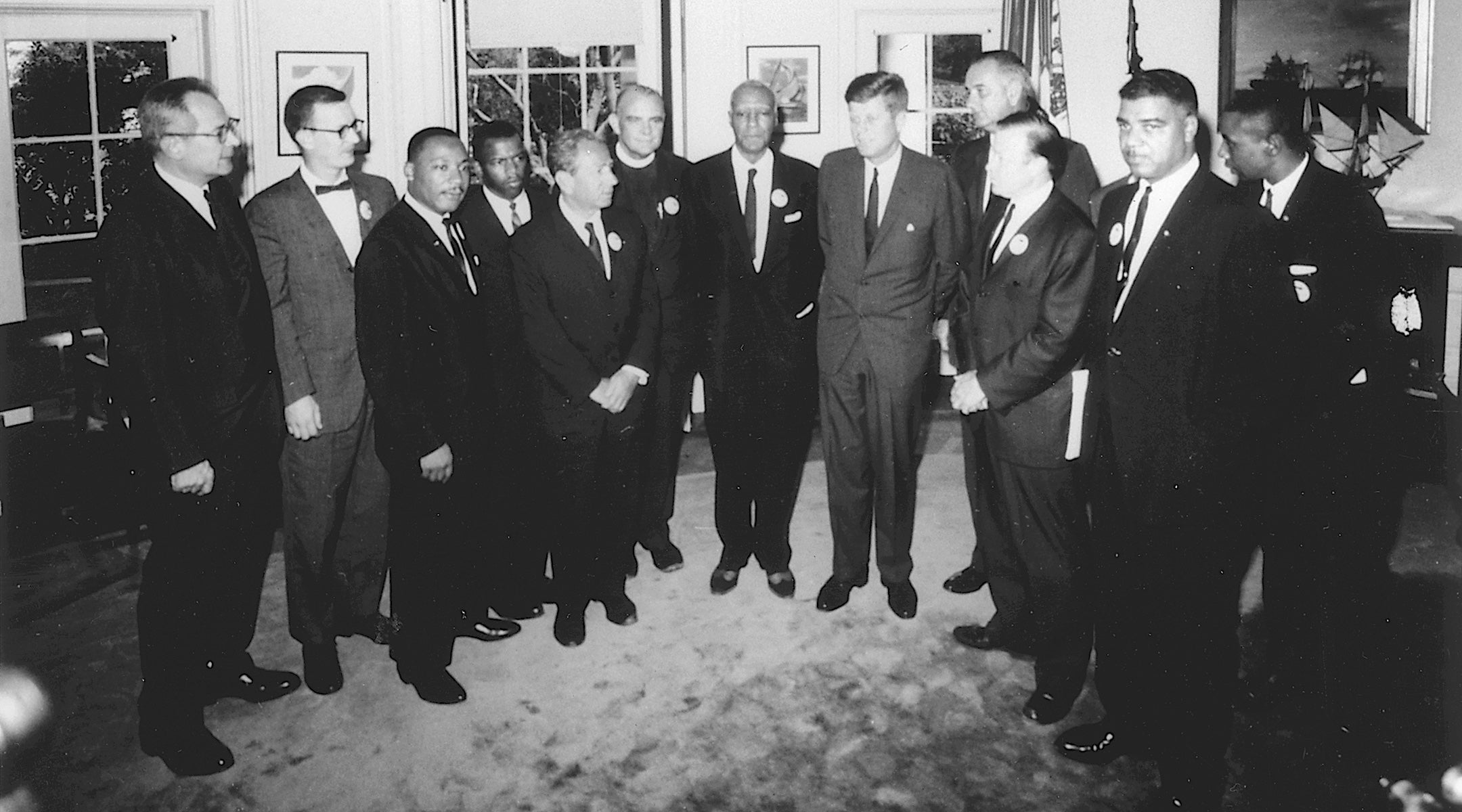
Rabbi Joachim Prinz, fourth from left in front row, joins leaders of the March on Washington, including Martin Luther King Jr. (third from left), at an Oval Office meeting with President John F. Kennedy, Aug. 28, 1963. (U.S. National Archives and Records Administration)
A frequently cited role model for activist rabbis is Joachim Prinz, the German refugee who led congregations in Newark, New Jersey and its suburbs in the last century. Even before leaving Germany he would rail against the Nazis. In America, he bucked the clear isolationist trend — and fear among many Jews of a backlash — by insisting that Europe’s fight was America’s fight.
Prinz rejected the traditional model of the drash, or homily, finding it “too solemn and lacking in concrete meaning. I was always out to find something relevant to the life of the people sitting in front of me.” He wondered how seriously people would take a faith tradition whose clergy couldn’t offer guidance on, say, waging war, addressing poverty or resisting authoritarianism.
Throw in Jewish security, and the stakes get higher yet.
Prinz’s jeremiads against Nazism and later in support of civil rights would assure his place in American-Jewish history. Whether it would assure him a place in a modern American pulpit is another story. Support for “social justice” — in the form of volunteerism and charitable giving — is fine. Also tolerated is a certain amount of activism on consensus issues, which have lately become elusive.
As for urging specific stands on candidates or pieces of legislation — rabbis quickly learn that neither smooths their path to contract renewal.
For many congregants, this is as it should be. They feel that the great knotty corpus of Jewish text shouldn’t be reduced to a policy prescription, or that they shouldn’t be forced to hear a political speech in a house of worship.
Cosgrove especially anticipated the kinds of objections — mostly tactical — he thought he might get from congregants: Opposing a popular candidate like Mamdani would invite an antisemitic backlash, or centering Zionism in the mayor’s race would confirm the slander of dual loyalty.
Buchdahl faced the opposite pressure: congregants insisting she endorse Cuomo. There have been some nasty Instagram posts calling her timid, with comments suggesting that some congregants may have resigned over the saga.
Buchdahl’s letter insists that declining to endorse does not mean she and the synagogue are abdicating their responsibility to Jewish safety. Rather, she wrote, the synagogue does its job by instilling the values that shape the political decisions of its congregants.
“Our role,” she wrote, “is not to enter political campaigns or to endorse or speak out against candidates, but to provide moral and spiritual clarity on important public issues.”
—
The post Rabbis Angela Buchdahl and Elliot Cosgrove show the split in the pulpit over political endorsements appeared first on Jewish Telegraphic Agency.
Uncategorized
Mamdani joins Theo Von’s podcast. They find common ground in criticizing Netanyahu.

(JTA) — New York Mayor Zohran Mamdani appeared for an interview with “manosphere” podcaster Theo Von, during which he called for the United States to join the International Criminal Court and enforce its arrest warrant for Prime Minister Benjamin Netanyahu.
“If I had my say, the U.S. government would have joined the ICC, honored every single warrant that they issued,” Mamdani said near the end of the 75-minute interview that was posted on Thursday.
“F–k yeah,” Von replied.
The interview came one week after Netanyahu visited the United Nations and delivered a speech during which he called Mamdani an “antisemite” and a supporter of Hamas. (Mamdani has condemned Hamas as a terrorist organization.)
Von, meanwhile, is part of a growing ecosystem of everyman “manosphere” podcasters who host sprawling conversations with a wide array of famous guests — he has hosted Donald Trump, Bernie Sanders, JD Vance and Mark Zuckerberg — and increasingly are seen as representing a crucial sector of the electorate. He drew an invite to Trump’s inauguration in 2025 after hosting him on the campaign trail the year before.

Since then, Von has become increasingly critical of Israel and pressed the case in his Vance interview that Israel is committing genocide in Gaza. The International Court of Justice, which is separate from the ICC, is adjudicating charges Israel committed genocide — which the country rejects — but has not issued a ruling. Von has also hosted guests who have spread conspiracy theories about Israel and Jews.
At the end of his interview with Mamdani, Von thanked the New York mayor for “talking a little bit about the genocide” during their podcast, noting that “a lot of people are afraid to speak about it in politics.”
“One thing I would just say is, your curiosity is a beautiful thing,” Mamdani told Von.
The chummy conversation was notable, arising as it did out of a meeting between an icon of the libertarian-leaning “manosphere” and a self-declared socialist.
Mamdani decried Israel’s campaign in Gaza during their conversation.
“People talk about a ceasefire — just last week, the Israeli military killed an 11-year-old boy, Palestinian boy in Gaza, in a section that’s considered to be a safe zone,” he said. “This is continuing.”
He also recalled hosting Palestinian families at Gracie Mansion, the mayor’s official residence, where they told him about “the ways that their lives have been shattered.”
Von asked Mamdani how he keeps people “from misdirecting energy that’s against Israel towards their Jewish friends,” especially as the mayor of the country’s most Jewish city.
Part of that, Mamdani said, is being clear that “no Jewish person in New York City is responsible for the actions of the State of Israel. And if you want to hold anybody accountable, it’s the people who are making those decisions — the prime minister, the State of Israel, also our complicity as American taxpayers knowing how many billions of dollars we have sent in bombs and continue to send.”
Mamdani also pointed to his administration’s official strategy to combat antisemitism, which it released earlier this week, as an effort to both condemn and prevent antisemitism. Some groups said the strategy “failed to address” anti-Israel rhetoric and links between anti-Zionism and antisemitism, while applauding aspects like security funding boosts and Holocaust education expansion.
Finally, he added, it takes “being very clear that critique of the State of Israel, the policy actions, the genocide — that in and of itself is not being antisemitic.”
“Yeah, I agree, speak up about it,” Von said.
Von, who has nearly 700 podcast episodes and more than 4.7 million YouTube subscribers, has interviewed or spoken positively about multiple controversial figures who have spread conspiracy theories about Israel and Jews, including former Fox News personality Tucker Carlson, streamer and Holocaust denier Nick Fuentes and commentator Candace Owens.
During an episode from this past January with comedian Dave Smith, Von called Fuentes “fascinating” and said, “He’s f–ing brave, dude.”
Von hosted Carlson on his show in December 2025. The two men spoke at length about Israel and Von criticized what he said was a lack of transparency in the control that Israel and corporate interests have over American politics.
“If they would just say, ‘Hey, America is a country that’s owned by Israel,’ or that it’s always been this outpost or this LLC of Israel — or maybe not even of Israel, it could just be of corporate entities, I’m not really sure exactly — but if they would just tell us, you can operate from a place of knowing what’s going on,” Von said.
Pro-Israel lobbies have repeatedly defended their role as no different than any other interest group seeking influence, citing the successes over the years of pro-choice and anti-abortion groups, environmental groups and gun owner groups, among others.
During that interview, Von also played a clip of CBS News editor-in-chief Bari Weiss calling Carlson anti-American and anti-Jewish, which elicited laughter from both Von and Carlson. Von then read out an AI-generated overview that described Weiss as “a vocal supporter of Israel.”
“If her allegiance isn’t to America first, how is she the head of an American network?” Von said.
“Well that’s of course an entirely fair question, that you’re not allowed to ask,” Carlson replied.
Von’s conversation with Mamdani this week covered a number of topics including socialism, the achievability of the American Dream and their preferred fish.
When asked about Netanyahu’s U.N. speech, Mamdani explained that he’d been meeting with the prime minister of the Netherlands about an LGBTQ center and the community’s history in New York.
“Then I get back from that meeting and it’s like, ‘Oh by the way, here’s what he was saying at the U.N.’,” Mamdani said.
“It’s so bizarre. Did it feel personal then?” Von asked.
Mamdani replied that “all of this is an attempt to distract from responsibility, name as many people as possible, try and make it into a back and forth.”
He added, “It’s not about me and him. It’s about the fact that he’s the architect of a genocide.”
This article originally appeared on JTA.org.
The post Mamdani joins Theo Von’s podcast. They find common ground in criticizing Netanyahu. appeared first on The Forward.
Uncategorized
A Jewish journalist recorded pro-Palestinian protesters outside services. He was reportedly suspended from his job
(JTA) — TORONTO – A number of Canadian groups are demanding answers in the wake of media reports that the country’s national broadcaster suspended a Jewish reporter after he posted a video of pro-Palestinian protesters outside Yom Kippur services and wrote about his pained reaction.
The reported suspension came after Neil Herland shared footage of protesters gathered outside the Meridian Arts Centre in north Toronto, which on Sept. 20 was hosting Yom Kippur services for The Song Shul.
Herland, who has worked for the Canadian Broadcasting Corporation for nearly 30 years, began his post on X, “On Yom Kippur I went to a synagogue service in Toronto and was met by protesters trying to taunt and intimidate me from entering the building.”
A man can be heard yelling “Zionist alert!” through a megaphone, while another masked protester approaches the camera and screams, “You’re going to hell.”
A pro-Palestinian group, Canadians for Justice and Peace in the Middle East, filed a complaint against Herland with the CBC, saying he had mischaracterized the protest.
“It is clear to CJPME that Mr. Herland was aiding the pro-Israel side of these demonstrations defending Mark Regev’s presence, while smearing these pro-Palestine protesters as antisemitic for their criticisms of Regev’s awful record on Palestinian human rights,” their complaint said, referring to the presence of a former Israeli diplomat at the event.
The Toronto Sun reported the suspension on Sept. 24. CBC declined to confirm the suspension and said reporting had mischaracterized what had happened.
“We don’t comment on internal matters,” a spokesperson said. “That said, we are aware of reporting on this matter which has errors and mischaracterizations but we can’t get into the specifics given the confidentiality of the situation.”
Reached by JTA, Herland declined a request for comment.
A press freedom group decried the reported suspension, however.
“Recording events in a public place and reporting them to the public is not misconduct,” Sheila Gunn Reid, president of the Independent Press Gallery — a non-profit advocating for independent and nongovernmental journalist organizations — said. “It is journalism. It is not the role of a public broadcaster to punish its journalists for doing their jobs to appease activist groups. Its role is to defend their right to report.”
In a thread under his tweet about the protest, Herland noted that “The guest speaker at the Toronto synagogue tonight was an Australian-born university teacher who lives in Israel and once served as Israeli ambassador to the UK. His speech was about making peace in the Middle East. Let’s hope that happens this year.”
He was referring to Regev, formerly the Israeli ambassador to Britain, who gave a talk during Yom Kippur services. Online defenders of the protesters chided Herland for not personally naming the prominent media defender of Israel’s war in Gaza in his post.
Commenters also scored Herland for describing the venue as a synagogue even though the service was held in a public events space.
However, Jewish groups who reviewed the video or otherwise tracked the protest said that Regev’s presence did not seem germane to the protesters’ chants, and noted that synagogues often move to event venues for the High Holidays because of the volume of congregants attending.
“The protesters claimed to have been demonstrating against the speaker, but I don’t recall seeing anything that particularly said they were targeting [Regev],” Rochelle Direnfeld, senior criminal counsel for the Alliance of Canadians Combatting Antisemitism, said in an interview. “It seemed to be much more general against Jews and supporters of Israel.”
Criticism of Israel is not inherently antisemitic, Direnfeld said, but the protesters’ apparent targeting of worshipers was worrying. “It’s not okay to blame Canadian Jews for what’s going on in the Middle East,” Direnfeld said. “Given what [the protesters] were saying to the people trying to enter the building for services, that’s what they were doing.”
Simon Wolle, CEO of B’nai Brith Canada, said the protests on Judaism’s holiest day amounted to intimidation. “It is deplorable that members of the Jewish community are subject to these incessant acts of hatred and intimidation,” he said. “It is especially alarming when these protesters target members of the community as they enter their houses of worship, in this instance on Kol Nidre, the holiest night of the year.”
Wolle said the CBC needed to explain its reported disciplinary measures. “Neil Herland had every right to document his lived experience, and the very idea that he would face disciplinary action for that is deeply concerning,” he said. “As Canada’s public broadcaster, the CBC owes the public an explanation for its inexplicable treatment of Mr. Herland.”
Vivian Bercovici, a lawyer as well as former ambassador of Canada to Israel and a CBC board member, said the alleged discipline Herland has faced is cause for concern.
“Herland didn’t say anything derogatory, rude or inappropriate,” said Bercovici. “He told us what was happening in a very clear and factual way, and so I think that the CBC owes us an explanation as to why that post was so egregious.”
Herland’s tweet thread also included a post noting that his late father was an Austrian Jew who survived the Holocaust in Romania, and that he “came to Canada as a refugee. This year I got an Austrian passport, in case Canada becomes unsafe for me as a Jew. I fear that moment is approaching, here in Canada and elsewhere.”
Herland’s expression of his own distress at the alleged harassment is not usual practice for reporters, but it is also not unheard of.
His comments echo those of many Canadian Jews, who increasingly are saying they do not feel safe in the country and even considering taking up potential offers to move to the United States as refugees.
Direnfeld said the incident reflected what is becoming a pervasive complaint among Canadian Jews that the authorities are not doing enough to decrease tensions. The police practice of deescalation was failing, she said.
“De-escalation can quickly turn into capitulation, which only serves to embolden these protesters to continue,” she said. “We’re now seeing the fruits of that capitulation in conduct such as what happened in Belleville,” she continued, referring to a gunman who tried to attack the Sons of Jacob synagogue on Yom Kippur but was killed in a shootout with police.
Bercovici said the protest was no less distressing because the Meridian Arts Centre is an events space.
“A synagogue can be anywhere, and there are a lot of religious groups that rent space over specific holidays because they don’t have their own building,” she said. “That’s just a fatuous, ridiculous argument.”
Herland has posted only once to X since his reported suspension: A photo of Shabbat candles on Friday, Sept. 25.
This article originally appeared on JTA.org.
The post A Jewish journalist recorded pro-Palestinian protesters outside services. He was reportedly suspended from his job appeared first on The Forward.
Uncategorized
A great Jewish intellectual understood the Kafkaesque horror of Tennessee’s botched execution
Two days ago, the state of Tennessee tried to kill Christa Pike, the Death Row prisoner who, in 1995, was found guilty of the torture and murder of her classmate Colleen Slemmer. After spending more than 30 years on death row, Pike was strapped to a prison gurney and, as journalists watched through a window, an execution team cycled through at least a half-dozen syringes before finding a vein suitable for the injection of pentobarbital.
Or so they thought.
After Pike herself tried to help the team find a vein, they injected her with a supposedly lethal dose of the barbiturate. Though it caused an intense burning sensation in Pike’s arm, the dose failed to do its job, leading the executioners to empty a second dose into what they thought was a vein but turned out to be the surrounding tissue. Shortly thereafter, a curtain was drawn across the window and, for an hour, the journalists heard Pike continue to breathe and snore. Pike’s legal team eventually learned that their client, barely but still stubbornly alive, had been rushed to the emergency room of a nearby hospital.
While Pike’s physical prognosis is uncertain, there is nothing uncertain about the ethical diagnosis of this event. At least this would be the case for two earlier journalists who wrote at length on the death penalty: Arthur Koestler and Albert Camus. Long after they both became celebrated novelists and intellectuals, the two men each wrote essays on state-sanctioned killing, which were combined and published in France with the title Réflexions sur la peine capitale, or Reflections on the Death Penalty.
These reflections are as relevant in our own age of drug-induced executions as in Koestler and Camus’ era of where the delivery system of death was a noose or the guillotine.
Born into a secular Jewish family in Budapest, Koestler was, as the phrase goes, a child of his century, one convulsed by catastrophic wars, murderous ideologies, and multiple genocides. Described by his friend George Orwell as an “outstanding figure” of his time, Koestler, like Orwell, fought in and reported on the Spanish Civil War. As a member of the Spanish republican forces, he was captured by Franco’s intelligence service and sentenced to death — a fate Koestler escaped when, after several months of imprisonment, he was released in a prisoner exchange.
Yet this experience deeply marked him. In the mid-1950s, he rallied to the campaign to end capital punishment in Great Britain, penning the essay “Reflections on Hanging.” Serialized in two newspapers, the essay galvanized public opinion and played a pivotal role in the parliamentary vote that, while not entirely abolishing the death penalty, severely limited it. Given the clarity and ferocity of Koestler’s writing — which, Rebecca West observed, was as historically misleading as it was rhetorically moving — this sea change in the public’s attitude and parliament’s position is not surprising.
One passage seems especially relevant for the recent events in Tennessee. “There is indeed a Kafkaesque horror attached to an execution,” Koestler writes, “which goes beyond the mere fear of death or pain or indignity. It is connected not with the brutality but with the macabre, cold-blooded politeness of the ceremony, in which the person whose neck is going to be broken is supposed to collaborate in a nice, sensible manner, as if it were a matter of a minor surgical operation…it is present in the delinquent’s knowledge that in the embarrassed stares of the officials he is already mirrored as a dead man with a blue face and ruptured vertebrae; and that what for him is the final, violent termination of life is for them merely an unpleasant duty, followed by a sigh of relief and a plate of bacon and eggs.”
Did the unnamed doctor, I wonder, stare with embarrassment as he repeatedly tried but failed at killing the — perhaps this is not the best word — patient? How, I also wonder, should readers respond to the description of Pike’s attempted execution? (With embarrassment, I admit while I was revulsed, I also continued sipping from a mug of coffee as I read the New York Times’ account.)

We can guess how Lucien Camus might have responded. His son, Albert Camus, told and retold the story in his writings of his father who, having witnessed a public execution by guillotine, returned to the house, vomited in the sink, and never spoke about the experience. In the essay “Reflections on the Guillotine,” which accompanied Koestler’s, Camus suggested that rather than telling the condemned man or woman that they will pay the ultimate price or their debt to society for their crime, they instead be told the truth. “If you kill you will be imprisoned for months and years, torn between impossible death and constantly renewed terror, we shall slip into your cell…tie your hands behind your back [and] bind your arms with a strap to that you are forced to stoop [and] then carry you through the corridors [and] seize you by the seat of your pants and throw you on a board [then] let fall from a height of seven feet a 120 pound blade that will slice off your head like a razor.”
What, then, did the judge overseeing the 1995 trial tell Christa Pike when the sentence was rendered? The delivery system for death then was the electric chair and, to the judge’s credit, she did inform Pike that she would be subjected to a degree of electroshock sufficient to kill her. I do not know when the agent of death shifted from electroshock to pentobarbital nor do I know if a judge explained to Pike how the drug would act on her brain and organs to bring about her death. But I am pretty certain that none of the judges informed Pike of one legal scholar’s assessment of this form of death: “It is not the most humane, it is the most humane-looking.” I am even more certain they did not inform her, in case she survived another botched execution by the state of Tennessee, which boasts a history of such botches, that her brain would be irreversibly damaged.
Finally, I am most certain that, whether strangled by a tightened noose, decapitated by a sharpened blade, or injected by what was possibly an expired dose of pentobarbital, the sheer barbarism exercised by officials wearing white coats remains constant.
The post A great Jewish intellectual understood the Kafkaesque horror of Tennessee’s botched execution appeared first on The Forward.
