



Uncategorized
Is this Vermont farm the American kibbutz? I camped out there during Sukkot — and got a taste of Judaism’s ancient agrarian roots
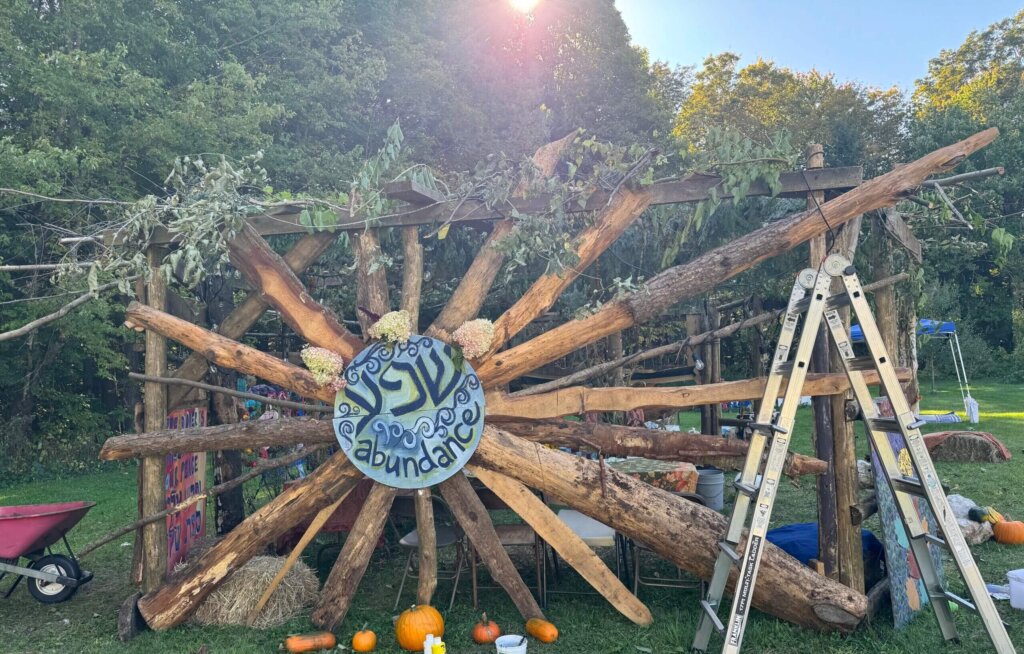
Sukkot, the Jewish harvest festival, can feel a little abstract for Jews like me who live in big cities, far removed from the agricultural cycle that gave rise to the holiday. Typically, the extent of my fall harvest consists of buying a pumpkin from Trader Joe’s.
But last weekend, sleeping in a tent at Living Tree Alliance, a Jewish farm and co-housing community in rural Vermont, I found myself much closer to Sukkot’s agrarian roots. Rows of colorful produce stretched across the 93-acre property, much of it destined for the “stone soup” that would become our dinner the following night. Plants grown on the farm formed the sukkah’s schach, or roof covering.
“I forgot scissors,” Melanie Grubman, one of Living Tree’s founding members, told me as she cut yellow flowers off their stems with her teeth for material to decorate the sukkah.
About 16 people, including a few families with children, live on this bucolic property year-round, in what may be the closest American equivalent to an Israeli kibbutz. Residents are expected to volunteer between 8 and 16 hours per month, doing farm chores, serving on committees, managing the on-site AirBnB and keeping common spaces clean. All disagreements are resolved through a system of “sociocracy,” a governance model based on consent; decisions are made only when no one objects. On Shabbat, that work ceases, and chickens raised by residents are butchered kosher-style for dinner.
By living closer to the land, their food supply, and each other, residents say they feel closer to Judaism, too.
“It’s hard for me to pray not in the garden,” Grubman said. “I have no desire to sit inside when holiness is blowing on me.”


The Founders

Sephirah Oshkello, 54, barefoot and wearing a long purple tie-dye dress, swayed back and forth with the rhythm of prayers. As we went around the circle naming those in need before reciting the Mi Shebeirach, the prayer for healing, she offered, “Mama Earth.”
Oshkello, a Hebrew priestess, or kohenet, also works as a holistic nutritionist when she isn’t gardening or leading prayers.
This free-spirited lifestyle is a far cry from the environment in which she grew up. Oshkello was raised in Great Neck, New York, where she attended Temple Israel, a Conservative synagogue.
But after college at University of Maryland, she joined a community service program in Tzfat, Israel, where she got a taste of Jewish communal living, studied Jewish tradition, and spent her days hiking. From there, she spent a year living on an Israeli kibbutz.
“From then on, I felt like, I want to create something like this in the States,” Oshkello said. “Because when I went to Israel, my mom said, ‘OK, go, but you better come back.”
She returned to Great Neck and attended an Orthodox synagogue, but quickly realized it wasn’t the right fit.
“Judaism is connected to the land, and when the Jews got kicked out of their land, it became a culture of the book,” Oshkello said. “I do love to study words, but it only serves one part of our being, right? In Kabbalah, we talk about body, mind, spirit.”
The idea for Living Tree took shape on Oshkello’s second date with her now-husband, Craig, at a vegetarian restaurant in Seattle in 1997, when she told him about her dream to create an intentional Jewish community. The couple moved to secular co-housing in New Hampshire, where they began scouting property in Vermont and making plans for their own Jewish community.
In 2015, she and Craig bought the 93-acre Living Tree property in Moretown, Vt., then just a field with trees and a sugar shack, and moved there about a year later.
Grubman, a 47-year-old Waldorf teacher and owner of an all-women stonemasonry business in Vermont, was among the first residents. Like Oshkello, Grubman grew up in a suburban Jewish community — in her case, a “ritzy” Conservative synagogue outside Philadelphia. But she never connected with the idea of praying while sitting still inside.
“I was one of these angsty teenagers who was like, ‘Nature is busting through the concrete!’” Grubman said. “‘My heart is crying!’”
At Wesleyan University, Grubman became president of the environmental club and wrote her own eco-Haggadah for Passover. She later helped jumpstart Wilderness Torah, a program reconnecting Jews with the agricultural context of the Hebrew calendar, in Berkeley and Oakland, California.
Along the way, she encountered spiritual leaders who helped her understand that Jewish practice could look different from the Judaism of her childhood.
She remembered one rabbi who arrived for Yom Kippur “in white pajamas, covered in dirt.”
“And we were like, ‘Oh, what’s he doing?’ And he was like, ‘Oh, I was davening in the woods,’” Grubman said. “That’s the opposite of suburban Philadelphia Yom Kippur — when you show up in some fancy dress [that] you went to the mall to buy and gossip.”
Living Tree, Grubman said, offered a way to make Judaism a part of daily life beyond prayer and study.
“I felt like Judaism and like the world in general can be very intellectual. And I am a very intellectual person,” Grubman said. “But the more I link it to what I’m doing with my body and my hands, it just feels like it makes more sense to me.”


‘Shtetl Vibes’
There’s a long history of Jews who have sought to build communal, self-sufficient communities. But turning that ideal into a sustainable way of life has always been complicated.
The first kibbutz was established in Ottoman Palestine in 1910; the movement expanded after Israel’s founding in 1948. But the kibbutz system largely collapsed during the country’s financial crisis in the 1980s, when the utopian socialist model slowly gave way to a privatized version. Kibbutzim retained many of their collectivist values, but residents no longer pooled their incomes, raised their children together, or lived completely off the land.
American Jews experimented with communal living, too. During the back-to-the-land movement of the 1960s and ’70s, tens of thousands of young, college-educated city dwellers moved to rural Vermont as part of a countercultural movement. While few communes were explicitly Jewish, residents included many Jewish hippies. (Sen. Bernie Sanders, who briefly lived on an Israeli kibbutz in his twenties, was kicked off a Vermont commune for allegedly loafing around and talking about politics rather than working the land.)
But few of those experiments lasted as fully communal settlements.
Today, efforts to revive Jewish communal living are taking new forms. Young Jews live together through organizations like Moishe House, where residents get subsidized rent in exchange for planning Jewish community events. In Berkeley, an urban Jewish cohousing community called Berkeley Moshav is under construction; residents will own condos and make collective decisions about shared spaces.
Living Tree Alliance, which operates as both a nonprofit and a homeowners association, has seemed to stand the test of time — it has been hosting residents for over a decade. But like the modern kibbutzim, it’s not a full escape from the trappings of capitalism: Residents, most of whom have day jobs outside their farming responsibilities, don’t share income, and they own their own homes while co-owning the surrounding land.
Grubman, who works three jobs, cringed when I asked if Living Tree sometimes felt like utopia.
“It actually is a lot of work. It’s really really challenging,” Grubman said. “But what else are you going to do? Look at your screen?”
Many of the residents I spoke to were attracted to Living Tree as an escape from modern malaise.
Gil Ben Moshe and Ella Sutherland moved to Living Tree a few months ago with their three children, ages 2, 5 and 14. The couple met at an anarchist community in northern California and co-founded an intentional community in Virginia. After deciding they wanted a Jewish co-housing community instead, they found Living Tree online and moved.
Ben Moshe, wearing a kippah over his long hair, a plaid flannel, and no shoes or socks, has fond memories of living on an Israeli kibbutz until he was 4, when his family moved to the city of Eilat. The transition to urban life was jarring, he said, and he vowed to eventually return to the pastoral life of his early childhood.
“I’ve been so shocked at the discrepancy between people really believing that community is the right way to live, but not actually meaning it when they say it,” Ben Moshe said. “People’s relationship with spirituality is one that resembles more of their shelf with porcelain knickknacks … it’s not their daily bread.”
Arielle Sabot, a 28-year-old who uses they/them pronouns, worked as an apprentice at Living Tree for a year beginning in 2023. They now live in the Boston area, where they attend a traditional egalitarian synagogue and work as an outdoor Jewish educator.
While at Living Tree, they lived in a tiny cabin that lacked running water. During the winter, they chopped their own wood to heat the cabin with a wood-burning stove.
The arrangement wasn’t always idyllic. There were no flush toilets. Dishes, which Sabot had to boil water to wash, could pile up. And living alongside neighbors who were also co-workers could get tense sometimes.
But that proximity, Sabot said, also made some aspects of Jewish life feel more manageable.
“I think it’s easier when your community is right outside your door,” Sabot said. “You don’t have to go somewhere. It was shtetl vibes.”


Getting Outside
Since Living Tree was founded more than a decade ago, organizations explicitly linking Jewish spirituality and the natural world have been “growing exponentially,” Oshkello said.
A 2014 national study helped document the growth of what it dubbed Jewish Outdoor, Food and Environmental Education, or JOFEE, and found more than 2,400 people had participated in immersive Jewish outdoors programs the previous year. In 2025, Adamah, one of the movement’s largest organizations, reported more than 45,000 participants in its programs, including almost 10,000 Jewish teens and college students.
Vermont is especially fertile ground for this kind of experiential Judaism. On Shavuot, Living Tree and the Jewish Community of Greater Stowe hike Mount Mansfield, the state’s tallest peak, carrying a Torah for a small taste of what Moses may have felt ascending Mount Sinai to receive the Ten Commandments. On Tu B’Shvat, Jewish Vermonters snowshoe beneath the full moon, stopping at different trees for reflection, poetry and song. And then there’s “Ski Ride Purim,” when skiers and snowboarders hit the slopes in costume, eating hamantaschen along the way.
“Vermonters are going to be outside as much as we can,” said Beth Liberman, executive director of Jewish Communities of Vermont, the state’s Jewish umbrella organization. “We’re bringing Judaism where it connects for so many people.”
There may be an even larger Jewish constituency to capture: In a 2020 Pew Research Center survey, 51% of American Jews said they derived a great deal of meaning and fulfillment from being outdoors — more than twice the share who said the same about their religious faith.
The Jewish connection with the outdoors was a major draw for Talia Wilk, a 20-year-old spending two weeks at Living Tree through a fellowship program. Wilk said she grew up going to Jewish summer camp, where Judaism felt intertwined with being in nature. Now living in Toronto, she works as a Hebrew school teacher and an educator at an outdoors school. When she heard about the Living Tree fellowship, she jumped at the chance.
“I’ve always had that kind of longing for a space where Jewish holidays and rituals are really connected to the seasons and to the land,” Wilk said.
For Sabot, residing at Living Tree changed their relationship to the Jewish lunar calendar. In Vermont, where the seasonal changes are particularly dramatic — lush greenery in summer, brilliant foliage in fall, mud in spring, and snow in winter — Jewish holidays timed around an agrarian cycle feel more tangible, Sabot said.
Younger Jews in particular, Oshkello said, connect with the idea of getting outside over sitting in pews.
“This next generation, they don’t want to be bored and sit and listen to other people preach,” Oshkello said.

At Living Tree, I began to understand what that connection could feel like. I awoke in my tent around 6 a.m. to the sunrise and roosters cock-a-doodle-dooing as my alarm. Meditating in the sukkah, we took deep breaths and placed our hands on the earth. Eating potluck dinner, we were invited to reflect on the journey of our food, from seed to mouth. On my last day, we learned how to press apples to make hot cider and pickle cabbage.
After three days immersing myself in nature, I headed back toward New York City, eager to take a hot shower and sleep in my own bed.
But the next morning, I found myself missing the fresh air and the feeling of being outside. All weekend, residents had talked about getting Judaism out of their heads and into their bodies. Crammed into the subway on my morning commute, I understood what they meant.
The post Is this Vermont farm the American kibbutz? I camped out there during Sukkot — and got a taste of Judaism’s ancient agrarian roots appeared first on The Forward.
Uncategorized
Rock legend Steven Van Zandt’s new gig: Holocaust education

(JTA) — Steven Van Zandt is worried about the Jews.
“There is that pre-Holocaust vibe,” the Rock and Roll Hall of Famer told the Jewish Telegraphic Agency recently about what he sees on social media, where he is a prolific user. “They spread lies around year after year after year, and if you say something often enough, people start to believe it.
“And that’s what happened that led to the Holocaust in the first place, and that’s what’s going on now.”
For a man equally beloved for his longtime work with Bruce Springsteen in the E Street Band and his role as Silvio on HBO’s “The Sopranos,” such a detour might seem unusual. But Van Zandt is looking to make his own mark in the world of Holocaust education, via his education initiative TeachRock, which since 2013 has provided K-12 lesson plans on a range of subjects built around popular music.
Titled “Jewish Heritage and the Holocaust: Exploring an Enduring Culture Through Music,” the initiative’s four-day lesson plan, launched this week, includes the onset of antisemitism in prewar Europe, survivor testimony and Jewish values. Anchoring the lessons are rock songs from the likes of KISS, the half-Jewish glam metal band, beloved Jewish folk singer Leonard Cohen and contemporary New York pop band Lawrence, which is fronted by two Jewish siblings.
It’s a departure from the somber tone of most Holocaust education programs, a space that the Jewish community has heavily invested in despite mounting questions about the effectiveness of such lessons in curbing antisemitism. Other contemporary Holocaust learning initiatives have employed video games, artificial intelligence and similarly novel approaches as educators struggle to adapt to a near future without living survivors to share their testimonies.
For Van Zandt, the lessons aren’t just teaching about the Holocaust, but also about highlighting positive Jewish influence in the world of popular culture. He rattled off a list of Jewish artists he admires, including Bob Dylan and the pop songwriting team Lieber and Stoller.
“I have a lot of gratitude for what they have contributed to my life, just in terms of enjoyment,” he said. “Show business doesn’t exist without the Jewish contributions.”
The guitarist founded TeachRock in 2013 alongside other big names from the world of music and the arts, including Springsteen, U2 frontman Bono, Jackson Browne and the director Martin Scorsese. On Thursday, the organization piloted its new Holocaust education lesson plan to 50 high school students at the Florida Holocaust Museum in St. Petersburg, timed to the state’s Holocaust Education Week. Florida’s Holocaust education task force is promoting the material to districts across the state.
“We always want to be educating in a way that feels like you’re not being taught. And I think this captures that,” Michael Igel, a contributing author on the TeachRock lesson plan who also chairs the statewide task force, told JTA.
For Igel, a descendant of survivors, the project fits neatly into his own efforts to bring Holocaust education into unconventional spaces. He’s planning future courses that incorporate food and theater.
“It’s still standards-based Holocaust education. But it’s being delivered to students in these different portals,” he said.
It was through Igel’s promotion of such nontraditional methods that he was approached by a member of TeachRock’s leadership council a year ago. TeachRock had recently been looking to offer lessons on Jewish heritage, and saw an opportunity to broach the subject of the Holocaust through Igel.
A huge E Street Band fan, Igel laughed as he recalled how the council member asked him if he had ever heard of Van Zandt.
The first of the curriculum’s four days opens with students listening to “Rock and Roll All Nite,” the 1975 hit by rock band KISS, before segueing into Jewish life in prewar Europe and the rise of antisemitism.
Igel noted the unique nature of the lesson. “When Gene Simmons with his tongue out is the first thing you see, you’re wondering, ‘What the heck happened to Holocaust education?’” he said.

Gradually the link becomes clear: The lesson explains that KISS frontman Gene Simmons is the son of a Holocaust survivor. Much of the curriculum is built around similar ideas of Jewish survival and resilience, as students are asked to contemplate how Simmons’ family background may have informed his outré stage persona. (Co-founder Paul Stanley is also Jewish.)
Such concepts, he said, help expand the idea of a Holocaust lesson beyond Jews as “victims in a snapshot of time.” In teacher training sessions, educators have responded well to the musical framing and excitedly discussed which songs they would want to pass down to future generations — a positive sign for Igel, who hopes to convince teachers to use the curriculum even outside of the state-mandated Holocaust Education Week lessons.
While Van Zandt, who is not Jewish, doesn’t craft the curriculum himself, he is friends with Simmons and the two have spoken before about wanting to use music to teach Jewish history. Max Weinberg, the E Street Band’s longtime drummer, is also Jewish.
The initiative comes at a moment when the world of popular music, like many other cultural sectors, has become engulfed in controversy over Israel. A recent dustup involved Ed Sheeran and Macklemore, in which Jewish venue owner Robert Kraft pressured Sheeran to drop the rapper from his tour over his onstage pro-Palestinian activism. That prompted many artists to support Macklemore, including Jewish actor Ilana Glazer, who spoke at one of his “Free Palestine” tour stops. Several leading musicians, including Lorde, Paramore and Björk, have also signed pledges to boycott Israel over its conduct in Gaza, while others including Pink and Boy George have taken opposite tracks.
All of this discourages Van Zandt, who famously led an international artist boycott of the South African resort venue Sun City in 1985 to protest Apartheid. The artists now backing the Boycott, Divestment Sanctions movement targeting Israel have cited the Sun City protests as a direct inspiration. (Sun City itself was founded by Sol Kerzner, the son of Jewish Russian immigrants.)
But Van Zandt says the two causes are different.
“Yes, I am known as the boycott king of the world,” he said. “It’s not the same situation. Trying to deny weapons for Israel to defend itself is obscene. It’s ridiculous. It’s terrible.”
He has feuded with Roger Waters, the Pink Floyd co-founder and outspoken pro-Palestinian activist, over BDS.
“I wrote him a very nice, detailed letter saying that it was misconceived, it’s a mistake, it’s not going to accomplish anything,” Van Zandt recalled. “I was very nice to him. Very diplomatic, very respectful. And then he starts just calling me names in the press.” (Waters has directed expletives at Van Zandt and other contemporaries who disagree with him about Israel in interviews.)
Igel, too, is thinking about how TeachRock’s lessons can address contemporary discourse over Israel, a subject that many Holocaust educators often are reluctant to bring up in the classroom even when students press the topic. His curriculum defines what a genocide is — “for a generation that needs to know what that word means, and what it doesn’t mean,” he said.
Following this week’s pilot program, both Igel and Van Zandt hope states beyond Florida will take an interest in their lessons. The rock star has ambitious goals for the initiative: to try to change the national conversation around Jews and Israel that has filled his social media feeds, which he describes as “lies on top of lies.”
“Eventually there’s got to be a national public conversation about this, which is not taking place,” he said. “So eventually it’s going to have to be. At that point, all bets are off.”
This article originally appeared on JTA.org.
The post Rock legend Steven Van Zandt’s new gig: Holocaust education appeared first on The Forward.
Uncategorized
Were Leopold and Loeb inspired by Nietzsche, or Jewish self-loathing?
Any production of Patrick Hamilton’s popular thriller Rope, like any game of Clue, can be reduced to props, setting and culprits.
The central prop is a large chest, containing a freshly-murdered body. The setting can vary: Mayfair in Hamilton’s 1929 original, Manhattan in Alfred Hitchcock’s 1948 screen adaptation starring Jimmy Stewart. The names of the players are sometimes different, but there are always two students in their finely-appointed apartment with the titular murder weapon.
Gordon Greenberg’s new adaptation, now playing off-Broadway at the New Group’s space at St. Clement’s, presents a novel clue as to what prompted the crime: a Christmas tree upstage right. In his take on this “well-made play,” which Greenberg believes has its deficiencies, the central characters, inspired by University of Chicago students Nathan Leopold and Richard Loeb, are once again Jewish, but doing their best to conceal that fact.
Hamilton, who wrote his play shortly after Leopold and Loeb’s conviction, was struck by the men’s alleged lack of motive, beyond a desire to pull off the perfect crime based on their nihilistic misreading of Friedrich Nietzsche’s philosophy. Greenberg doesn’t buy that the killing was dispassionate, and believes a crisis of identity was at play.
“What drew me to it was thinking about what the factors might have been that went into this murder that I personally find hard to believe was just theoretical,” said Greenberg, a director and playwright, who recently revived Joseph Stein and Stephen Schwartz’s The Baker’s Wife off-Broadway. “I don’t think anyone does anything for purely theoretical reasons. We can extrapolate them later, but in the moment we are going on gut impulses and human needs and sexuality and jealousy and all of these fiery emotional poles that make us human.”
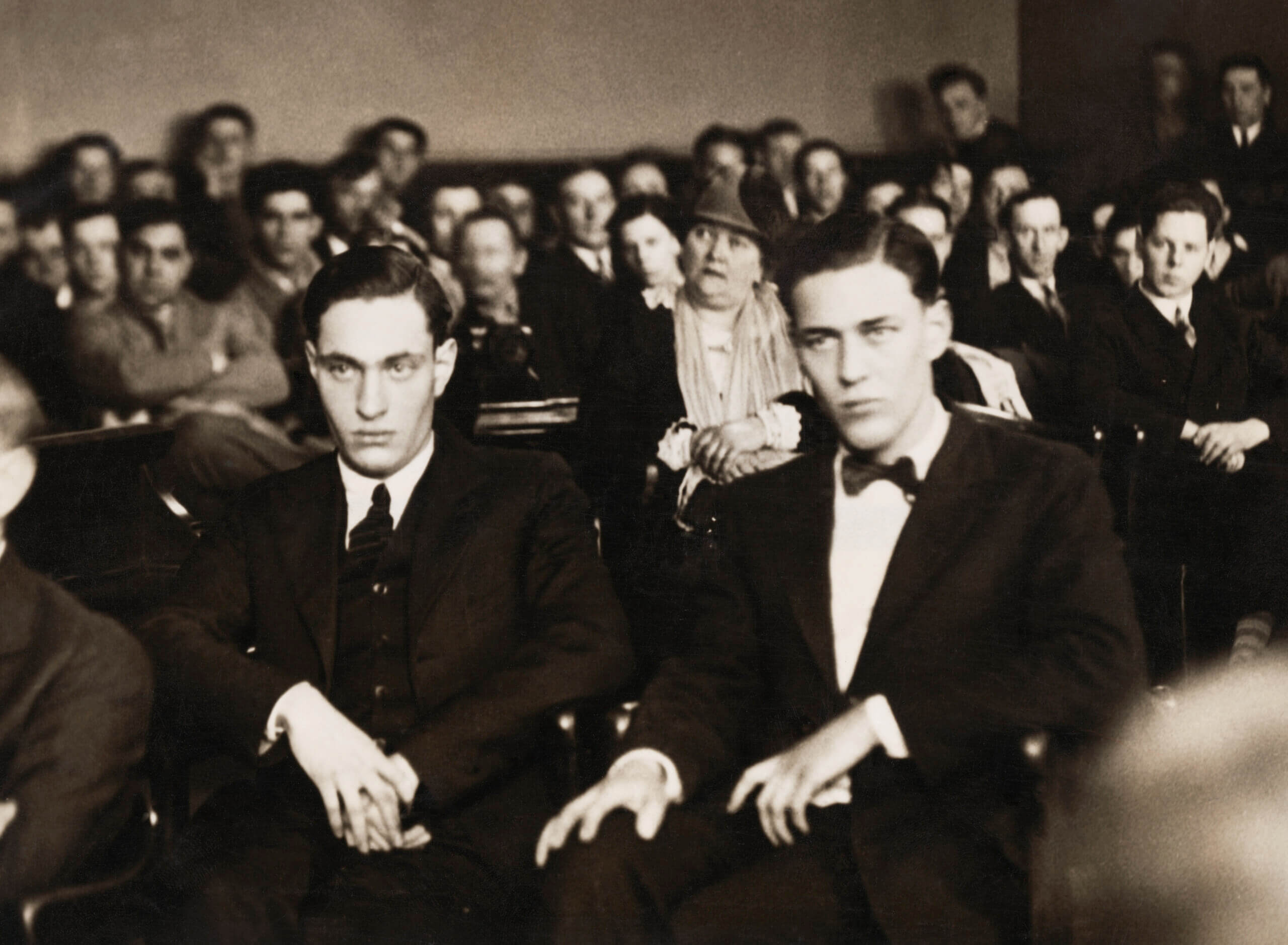
Greenberg, who is gay and Jewish, had long been fascinated by the Leopold and Loeb case, wondering what led two well-bred, cerebral Jews to commit a supposedly “motiveless” murder. (In the real crime, notably fictionalized in Meyer Levin’s Compulsion, Nathan Leopold and Richard Loeb killed a 14-year-old boy, Robert Franks; in Rope, they kill a wealthy classmate.)

Hamilton’s play, which Greenberg found to be “antiseptic,” de-Judaized and stripped of queerness, is not concerned with the “why” of the killing.
His murderers, Brandon, described as “tall, finely and athletically built, and blonde” and Granillo, “a Spaniard” with the “shrug of the shoulders characteristic of his race,” are in it for the thrill. They convene a dinner party and serve the meal on the chest containing their victim, certain they won’t be caught.
In Greenberg’s version, set in 1957 Manhattan, Brandon is Garret Stern (Cameron Monahan), a working-class striver who declaims, in a break of the fourth wall, that he “wants to be mistaken for the son of assimilated German Jews, not the shtetl Jews with bent vowels and calloused hands from whom he actually descends.” (As part of the ruse, he’s abandoned his given name of Gary.)
Granillo is now Nate Singer (Corey Fogelmanis), the Yekke scion of a garment district macher who, to his upwardly-mobile mother’s delight, “can almost pass for gentile.” Both are students at Princeton and plan to drop the body back in Jersey after their macabre dinner party.

Like the real Leopold and Loeb, they are also involved sexually and sadomasochistically. Greenberg says he was partially inspired by Tom Kalin’s 1992 film Swoon, which revisited the killers through a queer lens.
Nate’s instilled self-hatred likely feeds into his desire to be dominated by Garret, whose rough upbringing as a Jew in postwar Skokie taught him the utility of violence. (His school principal praised him for breaking a boy’s nose, saying “your people aren’t exactly known for defending themselves.”)
Greenberg, who said that, as an actor he played “every Herb Gardner and Neil Simon play around,” chose to move the action up to the era Lavender Scare and a resurgence of casual, clubby antisemitism following the “chemotherapy of World War II” that briefly put it into remission.
Nate and Garret’s guests, for their post-Christmas shindig, whose centerpiece is a chest containing a corpse, include a polished, pedigreed classmate; a droll Sarah Lawrence student; their closeted professor, who will catch them in the lie; and a Mayflower-descendant judge who happens to be the father of Ronald Kentley, the deceased.
Driving the boys’ motive and cue for passion is Nate’s tormented attraction to Ronald, who he fears might out him and land him on McCarthy’s list. Garret is jealous, but sees an opportunity: In bumping Ronald off, he hopes to take his place as the judge’s surrogate son, gaining entry to the patrician world to which he aspires.
But their guests’ routine macroaggressions show the futility of trying to overcome their backgrounds. The Christmas tree is fooling no one. Greenberg is similarly unconvinced that Leopold and Loeb’s murder was merely a Nietzschean performance, undertaken to prove that morality need not apply to superior intellects.
“No one really knows what was going through their mind, and no one ever will,” Greenberg said of Leopold and Loeb’s crime. “But taking one of these fascinating true crime stories and positing what the humanity is behind it, what’s all the flesh on the bone, is to me the fascination and the fun exercise.”
The post Were Leopold and Loeb inspired by Nietzsche, or Jewish self-loathing? appeared first on The Forward.
Uncategorized
Documentary reveals composer Dmitri Shostakovich’s empathy for the Jews
אין רוסלאַנד איז לעצטנס אַרויס אַ דאָקומענטאַר רעזשיסירט פֿון גריגאָרי אילוגדין, מיטן נאָמען „DSCH: סימפֿאָניע נומער 13‟, וועגן דעם וועלט־באַרימטן קאָמפּאָזיטאָר דמיטרי שאָסטאַקאָוויטש און די ייִדן. כאָטש ער איז נישט געווען קיין ייִד, האָט ער געשאַפֿן מוזיק פֿאַר ייִדישע לידער און געווידמעט זײַן 13טער סימפֿאָניע דעם חורבן פֿון די ייִדן.
מיט דער אַברעוויאַטור DSCH, וואָס פֿיגורירט אינעם טיטל פֿונעם דאָקומענטאַר, פֿלעגט שאָסטאַקאָוויטש אונטערשרײַבן זײַנע נאָטן. מיינען מיינט עס D. Schostakowitsch. דאָס ווייסן, מסתּמא, אַלע מוזיקער, וועלכע שפּילן זײַנע ווערק. ווייניקער איז אָבער באַקאַנט דעם קאָמפּאָזיטאָרס שײַכות נישט בלויז צו ייִדישע טעמעס אין אַלגעמיין, נאָר דווקא צו ייִדיש. געוויינטלעך זינגט מען אויס זײַנע ייִדישע לידער בלויז אין דער רוסישער איבערזעצונג; אויף דער וועבזײַט „ייִדיש־קולטור‟ קענט איר זיי אויסהערן אויף ייִדיש.
אין פּעטערבורג איז די פּרעמיערע פֿונעם פֿילם פֿאָרגעקומען אינעם קינאָ־טעאַטער „אַווראָראַ‟, וווּ שאָסטאַקאָוויטש האָט אין די 1920ער יאָרן אָנגעהויבן זײַן מוזיקאַלישע קאַריערע ווי אַ יונגער פּיאַניסט, וועלכער האָט אַקאָמפּאָנירט שטומע פֿילמען. דער אַלטער קינאָ־טעאַטער, געעפֿנט אין 1913, האָט דעמאָלט געהייסן „פּיקאַדילי‟.
אין 1961 האָט דער רוסישער דיכטער יעווגעני יעווטושענקאָ אָנגעשריבן זײַן קורצע פּאָעמע „באַבי־יאַר‟ וועגן דעם טרויעריק־באַקאַנטן אָרט אין קיִעוו, וווּ די נאַציס האָבן אומגעבראַכט איבער 100 טויזנט מענטשן, אַרײַנגערעכנט צום ווייניקסטן 33,771 ייִדן. די פּאָעמע הייבט זיך אָן מיט די ווערטער „אויף באַבי־יאָר זײַנען קיין דענקמעלער נישטאָ‟. דאָ ציטיר איך יוסף רובינשטיינס ייִדישע איבערזעצונג, וועלכע איז דערשינען דעם 8טן אָקטאָבער, 1961, אינעם פֿאָרווערטס.
שאָסטאַקאָוויטש, דעמאָלט שוין וועלט־באַרימט, האָט באַשלאָסן צו שאַפֿן אַ סימפֿאָניע מיט אַ באַס־זינגער, אַ באַסן־כאָר און אַן אָרקעסטער, וווּ עס ווערט אויסגעזונגען די דאָזיקע פּאָעמע, און האָט עס פֿאַרענדיקט אין 1962. יעווטושענקאָ האָט ספּעציעל פֿאַר דער סימפֿאָניע אָנגעשריבן נאָך אַ ליד מיטן נאָמען „פּחדים‟. אין דעצעמבער 1962 האָט מען צום ערשטן מאָל אויסגעשפּילט שאָסטאַקאָוויטשעס 13טע סימפֿאָניע אין מאָסקווע, און אין מאַרץ 1963 אין מינסק.
דער פֿילם דערציילט, פֿאַר וואָס שאָסטאַקאָוויטש האָט זיך בײַם אָנהייב אָנגעטראָפֿן אויף גרויסע שוועריקייטן מיט אָט דעם ווערק. לויט דער סאָוועטישער שיטה איז געווען פּאָליטיש אומקאָרעקט צו דערמאָנען די טראַגעדיע פֿון באַבי־יאַר אין שײַכות באַזונדערס צו ייִדן, ווײַל דאָרטן זענען דערמאָרדעט געוואָרן – און, קוואַנטיטאַוו גערעכנט, מער ווי ייִדן – אויך סאָוועטישע געפֿאַנגענע און אַנדערע מענטשן. דערצו, האָט מען פֿאַרשוויגן די ראָלע פֿון די אוקראַיִנישע קאָלאַבאָראַנטן אין דער מאַסן־שחיטה.
די טעמע פֿונעם ייִדן־חורבן האָט מען בכלל אויסגעמיטן, ווײַל מצד דעם אָפֿיציעלן קוקווינקל זענען ייִדן געווען אַ רעלאַטיוו קליינער טייל צווישן די 26 מיליאָן אומגעקומענע סאָוועטישע בירגער. קיין דענקמעלער זענען אין באַבי־יאַר טאַקע נישט געווען ביז 1976, ווען מע האָט אויפֿגעשטעלט אַ מאָנומענט לזכּרון די דערמאָרדעטע „בירגער פֿון דער שטאָט קיִעוו און קריגס־געפֿאַנגענע‟. ערשט אין 1991 האָט זיך דאָרט באַוויזן אַ באַזונדערער ייִדישער דענקמאָל, און נאָך שפּעטער, אין 2016, אַ ציגײַנערישער.
אינעם דאָקומענטאַר ווערט דערמאָנט שאָסטאַקאָוויטשעס שײַכות צו דער ייִדישער שפּראַך. אין 1948, ווען אין סטאַלינס צײַטן האָבן אַ סך ייִדן געליטן פֿון רדיפֿות כּלומרשט צוליב זייער נאַציאָנאַליזם, האָט שאָסטאַקאָוויטש געשאַפֿן זײַן לידער־ציקל (אָפּוס נומער 79) „פֿון דער ייִדישער פֿאָלקס־פּאָעזיע‟, באַגרינדעט אויף יחזקאל דאָברושינס און אַבֿרהם יודיצקיס זאַמלונג „ייִדישע פֿאָלקס־לידער‟ (פֿאַרעפֿנטלעכט אינעם יאָר 1940 אין מאָסקווע).
איר קאָנט זיך באַקענען פּרטימדיק מיטן דאָזיקן ציקל פֿון שאָסטאַקאָוויטשן אויף ייִדיש און ענגליש אויף דער וועבזײַט „ייִדיש־קולטור‟, וועלכע האָט, ווי פֿריִער געזאָגט, אַ געוויסע שײַכות צום נײַעם דאָקומענטאַר. דער גרינדער פֿון דער דאָזיקער וועבזײַט, ד״ר מאַרק זילבערקוויט, איז אויך דער פּראָדוסער פֿונעם פֿילם. אילוגדין, דער רעזשיסאָר, האָט מיך פּערזענלעך פֿאַרבעטן אויף דער פּעטערבורגער פּרעמיערע פֿונעם נײַעם דאָקומענטאַר ווי אַ ייִדיש־שפּראַכיקן זשורנאַליסט. ער האָט מיר איבערגעגעבן, אַז ייִדיש שפּילט פֿאַר אים אויך אַ גרויסע ראָלע און ער האָפֿט ווײַטער צו פּאָפּולאַריזירן ר די שפּראַך.
וואָס שייך דער קאָמפּליצירטער באַציִונג פֿונעם ראַטן־פֿאַרבאַנד צו ייִדישע טעמעס איז כּדאַי צוצוגעבן, אַז אין 1961, דאָס זעלבע יאָר וואָס יעווטושענקאָ האָט אָנגעשריבן „באַבי־יאַר‟, האָט זיך אין מאָסקווע געעפֿנט דער ייִדישער ליטעראַרישער זשורנאַל „סאָוועטיש היימלאַנד‟. דאָרט און אין דער סאָוועטיש־ייִדישער ליטעראַטור בכלל האָט מען יאָ באַהאַנדלט דעם ייִדן־חורבן.
איין וויכטיקע זאַך ווערט נישט דערמאָנט אינעם פֿילם: ווען שאָסטאַקאָוויטש האָט געשריבן זײַן 13טע סימפֿאָניע, מיט וועלכע ייִדישע שרײַבער און דיכטער האָט ער זיך געחבֿרט? דער ענטפֿער וואָלט טאַקע געווען גוט צו וויסן.
The post Documentary reveals composer Dmitri Shostakovich’s empathy for the Jews appeared first on The Forward.
