


Uncategorized
‘East of Eden’ was my family Bible — until I read the real one.
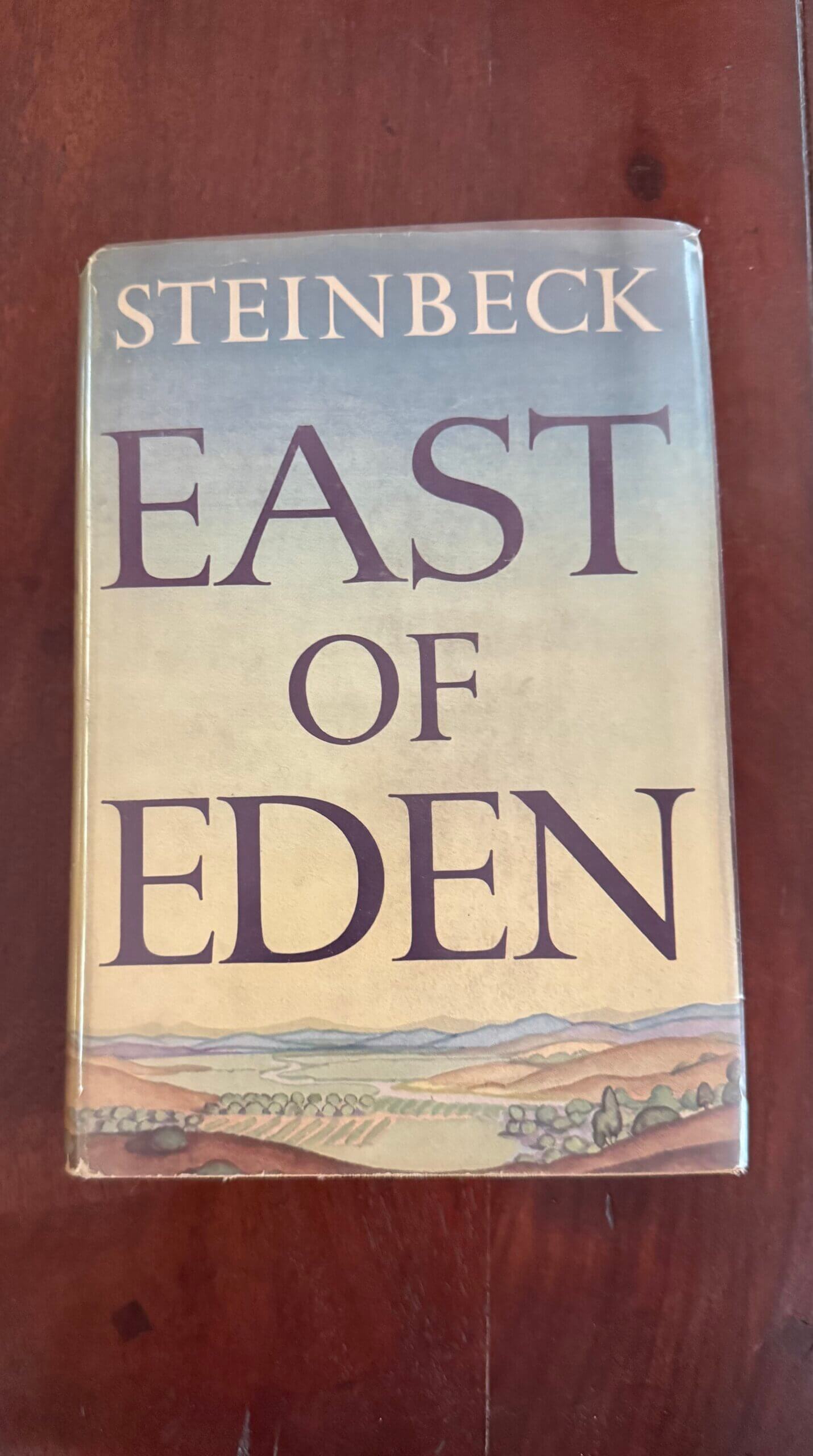
I didn’t know until recently whether the house I grew up in had a Bible, but I always knew we had a first edition of John Steinbeck’s East of Eden.
It’s my mother’s, gifted to her by her boss at Brattle Book Shop, an antiquarian book store in Boston, where she worked in college. Its dustjacket shows a pastoral scene, a simple rendering of a valley in greens and ochres. Were I to inherit it, and were it in better shape, it would be the most valuable thing I own. (In 1975 it went for $25.)
I never picked it up to actually read it: too precious. My own copy was a paperback with deckle edges. I left it behind on a communal shelf at a hostel in London for some other traveler 12 years ago during my first trip to Europe.
The novel, about three generations of the Trasks and how they struggle to earn their father’s approval, urges us to consider what we carry with us and what we discard. The question of legacy was certainly in the mind of Steinbeck, who considered it his masterpiece. While the author includes his mother’s side of the family, the Hamiltons, as characters, I’m not quite sure if he consciously linked his biblically-inspired epic to his paternal side’s short residence in the Holy Land.
Steinbeck’s grandfather Johann Adolf Großsteinbeck helped to establish an agricultural community, Har Hatikvah, outside of Jaffa in the 19th century. The community, made up of Christians who believed the end times were at hand, disbanded in 1858, after Johann’s brother Friedrich was killed in a raid by the locals.
Zoe Kazan’s Netflix adaptation of the book is hyper-aware of her own paternal grandfather, Elia Kazan, who adapted the film in 1955 with a smoldering star named James Dean. At the heart of her response is the word “timshel,” absent from her grandfather’s adaptation but central to Steinbeck’s book.
It’s not a real Hebrew word, but a poor transliteration that Steinbeck incompletely translated as “thou mayest.” To the characters, reading it from a verse in Genesis, it signifies an open path. In reintroducing the word to the story — a more holistic, and by my lights better, telling — Kazan has said she is showing that we have choices.
We can choose, for example, not to name names before the House Un-American Activities Committee as Elia Kazan did and, more to the point, we can opt to be different from our families and learn from their mistakes.
One line, spoken by the character Lee and tweaked slightly for the series, earns a new dimension with Zoe Kazan penning the script: “It’s easy to excuse yourself because of your ancestry, but whatever you do, it will be you who does it.”

Steinbeck, for his part, did not follow his forebears in settling Ottoman Palestine as a messianic Christian. He visited in 1966, when it was Israel, on assignment from Newsday to document the development of the new country. (His impressions, coming a year before the Six-Day War, were highly favorable; his pitstops included Masada and the remnants of his family’s settlement.)
My own differences from the older generation —I was the one who told my disappointed mother that Steinbeck botched his Hebrew — has been a process.
I hadn’t yet read Genesis when I first read East of Eden. Now that I have, I see many biblically mixed metaphors. The first patriarch Cyrus Trask — who perhaps ironically, given his inflated record as a Union soldier, shares the name of the king who liberated Jews from Babylon — lost a leg in the war, which could recall the injury Jacob sustained fighting the angel. In accepting the gift of one son and not the other, Cyrus also stands in for God the Father.
His sons are Adam and Charles (the first letters of their names tell us who’s Abel and who’s Cain), who are in fact half brothers like Isaac and Ishmael. Adam’s wife, Cathy, is the serpent — and Eve, Lilith, Satan, Jezebel and perhaps simply the concept of evil.
Adam and Cathy’s sons, Caleb and Aron, are twins, like Jacob and Esau, but their story replays that of Cain and Abel. The book’s title, taken from Genesis, refers to where Cain was cast out, is misleading. The book begins in Connecticut, Adam moves West to Salinas, California. Charles stays put and dies at home, never experiencing exile.
I didn’t grow up knowing all these beats from the Tanakh, and it’s beside the point, really, and yes, pedantic. Steinbeck’s genius is not in how closely he hews to the biblical narrative, but in how he finds the echoes that are there in the origin story of mankind and the Jewish people.
The dynamics we see in Cain and Abel travel down to Ishmael and Isaac, Jacob and Esau, Joseph and his brothers. In each of their stories is betrayal, favoritism and the common theme, as expressed by Sam Hamilton, the character modelled on Steinbeck’s grandfather, that when it comes to love “no one ever had enough,” a feeling that can induce even fratricide.
I never felt I lacked love, but there are less dramatic ways to disappoint one’s parents. I might have left my mother’s first edition in London instead of my ratty paperback. I’m sure I’d have been forgiven, but it’s better as an inheritance.
The post ‘East of Eden’ was my family Bible — until I read the real one. appeared first on The Forward.
Uncategorized
Somerville councilors to discuss Israel divestment proposal
(JTA) — SOMERVILLE, Mass. — The issue of divestment from Israel returns to the Somerville City Council in Massachusetts on Tuesday night as lawmakers plan to discuss how to implement a nonbinding ballot question on the matter that passed last year.
The divestment push has divided the city of more than 84,000 residents, which has a long-standing Jewish population. It is located between Cambridge, home to Harvard University, and Medford, a city with which it shares the Tufts University campus.
After Question 3 passed with 55.7% of the residents’ vote in November 2025, the City Council that same month passed a resolution committing to work toward an ordinance within a year to enact the ballot’s goals.
The measure to that effect, introduced in June, would bar the city from investing in or procuring labor, services or goods from companies that support entities identified by the ordinance as violating international law, including Israel.
Unlike the divestment proposal awaiting a November ballot vote in Providence or the binding human rights divestment ordinance passed by Medford’s city council in 2025, the Somerville ordinance specifically mentions Israel and Palestine.
In response to the push for a binding ordinance, 74 registered voters in Somerville submitted a petition for a hearing, which was held in September, before final action is taken, citing concerns about its impact on the city. The issue has now moved to the city’s Legislative Matters Committee, which is meeting Tuesday night.
Among the groups opposing divestment is Shalom Somerville, which submitted the September petition stating that “the sense of belonging and safety experienced by Jewish, Israeli and other residents of diverse backgrounds” is at risk as a result of the ordinance.
Sam Gechter, co-founder and president of Shalom Somerville, said that the ordinance singles out Jews who support Israel, which makes it antisemitic. Deputy City Solicitor David Shapiro also advised in November 2024 that such an ordinance would be “likely invalid,” according to a letter from the Anti-Defamation League and the Louis D. Brandeis Center for Human Rights Under Law.
“I think it’s incredibly irresponsible,” Gechter said, suggesting that the ordinance would slow down governmental action. “But the biggest thing for me is that it makes Jews feel unwelcome in Somerville.”
A local organization, Somerville for Palestine (S4P), has been a driving force behind both the ballot question and the ordinance, which the group developed in collaboration with sponsoring city councilors Ben Ewen-Campen, Ben Wheeler, Wilfred N. Mbah and Jon Link. “It’s what people voted for,” said Mo Katz-Christy, a member of S4P’s leadership and Jewish Caucus. “We want to follow the will of the people.”
The ADL issued a statement condemning the ordinance in June. It also joined the Brandeis Center in issuing a letter calling the proposal an unconstitutional intrusion into foreign affairs.
Other Jewish organizations disagree. Jewish Voice for Peace Boston has worked closely with S4P to back the measures. “I don’t think that those objections have validity,” said Eli Gerzon, a longtime member of JVP. “As a Jewish organization, we are especially concerned that ‘never again’ really means what it says: never again, that we never let a Holocaust, a genocide happen.”
This article originally appeared on JTA.org.
The post Somerville councilors to discuss Israel divestment proposal appeared first on The Forward.
Uncategorized
A major Jewish museum hopes to join the Smithsonian – at a difficult moment for the storied institution
(JTA) — Philadelphia’s Weitzman National Museum of American Jewish History is moving closer to becoming part of the Smithsonian Institution at a moment of significant upheaval for the storied museum network.
A new congressional commission will study whether to make the museum part of the Smithsonian. Its members were sworn in Tuesday, when they also held their first meeting.
In an exclusive interview with the Jewish Telegraphic Agency, the commission’s new chair Philip Darivoff, a former longtime chair of the Weitzman, and vice chair Dara Horn, a New York Times bestselling author, said that the Weitzman joining the Smithsonian would send a powerful message that Jews are a crucial component of the history of the country.
“It’s a different statement that our country makes when it says that the study of Jewish American history and culture is important to this nation,” Darivoff said. Both he and Horn also hope that a boost in the Weitzman’s profile could combat what they called an “epidemic of ignorance” among Americans when it comes to knowledge of Jewish history and culture.
“This really would be an elevation of the Jewish community,” Horn, author of “People Love Dead Jews” and “The Final Solution to the Jewish Question,” told JTA. “The place that Jews show up in a school curriculum is typically more about the Holocaust” — an area that the author has written critically about in the past as too limiting a view of Jewish life.
Horn believes in the Weitzman project, she said, because she hopes to emphasize the ways that Jews have contributed to American founding ideals such as religious pluralism.
“I’m really interested in the connections between the Jewish story and a lot of our foundational ideas in this country,” she said. Jewish ideas such as the Exodus from Egypt in the Passover story “were inspiring to Americans,” she added.
The wheels for the Weitzman joining the Smithsonian began turning in 2024, when Congress passed legislation in 2024, then signed by President Biden, to establish the commission. The group spent the next two years putting the commission together, and has two years from its first meeting to research and publish a report on the feasibility of such a move — though Darivoff said he hopes to finish the work well before the deadline.
Adding a new member to the Smithsonian has been known to take years, if not decades. The two most recent additions, the National Museum of the American Latino and the American Women’s History Museum, were both long in the works.
Founded in 1976, the Weitzman is already an existing, fully functioning institution — and also already a Smithsonian affiliate, meaning it can share resources with other museums in the system. Unlike a museum being built from scratch, the Weitzman already has a building and collection, which proponents hope could speed the process.”
Dan Tadmor, the Weitzman’s CEO, told JTA that joining the Smithsonian would improve their educational mission.
“We have a national footprint for our educational programming, but of course we’d like to widen it,” he said. “Who would say no to a curriculum that’s been developed by a Smithsonian museum?”
The Weitzman’s bid for increased prominence within the Smithsonian comes as the Trump administration has sought to exert greater control over the latter — home to such storied institutions as the National Museum of American History, the National Portrait Gallery and the National Zoo.
This summer the White House issued a report alleging “radical ideology” in the museums’ content, and Interior Secretary Doug Burgum recently announced plans for signs accusing Smithsonian leaders of ideological bias. Observers say such signs are indicative of larger administration priorities opposing the teaching of historical subjects such as slavery. Smithsonian Secretary Lonnie Bunch III is stepping down at the end of the year.
A representative from the Smithsonian declined to comment to JTA on the Weitzman’s bid, or on its current political conditions.
The commission’s chair and vice chair of the new Weitzman said that the current political upheaval shouldn’t affect their work. The Smithsonian, Horn said, “has lasted through many political winds.”
“I think we see this as a long-term project that’s about the place of Jewish Americans in this country’s history,” Darivoff said. “The Smithsonian is a really important institution for this country, and it is the great museum complex of our nation. God willing, it will be flourishing for centuries to come. It’d be an honor to be included in the Smithsonian.”
This article originally appeared on JTA.org.
The post A major Jewish museum hopes to join the Smithsonian – at a difficult moment for the storied institution appeared first on The Forward.
Uncategorized
Two deaths in Manchester synagogue attack last year will be probed through public inquiry, Britain says
(JTA) — The deaths of two Jewish men in an attack on a synagogue in Manchester last year will be examined through a public inquiry, the British home secretary announced on Monday, a necessary step to include sensitive information in the investigation.
Melvin Cravitz and Adrian Daulby were killed during the attack on Yom Kippur on Oct. 2, 2025, when Jihad Al-Shamie rammed a car into a group of worshippers outside the Heaton Park Hebrew Congregation in Manchester and stabbed two people. Cravitz died from stab wounds and another man, Andrew Franks, was seriously injured but survived. Daulby was shot by police while blocking the synagogue doors to stop Al-Shamie from entering. Two other people were seriously injured.
Al-Shamie, a Syrian-born British citizen, said he was acting for the Islamic State, also known as ISIS, before police shot him dead.
Home Secretary Shabana Mahmood announced the public inquiry in a statement about national security at the House of Commons, saying that “what happened that day must be fully understood.”
“This will ensure that all evidence can be heard, including any sensitive national security material that could not otherwise be fully heard in the coroner’s court,” said Mahmood.
Judge Alexia Durran, the chief coroner of England and Wales, was overseeing inquests into the deaths of Cravitz and Daulby. Durran last month recommended that Mahmood convert the inquests into a public inquiry, following statements from Home Office lawyers that some information from MI5 would be withheld from open court due to national security concerns. A full investigation that involves hearing sensitive material in private requires a public inquiry.
Earlier this year, Greater Manchester Police’s chief constable Stephen Watson said he was “deeply sorry” for a “missed opportunity” to uncover the plot against the Heaton Park synagogue. Watson made the apology after prosecutors revealed that Al-Shamie had two prior arrests for allegedly breaching a non-molestation order and alleged rape, and his mobile devices were not examined until after the synagogue attack.
Mahmood listed “a series of attacks on our Jewish community” in the year since the synagogue attack, including the stabbing of two Jewish men in the London neighborhood of Golders Green, a spate of arson attacks and a “foiled but potentially lethal plot” against Jews in Manchester on the eve of Yom Kippur last month. In the last case, two Iranian men have been charged with terrorism offenses.
“Faced with the threat posed to our Jewish community, we have increased funding to the police by an additional £250 million to boost police presence in key Jewish areas and to tackle antisemitism on our streets,” said Mahmood.
She added, “I know we cannot simply build higher walls around our Jewish community and expect them to live in fear. So we must root out the evil of antisemitism wherever it lurks in society, and this government is committed to that effort.”
Mahmood’s announcement comes days after the Home Office released data showing that hate crimes against Jewish people in England and Wales rose 10% in the year ending in March.
Mahmood said the United Kingdom was aware that “the Iranian state is targeting our Jewish community,” adding that the threat posed to Jews demonstrated “how the lines are increasingly blurring between extremism and state threats.”
The post Two deaths in Manchester synagogue attack last year will be probed through public inquiry, Britain says appeared first on The Forward.
