


Uncategorized
Why rabbis across America are taking sides in New York’s mayoral race
Rabbi Danny Schiff had a rule: no national letters.
The community scholar of the Jewish Federation of Greater Pittsburgh avoided open statements about far-off politics. But this month, he broke that rule — for a mayor’s race nearly 400 miles away.
“I never, ever, ever sign on to national rabbinic letters,” Schiff said. “And I made a lifetime exception for this particular instance.”
That exception was Zohran Mamdani — a New York state assemblyman, outspoken critic of Israel and, according to polls, the frontrunner to become the city’s first Muslim mayor. Schiff joined more than a thousand rabbis who signed an open letter opposing Mamdani, arguing that he “gives oxygen to anti-Zionist voices” and represents “a threatening reality for the American Jewish future.”
Schiff, who splits his time between Pittsburgh and Israel, said Mamdani’s campaign risks normalizing a “playbook” that other politicians might follow.
But not all rabbis saw danger in Mamdani’s rise. From Oregon to California to Illinois, other clergy have spoken out in support of him — or at least in defense of his right to run without being cast as a threat. The unusual spectacle of rabbis across the country weighing in on a New York City election has revealed deep fault lines over Israel, antisemitism, and what Jewish leadership looks like in 2025.
The question animating the debate is less who should be mayor of New York than what it means, right now, to speak as a rabbi in public life.
A new letter of solidarity
A new open letter published Tuesday, titled Jews for a Shared Future, gathered more than 150 signatures from rabbis, cantors, rabbinical students and Jewish leaders who reject efforts to frame Mamdani’s candidacy as a threat.
“As antisemitism and Islamophobia both rise in America, we understand that our fates are bound together,” the letter reads. “Jewish safety cannot be built on Muslim vulnerability, nor can we combat hate against our community while turning away from hate against our neighbors. Our traditions teach us that justice is indivisible — we are only truly safe when we ensure the safety and dignity of all. This is not merely strategic; it is sacred.”
The letter’s point person, Rabbi Shoshana Leis, co-rabbi with her husband of Pleasantville Community Synagogue in Westchester County, New York, said she wrote it after seeing how the national conversation about Mamdani had hardened into mutual accusation.
“I felt there needed to be a response,” she said. “I didn’t want to endorse any candidate, but I wanted to give an alternative perspective — the way we’re going to live safely is to engage across differences and choose our shared future.”
Leis called New York “our pluralistic, treasured city,” and said Jewish safety “is fully interdependent on the safety of everyone in New York City.” Her letter, she added, was meant to be “a letter against divisiveness.”
‘Mamdani has become the lightning rod’
Mamdani’s positions on Israel have roiled New York’s Jewish community — the largest in the United States — as he has faced scrutiny for refusing to outright condemn the slogan “globalize the intifada,” calling the Gaza war a “genocide,” and pledging to arrest Israeli Prime Minister Benjamin Netanyahu if he visits the city.
In Manhattan, two of the city’s most prominent rabbis took sharply different approaches to the campaign. Rabbi Elliot Cosgrove of Park Avenue Synagogue openly urged congregants to back Andrew Cuomo, calling Mamdani a threat to Jewish security. Rabbi Angela Buchdahl of Central Synagogue reaffirmed her congregation’s stance against political endorsements.
Adding to the moment, a July ruling by the Internal Revenue Service said that clergy can now endorse political candidates without automatically jeopardizing their congregations’ tax-exempt status, a change that has effectively loosened decades-old restraints on rabbinic speech from the pulpit.
The divergent choices of Buchdahl and Cosgrove captured a new era in which rabbis, once shielded from electoral politics, now face pressure to take public stands in the age of livestreamed sermons and viral petitions.
From Los Angeles, Rabbi David Wolpe, emeritus of Sinai Temple, said the anxiety is less about New York policy than precedent. “It’s New York — and whatever happens in New York is, by definition, national news,” he said. “People worry that a mayor of a major city with Mamdani’s views creates both a permission structure and an incentive for others to follow.”
For Rabbi Danya Ruttenberg, who writes the newsletter Life Is a Sacred Text from Chicago, the controversy reflects deeper communal and generational shifts. “Mamdani has become the lightning rod for Jewish communal tensions,” she said. “All of our intra-communal tsuris — everything that had begun to boil over since Oct. 7 — needs a new place to manifest, and this is where it’s going.”
She said the uproar is less about New York than about Jewish anxiety. “People’s fears about ‘antisemitism on the left’ find prominent articulation here, while a whole world of antisemitism on the right is being left unaddressed,” she said.
“There has been a sea change in how an entire generation engages with Israel,” she continued. “Mamdani’s popularity with younger Jews is reflective of that. It’s easier to blame him than to grapple with how the conversation around Israel has changed nationally and globally.”
Ruttenberg added that if she lived in New York, she would endorse him. “He has said repeatedly that he’s going to increase hate crime funding by 800% in New York, a city that he is meant to serve. His priority is not foreign policy.
“He’s become symbolic of all of these fears that people have about so many other things that are not his to hold,” she said.
‘We don’t need rabbis fighting rabbis’
From Eugene, Oregon, Rabbi Ruhi Sophia Motzkin Rubenstein of Temple Beth Israel — a Reconstructionist congregation of about 400 households — signed the Shared Future letter.
“It’s absolutely absurd that I’m weighing in on a New York City election,” she said. “But I do have a stake in how Jews and rabbis are publicly portrayed on a national scale.”
“I do think there is a manufactured panic that is very dangerous,” she added. “This is not the greatest threat to the Jewish people. This is a dangerous red herring.”
Not every rabbi fits neatly into one camp. Rabbi Suzanne Singer, emerita of Temple Beth El in Riverside, California, signed both letters — the one opposing Mamdani and the one urging solidarity.
“I hesitated before signing the first letter because I didn’t particularly want to attack one person,” she said. “I don’t think Mamdani is an antisemite. He’s an anti-Zionist, and there are plenty of Jews who are anti-Zionist. That doesn’t make him an outlier.”
Singer said she worries about rhetoric that casts Israelis as “settler colonialists,” and believes Israel and the Palestinians both have the right to self-determination. But she was also drawn to the second letter’s message. “We have to find a way to work together and live together,” she said. “Antisemitism is enough — we don’t need rabbis fighting rabbis.”
She expects some overlap between signatories of both letters. “The first letter, I wish it hadn’t targeted Mamdani so directly,” she said. “Everything has gotten to be black and white — there’s no nuance, no complicated narrative anymore.”
The moral crossroads
For Schiff, the Pittsburgh rabbi who broke his lifetime rule, the issue is existential. “Clearly Mamdani has made it his business to let everybody know what his views are on Israel — in the largest Jewish city in America,” he said. “Other politicians around the country might take note.”
“The end of the kinetic war has not brought an end to the war of delegitimization against Israel,” Schiff added. “If you can’t beat Israel militarily, then the anti-Zionism campaign becomes the favored route for aggression.”
Ruttenberg sees something different in that lightning. “If we think that magically defeating Mamdani will somehow return us to the way things used to be,” she said, “that is not what is going to be the outcome.”
She also questioned the moral calculus behind the opposition’s preferred candidate. “If we want to talk about Torah values,” she said, “Cuomo is a serial sexual abuser who spent $20 million of taxpayer money paying for his defense. In what way do my colleagues think this is any representation of either pragmatic or ethical values?”
Her conclusion was blunt, and hopeful. “When we make choices out of fear, it tends to end badly,” she said. “And when we choose based on building relationships and solidarity — understanding that our liberation is bound up with everyone else’s — that’s how we win, as Jews and as people.”
Jacob Kornbluh contributed to this article.
The post Why rabbis across America are taking sides in New York’s mayoral race appeared first on The Forward.
Uncategorized
Is this Vermont farm the American kibbutz? I camped out there during Sukkot — and got a taste of Judaism’s ancient agrarian roots
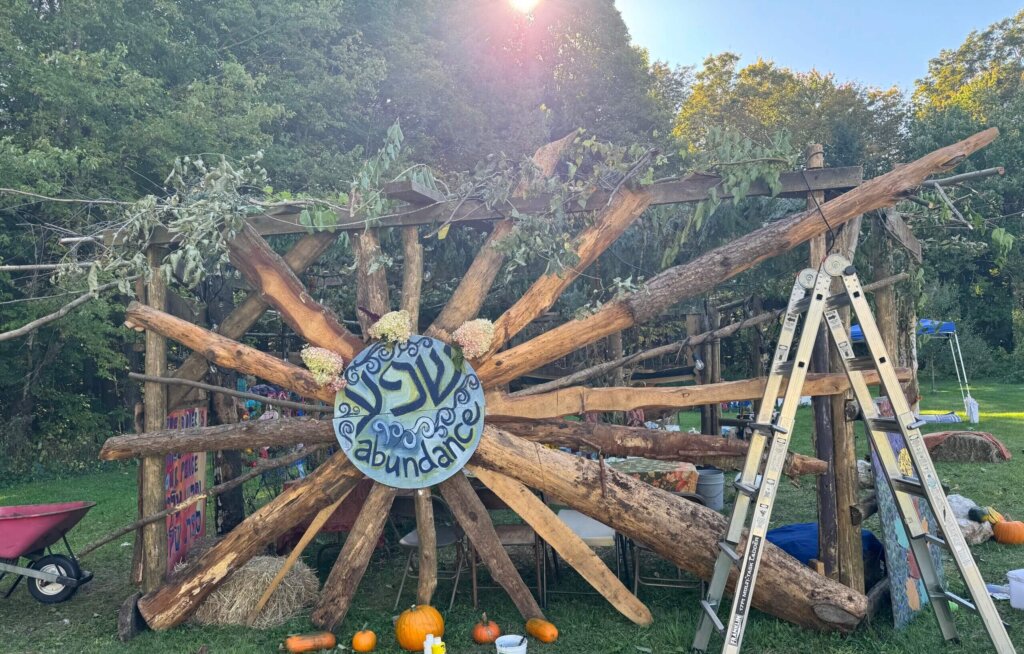
Sukkot, the Jewish harvest festival, can feel a little abstract for Jews like me who live in big cities, far removed from the agricultural cycle that gave rise to the holiday. Typically, the extent of my fall harvest consists of buying a pumpkin from Trader Joe’s.
But last weekend, sleeping in a tent at Living Tree Alliance, a Jewish farm and co-housing community in rural Vermont, I found myself much closer to Sukkot’s agrarian roots. Rows of colorful produce stretched across the 93-acre property, much of it destined for the “stone soup” that would become our dinner the following night. Plants grown on the farm formed the sukkah’s schach, or roof covering.
“I forgot scissors,” Melanie Grubman, one of Living Tree’s founding members, told me as she cut yellow flowers off their stems with her teeth for material to decorate the sukkah.
About 16 people, including a few families with children, live on this bucolic property year-round, in what may be the closest American equivalent to an Israeli kibbutz. Residents are expected to volunteer between 8 and 16 hours per month, doing farm chores, serving on committees, managing the on-site AirBnB and keeping common spaces clean. All disagreements are resolved through a system of “sociocracy,” a governance model based on consent; decisions are made only when no one objects. On Shabbat, that work ceases, and chickens raised by residents are butchered kosher-style for dinner.
By living closer to the land, their food supply, and each other, residents say they feel closer to Judaism, too.
“It’s hard for me to pray not in the garden,” Grubman said. “I have no desire to sit inside when holiness is blowing on me.”


The Founders

Sephirah Oshkello, 54, barefoot and wearing a long purple tie-dye dress, swayed back and forth with the rhythm of prayers. As we went around the circle naming those in need before reciting the Mi Shebeirach, the prayer for healing, she offered, “Mama Earth.”
Oshkello, a Hebrew priestess, or kohenet, also works as a holistic nutritionist when she isn’t gardening or leading prayers.
This free-spirited lifestyle is a far cry from the environment in which she grew up. Oshkello was raised in Great Neck, New York, where she attended Temple Israel, a Conservative synagogue.
But after college at University of Maryland, she joined a community service program in Tzfat, Israel, where she got a taste of Jewish communal living, studied Jewish tradition, and spent her days hiking. From there, she spent a year living on an Israeli kibbutz.
“From then on, I felt like, I want to create something like this in the States,” Oshkello said. “Because when I went to Israel, my mom said, ‘OK, go, but you better come back.”
She returned to Great Neck and attended an Orthodox synagogue, but quickly realized it wasn’t the right fit.
“Judaism is connected to the land, and when the Jews got kicked out of their land, it became a culture of the book,” Oshkello said. “I do love to study words, but it only serves one part of our being, right? In Kabbalah, we talk about body, mind, spirit.”
The idea for Living Tree took shape on Oshkello’s second date with her now-husband, Craig, at a vegetarian restaurant in Seattle in 1997, when she told him about her dream to create an intentional Jewish community. The couple moved to secular co-housing in New Hampshire, where they began scouting property in Vermont and making plans for their own Jewish community.
In 2015, she and Craig bought the 93-acre Living Tree property in Moretown, Vt., then just a field with trees and a sugar shack, and moved there about a year later.
Grubman, a 47-year-old Waldorf teacher and owner of an all-women stonemasonry business in Vermont, was among the first residents. Like Oshkello, Grubman grew up in a suburban Jewish community — in her case, a “ritzy” Conservative synagogue outside Philadelphia. But she never connected with the idea of praying while sitting still inside.
“I was one of these angsty teenagers who was like, ‘Nature is busting through the concrete!’” Grubman said. “‘My heart is crying!’”
At Wesleyan University, Grubman became president of the environmental club and wrote her own eco-Haggadah for Passover. She later helped jumpstart Wilderness Torah, a program reconnecting Jews with the agricultural context of the Hebrew calendar, in Berkeley and Oakland, California.
Along the way, she encountered spiritual leaders who helped her understand that Jewish practice could look different from the Judaism of her childhood.
She remembered one rabbi who arrived for Yom Kippur “in white pajamas, covered in dirt.”
“And we were like, ‘Oh, what’s he doing?’ And he was like, ‘Oh, I was davening in the woods,’” Grubman said. “That’s the opposite of suburban Philadelphia Yom Kippur — when you show up in some fancy dress [that] you went to the mall to buy and gossip.”
Living Tree, Grubman said, offered a way to make Judaism a part of daily life beyond prayer and study.
“I felt like Judaism and like the world in general can be very intellectual. And I am a very intellectual person,” Grubman said. “But the more I link it to what I’m doing with my body and my hands, it just feels like it makes more sense to me.”


‘Shtetl Vibes’
There’s a long history of Jews who have sought to build communal, self-sufficient communities. But turning that ideal into a sustainable way of life has always been complicated.
The first kibbutz was established in Ottoman Palestine in 1910; the movement expanded after Israel’s founding in 1948. But the kibbutz system largely collapsed during the country’s financial crisis in the 1980s, when the utopian socialist model slowly gave way to a privatized version. Kibbutzim retained many of their collectivist values, but residents no longer pooled their incomes, raised their children together, or lived completely off the land.
American Jews experimented with communal living, too. During the back-to-the-land movement of the 1960s and ’70s, tens of thousands of young, college-educated city dwellers moved to rural Vermont as part of a countercultural movement. While few communes were explicitly Jewish, residents included many Jewish hippies. (Sen. Bernie Sanders, who briefly lived on an Israeli kibbutz in his twenties, was kicked off a Vermont commune for allegedly loafing around and talking about politics rather than working the land.)
But few of those experiments lasted as fully communal settlements.
Today, efforts to revive Jewish communal living are taking new forms. Young Jews live together through organizations like Moishe House, where residents get subsidized rent in exchange for planning Jewish community events. In Berkeley, an urban Jewish cohousing community called Berkeley Moshav is under construction; residents will own condos and make collective decisions about shared spaces.
Living Tree Alliance, which operates as both a nonprofit and a homeowners association, has seemed to stand the test of time — it has been hosting residents for over a decade. But like the modern kibbutzim, it’s not a full escape from the trappings of capitalism: Residents, most of whom have day jobs outside their farming responsibilities, don’t share income, and they own their own homes while co-owning the surrounding land.
Grubman, who works three jobs, cringed when I asked if Living Tree sometimes felt like utopia.
“It actually is a lot of work. It’s really really challenging,” Grubman said. “But what else are you going to do? Look at your screen?”
Many of the residents I spoke to were attracted to Living Tree as an escape from modern malaise.
Gil Ben Moshe and Ella Sutherland moved to Living Tree a few months ago with their three children, ages 2, 5 and 14. The couple met at an anarchist community in northern California and co-founded an intentional community in Virginia. After deciding they wanted a Jewish co-housing community instead, they found Living Tree online and moved.
Ben Moshe, wearing a kippah over his long hair, a plaid flannel, and no shoes or socks, has fond memories of living on an Israeli kibbutz until he was 4, when his family moved to the city of Eilat. The transition to urban life was jarring, he said, and he vowed to eventually return to the pastoral life of his early childhood.
“I’ve been so shocked at the discrepancy between people really believing that community is the right way to live, but not actually meaning it when they say it,” Ben Moshe said. “People’s relationship with spirituality is one that resembles more of their shelf with porcelain knickknacks … it’s not their daily bread.”
Arielle Sabot, a 28-year-old who uses they/them pronouns, worked as an apprentice at Living Tree for a year beginning in 2023. They now live in the Boston area, where they attend a traditional egalitarian synagogue and work as an outdoor Jewish educator.
While at Living Tree, they lived in a tiny cabin that lacked running water. During the winter, they chopped their own wood to heat the cabin with a wood-burning stove.
The arrangement wasn’t always idyllic. There were no flush toilets. Dishes, which Sabot had to boil water to wash, could pile up. And living alongside neighbors who were also co-workers could get tense sometimes.
But that proximity, Sabot said, also made some aspects of Jewish life feel more manageable.
“I think it’s easier when your community is right outside your door,” Sabot said. “You don’t have to go somewhere. It was shtetl vibes.”


Getting Outside
Since Living Tree was founded more than a decade ago, organizations explicitly linking Jewish spirituality and the natural world have been “growing exponentially,” Oshkello said.
A 2014 national study helped document the growth of what it dubbed Jewish Outdoor, Food and Environmental Education, or JOFEE, and found more than 2,400 people had participated in immersive Jewish outdoors programs the previous year. In 2025, Adamah, one of the movement’s largest organizations, reported more than 45,000 participants in its programs, including almost 10,000 Jewish teens and college students.
Vermont is especially fertile ground for this kind of experiential Judaism. On Shavuot, Living Tree and the Jewish Community of Greater Stowe hike Mount Mansfield, the state’s tallest peak, carrying a Torah for a small taste of what Moses may have felt ascending Mount Sinai to receive the Ten Commandments. On Tu B’Shvat, Jewish Vermonters snowshoe beneath the full moon, stopping at different trees for reflection, poetry and song. And then there’s “Ski Ride Purim,” when skiers and snowboarders hit the slopes in costume, eating hamantaschen along the way.
“Vermonters are going to be outside as much as we can,” said Beth Liberman, executive director of Jewish Communities of Vermont, the state’s Jewish umbrella organization. “We’re bringing Judaism where it connects for so many people.”
There may be an even larger Jewish constituency to capture: In a 2020 Pew Research Center survey, 51% of American Jews said they derived a great deal of meaning and fulfillment from being outdoors — more than twice the share who said the same about their religious faith.
The Jewish connection with the outdoors was a major draw for Talia Wilk, a 20-year-old spending two weeks at Living Tree through a fellowship program. Wilk said she grew up going to Jewish summer camp, where Judaism felt intertwined with being in nature. Now living in Toronto, she works as a Hebrew school teacher and an educator at an outdoors school. When she heard about the Living Tree fellowship, she jumped at the chance.
“I’ve always had that kind of longing for a space where Jewish holidays and rituals are really connected to the seasons and to the land,” Wilk said.
For Sabot, residing at Living Tree changed their relationship to the Jewish lunar calendar. In Vermont, where the seasonal changes are particularly dramatic — lush greenery in summer, brilliant foliage in fall, mud in spring, and snow in winter — Jewish holidays timed around an agrarian cycle feel more tangible, Sabot said.
Younger Jews in particular, Oshkello said, connect with the idea of getting outside over sitting in pews.
“This next generation, they don’t want to be bored and sit and listen to other people preach,” Oshkello said.

At Living Tree, I began to understand what that connection could feel like. I awoke in my tent around 6 a.m. to the sunrise and roosters cock-a-doodle-dooing as my alarm. Meditating in the sukkah, we took deep breaths and placed our hands on the earth. Eating potluck dinner, we were invited to reflect on the journey of our food, from seed to mouth. On my last day, we learned how to press apples to make hot cider and pickle cabbage.
After three days immersing myself in nature, I headed back toward New York City, eager to take a hot shower and sleep in my own bed.
But the next morning, I found myself missing the fresh air and the feeling of being outside. All weekend, residents had talked about getting Judaism out of their heads and into their bodies. Crammed into the subway on my morning commute, I understood what they meant.
The post Is this Vermont farm the American kibbutz? I camped out there during Sukkot — and got a taste of Judaism’s ancient agrarian roots appeared first on The Forward.
Uncategorized
In its first detailed response to ‘NAZA’ documentary, IDF claims ‘fundamental errors’
(JTA) — The IDF on Thursday issued its first detailed response to “NAZA” after viewing the full documentary alleging Israeli forces knowingly killed large numbers of civilians in the Gaza war, accusing the filmmakers of making fundamental errors about how civilian-casualty estimates, strike approvals and intelligence tools were used.
“The film’s narrative is based on substantial factual errors stemming from a misrepresented and manipulative depiction of reality,” the IDF said in a statement accompanying its findings. The film “presents a distorted, misleading and disingenuous picture of the IDF’s target planning and striking process,” the military said, arguing that it conflates preliminary intelligence work with the later operational and legal process used to decide whether and how a target can be struck.
The filmmakers, who are Israeli, have previously defended the film’s reporting, saying the identities of its anonymous sources and the cases they described were verified and that editors at the Guardian, which produced the film, had access to the underlying material.
The 10-page response came after an IDF representative attended a screening of “NAZA,” directed by filmmakers Yuval Abraham and Rachel Szor, in Bologna, Italy, allowing the military to assess the full film for the first time. The army had previously rejected the documentary’s allegations based on excerpts and publicly available material, saying at the time that the filmmakers had not provided it with a copy despite a request to do so.
The film is based on interviews with 24 Israeli soldiers, most of them intelligence personnel, who describe their roles in surveillance, target selection and strikes in Gaza. NAZA is the Hebrew acronym for collateral damage. The film, which won the Special Jury Prize at the Venice Film Festival last month, argues that the military accepted high civilian casualty estimates, relied heavily on AI tools to generate targets and weakened safeguards governing strikes.
The IDF in its response Thursday rejected one of the documentary’s most prominent claims, that a strike had been approved despite an estimated civilian death toll of about 500. The military said it had “never planned, approved or carried out” a strike in which 500 civilians, or “anything close to that number,” were expected to be killed.
The IDF also rejected the film’s claim that junior Hamas operatives could be approved for targeting with up to 20 expected civilian casualties, and that senior commanders could be targered with as many as 200. It said the film had confused thresholds requiring approval from more senior commanders, who could then reject the operation, with permission to kill a fixed number of civilians. The military said that no 200-casualty approval threshold had ever existed and that actual thresholds were “much lower,” without specifying what the thresholds were.
The IDF did acknowledge that several incidents involving civilian deaths near humanitarian aid distribution sites prompted operational reviews, changes to instructions and other measures in those areas. However, it disputed testimony that soldiers fired indiscriminately at civilians near the sites and said troops were permitted to fire only at militants or people posing an immediate threat.
Abraham has accused Israeli media of failing to seriously investigate civilian casualties and rules of engagement in Gaza during the war.
The IDF also rejected the film’s suggestion that civilians who remained in evacuation zones could then be treated as legitimate targets. It said evacuation orders did not change a civilian’s status and that every strike still required identification of a military target and a separate proportionality assessment.
When it came to the film’s portrayal of “Lavender” as an AI-powered list of targets approved for attack, the military said the production had misunderstood what the program was: a database used to cross-reference intelligence on members of militant groups which did not make someone in the database a target.
“Artificial intelligence does not determine whether an object or a person is designated as a target, nor whether a target is struck,” the IDF said, adding that those decisions are made by human analysts and commanders.
The IDF also argued that many of the anonymous soldiers featured in “NAZA” were describing only “limited, initial stages” of the targeting process. “Such testimonies therefore cannot be treated as a complete account of the policies at hand, the decisions made and what ultimately happened,” the military said.
A Guardian News & Media spokesperson, in a statement sent to the Jewish Telegraphic Agency, said the Guardian “stands fully behind the film,” which it said was based on three years of reporting by the outlet and its partners and interviews with more than 100 sources familiar with IDF systems used in Gaza, including senior commanders involved in authorizing strikes.
The Guardian also rejected what it described as the IDF’s attempt to portray the film’s interviewees as “junior-ranking officers involved only in the early stages of the targeting process.”
“They include officers and soldiers who were involved in multiple stages of the targeting process in Gaza, including intelligence, operations and the final authorization process,” the statement said.
The military did not describe all 24 participants as junior personnel and said only that the testimony of the soldiers interviewed in the film “generally” focused on “limited, initial stages” of the targeting process.
The Guardian said the “process of assessing the credibility of the testimonies was rigorous” and included “leaked classified documents, detailed verification of specific strikes and corroboration via a wider pool of confidential journalistic sources who did not appear on camera in the film.”
The Guardian also said the New York Times, Washington Post and Associated Press had “confirmed the IDF’s use of AI-driven systems in the Gaza offensive and the loosening of safeguards to protect civilians.”
The IDF disputed the film’s suggestion that it did not examine civilian casualties after attacks. Several units tracked strike outcomes and civilian-casualty reports and hundreds of incidents had been reviewed during the war, the military said, arguing that intelligence personnel interviewed in “NAZA” do not appear to belong to those units and “are not positioned to testify on this matter.”
The IDF rejected the film’s criticism that its collateral-damage estimates did not distinguish between adults and children. It said international law treats all civilians as protected regardless of age, adding that when commanders knew children were present, that information “led commanders to cancel, postpone or replan strikes.”
It also pushed back on an interviewee’s claim that the IDF believed there were “no uninvolved civilians in Gaza,” saying that may have reflected the soldier’s personal views but did not represent military policy or orders. It also rejected the film’s genocide allegations, saying the interviewees were not in positions to establish genocidal intent by senior commanders or political leaders.
The IDF also criticized the filmmakers’ reporting methods, saying they provided no dates, locations or other identifying details for alleged strikes and did not put their specific allegations to the military before the film’s release. “The filmmakers could have identified and avoided the substantial errors apparent in the film had they conducted adequate verification and corroboration in good faith. The end result shows they did not,” the military said.
The Guardian statement did not say whether the filmmakers solicited detailed responses from the IDF, and why if they did not..
The military said “NAZA” also gave insufficient weight to the Oct. 7 Hamas attack, the group’s use of civilian areas for military activity and measures Israel says it took to reduce civilian casualties, including warnings, changes to strike plans and the cancellation of attacks.
This article originally appeared on JTA.org.
The post In its first detailed response to ‘NAZA’ documentary, IDF claims ‘fundamental errors’ appeared first on The Forward.
Uncategorized
Zara removes Halloween costume likened to concentration camp uniform
(JTA) — Spanish fashion retailer Zara removed a children’s Halloween costume from its website on Wednesday after social media users noted that the gray-and-blue striped outfit resembled prison garb worn by inmates in Nazi concentration camps.
Zara described the ensemble as “Kids costume featuring vertical stripes with decorative topstitching, a lapel flower and a distressed effect. Includes a cardigan and shorts. Gray / Blue.”
The post was visible via a Google search that continued to display an indexed version of the Zara product page after the listing itself had been removed.
The costume resembles the suit worn by Michael Keaton’s title character in the 1988 horror-comedy “Beetlejuice” and its 2024 sequel, “Beetlejuice Beetlejuice.” Even so, social media users said the vertical stripes and shiny crisscrosses, which some media outlets described as “fake stitched scars,” resembled concentration camp uniforms and the barbed wire visible in many World War II photos.
Priced at $59.90 in the U.S., according to another indexed version of the listing, the costume drew criticism online in Europe on Tuesday. It gained wider attention Wednesday after Israeli journalist Dov Gil-Har, activist Hen Mazzig and others shared images of it on X.
The listing was no longer accessible by Wednesday afternoon. It was unclear exactly when Zara removed it. No reason was given for its removal, and Zara has not made any public statements regarding the controversy, nor has it responded to the Jewish Telegraphic Agency’s request for comment.
One Instagram commenter wrote “@zara how many levels of approval did this go though (sic)? Who is working for you?” A Facebook user said “It’s supposed to be a groom costume. It does somewhat resemble a (sic) Auschwitz uniform. With all the anti-semitism on the rise I am not surprised.” Another Instagram user asked, “What were they claiming it was meant to be?”
Zara has in the past faced similar controversies over clothing that evoked Nazi or Holocaust imagery. In 2007, it withdrew a handbag from its stores after a customer discovered a swastika embroidered on it; Inditex, Zara’s parent company, said the symbol had not appeared on the design Zara had approved.
In 2014 Zara apologized for selling a blue-and-white-striped shirt with six-pointed yellow-star badges on the chest. The Zara Israel website identified it as a “striped sheriff t-shirt” and the word sheriff was cut out in small letters on the star. The likeness to concentration camp uniforms and the yellow Star of David badges Jews were forced to wear under Nazi rule led Zara to stop selling the shirts and destroy the remaining inventory.
When reached for comment, the Conference on Jewish Material Claims Against Germany, which represents Holocaust survivors in compensation negotiations, said the repeated incidents underscore the need for Holocaust education.
“This is not the first time this has happened and it once again makes abundantly clear: The glaring absence of Holocaust knowledge is pervasive,” Gideon Taylor, Claims Conference president, wrote in an email to JTA. “It shouldn’t take the risk of a Shoah survivor opening their door and seeing children that look like they are in concentration camp uniforms for us to see where we have to do better. This should serve as a message to us all of why Holocaust education is so important.”
This article originally appeared on JTA.org.
The post Zara removes Halloween costume likened to concentration camp uniform appeared first on The Forward.
