


Uncategorized
With the last hostage released, is American Jewish unity over?
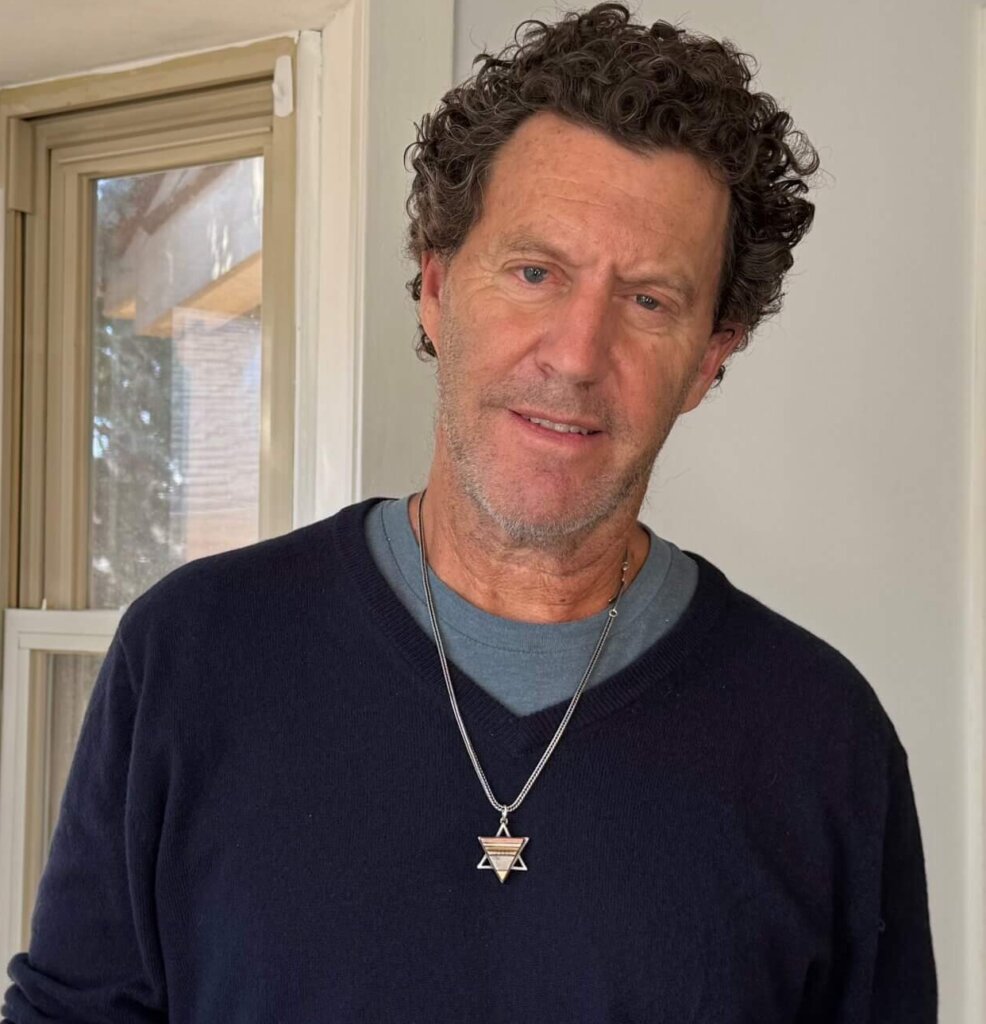
When the remains of the last Israeli hostage in Gaza returned to Israel this week, Scott Spindel, a lawyer in Encino, Calif., finally took off the thick steel dog tag he had put on after the Hamas attack of Oct. 7, 2023.
His friend Lauren Krieger, an orthopedic surgeon, did the same. And he pulled down the last of the names of the hostages remaining in Gaza that his wife, Jenn Roth Krieger, had placed in the window of their Santa Monica home.
During the nearly 28 months that Israeli hostages remained in captivity in Gaza, Krieger, 61, and Spindel, 55, consistently argued over Israel’s war in the strip.
“Lauren would say that we probably were a little too extreme,” Spindel, whose daughter serves in the IDF, told me in a telephone interview. “I don’t think we blew up enough buildings.”
But those differences paled beside their mutual concern over the fate of the hostages.
“Unfortunately,” said Spindel, “it took tragedy to pull us together.”
So it was across the American Jewish landscape. Then, the body of Staff Sergeant Ran Gvili, the 24-year-old Israeli police officer killed on Oct. 7 and taken by Hamas terrorists back into the enclave, was returned to Israel — the last of the hostages to come home.
Jews from across the political spectrum unpinned yellow ribbon buttons from their lapels, removed the hostage posters from their synagogues, and folded up and put away the blue-and-white flags displayed as a symbol of the missing Israelis.
The marches and vigils American Jews held on behalf of the hostages — small but meaningful echoes of the mass rallies that roiled Israel — came to a quiet halt.
Jewish unity is forged in adversity. Without it, we are apt to find enemies among ourselves. And as painful as the hostage saga was, it unified an otherwise fractious American Jewish community in a time of crisis.
Without that common concern, are even deeper rifts our future?
“As committed and connected as we were,” said Spindel, “it doesn’t change the fact that we also were still divided about solutions.”
A family in distress
Across the United States, synagogues of all religious and political bents regularly joined in the same Acheinu prayer for the release and return of the hostages.
“Our family, the whole house of Israel, who are in distress,” the prayer begins — a wholly accurate summation of the totality of Jewish concern.
Surveys showed that the hostages unified American Jews even when Israel’s Gaza campaign divided them. An October 2025 Washington Post poll found that a plurality of American Jews disapproved of Israel’s military actions in Gaza — but a whopping 79% said they were “very concerned” about the hostages.
There have been other moments in recent Jewish history when calamity created unity. The 1995 assassination of Prime Minister Yitzhak Rabin, for instance, brought together the vast majority of American Jews in mourning, even those who opposed his policies.
And, of course the brutal Oct. 7 attack, which claimed almost 1,200 lives, created a near-universal sense of shock and sorrow.
But the hostage crisis may have had an even deeper emotional — and perhaps political — impact.
“Even for people who were not affiliated Jewishly, those hostages struck a deep, deep chord,” Krieger told me. “It felt personal. I don’t think we’ve had that level of collective trauma in our lifetimes in that same way.”
And a family divided
The hostage crisis bonded American Jews to one another, and to their Israeli counterparts, at a time when enormous political rifts were opening within their communities.
In the U.S., as in Israel, there were sharp disagreements over Prime Minister Benjamin Netanyahu’s conduct of the war and whether he was even prioritizing the hostages’ safety.
And the encampments and protests against the war at college campuses — in which many Jewish students participated, and to which many others objected — created even deeper divisions over support for the Jewish state.
But if the hostage issue didn’t erase such differences, it muted them. Krieger and Spindel could frustrate each other in conversations about the conduct of the war, or American support for it. But in the end, they were both in that 79% that the Washington Post poll identified.
What will hold them — and the rest of us — together, now?
The hostage crisis provided something history unfortunately bestows upon Jews with regularity: an external enemy that transcended ideological differences. With it gone, American Jews return to what they’ve always been — a community bound by tradition, and riven by politics.
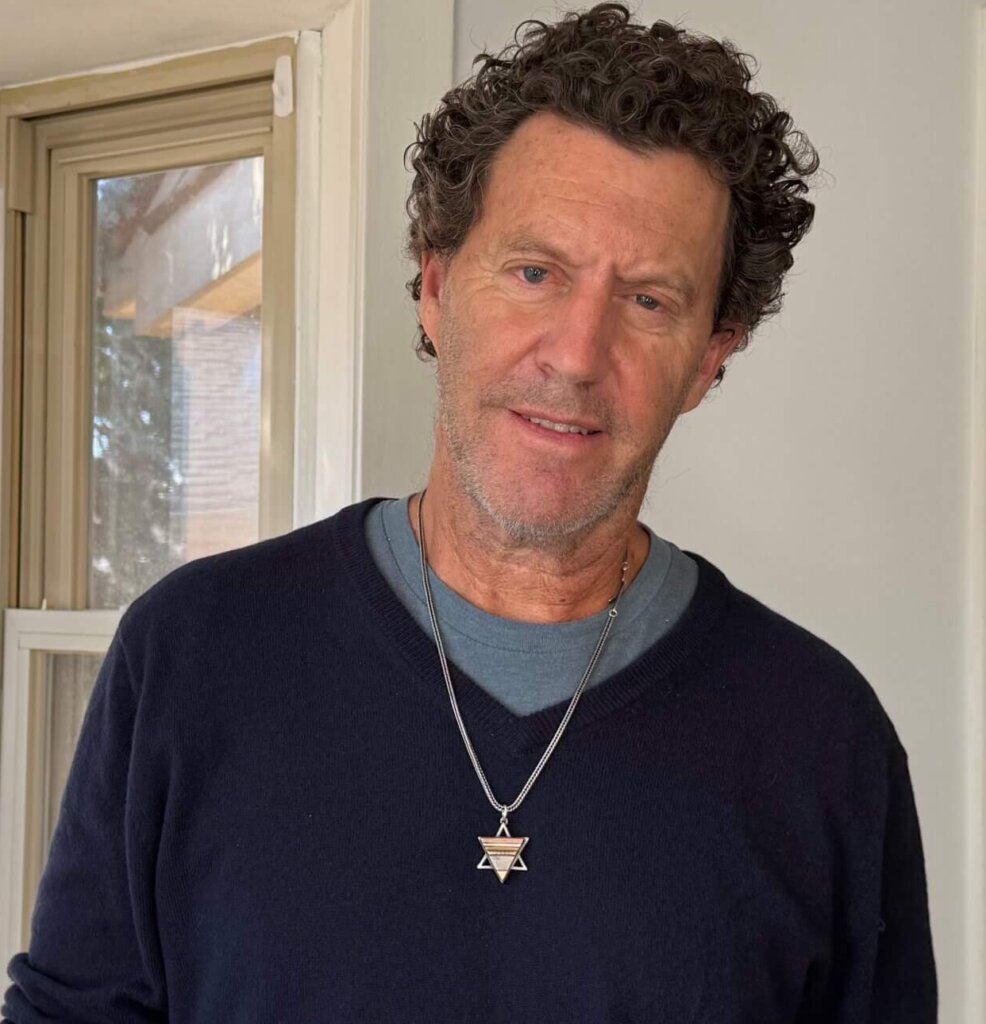
Krieger and Spindel have already resumed their arguments. But even though the dog tags are gone, they’re both still wearing Jewish stars on silver chains around their necks. When someone admires Krieger’s, he takes it off and gives it to them. He buys his metal stars in bulk on Amazon, and has given away dozens since Oct. 7.
“I want people to feel like I do,” he said, “like we’re a peoplehood worth cherishing.”
Worth cherishing — even though we can’t agree on much else.
The post With the last hostage released, is American Jewish unity over? appeared first on The Forward.
Uncategorized
Watch: The cattle farmer building a synagogue in a cornfield
For the past year and a half, we’ve followed Nik Jakobs, a third-generation cattle farmer in Sterling, Illinois, who is building a synagogue in a two-acre cornfield. Alongside it, he is also building a museum of tolerance.
Our coverage began when Nik traveled 600 miles to rescue the ark, bimah and stained glass from a closing congregation in Pennsylvania. After we published our first story about the unlikely journey, additional synagogues began donating their own sacred objects, each from a community that could no longer keep them.
Nik, 41, is the grandson of Holocaust survivors, and the museum is his way of teaching the tolerance that saved his family. His grandmother, Edith, was 11 in 1942 when a Lutheran farmer named Willem Drenth offered the family’s home as a hiding place. She was one of 13 Jews who lived in that single room for two years and eight months, with no electricity and no running water. About a hundred villagers knew about the Jews in hiding. No one said a word.
While in hiding, Edith kept busy by learning to knit. She embroidered a cloth, which survived and will now cover the Torah in Nik’s new synagogue.
This spring, Nik and his family traveled to the Netherlands, where the village staged a play about the family in hiding and the Drenths. They watched actors portray their ancestors, and the Christians who kept their family alive.
Edith died this month at 95. Her voice, trained to a whisper in hiding, never regained its full volume. Her story did.
That story is now drawing others in. The Anne Frank House donates one sapling a year, grown from the chestnut tree Anne saw from her attic hiding place. It has chosen the Illinois synagogue and museum to plant its next one. After visiting Anne’s house with his four daughters, Nik put it this way: “Anne’s story ends. My grandmother’s didn’t.”
Nik and his family broke ground on the sanctuary this spring, on land beside a Lutheran church — the same faith as the farmer who saved his family.
If all goes as planned, the doors open in late 2027. They hope the first service will be the bat mitzvah of Nik’s oldest daughter, Taylor. The pews will hold the congregants of the closing synagogues whose ark, Torah and windows helped build the room, there to see their old homes live again.
Catch up on all of our stories about Nik Jakobs.
The post Watch: The cattle farmer building a synagogue in a cornfield appeared first on The Forward.
Uncategorized
In this Florida district, politicians battle over who most loves Israel
(JTA) — BOCA RATON, Fla. — Rep. Jared Moskowitz said that he is “proud to be known as the most pro-Israel Jewish Democrat in Congress” during a synagogue event in one of the country’s most Jewish congressional districts on Tuesday evening.
The comment came during a one-hour candidates’ forum featuring Moskowitz and his Republican challenger, Scott Singer — both Jewish and both wearing kippahs — that largely centered on Israel and got testy at moments.
Moskowitz said he is “proud to have AIPAC’s endorsement” at a moment when the popularity of Israel and the pro-Israel lobbying group AIPAC has plummeted among Democratic voters amid Israel’s military campaign in Gaza and the war with Iran.
But the crowd at the Reform synagogue Congregation B’nai Israel in Boca Raton was, like Florida’s 25th Congressional District itself, split across party lines, and staunchly pro-Israel.
“This isn’t New York, this isn’t Boston — this is South Florida,” attendee Edward Kone told the Jewish Telegraphic Agency.
Moskowitz had soundly defeated democratic socialist challenger Oliver Larkin, a sharp Israel critic, in August. As Democrats look to take control of the House of Representatives, Florida’s recently redrawn 25th Congressional District — which would have favored Trump by 9 percentage points in 2024 but backed Joe Biden in 2020 under its new boundaries — is being closely watched ahead of the Nov. 3 midterm elections.
Despite some tense moments between Moskowitz and Singer, who was Boca Raton’s mayor until earlier this year, the two politicians have been largely aligned on the issue of Israel.
Both have condemned accusations that Israel has committed genocide against Palestinians in Gaza. They each oppose any effort to condition or cut off U.S. military aid to Israel. Both supported Israel’s strikes on Iranian facilities in 2025, though Moskowitz has since called for the U.S. to end its war with Iran.
Moskowitz referenced his and Singer’s shared pro-Israel viewpoints on Tuesday during the forum moderated by South Florida Sun Sentinel journalist Anthony Man.
“This is exactly why nothing gets done in Washington. This is exactly why nothing is functioning: Because literally two people who agree on 99% of this stuff want to take this 1% and try to ram it down people’s throats,” Moskowitz said.
Singer, however, made a point of emphasizing where the two candidates differ on Israel. He criticized Moskowitz for voting for the March 2026 war powers resolution in response to the Trump administration ordering strikes on Iran without congressional authorization. While Moskowitz has called for the administration to end the war, Singer argued that the threat of Iran must be thoroughly dealt with. “We have to ensure victory here,” he said.
For siblings Edward and Susan Kone, both Jewish Republican voters who attended the forum, Moskowitz’s record on Israel does not stack up against Singer’s positions. They, too, criticized Moskowitz for voting to end the Iran war, and for his 2023 vote to keep Minnesota Rep. Ilhan Omar on the Foreign Affairs Committee.
“I’m America first, but Israel is extremely important to me. And on Israel, Jared Moskowitz just doesn’t add up,” Edward Kone said. Omar is among a number of pro-Palestinian Democrats whom Republicans say are leading the party’s left-wing flank in turning it against Israel..
Singer himself blasted Moskowitz for his vote against removing Omar, and tied Moskowitz to the left flank of the Democratic Party.
“The strategy is adjective, verb, Ilhan Omar, I got it. Let’s move onto the next topic,” Moskowitz responded, drawing some groans from the audience.
Others in the room had voted for Moskowitz in previous elections, and said they were likely to do so again, at least in part because of his Israel stance.
“He has a good track record with Israel, and as an American Jew I appreciate that,” said Peter Davidson, an independent who is a member of Congregation B’nai Israel.
Moskowitz pointed to his endorsement from AIPAC and Singer’s lack of an endorsement from Rep. Randy Fine, a fellow Jewish Republican from Florida, as evidence that he is seen as satisfyingly pro-Israel across parts of the political spectrum. He also pointed to a post on X by Jeff Miller, an RJC board member, who wrote that he has “zero interest in tearing down one of the few Democrats left willing to stand unapologetically with America and Israel.”
“They’re staying out,” Moskowitz said. “They’re specifically saying, ‘We’re not going to oppose Jared Moskowitz because of his record fighting antisemitism and fighting for the State of Israel.’”
Singer has the endorsement of the RJC as well as Trump. He admitted during the forum that he had reached out to Fine for an endorsement and was rejected.
Earlier this year, Singer downplayed anti-Israel trends on the right as “a few fringe commentators” who are out of step with Trump. Moskowitz challenged him to name three of those figures: Tucker Carlson, Candace Owens and Florida gubernatorial candidate James Fishback.
Singer named all three and said “I gladly, shamelessly condemn” them, but countered that Democrats are voting in anti-Israel voices while Republicans cast theirs aside.
Man also asked Singer about President Donald Trump’s use of the term “Shylock” on Monday, a term that references a character from the play “The Merchant of Venice” which is rooted in an antisemitic trope.
“I think that’s an ill-advised term,” Singer said, before pivoting to praise of Trump and urging the audience to focus on what the president has done for Israel rather than his choice of words..
“‘Merchant of Venice’ happens to be my favorite Shakespeare play. That term has multiple meanings. But let’s look at the real record beyond an offhand comment: No president has been better for the State of Israel than President Trump,” Singer said, drawing applause.
As for the upcoming Israeli elections — which Trump recently weighed in on — Singer told reporters after the event that he was too busy with his own race to make endorsements and does not have a preferred candidate.
“To be candid, I have some awareness of it, but I’m not following it intently,” he said.
Singer’s attacks on Tuesday often focused on Moskowitz’s Democratic Party, which he says will drown out the congressman’s pro-Israel views as it takes its cues from its left-wing flank. He pointed to Moskowitz’s quote from last month, when he said that pro-Israel voices are being “ostracized” in the party.
“It’s great that he says these things, but he’s also voted to empower Ilhan Omar twice,” Singer said. “He’s tried to go along to get along with the Squad, and it’s not working.”
But for some in the crowd, that attack didn’t quite land.
Davidson, an independent, said he is “not a great fan” of the Democratic Party. But for him, Moskowitz is an exception.
“He’s more of an independent thinker,” Davidson said. “Crosses a lot of party lines.”
This article originally appeared on JTA.org.
The post In this Florida district, politicians battle over who most loves Israel appeared first on The Forward.
Uncategorized
Brad Lander detained by Israeli police in the West Bank while helping Palestinians harvest; dozens of rabbis and activists arrested

Dozens of Israeli and international activists, including U.S. congressional candidate Brad Lander, were detained by Israeli authorities in the occupied West Bank on Wednesday morning while accompanying Palestinian farmers harvesting olives. After Landers was released, the Israeli activists were later placed under arrest, and the foreign citizens were reported to be awaiting interrogation.
The delegation was hours into their work when they were told they were unlawfully inside a closed military zone, according to Anton Goodman, acting CEO of Rabbis for Human Rights. Authorities detained the group even after he agreed they would leave immediately, he said.
Goodman told the Forward that 42 Israeli members of his delegation and another 28 foreign citizens were being held at the police station in nearby Beitar Illit.

“Those of us with Israeli citizenship are being detained outside of the police station,” Goodman said by phone while he was detained. “The foreign passport holders have been separated from us, and I have been told by a senior security officer that they will be interrogated by Army personnel.”
Shorty after speaking to Goodman, Tamar Glezerman, an activist from New York who holds Israeli citizenship, informed the Forward that the detainment had been converted to arrests “because you cannot detain people for more than three hours.” Glezerman also said the foreign citizens had been taken to a military base for interrogation.
According to Goodman, the delegation was helping Palestinians who have faced severe restrictions on access to their land since Oct. 7, 2023, when authorities informed the group that the area had been declared a closed military zone.
“There is no possible way we could have known that this morning,” Goodman said. “And even so, I told them we would respect the decision and leave immediately.
“But that was not good enough for them,” he continued. “I was informed that the entire group was being detained for ‘identification purposes.’”
At the time of the interview, Goodman said, only Lander had been released. The others remained detained, including a Palestinian woman whose family owned the olive grove where the harvest took place. Lander, a progressive Democrat running for Congress this year, has been vocal in his criticism of both settler violence and Israel’s actions in Gaza.
Rabbi Jill Jacobs, CEO of T’ruah: The Rabbinic Call for Human Rights, also confirmed that she and dozens of other Americans, along with Canadian and British citizens, had been detained, their passports confiscated. They were being taken by bus to the same police station, she said at the time.
“There is a Jewish principle of accompaniment of those in danger,” Jacobs told the Forward. “We were living that out, in contrast to the settlers who justify stealing olives and carrying out violent acts contrary to Jewish law.”
Despite the uncertainty over what would happen to her delegation, Jacobs said they remained in good spirits.
“We are currently on the bus saying divrei Torah and singing niggunim and religious songs,” she said, referring to Torah teachings and wordless melodies.
“It is a sad comment on the current state of Jewish affairs that they are arresting rabbis picking olives, and not the settlers who steal them, poison trees, and violently attack human beings,” Jacobs added.
The detentions follow an especially brutal week in an already escalating wave of settler violence in the West Bank. On Friday, settlers severely beat Washington Post photojournalist Heidi Levine while she covered the olive harvest in Abu Falah, leaving her with fractured vertebrae and a broken rib. The following day, settlers attacked a delegation of European diplomats and other visitors near Taybeh. Palestinian residents have also faced repeated assaults, with dozens reported injured, several seriously.
Goodman called the mass detention “insane,” criticizing both its scale and the deployment of security forces against volunteers.
“This is the largest mass detainment we have ever seen,” he said. “But it’s not just that. All across the West Bank we have seen a complete deterioration of the rule of law as settler terrorists rampage through Palestinian villages with little consequence or deterrent. Now you have a completely peaceful delegation who are only here to help with the olive harvest and 100 security personnel are dispatched to detain them?
“What a complete and utter waste of public resources.”
The post Brad Lander detained by Israeli police in the West Bank while helping Palestinians harvest; dozens of rabbis and activists arrested appeared first on The Forward.
