


Uncategorized
This mixed Jewish-Arab school in Ramle seeks to model a blueprint for Israel’s future
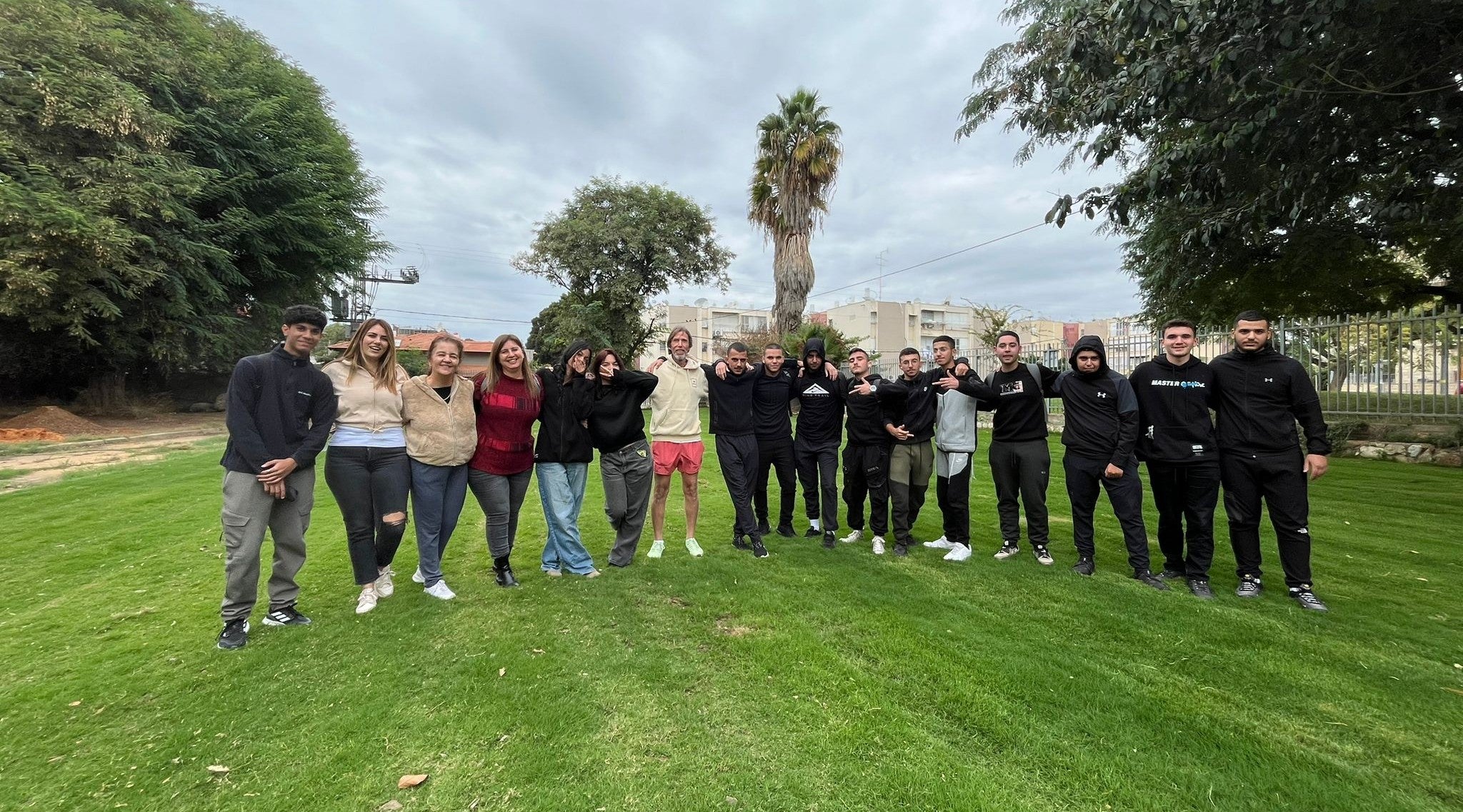
RAMLE, Israel — In the heart of the central Israeli city of Ramle, where Jews and Arabs live side by side, the Yigal Alon Multidisciplinary High School is trying to spearhead a quiet revolution.
The student body reflects the full tapestry of Israeli society, with students who are Jewish, Muslim, and Christian, religious and secular, native-born and immigrant. The school has a particularly large Ethiopian-Israeli population, and students with special needs. In Israel, such diversity is often treated as a problem to be managed. At Yigal Alon, it is treated as an opportunity, one that was especially important during Israel’s two-year war.
When 32-year-old alumnus Moshael Shlomo, a commander in the IDF’s Yamam counterterrorism unit, was killed on October 7, 2023, his death reverberated through the school community. Shlomo, who grew up in a socioeconomically disadvantaged home in Ramle, attended Yigal Alon from 2006 to 2009, and was known for his charisma, athleticism and drive to help others. He served as a paratrooper, then rose to become an IDF team commander and demolitions expert in Yamam.
After Shlomo’s death in combat with Hamas attackers near Kibbutz Be’eri, Yigal Alon students worked with school staff and Shlomo’s family to begin transforming a neglected plot on the school campus into a lawn — the first stage of a memorial project that eventually will include a sports field, outdoor seating and garden of peace. The project seeks to honor Shlomo’s memory by creating a space that reflects his passion for athletics and community, and the area will serve as an after-school haven for teenagers who by and large can’t afford the kind of extra-curricular activities their peers do. Administrators hope teens using it will build stronger peer relationships and practice the values Shlomo embodied, including generosity and service to community and country.
“It isn’t just about Shlomo’s athleticism,” said sports teacher Dotan Rotshtein, who is spearheading the project. “It’s about his character of determination and kindness. This project will educate students in his spirit.”
The project at Yigal Alon is one example of the many ways Israelis are memorializing those killed during the war, trying to make something positive out of the pain, hardship and loss they endured during the longest conflict in Israel’s history. Rather than serving as a flashpoint, Shlomo’s death became a unifying experience for Yigal Alon, bringing Arab and Jewish students together in determination to build something positive.
The school, one of 50 in the Amal educational network, offers a rare and tangible model for how to bolster Arab-Jewish coexistence and build a society rooted in shared humanity, administrators said.
“This school is a home not just for students, but for families,” said principal Barak Friedman, himself a school alumnus and Ramle native. “Everyone belongs. Everyone matters.”
In Israel, only eight out of 250 municipalities are considered mixed Jewish-Arab. Almost all public schools are segregated along ethnic and religious lines. Yigal Alon is one of Israel’s very few mixed Arab-Jewish public schools.
“Once people saw this as a liability,” Friedman said. “I see it as a wonderful opportunity.”

“At a time of growing extremism in Israeli society, the connections between these youths is quite unique and inspiring,” said Barak Friedman, principal of the Yigal Alon school in Ramle, Israel. (Courtesy of Amal)
Staff at the school try to weave the values of shared humanity into academic life. During the war, students met weekly in conversation circles where Jewish and Arab classmates spoke openly about how the conflict was affecting their families. They worked together on projects like murals and performances to express their emotions.
Older students tutor younger ones, often across language and cultural lines, and 11th graders complete community service work in both Jewish and Arab institutions. The school also has a large group of Shinshinim — Israeli volunteers from pre-military academies who work alongside teachers to help give students one-on-one attention and assist those with learning disabilities.
Jewish and Arab students and teachers work side by side.
“Students aren’t interested in the ethnic background or origin stories of fellow students; what matters to them is their relationships with each other,” Friedman said. “At a time of growing extremism in Israeli society, the connections between these youths is quite unique and inspiring.”
These connections flourished even during the war.
Within the Amal network — whose diverse portfolio of schools ranges from vocational schools that serve traditionally marginalized Israeli populations including immigrants, Arabs, and haredim to science & technology schools in Israel’s biggest cities — 45 alumni were killed in the war, many of them siblings or cousins of current students. Schools were struck by missiles, relocated due to being in conflict zones or absorbed evacuees. Some students had relatives taken hostage to Gaza, and many had parents or siblings in combat. Everyone was affected.
“The loss is not only in the fallen,” said Asher Ben Shoshan, Amal’s head of human resources. “Many of our students and staff were living with traumas.”
Amal’s schools responded by expanding trauma-related programming, offering counseling, and creating spaces for students to process emotions through dialogue and creativity.
“We’re not just teaching algebra or English,” Ben Shoshan said. “We’re helping young people hold their lives together. That is the mission now.”
Traditionally a network of vocational schools, Amal has focused in recent years on turning its schools into centers of science and technology while also trying to heal Israel’s societal rifts and strengthen democratic values among its more than 3,000 teachers and 26,000 students.
“We believe that education is not just about knowledge but about citizenship,” said Tamar Peled Amir, Amal’s deputy director general for education, technology and R&D. “Our classrooms are where the future of Israel is being written — not just with math equations or essays, but with empathy, resilience and an unwavering commitment to building a shared society.”

The killing of Yigal Alon alumnus Moshael Shlomo on Oct. 7, 2023, galvanized the school community to come together and build something to honor the memory of the slain IDF commander. (Courtesy of Amal)
Karen Tal, Amal’s director general, said focusing on Israeli society is part of the schools’ educational responsibility.
“We don’t have the luxury of detachment,” Tal said. “Our responsibility is not only academic. It is human. Shared society is not a slogan. It is the essence of democracy. When students learn to listen to one another, to respect differences and to see the humanity in the other, they are learning what it means to live in a democratic society. That is the Israel we are working to build, one classroom at a time.”
Arab students in Rotshtein’s after-school fitness club now wear team shirts bearing Shlomo’s name. “They want to feel part of this country, part of his legacy,” Rotshtein said.
“The space we decided to build in Moshael’s honor reflects who he was: generous, kind, committed to others,” Rotshtein said. “It is also a project that brings people together, Jews and Arabs, in a spirit of unity.”
Friedman, the principal, said, “Whether you are Jewish or Arab, religious or secular, we teach our students to take responsibility for themselves, for each other and for society. Because only that kind of responsibility will allow Israel to heal.”
It’s an ethos Friedman himself embodies: As part of his military reserve duty, he’s a “notifier” —part of the three-person crew that visits parents’ homes when a soldier is killed to inform them of the terrible news. The experience has shaped his worldview, and the school’s focus on service to community.
Much of the implementation for school-specific initiatives like the Shlomo memorial project relies on community partnerships and philanthropy.
“We are reaching out to the global Jewish community and to friends of Israeli democracy everywhere,” said Yael Nathanel, Amal’s resource development director. “Projects like this do not just build walls and gardens. They build empathy, resilience and vision. But we need help to ensure that this becomes a reality.”
—
The post This mixed Jewish-Arab school in Ramle seeks to model a blueprint for Israel’s future appeared first on Jewish Telegraphic Agency.
Uncategorized
Portuguese artists pull out of Jerry Seinfeld-headlined festival
(JTA) — Several Portuguese artists have dropped out of a comedy festival in Lisbon headlined by Jerry Seinfeld, citing their support for Palestinians and implying opposition to Seinfeld’s support for Israel.
At least six acts over recent days have canceled their appearances at the MEO Commedia a La Carte Fest, a new international comedy festival in the Portuguese capital. The event from Oct. 29 to Nov. 1 has advertised that it will host Seinfeld’s first live appearance in Portugal.
Though none of the artists who withdrew mentioned Seinfeld by name, some hinted at a boycott against his pro-Israel views. The Jewish comedian has become one of Hollywood’s most prominent advocates for Israel since October 2023.
Actress and comedian Inês Aires Pereira announced on Instagram on Saturday that “one of the names” featured at the festival “persistently defends ideas and acts that I consider indefensible,” adding, “We cannot relativize or normalize a genocide.”
The comedy duo Cebola Mol posted a graphic of themselves with a watermelon, widely recognized as a symbol of solidarity with Palestinians. “We will celebrate justice, freedom and joy with you on another occasion,” they said on Instagram.
The festival announced on Friday that performances by the groups Tributo Pop and Conjunto Cuca Monga were also canceled, but did not provide reasons. Two other acts, comedian Pedro Tochas and visual artist Vhils, shared their cancellations on Instagram without further details.
Seinfeld has aligned himself with Israel during its current conflict in Gaza, following decades of largely avoiding commenting on political issues. He visited Israel in December 2023 to meet with the families of hostages seized by Hamas on Oct. 7 of that year. Since then, he has attracted attention for a series of dismissive remarks toward pro-Palestinian advocates.
During an appearance last year at Duke University, Seinfeld compared pro-Palestinian activists with the Ku Klux Klan, saying, “The Klan is actually a little better here because they can come right out and say, ‘We don’t like Blacks, we don’t like Jews.’ OK, that’s honest.”
Representatives of Seinfeld and producers of the MEO Commedia a La Carte Fest did not immediately respond to requests for comment.
The post Portuguese artists pull out of Jerry Seinfeld-headlined festival appeared first on The Forward.
Uncategorized
UK, France, Canada to ban goods from Israeli settlements
(JTA) —
The United Kingdom, France and Canada will ban goods produced in the West Bank settlements and Jewish neighborhoods of East Jerusalem, British Foreign Secretary Ed Miliband told Parliament on Tuesday, explaining that all such communities were deemed by his country to be illegal.
The declaration exacerbated the rising tensions riling the traditionally strong Israel-U.K. alliance. Israeli Foreign Minister Gideon Sa’ar warned that these steps stoked antisemitism against British Jews in an on-camera statement to reporters in Jerusalem.
Sa’ar charged that the measures were a politicized hostile action deliberately taken ahead of Friday’s Jewish New Year holiday, with an eye toward influencing the country’s Oct. 27 elections.
Israel, he said, is responding by closing the British Consulate in Jerusalem that services Palestinians. It will also remove British representatives from the International Gaza Support Center in Kiryat Gat and halt the British training of Palestinian Authority security forces. He added that Israel would bar the entry of 12 British politicians and other nationals involved in anti-Israel activity.
France and Canada have also announced a ban on the import of settlement goods, Miliband told parliament. He noted that the Netherlands, Ireland, Belgium, Spain and Norway have either banned goods or in the process of doing so.
In the same address, Miliband affirmed Israel’s right to exist, reflected on his own Jewish roots and rejected the notion that there was a connection between the policy steps against West Bank settlement activity and the safety of British Jews.
What is motivating the U.K., Miliband said, is “a deep sense of shame about what has unfolded in Palestine under the eyes of the international community” as well as Israel’s “clear intent to bury the Palestinian state.”
In response, he said, the U.K. “will introduce an import ban on goods from illegal settlements in the occupied [Palestinian] territory” as part of a “new comprehensive sanctions regime” that will be put in place within nine months.
This will include, he said, “action against specific companies and individuals who provide services, such as construction, infrastructure, financing or real estate for settlement expansion.”
To those who “finance or facilitate illegal settlements, let me say this, you will face the full force of U.K. sanctions,” Miliband warned.
Miliband clarified that the ban would not affect the export of religious items or life-saving Israeli medications. He explained that trade with the settlements was minimal and that the greater impact would be the sanctions on services.
As part of declaring the ban, Miliband said that the British government is also adopting the International Court of Justice’s 2024 advisory opinion that all Israeli settlement activity over the pre-1967 border was illegal.
But others in Parliament pushed back against Miliband’s declaration. MP Richard Tice of Britain’s right-wing Reform party said that the sanctions were a grave mistake that would “embolden the scourge of antisemitism against British Jews on British streets,” endanger ties with the United States and lead to “tit for tat” sanctions from Israel.
Miliband shot back that “no British Jew is responsible for the policies of the Israeli government and it behooves all of us to make sure that there can be no confusion about that,” saying that Tice’s statement “fell foul” of that goal.
The U.K. action is the latest escalation in tensions between Israel and the Labour-led British government headed by Prime Minister Andy Burnham, who took power in July.
The prior government, led by former Labour Premier Keir Starmer, had already angered Israel by recognizing Palestinian statehood in 2025, suspending licenses for the export of arms to Israel and freezing talks toward a free-trade agreement.
France and Canada are also announcing a ban on the import of settlement goods, Miliband told parliament. He explained that the Netherlands, Ireland, Belgium, Spain, and Norway have either banned goods or in the process of doing so.
In concert with Miliband’s appearance at Parliament, Britain and 11 other countries issued a joint statement pledging “their intention to introduce national and/or support European restrictions on trade in goods with settlements which are illegal under international law.”
Those other countries were Canada, Denmark, Finland, France, Iceland, Ireland, Norway, Poland, Portugal, Spain and Sweden.
The 12-country bloc said it was taking this step to maintain the viability of the two-state resolution to the Israeli-Palestinian conflict, describing the situation in the West Bank as “rapidly deteriorating.”
In its statement, the bloc stressed that it was taking this step amid an “unprecedented level of settler violence and settlement expansion, including the unacceptable decision to publish tenders for the E1 settlement project.” That project is seen as cutting through land that would render a Palestinian state unviable.
The post UK, France, Canada to ban goods from Israeli settlements appeared first on The Forward.
Uncategorized
California Gov. Newsom, a presidential hopeful, slams Netanyahu and AIPAC in PBS interview
(JTA) — California Gov. Gavin Newsom, a 2028 presidential hopeful, ventured farther than ever in his criticisms of Prime Minister Benjamin Netanyahu, in a weekend interview that delved into the Democratic Party’s relationship with Israel.
“I think it’s overwhelmingly opposed to the current regime in Israel,” Newsom said of the party, in a PBS News Hour interview with Amna Nawaz.
Pressed by Nawaz on divisions among his colleagues on Israel, Newsom denied that the subject is “even controversial anymore,” stressing that “the condemnation of what Bibi Netnayahu’s doing is almost universal.” The governor slammed the Israeli military’s conduct in Gaza and condemned the settler violence that has expanded in the West Bank.
“We want a democratic and secure Israel, and we want a secure and democratic Palestinian state as well right next door,” Newsom said, adding that Netanyahu has proved counterproductive to achieving a two-state solution.
Though he repeatedly maintained that Democrats are not divided on Israel, the governor acknowledged that “some of the language” by fellow Democrats “has been weaponized.” Certain “aspects of rhetoric” from individual candidates, he added, are on “the spectrum of concern,” Newsom said.
A number of candidates from the party’s far left place most if not all of the blame on Israel for a war in Gaza that has resulted in tens of thousands of Palestinian deaths. and downplay the role of Hamas in launching the war with the Oct. 7, 2023 raid inside Israel in which 1,200 people were killed and more than 250 were abducted. Newsom’s rhetoric is of a piece with party moderates who are critical of the Israeli government but who call for a secure Israel, reject Hamas and who resist pressure from the left to call Israel’s actions “genocide.”
Newsom nonetheless insisted that the party is unified on the issue. “But I think universally, everyone agrees, even if you don’t think it’s genocide, that it’s been a moral catastrophe,” he said of the war in Gaza. “The vast majority of us also agree about the atrocities on Oct. 7th and how horrific and unacceptable it was, and the terrorism that was perpetrated by Hamas.”
Newsom was among the many U.S. politicians to visit Israel in October 2023, meeting with survivors and families impacted by the attacks.
During a March book tour, Newsom sparked a backlash when he said that some people were referring to Israel “appropriately as sort of an apartheid state.” He quickly walked back these remarks, telling Politico that he had used the term “in the context of the direction that Bibi is going.”
“I revere the state of Israel,” he declared at the time.
The governor warned, however, that if Netanyahu proceeds in the direction of West Bank annexation, apartheid could become “a word you may hear others use.”
In addition to amplifying his condemnation of Netanyahu this weekend, Newsom also addressed the fact that fewer Democrats are accepting funds from political action committees affiliated with the American Israel Public Affairs Committee, the pro-Israel lobbying group.
As for Newsom himself, Track AIPAC, an organization that compiles Federal Election Commission data to flag pro-Israel campaign contributions, did not log any such donations to the likely presidential candidate. But the group did flag him as “pro-Israel.”
“It’s a minority of Democrats that are accepting AIPAC,” the governor said, noting a “dramatic change” over the last couple years.
“The vast majority of Democrats I talk to, even Democrats in the past that have in the past have taken AIPAC money, are pledging not to now,” Newsom added. “That’s more of a mainstream position, interestingly, within the Democratic Party.”
The post California Gov. Newsom, a presidential hopeful, slams Netanyahu and AIPAC in PBS interview appeared first on The Forward.
