


Uncategorized
They rallied rabbis against Mamdani’s anti-Zionism. What does The Jewish Majority do next?
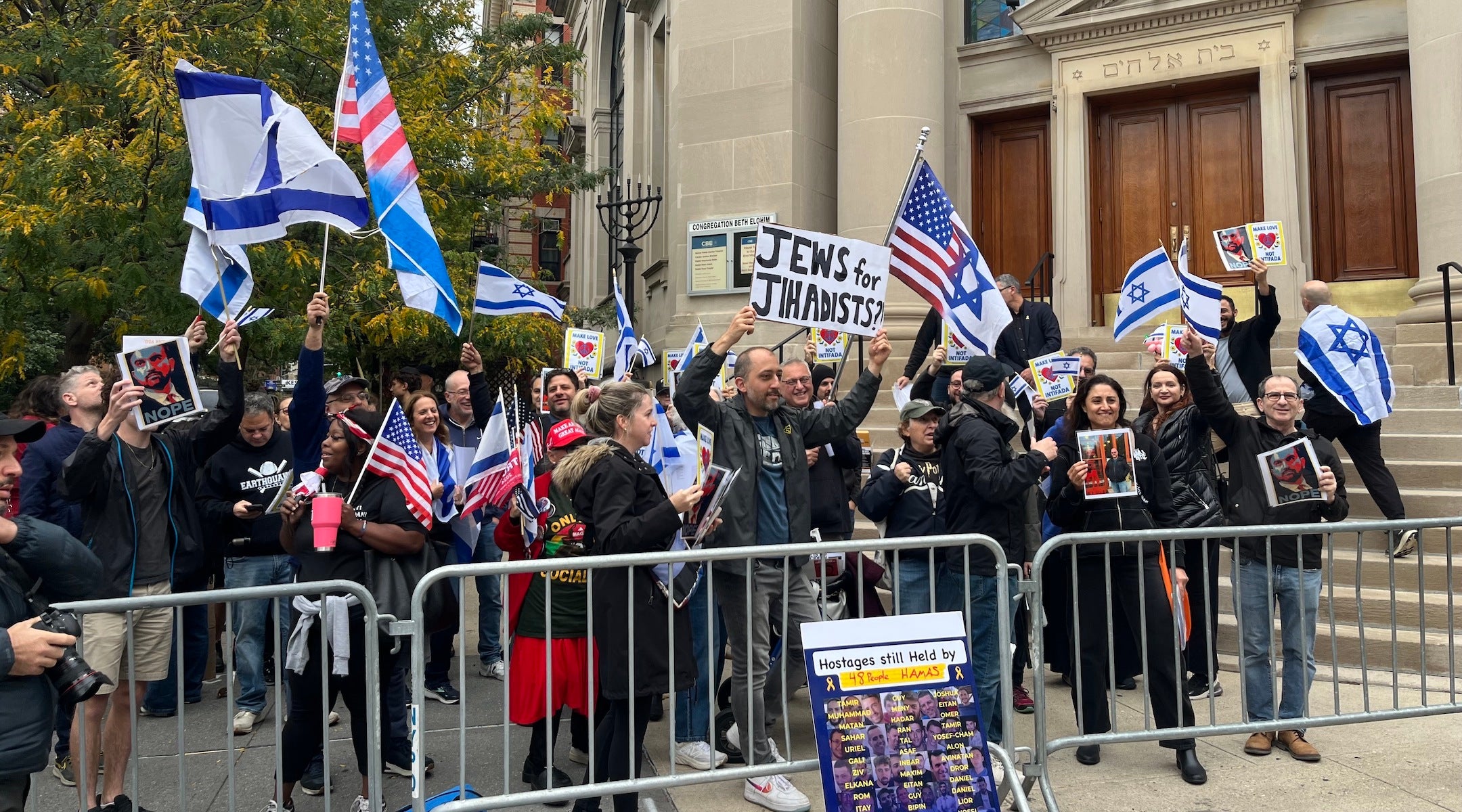
(JTA) — Plenty of Jews were concerned about the specter of Zohran Mamdani becoming mayor of New York. But few did as much to mobilize other Jews around the issue as Jonathan Schulman.
Via his newly formed organization, The Jewish Majority, Schulman circulated a letter to rabbis and cantors around the country opposing “rising anti-Zionism and its political normalization throughout our nation.” The letter, which called out Mamdani by name, was signed by more than 1,100 Jewish congregational leaders — one of the most widely endorsed missives of its kind — and galvanized many clergy who had been reluctant to use their pulpits to wade into a political arena.
They didn’t get what they wanted. Yet the day after a decisive victory by Mamdani, Schulman wasn’t as despondent as one might imagine. Instead, he sees his group’s work as a success.
“This wasn’t about Mamdani,” he told the Jewish Telegraphic Agency on Wednesday, rejecting the suggestion that his campaign amounted to an effort to get Jews to vote against the mayor-elect.
Instead, Schulman said, The Jewish Majority proved that it could combat a “subversion of the accurate representation of the Jewish narrative.”
He sees his work as simple: providing an organized Jewish voice, on Israel and other issues, to counteract what he sees as the growing influence of left-wing Jewish groups like Jewish Voice for Peace and Jews for Racial and Economic Justice. As members of those groups have aligned closely with Mamdani and stand to grow their influence under his administration, the Jewish Majority aims to serve as a counter-narrative.
“They exist to present fringe views to the public as normative,” he said. “If we decide to let them be the only ones to hold the microphone, that would be a mistake we can’t afford to make.” That includes on the issue of “political anti-Zionism,” which Schulman insists was the goal of the rabbinic letter — rather than an explicit anti-endorsement of Mamdani as a candidate.
There are an estimated 3,000 to 4,000 rabbis in the United States, meaning that potentially a third of them signed on to a single statement. Others indicated that they agreed with the sentiments but chose not to sign for other reasons.
“We’ve seen countless examples over the past couple of years of Jews coming out in support of anti-Zionist candidates,” Schulman said. “And now that narrative has shifted. Now you look at that narrative and it’s hard to say, ‘Well, look, these rabbis are supporting this candidate.’ Well, in fact, what you’re seeing is overwhelmingly one of the largest displays of rabbinic unity that we’ve seen in our country, saying we don’t accept the normalization of political anti-Zionism.”
He is skeptical of early exit polling purporting to show as many as one-third of Jewish voters in New York breaking for Mamdani, and suspects the actual number is closer to the “80-20” split that research suggests also reflects the Jewish consensus around Zionism.
Promoting an institutional Jewish consensus will continue post-Mamdani. Schulman insisted The Jewish Majority would not be making policy, only amplifying the views of major Jewish groups such as the Anti-Defamation League, the American Jewish Congress, Jewish federations and the New York Board of Rabbis. He also said he would not seek to join the Conference of Presidents of Major Jewish Groups or other coalitions.
“We’re here to reflect,” he said. “It’s not my job to weigh in.” One item on his agenda, he said, is instituting “training programs” to teach Jewish leaders how to “present normative communal perspectives.”
Schulman has felt his own priorities within the Jewish community shift. Before striking off on his own, he spent 18 years at the pro-Israel lobbying giant AIPAC. One of his duties was to “work with congregations throughout the United States to increase the level of pro-Israel political activism in American synagogues.”
He left AIPAC in August 2024, as the group’s brand was becoming increasingly toxic amid the war in Gaza. Today even some moderate Democrats, like Massachusetts Senate candidate Seth Moulton, have sworn off accepting AIPAC donations. When radio host Charlamagne tha God wanted to insult Democratic Minority Leader Hakeem Jeffries as someone with no real principles, he called the Brooklyn congressman “AIPAC Shakur.”
Schulman declined to comment on whether he had split from AIPAC ideologically. “I have a lot of respect for my former colleagues, and it’s a great organization,” he said. Nor does he see his work with The Jewish Majority as a throughline from his work there. Despite the overlapping focus on Jewish clergy, he insisted, this is “not ‘AIPAC by a different name.’”
Instead, he said, he left AIPAC because he had identified this new problem — the growing influence of left-wing Jewish groups after Oct. 7 — and wanted to counteract it, in a way he deemed non-political in nature. Even with all the Jewish organizations that were opposing anti-Zionism on the national stage, he said, “there is nobody whose job is to make sure that the Jewish community is accurately represented, that Jewish communal values are accurately represented.”
Those same Jewish groups, whose priorities he hopes to give a megaphone to, are scrambling in the wake of Mamdani’s big win. The ADL has launched a “Mamdani monitor” to keep tabs on the new mayor’s administration. JFREJ, meanwhile, sees no reason to come to the Jewish center: A victory Zoom call scheduled for Thursday to “celebrate our massive win” is set to feature pro-Palestinian activist Linda Sarsour and Jamaal Bowman, the former “Squad” congressman who is rumored to be on Mamdani’s schools chancellor shortlist.
Schulman is optimistic about building an organized Jewish counter-narrative to that perspective — so long as the ceasefire in Gaza holds.
“The American Jewish community has been undergoing a profound change, and because we’ve been in the middle of this war, which has been a propaganda war here in America that we’ve seen proliferating, we haven’t had the capacity to really think about, ‘What is the future going to look like?’” he said.
“People are starting to finally say, OK, the fighting has stopped, and we need to think about how the Jewish community is going to be able to represent itself for the long haul.”
The post They rallied rabbis against Mamdani’s anti-Zionism. What does The Jewish Majority do next? appeared first on The Forward.
Uncategorized
Why The 36 Award
Antisemitism is, unfortunately, a fact of life in the United States and around the world. Jewish people continue to experience harassment, discrimination, and violence. Antisemitic tropes and conspiracy theories exacerbate the problem.
Antisemitism does not exist in isolation; it both reflects and accelerates the erosion of democratic norms, institutions, and trust, emerging alongside other forms of hate and prejudice that collectively weaken the social fabric and the shared commitments on which all communities depend.
And while naming antisemitism and its impact is necessary, what truly matters is our shared responsibility to confront it.
This is a moment to push back collectively, within and beyond the Jewish community. No single organization, community, or ideology can meet this challenge alone. The pursuit of solutions requires acknowledging what we do not yet know, remaining open to learning, and committing to the collective effort.
Nathan Cummings Foundation (NCF) approaches this work as part of a broader justice journey and our commitment to Racial, Economic, and Environmental Justice (REEJ). As an institution rooted in the Jewish tradition of tikkun olam, repairing the world, our commitment to social justice and Jewish values has long guided our work across our focus areas, which includes being in partnership with leaders across REEJ.
We believe that our pursuit of justice is incomplete if it does not also address antisemitism. Antisemitism is oppression and is inseparable from broader struggles against bigotry, exclusion, and threats to democratic life. Addressing it strengthens movements, deepens solidarity, and reinforces the conditions necessary for collective progress.
Recognizing and engaging this challenge is essential to building a more just, inclusive, and democratic society and advancing our pursuit of REEJ.
With all of this in mind, NCF, in collaboration with the Jewish Social Justice Roundtable and supported by a growing coalition of partners across the country, created The 36 Award. The award takes its name from a powerful concept in Jewish tradition: the belief that in every generation there are 36 righteous individuals whose actions help sustain the world.
Across the country, there are people confronting antisemitism in ways that do not always attract headlines. They are building relationships across lines of race, faith, geography, and ideology. They are helping communities navigate difficult conversations. They are creating new models, narratives, and pathways toward understanding. In many cases, they are demonstrating that combating antisemitism and advancing broader justice are not competing goals but mutually reinforcing ones. The 36 Award is designed to find those individuals and elevate and support their work.
The challenges before us are significant. Yet history reminds us that lasting progress often begins with people willing to see possibilities others overlook. The search for those people is what The 36 Award truly represents.
We believe that new ideas matter and that solidarity can be built through courageous leadership, which often emerges where few are looking. We are excited to announce the inaugural winners of The 36 Award. Please visit 36award.us to learn about these inspiring individuals.
Sincerely,
Rey Ramsey, President & CEO
Amy Sorensen Ben-Dov, Chair, Board of Trustees
Nathan Cummings Foundation
The post Why The 36 Award appeared first on The Forward.
Uncategorized
The 36 Award Winner: Building a Public Health Response to Antisemitism
Myrieme Churchill, Executive Director of Parents for Peace (P4P), has been named an inaugural recipient of The 36 Award, honoring a decade of work building what may be the first confidential intervention program in the world focused specifically on antisemitism.
Churchill leads P4P, a national public health organization serving families, schools, and communities across the United States and Canada. Through its Antisemitism Intervention and Recovery (AIR) Program, P4P brings together licensed psychologists, peer interventionists, and a team that includes former neo-Nazis and former jihadists. Its central argument once sounded unlikely to many in the field: extremism is not just a security issue, but a public health crisis that demands early intervention, education, and community-based support. The need has grown sharply. P4P says it saw a steep rise in anti-Jewish hatred after October 7, 2023, both in its own caseload and across society. In 2025, 70 percent of its helpline cases involved antisemitism, spanning far-right white nationalism, jihadist networks, and far-left movements.
Churchill’s path to this work began in Morocco. The daughter of a Black Moroccan Muslim father and a white French Christian mother, she grew up biracial and rarely felt she belonged anywhere. As a child, she was excluded and targeted by other children who misidentified her as Jewish and often used the word “Jew” to insult her.
“That history gives me a deep appreciation for how identity, exclusion, and belonging shape people’s lives,” Churchill said.
Those early experiences left her with questions that have stayed with her ever since: Why do people hurt one another? Where does hate come from? Why have Jews so often been made the scapegoat? The questions led her to a career as a therapist. Her early work took her to the streets of Marseille, where she worked with young immigrants targeted by traffickers, and later to Boston, where she treated people with mental illness and addiction. Both jobs, she said, taught her how vulnerable people are at risk for abuse, self-destruction, and harming others.
Over years of clinical work in addressing addiction, Churchill began to notice a pattern. For some people, extremism seemed to work the way a drug does, offering relief from pain along with a sense of identity and purpose. People could get hooked on hate the way others get hooked on substances.
That insight became the foundation of the P4P model. Rather than treating extremism of any kind, including antisemitism, as a set of beliefs to argue with, the organization treats it as a maladaptive way of coping with grievance, isolation, and trauma. In P4P’s framing, extremism works like a psychological addiction, offering belonging at the cost of truth, safety, and humanity. Instead of relying on shame, public condemnation, or debate, P4P helps families recognize warning signs and assess escalating behavior, and helps their loved ones build healthier sources of identity, belonging, and purpose, while working with public safety resources when necessary. The goal is to replace hate with resilience, education, and genuine connection.
AIR, which P4P bills as the world’s first antisemitism helpline, builds on the organization’s existing public health approach and helpline model. It offers free, confidential support from trained interventionists to worried families, educators, and community members, as well as to people who are trying to step away from anti-Jewish beliefs themselves. P4P is also developing trainings for families, schools, and religious organizations on recognizing early warning signs, navigating online risks, and responding with evidence-based intervention.
The model was tested on the very first call to the AIR helpline in 2016. A mother had found several rifles under her son’s bed, along with a manifesto describing his plan to attack a synagogue. She was terrified and reluctant to contact law enforcement. Churchill stayed on the line and worked to earn the mother’s trust enough that she would call 911. The FBI later confirmed that the guns had been confiscated and that the young man had been hospitalized for treatment of psychosis.
“Courage sometimes means entering the worst moment of someone’s life and not looking away,” Churchill said.
P4P says its early intervention work has since helped prevent potential attacks on synagogues and violence against Jews, and has helped hundreds of people repair relationships, return to school or work, and rebuild lives no longer governed by extremist ideology.
Sagit Sade Attia, a member of the P4P board, described that work as a deliberate moral choice. “Rather than writing off people consumed by hate as beyond redemption, Myrieme has chosen the far more difficult path of engaging directly with individuals and families affected by radicalization, while never losing sight of the needs and safety of those targeted by hate,” she said.
The choice has not always been easy to explain. When Churchill first began describing extremism as an addiction, she recalled, people looked at her as if she had three heads. Public health framing has since moved closer to the mainstream, but an approach that begins with compassion for people who hold antisemitic views can still invite skepticism at a moment when Jewish communities feel under threat. Churchill answers by pointing to outcomes like the hundreds of families supported.
P4P doesn’t do this work alone. It has partnered with the Combat Antisemitism Movement, the ADL, the American Muslim and Multifaith Women’s Empowerment Council, and the Department of Homeland Security, as well as Bangladeshi and other immigrant communities. It has worked with the Harvard School of Public Health and Georgia State University to evaluate its work and to train former extremists as interventionists. Churchill has spoken at Eradicate Hate following the 2018 Tree of Life shooting, briefed Congress as part of a bipartisan effort, and testified before the Massachusetts Special Commission on Combating Antisemitism, where she urged antisemitism trainings in schools. Churchill puts it simply: “Antisemitism is not a Jewish problem alone; it is an all-of-us problem, and everyone pays the price when it spreads.”
The post The 36 Award Winner: Building a Public Health Response to Antisemitism appeared first on The Forward.
Uncategorized
Building the Legal Case Against White Nationalism
David Brody, founder of the Alliance of Jewish Americans, has been named an honorable mention for The 36 Award in its inaugural year. Brody has spent his career in courtrooms and coalitions confronting hate, and he believes Jewish safety in the United States depends on standing with every community that white nationalism targets.
Brody traces his commitment to his family and to the South. “As a Jew from Georgia, my Jewish identity was defined against the backdrop of the Black-Jewish shared struggle in the South,” he said. His great-grandmother fled pogroms, arrived in the United States as an unaccompanied minor with no English or education, and became a union organizer. His father registered voters for the Southern Christian Leadership Conference and spent four decades researching how poverty and discrimination affect the health of rural Black families. “My family taught that being Jewish in America means fighting for social justice,” Brody said.
Before launching the Alliance in 2026, Brody founded and led the Digital Justice Initiative at the Lawyers’ Committee for Civil Rights Under Law, the first tech policy program at a legacy racial justice organization. There, he built the first case applying public accommodations law to online harassment, representing Taylor Dumpson, the first Black woman to serve as student government president at American University, against a neo-Nazi website’s publisher who targeted her. Brody co-led the team representing Metropolitan AME Church in Washington, D.C., in its case against the Proud Boys after the group vandalized the church. He helped draft and championed what became the AI Civil Rights Act of 2025, which more than 80 civil rights, privacy, consumer, and labor groups have endorsed. His nominator, Erin Simpson of the Ford Foundation, said Brody coined the phrase “privacy rights are civil rights” at a time when many did not yet see the connection. She described him as “the engine that powered an entire community of racial justice and technology policy organizations.”
Brody said Jewish civil society is robust but has lacked a dedicated national legal organization, similar to the NAACP Legal Defense Fund or Lambda Legal. The Alliance is meant to fill that gap. It uses open-source investigative techniques to collect and preserve evidence of civil and human rights violations and white nationalist threats, with the goal of making that evidence admissible in court.
From his years litigating against white supremacists, Brody saw that few organizations take on litigation against white nationalism systematically, and that most investigative work in the field produces research reports rather than evidence that can stand up in a legal proceeding. He argues that white nationalism, which has motivated deadly attacks ranging from Pittsburgh’s Tree of Life synagogue in 2018 to a Buffalo grocery store in 2022, poses the greatest threat to Jewish safety in the United States in generations.
The Alliance’s work includes both near-term and longer-term legal investigations. Part of this work involves leveraging AI tools responsibly, such as using them to accelerate needle-in-a-haystack investigations of white nationalist activity or other threats that would not be cost-effective for human researchers. Other work is meant to provide evidentiary foundations for long-term efforts to research, document, and seek accountability for rights violations in the U.S. Brody said he is focused on what the field needs now and what it will need in five years.
Brody’s approach to coalitions is grounded in patience. He spent six years drafting model bills, persuading allies with different priorities, and testifying twice before Congress in support of privacy protections. In 2024, when a bipartisan privacy bill in Congress was stripped of its civil rights protections, Brody gathered signatures from more than 50 organizations on an opposition letter in under 24 hours, and the bill died. “Those groups did not sign because I told them what to do,” he said. “They signed because I spent years working with them, earning their trust, and advocating for their interests.”
Brody credits the courage of his clients for putting their names and faces on high-profile cases against violent white supremacists. He arranges his work so that, by the time a moment of risk arrives, “we have friends at our side.” He resists the idea that this takes a special method. “Building bridges does not require a special approach,” he said. “One should show up for everyone, listen with empathy, and do the work.”
The post Building the Legal Case Against White Nationalism appeared first on The Forward.
