


Uncategorized
King David gets the kiddie treatment
The figure of David is most often imagined nude, and for some people that’s a problem.
Michelangelo’s statue was once made to don a fig leaf in exhibition replicas. As recently as 2023, a school principal in Tallahassee, Florida resigned after parents complained that an image of the marble used in a lesson on Renaissance art was pornographic. (Interestingly, no one is calling for a redacted edition of the Bible, where David is an unabashed adulterer who dances naked before the lord.)
David, like Odysseus, was a man of twists and turns, and that’s what makes him so compelling. Yet there has always been a temptation to contort him into a tidier package, PG and legible to youth. In Hebrew school — and, I imagine, Christian Sunday schools — we hear of his underdog exploits with Goliath. We rarely hear what happens next.
As novelist Geraldine Brooks observed in her book The Secret Chord, David was “the first man in literature whose story is told in detail from early childhood to extreme old age.” It is also a singularly strange story to adapt for children beyond that initial showdown with a Philistine with a pituitary disorder — the rest of David’s story is rife with sex and violence.
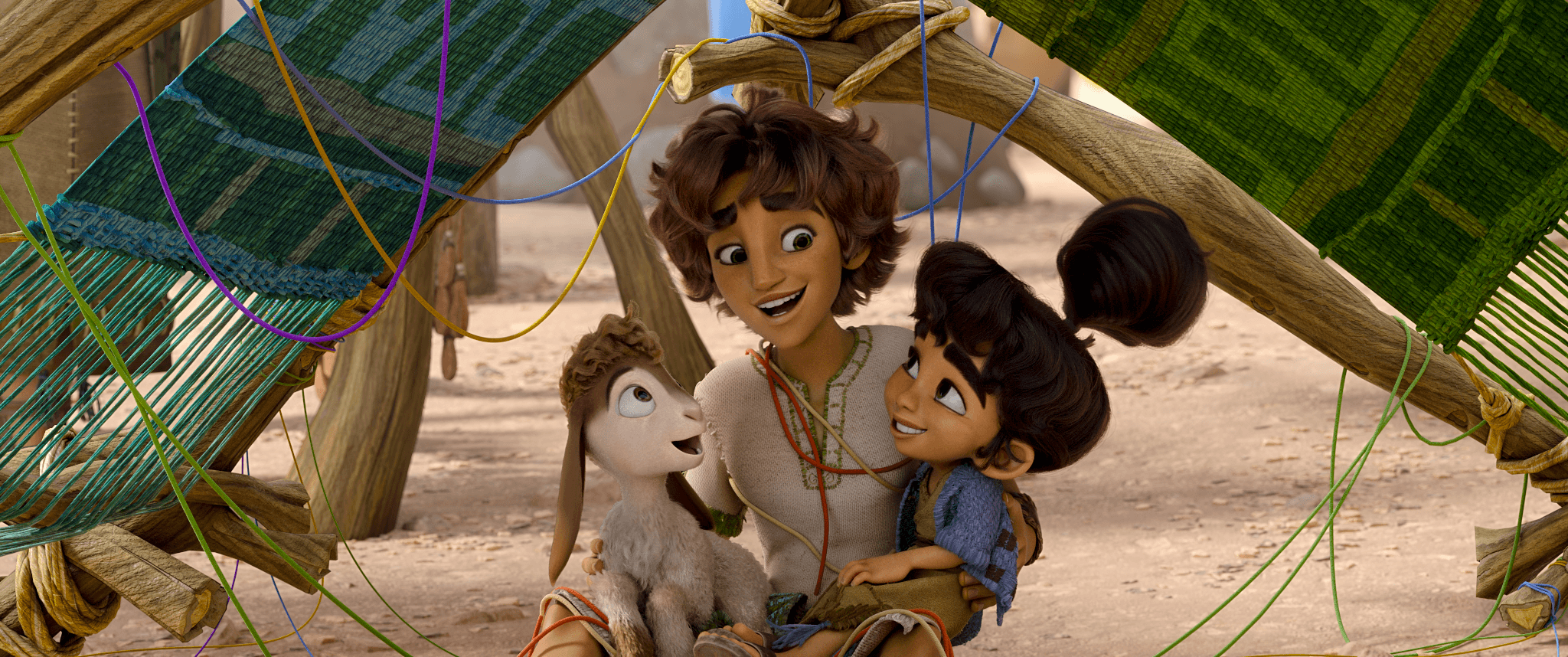
Even so, Angel Pictures, the up-and-coming, largely faith-based production house behind The Sound of Freedom (a fear-mongering pageant about human trafficking) and The King of Kings (about you know who) endeavored to put this narrative to film, following a “prequel” series, called Young David. The resulting animated musical David punches above its weight in production value with meticulous filaments of CGI hair and charismatic character design. If you’re looking for biblical fidelity, it mostly follows the text, but in making it family friendly — and perhaps to point in the direction of a certain legacy sequel — it slaps a narrative fig leaf over the interesting bits. Somehow, like so many neutered renditions of Leonard Cohen’s “Hallelujah,” it makes David boring.
Why target this one to kids? David is introduced as a shepherd boy with a sling, making him ripe for a young audience, at least if you skip the part where he decapitates Goliath and carries his head around as a trophy, which this film does. Most children’s media about him emphasizes those salad days heroics or his side hustle as a psalmist.
But the boy will go on, soon after he reaches his age of majority, to procure 200 Philistine foreskins in battle as a bride price. In exile from Saul, we’re told that, when he raided a region, “he would leave no man or woman alive.” At Hebron, he rewards the eager assassins of his rival by relieving them of their hands and feet.
What about this demands the Dreamworks treatment? The aforementioned prequel kiddie show, with its humble pastoral lessons, had to lead to something, I suppose, and here it’s a musical time jump with a new character model and older voice actor. The ads invite us to “watch how a boy becomes a man,” and, more saliently, to do the watching “this Christmas.”
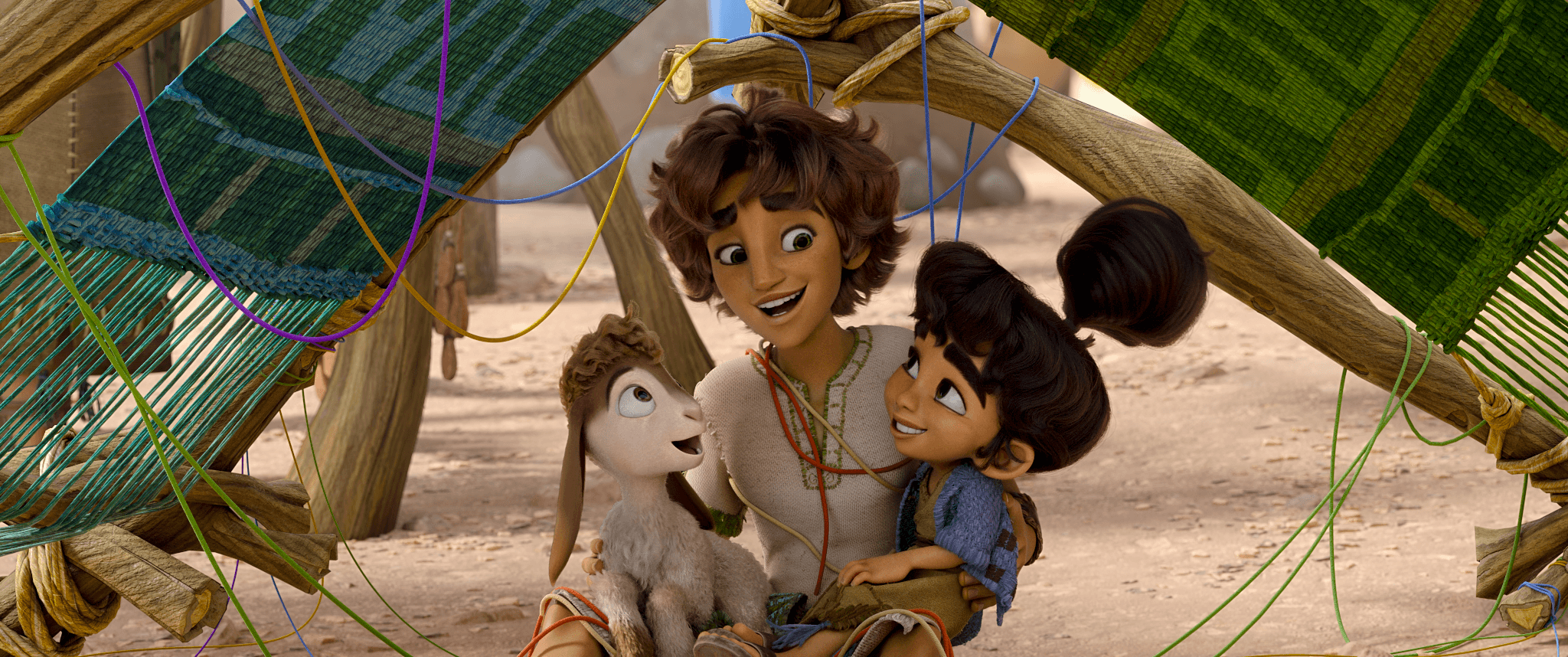
To Christians, David is a sort of Old Testament flashing arrow pointing to Christ. “Christ” means anointed one; David, as we see in the film’s opening moments, after he saves a whelping lamb from a lion, had a horn of oil poured over him by Samuel. Jesus, a metaphorical shepherd, is sometimes called the Son of David.
As scholars of Christianity like Elaine Pagels have noted, the genealogy laid out by Matthew and Luke connects Jesus to David as a way of fulfilling messianic prophecies in Isaiah. This is then, a stealth Christmas story or almost a Jesus prequel, kind of a biblical Phantom Menace, with the added benefit of capturing a Jewish audience that goes out to the movies on Christmas and may be looking for family fare. Catholic comedian Kevin James has promoted it, as has Michael Rappaport.
The story, buoyed by boilerplate praise pop that sings of running towards adventure and “following the light,” tracks the moment David is selected as the future king up to his coronation, stopping before his uniting of the kingdoms in a new capital and his late vocation as a rooftop voyeur with major character flaws.
This David — auburn-haired and American-accented, while all other characters sound vaguely Israeli — is instantly likable, and unbearably insipid, “a man after God’s own heart.” The film had a rabbi advisor — one whose focus is on “ministering to Christians” — and that brings a veneer of Jewish authenticity. Samuel sings some of Psalm 118 in Hebrew as he anoints David (an odd choice given that David is the traditionally-credited author). Production notes boast of paleo Hebrew text appearing throughout and identify some of the songwriters as “Jewish believers in Jesus.” There are wolf motifs littering in the palace of Saul, whose tribe’s founder was likened to a ravenous wolf. Despite these trappings, the project feels derived from a familiar Christian impulse, and errs by taking David’s story beyond the Valley of Elah, where our hero still had a semblance of innocence.
The infancy narrative of Jesus may work for young people around Christmas time, sparing them the gory details of the crucifixion. But beyond a point, David’s early life can’t be so neatly detached from what follows, as the rest of the Bible, even the Christian parts, relies on it. It is hard to imagine this David — pure, faithful, a good shepherd who is reluctant to lead and ostensibly asexual — conquering Jerusalem. It’s harder still to imagine him having his way with Bathsheba (in what many now regard as rape), sending her husband to his death and losing several children as God’s punishment for these transgressions.
None of these events are the film’s concern, but without those pivotal plot points, we don’t have the Temple or the king — Solomon, born of Bathsheba — to build it. Without a temple in Jerusalem, there’s no backdrop for the Passion the film’s hinting at to play against.
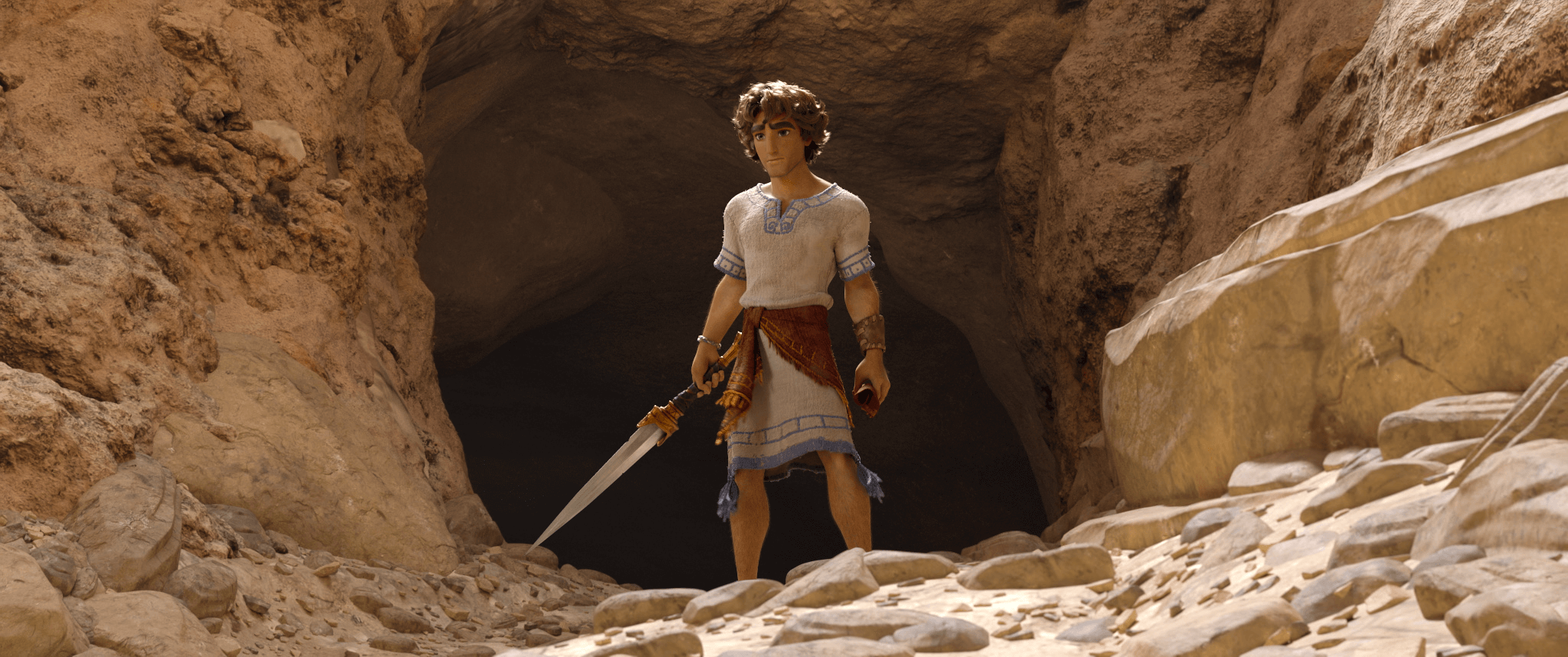
The screenplay, by directors Brent Dawes and Phil Cunningham, seems to be optimizing for action — Cunningham described David’s journey as “packed with adventure, with music, with fun” — while staying too squeamish to mount a proper battle scene. There’s the intrigue of Saul’s court, and the thread of dramatic irony, as the old king confides in David about his fear of God’s appointed successor, not knowing it’s him. We see David dash into exile in the wilderness, but we don’t witness his raids or any other mischief, only a crisis of faith. We get a glimpse of the mincing Philistine king Achish (we know he’s evil because of his eyeshadow and earrings) and the skull-laden Amalekites who raze David’s outpost at Ziklag and take his followers captive. (Saul’s failure with the Amalekites is appropriately sanitized — he fell short by letting them escape, not in sparing Agag’s life and keeping his best livestock. If God ordered their genocide, as he does in the source material, we don’t hear about it.)
In case there was any doubt, after David’s mom — here a speaking character — praises God as “the way and the light,” there’s a specific endgame in mind that necessitates our hero be presented as older and on his way to kingship.
To drive the point home, in an invention of the film, the Amalekites hoist David onto a tree to kill him while his mother weeps at his feet. This isn’t some first chapter of David’s rule but the foreshadowing of Jesus’ reign, and you can’t exactly crucify the little shepherd boy with the lyre. (Spoiler: He lives.)
While not to my taste, this would be forgivable if the film, however handsomely animated, didn’t fall into the same old timeworn tropes that even kids are surely bored of now: the precocious younger sister, the fat brother gorging on dates, the upstart Israelite army with vases for helmets who gulp, “Yup, we’re dead,” upon seeing the well-equipped Philistines and their six-cubit champion.
Worse still, the film calls to mind other, better ones, appropriate for children but nowhere near as condescending.
A standout number has David’s mother singing about the world as a tapestry (Carole King she ain’t) and “the view that heaven sees,” essentially a rip off of Prince of Egypt’s “Through Heaven’s Eyes.” You may also cringe at the line “like the way we work the loom, he knit you from inside the womb,” seemingly a play on Jeremiah 1:5, often used by Christians to justify pro-life positions.
David deserves better, but the good news is there’s competition. Amazon’s House of David, now in its second season, goes deep on the dynamics of Judah and Israel, often employing midrash to add texture to the intrigue, and it was reported in 2022 that Leviathan Productions, an outfit focused on Jewish stories, had optioned Brooks’ excellent The Secret Chord.
That shepherd boy from Bethlehem became a giant himself — and we will never stop singing his psalms or wrestling with his complicated, at times cancel-worthy, story. Angel Studios’ David may still challenge Goliath, just not the audience.
The post King David gets the kiddie treatment appeared first on The Forward.
Uncategorized
Planned auction of a Holocaust-era Torah fragment sparked outcry, then intervention
(JTA) — A Torah scroll fragment believed to have been used as parcel paper by Nazi SS soldiers is expected to be donated to a US Holocaust remembrance organization after a Norwegian auction house listed it for sale last week, sparking an outcry.
A spokesperson for Israel’s Foreign Ministry told JTA that Foreign Minister Gideon Sa’ar had directed the ministry and Israel’s embassy in Norway to intervene to prevent the sale of “a sacred manuscript looted by the Nazis.”
“Thanks to the embassy’s efforts, the auction was canceled and the parchment will be donated to a Holocaust remembrance organization in the United States,” the spokesperson said.
The Torah fragment is expected to go to Remember Us The Holocaust (RUTH), a San Diego Holocaust remembrance organization working to establish a permanent museum. In a statement sent to JTA, RUTH said it had worked over 48 hours to “secure the fragment for preservation” and Holocaust education.
The organization also enlisted Adolfo Roitman, the former curator of the Dead Sea Scrolls and head of the Shrine of the Book at the Israel Museum in Jerusalem, to advise on its “appropriate treatment and respectful exhibition,” the statement said.
Moisés Salinas Fleitman, RUTH’s executive director, told JTA that the donation had been confirmed by email last Tuesday but had not yet been finalized. He said there was “no expert confirmation as of yet of the provenance of the scroll,” and that the consignor had told RUTH the parchment was “found on a public market in Poland” over three decades ago. RUTH had not yet inspected the fragment or any evidence supporting that account, he added.
Salinas Fleitman said his understanding was that the fragment had been withdrawn from the auction, but RUTH could not confirm what had happened amid conflicting news reports. The organization also declined to identify the person in possession of the fragment, citing its policy of protecting anonymous donors. RUTH’s procedures for verifying authenticity and legitimate provenance take time, the organization said, adding that the organization would not accept the fragment unless both could be established.
The controversy began when the fragment was put up for auction Oct.18 by Oslo-based Valkyrie Historical Auctions, an online auction house specializing in Third Reich memorabilia.
The handwritten calfskin parchment, estimated to fetch between $1,500 and $2,000, was advertised as a “sad and powerful symbol” of the destruction of European Jewish life.
Valkyrie identifies its president as Norbert Podlesny, a historian and author of a trilogy on the Holocaust. The auction house says its items are examined by experts and carry a lifetime guarantee of authenticity. Neither Valkyrie nor Podlesny responded to repeated inquiries from JTA.
The auction house’s original listing explicitly described it as having been plundered by SS soldiers during the Holocaust, an account its representative subsequently disputed in comments to a Norwegian newspaper. The parchment was also described as having been used to wrap a package sent to Germany.
The Valkyrie website recorded a winning bid of $8,500 on the Torah fragment, more than four times the upper estimate for the parchment.
Video footage of the live auction reviewed by JTA shows bidding on the fragment proceeding, with offers rising incrementally. The footage does not establish who placed the bids or whether a transaction was ultimately completed.
Conflicting accounts have left it unclear whether the fragment was formally withdrawn, purchased by the auction house itself or simply withheld from the winning bidder.
Other lots in the same auction included a death certificate for a Polish prisoner at Dachau, a book from the scientific library at Auschwitz, and a dress bearing a yellow Star of David marked “JUIF.”
The controversy went public after the Foreign Ministry condemned the planned sale in a post on X headed “A Nazi celebration in Oslo.”
The ministry also criticized Norway’s proposal to end dedicated funding for school trips to former Nazi concentration camps, with the funding instead transferred to general local government allocations.
“Auctions of sacred texts looted by the Nazis: IN. Visits to extermination camps: OUT,” the ministry wrote.
Gideon Taylor, president of the World Jewish Restitution Organization (WJRO), said that the auction house had taken steps to remove the fragment from public sale but added that those measures “in no way” resolved the issue.
“There are many unanswered questions,” Taylor told JTA.
He urged Valkyrie to identify the seller, explain how the fragment had been acquired, disclose what provenance information accompanied it and undertake further research into its history. He also questioned why the auction house had agreed to sell the parchment despite its original description as Nazi-looted property.
“There is a profound contradiction in recognizing an object as a symbol of the Holocaust while treating it as something to be bought and sold,” he said.
He said the case exposed a “lack of historical awareness” of how the systematic plunder of Jewish property, both private and communal, formed part of the Nazis’ campaign to annihilate European Jewry.
“This is not simply an antique or a historical curiosity. It is a sacred Jewish object that represents a community’s religious life and the devastating destruction of that life during the Holocaust,” he added.
WJRO has called on the Norwegian government to launch an investigation into the auction house’s handling of the fragment, Taylor said, adding that similar questions had arisen concerning other objects previously sold by it.
Taylor also called for “a coordinated international effort” to tackle the trade in sacred Jewish objects looted during the Holocaust and still held by private collectors.
“This is not about private collections, this is about the memory of the Jewish people,” he said.
Norway is among 35 countries that have endorsed the 2024 Best Practices for the Washington Conference Principles on Nazi-Confiscated Art. The nonbinding guidelines cover Holocaust-looted religious and communal property, including sacred scrolls, manuscripts and synagogue objects, and recommend returning objects determined to have belonged to Jewish communities to successor communities or institutions. They do not automatically require restitution of an item offered through a private auction.
The dispute follows other controversies over the sale and ownership of Holocaust-era artifacts. Last November, a German auction house canceled a planned sale of more than 600 concentration camp-related objects, including prisoners’ correspondence, identification documents and a yellow Star of David, following protests from Holocaust survivors and Jewish organizations.
Earlier this year, Poland returned 91 Jewish religious objects to Greece, decades after they were seized by the Nazis from synagogues in Thessaloniki. WJRO helped coordinate their restitution following years of research and negotiations.
This article originally appeared on JTA.org.
The post Planned auction of a Holocaust-era Torah fragment sparked outcry, then intervention appeared first on The Forward.
Uncategorized
People accusing El-Sayed of Muslim Brotherhood ties will accuse Jews of dual loyalty too
Abdul El-Sayed, Democratic candidate for Senate in Michigan, has said that he has no ties to, and disavows, the Muslim Brotherhood. It does not matter how many times he is asked about this, or how many times he answers, because there will be those who insist that it is a real concern. Their position relies not on reality, but on a deep-rooted idea Jews should recognize: that people who are “other” hold dual loyalties, and that those dual loyalties are a danger to America.
El-Sayed has had ample reason and opportunity to assert his distance from the group, as he has been asked about it over and over again. (The connection to the Muslim Brotherhood specifically seems to be a tweet from El-Sayed’s half-sister saying their mother was once involved with the organization.) He was asked at a town hall earlier this month to disavow the Muslim Brotherhood; he was asked about the Muslim Brotherhood earlier this month on Meet the Press; he was asked about it by Fox News; and he was accused without evidence by his opponent, Republican Mike Rogers, of being “bought” by the Muslim Brotherhood and of being a national security risk in their debate last week. Other Democrats were also asked to weigh in: CNN, for example, asked Sen. Chris Murphy if Democrats were “concerned about this with El-Sayed.”
American Jews should object to this cynical, baseless fearmongering because it is wrong and destructive in and of itself to charge that a person who is Muslim is a threat to national security. American Jews should also recognize it for what it is: a charge of dual loyalty, and one they should speak up against if they do not want similar charges leveled against Jewish politicians. This is true even if they disagree with El-Sayed or do not want to see him win in next week’s midterm elections.
For American Jews, dual loyalty is an old and familiar antisemitic trope. It’s a suspicion and accusation that has followed us around the globe and across decades and says that we can never really be loyal to the country or society in which we find ourselves because we are secretly loyal only to each other or, more recently, to Israel.
American Jews — understandably, given the history of this trope — are attuned to politics that smack of dual loyalty. For example, Pennsylvania Governor Josh Shapiro wrote in his book that, when he was being vetted as a potential running mate for Kamala Harris in the 2024 presidential election, he was asked if he had ever been an Israeli agent and felt that that was inappropriate. In fact, being asked about loyalty to other countries is a regular occurrence in obtaining a security clearance.
Nevertheless, Shapiro’s alertness to it speaks to the sensitivity American Jews, and particularly politicians, feel around being accused of dual loyalty, especially as Israel becomes a “litmus test” in Democratic party politics. For example, was congressional candidate Scott Weiner chased from a rally for trans rights solely because he had declined to say that Israel committed a genocide in Gaza (before he said they did days later), or was it because he’s Jewish?
And this past weekend, a RebellionPac ad in which a couple can’t buy eggs because, they say, the United States sends money to Israel, concludes with “Mike Rogers is for they/them” — cutting to photos of Israeli politicians — “Abdul El-Sayed is for you,” suggesting that being supportive of Israel is at odds with being supportive of Michigan, which some Jews feel creates a permission structure for antisemitism and suspicion toward Jews.
U.S. President Donald Trump, meanwhile, once again put forth his specific version of the dual loyalty trope, in which to be a true American Jew is to vote for him because he supports Israel, by saying American Jews should be “ashamed of themselves” if they voted for El-Sayed.
It is not enough for American Jews to be against dual loyalty when it is leveled against us. We just need to be against it. Because if you do not want it to be acceptable to cast aspersions regarding a candidate’s race, religion, or ethnicity, and if you do not want there to be different, special, higher bars that candidates need to meet because of their culture or where they pray, then you need to be against that for anyone. Otherwise, you’re accepting it for everyone.
I am not equating Israel with the Muslim Brotherhood, nor am I defending the Muslim Brotherhood. What I am saying is this: If you are offended by the idea that Jews need to prove that we are not first and foremost loyal to Israel, or by the notion that Jews should be punished for perceived connections to Israel, then you should also be offended by what politicians and pundits are demanding of El-Sayed. You should do this not only because not doing so is hypocritical (though we, as a nation, seem long past the point of hypocrisy mattering), but because the more comfortable we are having charges of dual loyalty in our politics, the more comfortable we are having charges of dual loyalty in our politics for everyone, including Jewish candidates.
I made a similar point last week on X (formerly Twitter) and was promptly accused of hating myself and Jews, loving the Muslim Brotherhood, and having my priorities wrong. In one response to my post, which read, “You don’t get a more tolerant, accepting, pluralistic, liberal country by accusing people of another religion of inherently hating and being disloyal to it and you, it is simply not going to work,” someone wrote, “I don’t want a more tolerant society you stupid twat, I want my kids to be safe at Jewish day school and I don’t want 24/7 security at shul.”
What I found most fascinating about this person’s reply was the idea that Jewish institutions could be safe in the United States, where we are a small minority, without ours being a tolerant society. That struck me as almost as fanciful as thinking that we could allow charges of dual loyalty for Muslim candidates and then turn around and ask that Jewish candidates not have to face dual loyalty accusations or special extra litmus tests.
Much as a society in which antisemitic conspiracy theories are allowed to flourish is ultimately a more conspiratorial, paranoid, and less trusting place for everyone, a polity where candidates are regularly charged with dual loyalty or disloyalty on the basis of their religion or ethnicity is just that — a political discourse where charges of dual loyalty are leveled against ethnic and religious minorities. We don’t get to choose against whom dual loyalty cards are played. We only get to choose whether we think it’s acceptable to play them at all.
The post People accusing El-Sayed of Muslim Brotherhood ties will accuse Jews of dual loyalty too appeared first on The Forward.
Uncategorized
Eight years after Tree of Life shooting, a Jewish burial society’s ranks have nearly doubled
After preparing five victims of the Tree of Life synagogue massacre for burial, members of Pittsburgh’s New Community Chevra Kadisha stood in a circle and held hands.
They had gathered like this before, taking a moment after their work to process what they had done. This time, they were caring for people murdered in their own community.
Volunteers from outside Pittsburgh had come to help. David Zimmer, a longtime member, remembered one visitor bringing a custom from another chevra kadisha.
“He passed around a piece of chocolate,” Zimmer recalled, “so that there should be something sweet.”
Eight years later, NCCK has nearly doubled in size. Before the attack, it had about 38 members, according to records reviewed by Patricia Cluss, one of its founders. Within four months, 11 people had joined. Today, it has 70.
The growth has brought more volunteers into some of the least visible work in Jewish communal life. A chevra kadisha, traditionally translated as a “holy society,” washes and prepares the dead for burial, dresses them in plain white shrouds and helps ensure they are treated with dignity. The work is considered a chesed shel emet, or true kindness, because the dead cannot repay those who care for them.
For NCCK, the aftermath of the attack also revealed another dimension of that care: The people accustomed to supporting others through loss needed support themselves.
Caring for their own
Pittsburgh’s NCCK was founded in 2004 to encourage greater participation in the Jewish tradition of caring for the dead. An Orthodox chevra kadisha already existed, and NCCK’s founders hoped to involve more Jews in the practice, regardless of their level of religious observance.
Cluss was among them. She had encountered an article about Reform Jews reviving Jewish burial practices that had fallen away in some communities. Until then, she had never heard of a chevra kadisha.
“I gotta do that,” she remembered thinking.
Deane Root joined early, too, drawn by an idea: What if Pittsburgh had a chevra kadisha open to anyone in the Jewish community? Root remembered a small group gathering, often in a member’s living room, to figure out the logistics of working with funeral homes and training volunteers.
Then came Oct. 27, 2018.
Root and his wife, Rabbi Doris Dyen, were approaching the Tree of Life synagogue building that Saturday morning when they heard a series of loud noises. They pulled into the parking lot and saw shattered glass.
Two NCCK members had been inside the synagogue, and the dead and wounded included people its members knew. At the Jewish Community Center of Greater Pittsburgh after the shooting, where families and friends gathered and waited for news, Root recalled that “not everybody knew for sure” what had happened to their loved ones.
When the victims were released for burial, NCCK began the work for which it had trained. Members also kept shmira, remaining with the dead and reciting Psalms until burial.
Allen Baum, who coordinates the NCCK men’s members, remembered that by the end, nearly every man in the group had participated in shifts. After the final tahara, the ritual preparation of a body for Jewish burial, they stood in a large circle, joined by women from NCCK as well.
Later, members gathered in a home, bringing food, reading poems and speaking about the people they had lost.Root was carrying the trauma of what he experienced that morning. He described a “video playing in my head constantly.”
Being together helped. “Let the community carry some of that burden,” Root remembered, “rather than keeping it all inside our own emotions and our own minds.”
A growing circle
Following the attack, younger Jews contacted NCCK after reading about its work. Some described joining as something they felt they needed to do as Jews. Others spoke of it as a form of social action.
Elana Glick, who joined NCCK around 2014 after her grandfather died, remembered that the group sometimes struggled to find enough volunteers before the massacre. Afterward, she said, the work became more public, even as members sought to preserve the privacy of the rituals.
At its annual dinner, Glick has watched the group grow. There have been “more and more tables added year after year because of people who have found this and wanted to be a part of this work,” she said.
“Being part of the chevra is one of the ways I feel most attached to my Judaism,” Glick said.
Sarit Wishnevski, executive director of Kavod v’Nichum, a national organization supporting chevrot kadisha and Jewish burial practices, has watched the movement become increasingly multigenerational. At the organization’s November 2025 gathering in Ojai, California, participants ranged from their 20s to their 80s, with one in their 90s.
The Jewish phrase l’dor v’dor is usually understood as passing something “from generation to generation.” Wishnevski suggested it can also mean practicing a tradition with generations alongside one another.
NCCK has also become a resource for other communities. Wishnevski called it a “really strong model,” citing materials its members have shared and their help with questions ranging from starting a group to making the work more inclusive of gender diversity.
The possibility of mass-casualty events has prompted other questions, too. “How will we be prepared?” Wishnevski said. “How will we show up if God forbid this happens here?”
Kavod v’Nichum is developing an emergency preparedness pilot effort. Wishnevski said the goal is not for a chevra kadisha to respond “in a silo,” but to build relationships with first responders, government agencies and other Jewish organizations.
Earlier this month, three NCCK members traveled to Chicago to teach other volunteers about something none would ever want to need: developing tahara liturgy for young children.
But most of the chevra kadisha’s work remains unseen, and the calls come without warning. “The only predictable thing is the unpredictability,” Baum said.
One summer, the men’s group went 11 weeks without a tahara. More recently, Cluss said, the women’s group performed 11 in two weeks. Sometimes volunteers arrive at a funeral home for one person and are asked whether they can stay for another. In recent years, NCCK has performed roughly 90 taharot annually.
For Cluss, the work had long been meaningful. After Tree of Life, she struggled to explain how that meaning had changed. Her daughter noticed something she hadn’t.
“Mom, do you ever notice when you’re talking about the chevra you always put your hand on your heart?”
Cluss hadn’t noticed.
The post Eight years after Tree of Life shooting, a Jewish burial society’s ranks have nearly doubled appeared first on The Forward.
