


Uncategorized
Debunked Hamas Casualty Figures and Their Impact on Reporting

Palestinian gunmen stand guard on the day that hostages held in Gaza since the deadly Oct. 7, 2023, attack, are handed over to the International Committee of the Red Cross (ICRC), as part of a ceasefire and hostages-prisoners swap deal between Hamas and Israel, in Khan Younis, southern Gaza Strip, Oct. 13, 2025. Photo: REUTERS/Ramadan Abed
Since October 7, 2023, Hamas has shaped global public opinion through its propaganda warfare. The terrorist organization excitedly recorded and uploaded the atrocities committed against Israelis that day to social media platforms, and those who saw any trace of it were rightfully horrified.
But shortly after, when the images weren’t as fresh and no longer front-page news, Hamas turned to a new strategy — playing victim to the Israeli army. And since then, the media has run with it.
For instance, on October 17, 2023, reports claimed an explosion occurred inside the Al-Ahli Hospital. The media rushed to re-print Hamas’ claim that more than 500 people had been killed.
Evidence then came out that displayed it was a parking lot adjacent to the hospital that had been hit by a misfired Palestinian Islamic Jihad rocket, and the casualties were fewer than reported.
The media has continued this pattern since. Any death toll that the Hamas-run Ministry of Health (MoH) publishes is immediately reported on by Western media, oftentimes without any attribution to Hamas.
This has resulted in blood libels being printed on the front pages of newspapers, blaming Israel for targeting non-combatants, including women and children.
But the vast majority of the casualty numbers that have been used throughout the war have been purposefully misrepresented by Hamas.
As of December 2025, the Hamas-run MoH has claimed that over 70,000 people have died in Gaza since the start of the war.
But further analysis done by Salo Aizenberg, a board member of HonestReporting, displays that this includes the casualties of Hamas fighters, natural deaths, and internal fighting amongst Gazans.
While the analysis is based on informed estimates, and the precise toll may take years to verify, it nonetheless highlights the extent to which Gaza casualty figures have been misrepresented in media coverage over the past two years.
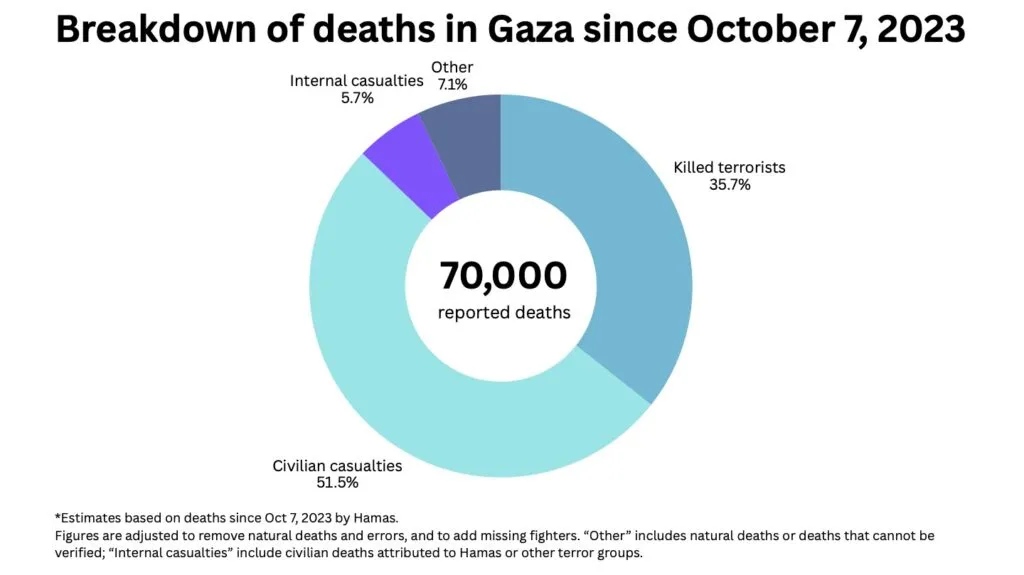
Although it is difficult to determine the exact number of terrorists killed by the IDF since the beginning of the war, estimates suggest the number to be more than 22,000 as of October 2025, not including those who were killed during the terrorist attacks on October 7. President Donald Trump has confirmed the number to be greater than 25,000, the number used in Aizenberg’s analysis.
Beyond combatants, throughout the war, there were likely to be around 11,000 natural deaths, based on pre-war patterns. Another 4,000 deaths were caused by internal fighting within Gaza from different factions, including firing on civilians at aid sites or executions of individuals Hamas deemed to be collaborating with Israel. An additional 1,000 estimated deaths can be attributed to errors in reporting.
After removing these casualty numbers from the total of 70,000, there are a remaining 54,000 deaths. Of the 54,000, one can reasonably assume that around 25,000 were terrorists, leaving 36,000 civilian casualties. While every innocent civilian casualty is a tragedy, this is nonetheless a remarkably low civilian-to-combatant ratio of 1.45:1, especially given the circumstances of urban warfare.
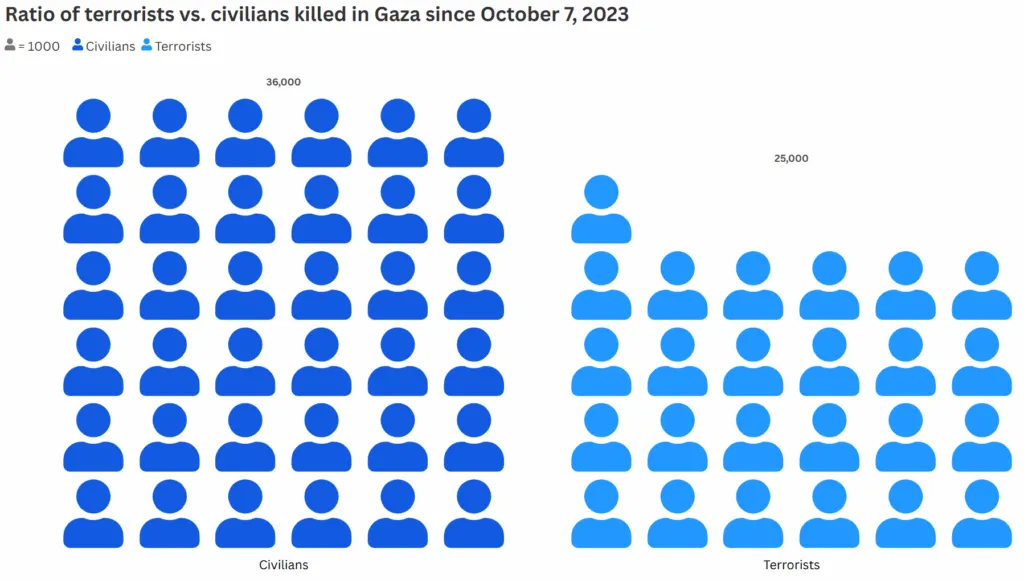
Visualization based on data by Salo Aizenberg.
These numbers entirely dispute the claims that the majority of deaths are civilians — a claim the media has previously made. One “investigative” piece done by The Guardian and +972 Magazine, published in the summer of 2025, claimed that 83% of casualties were civilians.
What the outlets willfully omitted, however, was that this figure counted only terrorists whom the IDF had identified before the war and could conclusively confirm as eliminated, excluding thousands of combatants who could not be identified during the fighting. By presenting this partial dataset as comprehensive, the article created a misleading impression that was then cited as authoritative.
This information is not necessarily new either.
A December 2024 report by the Henry Jackson Society found that 84% of the publications analyzed failed to make the critical distinction in total numbers between combatant deaths and civilian deaths, further illustrating the extent to which misleading casualty narratives have been allowed to take hold. The report also found that men of combat age were disproportionally represented, and natural deaths were included in casualty statistics.
Perhaps even more telling is the ratio between male and female casualties. Males of combat age (18-59) died at 3x the rate of women the same age, resulting in a 3:1 ratio. The 32,690 deaths of men of combat age account for 46.7% of total casualties.
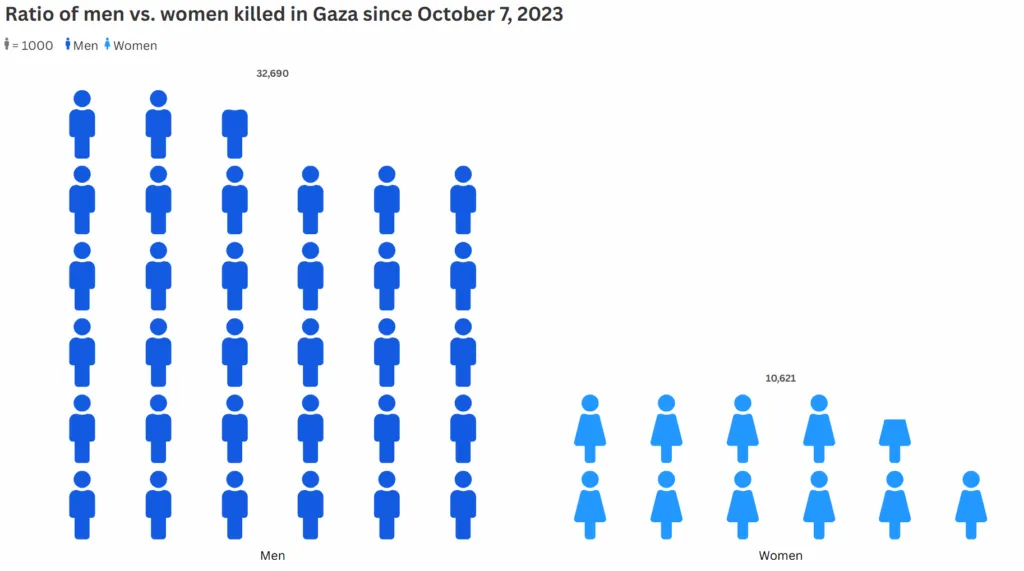
Visualization based on data by Salo Aizenberg.
Outlets, including the Associated Press, BBC, and Washington Post, have all previously parroted the claim that 70% of the casualties in the war were women and children. Naturally, it was based on falsified data, and the new casualty analysis once again disproves this claim.
Even after the UN walked back this percentage due to incomplete information, news outlets have continued to print that more than half of the casualties are women and children.
Throughout the two years of war, the media have repeatedly reprinted Hamas’ libels and casualty figures with little skepticism, allowing a terrorist organization to shape the narrative without rigorous analysis or verification.
Inflated civilian casualty claims will continue to distort public understanding of the war by obscuring the true civilian-to-combatant and male-to-female casualty ratios.
It is therefore only responsible journalism for every outlet that published Hamas’ casualty figures without questioning them to issue corrections and acknowledge that not every casualty during the war has been the result of IDF action.
The author is a contributor to HonestReporting, a Jerusalem-based media watchdog with a focus on antisemitism and anti-Israel bias — where a version of this article first appeared.
Uncategorized
JD Vance refuses to disavow Tucker Carlson
(JTA) — Vice President JD Vance acknowledged that he has “political disagreements” with Tucker Carlson, the former Fox News personality who has spread antisemitic conspiracy theories and sparked a rift within the Republican Party.
But that won’t impact their friendship, Vance said during a press conference on Thursday at the White House.
“Everybody knows that Tucker Carlson and I are friends, and I think it’s very obvious that Tucker has said some things that I disagree with,” Vance said.
He pointed to Carlson’s criticisms of Vance’s boss, President Donald Trump, as well as Carlson’s suggestion that he would rather Democratic progressive Abdul El-Sayed win Michigan’s U.S. Senate seat than Republican Mike Rogers, as examples of where they disagree.
“Tucker is a friend despite the fact that we disagree on a number of things. And I’m not going to play the game where I throw friends under the bus because I have political disagreements with them,” Vance said.
Vance’s refusal to disavow Carlson comes days after he appeared in a closed-doors session in Las Vegas before hundreds of Republican Jewish Coalition members, some of whom have indicated that they would prefer Secretary of State Marco Rubio to Vance as Trump’s successor in 2028.
His RJC appearance started and ended with standing ovations for the vice president, and he spoke about the importance of the U.S.-Israel relationship and denounced antisemitism during the 35-minute conversation. He angered a number of attendees and Jewish conservatives, however, when he sidestepped a question about Carlson and other controversial right-wing podcasters.
On Thursday, a reporter asked Vance about “those who are uneasy” with his close relationship to Carlson and believe that he is avoiding addressing questions about it.
“I’m not avoiding anything,” Vance countered.
After declining to distance himself from Carlson, Vance said that his refusal to do so should be a model for how other Americans engage in discourse across lines of disagreement.
“If you have a disagreement with someone politically — even over a deeply held issue — you should still be friends with that person, because the whole republic depends on people of different perspectives being able to talk to one another,” Vance said.
This article originally appeared on JTA.org.
The post JD Vance refuses to disavow Tucker Carlson appeared first on The Forward.
Uncategorized
Jerusalem cafe bows to Haredi protests, will no longer open on Shabbat
(JTA) — Cafe Basimta, the Jerusalem coffee shop that became a flashpoint in the city’s long-running dispute over Shabbat observance, will stop opening on Saturdays beginning this weekend after two months of weekly ultra-Orthodox protests.
The cafe said Thursday that the decision was made “after prolonged deliberation and with a heavy heart,” out of a desire to lower tensions and restore calm.
Eli Birnbaum, CEO of the messianic group Jews for Jesus, which runs the cafe, called the move a “difficult and painful decision” in the statement, saying it stemmed from a responsibility to its customers, its faith and Israeli society.
“Over the past few months, the cafe has become a focal point of friction and danger, a reality that contradicts our identity as Jews who believe in Jesus and our belief in loving others, respect and bringing people closer together, even with those who oppose us,” Birnbaum said.
He thanked Israel Police, the Jerusalem municipality and those who had come to support the cafe during the protests. “We now want to return Cafe Basimta to what it was intended to be: a calm, pleasant and open place for coffee, culture and dialogue.”
The decision marks a reversal for Cafe Basimta and its operator, Yoel Ben David, who said after the first protest on July 4 that the business would continue opening on weekends despite pressure from demonstrators. By late July, Ben David told the Jewish Telegraphic Agency that the protests had actually helped business financially, but added: “Me and the staff, we don’t love it. We’d all love it to just chill out.”
Basimta opened earlier this summer in Jerusalem’s central Nahlaot neighborhood, near the Mahane Yehuda market. It later emerged that the cafe was operated by Jews for Jesus, a missionary organization whose members identify as Jews who believe Jesus is the Messiah.
The demonstrations began July 4 and continued for nine consecutive Saturdays through Aug. 29. At the first protest, dozens of ultra-Orthodox demonstrators, many of them minors, surrounded the cafe, banged on its windows and overturned tables, according to staff and video from the scene.
Later protests saw demonstrators break through police barricades and try to approach the cafe, while a bag containing feces was thrown at its entrance on another weekend. In August, a woman was accused of putting glue in the front-door lock, delaying the cafe’s opening.
Supporters meanwhile began turning up each Saturday to patronize the cafe, at times forming long lines outside, while police deployed officers and barricades to separate the two sides. Politicians including Yisrael Beytenu Chairman and former Defense Minister Avigdor Liberman and Democrats Chairman Yair Golan, a former IDF deputy chief of staff, also visited or backed supporters of the cafe.
Golan denounced Thursday’s decision as the result of “haredi terror,” saying weeks of violence, demonstrations and threats had ultimately forced the cafe to give in. Liberman said the closure showed growing religious coercion, writing on X that in “Israel 2026,” drinking coffee on Shabbat was forbidden while “hating, attacking and rioting on Shabbat was permitted.”
Jerusalem Deputy Mayor Adir Schwartz, who heads the pluralist Hitorerut municipal faction, also criticized the closure. Hitorerut said it was examining ways to operate a cafe on Saturdays in response to Basimta’s closure.
A spokesperson for Jews for Jesus told JTA that any such initiative was unrelated to Basimta or the organization.
Basimta’s ties to Jews for Jesus have also prompted a separate campaign against the cafe by anti-missionary activists. Rabbi Binyamin Vulcan, who heads the counter-missionary activities of Or LeAchim, told JTA in July that the organization was planning a weekday demonstration focused specifically on the cafe’s connection to Jews for Jesus and was seeking to have it closed through municipal channels.
This article originally appeared on JTA.org.
The post Jerusalem cafe bows to Haredi protests, will no longer open on Shabbat appeared first on The Forward.
Uncategorized
Spain’s Jewish federation reports over 200 antisemitic incidents in 2025
(JTA) —
MADRID — Spain’s Jewish umbrella organization and a watchdog group have reported that antisemitic incidents rose 14.5% in 2025, warning that hatred was being “normalized.”
The Federation of Jewish Communities of Spain (FCJE) recorded 221 antisemitic incidents in Spain last year, up from 193 in 2024, in a report released Wednesday together with the Movement Against Intolerance (MCI), a Spanish human rights group. Spain is home to an estimated 40,000 to 70,000 Jews.
The trend matches an increase in hate incidents documented by the Spanish government. Spain’s Interior Ministry said in June that Jews were targeted in 69 hate crimes and incidents in 2025, jumping from 37 in 2024. Data from the Interior Ministry reflects crimes that are formally reported or detected by police, while the FCJE monitors incidents collected from community members, social media and other sources.
The new report came from the Observatory of Antisemitism, a joint initiative by the FCJE and the MCI to track antisemitism since Hamas’s attacks on Israel on Oct. 7, 2023, and Israel’s ensuing assault in Gaza. The initiative has followed incidents such as the vandalism of Holocaust memorials with swastikas, the desecration of Jewish graves and the individual targeting of Jews, including a group of French tourists who were harassed and spat on in July while leaving a synagogue in Barcelona.
“Since October 7, 2023, Spanish Jews have had to go to our gathering places with special security measures,” FCJE president David Obadía said in a statement. “Our children are the only ones who go to school with a police presence, and insults and discrimination are part of our reality practically every day.”
María Royo, a spokesperson for the FCJE, blamed “campaigns against Israel” for the rise in antisemitic incidents. She told the Jewish Telegraphic Agency that some groups, saying Israel has committed genocide in Gaza, also “blame all Jews.”
“The security forces are doing everything within their power, but the government, politicians, media and opinion leaders could be much more rigorous and careful to prevent this situation,” said Royo.
Spanish Prime Minister Pedro Sánchez is among Europe’s most vocal critics of Israel, which he says has committed genocide. The Israeli government has repeatedly said the Spanish government is antisemitic, an accusation that Spain strongly rejects.
Esteban Ibarra, the president of the MCI, said in a statement that antisemitism should be distinguished from debates about Israel.
“Antisemitism is not an opinion or a political disagreement: it is a form of hatred and discrimination against Jews,” said Ibarra. “When it is tolerated, normalized or minimized, coexistence deteriorates and democracy is weakened.”
This article originally appeared on JTA.org.
The post Spain’s Jewish federation reports over 200 antisemitic incidents in 2025 appeared first on The Forward.
