


Uncategorized
5 things to know ahead of the Trump-Netanyahu meeting
President Donald Trump and Israeli Prime Minister Benjamin Netanyahu are set to meet at the White House Wednesday in a highly anticipated discussion. The primary focus of the meeting is expected to be the ongoing negotiations between the United States and Iran, particularly regarding Tehran’s treatment of protesters and the possibility of a renewed agreement on Iran’s nuclear program.
But it also comes amid intensifying debates over U.S. military assistance to Israel, eroding bipartisan support for that aid, and recent controversial Israeli moves in the West Bank, all of which could shape the conversation.
How US military aid to Israel works
U.S. military aid to Israel has long been governed by a 2016 memorandum of understanding under which Washington pledged $38 billion in assistance over a decade — $33 billion in military grants and $5 billion for joint missile defense programs. Israel receives roughly $3.8 billion annually, including approximately $500 million earmarked for missile defense. The agreement is scheduled to be renegotiated in 2028.
Since the outbreak of the Gaza war on Oct. 7, 2023, Congress has authorized at least $16.3 billion in additional aid. The flow of funds is subject to congressional review and measures such as the Leahy Law, which bars assistance to foreign security forces implicated in gross human rights violations.
US aid to Israel no longer enjoys the bipartisan support it once did
Amid the Gaza war and the rise of a U.S. anti-war, pro-Palestinian movement, American public support for Israel has declined significantly across both major parties.
A 2025 Pew Research Center study found that only 24% of Americans under 30 view the Israeli government favorably, compared with roughly half of those over 60. Among Republicans, negative views of Israel increased from 27% in 2022 to 37%, while among Democrats the rise was steeper — from 53% to 69%. Nearly 4 in 10 adults under 30 believe the U.S. provides “too much” aid to Israel, compared with one-third of adults overall.
The debate over U.S. aid to Israel played a significant role in last week’s Democratic congressional primary in New Jersey. A super PAC associated with the pro-Israel lobbying group AIPAC spent more than $2 million on negative ads that helped fuel the defeat of former Rep. Tom Malinowski, who describes himself as pro-Israel but who drew AIPAC’s fire because he is opposed to unconditional aid.
Why Netanyahu wants to reduce U.S. military aid
In recent weeks, Netanyahu and other Israeli officials have publicly expressed a desire to reduce Israel’s dependence on U.S. military assistance. Netanyahu has said he hopes to “taper off” U.S. aid over the next decade and has indicated that he does not intend to seek a full renewal of the 2016 agreement.
This push is rooted in frustrations during the Gaza war, when several allies, including the Biden administration, temporarily halted or delayed certain arms transfers over concerns that specific munitions could be used in ways that might cause excessive harm to Palestinian civilians. Israeli officials argue that these restrictions constrained Israel’s ability to fight at critical moments.
Israeli leaders also see strategic and economic value in redirecting the billions of dollars currently spent on U.S. weapons toward Israel’s own defense industry. At the same time, declining support for U.S. aid to Israel among both “America First” Republicans and Democrats concerned about Gaza casualties has made the Israeli government increasingly wary of relying on Washington for its long-term defense needs.
On Jan. 28, Netanyahu claimed that what he called an arms “embargo” under former President Joe Biden cost Israeli soldiers their lives — a statement former U.S. officials quickly condemned.
“Netanyahu is both not telling the truth and ungrateful to a president that literally saved Israel at its most vulnerable moment,” said Amos Hochstein, a former U.S. diplomat under Biden. Brett McGurk, who served in senior national security roles under presidents George W. Bush, Barack Obama and Trump, as well as Biden, said the claim was “categorically false.” Former U.S. Ambassador to Israel Tom Nides added: “He is wrong. Biden’s support for Israel has been rock solid, and he provided it at enormous political cost.”
For its part, the Trump administration published its 2026 National Defense Strategy at the end of January, which states, “Israel is a model ally, and we have an opportunity now to further empower it to defend itself and promote our shared interests.”
The meeting’s focus: Iran
Discussions regarding Iran are expected to dominate the meeting. Iran and Israel have long been adversaries, with Tehran openly committed to Israel’s destruction. The meeting comes ahead of months of increased tension between the two nations. During the 12-Day War in June 2025, Israel struck key Iranian military assets, and the U.S., buoyed by prior Israeli military successes, attacked major Iranian nuclear facilities. The present condition of Iran’s nuclear and ballistic missile programs after the strikes is unclear, and Israel remains determined to eliminate the security threat posed by Iran.
Following the outbreak of anti-regime protests in Iran in mid-January, Trump encouraged demonstrators in a Jan. 13 Truth Social post, writing: “Iranian Patriots, KEEP PROTESTING—TAKE OVER YOUR INSTITUTIONS!!! … HELP IS ON ITS WAY.”
Shortly after the post, Netanyahu reportedly urged Trump not to strike Iran, citing fears of a major Iranian retaliation against Israel — an outcome Iranian officials have explicitly threatened. While Trump has repeatedly warned Iran of potential military action over Iran’s treatment of protesters, and moved a fleet of aircraft carrier strike groups to the Middle East, he has emphasized his preference for reaching a diplomatic solution with Iran, particularly focused on the country’s nuclear program.
The Trump administration met with Iranian officials in Oman over the weekend in the hopes that a deal might be struck. With talks expected to continue next week, Netanyahu is now seeking to broaden the scope of any potential agreement between the U.S. and Iran. According to a statement from his office, Netanyahu hopes the Trump administration will push for provisions addressing Iran’s ballistic missile program and Iran’s support for regional militant groups, including Hamas, Hezbollah, and the Houthis, as well as ensuring Iran cannot have a nuclear weapon.
On the sidelines, Israel makes controversial moves in the West Bank
Recent Israeli decisions regarding the West Bank may also surface during the meeting, following announcements on Sunday by Israeli Finance Minister Bezalel Smotrich and Defense Minister Israel Katz of new measures expanding Israeli control over territory in the West Bank presently controlled by the Palestinian Authority. The steps will make it easier for Jewish Israelis to purchase land in the West Bank and could allow Israeli police to demolish homes in areas under PA jurisdiction — moves that would violate the Oslo Accords.
The recent Israeli decisions run counter to explicit Trump administration requests that Israel avoid controversial actions in the West Bank, particularly as Arab states have warned that steps toward annexation could jeopardize their willingness to help manage postwar Gaza or normalize relations with Israel.
Trump told Axios on Tuesday, “We have enough things to think about now. We don’t need to be dealing with the West Bank.” U.S. officials also reiterated Trump’s opposition to Israeli annexation of the territory, stating, “A stable West Bank keeps Israel secure and is in line with this administration’s goal to achieve peace in the region.”
With a potential deal with Iran on the table, U.S. military aid to Israel under growing scrutiny, and Israeli actions in the West Bank complicating regional diplomacy, Wednesday’s meeting comes at a unique moment for the U.S.-Israel relationship. But as past meetings between Trump and Netanyahu have shown, there is a very real chance the meeting could veer off script.
The post 5 things to know ahead of the Trump-Netanyahu meeting appeared first on The Forward.
Uncategorized
Nazi imagery nothing new for crypto casino behind Orlando fight with swastika flags and Hitler salutes
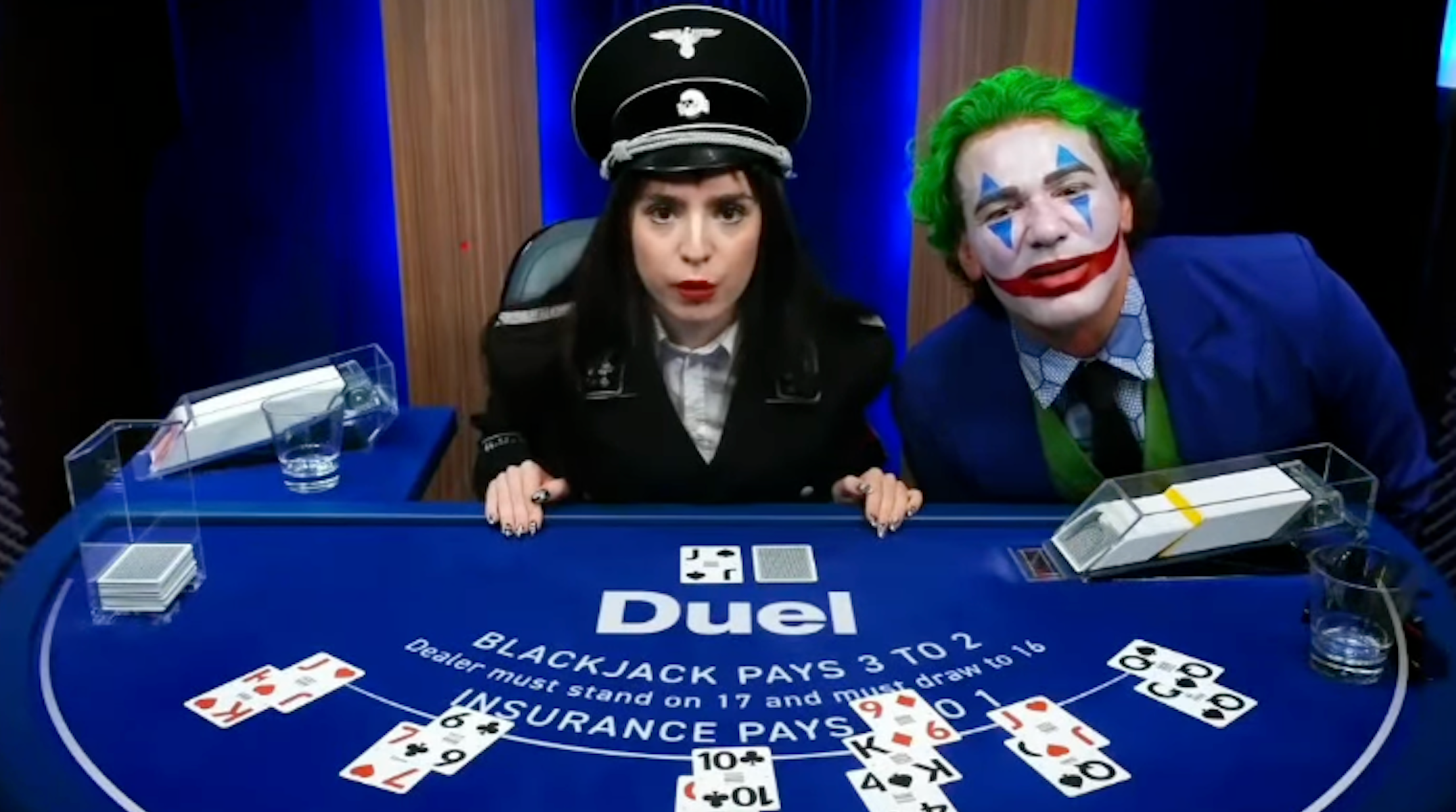
(JTA) — Nazi salutes. A swastika flag. Fights in the stands. They were all part of the scene at a recent combat sports event in Orlando that pitted an Israeli Jew against an avowed racist with SS bolts tattooed on his chest – and ended with the latter mocking his defeated foe as “a short little f–king Jew prick.”
The condemnation that followed the Aug. 29 event was aimed in a number of directions: at Paul Miller, the fighter who performed the Hitler salute after his win; at the attendees who returned the salute and displayed the Nazi flag; and at the Kia Center, the city-owned arena best known as the home of the NBA’s Orlando Magic, which hosted the fight night.
Politicians were shocked by the display and wrote statements condemning the event — but the Nazi symbols were nothing new for Duel, the online cryptocurrency casino behind the promotion.
Founded last year and billing itself as “the first casino that gives a f–k,” Duel has used Nazi symbols and racist language in its gambling programming. And its owner, Ossi Ketola, a Finnish high-stakes poker player, is himself a self-described First Amendment absolutist with his own history of racially charged comments. He celebrated his free speech devotion just one week after the Orlando event, in a social media post featuring a photo of himself with Donald Trump Jr.
One of Duel’s blackjack dealers, Nelli Levonyan, has worn a Nazi outfit with a swastika armband on multiple occasions while dealing cards on the blackjack stream. In a skit from the blackjack table that circulated online, a man, dressed up as an Orthodox Jew and holding an Israeli flag, attacked Levonyan by throwing coins at her. Levonyan’s character then sprayed something at the Jewish man — “Gassing!” he yelled — and said, “Go away from me, you dirty kike.”
In another blackjack stream, the dealer imitated one of the two San Diego mosque shooters, who killed five people in May. Levonyan has sung the lyrics to “Heil Hitler,” the Ye (formerly Kanye West) song, during a stream. She has also appeared alongside Miller while hosting the card game.
Earlier this month, Ketola joined a neo-fascist rally in Helsinki staged by the far-right party Sinimusta Liike, or the Blue-and-Black Movement. Ketola, who was dressed in a Spongebob costume, livestreamed the rally and posted the footage with the title “Saving white Finland.” Speaking about immigrants, he said that people “need to be educated about how the genes work, and how these people realistically cannot be integrated here.”
He then attended an anti-fascist rally held elsewhere in Helsinki simultaneously, prompting left-wing demonstrators to chase him and his video crew back to their car. Ketola could be heard off-camera yelling “Sieg heil” as they drove away.
“What f–king violent pussies. Imagine what f–ing leftists,” Ketola said after taking off the Spongebob costume. “You see? These right-wing people, white people, the most friendly people. I just walked there, we didn’t say anything, we didn’t do anything — we go to these leftists and they try to f–ing attack us. F–ing dumb stupid f–ing n–ers.”
The following night, Ketola attended the dinner with Trump and about a dozen others in Tallinn, Estonia, hosted by Studioworks, a company that develops software for online casino sites. Ketola posted a photo of himself and the U.S. president’s son on Instagram, and wrote that he discussed “Duel, the state of the world and current political climate with him and his staff.”
“The political situations in our respective countries have become increasingly similar, with a rising tide of violence and radical leftism in both America and Finland,” Ketola wrote. “As a firm 1st amendment absolutist and an individual with many values that coincide with Republicans and Donald Trump himself, this was a great chance to align on many things important to both.”
Neither the Trump Organization, Miller, Ketola nor Levonyan responded to requests for comment.

Duel was founded last summer and has featured some prominent personalities on its streams, including boxing great Mike Tyson — who told Levonyan, “You dumb b–h, you like Hitler” — and the “looksmaxxing” influencer Braden Peters, who is known as Clavicular.
The fight night that it organized and promoted in Orlando was its first foray into combat sports, and made for the company’s biggest splash yet. It also caught the attention of at least one watchdog and a local lawmaker.
“Right after the event there was a lot of criticism put on the venue, which didn’t have much responsibility in this, and not enough eyes on the people who actually made it happen,” Mark Pitcavage, senior fellow at the Anti-Defamation League’s Center on Extremism, told the Jewish Telegraphic Agency. (The city had said that, as an operator of public venues, it “cannot deny access because we disagree with the political ideology, opinion or perspective, regardless of the message.”)
State Rep. Anna Eskamani called for the Florida Athletic Commission to revoke Duel Arena’s license. The commission’s members were appointed by Florida Gov. Ron DeSantis, who has not commented on the event. The governor’s office did not respond to multiple requests for comment from JTA.
DeSantis’ immediate predecessor and fellow Republican, U.S. Senator Rick Scott, posted that the event was “utterly disturbing” and that “Antisemitism has NO PLACE in Florida.”
Pitcavage said that combat sports are “a draw for far-right extremists and white supremacists” who often view themselves as “white warriors.” He noted, however, that they make up a small portion of the participants and fans.
“It’s not at all surprising that some of them will get into various types of what they would consider manly, or warrior-like athletics,” he said.
Duel’s involvement in the Orlando event put the intersection of online gambling sites and far-right ideologies on his radar. “It’s something we’re starting to look into,” Pitcavage said. He noted that Duel is registered and licensed offshore on the autonomous island of Anjouan, making it more difficult to investigate.
Eskamani, who is running for mayor of Orlando, told JTA that Duel should not be allowed to operate in Florida, citing reasons that she says would beat the city’s First Amendment defense.
“These offshore cryptocurrency — I mean, there are so many red flags in how this entity is operating that from a purely financial security position for a public venue, I would not want to accept a reservation,” Eskamani said.
Duel set and promoted the matchups on the fight card, which included the kickboxing match between Miller, who goes by the moniker “Gypsy Crusader,” and his fellow influencer Ben “King” Azoulay.
Miller, who has made numerous appearances on Duel’s casino games streams, has been known to use racial slurs and denigrate minority groups in his online content. He was convicted in 2021 of felony weapons charges, and sentenced to 41 months in federal prison. He had posted about initiating a race-based civil war.
During a livestreamed conversation with Adin Ross, a Jewish streamer who has interviewed or maintained friendly relationships with controversial figures including Nick Fuentes and Andrew Tate, Miller said there are no exceptions in his feelings toward Jews.
“I respect you for having an opinion that is different from the Jews,” Miller told Ross. “But that doesn’t mean that I would not laugh if I see you in a gas chamber.”

Clips from the Orlando event showed Miller performing the Nazi salute twice after his victory — something he has done after winning previous fights — prompting a number of attendees to do the same. One fan brought a Nazi Germany flag and waved it in his seat.
“He’s not a tough guy, he’s not an alpha male. He’s a short little f–ing Jew prick,” Miller declared about his opponent Azoulay in his post-fight interview, eliciting some cheers from the crowd.
U.S. Rep. Randy Fine, the Jewish Republican firebrand whose district includes Palm Coast and Daytona Beach, posted a video of the Nazi flag being unfurled and wrote, “This is not a joke and it is not edgy. The guy who did this is old enough to know exactly what that symbol means and to know that it’s not funny. We will make an example out of him.”
Asked what he meant by making an example of the attendee, Fine told JTA, “We put the video out so he would be recognized and be held publicly accountable. Most folks are unwilling to associate with Nazis.”
Cheering Miller on ringside was Jake Shields, a former mixed martial artist-turned far-right influencer who has espoused conspiracy theories about Jews and Israel. Shields wore a shirt reading “FCK ISRL.” Myron Gaines, a prominent streamer who has spread similar conspiracy theories and performed Nazi salutes, was in the stands, and told Miller before the fight, “You fight for the goyim,” according to clips shared on social media.
Pitcavage said he has been tracking a trend of the far-right getting involved in combat sports since the late 1990s, as mixed martial arts and UFC became a more mainstream phenomenon and amateur gyms became widespread and increasingly accessible.
The ADL has flagged that in recent years “active clubs,” or “localized white supremacist crews” that gather for fight training, have become more common. The ADL writes that these groups “see themselves as fighters training for an ongoing war against a system that they claim is deliberately plotting against the white race.”
As news outlets covered backlash to the Orlando fight night, Duel issued its own statement saying it was horrified “to learn that a group of viewers were displaying symbols of hate at our event.” The company criticized the city’s “shocking remarks that the ‘First Amendment’ applies and that ‘free speech’ is permitted at their arena,” and pledged to “work with local activist groups to push back on this and ensure that this kind of hate does not fester ever again.”
The statement appeared to be an example of Duel trolling with deadpan, buttoned-up language. Before the fight, Ketola had similarly released a promotional video that appeared to be condemning Miller’s views. “Paul Miller is a Nazi. Being a Nazi is bad,” Ketola narrated, over footage of him shaking his head. “We cannot support this. The only reason we are allowing him to fight is to ensure the good guys get to add another victory to their record.”
Then, after Miller’s win, Duel’s Instagram account left a comment that told a different story.
“The good guys won,” Duel wrote.
This article originally appeared on JTA.org.
The post Nazi imagery nothing new for crypto casino behind Orlando fight with swastika flags and Hitler salutes appeared first on The Forward.
Uncategorized
I want to rescue the word Zionism. We cannot reduce a vast Jewish idea to the politics of the moment.
On Rosh Hashanah, I spoke about my predecessor Rabbi Alexander Kohut. He was the renowned European scholar who gave his first sermon here in 1885 and began with the Gomel prayer, thanking God for bringing him safely to America, to this promised land.
I need to tell you how the rest of that sermon went down. Our new German-speaking rabbi proceeded to warn our congregation about the changes he saw happening in American Judaism that threatened our connection to the Jewish people as a whole.
Two years earlier, when Hebrew Union College ordained its first class of American-trained Reform rabbis, its celebratory dinner included littleneck clams and shrimp salad: the infamous Trefa Banquet. It was a provocative declaration that American Jews were no longer bound by archaic laws that separated us from our neighbors.
Kohut cautioned that discarding tradition would leave Judaism a skeleton “without spirit and heart.” If every Jew could simply pick which rules to follow, what would hold us together as a people?
Kohut illustrated this point with a famous Midrashic parable. A group of people are traveling together on a boat. When one passenger begins drilling a hole beneath his seat, the others cry out, “What are you doing?” He responds, “Why do you care? The hole is only under my seat.” Kohut’s sermon sent shock waves through the Jewish community.
The next Shabbat, Rabbi Kaufmann Kohler, the leading voice of radical Reform, answered from his own pulpit just eight blocks uptown, arguing, “Judaism is a living faith, not a religion confined to dead letters.” For weeks, the two rabbis traded sermons before packed pews. The Kohut–Kohler debates even made the front page of The New York Times.
Later that year, Kohler helped author the Pittsburgh Platform, defining the principles of a new American Reform Judaism. Its most consequential statement was not about kashrut or ritual garb but about peoplehood, declaring, “We consider ourselves no longer a nation, but a religious community.”
America had offered Jews a radical promise: you could be fully Jewish and fully American. With America gratefully embraced as our new nation, Judaism could just be our religion, like our Protestant neighbors’ down the street. It was liberating, but it also amputated a part of Jewish identity that had been essential for thousands of years.
Of course, Judaism is a religious practice. But for centuries, it was also our law and calendar, our language and literature. Jewish identity runs through how we speak and argue and tell a joke, and through that inexplicable pull that, when something happens to a Jew we have never met in a place far away, we somehow feel it happened to us.
The 20th-century philosopher Martin Buber understood why. Most religions, he noted, begin with an individual revelation. A prophet or a spiritual teacher has an encounter and shares it with others. But Judaism’s defining religious encounter is different. At Sinai, revelation happens to an entire people. Buber wrote, “In the hour of faith, the group becomes a nation. Only as a nation can it hear what it is destined to hear.” Jewish faith and peoplehood cannot be pulled apart.
But we kept trying. Modernity asked us to check a box. Religion, race, nationality: What are we?
The author Dara Horn gives the best answer I’ve heard. She says, “It’s not complicated. It’s just old. Jews are a joinable tribal group with a shared history, homeland, and culture.” That’s a whole sentence in English, but in Hebrew, it’s just two letters: Am. We are Am Yisrael, the people Israel.
Around the turn of the 20th century, just as Reform Jews were loosening their claim on nationhood, Europe told our Jewish brethren, “Not so fast.” Pogroms swept through the Russian Empire. Political movements in Germany demanded the rollback of Jewish rights. Vienna, the glittering capital of European culture, elected an openly antisemitic mayor. And in France, Alfred Dreyfus, a Frenchman by birth, language, and military service, discovered that to his accusers, he was simply a Jew.
Europe kept asking what was called the Jewish Question: What to do with the Jews? Could they assimilate enough to belong, or would they always remain strangers in the lands they called home?
Jewish leaders began asking a different question: How can we take our future into our own hands? Different Jews gave radically different answers. Their answers came to be called Zionism.
The political Zionist Theodor Herzl asked, “How do we save the Jews?” His answer was sovereignty. Jews could no longer depend on the tolerance of other nations for our safety.
The cultural Zionist Ahad Ha’am pushed back: “What good is saving the Jews if we fail to save Judaism?” His answer was cultural renewal, a Hebrew spiritual and cultural center that could renew Jewish life everywhere.
The Labor Zionist A.D. Gordon pushed the question further: But what kind of Jews are we trying to become? His answer was labor. Jews would become rooted again by working the soil, remaking not only a homeland but ourselves.
The religious Zionist Rav Kook asked, “How can this national rebirth also be a spiritual rebirth?” His answer was redemption. By rebuilding Jewish national life, even secular pioneers participated in a sacred process larger than they understood.
There was never just one Zionism, and there still isn’t today. Early Zionists disagreed about every aspect of the state they hoped to build. Zionism was a family argument about how an ancient people takes responsibility for its future.
Journalist Haviv Rettig Gur has defined Zionism as a rescue project, because underlying all of those competing visions was one urgent conviction: There has to be somewhere in the world where we do not need another nation’s permission to live as Jews.
The Holocaust made that need undeniable. Even after the world witnessed the Nazis’ machinery of extermination, hundreds of thousands of survivors languished in displaced persons camps because most nations still refused to take us in. Later, more than 800,000 Jews were expelled from Arab and Muslim countries such as Iraq, Libya, and Iran, erasing Jewish communities that had endured for thousands of years.
And in the 1990s, Israel took in over a million Jews fleeing persecution from the former Soviet Union, and tens of thousands of Ethiopian Jews escaping famine and civil war. After the founding of the State of Israel, Jewish survival never again had to depend on whether someone else would open the door.
And that brings me to a rescue project for our generation. I want to rescue the word Zionism.
A Jewish Federation survey earlier this year grabbed my attention. Nine out of 10 American Jews believe Israel has a right to exist as a Jewish and democratic state. Nine out of 10. But only a third of us are willing to call ourselves Zionists. Why does that matter? Because when a majority of Jews reject the name Zionist, it obscures just how mainstream support for the Jewish state and attachment to Jewish peoplehood is for Jews.
Zionism, simply put, is the belief that the Jewish people have a right to self-determination in our ancestral homeland. If you believe Israel should exist as a Jewish state, you are already standing inside the Zionist argument.
Let me tell you why I am a Zionist. To me, Zionism is what becomes possible when the Jewish people can fully shape our own lives. In Israel, Jews not only live from January to December, but from Nisan to Adar, from Rosh Hashanah to Tisha B’Av. Children order ice cream in the language of our prophets. Jews have built amazing universities and hospitals where Jewish and Palestinian citizens study side by side and save lives together. Engineers make the desert bloom one drip at a time. And we live again in a land toward which Jews in exile have directed our prayers for 2,000 years.
With that return comes the responsibility to build a society worthy of our deepest Jewish values, always striving for peace. And because I know how essential safety and self-determination are for my people, my Zionism cannot deny those same fundamental rights to another. Palestinians, too, must live with dignity, security, and freedom in that land. That, too, is my Zionism.
Today, I’m not addressing the one in 10 Jews who reject the very idea of a Jewish state, though my door and this synagogue remain open to you. I’m speaking to the majority of Jews who believe in the Jewish state but refuse the Zionist name. And you’ve told me why.
You’ve said, “I don’t want to call myself a Zionist because I can’t support the Israeli government’s or military’s treatment of the Palestinians.” But Zionism is older and larger than any government. Dissent, even contempt for an Israeli leader or policy, does not place you outside Zionism. It puts you alongside Israelis who have filled the streets for years protesting their own government because of their Zionism.
You’ve said, “I’m ashamed of Israeli extremists who commit crimes in the name of religious Zionism.” But all of us should be appalled by extremist settler violence. No one should stand in the same camp with racist ministers who excuse or enable this Hillul Hashem, this desecration. Hundreds of prominent Zionists, including prime ministers, former IDF generals, and heads of the Mossad and Shin Bet, have all condemned this Jewish terrorism and demanded an end to the violence and displacement in the West Bank.
You’ve said Zionism has become a slur, “She’s a Zionist” is now shorthand for colonialism, racism, apartheid, even genocide. But these words have a history. In the 1960s, Soviet propaganda deliberately recast the Jewish national liberation movement as a colonialist and imperialist project, while using anti-Zionism to oppress Soviet Jews, even sponsoring a 1975 UN resolution equating Zionism with racism. The label Zionist has been weaponized against Jews for more than half a century.
We cannot reduce a vast Jewish idea to the politics of the moment. As British writer Howard Jacobson says, “Zionism is not a country or a system of government. Zionism is an expression of a people’s soul. It is a longing and a necessity, a utopian fantasy. It’s an understanding of history and a solution, an act of reasoning, an act of despair, a prayer, a poem, and a song.”
And since when do we Jews let other people do our naming for us? If we refuse the Zionist name because others have smeared it, or because some have stained it with violence, we hand the word to its most fanatical followers and its most hostile opponents. We abandon the Zionists working every day to build a more just, secure, and peaceful Israel for all its inhabitants. And we surrender a word that has carried the dreams, sacrifices, and hopes of Am Yisrael for generations.
One of our young Central members spent the last year in Israel, and he said his time there both increased his love for the Israeli people and his disgust for the current government. He’s not the type to join in protests, but on Fridays he traveled to the West Bank to accompany Palestinian shepherds and farmers so they could work with less fear of harassment or violence from settlers. Israeli groups call this “protective presence.” This young man called it his Zionism.
I especially want the next generation to know that claiming Zionism means believing in Jewish sovereignty and insisting that it’s not exempt from our tradition’s moral demands. It means seeing clearly where Israel has been a beacon and a blessing, and where it has failed to live up to the values stated in its own Declaration of Independence: freedom, justice, and peace, and equal rights for all its citizens.
When we fall short of our promise, as every person and every nation does, the Jewish response is not abandonment. It is teshuvah, a return to who we are meant to be. That is what Yom Kippur asks of us. Teshuvah requires honest accounting and change. But the goal of teshuvah is not shaming. Teshuvah is fundamentally an act of hope, the hope of return.
When the Israelites first returned to Jerusalem in the sixth century BCE after their first exile, they sang.
“When God returned us to Zion, we were like dreamers.” They couldn’t believe it. They were living inside what once seemed impossible: to be back in their land.
Zionism has always required that kind of imagination. Theodor Herzl looked at a scattered, vulnerable people and imagined us sovereign again in our ancestral homeland, saying, “Im tirtzu, ein zo agadah. If you will it, it is no dream.” Less than half a century later, the State of Israel was born. Impossible, until it happened.
And after the 1973 Yom Kippur War, Israelis regarded Egypt as their most formidable enemy, and the vast majority of Israelis did not believe peace was possible. But soon thereafter, Israel’s mightiest adversary became the first Arab state to make peace with it. Impossible, until it happened.
And in recent memory, after 738 days of despair and fear that we would never see every hostage out of Gaza, on Simchat Torah, two years after their kidnapping, every last living hostage came home. It was a miracle made possible by the relentless work of so many and the prayers of Am Yisrael from around the world. Impossible, until it happened.
Im tirtzu, ein zo agadah. If you will it, it is no dream.
There is so much that still feels impossible in Israel right now. But if our history teaches us anything, it’s not to underestimate what is yet to come, or our responsibility to help shape it.
Rabbi Kohut served this congregation around the time of the birth of the modern Zionist movement. His message to us in 1885 is no less true today. We Jews are in the same boat. Half of the Jews of the world live in the State of Israel. No Jew should say, “Why should I care? The hole is only under their seat.” We cannot walk away from the most important sovereign project of the Jewish people. We must proudly claim the name Zionist and take our place in the unfolding story of Am Yisrael.
The post I want to rescue the word Zionism. We cannot reduce a vast Jewish idea to the politics of the moment. appeared first on The Forward.
Uncategorized
Canadian leaders condemn shooting outside Ontario synagogue at the start of Yom Kippur
(JTA) — Canadian leaders have condemned a shooting outside the Sons of Jacob synagogue in Belleville, Ontario, at the start of Yom Kippur that left a police officer seriously injured and forced the congregation to cancel services on the holiest day of the year.
“Jewish people must be able to practice their faith safely. They deserve to live their Jewish lives proudly, freely, and openly,” Canadian Prime Minister Mark Carney wrote on X on Monday.
Ontario Premier Doug Ford joined in the condemnation with his own X post. “I’m disgusted by the shooting that took place outside the Sons of Jacob Synagogue,” he wrote. “My thoughts are with the Jewish community in Belleville and across Ontario, who have every right to gather and worship safely and without fear.”
At a press conference on Monday, Belleville’s deputy police chief Sheri Meeks identified the shooter as Shawn Ward, 29, from the neighboring city of Quinty West and the injured officer as Constable Jeff Smith.
The incident occurred at 7:10 p.m. Sunday, according to brief statements by the Belleville Police Service and the Special Investigations Unit (SIU). Belleville is a little more than 100 miles east of Toronto.
Both Meeks and SIU spokesperson Kristy Denette gave details of the gun battle that unfolded outside the synagogue, which is located at the corner of a residential street of single family homes.
The synagogue posted on social media that “there were no injuries of anyone inside the building.”
Ward allegedly arrived at the scene in a truck with a shotgun and fired at Smith, who was stationed outside the synagogue. Smith returned fire and as did a second officer who arrived at the scene.
Some 20 to 30 shoots were fired, with some hitting nearby vehicles and homes, Denette said, explaining that Ward was now in “life-threatening condition” at a hospital. Meeks added that Smith was in a hospital’s intensive care unit with serious injuries but was expected to recover.
There is a team of four investigators and two forensic investigators who are speaking to witnesses and looking through surveillance and body camera video footage, Denette explained.
A CBC report showed footage of Smith’s black unmarked vehicle parked outside the synagogue, which is now riddled with bullets, and explained that Ward’s truck was parked just across the street.
Synagogue president Norm Weddum recalled the attack for the CBC, explaining that he was ushering worshippers into the sanctuary to start the Yom Kippur services when they heard noises that sounded like “boom, boom.”
When it became clear it was gunfire, everyone ran into the synagogue auditorium and closed the doors, recalled Weddum as he described yelling at everyone to “hit the floor.”
Once the gunfire stopped, he and a number of members went to the synagogue doors and saw the impact of the gun battle and the evacuation of the shooter and the police officer from the scene by ambulance. After the attack, he said, police also entered the synagogue.
Weddum said he believed the gunman had intended to attack the synagogue but was thwarted by Smith, who had been in an unmarked vehicle.
At the press conference on Monday, a reporter asked Denette if the incident could be considered a “terrorist attack aimed at the Jewish community.”
She responded that said “common sense would say that probably was the case,” but that her department’s investigation was limited to the exchange of fire and that the Belleville police were looking at motive.
Meeks characterized it as a hate crime in a statement she made at the press conference aimed at the Jewish community.
“We recognize the concern and uncertainty many may be feeling, particularly given that this occurred near the Sons of Jacob synagogue during one of the holiest days in the Jewish faith. Let me be very clear: Antisemitism, hate and violence have no place in our community,” Meeks said.
“Every person deserves to feel safe when attending a place of worship, gathering with loved ones or participating in community life,” she stated.
There are increased patrols and heightened police presence through the city, including houses of worship, Meeks added.
A number of Canadian politicians spoke out on X against the attack, including opposition leader Pierre Poilievre and Toronto Mayor Olivia Chow.
This article originally appeared on JTA.org.
The post Canadian leaders condemn shooting outside Ontario synagogue at the start of Yom Kippur appeared first on The Forward.
