


Uncategorized
She’s a Democratic Socialist who affirmed Israel’s right to exist. Can she be LA’s next mayor?
LOS ANGELES – City Councilmember Nithya Raman won the backing of two very different organizations the last time she ran for office. One of them was Democrats for Israel Los Angeles, a liberal Zionist group. The other was perhaps the most overtly anti-Israel collective in town — the local chapter of Democratic Socialists of America. Raman’s politics divided both groups, but the unconventional coalition helped lift her to re-election.
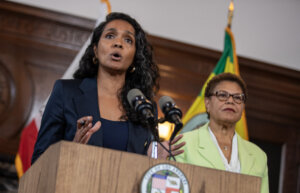
Two years later, Raman hopes to recapture that broad appeal in her bid to be the city’s next mayor. The 44-year-old DSA member, who represents parts of the San Fernando Valley, Hollywood and Silver Lake, surprised her colleagues and incumbent Mayor Karen Bass earlier this month with her late entry into the June 2 primary race. And while political observers on both coasts have noted her similarities to New York City Mayor Zohran Mamdani, whose 50,000 campaign volunteers drew from a slew of progressive groups, Raman hopes her tenure on city council — and the Jewish allies she’s made along the way — can attest to the differences.
“Mamdani is clearly a very popular politician, and so to be compared to a popular politician who is very good at communication — it’s a good thing,” Raman told the Forward in a phone interview. “I will also say that I am my own person, and I have a record of service here — five years of service to the city and to my district that clearly lay out who I am, how I have governed, and my approach.”
Raman’s relationship with DSA is something of a rocky symbiosis. In 2020, she became the first member of the movement to win a seat on LA’s city council, with left-wing grassroots organizers helping turn out a record number of voters to defeat an incumbent. Raman has since broken with DSA on votes and in public comments, on both Israel-related issues — for one, she does not support the Boycott, Divest and Sanctions movement — and municipal ones. Yet even as three other DSA members have joined her on city council — and another, Rae Huang, runs for mayor — Raman remains the chapter’s biggest star as well as its strongest candidate in the race.
Her community outreach and her openness to engaging on Israel and antisemitism have endeared her to some Jewish voters in LA’s 4th council district, and she won re-election in 2024 despite a redistricting that largely subtracted the progressive base that put her in office. She touts her second victory as proof of her broadly effective governance. But some Jewish constituents remain ambivalent about or opposed to Raman due to politics they deem insufficiently pro-Israel or because of her affiliation with DSA.
Interviews with 10 local Jewish leaders, including five who live in her district or whose institutions predominantly serve her constituents, underscored both the inroads Raman made with Jewish communities during her tenure and the difficulty she may have winning over voters citywide. (The top two primary finishers advance to a November runoff if no candidate receives a majority of the vote.)
“I know if I had a need, she would take my phone call and would do her best to be of assistance,” said Rabbi Sarah Hronsky, who leads Temple Beth Hillel, a Reform synagogue located just outside her district in Valley Village. “I think she genuinely cares about humanity. I just don’t think it is very clear to the Jewish community where she stands on the topic of Israel, and where she stands in terms of the increase in antisemitism.”
Those positions are well documented, and in some cases Raman has volunteered them. And though they were a wedge issue inside DSA, they also offer a point of departure from Bass, an establishment Democrat whose handling of Jewish issues — especially on anti-Israel protests — has been called into question.
Building a track record — and Shabbat-friendly crosswalks — in Jewish areas
Even as Raman, a Harvard-educated urban planner, soared from obscurity into office in 2020 on a groundswell of progressive activism, she did not neatly map onto DSA politics.
The national organization calls for an end to U.S. aid to Israel in its national platform, and the 90% of the LA chapter — some 2,000 dues-paying members, according to one longtime organizer — voted in 2017 to endorse the Boycott, Divestment and Sanctions movement. Raman, with DSA’s endorsement already in hand, took a softer tack that summer on a Democrats for Israel questionnaire. In a written response, she affirmed Israel’s “right to exist” and said she did not support BDS, though adding her view that such efforts are protected by the First Amendment.
“I personally am deeply upset by policy decisions in India, my own country of origin, and while I have not participated in a boycott, I understand the argument for withholding economic activity,” she wrote. (Raman moved to the U.S. when she was 6.)
With Raman an outsider candidate for the council seat and not favored in the election, the responses attracted little attention outside of DSA. She eventually won in an unusually shaped jurisdiction that included Jewish and Israeli neighborhoods like Hancock Park and Sherman Oaks and young, progressive pockets like Koreatown and Silver Lake.
“I don’t think she’s afraid to diverge from the points of view of the DSA.”
Gregg SolkovitsPresident, Democrats for Israel Los Angeles
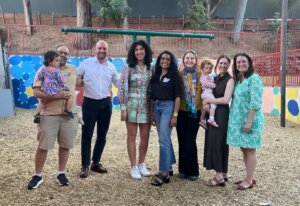
Once in office, Raman became a regular guest at Jewish community functions in and around her district. She joined Stephen Wise Temple for High Holiday services and the Silver Lake JCC for a Passover seder. Hronsky noted that Raman often stayed for the nearly two-hour duration of Valley-wide “Shabbat in the Park” gatherings, rather than the perfunctory photo-op-and-handshakes some might expect of a busy politician.
“When I ran, I actually didn’t know that this would be such a big part of my job,” Raman told the Forward. “But it’s been really good to be able to be a small part of the bigger Jewish community.”
Outside Chabad of Sherman Oaks, she helped push through the addition of a timed traffic signal that enabled Orthodox Jews to cross a busy thoroughfare on Shabbat — an improvement the synagogue’s rabbi, Mendel Lipskier, said he had sought for more than a decade.
The Hamas-led Oct. 7, 2023, attacks, in which around 1,200 people in Israel were killed and another 250 taken hostage into Gaza, thrust her connection to DSA into the spotlight.
That day, as Raman issued a statement “condemning the horrific violence by Hamas and praying for a peaceful end to this conflict,” the national DSA in its statement called the massacre a “direct result of Israel’s apartheid regime.” Raman, who had attended an Oct. 9 vigil at Stephen Wise, soon released a longer second statement in which she rejected DSA’s missive as “unacceptably devoid of empathy.”
Split constituencies
Her politics continued to defy easy categorization as the war in Gaza wore on. During a temporary ceasefire in November 2023, Raman adjourned a session of city council by memorializing the 11,000 Palestinians who had reportedly died to that point in Gaza. “My pain is unspeakable,” she said, closing the message by calling for “urgent action to stop these civilian casualties and bring the hostages home.”
The following June, she introduced a municipal resolution calling for an immediate ceasefire and release of hostages. The resolution, which never reached a vote, was slammed by the local Jewish federation and other mainline Jewish groups as “fostering hostility toward the Jewish community.” (The federation declined to comment for this article.)
The ceasefire calls put her at odds with much of her Jewish constituency, which leans heavily pro-Israel. One Jewish leader said his synagogue, which serves many of her constituents, had had to keep Raman at arm’s length because not declaring Hamas entirely responsible for the devastation in Gaza meant Raman failed some congregants’ pro-Israel litmus test.
Yet as her term wound down, Raman found the support of DFI-LA, a Democratic Party club that considers local Jewish issues in addition to candidates’ stances on Israel. Gregg Solkovits, the organization’s president, said the combination of Raman’s public statements on Israel and her community engagement outweighed the ceasefire calls.
“She had reached out to the Jewish community and made clear indications that she was willing to be educated on our issues and to work with us,” Solkovits explained in an interview, “and she has continued to do that as she’s taken office.”
The vote of confidence had been controversial within the organization. “There were members of our executive board that are very bothered by anyone who comes out of DSA world,” he said. But Raman, Solkovits added, was not as ideologically rigid as other DSA politicians.
The independent streak cost her some fans in DSA, whose LA chapter endorsed Raman but also censured her for pursuing the pro-Israel club’s support. Though Council District 4 lost DSA-friendly Koreatown in the redistricting process, Raman won reelection with a majority of votes in the first round of voting.
“I don’t think she’s afraid to diverge from the points of view of the DSA,” Solkovits said. “In fact, I think she’s broadened her base. Which is one of the signs of a smart politician.”
Raman continued to tackle Jewish issues after her re-election. After a pair of Israeli diplomats in Washington, D.C., were assassinated in 2025, allegedly by a pro-Palestinian gunman, Raman issued a statement condemning the attack as a “horrific act of antisemitism.” And when vandals spray-painted antisemitic graffiti in her district, Raman and a staffer went to paint over it.
“Ultimately, my role is to make sure that my residents feel safe, to make sure that my residents know that issues related to violence or antisemitism are being taken seriously — that our response will be aggressive, proactive, preventative,” Raman said.
But not everyone finds her record as convincing as Solkovits does — or feels as heard as Temple Beth Hillel’s Hronsky. Lindsey Imber, who sits on the Sherman Oaks Neighborhood Council, said Raman dodged her question about pro-Palestinian encampments on college campuses and never returned to the neighborhood council meetings after that.
But Imber, who is Jewish, suggested that Raman’s approach to homelessness — which included her opposition to a rule that banned encampments less than 500 feet from schools — may be just as problematic to Jewish voters as any other issue.
“That was one of the things that really created a schism between the council member and the and the actual constituency of the district,” Imber said.
Others outside the district say Raman’s DSA connections are inherently disqualifying. Nate Miller, an LA-based public relations executive who specializes in Jewish affairs, said that while he was frustrated with Bass, he could not vote for a member of the movement.
“I understand those concerns, and I respect those concerns,” Raman said. “But I think that I have been able to really, really work to make sure that the Jewish community in my district knows that I am there for them in the ways that a council member would need to be. And that is exactly the way that I would show up for them if I were to be the mayor.”
Senior leaders of several synagogues in her district — including Stephen Wise, Valley Beth Shalom and Temple Israel of Hollywood — declined to speak on the record for this story. (Lipskier, of Chabad of Sherman Oaks, said he did not follow city politics and that his interactions with Raman were limited but that “whatever we asked for, she was nice, she was available. I don’t have nothing negative to say.”)
Crossing to victory
The incumbent Raman wants to supplant is fighting to retain her own Jewish backing. Bass, who attended public high school in heavily Jewish West Los Angeles, has long enjoyed a broad base of support that includes labor unions, the liberal donor class and a coalition of legacy progressive groups.
But her approval rating has plummeted since the January 2025 wildfires, which wiped out the Pacific Palisades, a wealthy and heavily Jewish enclave. Two candidates running to her right — Adam Miller and Spencer Pratt — may siphon off some votes in the primary.
Jewish leaders also said Bass failed to deliver on commitments she made after a 2024 protest outside a West Los Angeles synagogue descended into chaos. One of those commitments was to establish buffer zones outside synagogues where protesting would be legally prohibited.
Raman told the Forward she was not sure where she stood on the issue. “The idea of protesting outside a religious institution is troubling to me,” she said, “but I also have voted to uphold First Amendment rights to speak up and to protest in the past. I think that we can find a way to balance people’s needs for safety with that First Amendment right.”
Raman will want to reignite the grassroots support that propelled her candidacy in 2020. But her late entry into the mayor’s race isn’t helping.
Raman admitted she had entered the fray too late to seek most primary endorsements, a reality underlined by Councilmember Hugo Soto-Martinez — himself a DSA member — declining to switch allegiances from Bass after her announcement. And Solkovits said he was not sure whether DFI-LA would support Raman this time around. (Bass received its support in 2024, but the group sometimes supports multiple candidates in the same race.)
And her positions on Israel make up only part of the frustrations that may be lingering among her DSA peers.
Raman broke with DSA council members on Measure ULA, a so-called “mansion tax” that had been a major progressive legislation but which Raman said hamstrung multifamily housing construction. She also voted against a $2.6 billion convention center upgrade supported by Soto-Martinez and fellow DSA member Eunisses Hernandez, who represent union-heavy districts. (Raman said the city was already under huge financial pressure and could not afford it.)
If that makes it harder to rally the base that first put her in office — and replicate the massive wave of progressive turnout that got Mamdani elected in New York — Raman says she isn’t worried.
“My goals here are centered around Angelenos, their safety and their ability to thrive in a city that is deeply unaffordable and in a city that is struggling to deliver basic services,” she said. “That’s the message that I think will activate voters.”
The post She’s a Democratic Socialist who affirmed Israel’s right to exist. Can she be LA’s next mayor? appeared first on The Forward.
Uncategorized
ICE targets an anti-Israel protester — this time, a Hasidic Jew
(JTA) — Yehonatan Ovadia, an Orthodox Jew from the anti-Zionist Satmar Hasidic sect, has joined a number of protests around New York and New Jersey against Israel.
Now, he’s at risk of being deported there.
Ovadia, 35, is originally from Israel and moved to the U.S. on a temporary religious worker visa in 2022, according to the text of a lawsuit requesting Ovadia’s release. His legal status in the U.S. was revoked earlier this year in connection with a November 2023 protest that he attended during which an Israeli flag was taken down from the town hall of Ramapo, New York. Ovadia said he was there but did not tear down the flag, and hate crimes charges against him were dropped.
But after a request to extend his stay in the United States was denied on the grounds of that protest, according to government documents shared with JTA, Ovadia was detained by the Immigration and Customs Enforcement agency in August, and remains in ICE custody in New York.
“In violation of our nation’s laws, he overstayed his welcome and refused to depart,” a spokesperson for the Department of Homeland Security told the Jewish Telegraphic Agency. “He will receive due process and remain in ICE custody pending the outcome of his immigration proceedings.”
ICE’s nationwide surge affected the area’s Jewish community earlier this year when the agency detained Ari Ladino, a Jewish bridal shop owner in Teaneck, New Jersey, and his mother. Both are originally from Bogota, Colombia.
Ovadia’s arrest by ICE comes as President Donald Trump’s administration has cracked down on pro-Palestinian activism, including with last year’s high-profile detention of Mahmoud Khalil, a prominent pro-Palestinian protest leader at Columbia University. The administration has accused Khalil and other pro-Palestinian activists and campus protesters of antisemitism.
Such an accusation would be particularly fraught against Ovadia, who is Jewish and holds anti-Israel views for religious reasons. Satmar Jews believe that a state of Israel cannot be established before the arrival of the Messiah.
In a lawsuit filed in August requesting Ovadia’s release, his lawyers argued that the Trump administration was penalizing him for protected speech motivated by religious beliefs. The government took “an official position,” Ovadia’s lawyers wrote, by preferring “one religious position within Judaism and [penalizing] an adherent of another.”
Unlike many Satmar Jews, who oppose Israel but are not active in political pro-Palestinian spaces, Ovadia has protested against Israel a number of times, including alongside members of the pro-Palestinian Hasidic group Neturei Karta.
His lawyer, Eric Lee, shared a statement from Ovadia on Wednesday after The New York Times broke the story of his detention: “From the Jewish people to our Palestinian brothers and sisters in Gaza and the West Bank and all over occupied Palestine! We didn’t forget from you! We are following you and we know that you are facing genocide! Please be strong and continue to believe!
“We know that the Zionist criminal war machine [is] torturing you every day and they want to silence you!” Ovadia said in his statement. “BUT we will be your voice! We will SHOUT AND DEMONSTRATE for you from New York, Washington, Canada, London and from every place that we can be free in the world!”
Chris Godshall-Bennet, another lawyer representing Ovadia, told JTA that the timeline on his client’s possible deportation is unclear, but the government designated Israel as “the location to which they would try to deport him” during a hearing on Wednesday morning.
Ovadia was one of two Hasidic men arrested in 2023 after a larger group protested outside Ramapo’s town hall, where an Israeli flag had been mounted a month earlier, shortly after Hamas’ Oct. 7 attacks. Surveillance footage showed at least four men removing the flag and then cutting it up with scissors, according to the U.S. Citizenship and Immigration Service’s notice of denial to Ovadia. He denied having any role in removing the Israeli flag or knowing ahead of time that his companions would do so.
He was arrested and charged with criminal mischief, petit larceny and conspiracy, all as hate crimes. The hate crime charges were dropped and in February 2024 he pleaded guilty to disorderly conduct, according to his lawsuit, resulting in a $200 fine plus an additional $125 charge.
“I said, ‘You know, I don’t have power, I’m out of money, I have no time, I am a teacher, I need to teach students every day,’” he told the Times. “‘Let’s end this with disorderly conduct.’”
With his religious worker visa set to expire in November 2025, Ovadia applied for a new visa in September, sponsored by Congregation Bnai Yoel in New York’s Orange County, according to USCIS denial notice. USCIS did not deny the request for the work visa, and said that Ovadia was not found to be “inadmissible” for a “conviction or commission of a crime involving moral turpitude.” But the federal agency did not approve the request either, and denied Ovadia an “extension of stay” in the country “as a matter of discretion,” citing the 2023 protest; without an extension of stay, Ovadia had no legal status in the U.S. following his visa’s November expiration.
The DHS said that it is “a privilege to be granted a visa or green card to live in the United States of America.”
“The Trump Administration acted well within its statutory and constitutional authority, as it does with any alien who advocates for violence, glorifies and supports terrorists, harasses Jews, and steals property,” DHS wrote.
This article originally appeared on JTA.org.
The post ICE targets an anti-Israel protester — this time, a Hasidic Jew appeared first on The Forward.
Uncategorized
French far-right leader accused of antisemitism, defended by Israeli minister
(JTA) — A French far-right leader is battling antisemitism allegations days after his party made historic gains in the country’s Senate elections — and an Israeli cabinet minister has come to his defense.
Jordan Bardella, the president of France’s nationalist, anti-immigration National Rally, came under fire this week for accusations that he made antisemitic remarks in private messages.
The controversy arose after the National Rally, whose leaders have sought to distance the party from the antisemitic roots of its founders, jumped to at least 14 seats in the French Senate elections on Sunday. The results meant the party and its allies surpassed the 10-seat threshold to form a parliamentary group in the upper house for the first time.
The Senate will remain controlled by a traditional conservative and center-right alliance, though that bloc lost several seats. The National Rally’s progress will give it more funding and better representation in leadership roles and committees.
Mediapart, a left-leaning French investigative outlet, reported on Monday that Bardella years ago allegedly sent antisemitic statements, including messages that said “all the banks are owned by Jews” and “the Jew must dominated (sic) other peoples, crush them and rob them, a Zionist is necessarily and profoundly Jewish.”
The messages were allegedly sent between 2013 and 2015, during Bardella’s early years in the party, then called the National Front. He joined the party in 2012 at age 16.
Israeli Diaspora Affairs Minister Amichai Chikli, who invited Bardella to a Jerusalem conference on antisemitism in 2025, defended him against the allegations. He told the Jewish Telegraphic Agency that he knows Bardella personally and that they are in regular contact.
Even if the quotes attributed to Bardella were authenticated, Chikli said, “a man is not sealed at 17. What matters is the 15 years that followed, and the man he became.”
Chikli referenced Bardella’s visit to the sites where Hamas killed Israelis on Oct. 7, 2023. He said that Bardella spoke in Jerusalem “against antisemitism and against anti-Zionism” and opposed President Emmanuel Macron’s decision to recognize a Palestinian state.
“No one will convince me that Jordan Bardella hates the Jewish people or the Jewish state,” said Chikli. “Just as no one will convince me that Emmanuel Macron respects them.”
Mediapart, which has a history of exposing political scandals, said it independently authenticated Bardella’s alleged conversations and drew them from a larger base of evidence corroborated by witness accounts. JTA has not independently verified the messages.
Bardella said on X that the alleged conversations were “blatant falsehoods” designed to undermine the National Rally ahead of France’s presidential election in April 2027. Marine Le Pen, the National Rally’s presidential candidate, is polling in first place as Macron prepares to step down because of term limits.
Mediapart, which has a history of exposing political scandals, said it independently authenticated Bardella’s alleged conversations and drew them from a larger base of evidence corroborated by witness accounts. The Jewish Telegraphic Agency has not independently verified the messages.
Bardella said on X that the alleged conversations were “blatant falsehoods” designed to undermine the National Rally ahead of France’s presidential election in April 2027. Marine Le Pen, the National Rally’s presidential candidate, is polling in first place as Emmanuel Macron prepares to step down because of term limits. Le Pen and Bardella have led the National Rally as a duo, and Bardella was set to be the party’s candidate until a July court ruling, which upheld criminal financial charges against Le Pen while also lifting a ban on her seeking public office. She has said she would name Bardella prime minister if she wins.
Bardella also said at a parliamentary meeting on Tuesday that he plans to take legal action against Mediapart, including possible complaints for forgery and forged documents, and accused the outlet of waging “total war” against his party. Le Pen, sitting next to Bardella, said that she had “absolute confidence” in him.
Israel’s Chikli said on social media that he and Bardella had common enemies. “Like the leftists in Israel, the leftists in France are experts at character assassination,” he said in his post, sharing a photo of himself shaking hands with Bardella at the Nova massacre site.
Chikli has cultivated ties between the Israeli government and European far-right parties, including others that have been criticized for histories of antisemitic and neo-Nazi figures in their ranks, such as Vox in Spain and the Sweden Democrats in Sweden.
Bardella, the National Rally and Chikli did not immediately respond to JTA requests for comment.
Chikli and Bardella both also accused Mediapart of a left-wing agenda. They each noted that the outlet’s co-founder, Edy Plenel, expressed sympathy in 1972 for the Palestinian militant group Black September, which killed 11 Israelis in a terrorist attack at the Munich Olympic Games that year. Plenel later disavowed those comments, which he said he made when he was 20.
Michel Wieviorka, a Jewish French sociologist who researches racism and extremism, told JTA that the antisemitism allegations strike at the heart of the National Rally’s aim to prove their “respectability.”
Le Pen has sought for over a decade to detoxify the party’s image. In 2015, she expelled from the party her father Jean-Marie Le Pen, a co-founder of the National Rally in 1972 who was repeatedly convicted of hate speech and Holocaust denial. Another founder and early leader of the party was Pierre Bousquet, who formerly served in the Nazi Waffen-SS.
Today, support for Israel has become key to the National Rally’s avowed renunciation of its antisemitic past.
“The strategy of [Bardella’s] party is to appear as the best friend of Jews, and Israel,” said Wieviorka.
Bardella invoked his visit to Israel in his denial of the alleged antisemitic messages.
“Since I began my political engagement, I have never had any ambiguity on the subject of the fight against antisemitism, to the point of being received, in 2025, by the Israeli government,” he said on X.
Meanwhile, French Foreign Minister Jean-Noël Barrot said on X that the accusations against Bardella revealed “the true face of the far right.”
“To all those with short memories: antisemitism is not a slip-up for the [National Rally], it is the history of this party,” said Barrot.
The post French far-right leader accused of antisemitism, defended by Israeli minister appeared first on The Forward.
Uncategorized
In a time of uncertainty, European Jews renovate synagogues and dedicate Torah scrolls
(JTA) —
Getting a “200-year-old lady” ready for a major debut is quite a task. But in Vienna, the Jewish community’s historic main synagogue made it just in time for the Jewish New Year.
The “lady” — Vienna’s stately Stadttempel synagogue, or City Temple — has been rededicated after more than a year of top-to-bottom renovations, from floors to windows, to the heating and cooling systems, from safety features to restroom facilities. The job cost more than 10 million euros, or $11.3 million.
The synagogue was “still beautiful but has its signs of age,” Rabbi Jaron Engelmayer told the Jewish Telegraphic Agency in a phone interview. “And it wasn’t adequate for some matters of today.”
“The whole concept was sticking to what it was and still is, but it has a new face,” said Engelmayer, who has been chief rabbi of Vienna’s Jewish community since 2020. The Orthodox congregation also inaugurated a new Torah scroll in ceremonies Sept. 15. Parts of it incorporated earlier manuscripts “written in the old synagogue of the Middle Ages in Vienna,” making it a bridge to history, he said.
Large and small, Jewish communities in Europe are marking the season of renewal in concrete ways at a time of uncertainty seeded by antisemitism and anti-Israel sentiment. In Budapest, the historic Rákospalota synagogue — used as a library warehouse for decades — recently held its first service in its renovated premises. And a 15-member Jewish prayer group in Leipzig has welcomed its first Torah scroll, on a 99-year loan.
All are looking to the future, whether fixing a hole in the roof or dedicating a holy book.
“Jews by definition have to be optimistic,” said Rabbi Pinchas Goldschmidt, head of the Munich-based Conference of European Rabbis, which represents some 800 Orthodox Jewish communities.
“They have no other choice. And having said that, if in the past there was a tendency to say, ‘okay, the situation is bad over here, let’s go somewhere else,’ today, wherever you look, the situation is not good,” he said.
Taking action is more constructive than regretting current circumstances, said Rabbi Elisa Klapheck, head of Germany’s non-Orthodox General Rabbinical Assembly, which has 45 member rabbis. “We can lament antisemitism, we can lament attacks on Jewish communities, but that doesn’t help us,” she said. “So I think on a smaller scale, but maybe a much more resilient scale, the chagim [holidays] have shown that there was a positive atmosphere.”
Ruth Ellen Gruber, developer of the Jewish Heritage Europe portal, a project of the Rothschild Foundation Hanadiv Europe, expressed amazement at the pace of the rehabilitations.
“Despite increasing incidents of antisemitism, there are so many synagogue restoration projects that I cannot keep up,” said Gruber. Whether maintenance or preservation, all are “sign[s] of resilience among Jewish communities, volunteers, researchers, NGOs, civic bodies, and others,” she said in an email to JTA.
Examples include the Ashkenazi Great Synagogue in Constanta, Romania; the grand synagogue in Metz, France; the domed synagogue in Trencin, Slovakia; the Etz Hayyim Synagogue in Larissa, Greece; and the historic Yanbol synagogue in Istanbul.
“Some will serve as museums or cultural centers that usually house Jewish heritage exhibitions; others will serve as venues for both Jewish worship and cultural events,” she said.
In Leipzig, Rabbi Esther Jonas-Maerten doesn’t actually have a synagogue building for her Beth Ez Chaim “Lehrhaus,” a study group that meets in private homes. But she now has a Torah scroll for participants in the program, which is open to all who wish to learn more about Judaism.
The scroll, on a 99-year-loan from the Kehilat Shalom synagogue in Gaithersburg, Maryland, will be formally dedicated in ceremonies on Oct. 4. “That will be the first public event with our new Torah,” Jonas-Maerten, a Conservative rabbi, told JTA in a phone interview.
After a long and fruitless search for a scroll her group could afford, she asked Washington, D.C.-based Rabbi Lauren Tuchman to share her appeal: “I wrote a letter basically saying, ‘Most wanted! A sefer Torah!” Jonas-Maerten recalled. “Within two weeks, I got a response.”
The U.S.-Europe connection has been a fruitful one, when it comes to Torahs.
Last year, the Conservative congregation Ki Tov in Warsaw received the gift of a scroll from New Jersey sister congregation B’nai Sholom/Fair Lawn Jewish Center. The scroll, originally from Europe, was donated in memory of Holocaust survivors.
The independent Berlin-Brandenburg congregation Ohel Hachidush received its first scroll in 2008 from Shir Tikvah in Troy, Michigan, and purchased a second scroll in 2024 from retiring Rabbi Moshe Halfon of Mount Sinai Synagogue in Cheyenne, Wyoming.
Both needed repair, especially the first one, Cantor Jalda Rebling, a Jewish Renewal movement ordainee who co-founded Ohel Hachidush with Anna Adam, told JTA.
“Its brokenness is also a symbol, I always say, for our Jewish history here in Europe,” said Rebling, “because all our Jewish lives are broken, and we all love this Torah.”
Vienna’s Jewish community currently has about 12,000 members. Before World War II, it numbered close to 200,000, according to the community’s website. Many fled, and about 47,000 Austrian Jews, most of them from Vienna, were murdered in the Holocaust.
Today’s community is “quite small in numbers, but very highly active and diverse in its traditions,” said Engelmayer, whose mother’s family came from Switzerland and father’s from Poland. “It goes from Ashkenazi to Sephardi, from secular to ultra-Orthodox, and it’s a whole range between. And it feels like a family.”
During Engelmayer’s tenure, “there was the COVID crisis and afterwards the war in Ukraine, which brought a lot of fugitives and refugees to Vienna – also Jews. And of course, the 7th of October, which brought a big rise in antisemitism, which is still being dealt with today.”
Nevertheless, celebrants went “through the streets of Vienna with high hats and proudly Jewish, bringing the new Torah scroll into the restored synagogue,” Engelmayer said: All those challenges led to “an increase of inner strength, of holding together, of answering to the crisis by much more Jewish life and being more active and more visible.”
The post In a time of uncertainty, European Jews renovate synagogues and dedicate Torah scrolls appeared first on The Forward.
