


Features
Part 2 of the story of the delusional Winnipeg con man: Meeting him for the first time in the summer of 2021

By BERNIE BELLAN (This is the continuation of a story that begins elsewhere on this website at The delusional Winnipeg con man who actually believed his own elaborate con and led one victim in Africa to consider committing suicide)
I actually met Fred Devlin several years ago – but never imagined that he was as delusional as I’ve now been made quite aware. As I noted in the story that did appear on my website until I removed it, Devlin believes that he is someone of incredible wealth. Not only that, as I noted at the beginning of that story, he also believes he has had a brilliant business career (and owns over 300 companies or 3,000 companies – depending on when you may have been talking to him. For instance, when I first met him – in 2021, he told me he owned over 300 companies. When I met him again just recently that figure had grown to over 3,300 companies).
He also claims that he is a fervent supporter of the State of Israel, has strong connections to the Mossad, and owns a great deal of land both in Winnipeg and in Israel. Finally, now that he had made his billions (or his trillions, as the case many be), he maintains that he only wants to devote himself to helping others – whether it is by investing in various business ventures or by engaging in philanthropic endeavours.
The problem, as I was to discover as I waded further and further into Devlin’s bizarre story, is that nothing he believes about himself is true. That, in itself, is not so unusual. Many people suffer from different forms of psychosis. The difference between most people who suffer from a psychosis and Fred Devlin, however, is that he has not stopped believing his fantasy for many years now. How long he has been suffering from his psychosis I am not quite sure because, as you might expect, no one close to him in his family is willing to talk about his illness.
And, that is one of the questions that has been plaguing me as I set out to do research for this story: Could Fred Devlin have been stopped through early intervention by individuals close to him? This fellow has been married for many years. What role has his wife played in enabling his delusional behaviour? And what of his parents? As I will explain, they have been well aware that their son is very sick. For how long, I’m not quite sure but, as I will relate, his psychotic behaviour clearly began manifesting itself when he was in his thirties – and he’s now over 60.
Devlin has been in and out of psychiatric wards – that much is apparent from stories I have been told by different people who talked to him at different stages in his life when he was actually hospitalized in different psychiatric wards. (When I was finally able to confront him about his history of being hospitalized because of his psychiatric disorder, of course he denied that’s ever been the case, but then said he didn’t want to talk about it.)
Still, after learning so much about the hurt Devlin has caused to so many people, I kept coming back to wondering what more could have been done to prevent him from inflicting so much damage – and pain, upon so many individuals over a very long period of time, as a result of his harbouring such a deep delusional psychosis? That question is at the heart of what has been motivating me to write this story.
Even as I write this – and so far the process has taken me several months, I continue to receive communications from different individuals whose lives have suffered terrible impacts as a result of having come into contact with Fred Devlin. I feel so helpless when I receive another message – whether it’s through an email, a text, a WhatsApp message, or occasionally a phone call, telling me that someone has just received another message from Devlin – again repeating the same delusional nonsense about his being fabulously wealthy and, that if they waited just a little bit longer, he was going to come through with the financial help he had promised them.
As I’ve already noted, at the beginning of February 2026, I had written the first two chapters of what I thought would be an interesting and probably for most readers, an absolutely unbelievable story about Fredl Devlin. I had posted those chapters to my website with the idea that it would certainly attract interest – and it sure did. It had over 1,000 views within two days.
But, the idea of turning that story into a story? That was the furthest thought from my mind at the time – for a number of reasons. For one, I’d never written a story and I knew how challenging an assignment that is (at least, that is – to write a good story. In the course of my career as a publisher and editor, I’ve received many books from publicists – often authors themselves, that I thought were simply awful – and could, at the very least, have used a good editor. The advent of self-publishing has led to a flood of poorly written books that, had they been submitted to a real story publishing firm, would no doubt have been rejected without hesitation.)
The other reason I was reluctant to turn what I had already written into a full-scale story was that, at first, I thought I didn’t really have enough material to warrant taking on such a daunting project. As time went on, however, and as I began to delve ever deeper into the subject matter that first attracted my attention, I began to hear from more and more individuals who were eventually to become part of the story you are about to read. I soon realized that the story was so much more complicated than I had first thought. In fact, I thought, it probably would best be treated as a continuing series of stories – much like a blog, on my own website, in which I could add new information as it came to me each day.
I wanted to expose that individual by having his name out there for anyone else who might be contacted by him with him telling them he wanted to invest in their projects. That way, I thought, anyone doing an internet search for his name would come across my story and immediately realize that this character is totally delusional – so no one would be duped by him again.
Could I have changed what I had written into something semi-fictitious by changing everyone’s names and kept that story up on my website? Perhaps. But then the story wouldn’t have had the same impact, would it? Who would have known who it was about whom I was writing? That’s the problem with writing a “roman `a clef” which, I admit, is certainly a problem with the way I’m telling the story here. My hope is that this story will serve as yet an added warning to be on guard for con artists, especially when advancements in artificial intelligence have made it so much easier to fool people into believing stories that sound quite credible. The difference in Fred Devlin’s case though has been that as he tells his stories, he sounds all the more convincing because he actually believes them. When I finally got the opportunity to confront him about his trail of deceit, however, even though he kept sticking to the line that everything he says about himself is absolutely “true,” I was able to trip him up by asking him why essential details, such as how many companies he owned, had changed from when I talked to him in 2021 to now. (You’ll see that if you read my entire interview with Devlin, which will be posted later this month.)
Here’s a short excerpt from my asking him about the number of companies he alleges to own:
“Me: How many companies now is it (in the group of companies)?
“Devlin: 3,300… 3,306.
Me: When I spoke to you in 2021, it was 300.
“Devlin: I was being honest. Okay.”
The absurdity of it all might leave you laughing, but bear in mind that I was firing rapid questions at him during that interview, trying to expose how ridiculous he was in talking about how wealthy he is. For almost everyone else to whom I’ve spoken about Fred, however, the impression he leaves is of someone who has quite a bit of money but doesn’t like to disclose the source of that money for reasons of confidentiality. That doesn’t sound so far fetched, does it?
Even as I write this I’m still in touch with people who have been contacted by the person I’m calling Fred Devlin. Several people have already read my first chapter and got in touch with me to tell me their own stories of being acquainted with Devlin.
I’m now so deeply involved in trying to help various characters in this story obtain some degree of justice over what Fred Devlin has done to them though, that I feel I owe them a duty to see this story though to the end – which may mean that I’ll be adding to this story for quite some time.
For instance, as I mentioned, I am now engaged in attempting to facilitate a lawsuit against Fred Devlin by one of the individuals who suffered the worst financial loss at his hands. While others with whom I spoke wasted hours of their time thinking that Paul Devlin was going to invest in their projects, this particular individual actually suffered real monetary loss as a result of his having signed what he thought was a fully legitimate contract with Devlin – in which Devlin assured him that he would be compensated if he were to stop paying any debts he owed to creditors. That promise to be compensated for debts ended up costing that individual a huge amount in penalties for unpaid debts.
And, even though, as I’ve explained, the lawyer who said he’s ready to file a lawsuit advised against it for the reason that Fred Devlin doesn’t seem to have any real money of his own, who knows? Maybe we’ll find that he has been given a great deal of money by his parents. Someone has been paying the charges he’s been racking up at the Fairmont, Hy’s, and other pricey establishments in Winnipeg.
As well, I’ve been helping another of Devlin’s victims – this time someone who lives in Africa. As I write this, that poor fellow has been contemplating committing suicide, he tells me; his life has been ruined so badly by his having fallen for another of the con man’s schemes. I’ve been spending a great deal of time with this poor African fellow – in fact, helping him quite a bit financially, in order to keep him from doing anything rash. That’s how badly some people have fallen prey to the con man who is the subject of this story.
Devlin’s story of conning people goes back to at least 2008, I discovered in talking to one individual who has had contact with Devlin for at least 18 years. Over a period of many years, I found in talking to others, Devlin had convinced a great many individuals that he was someone of immense wealth who was interested in helping them further their ambitions – whether those ambitions were related to business or, in another instance, to creating a charitable foundation.
But, as I’ve already noted, I did publish two chapters about the con man on my website, and I received that warning letter from the lawyer telling me that I could be sued for defamation if I didn’t remove what I had written from my website.
I had previous experience with being threatened with a defamation lawsuit. I had written an exposé of a prominent Manitoba investment fund which, I alleged, was hiding the true state of its precarious financial situation from investors in that fund. I learned from that experience that a lawyer can pick apart a story to find minute flaws and claim that his or her client was defamed as a result, no matter how inconsequential those mistakes may have been to the larger story. Even though I was vindicated in the end in that particular instance by my story eventually proving largely right – and the investment fund was forced into receivership, having to hire a lawyer to fend off a lawsuit taught me that “libel chill” is a very effective tool when someone powerful wants to squelch criticism.
Something else happened to me though, after I published those two stories to my website, and as I continued to probe ever more deeply into the story about which I had begun to write. I began to hear stories from more and more individuals how they, too, had been duped by by the individual whose real name had been exposed in the stories on my website. Their stories were all so fascinating – often bizarre, that I began to think: No one is going to believe this; it’s so outlandish.
So, if it will make you want to read on but, as you’re reading you’re going to say: This is so absurd I can’t believe this really happened, then consider it fiction in the same way that writers such as Norman Mailer, Tom Wolfe, and Gay Talese would combine elements of fiction in writing about events that were largely true. I myself don’t know how much to believe of the stories I was told by so many individuals about the person who ensnared them all in what ultimately was one giant delusion, but regardless how much of what they told me was true, the stories were endlessly fascinating.
And that’s what this story is really about. It’s about someone who was – and still is, so completely deluded that when he tells someone that he’s a “trillionaire,” for instance, or that he owns “3,339” different companies around the world well, hard as it is to believe, this guy actually believes what he is saying is true.
As I began to do research for this story I read about individuals who suffer from a delusion psychosis. I referred previously to a definition of delusional psychosis, but just to reiterate, according to the Cleveland Clinic, “delusional psychosis is a mental health condition in which a person can’t tell what’s real from what’s imagined. There are many types, including persecutory, jealous and grandiose types. It’s treatable with psychotherapy and medication.”
During the course of my over-40 year career as a newspaper publisher, I’ve met a number of strange individuals – a few of whom deserved to be put into straitjackets, but never had I met anyone whose story was so strange that when I began telling friends the story, their almost immediate reactions were along these lines: “We don’t believe you. It’s too crazy to have happened.”
I take as inspiration for this story a story that I read and reviewed several years ago, titled “Proof of Life,” written by someone by the name of Daniel Levin. That story tells the story of Levin’s having been engaged to seek the whereabouts of a young American man who had gone missing in Syria in the early days of Syria’s civil war.
Levin describes meeting a wild mix of characters in various parts of the Middle East. Whether the stories they were telling him were true or not he couldn’t actually tell for certain, he admits, but they were all so alluring that he followed up each and every one of them. In the end, he does come to a rather sobering conclusion about what happened to that young American but, like just about every other story about someone who’s gone missing during a period of great turmoil, it’s almost impossible to distinguish fact from fiction as to what really happened.
Still, it’s Levin’s telling of the story that I found so captivating. In the end, it didn’t matter whether he had cobbled together a series of disparate stories that often contradicted one another; the cast of characters he assembled was interesting enough to hold your attention without wondering whether anything Levin says they told him was true or not.
I actually interviewed Levin because I was so interested in knowing what motivated him to enter into a story that was labyrinthian in scope – and I wanted to know more about the techniques he used to get stories from some very scary characters.
I admired his perseverance in chasing down the story – at great risk to his own safety, and I have often thought of his determination not to be deterred from following wherever his story may have led him – no matter how dangerous following that road may have been.
And, because I myself still have such a hard time believing what I’ve been told in the story you’re about to read, rather than simply writing a piece of journalism based on accounts I have been told – which all contain so many gaps and rabbit holes, I thought it best to write something more speculative in which I will imagine what may have led different individuals to fall prey to Devlin’s delusion at different times. In the same way that Daniel Levin had to fill in many gaps when he was writing his story – to the point where it could easily be considered a work of fiction, I’ve had to fill in many gaps in writing this story – also to the point where I now wonder how any of what I’ve heard and read happened could really have happened?
The story begins in Winnipeg, where Devlin grew up – and still lives. According to individuals with whom I spoke who knew him when he was younger, Devlin had a normal childhood. Further, he showed exceptional promise as a student and looked to be headed toward a very successful career path. His wealthy parents were both successful in their respective careers.
Fred claimed to have been successful in business, starting from a very early age – when he was only 18 years old. In one published account he says that he had already developed several properties in Winnipeg by the time he was in his early twenties, and was already CEO of an Ontario-based development company.
Following is a story written about Fred in 1990, when he was just 24. (For the purposes of this story, I’ve changed his name in the 1990 story from how it appeared in the real story.) The story appeared in a business publication, a copy of which you are not likely be able to find anywhere. Luckily, I was able to obtain a copy of the story from someone who had managed to get a hold of a copy of the story. How he was able to do that he would not tell me.
Here is the story:
“When you first meet Fred Devlin, you are immediately impressed both by his youth and his sincerity in what he is doing with his life. At 24 years of age, he has already spent several years in the business trenches, having been the president of his own company since 1986.
“As careful with his words as he is with his investments, he has been programming himself towards success since his initial reach into the speculative market of real estate.
“With his first acquisition of a small property in Winnipeg, he formed Xanadu Enterprises (note: also not the real name of his company). While buying and selling properties yielded significant financial reward, making a fast buck was far from this young entrepreneur’s dream.
“ ‘The property market is not one which facilitates speculative investment and overnight profit,’ he says. ‘Rewards are gained through the acquisition and development of real assets, which, only under proper care, over time, can reach their true potential.’
‘ “Though Fred continues his career in the real estate industry, he decided to return to University to complete his degree in Economics, and target his newly expanded company, Xanadu Corporation, in 1987.
“Combining business with his classes has kept this self admitted workaholic on a six-and-a-half day killer schedule. From seven in the morning to midnight, his days are divided into six hours for classes and related study and six hours are devoted to his business ventures.
“Intending to enter the Master of Business Administration program in the fall of 1990, he has found that the practical experience gained through his real estate developments has complemented his classroom theory.
“With developing and managing real estate projects as his company’s mandate, Fred has concentrated on the Osborne Village area. (Osborne Village is an area in Winnipeg that is close to the downtown.) He finds the area to be ideal for his projects, with its trendy restaurants and shops, while being in proximity to the amenities of downtown.
“To this end, he recently developed Cauchon Place, a luxury condominium project, in conjunction with Tri-Star Development, an Ontario-based company of which he is Chief Executive Officer. The first phase of the project, located at 99 Cauchon Place, has been completed, and all units, valued at $130,00 and up, have been sold.
“Within two to three years Xanadu Corporation expects to have five more units ready for mixed commercial and office space. The expansion of his company has allowed Fred to take on new investors, secure a larger line of credit and utilize various tax advantages.
”Foregoing much of the immediate gratification of someone who has achieved financial success, Fred still lives at home with the two people he refers to as his best friends, his mother and father.
“ ‘I’m a fairly family oriented person and they support me unconditionally in whatever I attempt, even though I don’t always take their advice,’ he says with a smile.
“Always looking for new projects to develop, either independently or with a small group of investors, Fred is now acquiring two apartment complexes that have been converted into commercial space, again in the Osborne Village area. He also has his eye on another type of development: ‘A senior citizens’ complex,’ he says, ‘where the environment is designed to suit the tenant’s specific ethnic and social needs, rather than the needs of the developer,’ is ‘high on his priority list.’
“Anther project on the drawing boards, with a long-time friend, is a medical office, with a group of interdisciplinarian specialists who would have direct ownership in the building. ‘I’m not a fan of strip malls,’ says Fred. ‘They become indistinguishable from one another and attract an eclectic assortment of tenants. What medical office wants to be next door to a video store selling adult films? You want some control over your working environment.’
” ‘We need to stop trying to copy other cities. Just because something works for Toronto or Vancouver does not make it automatically right for Winnipeg.’ Fred adds that ‘a city has to grow to justify developments like The Forks, The Exchange District and Portage Place, with the buildings following a logical and consistent plan.’ He foresees a trend in multiple use space, combining commercial, retail and living areas in one well designed building. ‘I don’t want to sound arrogant, but I feel I have a destiny to do something of great value with my life,’ he says. ‘I want the world to know I was here.’
” ‘A building, for example, should be more than just a structure; it should improve the quality of life for the people who work and live there. That’s what I want to achieve.’
“W hen you consider that this young man started off in 1986 with an investment of $3,000 and is now 50 percent owner in a million dollar investment company, maybe we should listen.”
Pretty impressive, huh? How much of what was written in that article was true is impossible to know, but I did some investigating of some parts of what Devlin claimed to have done. I did a search for Tri-Star Development, for instance, but could find no reference to a company in Ontario by that name – although it’s possible that one may have existed in 1990. As for “99 Cauchon Place,” all that turned up was a nice looking two-unit town home on 99 Cauchon Street – but no luxury condominium project called 99 Cauchon Place.
And, as for the project that Fred wanted to develop with a friend – I contacted that friend, whose name I recognized in the original article – and was someone I knew. He told me that he had left Winnipeg in 1989 and had never entered into any sort of a plan to develop a medical office with Fred.
The author of that article passed away several years ago. I would have loved to have asked that person whether they ever did anything to corroborate any of Devlin’s story. Looking back on the inconsistencies that I was able to discern, it points to an early pattern of Devlin’s dissembling – something that was going to emerge as a much more severe issue later in his life.
One line in that story though, really resonates, when Devlin says: ” ‘I don’t want to sound arrogant, but I feel I have a destiny to do something of great value with my life. I want the world to know I was here.’
Was that the first hint that Devlin had delusions of grandeur? Perhaps, but as I was to discover, Devlin actually did embark on a course that would most likely have led to his becoming a very successful businessman had something not happened to him at some point when he was around 30. In fact, Devlin did obtain a Masters of Business Administration – in 1992.
The only other chapter of his life that I could come across, aside from that article written about him in 1990, was when he assumed a position of some authority in the area of aviation and there was a reference to him in a 1998 article noting his having become executive director of something called the Airport Area Business Development Zone. (Later, when I received a surprise message from Devlin inviting me to meet with him and did actually meet with him, he claimed to have been involved with the opening of something called Winnport. You can read the complete transcript of that meeting at the end of this story.)
What happened in Devlin’s life in the intervening years between 1998 and now I’m not exactly sure. I happened to know Devlin’s parents – not well, but well enough to have asked them years ago when it was that their son started to develop the delusion that he was a fabulously successful businessman? As one might expect when it comes to talking about a son or daughter who is clearly disturbed, Devlin’s parents did not want to discuss his situation beyond admitting that he “wasn’t well.”
That conversation with his parents – specifically his mother, however, did not occur until about six years ago, when Devlin himself had called me out of the blue, saying that he wanted to meet with me because he wanted me to write a story about him. I did agree to meet with him. I vividly recall that meeting because it was quite a warm summer day in Winnipeg and we had arranged to meet on the outdoor patio of a well-known Winnipeg pizzeria.
Not knowing what Devlin looked like, but since he had told me he knew who I was from seeing my picture in my newspaper, I arrived early so that he would be able to find me seated at a table. I was quite surprised when, despite the warm temperature that day, up walked a man wearing a trench coat – and dark glasses. He didn’t take off those glasses until well after we had begun to talk. That in itself was not so unusual; keeping that trench coat on though? That was simply weird.
As we engaged in conversation, Devlin mentioned that he quite admired my writing and what I had done with my newspaper. In fact, he said, he’d like to talk about buying it.
“Oh really?” I thought. Well, that’s interesting. But, it was when he began to describe his vast business enterprises that I began to wonder whether this guy was for real.
However, Devlin had come prepared. He had a briefcase with him – and out of that briefcase he pulled a small photo album. Among the pictures he showed me were ones of an executive jet. That jet had a logo on it – a logo, which Devlin said, was the logo of his company. He also mentioned that the late Winnipeg business mogul Izzy Asper had taken a liking to him and, in fact, had mentored Devlin for a time.
“Impressive,” I thought. But why hadn’t I heard of him? I wondered. I asked him that same question.
His answer was that he kept a very low profile, so as not to attract attention to himself. Also, since he was now so fabulously wealthy, his main goal in life, he explained, was to devote himself to what he described as “tikkun olam,” which is a phrase in Hebrew meaning “repair the world.”
To that end, Devlin said, he had established a charitable foundation and was engaged in various philanthropic projects around the world. And that’s why Devlin wanted to meet with me, he noted. He wanted me to write about all the good work he was doing in the world.
Well, that didn’t quite fit with keeping a low profile, I thought, but then again I was just the publisher of a small Jewish newspaper in Winnipeg. Writing an article about him for my paper wasn’t necessarily a contradiction of his wanting to keep a low profile. (It’s not as if you can say about being profiled in what was then The Jewish Post & News or what is now jewishpostandnews.ca: “If you can make it here, you can make it anywhere.”)
So far, so good, I thought. What Devlin was saying might be true. He just might be a very wealthy businessman – one who wanted to do good in the world. (Remember that description he gave of himself in that 1990 article.)
To reassure me that he was on the up and up, Devlin handed me a business card – with his group of companies logo emblazoned on the front. What was even more impressive was the address that the card gave as the headquarters for his group of companies: Luxembourg!
“Wow!” I thought. This guy might be the real deal. Luxembourg? You have to be of some substance to be headquartered in Luxembourg. Devlin told me to contact the CEO of his company, someone I had also never heard of, by the name of David Simkin (and, in this case, I’m using the real name that was printed on the back of that business card rather than a phoney name because, as far as I could ascertain, there is no such person as David Simkin. He’s just another figment of Fred Devlin’s delusion.)
Simkin’s name and email address, Devlin indicated, was on the back of the card. The card said that the head office for his company was in Luxembourg. At that point I told Devlin that I would look into his company with an eye toward doing a story about him. Despite his rather strange appearance and the fact that I had never heard of him, who was I to dismiss him as inauthentic? One thing about our leaving to go our separate ways that set me wondering about him when we both got up to leave, however, was his obvious discomfort when I thanked him for my meal. He seemed quite uncomfortable with having to pay the bill, small amount that it was notwithstanding.
I returned home and immediately began to look up his company name on the internet. I could find a name all right, but nothing beyond that. There was no description anywhere just what is was that this group of companies actually did or even what were names of any of the companies in the supposed group of companies.
I did send an email to the email address for David Simkin that was given on the card Devlin had handed me – and it didn’t bounce back. But when, after a couple of days of not hearing anything from this Simkin character who, Devlin had said, was the CEO of his vast group of companies, I began to suspect that the whole thing was some sort of twisted joke.
I happened to have Devlin’s mother’s phone number, so I called her. I told her about my meeting with her son. Her response, as I’ve already noted, was: “He’s not well.” She also added: “Go easy on him.”
All right, it wasn’t the first time I had met someone who had embellished their achievements and wanted me – or one of my writers, do a story saying how successful they were. I simply put Devlin out of my mind and left it at that – for a while.
Several months later, however, I got another phone call from Devlin, this time saying he wanted to talk seriously about buying my newspaper. Now, I should explain that, while I could dismiss him as a phoney, I did know his parents had money. I figured that even if he himself had no money, he could probably get his parents to put up the cash – depending on what amount we were talking about. (I should also explain that, at that point, I was quite willing to sell The Jewish Post & News. In fact, I had been actively seeking a buyer for some time – to no avail.)
I did agree to meet with him, this time at a very well known hotel in downtown Winnipeg, the Fairmont. (That hotel would come to figure prominently in many of the stories I was to hear later from many of the individuals who had fallen prey to Fred’s tangled web of deceit. And, as you will see if you read to the end of this story, it was to the Fairmont I headed when I received a surprise phone call from Devlin months after I had begun to write this story, inviting me to meet with him in person.)
We met, had a cup of coffee, but nothing ensued. There was no discussion of his buying the paper beyond his saying it was something he still wanted to do. But, what of all the good works he was doing all around the world? he asked me. Was I still willing to do a story about him?
“Is this guy for real?” I thought. I remembered the words his mother had used: “Go easy on him.” I told Devlin that I was sorry, but I just couldn’t find anything at all to substantiate what he had told me about his vast group of companies, so unfortunately there would be no story. I didn’t want to say to him what I really thought, which was that he was a total nutcase.
And, that’s where my involvement with Devlin ended – except for a chance meeting somewhere a few year later (where it was, I can’t remember) when Devlin happened to be with a woman whom he introduced as his wife. I was also with my wife, whom I also introduced. We left it at that.
Features
Musings from Dizengoff Street – by Bruce Brown (updated Oct. 5)

(Posted Oct. 6): Commemorating Oct 7 2023
Shortly after that tragic day. Visiting the haunting display of despair and hope at Dizengoff Square. The wounds still raw. Was mainly despair. With only a glimmer of hope. Overcome by the collection of bloodied and blindfolded stuffed teddy bears strewn against the Agam Fountain.
Driving home afterwards. Two songs played on the radio. One after the other. As if the music score to a very sad movie. Even today, when hearing these songs. They conjure up memories of my mindset three years ago.
George Harrison’s ‘While My Guitar Gently Weeps’. “I look at the world / And I notice, it’s turning / With every mistake / We must surely be learning / Still my guitar gently weeps…”
Paul McCartney’s ‘Blackbird’. “Blackbird singing in the dead of night / Take these broken wings and learn to fly / You were only waiting for this moment to be free / Blackbird fly / Into the light of a dark black night…”
Always remembering. But looking forward.
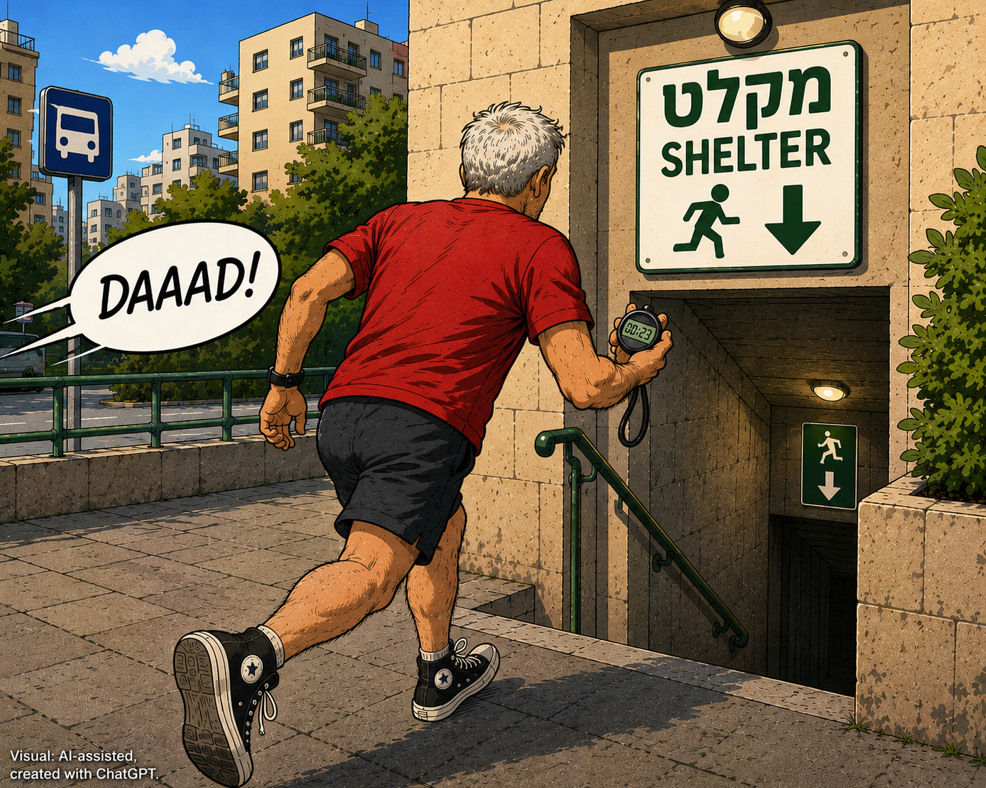
(Posted Oct. 1): So my daughter told me about the new apartment rental she was considering for the upcoming academic year in Jerusalem. “Third floor. Three bedrooms for three roommates. Twenty minutes from the university. Close to the bus stop. Grocery store nearby.” She itemized. Then with her next breath, “Shetler in the next building.” Kinda’ took my breath away. Is that where we live? What we’ve become? What pre-occupies us? Yes. Yes. Yes.
Despite my recurring safe room musings. It still kinda’ shook my core. But once I regained my existential footing. I realized how lucky we are. We have a well-prepared wartime infrastructure. We are conscious of wartime safety and security. It’s become second nature. Even when choosing an apartment. Then I recalled how last year. When my daughter first moved to Jerusalem. I focused on the shelter thing. Even timed a dash to the nearest shelter. She cringed with embarrassment. As she does with much of what I do – dad stuff and I digress. Now here she is. One year later. Itemizing her well thought out considerations. Including the shelter. I guess she listens to me after all. Well…sometimes anyway.

(Posted Sept. 28) Caution. Caution. A very long muse ahead….
So Prime Minister Netanyahu made his fifteenth address at the United Nations General Assembly. I get excited with every speech. Preparing some lightly buttered popcorn and comfortably settling in front of the T.V. for some high-stakes geopolitical posturing. And this one didn’t miss the mark and the high bar Netanyahu sets for himself.
Liked when he referred to our ‘friends’ leaving the hall before he spoke. Asking. And smirking. At the beginning of his speech. If there are any other “moral cowards” who would like to leave. He could have said much worse.
Liked his strong defense against the acrimonious, hostile, and simply incorrect accusation of genocide. Insisting, with examples, of Israel being guilty of the opposite. Supplying a million polio vaccinations. Distributing two million tons of food. Providing warnings of pending attacks -leaflets, cellphone calls, ‘knocks on the roof’ (an IDF tactic of firing non-lethal projectiles towards roof tops as warning to noncombatants to evacuate before a pending airstrike)- in civilian areas where Hamas is inevitably hiding. Netanyahu also referenced Colonel John Spencer, head of Urban Warfare studies at West Point and the preeminent expert on, well, urban warfare. Who clearly defends Israel as having done more to prevent civilian casualties in war than any other military in history. That’s quite a claim! So yes. Israel can actually be guilty of ediconeg – the opposite of genocide.
Didn’t like Netanyahu’s Ben-Gviresque defense of violent West Bank settlers. Or is it Judea & Samaria. I admittedly struggle in geographically defining the area, I digress. And didn’t like him referring to these settlers as “juvenile delinquents”. They are much more than that! If not terrorists, they should at least be called -and treated- as violent criminals. I admittedly struggle with finding the appropriate label, again digressing. Overall, this struck me as pandering to his far-right electorate. Standing before the green marble wall of the UN podium…hmmm, not the most appropriate venue for local electioneering.
Didn’t like his beeper reference. While brilliant, the pager attack in Lebanon happened in Sept 2024. Was so taken aback by this reference that I fact checked the date between mouthfuls of popcorn. And Israel already took credit for this publicly and at several international forums. Just seemed a bit dated, forced and out of place.
Liked the swipe at our ‘friend’ Mamdani. On the podium of the U.N. in N.Y. No less!
Liked his call for Jews around the world to stand tall. “Raise your head high. Be proud. Be confident. Don’t be intimidated.” He admonished. Okay, confession time. I will not speak Hebrew with the wife when travelling overseas. Am a bit scared and maybe need to stand a bit taller. I digress.
Liked Netanyahu’s callout to the Iranian people. Declaring that “The power of the people will overcome the people in power.” Although he didn’t have to provide a public service announcement for Elon Musk’s Starlink, waving a Starlink device at the podium.
Didn’t like, as pointed out by the Jerusalem Post, that there was no complementary vision to his fiery, hardline and somewhat Sparta-like rhetoric. No mention of a more conciliatory, Athenia-like vision for the day after. Emphasizing Israel’s desire for peace and what it can and has offered the world.
Loved the overall theme. That Israel will survive. And thrive. Because, as he exclaimed several times, “We have no other choice!” This was based on a reference in his address to his older brother Yonathan Netanayhu who led the rescue at Entebbe in 1976 and was the only Israeli casualty. Netanyahu even thanked the Uganda government for recently erecting a statue dedicated to his brother. Thought this a nice, personal touch.
Loved Netanyahu’s passion. His fiery indignation echoing throughout his almost forty-minute speech. His fury at the goldarn outrageous, bigoted, noxious branding of Israel as ‘bad’ by much of the world’s useful idiots. Although should have channeled some of that ire to a more conciliatory day after vision.
Anyway. As for the United Nations. That bastion of partiality and moral cowardice. Think it should be renamed the United Naars. Again I digress.

(Posted Sept. 25) Looping back to an August 9 muse about my visit to Jerusalem’s Basimta Café and its dispute with the neighborhood ultra-orthodox for opening on Shabbat. Which I felt was a bit of a storm in a teacup as there wasn’t much protest action when I visited. But kerfuffles nonetheless. Unfortunately the café decided against remaining open on Shabbat. According to the café manager “…it will return to what it was intended to be: a calm, pleasant and open place for coffee, culture and dialogue.” As it turns out, the manager is also CEO of Jews for Jesus. Which is fine by me. Live and let live. But just wondering if this was also reason for the café brouhaha. As there are many other Jerusalem cafes open on Shabbat which the ultra-orthodox do not protest against. Not that I want to give anyone ideas. Just sayin’.
(Ed. note: Just to put Bruce’s latest musing in context, here again is what he wrote on August 9): August 8, 2026)
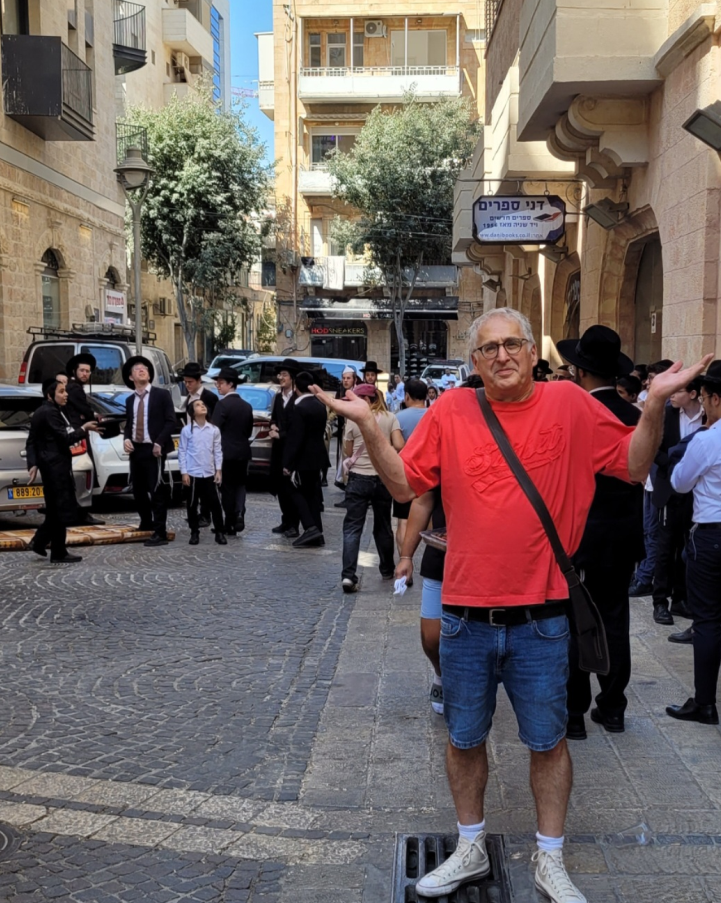
Outside Basimta Café in Central Jerusalem. Love the red shirt against a tiny sea of black. Not sure I am shrugging because of the ultra-orthodox uproar over a Jerusalem café operating on Shabbat or the lack of an ultra-orthodox uproar over a Jerusalem café operating on Shabbat. For the last six weeks Israeli headlines shouted about the cafe chaos. With the ultra-religious blocking entrances and storming the café. While shouting ‘Shabbos! Shabbos!’ Upsetting the secular amongst us just wanting to enjoy our Saturday iced matchas. So the wife and I thought we would check it out. And. Yes. Buy something to support the business. Uproar. Not. Blocked entrances. Not. Storming the café. Not. Albeit there were police barriers separating the devout protesters from the coffee drinkers. The protesters being just a few dozen black clad, pious Jews. Mostly teenagers. And yes. Shouting ‘Shabbos! Shabbos!’ Certainly underwhelming in its reported mayhem. Reminds me of the famous saying misattributed to Mark Twain – “If you don’t read the newspaper, you’re uninformed. If you do, you’re misinformed.” But I did enjoy my iced matcha.

(Posted Sept. 22) Admire him or despise him. Love him or hate him. Commend him or vilify him. Praise him or criticize him. Respect him or disdain him. Believe him or doubt him. Vote for him or not. However you perceive him. And whether you support him. Wishing Prime Minister Netanyahu a successful visit to New York and the U.N. And that we won’t have to send him a cake with a hacksaw baked inside. Mamdani… stand down!

(Posted Sept. 18) Just wonderin’. When a tree falls in a forest and no one’s there to hear it, does it make a sound? And if Iran says it’s not enriching uranium and no one’s there to verify it, do they develop fissile material?
Now Iran just obtained a seat on the General Committee of the International Atomic Energy Agency’s General Conference – how crazy is that. Like letting the cat guard the milk.

(Posted Sept. 15) Apparently some superheroes are against us. But not really. Whewww!!! Fortunately it’s just the progressive actors who play them in movies. Such as Benedict Cumberbatch (Dr. Strange) and Mark Ruffalo (the Hulk) as well as other minor actors not worth mentioning. What are these misinformed thespians aligning themselves with. Not sure they really know. Well. It’s with The Freedom for Marwan campaign, which pushes for the release of convicted, arch-terrorist mastermind Marwan Barghouti. Convicted in 2004 and sentenced to five life sentences plus 40 years for orchestrating various heinous shooting sprees in Israel during the Second Intifada (2000-2005). Killing and wounding too many innocent Israeli civilians including a Greek Orthodox monk outside Jerusalem. As a comic book fan, and closet Batman and Aquaman (when I swim), it saddens me that these guardians of the universe can be associated with defending evil. But then I remind myself it’s only the actors -what do they know anyway- and not really the superheroes. Unlike our own Gal Gadot (Wonder Woman), Natalie Portman (the Mighty Thor), Shira Haas (Sabra) and Liev Schreiber (Sabretooth). All firmly on the side of good.

(Posted Sept 10) Honey cakes. Honey cakes. Honey cakes. It’s that time of year. Yummy! Here comes Rosh HaShana 5787. And its…. You guessed it. Honey cake season. That light brown loaf our baba used to make. Starting a few weeks before Rosh HaShana and extending through Yom Kippur – a first bite to break the fast and usher in a sweet year- honey cakes are found throughout the country. The familiar sight of the ready-made, pre-packaged, ‘assembly-line’ honey cakes wrapped in cheap cellophane found in Grocery stores. The freshly baked honey cakes adorning window displays at local bakeries. The exorbitantly priced, gourmet honey cake desserts offered at fancy Tel Aviv restaurants. And of course, honey cakes festooning the festive, colorful, Rosh Hashana dinner tables across Israel. I bake my own honey cake which is pretty good. My wife and kids would beg to differ. But these slightly glazed honey cakes -of my own culinary, shtetl inspired creation- are heartedly enjoyed by me as I gain several honey cake induced pounds. Shana tova!

(Posted Sept. 8) Hoarding. A combination of my own little wartime PTSD and some recent headlines about Iran trying to coordinate a multifront attack (is that capability still there?!) and October 7 like rumblings from the West Bank (or Judea & Samaria, depending if you wear a kippa and if its knitted and if it tilts to this side or that side -that’s a shtetl insider joke). I digress and Yikes! And we just had a nation-wide drill of the IDF’s top-level headquarters preparedness for such scenarios. Double Yikes! So ya. I’m always checking and rechecking that we have way more than enough of some things. The thought of entering another prolonged war and some stuff no longer available, even for a short time, scares the bejeebers out of me. Just writing about it triggers the ‘go and buy’ dopamine hit. Medications. Toilet paper. Bottled water. Canned goods. Also worried about the country running out of bullets. But I can’t hoard those.

(Posted Sept. 5) An open letter to the zany and zealous mouthpieces of those delightful, anti-Israel protests held regularly in Toronto. In the heavily Jewish Bathurst & Sheppard area no less. Fear and harassment in the community? Not by the hairs of our chinny chin chins.
Dear Friends.
Are you serious.
Sincerely,
Bruce Brown, a Zionist who does not rape children. Who does not murder children. Who does not eat children. And, get this, who lives in Israel.
(Ed. note: To better understand what Bruce is talking about, go to this story on our website: Police open hate-crime investigation)

(Posted Sept. 1) Can you be more of an international embarrassment and liability? Yes talking about Israeli’s antagonist extraordinaire and National Security Minister Itamar Ben Gvir.
Declaring that Israel should kill ’30-40 Gazans a day’. Seriously?!?! His actual statement may have been more refined and qualified. But it doesn’t really make a difference. That’s the takeaway. Like whose side is he on anyway. Talk about giving our detractors ammunition to delegitimize our little shtetl. Hello?!?!
And a few days later. Showing off in front of a gallows site under construction at a high security prison. Seriously?!?! The death penalty for terrorists. Right or not – I think the former. But like can you give us reason to be compared to an extremist state. That’s the takeaway. Like whose side is he on anyway. Talk about giving our detractors ammunition to delegitimize our little shtetl. Hello?!?!
Serenity now!

(Posted August 28) Kites. Color. Childhood. Hamas and friends should watch Mary Poppins with the final kite flying scene. Remember that song, Let’s Go Fly A Kite. Ya, I know. Somewhat ethnocentric. But still…. I have fond memories of flying kites with my kids. Down the Mediterranean shoreline in Tel Aviv. At the Ness Tziona kite flying festival. Along the green grounds of the Weizmann Institute. Laughing and running. Looking to the sky with awe. Multi-shades and fancy. Kites.
With your fist ‘olding tight
To the string of your kite
…oh, oh, oh!
Lets go fly a kite
Kites. Fun. Laughter. Innocence.
Kites. Not an instrument of war.

(Posted August 25) How principled can you be! Ireland -one of the most anti-Israel and foggiest countries in the EU- insisted that its government’s new, 60$M executive jet NOT be equipped with Elbit’s FalconEye navigation system, which helps pilots navigate in fog -how ironic- and other difficult weather conditions. Without this unique system the plane must be diverted to alternative airports. This a part of the government’s official boycott of Israeli goods. So good luck to Prime Minister Michael Martin in landing his aircraft in Dublin.
And despite some negative sentiment towards everything Israel, Elbit achieved over 32$B in backorders with Europe driving much of its export growth. On a more personal muse. The morning after Iran’s first attack on Israel (April 13 2024), I woke up not with fear and panic. Well. Okay. Some of that. But also great excitement regarding an investment opportunity which developed overnight. Actually it was the wife’s suggestion. After Israel successfully intercepted over three hundred missiles and drones – showcasing the strength of Israel’s defense industry- my wife had a eureka moment. What better public relations for Israel’s defense industry. Let’s buy stock in Elbit, a key player in that ecosystem. We did. And about eighteen months later we cashed in. With about 150% profit. This is not an endorsement to buy… blah, blah, blah….
Again. Good luck to Prime Minister Martin.

(Posted August 21) Sometimes musings are terribly sad. But should be shared.
Happy belated birthday beautiful Ariel. Turned seven on August 5th. Thought about him and his younger brother Kfir and mother Shiri. All murdered by Hamas shortly after their unbelievable and surreal abduction on Oct 7 2023.
As I was driving home today. “I Thank You Child” by Zakk Wylde shuffled onto my Spotify. Always kills me, this song. It was played by Yarden, the father who himself was held hostage, at the funeral of his family. For Ariel and Kfir. The lyrics chilling. The frequent drum rolls haunting.
It was you who made living all worth the while
Oh, I thank you, my child
Comfort in your eyes
For the warmth inside your smile
Faith’s done gone astray
It was you who made living all the while
All my fears repressed
Oh lovin’ you child it’s the best
This song. Written almost thirty years ago. Finds its devastating meaning today. With the Bibas family tragedy.
How.
Listen to the song here:
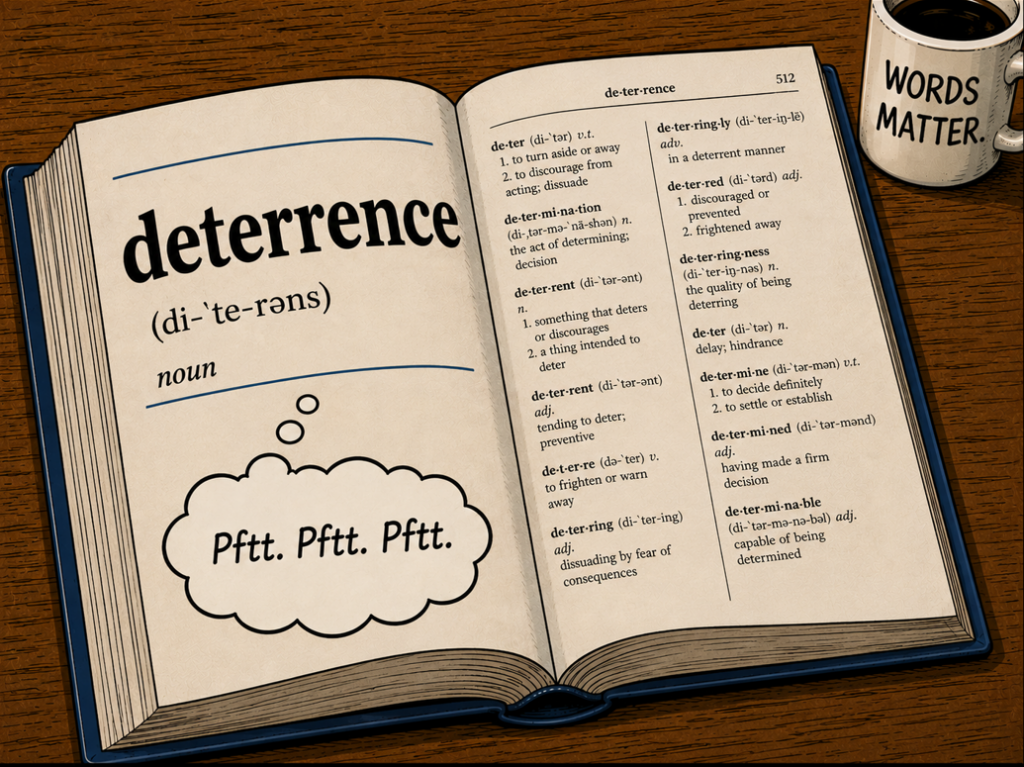
(Posted August 18, 2026) And the beat goes on in the strait. A bit quieter lately although may be heating up again with the 60day ‘ceasefire’ officially expired. And while Iran occasionally lashed out over the last two months, they did not attack Israel. How do you spell deterrence. According to my Yiddisha mama, its spelled ‘Pftt. Pftt. Pftt‘.

(August 14, 2026) Despite three years of varying degrees of warfare. Moody’s biannual report of the Israeli economy was quite positive. Basically, the report saw no pressures on Israel’s credit rating. While the macro data remains strong, Israel still faces a complex geopolitical situation further complicated by upcoming elections (we pondered about how crazy that is in an earlier muse). And Israeli’s inflation rate for the first half of 2026 fell to a historic five year low of 1.2% (vs Canada’s 2.6%). As for my own pocketbook. Haven’t had an infamous Israeli bank overdraft in years. So all is fine.
If that’s not enough economic voodoo talk for one musing. According to one famous barometer. Israel moved to second place in the Economist’s Big Mac Index. Introduced in 1986, this tasty indicator compares the purchasing power parity across countries by measuring the price of a McDonald’s Big Mac -which most can relate to- against the benchmark U.S. burger. So while a Big Mac in the U.S. costs $6.22. In Israel it costs $7.67, the second most expensive place to buy the hamburger in the world, Switzerland being the most pricey at a whopping (no reference to Wendy’s) $9.04. While the cheapest Big Mac can be enjoyed in Indonesia at only $2.38. Canada ranked 22nd of the fifty-four countries considered, at $5.85. Parity. Smarity. I’m going for my Big Mac fix. Just after I finish writing this muse….

(August 11, 2026) Bravo Boy George. We certainly will dance again! And what better way than with his new reggae tune. Now Boy George is dealing with a hostile backlash against his just stand for Israel. Having to withdraw from London’s East End production of Jesus Christ Superstar where he was going to play – guess it. King Herod. Never a big Culture Club fan, but I am anyway -as a sign of support- going to download his greatest hits to my Spotify library. And hoping to have a chance to buy a concert ticket should Boy George perform in Israel. Kind of reminds me of Bob Dylan’s 1983 song Neighborhood Bully. Also in defense of Israel. I’m going to download that song as well. Although don’t think he was hounded the way Boy George is now. Sign of the times I guess.
+++++
Coming clean. I sometimes find myself chanting, to no one in particular, that snappy little ditty ‘from the river to the sea, Palestine will be free.’ Now why can’t we come up with something as catchy. With such an impressive gene pool of great Jewish songwriters. George Gershwin. Irving Berlin. Burt Bacharach. Carole King. Neil Diamond. Leanard Choen. Paul Simon. Gene Simmons, Amy Winehouse. Bob Dylan. And yes, even the Buddhist Boy George. And still… gurnish! No wonder we’re losing the global PR battle
(August 8, 2026) Outside Basimta Café in Central Jerusalem. Love the red shirt against a tiny sea of black. Not sure I am shrugging because of the ultra-orthodox uproar over a Jerusalem café operating on Shabbat or the lack of an ultra-orthodox uproar over a Jerusalem café operating on Shabbat. For the last six weeks Israeli headlines shouted about the cafe chaos. With the ultra-religious blocking entrances and storming the café. While shouting ‘Shabbos! Shabbos!’ Upsetting the secular amongst us just wanting to enjoy our Saturday iced matchas. So the wife and I thought we would check it out. And. Yes. Buy something to support the business. Uproar. Not. Blocked entrances. Not. Storming the café. Not. Albeit there were police barriers separating the devout protesters from the coffee drinkers. The protesters being just a few dozen black clad, pious Jews. Mostly teenagers. And yes. Shouting ‘Shabbos! Shabbos!’ Certainly underwhelming in its reported mayhem. Reminds me of the famous saying misattributed to Mark Twain – “If you don’t read the newspaper, you’re uninformed. If you do, you’re misinformed.” But I did enjoy my iced matcha.

(August 6, 2026) Here we go again. Another round of forever negotiations. As someone who negotiates for a living. The way things are going in the straits. If I had to recommend a book on the subject to a new hire. Between The Art of the Deal, A Presidential Edition by Donald J. Trump or The Real Art of the Deal by the Mullahs of Iran with a special forward by the IRGC. Well. I would choose the latter.

(August 3) Bravo Yoav Segalovitz, Liberal Yesh Atid MK and Monsour Abbas, United Arab Ra’am MK and party head. For breaking a glass ceiling where a Jewish lawmaker joins an Arab political party. No less a political earthquake in my little shtetl. Which can significantly impact coalition block arithmetic and posturing and strategy in the upcoming elections. Now Ra’am can be considered a legitimate ‘Zionist’ partner when forming coalition blocks and potentially pushing the ‘center left/right’ party over the 60 seat majority threshold. In our crazy parliamentary democracy defined by a multi-party (about fourteen!!), proportional representation system. To paraphrase Winston Churchill, Israel’s proportional representation model of governance is the best parliamentary democracy system except for all other forms of working democracies. Stay tuned for more amateurish political musings as we move towards Israel’s 26th national election – five of them held since 2019.

(August 1) Although both sides say they are open to diplomacy. Neither really trusts the other. And American military action, or its threat, continues. I read headlines in the middle of the night -it’s a nervous habit lately– that the Dynamic Duo of Trump and Netanyahu may again strike in unison. Possibly this weekend. Yikes! Prompting me, at 2:30 AM, to dash around the house stocking my safe room. Bottled water. Canned food. Medicines. Documents. The beat goes on….
If it’s crazy here. It’s insane in Italy. With a recent online ‘Jew Hunt’ in the Milan area. Before being removed, the digital forms urged reportings of Israelis and Italian Jews staying in local hotels. The infamous Global Sumud Movement -yes, the one coordinating ‘peace and humanitarian’ flotillas to Gaza- was somehow connected. Although they deny involvement?! This deranged decree was looking to identify Zionist tourism and Zionist neo-colonization in Italy. I’ll stick with stocking the saferoom.
Then there’s New York Mayor Mamdani, a Global Sumud Movement supporter, threatening to arrest Prime Minister Netanyahu if he comes to New York. But since discovered he has no legal right for such a grandstanding, antisemitic, anti-Israel, anti-Western, anti-democratic antic. Maybe Mandami should be arrested! Or at least impeached. For being a grandstanding, antisemitic, anti-Israel, anti-Western, anti-democratic mayor.
Here’s a post Bruce sent us Friday, July 31:
WARTIME MUSINGS
Should credible threats against FLOTUS and ‘FSOTUS’ (first son..) not be justification to attack first.
As for yesterday’s summit. Netanyahu really can’t win. Explainer. If Trump now attacks without victory its ’cause of Netanyahu. If Trump now attacks with victory its ’cause of Trump. And, in Israel, if Trump doesn’t attack -victory or not- Netanyahu failed in his eighth meeting with Trump. And if Trump does attack -victory or not- half the country will vilify Bibi anyway. Missing a permutation?
Ya. I know. Kinda’ need a definition of victory for that musing to work.
And here in my little shtetle. We go to sleep unsure if there will be a code red in the middle of the night. And if not. We wake up thinking it will be tonight. How do you define stress?

Seemed like an appropriate way to end this musing.
Bruce Brown is a former Winnipegger who made aliyah to Israel over 35 years ago. Bruce first began writing for us – in his own inimitable style, in 2012, during what was known as “Operation Pillar of Defense.” His occasional musings on aspects of life in Israel that were far from what you’d typically read in other reports from Israel were hugely popular – both in the print Jewish Post & News and on this website.
We’re now glad to report that Bruce is back writing for us – this time on a regular basis. We will post Bruce’s reports as they arrive – with the date of each post at the beginning of that post.
Here’s some information about Bruce – and awards he’s received for his writing:
Bruce Brown. Canadian born. Now living in Israel (for a long time). Bruce works in Israel’s hi-tech sector by day and, in spurts, is a somewhat inspired writer by night. He received the American Jewish Press Association’s award for writing excellence in 2019 and 2025. And wrote the1998 satire, “An Israeli is….”. Bruce’s visuals are AI-assisted and created with ChatGPT under his inimitable visual concept and creative direction. Bruce’s musings are political, social, economic and personal. With lots of biting, contrarian, sardonic, irreverent and mischievous insights.
Features
How the Experience Changes From Spectator to Player in Perya Games

Perya games often attract a crowd for a reason. Standing near a booth during a fiesta lets you track the colors, follow the dice, and read the reactions around the table. The tension builds with every roll, yet nothing personal sits on the line when you choose to watch. The moment you place a bet, the same game can feel entirely different, because what used to be casual observation turns into a committed choice with a real outcome.
This guide breaks down the difference between watching a perya game and actually playing one, including how digital Perya and online color games shift the social feel of the experience.
Quick Overview
Spectatorship allows time to observe. A viewer can study color trends, listen to other players’ comments, and enjoy the drama without making an immediate wager. Participation requires a decision before the result, plus the emotional and financial weight that tends to follow each round. Digital perya adds another layer by moving the experience from a shared booth environment to a private screen.
The Core Difference: Distance vs Decision
Watching provides distance. A spectator can linger for multiple rounds, note which colors appear, and talk to friends nearby. No deadline exists to commit, and leaving the booth stays simple because no money has been placed.
Playing removes that cushion. A player selects before the outcome appears. In a traditional perya color game, the decision comes first—choose a color—then the operator rolls three colored dice. Philippine event references often describe the same basic structure: a color choice followed by a three-dice result.
Why Watching Can Feel Lighter
From the sidelines, everything becomes easier to take in. A spectator can catch small details: one player switching picks at the last second, someone celebrating loudly, or the operator preparing the next round. With no wager involved, attention can stay flexible.
Spectators also get to mentally “test” picks for free. A viewer might think, “I would have chosen red,” without any consequences. When a player makes that same pick with money attached, the result tends to land harder. A win may feel like relief, while a loss can lead to disappointment, surprise, or the urge to jump into the next round quickly.
A Fiesta Scenario: When a “Streak” Becomes a Trap
Consider Nico, a typical fiesta visitor. Nico starts out watching the Color Game from behind the crowd. After three rounds, red appears more than once, and the repetition begins to stand out. From a spectator’s angle, noticing a “streak” feels like harmless pattern-spotting.
Once Nico decides to play, the emotional temperature changes. Money becomes tied to a color choice, and the next roll becomes personally important. The key issue is predictability: seeing repeated results does not create proof that the next outcome will follow the same direction. A sequence of earlier colors offers history, not certainty.
The Social Experience: Booth Culture vs Private Play
Perya in the Philippines is often tied to community celebrations. A traditional peryahan sits alongside rides, food stalls, and other booths, creating an atmosphere that feels closer to public entertainment than a quiet gambling setting. Many descriptions of perya culture focus on that social environment—neighbors gathering, friends commenting on outcomes, and strangers reacting together in real time.
This setting affects the split between watching and playing. Someone standing beside the booth can laugh, talk, and observe without the same pressure a bettor feels. Players stay inside the same lively space, yet attention narrows to selecting, waiting, and reacting.
Online perya removes much of that layer. The game may look familiar, but the crowd energy, booth sounds, and spontaneous conversation get replaced by an app interface. The experience becomes more individual, even when the rules resemble the ones used in physical perya booths.
Online Perya and Digital Color Games: What Carries Over, What Changes
Searches for “online perya” reflect how the term “perya” goes beyond a direct English translation of fair or carnival. In local use, it connects to fiestas, attractions, booth games, and shared social time. A digital platform can copy the mechanics of a particular perya game while leaving behind the environment that gives it much of its personality.
GameZone’s perya-related materials, for example, describe digital versions of familiar concepts such as Color Game and other arcade-style titles. Its Color Game format references six colors and three dice and includes reminders that previous results do not function as reliable predictors for future rounds. Gameplay familiarity and lived experience do not always match, especially when the setting shifts from a shared booth to a personal screen.
Pattern-Watching and the Illusion of Predictive Power
A common mistake involves turning observation into assumed advantage. A spectator might watch a sequence such as:
Red → Red → Blue → Red
and start looking for a rule. That mental move makes sense because humans naturally search for order in random sequences. Gambling research often discusses cognitive biases tied to pattern detection, including how representativeness and availability can influence judgment in chance-based activities such as dice tasks and bingo-style environments.
A pattern that feels meaningful may still fail as a guide. Past outcomes help describe what already occurred, rather than guarantee what happens next. Treating streaks as certainty can push decisions that rely more on emotion than probability.
Watching vs Playing: How Reactions and Behavior Shift
A spectator noticing repeated colors may treat it as casual information. A player seeing the same repetition may feel pressure to act on it, even without any real evidence that the next roll will follow the same direction.
Choice also reshapes emotional response. A viewer can imagine different picks without consequence. A player must commit to one selection, which makes uncertainty feel immediate. When a result conflicts with expectations, a spectator continues watching. A player may feel disappointment and consider changing strategy or betting again quickly.
Other people’s reactions land differently too. From the sidelines, celebrations and complaints add entertainment. From inside the game, those reactions can affect mood, focus, and decision timing, especially between rounds.
Risk and Responsible Play: When Money Enters the Picture
The gap between watching and playing becomes more serious when wagers are involved. Spectating stays low-risk entertainment. Playing introduces financial exposure and the need for self-control.
Time and budget planning can matter more than “reading” the table. Increasing a stake due to frustration, treating near-misses as signals, or believing a result is “due” can lead to impulsive choices. PAGCOR’s responsible gaming guidance commonly emphasizes setting time and money limits, expecting that losses can happen, avoiding borrowed funds, not chasing losses, and using self-exclusion tools when stepping away becomes difficult.
GameZone Notes: Licensing, Age Limits, and Official Sources
GameZone, also referred to as GZone in some materials, appears on PAGCOR’s regulatory listing as GAMEZONE (TOTAL GAMEZONE XTREME INCORPORATED), and the platform identifies itself as PAGCOR-licensed. Its terms and login flow indicate access for qualified users aged 21 and above, including an age confirmation step.

For iPhone users, the Philippine App Store listing for GameZone – #1 Tongits Platform identifies DigiPlus as the developer and lists an iOS 15.0 or later requirement. Verifying developer details and using official store listings can help avoid unofficial download sources.
FAQ
Is watching a perya game different from playing one?
Watching involves observation without wagering, while playing requires a personal decision and introduces financial risk.
Does watching many rounds help predict the next result?
Multiple past outcomes can show what has happened, but a sequence alone does not establish a dependable prediction for the next round.
Can people under 21 use GameZone?
GameZone’s terms and login requirements restrict registration and play to qualified individuals aged 21 and above.
Features
THE RED INHERITANCE — PART 2
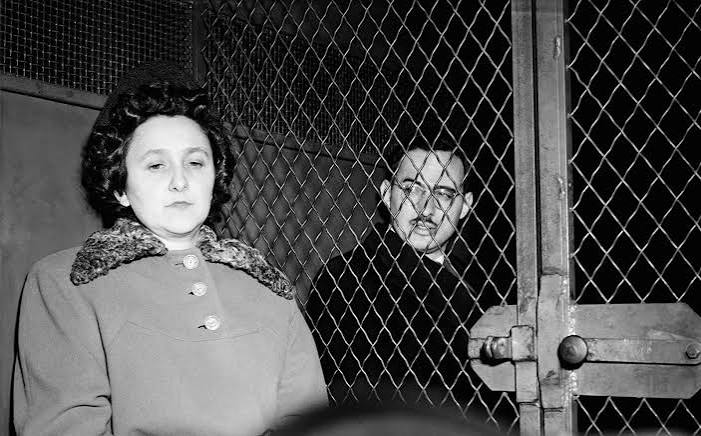
(Ed. note: If you haven’t read Part 1 of “The Red Inheritance,” you can find it here: The Red Inheritance.)
By H.C. Piloski
FOREWORD
The Wider Circle
What follows is not a continuation so much as an expansion. The first part traced a single thread — a granddaughter’s attempt to understand the man whose life shaped her own. But every thread, once pulled, reveals others. And every inheritance, once examined, widens into a circle.
This second part enters that wider circle.
It begins with a photograph discovered only after the first part was finished: a small, creased image of a protest on Carlton Street in June 1953. In the blur of bodies stands a young man — Rachel’s grandfather — raising his hand in defense of Julius and Ethel Rosenberg, two American Jews condemned in a trial that divided a continent. That photograph opened a door Rachel had not known existed.
It revealed that her grandfather’s world was not confined to Winnipeg’s North End, nor to the furnace rooms and union halls where he spent his working life. His convictions reached outward — to New York, to Europe, to Israel and Palestine, to the global struggles of the twentieth century.
This part follows those convictions.
It traces his years in the CPR union, where he learned solidarity not as a slogan but as a practice. It follows his activism within the Jewish left — activism that began long before his retirement, rooted in the political commitments he carried through the railway yards, the union halls, and the neighbourhood streets of the North End. It examines his belief in Israel’s creation and his unwavering insistence on Palestinian rights. It explores his commitment to nuclear disarmament, his distrust of state power, his hope for a world that might yet choose justice over fear.
It also follows the path of his son — Rachel’s father — who walked beside him for a time before turning away, carrying both admiration and ambivalence. And it follows Rachel herself, as she moves from personal memory into historical inquiry, discovering that her grandfather’s life was part of a larger, often contradictory, often painful, always human story.
This part is not an attempt to sanctify him. It is an attempt to understand him — and the century he lived in.
The shadows are real. The contradictions are real. The hope is real.
This story is one thread in a larger tapestry of inherited memory and consequence. And the circle continues to widen.
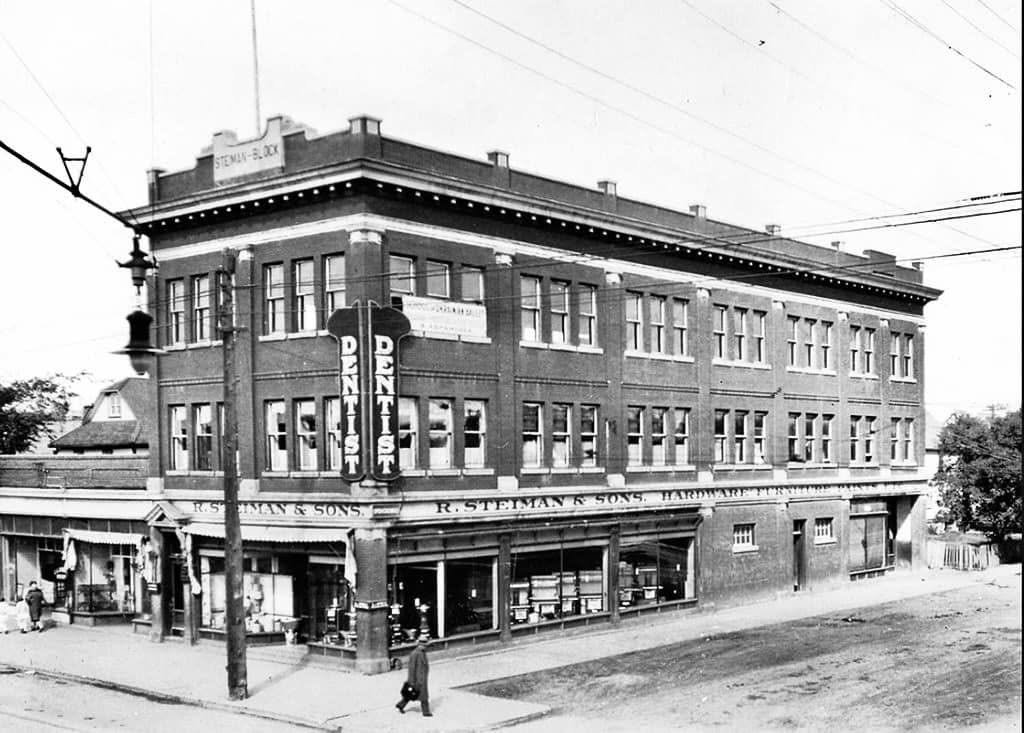
PROLOGUE
Rachel had always believed her grandfather’s world ended at the corner of Selkirk and Salter — the bakery, the union hall, the old brick houses of the North End. It was a geography of memory, not history. A place where men argued about wages and women argued about recipes, where politics was spoken in kitchens and carried in pockets, folded like prayer.
But after he died, and after she finished the part she thought would be the end of it, she found the photograph.
It was small, creased, almost brittle. Her father had tucked it into a folder he hadn’t opened in years. On the back, in her grandfather’s handwriting, were the words: Carlton Street, June 1953.
On the front: a crowd of men and women standing outside the old Winnipeg Free Press building. Some held signs. Some shouted. Some looked frightened. And there, almost lost in the blur of bodies, was her zaida — younger than she had ever seen him, his hair black, his jaw set, his hand raised in a gesture that was not anger but insistence.
She didn’t know what the protest was about until she looked up the date.
The Rosenberg execution.
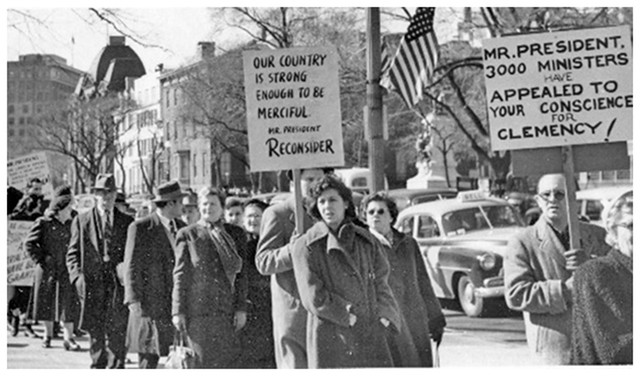
Her grandfather had stood on Carlton Street, in Winnipeg, protesting the death of two American Jews accused of betraying their country. He had stood there as though the fate of strangers thousands of miles away was somehow his own.
That was the moment Rachel understood: Her grandfather’s world had never been small. It had only been local.
The circle was wider — far wider — than she had ever imagined.
And if she wanted to understand him, truly understand him, she would have to follow that circle outward: from Winnipeg to New York, from union halls to espionage files, from the Holocaust’s shadow to the contradictions of Israel and Palestine, from Cold War paranoia to the fragile hope of peace.
She would have to learn why a man who loved his family so fiercely also believed he owed something to the world.
She would have to learn why her father followed him for a time, and why he stopped.
She would have to learn what it meant to inherit not only memory, but conviction.
Rachel closed the folder. She packed a suitcase. She booked a flight.
The wider circle had opened. She stepped into it.
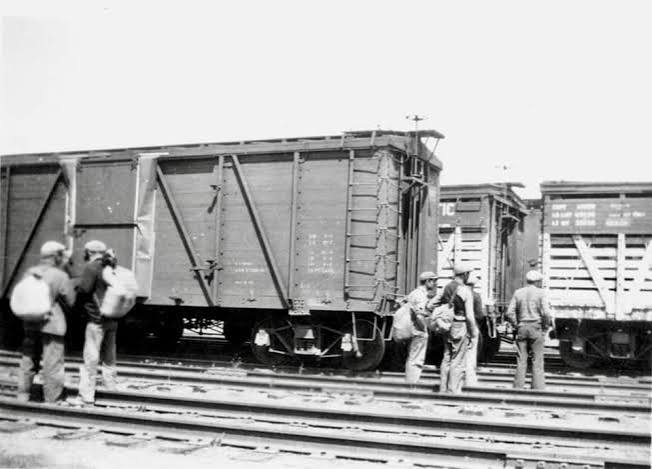
THE UNION MAN
The first thing Rachel noticed about the CPR archives was the smell — dust, paper, and the faint metallic tang of old machinery, as though the building itself remembered the trains that once thundered past it. She had come here reluctantly, almost skeptically. She wasn’t sure what she expected to find. Her grandfather had worked for the railway for decades, but she had always thought of it as a job, not a calling.
She was wrong.
The archivist, a thin man with wire-rimmed glasses, handed her a stack of union newsletters from the 1950s and 60s. “Your grandfather’s name appears quite a bit,” he said, almost casually. “He wasn’t just a member. He was active.”
Active. The word felt too small.
She flipped through the pages. There he was — David Levinson — listed as a shop steward, then as a delegate, then as a representative on a labour committee that had petitioned the CPR for safer working conditions. She found minutes from meetings where he had argued for wage parity, for antidiscrimination clauses, for the hiring of more immigrant workers. She found a letter he had written to the union president, urging solidarity with striking textile workers in Montreal.
She found, tucked between two newsletters, a faded photograph of him standing outside the CPR yards, his arm around a fellow worker, both of them smiling in a way that suggested victory, or at least defiance.
Her grandfather had not been a man who simply held opinions. He had been a man who acted.
But what struck her most was not the union work itself — it was how deeply it intertwined with the politics she had only begun to understand. In the margins of one newsletter, in her grandfather’s unmistakable handwriting, she found a note:
Solidarity is the only weapon the poor have.
It wasn’t a slogan. It was a belief.
And suddenly, she understood something she had missed entirely: her grandfather’s political life had not begun after retirement. It had begun here — in the yards, in the meetings, in the long nights spent drafting resolutions and writing letters. His involvement in the Jewish left, his membership in the Communist Party, his activism for peace and justice — all of it had grown from the soil of the railway.
He had carried his convictions with him to work every day, tucked into his lunch pail alongside sandwiches wrapped in wax paper. He had argued politics during breaks, organized meetings after shifts, and spent weekends in smoky rooms debating the future of workers, of Jews, of the world.
Rachel felt a strange mixture of pride and unease. Pride, because she could see the beginnings of the man she had written about in the first part — the stubbornness, the moral clarity, the refusal to accept injustice as inevitable. Unease, because she realized how little she had understood him.
She had written about his politics, but not their roots. She had written about his convictions, but not their labour. She had written about his life, but not his work.
Her father had tried to tell her, once. He had said, “Your zaida wasn’t just a leftist. He was a union man. That’s where it all started.” She had nodded, distracted, thinking she already knew.
She hadn’t known anything.
She turned another page and found a brief report from a meeting of the Jewish left organization — dated 1961. Her grandfather had spoken about the dangers of nuclear proliferation, about the moral responsibility of workers to oppose war, about the need for solidarity across borders. He had been involved long before retirement. He had been involved while raising a family, while working shifts, while navigating the Cold War’s suspicion and fear.
He had lived his politics openly, stubbornly, deliberately.
Rachel closed the newsletter and sat back.
The wider circle was not only global. It was personal.

CARLTON STREET, 1953
Rachel didn’t intend to go to Carlton Street. She had only meant to walk, to clear her head after the shock of seeing her grandfather in that photograph. But her feet carried her there anyway, as though the city itself remembered what she had forgotten.
The former Winnipeg Free Press building — the Old Lady of Carlton Street — was still there, though it no longer housed reporters or printing presses. Its stone façade, once the backdrop to arguments, deadlines, and the hum of a city’s news, now sheltered provincial civil servants shuffling between offices, fluorescent lights, and government memos. Rachel stood on the sidewalk where her grandfather had once stood, where he had raised his hand in protest on a June afternoon in 1953, demanding justice for two American Jews he had never met. The building had changed purpose, but not presence. It watched her with the same quiet solidity it must have offered him, as though it remembered everything.
She tried to imagine the scene: the crowd, the signs, the tension, the fear. The way people must have looked over their shoulders, worried about being photographed, named, watched — but her grandfather and the few other protesters looked up, not down, toward the illuminated news bulletin above the entrance.
She tried to picture him — young, determined, stubborn — standing there with the conviction that what happened in New York mattered in Winnipeg, that injustice anywhere was a threat everywhere, that solidarity was not a slogan but a responsibility. She imagined him arriving after a shift at the CPR yards, still smelling faintly of grease and metal, carrying the political commitments he had already been living for years: union solidarity, Jewish left activism, Communist meetings held in borrowed basements and back rooms. Carlton Street had not been an exception. It had been an extension of the life he was already leading.
She wondered if her father had been there too, a boy holding his father’s hand, not understanding the words but understanding the urgency.
She wondered why no one had told her.
She wondered what else she didn’t know.
A bus hissed to a stop beside her. A group of teenagers spilled out, laughing, unaware of the ghosts beneath their feet. Rachel felt a sudden, sharp ache — not grief, exactly, but recognition. Her grandfather had lived in a world where politics were not abstractions but obligations. He had believed that the fate of strangers mattered. He had believed that justice was not a matter of geography.
She took out the photograph again. She held it up to the building. The past and present did not align, but the gesture felt necessary.
Her phone buzzed. A message from her father: “Call me when you can. I found something else you should see.”
She stared at the screen. Her father had always been careful with his words, careful with his memories, careful with the parts of his life that touched his father’s politics. He had followed his father for a time — marches, meetings, pamphlets — before turning away, quietly, without explanation.
Rachel lowered the photograph, walked back to where she had parked, unlocked the car, and slid into the driver’s seat. She started the engine and pulled away from Carlton Street, heading north through the familiar grid of the city, toward her father’s house.
The wider circle was widening again. And she was being pulled into it.
THE FATHER’S BOX
Her father lived in the same house Rachel had grown up in, though it felt smaller now, as though the walls had absorbed decades of arguments, silences, and the quiet persistence of memory. He met her at the door with a look she couldn’t quite read — not worry, not excitement, but something like resignation. From the back room Rachel could hear her mother speaking softly to someone.
“I found more,” he said. He didn’t hug her. He never did. But he stepped aside to let her in, which was its own kind of embrace.
The dining room table was covered with papers. Not scattered — arranged. Her father had always been meticulous, even when the rest of his life felt chaotic. Rachel saw folders, envelopes, a few brittle photographs, and a cardboard box she recognized instantly.
Her grandfather’s box.
It had sat in the basement for years, untouched, because her father had insisted it was “just old papers.” Rachel had believed him. She had believed a lot of things he said about her grandfather, because he said them with the authority of someone who had lived through the same storms.
Now she wasn’t sure what he had lived through, or what he had chosen to forget.
Her father gestured to the box. “I didn’t want to open it before,” he said. “I wasn’t ready.”
Rachel sat down. “What changed?”
He hesitated. “You did.”
She didn’t know what that meant, but she didn’t ask. She reached for the box. The cardboard was soft with age, the edges worn. She lifted the lid.
Inside were papers from the Jewish left organization her grandfather had devoted himself to — not only after retirement, but long before it. Meeting minutes. Pamphlets. Letters. A stack of mimeographed newsletters with headlines about peace, justice, workers’ rights, and the dangers of nuclear proliferation. She saw dates from the 1950s, the 60s, the 70s — decades of activism layered like sediment.
And then she saw it — a folder labeled Holocaust Education Committee.
Her breath caught.
She opened it carefully. Inside were copies of speeches her grandfather had given before the Winnipeg School Board, urging them to include Holocaust education in the curriculum. There were letters he had written to the Minister of Education, arguing that genocide was not a Jewish tragedy but a human one, and that children needed to understand how hatred becomes policy.
There were notes in his handwriting — fierce, urgent, uncompromising:
Memory is not passive. Memory is protection. Teach them before someone else teaches them to hate.
Rachel felt her throat tighten.
Her father watched her quietly. “He believed in that work,” he said. “More than anything.”
She looked up. “You never told me.”
He exhaled, long and slow. “I didn’t think you wanted to know. You were always… focused on the personal. The family stories. The furnace. The neighbourhood. I didn’t think you cared about the politics.”
“I care now,” she said.
He nodded, but his expression shifted — something darker, something unresolved.
“There’s more,” he said. “About me.”
Rachel waited.
Her father sat down across from her, folding his hands as though preparing for confession.
“I followed him,” he said. “For a while. The meetings. The marches. The Rosenberg protest — I was there. I was a kid, but I remember the shouting, the fear. I remember him telling me that justice mattered even when it was dangerous.”
Rachel felt a jolt — not shock, but recognition. She had always sensed there was something her father wasn’t saying.
“But I couldn’t stay,” he said. “Not like he did. I didn’t have his… certainty. His stubbornness. His faith in people. I admired him, but I couldn’t be him.”
Rachel didn’t speak. She let him continue.
“He never blamed me,” her father said. “But I blamed myself. For a long time.”
Rachel reached across the table and touched his hand. It was the first time she had done that in years.
Her father swallowed hard. “There’s something else,” he said. “Something you need to see.”
He stood, walked to the hallway, and returned with a thin envelope. He placed it in front of her.
Rachel opened it.
Inside was an RCMP surveillance report. Her father’s name was on it.
She felt the room tilt.
“They questioned me once,” he said quietly. “About meetings I’d gone to with him. They wanted to know who he talked to. Who he met with. I never told you. I never told anyone.”
Rachel looked at him — really looked at him — and saw the weight he had carried, the fear he had inherited, the silence he had chosen.
Her grandfather had lived his politics openly. Her father had lived them in the shadows.
And she — she had lived them unknowingly.
The circle widened again.
Rachel closed the envelope. She didn’t know what to say. But she knew what she had to do.
THE EDUCATION FILES
Rachel carried the box home like something fragile, though it wasn’t the cardboard she was protecting — it was the weight inside it. She set it on her kitchen table, cleared a space around it, and opened it again, this time slowly, deliberately, as though she were entering a room she had been warned about.
The Holocaust Education Committee folder lay on top. She lifted it out and spread the contents across the table. The papers were yellowed, but the ink was still sharp, still insistent. Her grandfather’s handwriting — angular, impatient, unmistakably his — ran along the margins of typed documents like commentary from a man who could never leave a thought alone.
She read the first speech.
It was addressed to the Winnipeg School Board, dated 1978. Her grandfather argued that Holocaust education was not simply about history, but about vigilance. He wrote that genocide begins with language, with silence, with the normalization of cruelty. He wrote that children needed to understand how ordinary people become complicit, how bureaucracies become weapons, how prejudice becomes policy.
He wrote:
If we do not teach them what happened, someone else will teach them why it should happen again.
Rachel felt a chill. She had known her grandfather was passionate about justice, but she had not known he had stood before the school board, before elected officials, before committees, insisting that memory was a civic duty.
She turned to the next document — a letter to the Minister of Education. Her grandfather wrote about survivors in Winnipeg who had never been asked to speak, whose stories were fading, whose trauma had been carried quietly through decades of Canadian politeness. He argued that the province had a responsibility to give those stories a place in classrooms, not as Jewish history, but as human warning.
Rachel imagined him writing these letters late at night, after work, after dinner, after everyone else had gone to bed. She imagined him sitting at the kitchen table — the same table where she had once eaten soup and listened to him tell stories about the neighbourhood — never knowing the depth of the battles he fought outside it.
She picked up another sheet — minutes from a meeting of the Jewish left organization. Her grandfather had spoken about the rise of neoNazi groups in Canada, about the danger of complacency, about the need for education as prevention. His words were blunt, unadorned, almost harsh:
We cannot rely on governments to remember. We must force them to.
Rachel sat back, overwhelmed.
This was not the gentle man who had fixed her bicycle, who had slipped her coins for candy, who had told her stories about growing up in the old North End. This was a man who had carried the Holocaust not as memory but as mandate. A man who believed that justice required confrontation. A man who refused to let silence do its work. A man who had fought fascism all his life — including as a Canadian soldier overseas during the Second World War.
She reached for another document — a list of schools where he had spoken. West Kildonan. Elmwood. St. James. River Heights. Transcona. Schools across the city, across neighbourhoods that had never known him, never known his history, never known the weight he carried.
She wondered how many students remembered him. She wondered what he had said. She wondered if any of them had gone home that day and asked their parents questions that had never been asked before.
Her phone buzzed. A message from her father:
Did you find the education files?
She typed back: Yes.
A moment later: He was proud of that work. He didn’t say it, but he was.
Rachel stared at the screen. Her father had inherited the silence, not the certainty. She had inherited the questions.
She looked again at the papers on the table. Her grandfather’s voice seemed to rise from them — urgent, insistent, unyielding.
This was not a man who had lived quietly. This was a man who had lived deliberately.
And she was only beginning to understand him.
Rachel gathered the papers, placed them back in the folder, and closed the box. She knew what she had to do next.
She needed to see the archives. She needed to see the records. She needed to see the world he had fought against — and the world he had fought for.
The circle widened again.
And she followed it.
Closing Note
Rachel sat at her kitchen table long after the papers were back in the box. The city outside moved on, unaware of the man whose life she had just unfolded — a life lived in conviction, in struggle, in stubborn hope.
She understood now that her grandfather’s politics had not been theory but duty, carried through union halls, marches, classrooms, and quiet nights at the kitchen table. She understood that her father had lived in the shadow of that certainty, and that she herself had inherited something different — the responsibility to listen.
She touched the photograph from Carlton Street, the crease worn soft by time. Her grandfather’s raised hand seemed less like protest now and more like insistence: Pay attention. Remember. Act.
She closed the box gently.
And now, she realized, she was listening too.
H.C. Piloski is the one who listens when the past begins to speak again.
Comment from Veronika (Oct. 1): Thanks
