


Uncategorized
Abdul El-Sayed is courting Jewish voters — without moderating his views on Israel

Michigan senate candidate Abdul El-Sayed isn’t toning down his rhetoric to win over Jewish voters.
He’s called Israel’s action in Gaza a genocide, wants to withdraw both offensive and defensive military aid to Israel, called the Israeli government “evil” like Hamas, has rebuffed questions about whether Israel has the right to exist as a Jewish state, and in an interview with the Forward, doubled down on his decision to campaign with controversial Twitch streamer Hasan Piker and his response to the attack on a Michigan syangogue in March: “Hurt people hurt people.”
Yet at a progressive synagogue and events hosted by Michigan’s Jewish Democratic caucus, El-Sayed, who is Muslim, is finding Jewish voters willing to hear him out — and a constituency of Jews who support his candidacy even when they disagree with him on Israel.
It’s a playbook New York City Mayor Zohran Mamdani employed to deflect allegations of antisemitism: Don’t soften on Israel or what rhetoric crosses a line, but speak with the Jewish press, meet with Jewish organizations and demonstrate a cultural fluency with Judaism beyond the politics of the Middle East.
The race, which could determine which party controls the Senate, is also a test of Israel politics in a swing state home to the nation’s highest concentration of Arab Americans.
The three leading candidates occupy distinct positions on the issue: El-Sayed has made criticism of Israel and AIPAC a central plank of his campaign. On the other end of the spectrum, Rep. Haley Stevens describes herself as “proud pro-Israel Democrat” and is backed by AIPAC. And in the middle, state Sen. Mallory McMorrow has won the endorsement of J Street, the liberal Zionist advocacy group that supports a two-state solution.
El-Sayed, who currently leads in the polls, maintains his candor has helped him build a Jewish coalition of his own.
“There’s going to be things that they disagree with, but at least they know I have the courage to say where I stand,” El-Sayed told the Forward. “I say it everywhere to everyone, and my positions are based in principle, not just political calculus.”
Jews for Abdul
While a number of Jewish organizations have expressed alarm at El-Sayed’s campaign, one synagogue welcomed him inside.
Congregation T’chiyah, a Reconstructionist synagogue outside Detroit that describes itself as progressive, hosted El-Sayed for a Passover Seder in April. Many of its congregants support El-Sayed’s campaign and are volunteering with a group dubbed “Jews for Abdul.”
One of those volunteers is Lex Eisenberg, a T’chiyah congregant who also organizes with the anti-Zionist group Jewish Voice for Peace.
“As progressive Jews, we’re all too familiar with the way that people who speak out for Palestinian freedom are smeared and attacked the way some are smearing Abdul right now,” Eisenberg said. “So the idea is that we want to be outwardly and publicly Jewish and supporting Abdul.”
El-Sayed’s campaign has also attracted some prominent progressive Jewish voices. Former Michigan congressman Andy Levin — who previously served as president of Congregation T’chiyah — endorsed El-Sayed alongside Bernie Sanders, the progressive Jewish senator from Vermont. (El-Sayed has called Sanders his “favorite Jewish uncle.”)

Levin, who identifies as Zionist, sees echoes of his own political battles in El-Sayed’s campaign. He lost his House election against Stevens in 2022 after AIPAC poured millions into defeating him, displeased with his support for a bill that backed a two-state solution and restricted use of U.S. taxpayer funds to expand settlements in the occupied West Bank.
“So many young Jewish people are active in Abdul’s campaign,” Levin told the Forward. “And it’s their Judaism that leads them to that position, because their Judaism teaches them that the way to fight antisemitism isn’t to circle the wagons and shut off the world, but to build alliances with other oppressed people.”
Welcoming leftist politicians is not unusual for Congregation T’chiyah: Its rabbi, Alana Alpert, was the founding director of the progressive political advocacy group Detroit Jews for Justice, and she has been honored by Rashida Tlaib, the Palestinian-American Michigan congresswoman censured by the House over her comments about Israel. (Alpert did not respond to the Forward’s request for an interview.)
“T’chiyah, of course, is a congregation that is focused on uplifting social justice around the idea of tikkun olam,” El-Sayed said.
Yet El-Sayed’s coalition also extends to those with complicated relationships to the Jewish state.
Roslyn Abt Schindler, a retired professor who taught Holocaust studies at Wayne State University, has been a member of Congregation T’chiyah for 48 of the synagogue’s 49 years. The daughter of Holocaust survivors, Schindler plans to vote for El-Sayed and agrees with his characterization of Israel’s actions in Gaza as genocide.
But she also supports a two-state solution — a position El-Sayed has not endorsed, and one she wishes he would.
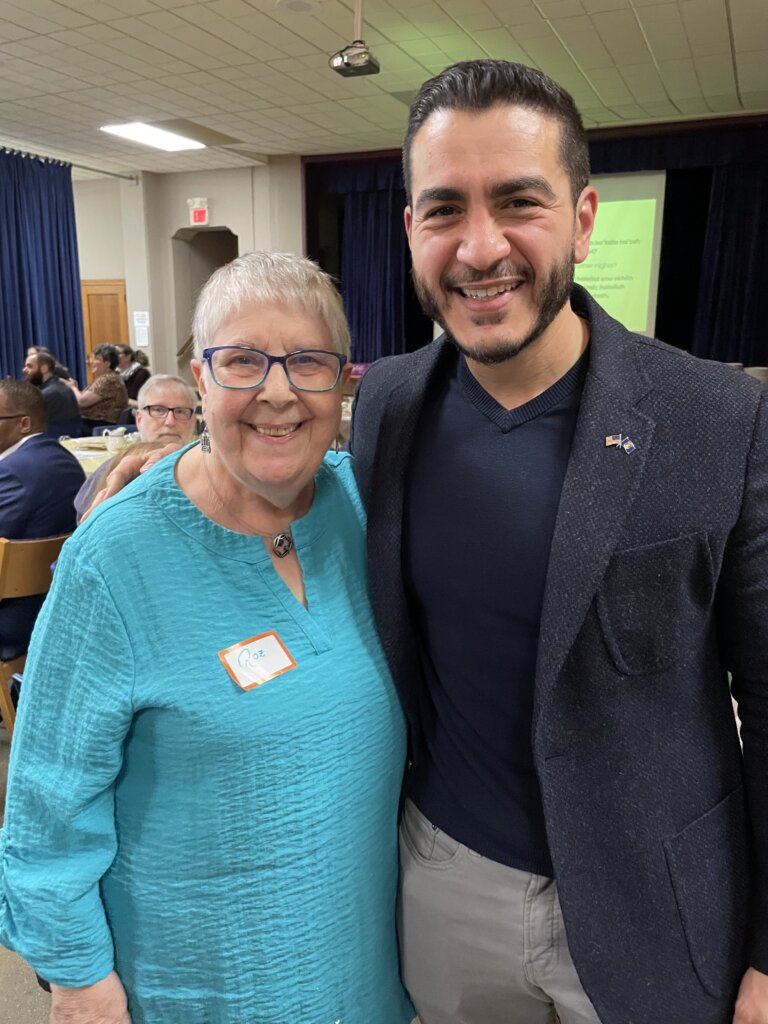
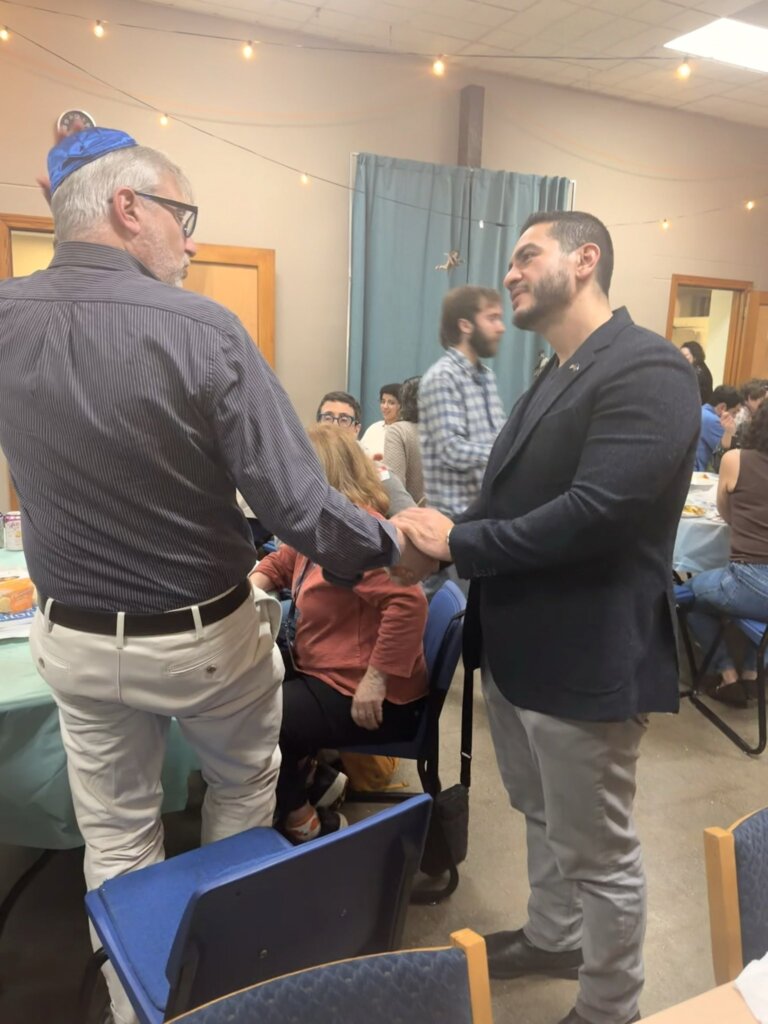
Schindler said the issues that matter most to her are affordability, campaign finance reform, environmental protection and Medicare for All. El-Sayed’s visit to her synagogue and Levin’s endorsement of him, she said, sealed the deal.
“His outreach to Jewish voters has been genuine and thoughtful,” Schindler said.
Decky Alexander, chair of the Michigan Democratic Jewish Caucus — which endorsed Stevens last week — agreed that El-Sayed has engaged Michigan’s Jewish community. He participated in a candidate forum co-hosted by the Jewish caucus, and he attended the organization’s “Summer Simcha,” the caucus’ annual fundraiser that draws Jewish leaders from across the political spectrum.
Alexander said she doesn’t personally support El-Sayed, but she believes the Jewish caucus could work with him and trusts that he takes antisemitism seriously. After the recent attack on Temple Israel, El-Sayed was the first politician to text her with a message of support.
“He’s present and showing up,” Alexander said. “And not just showing up to really left-leaning communities that are Jewish, but across the board.”
‘Hurt people hurt people’
Other Jews say that outreach has done little to quell concerns about El-Sayed.
“When a public figure is struggling to affirm Israel’s right to exist, many Jews are going to see that as a challenge to Jewish self-determination, not simply a policy disagreement,” said Amy Sapeika, community director of American Jewish Committee Detroit.
The other candidates, meanwhile, have for the most part only hinted at their differences with El-Sayed when it comes to Israel and antisemitism — a polite tenor Alexander partly chalked up to a culture of “Midwest nice.”
Stevens, seen as the Democratic establishment pick, has touted her record of speaking up against antisemitism “in all its forms” and described herself as a lawmaker who is “leading on combating antisemitism in a bipartisan way.”
McMorrow has walked a middle ground, saying that Israel’s military offensive in Gaza meets the critera for genocide while also dismissing definitional debates as semantic. She has also said the Democratic Party has an antisemitism problem, citing an antisemitic slur yelled at her Jewish husband during this year’s Democratic Party convention in Detroit.
The National Jewish Democratic Council of America issued a rare dual endorsement of Stevens and McMorrow — explicitly drawing contrast with El-Sayed.
“There are two candidates who stand with our community on issues of importance to Jewish voters, and there is one who does not,” CEO Halie Soifer said in a statement.
Those tensions came to a head after a man rammed a truck into Temple Israel in West Bloomfield in March with the stated intent of killing as many people as possible. El-Sayed issued a four-minute video condemning the attack, while also noting that the perpetrator had four family members killed in an Israeli airstrike in Lebanon, including two children.
“Hurt people hurt people,” he said.
The response drew a public rebuke from Temple Israel’s Rabbi Jen Lader, who wrote in a Free Press op-ed that El-Sayed was “suggesting that violence against a synagogue in suburban Detroit could be understood through the lens of Israeli actions,” which she deemed “offensive.”
El-Sayed rejected the premise that linking the two events amounted to excusing violence.
“It’s unserious when you want to decontextualize violence, and then say you want to stand against violence,” he told the Forward. “I will never be the kind of policymaker who doesn’t want to understand why things happened if I’m serious about stopping them from happening.”
About a month after that attack, El-Sayed hosted a campaign event with Hasan Piker — a Twitch streamer often called the “Joe Rogan of the left” who has likened liberal Zionists to “liberal Nazis,” said he doesn’t have an issue with Hezbollah, and also said that “Hamas is 1,000 times better” than Israel, among a slew of other controversial statements.

The event drew condemnation from Michigan State Hillel and the Anti-Defamation League, which called the decision to campaign with Piker “absolutely shocking.”
It also drew the most direct rebukes to date from both opposing campaigns. Stevens told Jewish Insider Piker is “the exact opposite of someone I’d be campaigning with,” and McMorrow critiqued El-Sayed for hosting the event “at a moment when there is clearly a lot of pain and trauma across our state.”
“How do you bring everybody together, especially when there are difficult conversations, where there aren’t easy answers? You don’t fan the flames and stoke division just to get attention,” McMorrow said.
El-Sayed told the Forward that he would not defend Piker’s most extreme remarks but argued that politicians should engage with a broad range of people, adding that he wanted to “reach out to the 3 million people who follow him, many of whom feel locked out of our politics.”
More broadly, El-Sayed argues that his critics conflate the Israeli government with the Jewish people. He often points to his experience as a Muslim in helping him understand the experience of a religious minority, framing antisemitism and Islamophobia as related threats.
“I know intimately what it’s like to be discriminated against for how I pray, and I don’t want anybody to experience that, be it because they are Jewish or because they are Muslim, or because they don’t pray at all,” he said.
It’s difficult to gauge how El-Sayed’s messaging is landing with Jewish voters; unlike in New York City, Michigan races do not have polling by religious affiliation. In any case, he may not need Jews’ support to take office: Jewish voters make up just 1.4% percent of the electorate in the state.
Still, El-Sayed said he is looking to connect.
“I’m open to engage with any and all communities,” El-Sayed said. “As I’ve always said, if you invite me, I’m going to come.”
The post Abdul El-Sayed is courting Jewish voters — without moderating his views on Israel appeared first on The Forward.
Uncategorized
On Columbus Day, remember Abraham Zacuto, the Jewish astronomer history forgot
(JTA) — Every October, Christopher Columbus returns not only as history but as controversy. The voyages associated with his name transformed the world, but their legacy is inseparable from conquest, coercion and the destruction that followed European expansion.
Yet the same Iberian age also produced a quieter and far less controversial revolution: advances in astronomy, mathematics, cartography, instruments and practical navigation that made sustained oceanic voyaging possible. Its protagonists included scholars, translators, mapmakers, instrument makers and pilots whose names are far less familiar than those of the captains who commanded the ships.
Among them, one figure deserves particular remembrance on Columbus Day: Abraham Zacuto, a Jewish astronomer born in Salamanca around 1452. Zacuto belonged to the same Iberian world as Columbus, but experienced its monarchies very differently. In 1492, Columbus sailed west under the patronage of Ferdinand and Isabella. That same year, the Catholic monarchs ordered the Jews of their realms to convert or leave. Zacuto left Castile and continued his work in Portugal. The celebrated maritime discoveries and the expulsion of Iberian Jewry were therefore not distinct historical worlds; they unfolded under the same rulers, at the same moment, within the same culture of ambition, knowledge and power.
Zacuto stands out within that larger scientific story. He was a rabbi, astronomer, mathematician and historian whose astronomical work helped give oceanic navigation a new degree of precision and practicality. His contribution belongs not at the margins of the Age of Exploration but within the scientific infrastructure that made long-distance navigation increasingly systematic.
Around 1478, Zacuto completed his great Hebrew astronomical work, “Ha-Hibbur ha-Gadol,” the “Great Composition.” Working within a long scientific conversation that included Greek, Islamic, Jewish and Christian astronomy, he refined and organized astronomical calculations in forms of exceptional practical value.
After the expulsion from Spain, Zacuto entered Portugal at precisely the moment when the kingdom was pushing maritime exploration farther into the Atlantic and down the African coast. Zacuto’s pupil, José Vizinho, a Jewish adviser to Portuguese King John II, was associated with the practical Latin and Castilian presentation of Zacuto’s astronomical material. In 1496, Zacuto’s Almanach Perpetuum was printed at Leiria in four known issues – three with Latin preliminary matter and one with Castilian.
The importance of those tables was intensely practical. They supplied precise, ready-to-use values for the changing position of the sun through the year. For a pilot on the high seas in daylight, far from recognizable coastlines, this meant that a noon observation of the sun could be combined with solar-declination data to determine latitude — the ship’s north-south position. The difficult astronomical calculations had already been embodied in the tables. What remained aboard ship was an operational procedure: Observe the sun, consult the appropriate value and calculate latitude. That combination of precision and usability greatly facilitated daytime position-finding at sea. Solar tables derived from Zacuto’s work entered early Portuguese navigational manuals and became part of the practical scientific culture of oceanic travel.
The clearest measure of Zacuto’s importance may be what happened next. The Almanach did not remain a local Portuguese publication. Its tables were reprinted repeatedly in Venice in 1498, 1502, 1525 and 1528. A work first printed in Leiria moved into one of Europe’s great publishing centers and continued to circulate for decades. That publishing history alone tells us something about the standing Zacuto’s astronomy acquired.
Its reach extended farther still. Zacuto’s astronomical material was translated and adapted into Arabic. One Arabic version was produced, likely in Istanbul, in 1505-06; another, associated with Ahmad ibn Qasim al-Hajari in Morocco around 1624, survives in several manuscripts. The work of a Jewish astronomer writing in Hebrew in 15th-century Salamanca had crossed into Latin, Castilian and Arabic scientific cultures.
Zacuto’s name also became entwined with the memory of the great navigators. Accounts have long connected his tables with Columbus and Vasco da Gama, including the famous 1504 lunar eclipse in Jamaica. In this episode, Columbus intimidated Indigenous Jamaicans by predicting the disappearance of the moon, relying on Zacuto’s almanac, which he had on board. A manuscript connected with the Almanach also survives in Seville’s Biblioteca Colombina, the library created by Columbus’s son Hernando. Taken together, these associations reveal the stature Zacuto’s work acquired in the historical memory of the Age of Exploration.
Perhaps the most striking part of Zacuto’s story is what happened to the man himself. Portugal valued the kind of expertise he represented. Yet in December 1496, King Manuel I ordered Portugal’s Jews to leave unless they converted, and in 1497 the crown subjected the Jewish population to mass forced conversion. Zacuto left Portugal as well.
Exile did not end either his travels or his scholarship. From Portugal he moved through North Africa, including Tunis, before eventually reaching Jerusalem. There, late in life, he returned once more to the astronomical work that had made his name known across the Mediterranean, recalculating and updating his earlier tables for the Jewish calendar and the meridian of Jerusalem. The strongest recent reconstruction of his life places his death in Jerusalem in Tevet 5274, or late 1513 or very early 1514 — commonly given as 1514.
Zacuto’s story is therefore larger than a footnote to Columbus. It joins two strands of Sephardic history too often told apart: persecution and exile, and the transmission of knowledge, texts and technologies across borders.
Zacuto’s own tables and 15th-century procedures are now obsolete, but their underlying navigational logic endures. Modern celestial navigation still determines position by combining observations of the sun, moon, planets or stars with authoritative astronomical data. The U.S. Naval Academy requires all midshipmen to study navigation, and its current curriculum includes celestial navigation alongside electronic methods. The U.S. Naval Observatory still describes celestial navigation as a critical independent backup to GPS and other electronic systems. And the Nautical Almanac, first published in 1855, remains the standard U.S. Navy resource for marine celestial navigation. The instruments and calculations have changed, but the essential logic remains: Observe the heavens, consult reliable astronomical data and determine position.
Zacuto’s scientific reputation also survives in an unexpected place. In 1935, the International Astronomical Union formally adopted the name Zagut for a lunar crater honoring Abraham ben Shmuel Zacuto. Modern astronomy has, quite literally, written his name onto the Moon.
Columbus remains a household name because voyages leave dramatic images: ships, landfalls, encounters and conquest. The calculations, tables, instruments, translations and printed books that made such voyages possible are easier to forget. Remembering Zacuto widens the story: His tables brought greater precision and practicality to daytime navigation; his work crossed languages and continents; and his life traced the routes of Sephardic exile from Iberia to Jerusalem. The age of maritime discovery was also an age of scientific discovery, and some of the knowledge that carried Iberian ships across oceans was created by scholars whose communities those same monarchies expelled.
The views and opinions expressed in this article are those of the author and do not necessarily reflect the views of JTA or its parent company, 70 Faces Media.
The post On Columbus Day, remember Abraham Zacuto, the Jewish astronomer history forgot appeared first on The Forward.
Uncategorized
Recorded anti-Jewish hate crimes rise 10% in England and Wales
(JTA) — Hate crimes targeting Jewish people in England and Wales rose by 10% in the year ended in March, according to the latest data released by the British government.
Police-reported hate crime — including crime influenced by other factors such as race and sexual orientation — overall increased by 7% compared with the previous year, according to the Home Office data released last week.
British Foreign Secretary Ed Miliband posted on X on Monday, “Antisemitism has no place in our society. This morning, I hosted a crucial discussion with the J7 Global Task Force to discuss how we can work together across countries to stamp out the scourge of antisemitism.”
Following the meeting, the Board of Deputies of British Jews issued a statement explaining that Miliband and the task force had discussed, among other things, “the sharp rise in global antisemitism” and the “continued demonisation of Israel.” Representatives from the U.K., the U.S., Canada, Germany, France, Argentina and Australia make up the task force.
“In the meeting, the J7 proposed a new international intergovernmental ministerial task force on antisemitism, comprising the countries represented in the J7 and taking on the key themes discussed. We were pleased that the Foreign Secretary agreed to host an inaugural meeting of J7 countries’ ministers to start this process,” the statement sent to JTA said.
The Community Security Trust, a charity that protects the Jewish community and monitors antisemitism, said on X that the new data show “that antisemitic hate crime remains at an unacceptably high level.”
“As seen previously, Jewish people continue to experience by far the highest police-recorded rate per head of religious hate crime of any faith group,” CST said. “This shows the disproportionate scale of anti-Jewish hatred and its impact on Jewish life in Britain.”
Religious hate crime rose by 13% overall in the 12 months to March 2026, the report said. The overall figure rose from 10,067 to 11,419 offenses.
The two groups most affected were Jews and Muslims, the Home Office said. Religiously motivated hate crimes against Muslims increased 15%, the report found, with spikes reported around public protests in September 2025 and the start of the U.S. war with Iran in February.
The number of recorded offenses affecting Jews rose from 2,874 to 3,162 offenses, spiking after the attack on Heaton Park synagogue in Manchester last year on Yom Kippur.
Two men, Melvin Cravitz and Adrian Daulby, were killed on Oct. 2, 2025, after Jihad Al-Shamie, who was wearing a fake suicide bomb belt, drove into the gates of Heaton Park synagogue and began attacking congregants with a knife. Cravitz died from stab wounds; Daulby was fatally struck by a police bullet during the response.
A spate of violent antisemitic incidents followed this year, including the torching of four ambulances belonging to Jewish volunteer service Hatzola on March 23 and the stabbing of two Jewish men in separate attacks in Golders Green on April 29.
The Home Office figures, which do not include data from London’s Metropolitan Police Service because of a change in how it records crime, showed the second-highest level of religious hate crime directed at the Jewish community since the Home Office began keeping records in 2018. It was surpassed only by the year ending March 2024.
“In the last year, there were 117 police recorded religious hate crimes targeted at Jewish people per 10,000 population, the highest rate for any religious group. The next highest rate was for religious hate crimes targeted at Muslims, with 13 per 10,000 population,” said the Home Office.
The report was published on Oct. 8, at a time of heightened sensitivity. Eleven people were arrested at pro-Palestinian marches in London a day earlier, despite calls by the Metropolitan Police to avoid demonstrating on the anniversary of Hamas’ deadly 2023 raids inside Israel.
Police reported 20 arrests at Saturday’s pro-Palestinian protest in London, where many demonstrators were wearing kaffiyehs, waving Palestinian flags and brandishing banners.
The level of hate directed at the Jewish community has remained at an “elevated level” since the beginning of the Israel-Hamas conflict, the report stated.
The CST said, “There is an urgent need to reduce the amount of incitement connected to conflict overseas,” adding that “much more needs to be done across society to tackle this problem.”
Over the summer the government announced a major funding boost to support the Jewish community, promising £250 million ($335 million) over the next three years for increased policing and protection of Jewish communities.
More remains to be done, according to community organizations.
A spokesperson for the Board of Deputies of British Jews said the report’s publication “confirms the need for rigorous prosecution to ensure deterrence, and a whole of society approach to tackling hatred and extremism, and to stopping conflict in the Middle East being used to incite hatred against the Jewish community.”
The Campaign Against Antisemitism said the report was evidence that the British justice system was failing the Jewish community.
“Antisemites, emboldened by the Hamas terrorist atrocity three years ago, are not only not letting up in their hatred but are doubling down,” it said in a statement. “That’s because there is no real deterrent. So really these figures are most damning for the criminal justice system, which has utterly failed to defend British Jews.
“Even as conflict in the Middle East is easing off, antisemitism in the U.K. is rising, yet there have been essentially no changes in policing policy over the past three years and nobody has been held to account for this monumental failure,” the campaign said.
This article originally appeared on JTA.org.
The post Recorded anti-Jewish hate crimes rise 10% in England and Wales appeared first on The Forward.
Uncategorized
Hasan Piker criticizes ‘opportunists’ who accused Mamdani of genocide
(JTA) — Hasan Piker called the protesters who jeered New York Mayor Zohran Mamdani at an Oct. 7 vigil last week “opportunists,” who “tarnished” the anti-Zionist movement’s message.
Piker, the popular streamer who has campaigned for a number of democratic socialist candidates, made his remarks Sunday at Jewish Currents Live, an all-day event hosted by the left-wing magazine at the Brooklyn Academy of Music.
Speaking on a panel titled “Can the Left Wield Power?”, he said that the protesters had “valid concerns,” including demands like firing police commissioner Jessica Tisch and disbanding the NYPD’s Strategic Response Group, a heavily armed unit that often responds to protests.
But he criticized the Democratic Socialists of America — the left-wing political organization that Mamdani has called his “political home” — for not playing a bigger role in last week’s protest, which started at City Hall and later overran an Israeli peace vigil. DSA did not sponsor the protest, though some campus chapters of its student section, the Young DSA, participated.
“The DSA not being at the forefront of the anti-Zionist mobilization in New York City is what allowed that mobilization to be tarnished by opportunists, sectarians and those who actually were calling him a genocidaire — which I obviously find to be ridiculous,” Piker said, referring to protesters’ chants of “Mayor Mamdani you can’t hide, we charge you with genocide.”
Piker, who has drawn heat for his anti-Israel views, did not comment on the Hamas iconography displayed by numerous protesters, nor the decision to crash an Oct. 7 vigil that memorialized the 1,200 people killed in the Hamas-led attacks on that date in 2023, and the 74,000 Palestinians who have been killed since then, according to Gaza health ministry figures, which do not distinguish civilians from combatants.
Separately, Mahmoud Khalil, the Columbia University pro-Palestinian protest leader who was detained by ICE last year, reportedly criticized those protesters’ “purity politics” during an event in Washington, D.C.
“You don’t have to agree with someone 100 percent — 85 percent is good,” he said, provided that the end goal is “liberating Palestine and ending the unconditional support of the United States.”
Where should Democrats draw the line?
Two Democratic congressional nominees from New York, Brad Lander and Darializa Avila Chevalier, appeared on a separate panel focused on Israel and the Democratic Party.
Lander is Jewish and Darializa Avila Chevalier helped lead Columbia University’s pro-Palestinian encampment in 2024. Peter Beinart, editor-at-large at Jewish Currents, moderated the panel, which also featured Georgia state Rep. Ruwa Romman, the first Palestinian American elected to public office in her state.
Their discussion exposed some of the gaps between Lander and Avila Chevalier, both progressives who were endorsed by Mamdani this year and who appeared in a campaign ad together alongside fellow Mamdani endorsee Claire Valdez.
Beinart asked where Democrats should draw the line on what is considered legitimate Palestinian resistance. He pointed to the pro-Palestinian protest held in New York City on Oct. 8, 2023, which Avila Chevalier attended and Lander called “abominable” at the time.
“I think international law has already drawn that line,” Avila Chevalier said, arguing that U.S. protests should target Israel, which receives U.S. support, rather than Hamas.
“We could be the biggest anti-Hamas protesters, but a protest against Hamas in the U.S. isn’t going to do anything,” Avila Chevalier said. “Because we don’t fund it. We don’t have any structural power over it, there is nothing tying us to that institution other than condemning it endlessly.”
After the event, Lander did not confirm to the Jewish Telegraphic Agency whether he had spoken about that Oct. 8 protest with Avila Chevalier.
“We have talked about these issues broadly in private, and I don’t want to characterize those conversations,” Lander told JTA. “And obviously I’ve made my feelings known in public, and I stand by them. I mean, on that day, I was in mourning.”
An attendee named Mark, 29, who declined to share his last name to avoid potential workplace complications, said he felt that Avila Chevalier “didn’t really acknowledge the criticism about perhaps disregarding loss of life; despite the power imbalance, it is lost life.”
For Lander, meanwhile, Mark said it was “politically expedient” for him to not directly address Avila Chevalier’s presence at the 2023 protest. “This is a super lefty crowd that probably would eat him alive if he went against her right now,” he said.
During the panel, Avila Chevalier repeated her call for an arms embargo against Israel while Lander stopped short of doing so, consistent with his statements in the past that Israel should be able to buy defensive ware. Both said Congress must pass the Block the Bombs Act and vote to suspend the sale of offensive U.S. military weapons to Israel. Lander was the only speaker on stage who advocated for a two-state solution in the region.
Beinart asked Romman about Jon Ossoff, the Jewish Democratic senator running for reelection in her state, and how she views his stance on Palestine. She said she was pleased that both Georgia senators have been consistently voting in favor of Bernie Sanders’ resolution to block arms sales to Israel, but added that “in terms of leading, in terms of rhetoric, there’s still a lot of work to be done.”
“We’ll get everyone to where we need them to be eventually,” she said.
‘The bund is back in town’
The Jewish Labor Bund — the early 20th-century socialist movement that fought against Bolshevism, Nazism and Zionism — came up at numerous points on Sunday. One attendee doled out fliers with a website URL and the message, “Tell your bubbe the bund is back in town.” It was also a subject of a conversation that featured Molly Crabapple, whose 2026 book “Here Where We Live is Our Country” focuses on the Bund.
Arlene Geiger, an Upper West Sider and longtime activist, told JTA that she related to those conversations.
“My connection to Judaism is not to Israel, it never has been. It’s more to Eastern Europe and the Bund, so that spoke to me,” Geiger said.
Mark, who is from New Jersey, said he doesn’t come from a “staunchly pro-Zionist” family, but that he has a new interest in leftist Jewish spaces since realizing that he could no longer comfortably distance himself from the issue of Israel, which he believes is committing a genocide.
“It’s just an education for me to be immersed in this kind of space,” he said.
This article originally appeared on JTA.org.
The post Hasan Piker criticizes ‘opportunists’ who accused Mamdani of genocide appeared first on The Forward.
