


Uncategorized
U.S. and Iran announce direct Lebanon track without Israel
(JTA) — Following tense high-level negotiations over the weekend, mediators in Switzerland announced Monday morning that Washington and Tehran have agreed on a 60-day roadmap toward ending the war.
The joint statement released by mediating countries Qatar and Pakistan also unveiled the creation of a Lebanon deconfliction mechanism. According to the mediators, this entails a direct U.S.-Iranian track to terminate military operations in Lebanon and includes the Lebanese government but not Israel. The mediators did not explain how that would operate or resolve the current hostilities between Israel and Hezbollah.
Throughout the weekend Jerusalem, which watched the talks and the announcement from the sidelines with concern, doubled down on its hardline stance against Iran and its proxy group Hezbollah.
Speaking to reporters in Switzerland Monday before returning to Washington, U.S. Vice President JD Vance clarified that Israel had the right to self-defense, but that “every other nation in the region has the right of self-defense” as well. The mechanism was to resolve direct violations of the ceasefire between Israel and Hezbollah, Vance explained, indicating that it augmented the ongoing diplomatic work.
“We also want to make sure that, you know, when things happen, they don’t spiral into a broader escalation,” he said, adding that “there really hasn’t been a mechanism to have those discussions until basically around 4 p.m. yesterday.” He said that the U.S. had been in constant contact with Israel on Sunday.
Prior to Vance’s statement, the Israeli government delivered its first overt criticism of the diplomatic efforts taking place at the Bürgenstock resort in Switzerland.
Addressing the Jerusalem News Syndicate Conference in Jerusalem Monday, Israeli President Issac Herzog said any negotiations to end the Israel-Lebanon conflict should be done by the two countries themselves and not “by Iranian extortion.”
He added, “Tying Iran to Lebanon not only leaves Israel exposed to constant threat; it leaves the Lebanese weak and powerless, and will prevent their president and government from moving forward.”
Herzog also noted that direct talks were already taking place between Lebanon and Israel in Washington under the auspices of the State Department. The next round of negotiations is scheduled for Tuesday, which Herzog said is designed to empower the Lebanese army to be the sole military force in its country. Hezbollah and Iran are not a party to those talks.
“The disarmament of Hezbollah must be inherent to any solution in Lebanon, and Iran cannot dictate the future of Lebanon – on these fundamental points there is full agreement between Israel and Lebanon,” Herzog stated.
He also thanked President Donald Trump for his efforts on Israel’s behalf, calling him “our closest friend and ally and leader of the free world.”
The Lebanese Presidency said Monday that President Joseph Aoun had received a phone call from US Vance, senior adviser Jared Kushner and Qatari Prime Minister Sheikh Mohammed bin Abdulrahman bin Jassim Al Thani, but did not clarify when that call occurred.
According to the Lebanese statement, the discussion focused on “consolidating the ceasefire in Lebanon, halting the Israeli military escalation, and the steps that must be taken in this regard, including the possibility of forming a cell for this purpose.”
The ongoing fighting between Israel and Hezbollah and the IDF’s presence in southern Lebanon has been a point of tension throughout the ceasefire deal between the U.S. and Iran. The shaky ceasefire has been in place since April 8 after Israel and the U.S. started the war on Iran at the end of February.
In early March, Iranian proxy Hezbollah joined in by attacking northern Israel. Jerusalem has maintained that the Lebanese front needs to stay separate and has continued to take aggressive retaliatory action against Hezbollah despite the U.S. imposing a separate ceasefire in Lebanon as well.
Meanwhile, Qatar and Pakistan said the U.S.-Iran memorandum included the establishment of a “High Level Committee” to oversee negotiations aimed at a roadmap “towards reaching a final deal within 60 days, laying the foundation for the immediate commencement of further technical talks” on Iran’s nuclear program, sanctions and dispute resolution. These were the first formal discussions as part of the new U.S.-Iran Memorandum of Understanding, with Vance representing Washington.
The vice president told reporters Monday that Sunday “was a very, very good day. We made a lot of good progress; we did exactly what we wanted to do,” including securing an agreement from Iran that inspectors from the International Atomic Inspection Agency be allowed back into Iran.
Negotiators also created a mechanism to ensure that the Straits of Hormuz remain open, Vance said, downplaying reports of disputes between the American and Iranian teams.
However, Iranian media reported that members of Tehran’s delegation briefly left the room during Vance’s remarks after learning that Trump was issuing threats against Iran following Iran’s announcement on Saturday that it planned to once again close the Strait of Hormuz.
Vance said it was true the Iranians had threatened to walk out, but in the end they stayed and negotiated until the early hours of the morning.
Trump told Fox News in a phone call on Sunday morning that he had spoken with Iran overnight and said that if the country closed the Strait, he would “blow the s— out of them.” Fox News also reported that Trump had said, “You won’t even make it back to your f—— country.”
Trump also posted on his Truth Social account on Sunday that unless Iran stops supporting Hezbollah, “We’ll hit Iran very hard again, just like we did last week, only harder!!!”
Iranian officials reportedly responded to what they termed U.S. “verbal threats,” saying that “any form of threat is considered a serious violation of the agreement.”
Iranian Foreign Minister Abbas Araghchi said Sunday the talks had delivered “major progress to end [the] Lebanon War,” and added that discussions included oil exports, sanctions relief, frozen Iranian assets and reconstruction plans.
On Sunday, however, Prime Minister Benjamin Netanyahu declared, “We will remain in the security zone in southern Lebanon for as long as it takes in order to protect the residents of the North.”
Vance on Monday said that Israel would have to withdraw, but only when it can do so safely. The Trump administration, he explained, hoped to reach a situation where both Lebanon’s territorial integrity and Israel’s security were protected, noting that Israel itself has said it doesn’t have permanent “territorial intentions” with regard to southern Lebanon.
In separate remarks at Sunday’s JNS International Policy Summit, Netanyahu said, “We have prevented Iran from carrying out a plan to annihilate us. We removed an existential danger.” He added, “We changed Israel’s security doctrine. We initiate. We attack. We surprise.”
Directly addressing the U.S.-Iran negotiations, he added, “No matter what happens in the talks, with an agreement, without an agreement, I pledge to you that Iran, as long as I am prime minister, will never have a nuclear weapon. Never.”
This article originally appeared on JTA.org.
The post U.S. and Iran announce direct Lebanon track without Israel appeared first on The Forward.
Uncategorized
Why a new ultra-Orthodox party supports drafting Haredi men to the IDF
(JTA) — JERUSALEM – Yehoshua Pfeffer is a popular British-born haredi rabbi in Jerusalem. He is unusual among the religious leaders in the ultra-Orthodox world because he believes that haredim can and should integrate into and contribute more to the wider Israeli society even as they uphold their Torah observance.
Arguably the most fraught implication of this belief is that large numbers of haredi men should join the Israeli military rather than receive draft exemptions that allow them to spend their early adulthood studying instead of serving. After Israel’s High Court struck down the decades-long exemption for haredi yeshiva students in 2024, the vast majority of draft-age haredi men have refused to serve in the military.
The issue of whether to force them to do so is at the center of Israeli politics heading into the Oct. 27 elections.
When asked last month which issues will have the “greatest influence” for them at the ballot box, Jewish respondents to an August 2026 Israel Democracy Institute poll ranked haredi IDF conscription in third place. Only foreign affairs/security and the economy/high cost of living took precedence.
Another survey, by Hiddush: Freedom of Religion for Israel, found that 66% of Jewish Israelis would prefer a broad post-election government that either excludes haredi parties entirely or loudly rejects their demand for a sweeping military exemption and large government subsidies.
Pfeffer’s party could bridge that gap. He chairs the rabbinic committee of a new haredi political party called The Haredi Public. The party promotes the introduction of secular studies in haredi K–12 schools (most boys’ schools currently teach only the most basic math and English); the normalization of employment for those who seek it; and IDF conscription for men who are not full-time yeshiva students.
The party hopes to attract the unknown percentage of haredi voters who want to work full-time and not rely on public assistance or philanthropy.
An estimated 34-40% of Haredi families live at or below the poverty line, due to the community’s high birthrate and the fact that only about half of Haredi men are employed. For those who work, employment can be limited by their lack of knowledge in the secular subjects needed for an advanced degree or even jobs that require a high school education.
Israel’s long-standing haredi political parties, which promote the views of the country’s most powerful rabbis, are dead set against requiring haredi young men to serve whether or not they’re studying.
Pfeffer explained that he sees things differently, and not just because “Israel needs the haredi community to contribute more to society; we need it for our own sustainability.”
The war that followed the Oct. 7, 2023, attacks by Hamas has changed perceptions among at least some haredim, he said.
“It internalized for us that whatever was before isn’t going to continue. We have to be part of Israel,” he explained. “If the haredi community at large wants to ensure that true Torah scholars can continue to study and be great rabbinic leaders, we have to ensure that everyone else serves in the IDF, doing their part, protecting our nation.”
However, he doesn’t want draft dodgers to be arrested. That type of crackdown “plays into the hands of the extremists,” he said, referring to people who want to stop the draft of haredim at all costs. Instead, the next government “needs to establish a way to incentivize those who go into the army.”
Pfeffer’s party probably won’t receive the number of votes needed to win a place in the Knesset, according to the polls, and Pfeffer understands it’s a steep uphill climb to surpass the 3.25% of the nationwide vote that a party needs to win at the ballot box to sit in the Knesset.
As a brand new party just establishing itself, its members have only recently gotten the word out through interviews, podcasts and parlor meetings. Additionally, it’s not clear how strongly its message resonates with the haredi public, which largely continues to vote for the party their rabbis tell them to support.
But Pfeffer sees a victory just in establishing the new party, which also stands out from the established ultra-Orthodox parties by making two of its top four candidates women.
Even if they don’t get into the Knesset, he said, “We are presenting an alternative, a voice, a vision of what this new idea looks like. If we don’t make it this time, we’ll make it next time. There’s a palpable excitement.”
Pfeffer said members of his party and its mission have been “very warmly received” by greater Israeli society, and that many members of the haredi public have privately expressed support for the party and its principles.
“There is an understanding that the sheer size of our community doesn’t give us the ability to continue the way we did in the past,” he said. Today, the haredi community represents about 14% of the Israeli population. When Prime Minister Ben-Gurion granted 400 full-time yeshiva students an exemption from IDF service in 1948, he could never have imagined that in 2026, tens of thousands of haredi men would refuse to serve.
Mixed feelings among haredim
In contrast with Pfeffer, on a recent morning in the ultra-Orthodox Jerusalem neighborhood of Geula, many people refused to discuss the issue. Those who did shared radically different opinions.
Like most haredi young men, Moshe Shmaya, a 33-year-old full-time yeshiva student, rejected calls for change within haredi society, because, he said, it would expose the community to values contrary to Torah and destroy its unique way of life.
“Israel considers itself a democracy, yet forcing people into the army is anti-democratic. The government starts wars and then expects us to participate,” Shmaya said while waiting for a bus to take him from the ultra-Orthodox neighborhood of Geula to prayers at the Western Wall. “But the main issue is that army service is incompatible with a haredi lifestyle: non-kosher food, female soldiers, not having enough time to pray and learn Torah.”
In response to these concerns, the IDF has created a haredi battalion to meet the specific requirements of haredi soldiers. The battalion has no female instructors and its food abides by the highest level of kosher certification. Prayer three times a day and Jewish study are a given, except under certain combat conditions. About 1,000 active-duty ultra-Orthodox soldiers serve in the battalion, while another 2,000 or so serve in other units.
Shmaya was aware of the unit but said it didn’t ease his concerns. “I personally don’t trust the army, and it’s really all about trust,” he explained.
However, David Levy, a Hassid man wearing a black bekishe, white knee socks and a tall streimel on his head, was more open to the idea.
While he had not heard of the Haredi Public party, he said its vision for haredi conscription “sounds interesting.”
“Since the war, I’ve come to realize that we can’t take Israel’s survival for granted,” Levy, a school administrator, said. “While I think that every young man should spend a few years in yeshiva study, I understand that the army needs soldiers right now. Hopefully we can find a way to allow thousands of young men to study in yeshiva while removing the stigma of military service for those who want to serve.
“Regardless of what anyone says, we all want Israel to survive and prosper,” Levy said.
Exhausted reservists
For one IDF reservist who has spent more than 600 days in uniform since the outbreak of war on Oct. 7, 2023, ensuring a haredi draft cannot come soon enough.
“It would be impossible to draft all of the tens of thousands of haredim who refuse to serve, but ensuring that more do serve would decrease the burden on those who do service,” said the reservist, a businessman whose livelihood has been impacted by his lengthy absences. He asked that his name not be published due to his position in the army.
Adding to the hardship that so many days of reserve duty have caused his family – who became temporarily homeless after their community on the Gaza border was attacked on Oct. 7, leading to its extended evacuation and their relocation to Jerusalem – is the lack of respect many haredim have for soldiers risking their lives and their families, the IDF reservist observed.
“For much of the war my wife has been alone with our children, and for a long time she didn’t know whether the next time I left home would be the last time she saw me alive,” he recalled while sitting in his home with his family in south Jerusalem. Meanwhile, “there are rabbis telling their students that military service is incompatible with being Orthodox, and to not pray for soldiers. I studied Gemorra for several years. The two aren’t incompatible.”
When Avi Losice, a Jerusalem resident, goes to vote on Oct. 27, the refusal of most haredi young men to serve in the IDF will be on the top of his mind.
Losice’s adult children have served around 700 and 400 days respectively in the IDF reserves over the last three years. While repeated stints in the military made it impossible for them to work and study for long stretches of time since Oct. 7, army-age yeshiva students who have evaded Israel’s mandatory military service have continued to study with the Netanyahu government’s blessing.
“Our reserve soldiers are stretched beyond thin,” Losice said of the dozens of reservists he knows personally, many of them married with children. “Their professional, academic and personal lives are being hammered by extensive service. The only way to give them relief is to spread the responsibility for the country’s security by including the haredi population.”
Modern Orthodox Rabbi Doron Perez, whose son, Captain Daniel Perez, was abducted and murdered by Hamas on Oct. 7, said the haredi draft issue is a “national priority” for the country, and that the need for security and unity, and not his son’s tragic death, will influence his voting choices.
Israel needs “a large and strong army,” Perez said, pointing to the long war and the toll it has taken on reservists. “We need to share the burden. With the haredi population continuing to grow, the issue must be addressed now.”
At the same time, Perez said he has “sympathy for haredim,” noting that for decades, every Israeli government, both left- and right-wing, kept the status quo. Prior to Oct. 7, the IDF itself spent years reducing personnel and shortening service.
“It’s not so easy to turn around a 75-year inertia we’ve allowed,” he said.
Losice agrees that change won’t happen overnight.
The fact that in the decade prior to the Oct. 7 attack, the military began to rely more on technology and intelligence while assuming it needed fewer foot soldiers was a miscalculation, Losice said. “We need haredi soldiers now more than ever before.”
This article originally appeared on JTA.org.
The post Why a new ultra-Orthodox party supports drafting Haredi men to the IDF appeared first on The Forward.
Uncategorized
Two Israelis critically wounded by Palestinian gunfire in West Bank
(JTA) — Two Israelis were critically wounded in a Palestinian shooting attack that lasted over 20 minutes next to a West Bank checkpoint on Route 35 just outside of Hebron early Friday morning. It occurred as the Israeli army was on alert for an increase in violence ahead of Tuesday’s Israeli elections.
Three others were lightly wounded, according to Magen David Adom, Israel’s emergency medical service. The Israel Defense Forces said its troops killed the two Palestinian assailants.
IDF Chief of Staff Lt. Gen. Eyal Zamir called the incident a “serious attack” and said the actions of Israeli troops at the scene had prevented an even more serious attack.
Footage of the incident published on social media and in Israeli media shows the assailants leaving their car and engaging an IDF force stationed at a checkpoint on a road used by Palestinian vehicles.
According to the military, the assailants were carrying an assault rifle, a handgun and a large quantity of ammunition.
The exchange of fire lasted more than 20 minutes, until an IDF force stormed the scene and killed both assailants, according to the military briefing. A large quantity of ammunition was found in the assailants’ vehicle, and the IDF assessed that they had been on their way to carry out a major attack against Israeli civilians.
One of the first responders to the scene, MDA emergency medical technician Tzuriel Edri, told reporters, “We arrived at a difficult scene while gunfire was still ongoing in the area.
“We entered with MDA’s bulletproof ambulance and immediately began helping evacuate the wounded. We loaded a young man in his 20s, who was unconscious with gunshot wounds and in very serious condition, into the ambulance and provided him with medical treatment.
“We evacuated additional wounded people to MDA ambulances that had arrived at the scene and immediately began transporting them to hospitals. Another patient in very serious condition was treated by IDF medical personnel in a mobile intensive care unit.”
Israeli officials signaled that they were preparing a significant response to the attack.
Prime Minister Benjamin Netanyahu held a security assessment with senior defense officials and announced he had instructed the IDF to immediately impose a siege on Hebron and “prepare for a full shutdown of all of Judea and Samaria starting today.”
Netanyahu added that Israel would “pursue Hamas terrorists and those who send them, everywhere and at all times. You have nowhere to hide.”
The IDF briefed reporters that Hebron, a Palestinian city of over 200,000, was under a full siege, with no one permitted to enter or leave the city. Elsewhere in the West Bank, IDF forces were conducting extensive checks of Palestinian vehicles arriving at major roads..
Yisrael Ganz, head of the Binyamin Regional Council and chairman of the settlers’ political organizing body, the Yesha Council, called it “a very difficult morning.” He praised the IDF soldiers who had prevented what he described as a planned “massacre” by the assailants.
“This is not a lone terrorist and not an isolated attack, but a broadening and intensifying threat that could end in a heavy disaster,” Ganz said.
This article originally appeared on JTA.org.
The post Two Israelis critically wounded by Palestinian gunfire in West Bank appeared first on The Forward.
Uncategorized
Can Netanyahu win again? The secret to his political survival – and why it may finally fail him
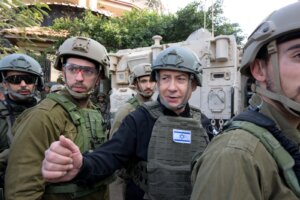
Israeli Prime Minister Benjamin Netanyahu was once dubbed “King Bibi” for his remarkable ability to win elections, starting with his surprise victory in 1996 at age 46. The number of political rivals who have risen and fallen during his decades in power is almost impossible to count.
But with the Oct. 27 election just days away – three years after Israel’s worst security failure under his watch and amid deep divisions at home and declining international support — could this finally be the 77-year-old Israeli leader’s last stand?
Recent polls show Netanyahu’s Likud party trailing former military chief Gadi Eisenkot’s Yashar party. Several right-wing and religious parties are also polling below the 3.5% threshold needed to enter the Knesset, threatening to waste thousands of votes that Netanyahu may need to secure a majority. Meanwhile, the opposition appears more organized and motivated than in previous elections, posing a serious threat to his nearly two-decade dominance of Israeli politics.
Netanyahu has spent much of his political career proving predictions of his demise wrong. In 2015, he defied polls and led the Likud Party to a surprise victory after warning on Election Day that Arab voters were heading to the polls in droves. In 2021, after 12 consecutive years as prime minister, he was forced into the opposition by an unlikely coalition led by Naftali Bennett and Yair Lapid. He returned to power less than two years later, almost immediately igniting mass protests over his judicial overhaul agenda, which his rivals said would concentrate power and eviscerate Israeli democracy.
Then came Oct. 7, the deadliest attack on Jews since the Holocaust. Israelis were furious over the security failures that allowed Hamas to breach the border and kill about 1,200 people. Families of hostages demanded the immediate return of their loved ones, and even longtime supporters questioned whether he could remain prime minister after the end of the military campaign in Gaza.
Netanyahu’s political future appeared bleak. Mazal Mualem, a political commentator and author of Cracking the Netanyahu Code, said in an interview that everyone close to Netanyahu whom she spoke with in the weeks after the attack believed it was over. “Bibi was the only one who thought he would survive,” she said, using Netanyahu’s nickname.
But Netanyahu refused to resign. He kept his right-wing coalition together through the war in Gaza, survived nationwide protests and hearings in his ongoing corruption trial. In a remarkable political achievement, he became the first Israeli prime minister in more than 50 years to lead a government through its full four-year parliamentary term — something he himself had never accomplished before in his long career.
How did Netanyahu survive?

In interviews with the Forward, Mualem and another Netanyahu biographer, Anshel Pfeffer, reflected on how Netanyahu has survived when his political career appeared doomed. They offered different explanations, but agreed on one thing: Netanyahu can never be counted out.
Pfeffer, a correspondent for The Economist and author of Bibi: The Turbulent Life and Times of Benjamin Netanyahu, said that while there’s “no equivalent” to his political instincts and campaign skills, Netanyahu also lacks certain human instincts, including “shame” and “introspection,” that might otherwise have forced him to step aside. “He has no shame,” Pfeffer said.
Netanyahu’s ability to hold on to power, Pfeffer added, also relied on a political system he spent decades building, in which the political careers and financial interests of his allies are tied to his success. That helped him keep far-right partners such as Itamar Ben-Gvir and Bezalel Smotrich, along with the Haredi parties, in his coalition despite disagreements over the war and military draft exemptions.
Mualem sees another reason Netanyahu survived: He transformed. “It’s almost as though he killed the old Bibi and a different person was born,” she said.
Netanyahu, once known for his risk-averse doctrine and being at times moderate on the Israeli-Palestinian conflict, became more willing to take bold military action. Under his leadership, Israel killed the leaders of Hamas and Hezbollah, launched strikes against Iran and expanded its military presence in Gaza, Syria and Lebanon. Mualem argued that this transformation helped Netanyahu win back voters who had turned against him after Oct. 7 and strengthen his standing among his political base. “He went to war for himself and for the country,” she said. “He didn’t give up.”
Can he do it again?

Netanyahu is now counting on those same political skills to carry him through another difficult election.
Recent polls show the parties in the anti-Netanyahu bloc holding an average of 55 seats, short of the 61 needed for a majority in the 120-seat Knesset. The two Arab lists — the United List, a coalition of three Arab Israeli parties, and Ra’am, led by Mansour Abbas — are generally counted outside either bloc. But their projected 13 to 15 seats could determine whether Netanyahu’s opponents can form a minority government or at least unite to elect a Knesset speaker from their ranks, giving them significant influence over the legislative agenda. Opposition leaders remain divided over whether they should cooperate with Arab lawmakers.
With little chance of winning over voters firmly opposed to him, Netanyahu is focusing on right-wing voters who supported him in previous elections but are now considering staying home. His goal is to convince them that the alternative to his leadership is too risky.
Netanyahu’s campaign slogan, “It’s the right or Palestine,” is tapping into post-Oct. 7 fears about the establishment of a Palestinian state, warning that an Eisenkot-led government dependent on Arab support will lead to Palestinian statehood. He made a similar claim in 1996 when he suggested Shimon Peres would divide Jerusalem.
Mualem said Netanyahu is approaching this race as if it were his first campaign. “Netanyahu’s secret isn’t magic,” she said. “It’s hard work and a refusal to give up. He never raises his hands in surrender.”
Shalom Lipner, a nonresident senior fellow at the Atlantic Council’s Middle East program, said Netanyahu has another important advantage: As prime minister, he can largely shape the national conversation. When attention turns to issues that expose his political weaknesses, including Haredi military exemptions or his government’s responsibility for Oct. 7, Netanyahu can redirect the focus to Hamas, Iran or other security threats.
Lipner, who served under seven consecutive Israeli prime ministers between 1990 and 2016, compared it to President Donald Trump’s political style. Both leaders, he said, are skilled at drawing attention to issues that favor them.
Earlier this week, Trump endorsed Netanyahu for reelection, giving his longtime ally another opportunity to highlight their partnership in confronting Iran. “If Israel has the wrong leader, which would be anyone other than Bibi, America will have to do this work ourselves, and I am not inclined to do so,” Trump wrote on Truth Social.
Netanyahu seized on the endorsement to rally his base and try to persuade undecided voters that his close relationship with Trump is essential to Israel’s security. “We have a job to finish,” he told Trump during a phone call that was turned into a campaign clip.
Lipner believes Netanyahu’s tactics face greater limits than in previous elections because Israeli voters have become increasingly skeptical and entrenched in their views.
Still, Netanyahu has little reason to stop trying.
Israeli political commentator Amit Segal suggested that the statement about working with Trump for the coming two years was aimed at swing voters tired of Netanyahu, but who “will find it easier to support him for final arrangements for one last job,” with the implicit expectation that this would be his final term.
The day after the election

For both Netanyahu and his opponents, winning more votes on Election Day is only half the battle. The bigger challenge is finding a way to form a government afterward.
Under Israel’s electoral system, the 37 parties running in this election cycle must win at least 3.25% of the national vote to enter the Knesset. Votes cast for parties that fail to cross that threshold do not translate into seats, potentially costing their political allies crucial seats available for redistribution.
That makes the fate of smaller right-wing parties, including one led by retired general Ofer Winter and a reservist-backed, economy-focused party led by former minister Yoaz Hendel, particularly important in determining the balance of power.
Voter turnout and first-time voters will therefore be critical to the makeup of the political map.
Even if Netanyahu does not win 61 seats, he could still benefit if the opposition cannot agree on a government. Polls show that a majority of voters want a different prime minister, but those voters are spread across parties with sharply different ideologies and priorities.
Eisenkot has suggested establishing a minority government with Arab lawmakers abstaining to allow it to be sworn in without formally joining the coalition. Other opposition figures, particularly Avigdor Lieberman, are opposed to alliances with Arab members.
These divisions are Netanyahu’s greatest hope. If the opposition can’t come to an agreement, that could set the stage for another election, leaving Netanyahu as prime minister until a replacement government is sworn in.
Is this his last stand?

All three experts said it is too early to predict whether this election will mark the end of Netanyahu’s career.
“At one point it’s going to be your last stand,” Lipner said. “I just don’t know if this is it.”
“Netanyahu has found so many ways to come back against all the odds against him,” Pfeffer said. “So you certainly can’t count him out, and I’m not going to try to.”
Mualem suggested that even if Netanyahu loses power, he may simply return to the opposition and wait for his rivals to fail. “Netanyahu doesn’t have another life,” she said. “Politics is the only life he has.”
The post Can Netanyahu win again? The secret to his political survival – and why it may finally fail him appeared first on The Forward.
