


Uncategorized
This Jewish museum is lending art across America — with one condition
Take a stroll through the Cleveland Museum of Art. Look closely in the Korean art galleries, and you will find a Jewish ritual spice container.
Among its collection of Italian Baroque art, you’ll stumble upon a marble Jewish marriage panel.
In the Middle East galleries, 19th-century Torah finials from Tbilisi, Georgia, blend seamlessly with the Islamic art that surrounds them.
Until recently, none of those objects were there. Like many art and history museums across the U.S., Cleveland had almost no Jewish ceremonial art on display. The few that do often display it in separate galleries exclusively reserved for Jewish art.
Now, Cleveland is just one of about a dozen museums across the country participating in a quiet initiative led by New York’s Jewish Museum, which is lending works from its collection to institutions that have little or no Jewish works on view. The Jewish Museum has one condition: don’t put them in a Judaica gallery.
“Jewish culture exists because for 3,500 years it’s been wandering the global diaspora,” said James Snyder, the director of the Jewish Museum, the art museum at the helm of the initiative. “How it looks is a function of its engagement, not its disengagement.”
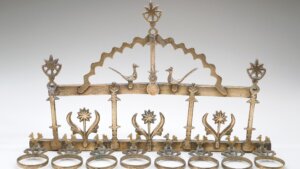
An Iraqi menorah adorned with peacocks belongs in a Middle East gallery, he argues, where visitors can see that the peacock was a common decorative motif across the region’s art, regardless of religion. A German Torah crown belongs among European decorative arts to tell the story about how, for centuries, Jewish ceremonial silver was largely crafted by non-Jewish silversmiths after Jews were barred from joining silver-making guilds.

20th century. Courtesy of The Jewish Museum

Bill Griswold, the director of the Cleveland Museum of Art, told the Forward that while the museum has had significant collections of Islamic, Christian, Buddhist and Hindu works, it “didn’t have a single important object of Jewish ceremonial art.” This, despite the fact that Cleveland has one of the country’s largest Jewish populations.
At the Toledo Museum of Art, curator Robert Schindler said there was “exactly zero Judaica” there until November 2025, when the museum purchased a rare 12th-century Afghan kiddush cup for $4 million — a record price for Judaica. The Toledo museum also joined the Jewish Museum’s lending initiative; a 13th-century synagogue inscription from Cairo will be displayed in a gallery that intends to compare different world religions.
“It’s a gap in the collection, and it’s a gap in the stories and narratives that we’re telling,” said Schindler. “This is sort of a very active way of trying to reckon with, and also make up for some of the things that we just didn’t collect previously.”

Jewish Museum curator Danny Smith-Salfati calls the partnerships “artistic interventions,” each one tailor-made. Staff from the Jewish Museum work alongside local curators to identify objects that naturally fit within existing galleries. They also train docents on the Jewish significance of the objects and how they fit into the historical narrative of the gallery where they are placed.
Museum directors say the response has been overwhelmingly positive. At the Detroit Institute of Arts, hundreds of visitors have shown up for events dedicated to the viewing of objects that include one of the oldest known Torah shields in the world and a casket from the 15th century adorned with zodiac symbols.
Judith Dolkart, the museum’s deputy director, said the interest has prompted the museum to think seriously about adding Jewish ceremonial art to its permanent collection.
Griswold said the Cleveland museum has welcomed more guests in this calendar year than in recent history, a surge he attributes in large part to interest in the works on loan from the Jewish Museum.
“When I’ve been in the galleries, and these works have been on view, there have been people gathered around these vitrines [glass cases], fascinated to discover something really new in the context of our collection,” he said.

Snyder began his tenure at the Jewish Museum in October 2023, just three weeks after the Oct. 7 attacks on Israel. He found himself navigating a moment of extraordinary tension. Museums across the country are still wrestling with pressure to take a stance on the conflict, confronting challenges such as disputes over public-facing staff members wearing keffiyehs to work and protests and vandalism tied to accusations that museum officials were providing support to Israel during the Gaza War. Jewish museums were not immune to that strife. According to a survey by the Council of American Jewish Museums, 81% of Jewish museums in North America and Europe reported antisemitic or anti-Israel harassment after Oct. 7.
“Museum staff were making statements that were shifting to the left, and shifting to pro-Palestinian, anti-Israeli,” Snyder said. “Museum boards were shifting the other way: pro-Israeli, shocked, horrified, and that was producing conflict in museums … it was in every museum in town.”
Once he took the helm, Snyder created a post-Oct. 7 action plan to help the Jewish Museum navigate the moment, which included a directors’ talk series and an educational program for staff on the Middle East, racism and antisemitism, and exhibits about the traumas of the war. He also thought hard about the museum’s approach to curation, seeking to explicitly draw connections between Jewish objects and the places and cultures in which they developed.

“A culturally specific museum is segregating itself,” he explained. “What you need to do is show that Jewish culture has been in the global diaspora longer than any other single culture for 3,500 years, demonstrating resilience and engagement worldwide.”
Suddenly, Snyder began receiving calls from directors of encyclopedic museums across the country. How could they build a collection of Jewish art and artifacts in their spaces?
His answer was blunt. “You really can’t today,” he told them. Most major Judaica already belongs to museums or private collectors, and when important objects do come to market, private buyers often outbid institutions, he said. Instead, he offered them another solution: borrow from the Jewish Museum.
“Take a dozen from us and don’t put them in a room,” Snyder recalled telling museum directors. “Sprinkle them. Take something from the Italian Renaissance, German Baroque, British Imperial, American Colonial, Asian…”
Smith-Salfati says this initiative fulfills part of the Jewish Museum’s mandate.
“We’re introducing Jewish material and Jewish concepts and Jewish ideas that are not widely known,” he said. “And debunking myths about what Judaism is and looks like.”
Snyder agrees.
“We see part of our job as dispersing Jewish culture across the landscape of our own American diaspora,” Snyder said. “It’s what we feel is our mandate — and one that’s all the more relevant because of the times we’re in.”
The post This Jewish museum is lending art across America — with one condition appeared first on The Forward.
Uncategorized
Why Dolly Parton sang a song about a Jewish journalist

A Broadway show, a star-studded television tribute, a new hotel and museum in Nashville. As odes to Dolly Parton keep coming, a recording of the late country music singer honoring an American Jewish journalist has recently surfaced.
Never before released in America, the song, “A Bridge Across,” sung by Parton and accompanied by the Nashville Symphony, honors slain journalist Daniel Pearl.
The song features spare lyrics set to violin music composed in honor of Pearl, a Wall Street Journal reporter who was brutally murdered by terrorists in Pakistan in 2002.
Originally recorded in 2008 by Parton, renowned fiddler Mark O’Connor, and the Nashville Symphony, the song was intended to be part of a compilation album called This is My America, produced and funded, oddly enough, in Canada but never released in the U.S.
It was O’Connor and his wife Maggie who resurrected the recording this fall, shortly after the deaths of Parton and another musician that connected the four artists: Oregon violinmaker Jonathan Cooper, who died in September.
Deeply troubled by the journalist’s murder in 2002, Cooper learned Pearl was an amateur fiddler and set out to create a quartet of string instruments – two violins, a viola and a cello – in the journalist’s honor. He entrusted the instruments to O’Connor to use during his annual summer music camp in North Carolina. Every year since, four students from the camp have received one of the Daniel Pearl memorial instruments to play for a year.
“These young people carry the message that love fights hatred through music-making and understanding that Daniel Pearl’s family want him remembered for,” O’Connor told The New York Times. Likewise, Cooper’s loving gesture inspired Parton, O’Connor said.
Canadian violinist Samantha Robichaud received one of the violins in 2005 and has gone on to become a successful recording artist with more than a half dozen albums. She has toured North America as an ambassador for the Daniel Pearl Foundation, sharing Pearl’s story, including his passion for

music and its power to change lives. Enter songwriters Tom McBryde and Lynn Wilbanks, whose introduction to Robichaud inspired verse.
On the album, the Nashville Symphony played one of Robichaud’s compositions while Parton introduced Pearl to listeners.
“He believed that music was something that could cross all social barriers, political borders and imaginary boundaries,” Parton says, before singing McBride’s and Wilbanks’ lyrics.
“A bridge across a question one journey begins, one step at a time to a place within.
A bridge across a border, a hand reaching out one heart at a time to erase the doubt.
A bridge across a difference can close a divide, one song to be sung on the other side.”
“It was perfect. She knows what he stood for,” Pearl’s father, Dr. Judea Pearl, told the Forward. “She was such a giving person.”
Judea Pearl met Parton in 2018 at the Los Angeles Press Club where she received that year’s Public Service Award for Contributions to Civic Life for her Imagination Library, which sends free books to children. (It inspired the creation of the PJ Library for Jewish books.) The Press Club recently dedicated its upcoming National Arts & Entertainment Journalism Awards to Parton’s memory.
In 2018, Judea Pearl was there to present the Daniel Pearl Award for Courage and Integrity in Journalism to Saudi Arabian writer and blogger Raif Badawi whose wife accepted the award while he served a 10-year prison sentence for his online activism.
The foundation devoted to Daniel Pearl’s legacy has been less visible since the 2021 death of Pearl’s mother Ruth who, as a young girl, witnessed and survived the anti-Jewish pogroms in Baghdad known as the Farhud.
As the 25th anniversary of his son’s murder approaches in February, Judea Pearl said the foundation will start a new chapter under his daughters’ leadership. Parton’s song lends the effort a touching soundtrack.
The post Why Dolly Parton sang a song about a Jewish journalist appeared first on The Forward.
Uncategorized
Mamdani marks first Oct. 7 anniversary as mayor with statement blasting Israel’s war in Gaza as genocide
On the third anniversary of the Oct. 7, 2023, Hamas attack on Israel — his first commemoration as New York City’s mayor — Zohran Mamdani mourned the Israeli victims and the 251 people taken hostage before devoting most of a statement to condemning Israel’s war in Gaza as a “genocide” and accusing the U.S. government of complicity in Israeli war crimes.
“The suffering did not begin nor end that day,” Mamdani said in a 200-word statement, noting the Palestinian casualties of the war that was launched as a military campaign against Hamas. “Three years later, we must refuse to accept a world in which occupation and apartheid continue, where war crimes are met with impunity, and our federal government continues its complicity with every arms shipment.”
The mayor’s words were in stark contrast to statements released by other elected officials, including New York Gov. Kathy Hochul, who noted it was the deadliest day for the Jewish people since the Holocaust.
“The pain of that dark day has not faded,” she wrote. “But neither has the strength, resilience and enduring hope of the Jewish people.”
House Democratic leader Hakeem Jeffries also noted the attack was carried out by “Hamas terrorists intent on destroying Israel,” but also acknowledged Palestinian deaths and Gaza destruction.
New York Attorney General Letitia James also released a statement, to “honor the innocent people murdered and families forever changed by the Hamas terrorist attacks,” a term some noted Mamdani did not use.
Jonathan Greenblatt, CEO of the Anti-Defamation League, noted another term Mamdani did not include.
“Not once do you say ‘Jews,’ Greenblatt wrote on X.
“You are weaponizing a day meant for mourning the worst massacre of Jews since the Holocaust to recycle your usual antizionist talking points,” he added. “The city with the largest Jewish population outside Israel deserves a mayor who can honor the dead without exploiting them.”
Democratic congressional nominee Brad Lander, an outspoken Jewish ally of the mayor, did not criticize the mayor’s statement. Instead, on his Substack, he shared his reflections on the anniversary, calling for Israelis, Palestinians, Jews and Muslims to mourn together as a first step toward peace.
“We can mourn for those lost on October 7th and still acknowledge the enormous imbalance of power between Israel and the Palestinians,” he wrote. “Over the past three years, so much more death, destruction, and displacement has fallen on Palestinians.”
But David Greenfield, a former Councilmember and head of the Met Council charity group, called Mamdani’s statement unhelpful, one that risks “further dividing” New Yorkers. “I really wish the Mayor of NYC would just focus on NYC,” he wrote on X.
Alex Vindman, a former Democratic Senate candidate in Florida, also criticized the statement, posting on X that it “did a real disservice” to Democrats and democratic socialist candidates who are making their appeals to moderates and independents in battleground states.
Former Republican congressman turned-Trump critic Joe Walsh posted on X: “Shame on you @NYCMayor. You can’t just give one day for Israel to mourn? One day? The deadliest day for Jews since the Holocaust, and you can’t remember only that atrocity today? You must throw in everything else today?”
A pro-Palestinian activist since his college years, Mamdani has been unapologetic about his anti-Zionist views that continue to shape his tenure. His harsh rhetoric on Israel and handling of antisemitism — including refusal to define that term — and defense of pro-Palestinian protests outside synagogues have strained relations with parts of the Jewish community.
Mamdani drew fierce backlash earlier this year when he produced a Nakba Day video commemorating the displacement of Palestinians during Israel’s founding in 1948 around Israel’s independence day.
A new poll published Wednesday morning found that 64% of Jewish voters in the city prefer that Mamdani skip any event marking the Oct. 7 massacre. As a Democratic nominee last year, Mamdani attended an Oct. 7 commemoration marking the loss of Israeli and Palestinian lives. That event is not on the mayor’s daily public schedule, but a meeting with a group of local Palestinian Americans is on the calendar.
Still, he has failed to satisfy some of his supporters, including young activists who backed his bid for mayor and attended the pro-Palestinian protests on college campuses after the Oct. 7 attacks. Multiple chapters of the Young Democratic Socialists of America are planning to demonstrate outside city hall tonight on the premise that Mamdani failed the Palestinian movement, capitulating, they say, “to Zionist pressure.”
The mayor declined to comment on this demonstration.
The post Mamdani marks first Oct. 7 anniversary as mayor with statement blasting Israel’s war in Gaza as genocide appeared first on The Forward.
Uncategorized
Chicago Jewish theater drops Naomi Ragen play, saying actors feared repercussions of working with the Israeli writer
(JTA) — Naomi Ragen, the New York-born Israeli novelist and playwright known for her portrayals of Orthodox Jewish women in crisis, says the cancellation of a planned Chicago revival of one of her plays represents a “return to McCarthyism” in the American cultural scene.
Ragen, 77, has revealed that plans by a Jewish arts company in Chicago to revive her 2001 play “Women’s Minyan” have been shelved. In a post shared with her thousands of followers on Facebook, Ragen included an email from the company’s artistic director saying that she had been inundated by messages from actors, directors and designers who feared that working with a “a pro-Zionist Jew/Israeli” like Ragen could damage their careers.
Ragen told the Jewish Telegraphic Agency that Chicago-based Arts Judaica first approached her in July with a request to stage her play about a haredi woman trying to flee her abusive marriage. Elayne LeTraunik, the company’s artistic director, told Ragen they intended to stage 13 performances next March.
Happy to collaborate, Ragen asked for a contract. She heard nothing until this week when she received a reply from LeTraunik, saying she “must sadly withdraw my intent to do the show.”
LeTraunik’s email continued: “People were seeing you were a pro Zionist Jew/Israeli and I was bombarded with actors, directors and designers who were actually afraid that doing a show with you as playwright would hurt their careers. I never have faced this before and I was stunned about all the accusations of ‘genocide’ flying around.”
The episode stands in contrast to Arts Judaica’s stated mission: Its website says that “American audiences need Jewish stories on stage more than ever.”
“In the past I have done plays about suicide bombers and never had a peep from anyone,” LeTraunik told Ragen. “This world is getting insane. Perhaps once all this dies down (if it ever does) I will try again. I am so sorry.”
Born in New York, Ragen emigrated to Israel in 1971, where she settled in Jerusalem. In addition to best-selling novels like “Sotah” and “The Sacrifice of Tamar,” she regularly writes opinion pieces sharing her hawkish views on Israel. On her website and on social media, she shares dispatches from her “Israel War Diary,” expressing strong support for Prime Minister Benjamin Netanyahu and IDF military action against Hamas. She has also spoken against what she describes as a worldwide “climate of hatred, fear, and intimidation.”
Some people, she said, have suggested the play was canceled because she is a right-wing Zionist. “Are we now back to McCarthyism, where you have to check the political credentials of an artist [before deciding] whether or not to promote their work?” she said.
“I thought all the progressives were against McCarthyism. Now we’re back there where I have to pass some kind of political test in order to have my work shown.”
LeTraunik told JTA she could never have predicted the pushback or the cancellation when she first approached Ragen. “This situation is one I have never faced before after a lifetime in theater,” she said.
“Since the play has nothing to do with politics I didn’t anticipate any problems,” she continued. “But unfortunately people had done research on Naomi and felt so triggered by her politics it appeared that there were concerns from would-be actors, etc. and even the person who had offered to put up some of the funding was not comfortable.
“As for me, I am almost 80 years old, [a] lifetime American and Jew and I have long decided not to get involved in the current political turmoil. I just want to do interesting theater.”
Ragen told JTA that while it is “strange to get such a response from a Jewish venue,” particularly one whose mission statement includes Holocaust education, she is not angry at LeTraunik.
“I have only sympathy for her,” she said. “I think all these Jewish cultural organizations are now under fire and what we need is not to criticize them because they’re not brave enough, but to understand the pressures they’re under.”
Earlier this month the Anti-Defamation League published a report alleging “the systemic exclusion and marginalization of Jewish and Israeli artists across American cultural life.” In its examination of museums, publishing and live entertainment, the ADL said it found that Jewish, Israeli and Zionist artists have “faced growing scrutiny, organized protest activity, online targeting, event disruptions, reputational campaigns and, in some cases, cancellations or institutional distancing.”
Ragen said her play, originally commissioned by Habima, Israel’s national theater, has previously been staged in the United States. She is not taking the cancellation personally, she said, but as a symptom of a far greater problem.
“You had a situation in Germany in 1938 where you couldn’t produce a Jewish play or any play which didn’t toe the Nazi line,” she said. “Are we going back to that?”
In her conversation with JTA, Ragen called on “American Jews and good people” to “be a little brave,” adding: “It’s not time to build another Holocaust museum — it’s time to wake up, smell the coffee, and put your money and your time and your effort where your mouth is.
“If you are a person who wants to promote Holocaust education, well, you’re living in the middle of it.”
This article originally appeared on JTA.org.
The post Chicago Jewish theater drops Naomi Ragen play, saying actors feared repercussions of working with the Israeli writer appeared first on The Forward.
