A little‑remembered Gilded Age millionaire helped make milk safe for American kids through his ‘retail giving’
The 1844 edition of the widely used schoolbook written by William H. McGuffey, “Newly Revised Eclectic Fourth Reader,” includes a dialogue about the difference between “true and false philanthropy”:
Mr. Fantom: I despise a narrow field. O for the reign of universal benevolence! I want to make all mankind good and happy.
Mr. Goodman: Dear me! Sure, that must be a wholesale sort of a job: had you not better try your hand at a town or neighborhood first?
As the discussion continues, the lesson becomes clear. Mr. Fantom’s approach is too ambitious to accomplish much, while Mr. Goodman’s, if narrower in scope, was likely to be more useful in practice.
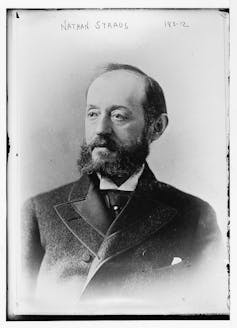
Nathan Straus made his mark in philanthropy after a successful career running the Macy’s department store. Library of Congress Image by
Many of Straus’ contemporary philanthropists were setting lofty goals for their giving. In oil magnate John D. Rockefeller’s case, it was promoting “the welfare of humanity throughout the world.” For steel tycoon Andrew Carnegie, it was “to promote the advancement and diffusion of knowledge and understanding.”
Straus pursued more mundane objectives that included championing milk pasteurization. Although his efforts are not as well known today as those of his more ambitious – and wealthier – counterparts, they accomplished a lot and showed that what might be called “retail giving” can have far-reaching effects.
Successful immigration story
The Straus family came to the United States from Germany in the 1850s during the first big wave of Jewish immigration. Lazarus Straus, Nathan’s father, followed a familiar path for Jewish immigrants at the time, beginning as a peddler and eventually establishing his own store in the small town of Talbotton, Georgia, where the members of his family were the only Jews.
He prospered, became a respected citizen and saw that his children received good educations, including in their religion.
Then the Civil War upended the family’s life, first by reviving antisemitic prejudices and then, eventually, by destroying the family’s business.
Starting anew in New York City, Lazarus and his older sons, Isidor and Nathan, began to sell imported china, glassware and other crockery to retailers in the Northeast and South. One was Rowland H. Macy, who had founded an eponymous store that was on the cutting edge of what Fisher calls a “retailing revolution.”
Macy’s innovations included stocking large inventories of many kinds of merchandise, competitive pricing, extensive advertising and providing a variety of services like public restrooms and a cafeteria to make shoppers’ experiences more pleasurable.
Aided by the rapid urban and economic growth of the late 19th century, the model flourished. Department stores displaced smaller, specialty shops. Other retail powerhouses, such as Bloomingdale’s and Lord & Taylor, soon competed with Macy’s.
The Straus family sold their wares at Macy’s. After Rowland H. Macy died, the Straus family became partners with its new owners. By 1896, the Strauses owned the store outright. And Macy’s was expanding: It bought another department store in Brooklyn and created a flagship building on Manhattan’s Herald Square, which Macy’s still occupies.
The landmark Macy’s department store in New York’s Herald Square opened in 1902 while Nathan and Isidor Straus ran the retailer. Library of Congress Image by
His philanthropy journey begins
While Isidor Straus oversaw the store’s internal operations, Nathan focused on the company’s external activities, such as purchasing, marketing and dealing with government and business leaders.
A third brother, Oscar, pursued a career as a politician and diplomat, eventually becoming secretary of commerce and labor under President Theodore Roosevelt and the first Jewish member of a presidential cabinet. Perhaps inevitably, this led to a series of public appointments for Nathan Straus.
However, as they became wealthier, Nathan and his wife, Lina, increasingly devoted their attention to a series of philanthropic projects.
In 1893, the U.S. entered a four-year economic depression, its worst until the 1930s. As unemployment in New York City rose, Nathan Straus used his merchandising skills to address the needs of the jobless and poor.
He created a number of “depots” near tenements and boarding houses that sold coal, food and fuel at discount prices. Fisher, Straus’ biographer, rightly calls these early examples of what is now known as “social entrepreneurship”: the application of business principles to solving social problems.
Making milk less deadly
As these efforts were getting away, Straus also launched what would become his major preoccupation: promoting pasteurized milk.
In New York City in the early 1890s, Fisher writes, “the annual mortality rate among children under five was about 15 percent,” or 18,000 infants and toddlers per year. A main cause was consuming raw milk, which, unless certified by inspectors, was likely not only to contain a variety of pathogens, such as tuberculosis bacteria, but spoil easily going from farm to table.
Although scientists had long known that heating could make milk safer, doctors and public health officials worried that sterilizing milk might also destroy its valuable nutrients.
Straus, who had lost one of his own children to what he believed was a milk-borne infection, built on his projects for the unemployed by working with New York social service agencies to develop pasteurization plants and infant-milk stations near low-income neighborhoods.
They sold sterilized and refrigerated milk at below-wholesale prices, or donated it to those who could not afford to pay. Businesslike efficiency kept costs low, as did donations. Multilingual ads publicized the product’s availability, doctors and nurses advised parents on child-rearing, and careful recordkeeping aimed at assessing the program’s health benefits.
Straus and his wife devoted much of their time and money to this work. In addition to establishing 297 milk stations in 36 cities, they also spoke and wrote widely about the merits of pasteurization.
By 1908, their efforts paid off when the U.S. Public Health Service endorsed pasteurization and state and local governments began requiring that milk sold in their jurisdictions be pasteurized. Raw milk remained available in many states, and debates over its safety continue to this day.
As a result of this and other Progressive Era measures, New York City’s health commissioner estimated that infant deaths dropped by two-thirds
during the first two decades of the 20th century, with similar declines elsewhere in the country.
The coastal Israeli city of Netanya was named after philanthropist Nathan Straus. Jack Guez/AFP via Getty Images Image by
Other causes
While most of Nathan Straus’ efforts occurred in the U.S., he used his trips to Europe for Macy’s to promote pasteurization on the continent.
During a 1904 visit, he toured the Mediterranean and stopped in Palestine, then part of the Ottoman Empire. Impressed by the early Jewish settlements and holy sites he saw, Straus became an ardent advocate for creating a Jewish homeland in the Middle East, an unusual position for a Jewish businessman of that era, according to Fisher.
On a subsequent trip, a broken leg kept Straus from returning to New York on the maiden voyage of the Titanic; his brother Isidor and sister-in-law Ida were not so fortunate.
In the U.S., Nathan Straus led Zionist organizations, while in Palestine, his chief contributions involved supporting a variety of health care and economic development activities, including Hadassah, the women’s health and community development organization founded by Henrietta Szold.
Nathan Straus’ achievements as a philanthropist are not widely known today because he did not create a grantmaking foundation that outlasted him, as Rockefeller and Carnegie did.
Instead, by the time of his death in 1931, Straus had donated much of his fortune. Fisher writes that Straus used to invoke an old Hebrew proverb: “Money given in health is gold. Money given in sickness is silver. Money given after death is lead.”
He also didn’t donate heavily to the burgeoning network of communal organizations set up to assist the growing population of Jewish immigrants, as did the financiers Jacob Schiff and Felix Warburg, who were also affluent Jewish immigrants from Germany.
As Fisher notes, this pattern of philanthropy resembles that of Straus’ friend – and pallbearer – Julius Rosenwald, the longtime head of Sears, Roebuck and Co. Both supported Jewish causes as well as major initiatives aimed at helping others: In Rosenwald’s case, it was schools for African American children in the South, while for Straus, it was milk pasteurization in New York City and beyond.
During and after World War I, they worked together to assist Jewish refugees in Europe. Fisher might have added that neither Straus nor Rosenwald sought much recognition for their work.
His thorough account should help give Straus the credit he deserves for his philanthropy. It should also show that donors do not have to aspire to “make all mankind good and happy” to make an important difference.
In many ways, Nathan Straus was an old-fashioned do-gooder, responding to the needs he saw with innovative solutions. As a result, he wound up accomplishing a lot of good.
“Emma,” a young Jewish woman who we met in 2019, didn’t belong to a synagogue. She didn’t have a Jewish partner. She didn’t observe Jewish rituals regularly. On most surveys about religion, she would not seem very engaged with Judaism.
But as Emma talked about what she did in her free time, a very different picture began to emerge. She visited Jewish websites and enjoyed listening to Jewish music. She read books about Jewish topics and had recently attended a retreat for young Jewish adults to learn Torah while also doing yoga.
She was highly invested in learning about Judaism, but she explored her identity without joining traditional institutions.
Most major surveys about religion ask whether someone belongs to a congregation, how often they attend services, whether they pray regularly and whether belief is important in their lives. Those measures help identify broad shifts, like the growing percentage of Americans who are religiously unaffiliated: the “nones.”
But many Americans’ religious lives, like Emma’s, are not disappearing; they are moving away from membership of traditional institutions. To understand what religion looks like in 21st-century America, researchers may need to ask different questions.
Learning through art
As scholars of Judaismand education, we have been exploring how people learn about religion beyond traditional places like synagogues, Jewish schools and summer camps. Between 2019 and early 2023, we spoke with hundreds of people and explored different leisure time activities to discover what people learn about Judaism and Jewishness through cultural arts.
We interviewed dozens of audience members at Jewish-themed shows on Broadway, such as “Leopoldstadt”and “Parade.” We attended Jewish concerts and asked attendees what they learned. We explored how social media communities offer spaces to talk about different Jewish topics, like what fans learned about ultra-Orthodox Judaism from watching the television show “Shtisel.”
‘Shtisel,’ an Israeli series about an ultra-Orthodox family in Jerusalem, ran for three seasons.
Our research revealed that there is a vibrant ecosystem of people learning about religion in their leisure time. Through the arts, both Jews and non-Jews encounter Jewish history, Jewish religious practices and representations of Jewish communities.
Screen and stage
Most people we spoke with told us that they felt meaningful connections to Judaism during activities that would rarely appear on a standard religion survey.
“Joan,” an unmarried woman in her 50s from Connecticut, told us that she was deeply invested in Judaism, but felt that synagogues and Jewish community centers were not welcoming to single people without families. Instead of joining a Jewish institution, she watched Jewish-themed TV shows and movies on Netflix, and joined social media communities to chat with other fans.
“Luis,” who lived in Boston but was born in Argentina, was a Sephardic Jew, a group that traces their ancestry and traditions to Jewish communities who once lived in Spain and Portugal. His wife was Ashkenazi, meaning her ancestors came from Central and Eastern Europe. She considered herself secular, and so the couple joined the Worker’s Circle, a nonreligious Ashkenazi institution rather than a synagogue.
Yet Luis loved deepening his knowledge of Sephardic culture, and he often attended concerts of music in Ladino, a Sephardic language related to Spanish, with other Sephardic immigrants.
American singer Sarah Aroeste writes and performs in Ladino.
For Joan and Luis, these activities were not peripheral to their Jewish lives. Rather, they were central avenues for learning and community. We interviewed hundreds of Jews who told us that cultural experiences were opportunities to reflect on Jewish practices, explore questions of belonging, connect with family histories and find friends with common interests.
New questions
Some aspects of these patterns were distinctive to Judaism. Historically, many Jews have understood Judaism to be a cultural world, and not only a theological tradition. Learning about cultural dimensions of Judaism has long been part of Jewish education.
The broader phenomenon of informal learning, though, extended far beyond a single tradition. Across America, increasing numbers of people learn about religion through media, cultural productions and digital networks. Christians may study biblical themes through podcasts, online discussion groups or religious influencers. Muslims may participate in online learning communities that connect believers across the world.
The challenge for religion researchers, then, is not simply to determine whether engagement with religion is rising or falling. Rather, it is to develop more nuanced ways of understanding how people explore religious themes and practices, beyond traditional institutions. Only then can we more fully understand how contemporary Americans actually live their religious lives.
Six months into the Iran War, the West has a second chance
Six months ago, the war against Iran began with a display of Israeli military and intelligence prowess so spectacular that rapid political change seemed within reach. Israeli strikes decimated much of Iran’s leadership, killing Supreme Leader Ali Khamenei, senior officials and military commanders, while demonstrating extraordinary intelligence penetration and an ability to strike at the heart of a regime that had spent decades protecting itself.
For supporters of regime change in Iran, myself included, the possibilities seemed extraordinary. I wrongly assumed the military campaign formed one part of a broader strategy, with the CIA and perhaps Mossad working inside Iran to prepare senior military officers, dissident elements of the Islamic Revolutionary Guard Corps or other power centers to move once the regime was suddenly leaderless. A coup seemed plausible, and the opening attack appeared capable of acting as the trigger.
That optimism proved misplaced. Six months later, the Islamic Republic survives under an even more hardline leadership, the United States has paid heavily for the conflict, Israel’s standing has plummeted dangerously as a result, and the world has endured an energy crisis. Western interceptor stockpiles have been disturbingly depleted as Iran has demonstrated how relatively inexpensive missiles and drones can impose enormously expensive defensive requirements on its enemies.
In addition to the failure to organize regime change, there was – incredibly – no American plan for dealing with Tehran’s predictable move to block the Strait of Hormuz, through which about one-fifth of the world’s crude oil and liquified natural gas flows.
That is particularly difficult to explain because the danger was both obvious and apparently understood inside the administration. The Wall Street Journalreported this week that then-Director of National Intelligence Tulsi Gabbard warned President Donald Trump before the war that killing Khamenei would probably produce more obstinate leaders, that Tehran would move to close the Hormuz and destabilize global energy markets, attack American forces and partners across the region, and redouble nuclear weapons efforts.
The most plausible explanation for Trump’s decision to proceed is the confidence of Israeli Prime Minister Benjamin Netanyahu and others that Iran’s historic weakness had created an opportunity for rapid regime collapse. Iran certainly was weak, but weakness and imminent collapse are very different things in a country without real elections or term limits and a willingness to kill as many of its own people as necessary.
The military math has meanwhile grown increasingly unfavorable. The United States and Israel are using sophisticated interceptors costing enormous sums against Iranian missiles and drones that can be produced far more cheaply. Months of fighting have placed pressure on Iron Dome, Patriot and other interceptor inventories at a moment when such weapons, if the war resumes, may be required all over the Middle East and even beyond. Iran has discovered an asymmetric advantage in forcing wealthy adversaries to spend vastly more on defense than Tehran spends on attacks.
It also discovered that the Americans had not rounded up a posse: America’s allies, who were not consulted in any of this, were clearly not on its side. Though they certainly hate the Islamic Republic, one could be forgiven for suspecting they hated Trump – who a month before the attack on Iran threatened NATO ally Denmark over Greenland – even more.
By June, the strategic balance was reflected in diplomacy. Trump had entered the war speaking about eliminating the Iranian nuclear threat and clearing the way for Iranians to overthrow their oppressors, yet the memorandum of understanding reached with Tehran represented a retreat from any such ambitions, containing none of the transformational conditions that might have justified the costs of the war.
Iran made no meaningful commitment concerning its ballistic missile program or its calamitous support for Hezbollah, the Houthis, Hamas, Palestinian Islamic Jihad and militias in Iraq, Syria and Lebanon. The agreement offered no protection for Iranians confronting a regime that had massacred tens of thousands of protesters. Instead it envisioned massive sanctions relief, unfreezing of assets, the removal of the American blockade and hundreds of billions of dollars for Iranian reconstruction and economic development; all this inevitably would have strengthened the same regime whose survival the war was expected to jeopardize.
Such were the shameful wages of hubris and poor planning, and it reflected Trump’s panic at the energy crisis unfolding as midterm elections approached. The Islamic Republic had every reason to view the June agreement as a victory – and yet, amazingly, it then overplayed its hand.
Rather than pocketing a strategic reprieve, Iran’s rulers continued asserting the right to control passage through the Strait of Hormuz and charge vessels fees and tolls. Accepting such an arrangement would create a dangerous precedent extending far beyond Iran, effectively granting a belligerent power a tollbooth over one of the world’s essential maritime arteries and inviting similar behavior around other strategic chokepoints. It would upend global maritime trade, and devastate America’s credibility as the chief protector of freedom on the seas.
The MOU’s negotiating period has now expired, and Washington this week shifted toward a strategy better suited to Iran’s actual vulnerabilities. Treasury Secretary Scott Bessent has unveiled what the administration calls an “economic D-Day,” beginning with sanctions against roughly 60 Iran-linked individuals, companies and vessels and threatening secondary sanctions against foreign entities that continue doing business with Tehran.
This was, of course, greeted with considerable skepticism, which the Trump administration has earned in spades. But in fact, combined with a determined blockade, the approach has the potential to accomplish what the original expectation of rapid regime collapse could not.
Iran has spent decades developing sophisticated methods for evading sanctions through disguised tankers, ship-to-ship transfers, shell companies, yuan transactions and an elaborate shadow economy. China purchases the overwhelming majority of the oil Iran manages to export and provides Tehran with both buyers and financial channels outside the conventional dollar system. Those mechanisms can help Iran disguise and monetize a barrel that reaches the international market, while they cannot create a physical route for the next barrel through a blockade.
And that is the main issue: the oil Iran is currently selling, which is its key export, is mostly what had been stashed before the war outside the blockade zone, on the high seas and elsewhere. It should run out in six months or less. The world just needs patience (though it would also help for the United States and NATO to make up and project a united front).
Iran’s resilience has been remarkable, but its economic position was precarious even before the war. The country entered the conflict suffering chronic electricity shortages, deteriorating infrastructure, a severe water crisis after years of drought and groundwater depletion, punishing inflation and a currency that had already lost most of its value in recent years. It was economic desperation that helped fuel the unrest that the regime answered with mass killing in January. It is very likely that this fury will explode again, stronger still.
The conflict has been transformed into a contest of endurance. Iran is betting that Western political patience will expire before its economic oxygen does, because democratic governments feel higher energy prices, business pressure and voter anger immediately, while authoritarian governments can impose extraordinary suffering on their populations.
The West possesses a countervailing advantage of overwhelming economic scale. Iran’s economy is tiny beside the combined economic power of the United States, Europe and their allies, while China’s economic relationships with America and Europe dwarf its commerce with Tehran. Sustained pressure can therefore force governments and companies to decide how much economic risk they are prepared to assume on behalf of a weakened Islamic Republic.
The first six months of the Iran War offer a harsh lesson about the limits of military power against a ruthless rival with asymmetric levers. But six months after a war built around the expectation of rapid collapse, the outcome depends on patience. The United States is now fighting the right war: Iran’s regime is a global rogue, and sometimes superpowers must use power, whether military or economic. Moreover, time is on its side, if it will bide it.
There is just one small problem: Trump, a man with almost no credibility, needs to credibly explain to the American people why it’s worth the pain.






You must be logged in to post a comment Login