


Local News
The Simkin Centre received over $500,000 in charitable contributions in 2025 – so why is its CEO complaining that “it cannot make the same number of bricks with less straw?”

By BERNIE BELLAN (This story was originally posted on January 14) I’ve been writing about the Simkin Centre’s aacumulated deficit situation ($779,000 according to its most recent financial report) for some time.
On January 14 I published an article on this website, in which I tried to find out why a personal care home that has an endowment fund valued at over $11 million is running such a huge deficit.
Following is that article, followed by a lengthy email exchange I had with Don Aronovitch, who is a longtime director of the Saul and Claribel Simkin Centre Foundation. My purpose in writing the original article, along with the update, is I’m attempting to ascertain why the Simkin Centre simply doesn’t use more of the charitable donations it receives each year to address its financial situation rather than investing then under the management of the Jewish Foundation:
Here is the article first posted on January 14: A while back I published an article about the deficit situation at the Simkin Centre. (You can read it at “Simkin Centre deficit situation.“) I was prompted to write that particular article after reading a piece written by Free Press Faith writer John Longhurst in the August 5 issue of the Free Press about the dire situation personal care homes in Winnipeg are in when it comes to trying to provide their residents with decent food.
Yet, Longhurst made one very serious mistake in his article when he wrote that the “provincial government, through the Winnipeg Regional Health Authority, has not increased the amount of funding it provides for care-home residents in Manitoba since 2009.”
In fact, the WRHA has given annual increases to personal care homes, but its allocations are not broken down by categories, such as food or salaries. As a spokesperson for the WRHA explained to me in an email: “PCHs receive per diem global operating funding based on the number of licensed beds they operate. This funding model is designed to support the full range of operating costs associated with resident care, including staffing, food services, utilities, building operations, and other day-to-day expenses.”
Now, one can make a perfectly valid argument that the level of funding from the WRHA has not kept up with inflation, especially inflation in food costs, but the Simkin Centre is in an even more precarious position because of the skyrocketing cost of kosher food.
“In recent years,” according to an article on the internet, “the cost of kosher food has increased significantly, often outpacing general food inflation due to unique supply chain pressures and specialized production requirements.”
Yet, when I asked Laurie Cerqueti how much maintaining a kosher facility has cost the Simkin Centre, as I noted in my previous article about the deficit situation at Simkin, she responded: “approximately $300,000 of our deficit was due to food services. I do not have a specific number as far as how much of the deficit is a result of kosher food…So really this is not a kosher food issue as much is it is an inflation and funding issue.”
One reader, however, after having read my article about the deficit situation at Simkin, had this to say: “In John Longhurst’s article on Aug 5, 2025 in the Free Press, Laurie (Cerqueti) was quoted as saying that the annual kosher meal costs at Simkin were $6070 per resident. At Bethania nursing home in 2023, the non-kosher meal costs in 2023 were quoted as $4056 per resident per year. Even allowing for a 15% increase for inflation over 2 years, the non-kosher food costs there would be $4664.40 or 24% lower than Simkin’s annual current kosher food costs. If Simkin served non-kosher food to 150 of its 200 residents and kosher food to half of its Jewish residents who wish to keep kosher, by my calculation it would save approximately $200,000/year. If all of Simkin’s Jewish residents wished to keep kosher, the annual savings would be slightly less at $141,000.”
But – let’s be honest: Even though many Jewish nursing homes in the US have adopted exactly that model of food service – where kosher food is available to those residents who would want it, otherwise the food served would be nonkosher, it appears that keeping Simkin kosher – even though 45% of its residents aren’t even Jewish – is a “sacred cow” (pun intended.)
So, if Simkin must remain kosher – even though maintaining it as a kosher facility is only adding to its accumulated deficit situation – which currently stands at $779,426 as of March 31, 2025,I wondered whether there were some other ways Simkin could address its deficit while still remaining kosher.
In response to my asking her how Simkin proposes to deal with its deficit situation, Laurie Cerqueti wrote: “There are other homes in worse financial position than us. There are 2 homes I am aware of that are in the process of handing over the keys to the WRHA as they are no longer financially sustainable.”
I wondered though, whether the Simkin Centre Foundation, which is managed by the Jewish Foundation of Manitoba might not be able to help the Simkin Centre reduce its deficit. According to the Jewish Foundation’s 2024 annual report, The Saul and Claribel Simkin Centre Foundation, which is managed by the Jewish Foundation, had a total value of $11,017,635.
The Jewish Foundation did distribute $565,078 to the Simkin Centre in 2024, but even so, I wondered whether it might be able to distribute more.
According to John Diamond, CEO of the Jewish Foundation, however, the bylaws of the Foundation dictate that no more than 5% of the value of a particular fund be distributed in any one year. There is one distinguishing characteristic about the Saul and Claribel Simkin Centre Foundation, in that a portion of their fund is “encroachable.” The encroachable capital is not owned by JFM. It is held in trust by JFM but is beneficially owned by Simkin, similar to a “bank deposit”. While held by the JFM, these funds are included in the calculation of Simkin’s annual distribution.
I asked John Diamond whether any consideration had been given to increasing the distribution that the Jewish Foundation could make to the Simkin Centre above the 5% limit that would normally apply to a particular fund under the Foundation’s management.
Here is what John wrote in response: “The Simkin does have an encroachable fund. That means that at their request, they can encroach on the capital of that fund only (with restrictions). This encroachment is not an increased distribution; rather, it represents a return of capital that also negatively affects the endowment’s future distributions.
”It is strongly recommended that encroachable funds not be used for operating expenses. If you encroach and spend the capital, the organization will receive fewer distribution dollars in the next year and every year as the capital base erodes. Therefore, the intent of encroachable funds is for capital projects, not recurring expenses.”
I asked Laurie Cerqueti whether there might be some consideration given to asking for an “encroachment” into the capital within the Saul and Claribel Simkin Centre Foundation?
She responded: “We are not in a position where we are needing to dip into the encroachable part of our endowment fund. Both of our Boards (the Simkin Centre board and the Saul and Claribel Simkin Centre Foundation board) are aware of our financial situation and we are all working together to move forward in a sustainable way.”
At the same time though, I wondered where donations to the Simkin Centre end up? Do they all end up in the Simkin Centre Foundation, for instance, I asked Laurie Cerqueti on December 15.
Her response back then was: “All donations go through our Foundation.”
I was somewhat surprised to read that answer, so I asked a follow-up question for clarification: “Do all donations made to the Simkin Centre end up in the Simkin Centre Foundation at the Jewish Foundation?”
The response this time was: “No they do not.”
So, I asked: “So, how do you decide which donations end up at the Foundation? Is there a formula?”
Laurie’s response was: “We have a mechanism in place for this and it is an internal matter.”
Finally, I asked how then, the Simkin Centre was financing its accumulated deficit? Was it through a “line of credit with a bank?” I wondered.
To date, I have yet to receive a response to that question. I admit that I am puzzled that a personal care home which has a sizeable foundation supporting it would not want to dip into the capital of that foundation when it is facing a financial predicament. Yes, I can see wanting the value of the foundation to grow – but that’s for the future. I don’t know whether I’d call a $779,425 deficit a crisis; that’s for others to determine, but it seems pretty serious to me.
One area that I didn’t even touch upon in this article, though – and it’s something I’ve written about time and time again, is the quality of the food at the Simkin Centre.
To end this, I’ll refer to a quote Laurie Cerqueti gave to John Longhurst when he wrote his article about the problems personal care homes in Winnipeg are facing: “When it comes to her food budget, ‘we can’t keep making the same number of bricks with less straw.’ “
(Updated January 24): Since posting my original story January 14 I have been engaging in an email correspondence with Don Aronovitch, who is a longtime director of the Saul and Claribel Simkin Centre Foundation.
On Jan. 19 I received this email from Don:
Hi Bernie,
Your burning question seems to be “Do all donations to the Simkin Centre end up going to the SC Foundation.”
In our attempts to explain the subtle workings of the Simkin Centre PCH, the Simkin Centre Foundation & the role of the Jewish Foundation of Manitoba, we somehow have failed to answer your question. I trust that the following will do the job.
All donations to the Simkin Centre (PCH & Foundation) go to the SC Foundation as a ‘custodian’ for the PCH.
Then, at the direction of the PCH, the monies, in part or in whole, are transferred to the PCH either immediately or subsequently. Further, again at the PCH’s direction, a portion may be transferred to the Foundation’s Encroachable Building Reserve Fund at the JFM.
Regards,
Don Aronovitch
I responded to Don:
But how are the monies that are transferred to the PCH treated on the financial statement?
Is everything simply rolled in as part of “Contributions from the Saul and Claribel Simkin Centre Foundation?”
On Jan. 22 Don responded:
Bernie,
I said previously and I repeat that the Simkin Centre has many sharp minds and therefore, it is eminently able to effect asset management strategies appropriate to the Simkin Centre’s ‘Big Picture’ which they understand fully. Having said that, please note that:
Other than the Simkin Stroll which brings in about $100k and goes directly into the Home’s operations to support the program being promoted, the annual contributions to the Simkin Centre are relatively nominal.
The suggestion that there may be a sub rosa plan to ‘starve‘ the PCH by stashing money in the Building Reserve Fund at the JFM is absurd, totally absurd!!
Don
I responded to Don:
Don,
According to the Simkin Centre Foundation’s filing with the CRA it received $205,797 in charitable donations in 2025 plus another $387,000 from other registered charities.
Would you describe those contributions as “relatively nominal?”
But – there is no way of knowing what portion of those donations was given back to the Simkin Centre for immediate use and what portion was invested by the Jewish Foundation.
Can you tell me why not? (Laurie says that is an “internal matter.” Why?)
By the way, I never wrote there was any plan to stash “money in the Building Reserve Fund at the JFM.”
I was simply asking what is the point of building up an endowment for future use when the Simkin Centre’s needs are immediate, viz., its accumulated deficit of $779,000.
Also, have you or any other members of the board had meals for a full week at the Simkin Centre? I have spoken to many residents during my time volunteering there who told me they find the quality of the food to be very poor.
Why I’m so persistent on this point Don is that Laurie Cerqueti has been making the case – quite often – that the amount of funding the Simkin Centre receives from the WRHA is far from adequate.
But, if it’s actually the case that the Simkin Centre receives a substantial amount in charitable donations each year, but chooses to invest a good chunk of those donations rather than spend them, then it’s hardly a valid criticism to make of the WRHA that it’s funding is inadequate.
Why is it so gosh darn difficult to come up with the amount Simkin has been receiving in charitable donations?
Could it be that it’s because a lot of people would be dismayed to learn the reason is that money is being invested rather than being spent?
-Bernie
Don responded:
Bernie,
I add the following to this, my last contribution to the thread below.
First, let’s stick with individual donors as those were the references you started with. Starting with the 2025 figure of $206,000 total, deduct $105,000 (from the Simkin Stroll) and also deduct the healthy 5 figure donation (from a longtime Simkin supporter). We then have approximately $60,000 from 20/30 individuals and YES, it is what I would call “relatively nominal”.
As an fyi, I am in Palm Springs and in the past several days, I have asked 4 individuals what would be their spending expectations of a charity to which they donated $25,000. The responses were almost identical and they can be summarized as “We only support organizations where we value their mission and trust their management. In trusting their management, we believe that they know best if our money should be used for current operations, for future operations or for both.“
Don
Does it make sense to say, as Don does, that when considering the amount of charitable dollars the Simkin Centre receives, one ought to deduct the proceeds from the Simkin Stroll and a “healthy 5 figure donation?” I don’t see the logic in that.
And, I’m still wondering: How much of the more than $500,000 in charitable donations the Simkin Centre received in 2025 came back to the Simkin Centre to fund its immediate needs and how much was invested?


Local News
Orri clementine oranges from Israel now available in Winnipeg

By BERNIE BELLAN (Posted April 3) For years many Winnipeggers made a habit of buying delicious Jaffa oranges from Israel, both because they were so delicious, also to support Israel. Those oranges used to be commonly available in many stores during the winter months, but as the years passed, it became increasingly difficult to find them.
Often groups of individuals would get together and place special orders for Jaffa oranges that could be brought into stores like the former Stewart’s Fruit & Deli on Grant Avenue. I remember asking the owners of Stewart’s – Frida and Aaron Herskovits, whether they could bring in Jaffa oranges, but over the years they told me that they found it was increasingly difficult to find a wholesaler that carried Jaffa oranges.
One of the reasons was that oranges from other countries, including South Africa, Chile, Spain, Morocco, and occasionally Mexico, were much cheaper than Jaffa oranges, so wholesalers simply stopped ordering them.
But last week I was contacted by a friend who told me that he found oranges from Israel in FoodFare on Portage Avenue – of all places. Now, I don’t want to get political, but FoodFare is owned by the Zeid family – and the Zeids haven’t exactly been huge supporters of Israel. So, I was somewhat surprised to learn that Israeli oranges were being sold in FoodFare.
When my friend sent me a picture of the bag containing the oranges, I saw that the name on the bag was “Orri.” I had never heard of Orri oranges, so I asked my friend how they tasted ?
“Absolutely delicious,” came the reply. But I’ve avoided shopping at FoodFare ever since October 7, 2023 when members of the Zeid family established themselves as staunch critics of Israel. And so, I didn’t head down to FoodFare myself to buy a bag of Orri oranges.
Lo and behold, I was in Superstore on Kenaston the other day and what do I see prominently featured right in the front of the store, but bags of Orri oranges – at the very reasonable price of $6.99 for a 907 gram bag. I bought a bag, brought them home, peeled one – and was in heaven! It was the most delicious clementine orange I had ever tasted.
But how come I had never heard the name “Orri” before? I wondered. So, I did some research -and here’s what I came up with, from the Orri website:
“Few people know that the original Jaffa Orri has a long history of nearly 30 years. The project was initiated in 1989 as a collaborative effort at Israel’s world renowned Agricultural Research Organization, the Volcani Center. The extensive research led by leading citrus breeders and botanists managed to develop an exceptional lineup of mandarin cultivars that hit their objectives. The new cultivars were planted in experimental plots across the country, and with results being better than anticipated, the rest is history.
“The later crowned “mandarin king” made its market debut in the early 2000s, quickly taking the Israeli market by storm. Despite accelerated orchards planting efforts, consumers simply couldn’t get enough, and demand kept falling short of supply. Year after year, as yields increased, Orri remained the premium brand of choice.
“Today, Orri’s popularity has been steadily climbing in markets such as France, UK, Holland, Germany, Russia, Canada and the US, and lately also China and Japan. While Israel remains the largest single exporter of Orri mandarins, licensed growers now exist in Spain, South Africa, South America and the US.”
Further research determined that “High sugar levels, low acidity, bright orange color, and a long shelf life, making them excellent for shipping.”
“Late-season harvest runs from January through early summer, ensuring availability when other mandarins are out of season.”
Finally, when it comes to availability in Winnipeg, here’s what I found: “Orri mandarins are available for purchase and delivery at major Canadian retailers like Loblaws (2 lb bags), Real Canadian Superstore, and No Frills. They are also available for delivery through Weee!, Uber Eats, and Instacart. Orri mandarins, known for being seedless, easy to peel, and very sweet, are usually in season from January to May.”
Local News
Jewish community leaders to take to the stage in new Theatre Centre, Manitoba Bar Association fundraising musical

By MYRON LOVE For more than 36 years a staple of the Royal Manitoba Theatre Centre season has been the RMTC’s annual joint production with the Manitoba Bar Association – featuring a cast composed entirely of Bar Association members. This year’s fundraising production is “Crazy for You” – a delightful romp in the style of 1930s musicals.
I well remember the Rainbow Stage production of the musical in 1999 with many memorable Gershwin Brothers’ songs – tunes such as: “I Got Rhythm,” “Naughty Baby,” “They Can’t Take That Away from Me,” “Embraceable You,” “But Not for Me,” “Nice Work If You Can Get It” and “Someone to Watch Over Me.” Introduced on Broadway in 1992, “Crazy for You” is based loosely on the Gershwins’ hit 1930 musical “Girl Crazy”.
The plot, typical of 1930s era musicals is about a young New York banker, Bobby Child, who is sent to Deadrock, Nevada, to foreclose on a rundown theatre. In Deadrock, Bobby falls for spunky Polly Baker, the theatre owner’s daughter. But Polly takes an instant dislike to the city slicker, so Bobby vows – through cunning, razzmatazz and a hilarious case of mistaken identity – to win Polly’s heart and save the theatre.
“Crazy for You” is a fantastic musical,” says an enthusiastic Gail Asper, who plays the role of Billy’s mother in the show. “I am very happy that we are putting it on this year. It has great dance numbers. Who would have thought there would be so many terrific dancers in our legal community?”
Asper, a leading patron of the arts (among her many contributions to the community) , has been involved with the annual legal stage production from its inception. “It was Steven Schipper’s idea,” Asper recalls. (Schipper served as RMTC’s artistic director from 1989 to 2019.) “He pitched it to the board who thought it was a great idea. Board member Jean Giguere was tasked with bring the idea to fruition. Jean and I are still great friends.”
Asper reports that “Crazy for You” is the 16th RMTC/MBA show in which she has had the pleasure of performing. “This is one of the best fundraising ventures I have ever been involved with,” she says.
(Her one regret though is that she isn’t a dancer.)
The cast also includes a second prominent member of our Jewish community in the person of Mr. Justice David Kroft (who was appointed to the Manitoba Court of Appeal in 2023). Kroft plays the role of Bela Zangler, the impresario (think Florenz Zeigfield) who is producing the show.
Kroft is a past president of the Jewish Federation of Winnipeg (following in the footsteps of his late father, Guy, and older brother, Jonathan). He has been a Combined Jewish Appeal canvasser for more than 25 years. In 2024, he was presented with the Max and Mollie Shore Memorial Award, which is given annually to an individual who has distinguished him or herself through long-standing leadership and dedication to the Combined Jewish Appeal and commitment to the principles and goals of the Federation.
For Kroft, this is his ninth Bar Association show. Last year, he reports, he was in the RMTC/MBA production of the comedy “The Man who Came to Dinner”.
Although, Kroft notes, his theatrical experience previous to the RMTC/MBA productions were high school operettas, he says that he has really enjoyed the opportunity to strut the boards.
Added to the meaning of the production this year is that Kroft is currently RMTC Board Chair. “This is one of our major annual fundraising initiatives,” he says in his role as Board Chair.
One other member of our Jewish community who will be in “Crazy for You” is Benji Greenberg, who will be making her sixth appearance in the annual fundraiser. She says that she has the role of Elaine, one of the show girls.
“I love the Gershwin music,” she says.
I wrote about Greenberg last year in regard to her participation for the first time in the annual Winnipeg Music Festival competitions. In high school (Grant Park) and university (the U of W), she notes, she was involved in performing arts study and productions.
She was called to the Bar in 2015. For the past four years, she has been working as an investigator for the Manitoba Advocate for Children and Youth.
A couple of years ago, she decided to take proper singing lessons. She credits her teacher, Geneva Halverson, for encouraging her to enter the Music Festival competition,
“Crazy for You” is scheduled to run from May 5 to 9 at the Tom Hendry Warehouse. Tickets can be purchased through RMTC. If you have a friend in the show, on the RMTC board or staff member, you can help them win a prize by buying a ticket linked to their name using the list online.
Sponsorships and advertising would also be welcomed.
Local News
Jewish Heritage Centre of Western Canada panel highlights contributions of Jewish women in building our community
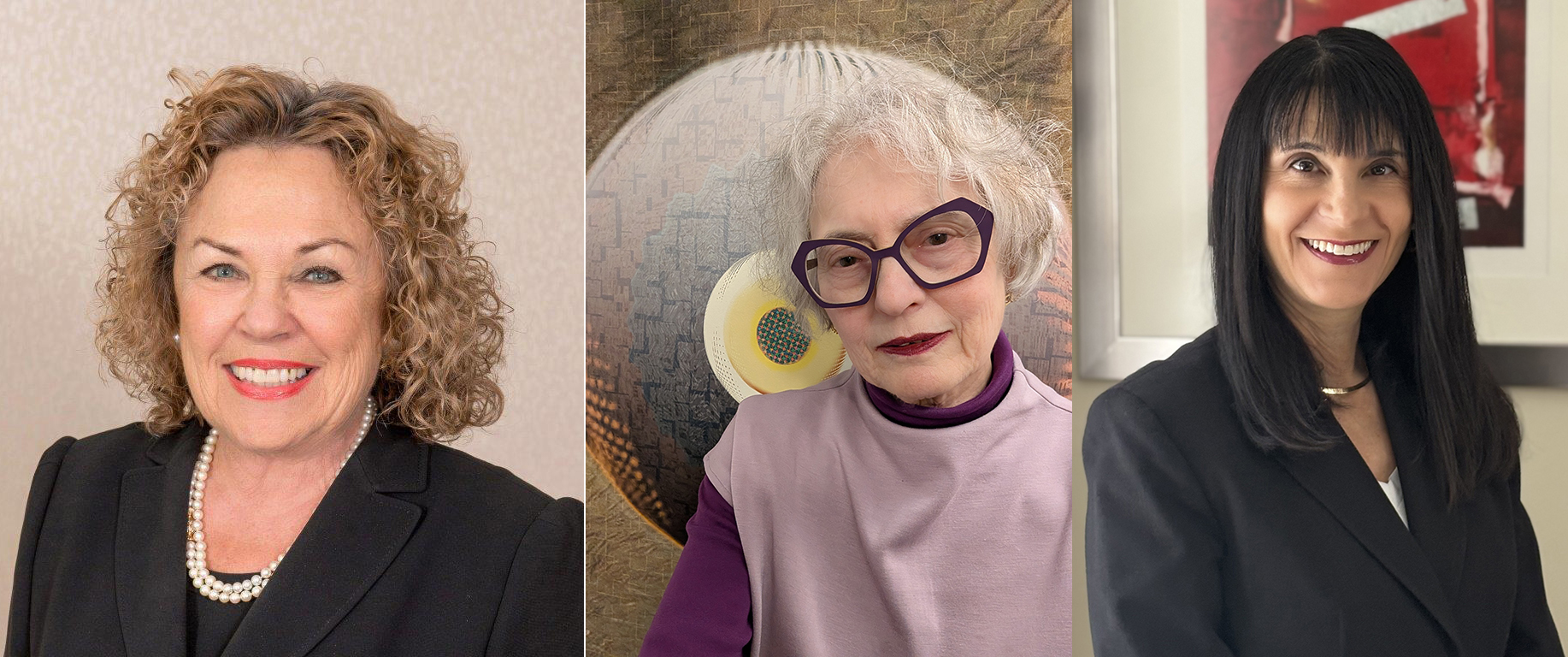
By MYRON LOVE For much of the Jewish community’s early history in Winnipeg, it was men who were acknowledged as our community leaders – as was common in society in general – while the work of scores of women working diligently behind the scenes was largely overlooked. While women’s organizations such as ORT, Hadassah, National Council of Jewish Women and many others raised money to help the needy in our community and Israel, noted Marsha Cowan, it was usually men who made the decisions.
On Tuesday, March 17, the Jewish Heritage Centre of Western Canada hosted a panel discussion: “Let Her Works Praise: Panel on the role of Women in Jewish Communal Life” (which was pretty well attended considering the wintry conditions) – seeking to show our community’s appreciation for the work of countless women over the years behind the scenes, as well as the growing number of women now working side by side with men in leadership roles.
Marsha Cowan – one of the three panelists, has straddled both worlds – as a leader in National Council of Jewish Women, and later as the first woman to serve as CEO of the Jewish Foundation of Manitoba.
Cowan began her presentation by reminiscing about her time at Peretz School and the old YMHA. Her first vehicle of choice as a volunteer was with the National Council of Jewish Women (NCJW). The latter’s major project was the Golden Age Club – Canada’s original drop-in centre for (largely) Jewish seniors. For years, the club operated out of a building near Salter and Selkirk in what used to be the heavily Jewish North End.
“After 40 years,” she recalled, “we realized that we needed a new building.”
The site for the newly renamed Gwen Secter Creative Living Centre was a former tire store at Smithfield and Main. Cowan chaired the successful campaign to raise the funds for the transformation of the building into the Gwen Secter Centre.
Cowan subsequently served as Vice-President of the National Council of Jewish Women. She also served as President of Jewish Child and Family Service;, Vice-President of the Women’s Division, Combined Jewish Appeal; and, most recently, as the first woman to be President and CEO of The Jewish Foundation of Manitoba.
““I remember walking into my first board meeting at the Foundation and finding myself one of only two women among 18 men,” she recalled. “But it was never a problem for me working in male-oriented organizations and institutions.”
One of the first things that she did as a board member though, was to push to establish the Foundation’s Women’s Endowment Fund in order to give women an opportunity to make philanthropic decisions involving the distribution of funding.
The fund, she noted, started with $20,000 contributed by about 150 women. Today, 32 years later, the Women’s Endowment Fund has a capital base of $2.4 million and distributes more than $100,000 a year to women’s charities.
In her presentation, Susan Turner began by recalling growing up in a traditional home in the North End, her early schooling, Shabbats spent with her father, Leible Hershfield, at the Rosh Pina Synagogue, and going to the YMHA, where Leible was the Athletic Director. The family moved south in 1958 so that her maternal grandfather, Lazar Tuberman, who lived with them, could be closer to the Shaarey Zedek Synagogue, where he was the shames. In her teen years and then at university, Turner sang in the synagogue choir.
A lifelong professional visual artist in printmaking and in video, Turner has worked in a number of positions – by turn as a school librarian, an editor, a graphic designer, an art instructor, a lecturer at the School of Art, a researcher and curator in the area of multiculturalism, an exhibits curator and designer, a gourmet pastry chef for restaurants, and as a volunteer in the arts community.
She noted that it was her mother, Babe, who got her involved working on projects in the Jewish community. “For many years Babe was Executive Director of the Jewish Historical Society. In the late 1970s, she recruited my husband Myron and me to be on the Programming and the Archives committees, and we remained active in one form or another for close to 40 years.”
“From 1999 to 2004,” Turner said, “I was the Coordinator of Volunteers at the Sharon Home, where I learned so much about ageing, dementia, and respectful elder-care.”
In 2005, at the behest of Stan Carbone, JHC Programs and Exhibitions Director, she began working as curator and exhibitions designer at the Jewish Heritage Centre. Some of the major exhibits she worked on were “The Jewish Wedding”, “Manitoba Synagogues”, “Jews in Manitoba’s Garment Industry”, and “Chief Justice Samuel Freedman.”
In addition to her work with the JHC, Turner noted that she and Myron volunteered through Jewish Child and Family Service with newcomers from Argentina and with Yazidi refugees. “However much Myron and I were able to assist them, our own lives were enriched by the experience,” she added.
Turner also showed images of her current art as well as a poetic video she produced using voice, music, image, and Yiddish about the final days of her mother Babe’s life.
Leah Craven, the third member of the panel, is representative of a younger generation of women who have assumed leadership roles in our community. A lawyer by training, she currently serves as President of the National Council of Jewish Women of Canada, Winnipeg Section. She is also a Board member of the Jewish Foundation of Manitoba – serving on their Governance and Grants Committees. She has previously been actively involved with Shalom Square, Gray Academy of Jewish Education, Congregation Etz Chayim, and Canadian Friends of the Hebrew University.
“I was raised in a traditional Jewish home where volunteering was simply part of life,” she recalled. “My (late) father, Mel Craven, was deeply involved in community work, and my mother, Reva, continues to volunteer actively. In our home, contributing wasn’t an ‘extra.’ It was just… part of being Jewish.
“As the granddaughter of Holocaust survivors, I grew up with a strong awareness of how vital community support systems are,” she continued. “I understood early that people struggle — and that communal care matters. I also understood I was fortunate, and that being able to give comes with responsibility.”
Craven recounted her first independent volunteer experience. While still in elementary school (Ramah), her father asked if she would teach basic Hebrew to a colleague’s church youth group.
“I took it very seriously,” she said. I made a Hebrew alphabet chart with transliterations and created name cards in Hebrew letters for each participant. It was my first time in a church and it was a welcoming experience, genuinely enjoyable. Looking back, I learned an early lesson. I stepped forward because someone asked me. Someone opened a door and trusted me.”
That pattern, Craven noted, has occurred repeatedly throughout her life.
In her university years, she was active in Jewish student organizations, Craven said. She was involved in advocacy for Soviet Jewry and spoke out against antisemitism.
“At university, I learned that community life isn’t only programming and events,” she observed. “It’s visibility, engagement, and standing up when it matters.”
As a working mother, she has continued to show up for our community – volunteering over the years at Folklorama (Shalom Square) and synagogue. “Helping to set up, clean up and greeting people (at shul) may not be glamorous, but it is foundational,” she noted. “Community is sustained by everyday acts of showing up.”
Craveb pointed out that formal barriers for women have changed over generations. “Many women are now invited to leadership tables,” she noted. “We are asked to chair, lead, speak and make decisions. That progress is real and important.
“At the same time, many women still carry the day‑to‑day responsibility for home and family,” Craven added. “As well, single mothers and women without job flexibility often face additional challenges in participating in volunteer roles.”
Craven said the biggest challenge for women volunteering in community is “capacity”. “In my experience that looks different at each stage of life”, she observed. “As a student, I had to balance community involvement with academics. As a young professional, there weere early career demands. As a parent, I sought involvement that fits naturally into family life – such as children’s programming at synagogue or volunteering at school.”
It was during that time – when her kids were babies – that Craven joined National Council. “I welcomed the opportunity to be part of a Jewish women’s organization dedicated to service, education,and social action,” she said.
Crave also noted the help her own children have given her. She would bring them to meetings and on deliveries. When they were a little older, they helped sorting ribbons and wrapping paper, stuffing envelopes and assembling mishloach manot.
“These small tasks mattered,” Craven said. “It allowed me to stay engaged and my children learned that community involvement isn’t separate from daily life,” she added. “It’s part of how we live — for me, it’s part of being Jewish.”
The balance between work, family and community is never fully resolved, Craven observed. “Involvement looks different at different times,” she noted. “Sometimes it’s leading. It can be making a phone call, delivering a meal, sitting beside somebody and saying – there is a place for you here – or just showing up.
“It often just begins because someone asks, invites or makes room.”
In conclusion, Craven expressed gratitude to ” the women who paved the way” and to “a community that values women’s leadership”.