


Local News
Jewish performers at the Fringe Festival

Introduction: As has been our custom over the years, we present previews of various Fringe shows that feature Jewish performers (or writers) – some from Winnipeg, some from other cities. This year’s Fringe Festival begins July 19 and runs through July 30. (We apologize if we may have missed someone – but if we have, it’s not too late to contact us and we’ll get a blurb up for you on our website.)
A One Human Being, Potentially Comedic Performance of….
LES MIS
A parody musical written & performed by Alli Perlov
Alli Perlov has been a theatre kid her entire life. Her experiences include training at Manitoba Theatre for Young People, a Bachelor of Arts from the University of Winnipeg, and a brief career in film and television in her teens.
For the past 12 years, Perlov has been a performing arts teacher in Winnipeg, teaching courses in musical theatre, improv and drama to students from Grades 6 to 12. In an effort to continue practicing what she teaches, Alli Perlov has mounted two one-person Fringe plays starting in 2017 and brings her third to this year’s festival with her show
Venue # 8: The Rachel Browne Theatre
“Perlov’s tongue-in-cheek parody is also steeped in a palpable sweetness that would melt even the most hardened revolutionary’s heart – 4 ½ Stars” Winnipeg Free Press, 2018
Some teachers take the summer off to recharge, while others mount a one-person Fringe festival show. In a revamped version of her successful 2018 sell out production “A One Human Being Potentially Comedic Performance of Les Miserables”, local performing arts teacher Alli Perlov aims to leave the audience in stitches as she performs 30 characters from the iconic musical based off the Victor Hugo novel.
In a musical parody full of charm and can-do spirit, Perlov tackles the task of making “try-hard” a compliment. Condensing the score to 52 minutes, and weaved with narrative, critiques and silly puns, everyone in the theatre is guaranteed a good time and a load of laughs.

Everything is Super Wow: Lots of Jewish
content!! created by Ira Cooper,
son of Winnipeger Gayle Myers
Come see a foot-fuelled, slapstick tragedy about bikepacking, dreaming big and giving up in your 30s. Follow Super Wow along a kinetic journey filled with new music, peppy puppets and awkwardly captivating dance breaks. Nominated for Outstanding Clown Show (Montreal) “I was entranced by Ira’s performance” – Sarah Deshaies, CKUT Radio “A great clown should be funny, courageous, vulnerable, and have a voice that needs to be heard. Super Wow formerly Mr. Coffeehead is all of that and more.“ – Bob Frazer
Spec Theatre
Venue #20 – The Studio at Théâtre Cercle Molière St Boniface

Teaching Shakespeare
Since debuting at the 1999 Montreal Fringe Festival, Teaching Shakespeare has had over 150 performances across Canada, and two theatrical runs in New York City.
This “formidably delightful” (Off-Off Broadway Review) parody of a college Shakespeare class and portrait of a frustrated actor turned frustrated professor last seen in Winnipeg in 2014, is returning to the 2023 Winnipeg Fringe Festival. However, the multiple award-winning monologue now has new material as the inept teacher has aged and is a senior citizen. Dr. Keir is still desperate to achieve his professional goals but now time is definitely running out!
Teaching Shakespeare received the “Overall Excellence Award – Solo” at the New York Fringe Festival in 2000, heldover at the Winnipeg, Saskatoon, Edmonton fringe festivals, selected for Centaur Theatre’s Wildside Festival, Victoria’s Uno Festival, London, Ontario’s Oh Solo Mio Festival, selected “Best in Fest” at the Orlando Fringe Festival, and televised nationally in Canada on BRAVO!
“I remember Teaching Shakespeare as one of the most enjoyable Fringe productions of the last decade. Actor/academic Keir Cutler gave us Dr. Keir, a self-styled Shakespeare expert giving a university class. It was the class from hell. Keir pulled off the amazing feat of feeding you some fascinating minutiae about Shakespeare while leaving you laughing at the awesome ineptitude of the teacher.” – Colin MacLean, Edmonton Sun.
Montrealer Keir Cutler has been called “a masterful entertainer,” (Winnipeg Free Press) “a marvel to watch,” (Toronto Sun) and “a phenomenal performer!” (winnipegonstage.com). Venue #10 -Planetarium Auditorium 190 Rupert Ave. – (theatre on lower level).
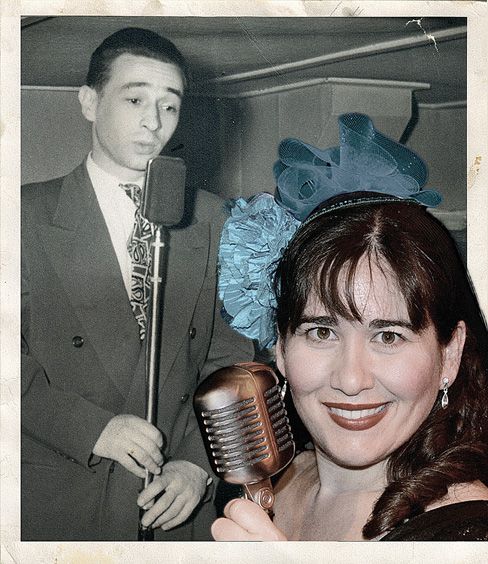
Melanie Gall – in 3 separate shows!
1- The American Songbook Experience
Move over, Frank Sinatra! Melanie Gall presents the story of the American Songbook – from the songwriters of Tin Pan Alley to the stages of Broadway and the Hollywood musicals of the 1930s and 1940s – with hits by George Gershwin, Cole Porter, Irving Berlin and other superstars of popular song. Featuring a dozen hits, including On the Sunny Side of the Street, I’m in the Mood for Love, Moon River and Stardust.Melanie Gall is the award-winning performer of Fringe sellout hits Ingenue, Piaf and Brel (5 STARS – Winnipeg Free Press) and Toast to Prohibition (5 STARS – Edmonton Journal). Her historic music shows have been performed in over 30 countries, as well as off-Broadway in New York and at London’s Royal Albert Hall.
2- Ingenue
Melanie Gall’s award-winning musical is back! Chosen as one of the top Fringe shows worldwide and mounted off-Broadway at SoHo Playhouse in 2019. Judy is an icon, loved as Dorothy in The Wizard of Oz. But in the 1930s, Deanna, “Winnipeg’s Sweetheart”, was the bigger star. While Judy struggled for success, Deanna became the idol of millions. Ingénue tells the true tale of the lifelong friendship – and rivalry – of these teen idols of Old Hollywood. “Gall is astonishing” – Metro Arts, 5 STARS Adelaide Advertiser, 4.5 STARS Winnipeg Free Press
3- Opera Mouse
Tilly Mouse lives under an opera house and she just loves to sing! But whenever anybody sees her, they scream and run away. With determination, imagination and help from her friends, Tilly proves that even a mouse can be a star! Featuring songs and arias from several operas, including Gianni Schicchi, Carmen and The Magic Flute. Opera Mouse has been performed in venues all around the world, ranging from a theatre in Canada and an orphanage in Morocco to a school in Sudan and a shopping mall in Algeria. “Best kids show” – CBC Manitoba

Adam Schwartz
Adam writes: “I have 2 shows this year. Neurohilarity which features the 5 funniest neurodivergent comedians in Winnipeg. Carole Cunningham, (The Debaters) Scott Koropas,(Yuk Yuks) Danielle Kayhara, (Winnipeg Comedy Fest) Quinn and Kane Greene (Winnipeg comedy fest) and Adam Schwartz with guest appearances by Jewish comedians Dan Goldberg and Willlw Rosenberg.
“I also have my solo show How I Met My First Neurodivergent Friend. A storytelling show about how growing up Adam kept his distance from people who were different because he thought it would make it harder to fit in. One day Adam woke up 36-years-old alone and lonely so he created his own community (Neurohilarity). “

OBSESSION: The Elizabeth Smart Musical
Robbi Goltsman-Ferris is the writer/producer of a show premiering at the Winnipeg Fringe Theatre Festival this year. Called “OBSESSION: The Elizabeth Smart Musical,” this moving production reveals the tragedies and triumphs of a female writer ahead of her time. It features Phil Corrin as the musical director, and Kelly Robinson and Kyra Krassnigg as two members of a remarkably talented and seasoned cast of six, including professional performers Brittany Hunter and Reid McTavish and director/choreographer Laura Kolisnyk.
The show features eight performances at Venue 4, the Center Culturel Franco-Manitobain (CCFM) on 340 Provencher Blvd, which offers FREE PARKING!!
Local News
Third annual JFest Winnipeg will be offering programs for all ages

By MYRON LOVE JFest Winnipeg is back with a good variety of musical performances, a book launch, popular Jewish-themed films, children’s activities, and a family-oriented Shabbat dinner.
“JFest,” observes Laura Marjovsky, the Rady JCC Director of Programming, “is an opportunity for our community to experience Jewish art and culture. With our range of JFest events, we are trying to reach out beyond what has been our base audience and appeal to all ages. We have a commitment to bring top notch Israeli performers to share the highest caliber of Israeli entertainment with our audiences.”
The week-long festival (November 14-21) kicks off with a performance by top-ranked Israeli singer-songwriter Harel Skaat. The popular Israeli star began singing as a child. He shot to fame when he finished second in the second season of “Kochav Nolad” – Israel’s version of “American Idol.” His first album was released in 2006 and achieved Platinum status – with one of the songs being ranked as “song of the year.” He followed that up in 2009 with a second album that reached Gold status. In 2010, he represented Israel at the Eurovision competition.
Skaat’s performance is scheduled for the Seven Oaks Performing Arts Centre (which is attached to Garden City Collegiate) beginning at 8:00 P.M. on Saturday, November 14. Patrons will have the opportunity to purchase an enhanced ticket to attend a meet and greet with Harel.
All other JFest programs and activities will be at the Rady JCC.
Music Producer Karla Berbrayer says Ben Caplan’s performance on Saturday, November 21 will also be another highlight. “Ben Caplan redefines what it means to be a modern folk artist,” Berbrayer says. “His music and stories are matched by his larger-than-life stage presence. This concert focuses on how his Jewish upbringing has influenced his entire performance career.”
“Flatland Famous” is returning by popular demand. This quintet, known for its performances at Winnipeg Jets games, will be presenting its concert, “Jewish Soul of Rock and Roll,” on Wednesday, November 18, at 7:30 pm. This year’s show will feature songs by Amy Winehouse, Neil Diamond, Barbra Streisand, Simon and Garfinkel, and other famous Jewish icons.
On Tuesday, November 17, local author Deborah Schnitzer will be taking centre stage with the launch of her new book, “The Woman Who Swallowed West Hawk Lake.” The University of Winnipeg English Professor Emeritus’s new novel explores intergenerational trauma related to Nazi breeding programs. Joining Schnitzer on stage will be a panel of professionals who have experience working with children who have experienced trauma.
And of course, “Best of the Fest” is back. Films to be presented will include“The Floaters” and “We Met at Grossingers,” two wildly popular movies at last spring’s Winnipeg International Jewish Film Festival.
“The Floaters,” to be screened on Monday , November 16 at 7:00 pm is a funny and bang-on depiction of Jewish summer camp culture.
“We Met at Grossingers” is a loving look back at the Borscht Belt in New York’s Catskills, where generations of young Jewish performers earned their dues and developed their acts. The film will be screened on Thursday, November 19 at 7:00 P.M.
On Friday November 20, JFest will host a Family Shabbat dinner featuring Anat Kriger, an Israeli-born, Toronto-based musician, actor, and children’s performer, who has made several appearances in Winnipeg at major communal events.
Kidfest on Sunday, November 15, will be a day-long potpourri of programming that will include live performances, workshops, bouncy castles, games and crafts, and much more.
Readers seeking more information about JFest can contact Laura Marjovsky at 204 477-7539 or lmarjovsky@radyjcc/com
Local News
Hen Mazzig, leading Israeli advocate, makes first Winnipeg appearance
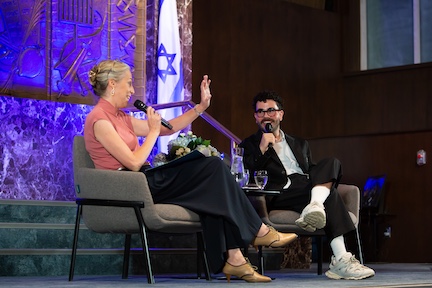
By MYRON LOVE On Tuesday, October 6, a large number of members of our community packed the chapel at the Shaarey Zedek Synagogue, eager to welcome Hen Mazzig in his first appearance in our community.
Over the past few years, the Israeli-born Mazzig – who was appearing at the invitation of our Jewish Federation and Combined Jewish Appeal team – has become one of Israel’s and the Jewish people’s leading advocates on the international stage. His online platforms reach as many 100 million viewers a month with a regular following of almost 1 million. He has been interviewed by numerous leading media outlets and has given addresses at close to 500 universities in recent years.
Mazzig’s presentation in Winnipeg (which was funded by the Asper Family and the Asper Foundation) took the form of a question and answer format with Sarah Mali, the Director General of JFC-UIA (Jewish Federations-United Jewish Appeal) Canada in Israel, asking the questions.
Mali , who was visiting Winnipeg for the third time in the past three years, began by expressing how honoured she felt about having the opportunity to converse with Mazzig – referring to Jewish Federation of Winnipeg President Carrie Shenkarow’s comments regarding Mazzig’s “devotion to Israel and the Jewish people”, his “deep sense of purpose, moral clarity” and “willingness to enter some of the most difficult spaces and conversations.”
The first question that Mali posed to Mazzig was related to his visit to the Canadian Museum of Human Rights and its controversial and one-sided take on the longstanding and ongoing Israeli-Palestinian conflict. She referred to a comment that Mazzig had made on X the day after visiting the museum, in which he wrote that while he “has no problem with people learning about Palestinian history,” he wished that “Palestine Uprooted” didn’t “distort the regional events, including the displacement of 800,000 people just like my grandmother, Hela, who became a refugee when Iraq turned on its Jewish community” post-1948.
“History can only lead to reconciliation when it is told honestly,” he observed. “Otherwise, it is just fuelilng an agenda.”
What most disturbed him about the exhibit, Mazzig told his audience, is that it erased his own family’s history. Expanding upon his family’s roots, he noted that his father’s family came to Israel from Tunisia and his mother’s side from Iraq. He spoke in particular about his maternal grandmother, Hela, who left behind “a beautiful civilization” – Jews had been living and thriving in Iraq since before the Roman destruction of Jerusalem 2000 years ago – to a new land (Israel), where she had to learn a new language (Hebrew) and rebuild her life.
Mazzig added that his grandmother is his anchor in life and the inspiration for all that he has accomplished.
Mali asked Mazzig about his ability to empathize with Palestinians. It was difficult to do, he answered. He got to know Palestinians, he recalled, during the Covid epidemic when he was serving as a medic with the Israel Defense Force and found himself responsible for helping Palestinians through that difficult time and transporting sick Palestinians to Israeli hospitals.
“Even though I fight so hard for Israel,” he observed, it doesn’t mean that I can’t feel empathy for anyone else.”
Mali asked Mazzig how October 7, 2023, changed him.
“I chose not to become a victim,” he said, “but rather to engage more with the world, bear witness, share our stories and talk about genocide. While I was actively advocating for Israel before October 7, I have been much more in demand since. I have become a lot more visible.
”I have found that a lot of people support us,” he continued. “They see what is happening and are on our side.”
On the other hand, he added, a lot of people don’t know anything about Israel. “It is a matter of education,” he said. “I encourage people to go to Israel and talk to Israelis.”
Mali’s last question was what Mazzig means when he writes that “I promise to love being Jewish ten times more than anyone hates me for it.” What does it mean to him to love and find joy and happiness in being Jewish”, she added?
It means cherishing our rich history, Mazzig responded, enjoying Shabbat dinners with family and friends, celebrating all of our holidays and traditions.
“The Jewish People have been through so much over the past 2000 years,” he said. “Many people have tried to destroy us, but we have survived. We are arisen from the ashes numerous time and continued to move forward. Not only are we still here but we have returned as an independent people living again in our ancestral homeland.”
Also addressing the audience at the Shaarey Zedek was Steven Shulman, the president and CEO of the Jewish Federations of Canada. Shulman heaped much praise on our Jewish community in Winnipeg.
“Winnipeg is special,” he noted, “not just in Canada but worldwide. Your CJA campaign continues to be the most successful in North America. You have an outstanding CEO (of the Jewish Federation of Winnipeg) in Jeff Lieberman, who is universally respected.”
He further praised Gray Academy and our community’s highly successful GrowWinnipeg campaign – which has attracted thousands of new families to our community over the past 25 years.
He noted that he was particularly impressed with how our community has come together to protest the biased Nakba exhibit at the Canadian Museum for Human Rights.
He also spoke of the many supporters that we have among non-Jewish Canadians – singling out, as an example, the police officer in Belleville who put his own life on the line protecting the city’s only Jewish congregation from a terrorist attack during yom tov services.
The last word went to Jeff Lieberman, who thanked all the members of our community who have contributed to the CJA campaign this year, as well as our many non-Jewish friends who continue to stand with Israel and the Jewish community.
Local News
Enrolment in videographer/photographer Jeff Gordon’s education programs growing exponentially
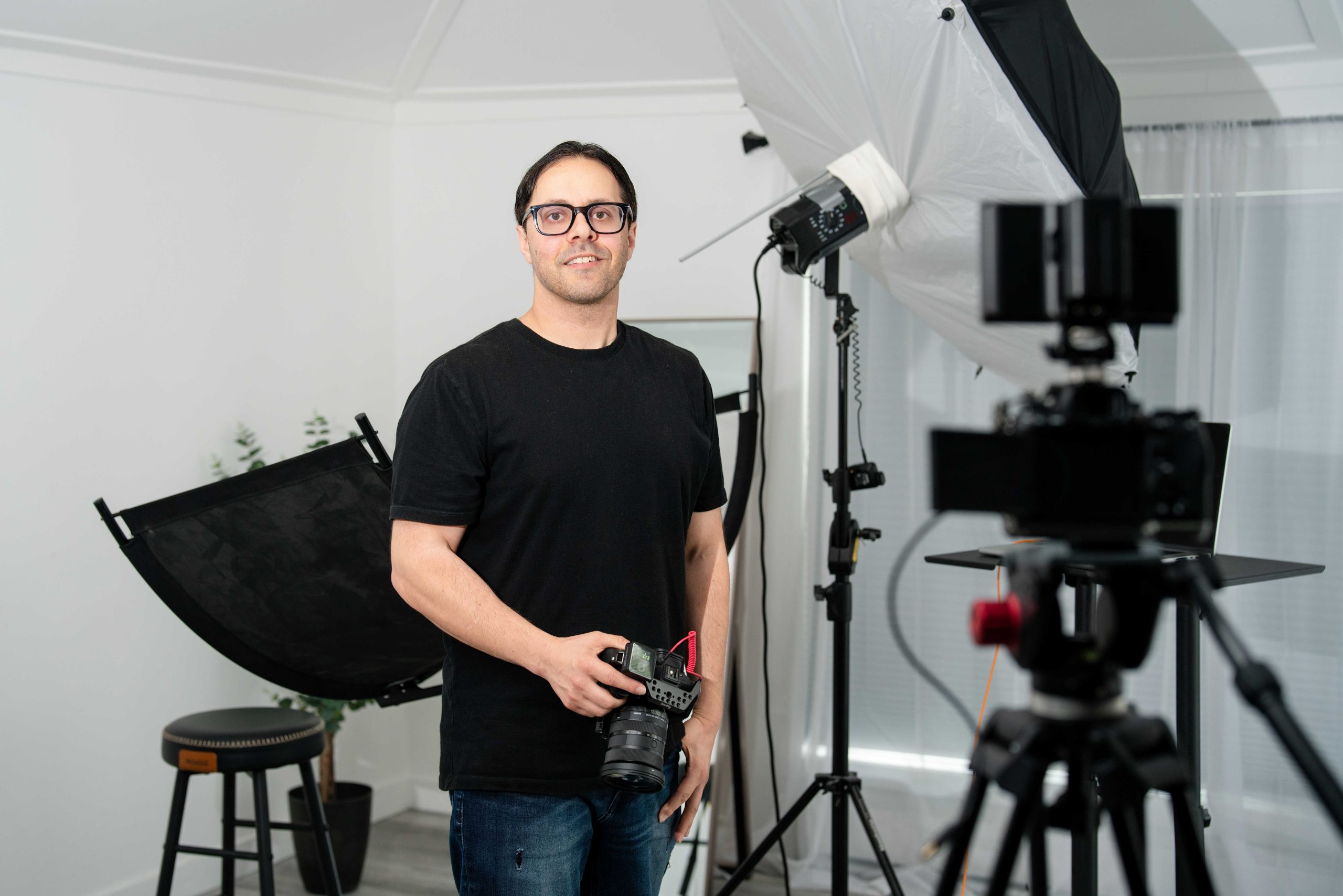
By MYRON LOVE When last I spoke with local videographer/photographer Jeff Gordon early last year, he had just launched his new training program for budding photographers and videographers. Now, about 20 months later, he is happy to report that his new course has grown well beyond his original expectations.
“My program has already graduated more than 100 students – with another four sessions beginning in September,” says the founder of JAG Videos and Photography. “I have recently introduced a new training program geared to organizations and businesses and have digitized my courses so that they can be accessed from anywhere in the world.”
What is unique about what Gordon is doing in that this is the only educational program that combines photography and video. “Up until now, the only options for anyone interested in learning the art of photography or making videos has been either Red River College or the University of Winnipeg,” Gordon pointed out in that earlier Post interview. “I recognized a niche here and my goal is to fill this gap.”
He launched his educational initiative in mid-January in his new studio behind his north River Heights home with three classes a week – one strictly for teenagers – over 16 weeks.
“The response exceeded my expectations,” he said in that earlier interview. “We sold out quickly and I have a waiting list. I am teaching the students everything I know about photographer and videography. The curriculum is easy to follow.”
Gordon’s interest in photography and videography – and teaching, he recalled, came about through his previous career as a musician. The graduate of the Hebrew Bilingual program at Brock Corydon Elementary School, and later, Shaftesbury High School – began playing drums in high school.
After high school, he enrolled at the Los Angeles Music Academy. In 2006, he graduated from the jazz program at Grant MacEwan University in Edmonton. His professional credits include 16 years as a drummer with the Sarah Sommer Chai Folk Ensemble, and five years as a member of a touring band called “Driver.”
It was while performing with “Driver” that he began doing videography. “I have always been fascinated by technology,” Gordon said. “While on tour, I began making videos of our live concerts. I would set up four or five cameras to record the shows.”
In 2014, Gordon took the plunge and dove into photography and videography full time with the founding of JAG Videos and Photography. He started with weddings and gradually started to develop a commercial and corporate clientele. He reported that he does a lot of head shots for businesses. He has also done a number of TV spots for Global and Corus.
Gordon’s curriculum is his own creation, based on his experience and a previous training manual he wrote years ago for an entirely different group of students: drummers.
“I used to have as many as 40 students at a time,” he recalled. “I really enjoy teaching. I love expounding on subjects I am passionate about.”
Gordon’s first foray into teaching had a focus on helping businesses and organizations, government departments and agencies enhance their online presence.
“Increasingly, we are in a digital world,” he points out. “Businesses need staff who are adept at making videos and taking photographs. Companies need staff who are able to create videos for them to promote the business online. I can customize my training programs to the needs of my clients to create their own social media and marketing materials.”
Gordon notes that this outreach wasn’t initially part of his expansion plans. “I had people coming to me for this training because there is no one else providing this kind of education,” he observes.
Gordon’s major new development this fall is that he has built and launched a full digital version of his course – which he calls The JAG Creator Academy. “Going digital has opened the training up beyond Winnipeg and makes it available to people globally,” he points out.
“I developed a website, filmed all my tutorials and recorded the video,” he says.
“I even have a sponsor for it,” he adds. (That would be Evoto – an AI-powered photo editing software built specifically for professional photographers.)
The program is only available in English but, Gordon reports, there has been a lot of interest so far.
The next stage in the evolution and growth of Gordon’s move into education will be a program which will coach businesses on SEO (Search Engine Optimization) – and which will involve helping businesses access Google and get their name at the top of search results.
“SEO is what has helped my business stay at the top of Google (searches) and in demand all these years,” Gordon notes. “I am running ads for my new SEO programming on Facebook and Instagram. I am anticipating that I will draw clients from across Canada and the United States.”
While he is still in demand locally as a photographer and videographer, he notes, the education side has also become a full-blown business of its own and, he reports, he is looking to hire additional staff.
As well, he is continually adding new topics and courses to his offerings.
Readers who may be interested in contacting Jeff can find him through his website, which is www.jagvideos.com.
