


Local News
Local entrepreneurs Dr. Norman Silver and Dave Berkowits’ QDoc connecting patients and doctors on line

By MYRON LOVE Three and a half years ago Bernie Bellan wrote a story for The Jewish Post & News about a new service that had just started up earlier in 2022. That story told how two entrepreneurs, Dr. Norman Silver and Dave Berkowits, came up with the idea of providing online care with physicians to patients who weren’t in a position where they could visit a physician in person.
At that time, the story noted, QDoc began with only 144 patients in May 2022, but was growing at a rate of 1,000 new patients a month. Since then QDoc has been a roaring success and has been expanding its reach well outside Manitoba.
You can read the original story about QDoc on this website at QDoc.
Here now is an update to that original story:
Roughly four years ago, long time pediatrician Dr. Norman Silver and his brother-in-law, Dave Berkowits, a leading Canadian healthcare software developer, joined forces to create a virtual medical program that connects physicians and patients online.
“In our first couple of months, QDoc was able to connect 55 patients with our team of physicians, Silver reports. “Last year, we had more than 124,000 patients sign in – or about 11,500 a month who signed in.
“We have working relationships with close to 200 doctors and 35 nurse practitioners who are in partnership with us.
“We also have almost 3,000 positive reviews online.”
Silver notes that while 70% of Qdoc’s patients are from rural and northern Manitoba, the system is also in operation in Nunavut and Northwestern Ontario.
For Berkowitz and Silver, Qdoc is akin to a match made in heaven. The son of Rita and the late Ron Silver has been a pediatrician for 20 years. His resumé includes many years as an ER doc at Children’s Hospital, as well as working out of the Pan Am Clinic for years.
According to a write-up abut Silver on the Doctors Manitoba web page, the innovative pediatrician has many accomplishment during his career aimed at improving healthcare in our province. These include a nurse-initiated X-ray program in the Children’s ER, which decreased the length of stay for children with fractures by 1.5 hours; an oral rehydration program in the waiting room for children with gastroenteritis, which expedited their stay; a pediatric sedation service at the Children’s Hospital; a pediatric locum program to provide uninterrupted service to children in Western Manitoba; and penicillin de-labelling clinics in both Brandon and Winnipeg.
As well, seven years ago, he and Berkowits and five other partners opened the Minor Injury and Injury Clinic – the first non-publicly owned urgent care center in Manitoba .
“We treat up to 50,000 patients a year at the clinic,” he reports.
Silver describes his QDoc founding partner and brother-in-law as “the best medical software developer in Canada.” The son of Sandra and the late Alex Berkowits earned his stripes working for Philips Canada (which, for most readers is probably best known for its electronic consumer products) in its medical products divisions, working with MRIs and CT Scan equipment.
He then went on to work in Alberta for 17 years as part of the leadership team that implemented digital image sharing in Calgary. The team also created software that allowed radiologists based in Calgary to read CT and X-ray studies taken in Whitehorse and Yellowknife. That improved the time it takes for ER departments located up north to have radiology exams read so that patients could be taken care of quickly
It was the Covid lockdowns that led to Berkowits and Silver’s first collaboration – a drive-up, appointment based COVID testing site at Red River College.
Silver notes that certain regulatory changes in Manitoba made it possible for a business such as QDoc to deliver its medical services to the general public. During the lockdown, the then new virtual QDoc program allowed patients and doctors to stay connected and patients who were seen to be covered by Manitoba Health.
Berkowits points out that all you need to sign on to QDoc and connect with a physician is access to a camera, a microphone, an internet connection and a provincial health card.
A patient going onto the system would click ‘see doctor now,’ and be connected to one of several doctors who would receive the text message notifying them that a patient wants to be seen.
“Our goal is to have a doctor respond to the patient within 20 to 30 minutes,” Silver says.
Berkowitz notes that QDoc has separate programs for virtual medicine, medical billing and medical booking.
For Silver, QDoc is Tikkun Olam in action on several fronts. “One advantage of our program is that by connecting a patient who lives maybe 20 km outside of Neepawa with his doctor in Neepawa, you save driving time and reduce potentially harmful emissions.”
He further reports that QDoc partners with the DCSP (downtown community safety partnership) to help deliver care to the homeless.
He adds that last summer, during the large scale evacuation of northern communities due to forest fires, QDoc was approached to help connect evacuees with their regular doctors.
Both Berkowits and Silver demonstrate Tikkun Olam in other ways as well. For the past 27 years, Berkowits has been responsible for security for Shalom Square. (Incidentally, he is the brother of Rob Berkowits, the Rady JCC’s executive director.)
Several years agoSilver (whose brother, Michael, has been president of the JNF for Winnipeg and Saskatchewan) along with his wife, Heather, started a family foundation. “Initially, we distributed about 60% of our giving to non-Jewish charities,” Silver reports. “Over the past two years, we have redirected our funding so that 90% now goes to Jewish causes.
“We have to look after our own,” he observes. “We can’t expect anyone else to.”
As for the future of QDoc, Berkowits and Silver have a vision for expansion – first throughout Western Canada and then, maybe the world.
“We think there may be opportunities in countries such as India and the Philippines,” he notes.
Readers who may be interested in hearing Silver talk about QDoc can attend a presentation he will be giving on Thursday, February 5, at the Kingshead Pub under the auspices of the High Growth Ventures Initiative, a strategic scholarship and community engagement initiative housed within Mount Royal University’s Institute for Innovation and Entrepreneurship. For more information about QDoc go to qdoc.ca




Local News
Sharon Delbridge’s annual health & wellness retreats in Puerto Vallarta have become popular with many Winnipeggers
By BERNIE BELLAN Over the years we have revisited stories from time to time – to catch up with individuals who have made a mark in this city and to see where their lives have taken them since the last time we wrote about them.
One such individual is Sharon Delbridge, the youngest daughter of Sol and Rachel Fink, and younger sister to Percy, Shayla (Posen), and the late Sheldon Fink (who died all too young at the age 57 in 2021).
Myron Love has written many times about Sol and Rachel Fink, who continue to amaze for their vitality – with Sol now 101 and Rachel having just turned 99.
As Sharon notes in an email sent to me, “My parents work out everyday. Not at Rady anymore. They do exercise at home & in their condo gym (200 Tuxedo) Move their bodies daily. My mom leads her and my dad daily in movement. It’s incredible.
“They have been a huge inspiration to all of us.”
Aside from the fact that the Fink family was a very musical family, their penchant for fitness is clearly something that rubbed off on Sharon, in particular.
My own wife, Meachelle, who was quite the fitness fanatic herself in her day (not that she’s been put out to pasture quite yet), profiled Sharon for The Jewish Post & News in 2015. In that story, Sharon explained how she came to be one of the most popular and best known fitness instructors, not only at the Rady JCC – where her classes in a wide variety of different areas, were – and still are, extremely popular, but at many other venues throughout Winnipeg.
Here’s part of what Sharon told Meachelle about how she came to teach so many different types of fitness classes:
“I’ve been into fitness my whole life. I come from a very musical family but also a family that always works out. When I was in my 20s I was teaching aerobics for several years as a part-time job while in university. When I had my three children (Milan, Jared and Cassie Ackerman) I ran a hand-painted clothing business in my home called Milan Designs, and I sold to ladies’ and children’s stores all over Canada.
“I was always working out and have loved fitness classes. I went back and got more certifications in my 40s. I’m certified to teach many specialties and have been actively teaching at the Rady for over 10 years. I now specialize in women’s boutique fitness: Zumba, Yoga and Barre classes. The three specialties blend beautifully together and I have a big following of people from all over Winnipeg that come to my classes. I have every Zumba certification that’s available: Zumba, Zumba Gold (for seniors), Zumba Toning (with weights), Zumba Aqua (in water), Zumba Step and Zumba Sentao (using steppers and chairs).
“I’ve taken many yoga certifications through the past 10 years and I’ve been teaching Barre classes, which are the latest and hottest classes for women. I’m always taking new training in these three specialties to continue to stay fresh and always have new and exciting things to present to my class. That’s how I stay unique in my field. I’m always learning and always developing my classes to be the best they can be. I spend tons of time finding the best music and choreographing.
“I truly feel that if you work out and look after your body, you will always have a positive outlook on life. Exercise is a huge healer mentally and physically. I have seen so many incredible changes in women that come to my classes. They have transformed their bodies and live happier and healthier lives.”
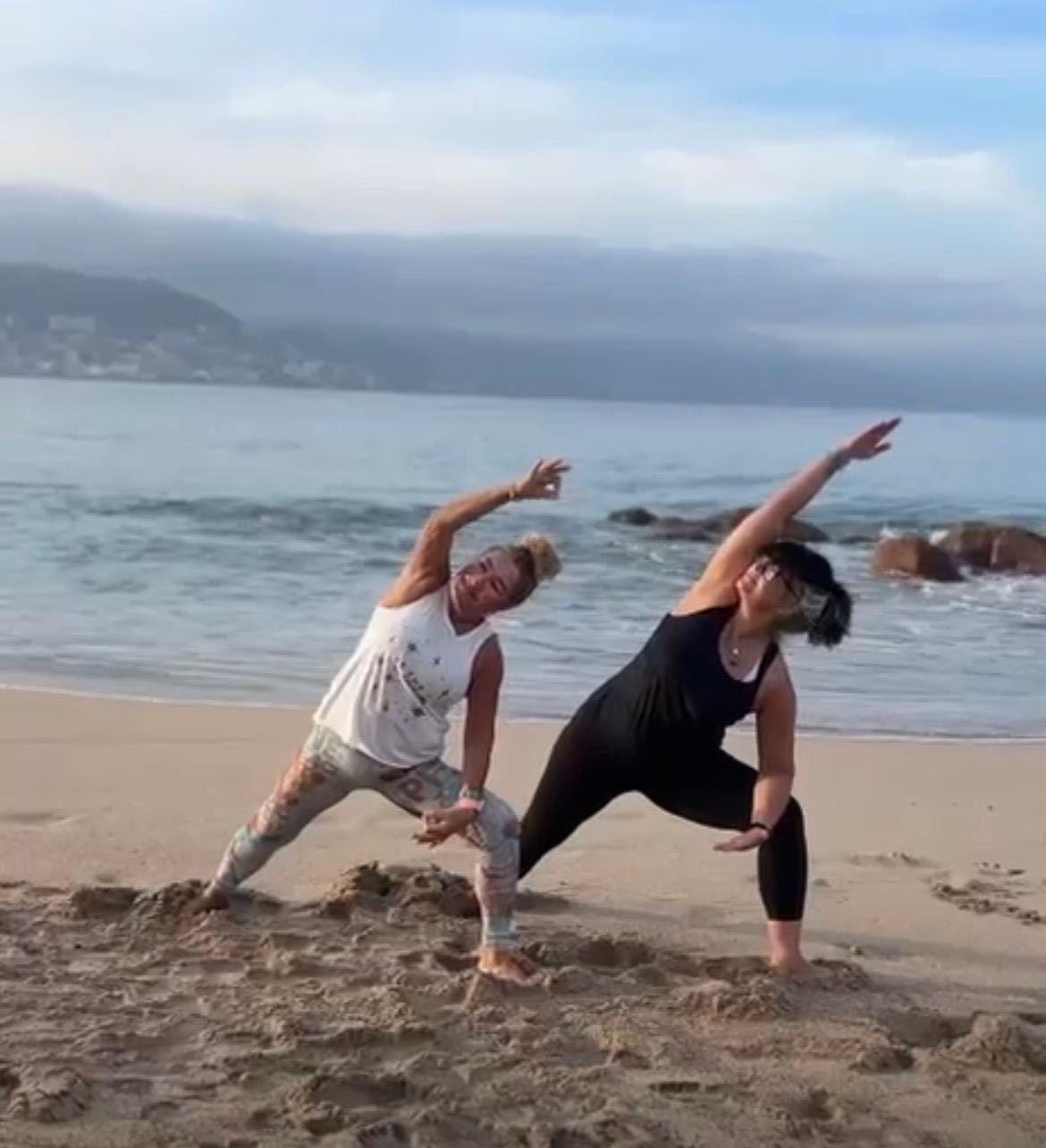
It was a year after Meachelle’s article about Sharon that Sharon and her husband, Darcy, began going to Puerto Vallarta for the winter. As Sharon noted, “I started teaching at a Yoga studio the first winter we were here in PV. It’s easy to meet people & build community when you’re teaching snowbirds from everywhere
I love sharing my love for fitness & yoga & moving our bodies.”
But, for six years prior to making Puerto Vallarta her and Darcy’s winter home, Sharon had already been conducting annual one-week health and wellness retreats in Puerto Vallarta. She has continued to conduct those retreats every year since. The most recent retreat was held from January 25-February 1 at the Fiesta Americana All Inclusive Resort.
Here’s how Sharon describes the purpose of those retreats:
“For over 15 years, my Health & Wellness Retreat has brought together women of all ages to reconnect, recharge, and celebrate movement, friendship, and balance. Hosted at a beautiful all-inclusive resort, guests can truly make the week their own holiday experience. While primarily a women’s retreat, many now bring their husbands or partners who are welcome to participate as much or as little as they choose.
“Throughout the week, we offer seven daily classes ranging from sunrise meditation and yoga to toning, Zumba, yin yoga, and our signature Aqua Zumba — which transforms into a high-energy, joy-filled pool party. Each evening, we gather for sunset yoga and take time to celebrate the beauty of the day together.
“The retreat blends wellness with enjoyment, allowing guests to indulge in the resort’s wonderful restaurants and social atmosphere while still feeling strong, energized, and revitalized. It’s a balanced, uplifting experience where participants leave feeling nourished in body, mind, and heart, often forming lifelong friendships. This year, we were proud to welcome 40 participants.”
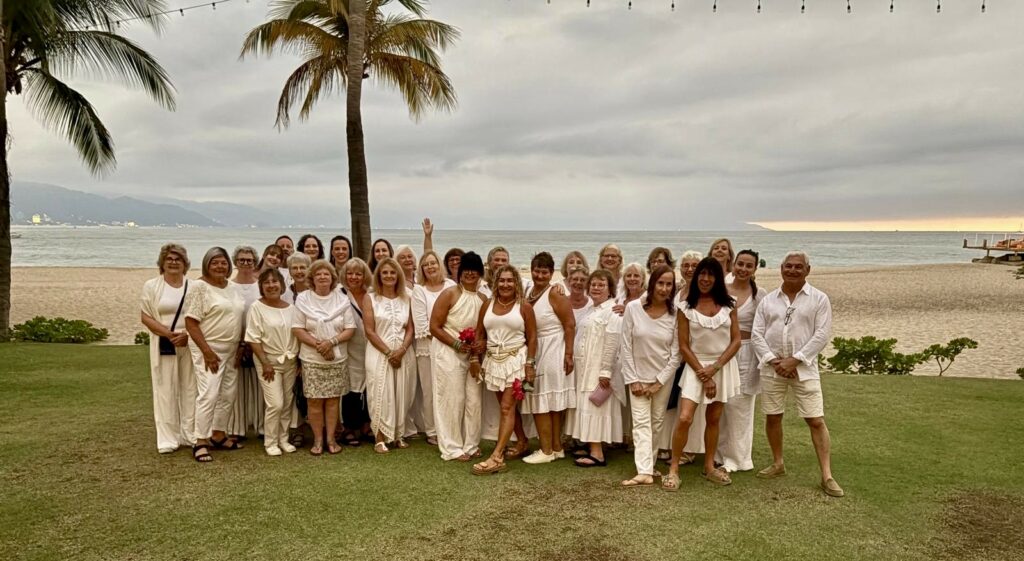
In the picture accompanying this article you might recognize several Winnipeggers. I asked Sharon how many Winnipeggers were participants in this year’s retreat?
The answer, she said, was the majority (31) were from Winnipeg, while six were from Las Vegas, one from Ottawa and two from Edmonton.
The last two years, Sharon also noted, another well known member of the Rady JCC staff, Dona Watts-Hastings, who’s a physiotherapist, also a yoga and Pilates instructor, has joined Sharon in conducting the retreat. Sharon adds that Dona’s physiotherapy clinic is inside the Rady JCC. Dona also brings some of her clients to the retreat.
I wondered though, how active Sharon is in teaching classes when she’s back in Winnipeg? Does she never tire of teaching so many classes? I wondered.
Sharon’s answer was: “Yes, I’m still in Winnipeg half of the year and I will always teach at the Rady… Zumba, sculpt , yoga & barre class – also spinning if they need me to sub. . I teach at Assiniboine park and other gyms, too. Every morning I teach and often sub other classes. Busy all spring & summer.”
Whew! It’s tiring just reading about everything Sharon does. If you would like to find out more about next year’s health & wellness retreat in Puerto Vallarta and how you might be able to join up, contact Sharon at sharon@freshsoulfitness.com.
To watch a video of what a typical day at the retreat consisted of go to freshsoulfitness
Local News
Jess Pudavick: artist and business executive
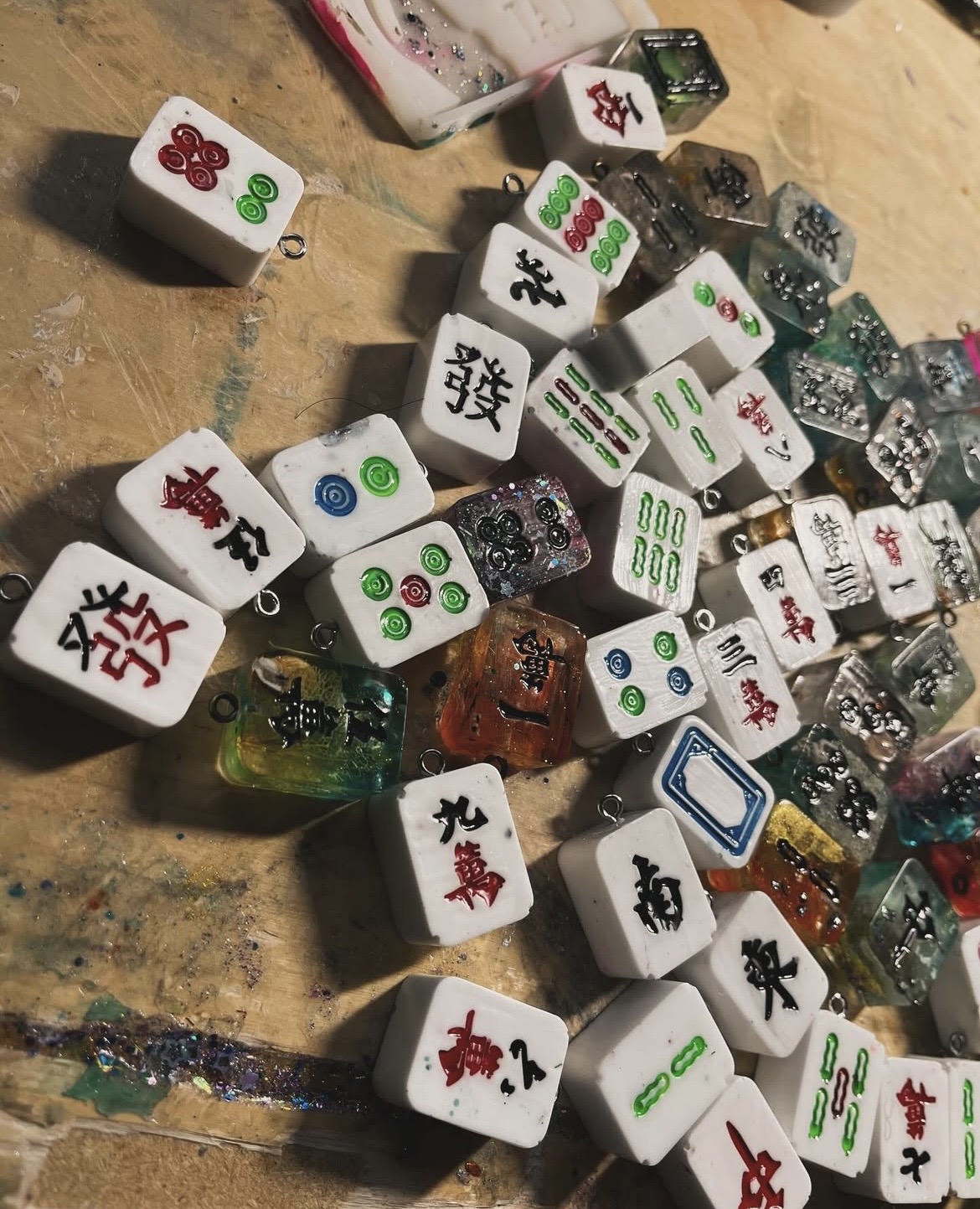
By MYRON LOVE Jess Pudavick is a rare individual in that she combines careers as an artist and a business executive.
I first became aware of Jess last summer when she was one of the artists/craftspeople with a display table at the Gwen Secter Creative Living Centre’s annual garage and craft sale. What piqued my interest was her focus on incorporating resins in her art pieces.
Last week, while interviewing Ms. Pudavick at Super-Lite Lighting on Waverley – I learned much more about the multi-talented Ms. Pudavick.
While I have a passion for art,” she notes, “I was not interested in becoming a stereotypical starving artist.”
The daughter of Stuart and Beth Pudavick joined the company (which her father acquired in the early 1980s (along with partners Simon Simkin and Allan Hochman) 17 years ago. Her brother, Ray, also joined the company 10 years ago, Jess notes.
At Super-Lite, Jess’s title is Custom Homes Lighting Consultant. She works with builders, designers and contractors to build the lighting for the home, as well as to choose the right lights for the space. She also manages the company’s social media and website.
“I enjoy working with my dad and Ray,” she says.”I also love what I do at Super-Lite. It is similar to my feelings about my art. You don’t know the end result when you start. It is nice to see something being built from nothing and seeing the end result – and knowing how happy the client is in the end.”.
As an artist, the graduate of Brock Corydon’s Hebrew Bilingual Program, Shaftesbury Collegiate and the University of Manitoba, recalls that she started at a young age. “As a kid,” she says, “I was always doodling and drawing cartoons.”
While she has worked with several different artistic media, she observes that what she likes about creating art with resins is the challenge.
“Resin is a temperamental material,” she points out. “When you start a project, you have no idea what the finished product will look like.”
She explains that there are two ways to work with resin. You can put traditional resin in a mold and wait 24 hours for the resin to dry. Or you can speed up the process by using a UV style resin and exposing the resin to UV rays.
“I prefer letting the resin dry naturally,” she says. “I find I have more control over it.”
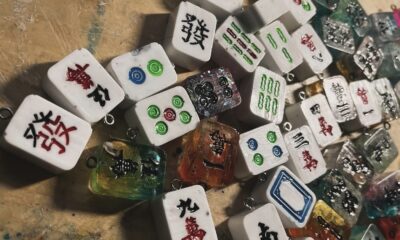
Her resin-infused art comes in many forms. She produces earrings and necklaces, candle holders and ashtrays, dice and computer keys. She has also created resin-infused mahjong and rummikub tiles and even sets of dominoes with paw prints. A popular item, Jess says, is a custom coloured/theme wedding set of dominoes.
“People love them,” she says of the dominoes tiles.
(The latter reflects her own passion for dogs for which she is often a foster “parent”. She notes that she also creates resin-infused memory keepsake urns for the ashes/hair or fur of beloved pets – a product that is gaining popularity.)
Then there is the resin-infused coffee table that has a place of honour in her own home. “With my love of plants and resin, my partner and I took our existing coffee table, added various clippings of my own plants and created a fun resin-sealed table,” she recounts. “It really looks cool. It is unique. it attracts visitors’ interest. Every time I look at it, I see something different.”
Jess reports that generally sells her works of art through craft sales and her Instagram page (@thejesso09) for between $10 and $30. Her major source of sales though, she adds, is through word of mouth.
But Pudavick avers that she doesn’t do her art with an eye to sales.
“I create for myself, not for the approval of others. I find it relaxing – a good way to reduce stress. It’s also rewarding to see that others want something you have created.”
She strongly believes that enjoying your work is an important element in being happy. Equally important, she notes, – both in business and art – is to have satisfied customers.
Local News
New Jewish holiday trivia game aims to educate younger Jews about different aspects of our traditions
By MYRON LOVE Growing up in Israel, says Meytal Benjamin, you are immersed in Jewish history, heritage, ritual and traditions. Jewish identity is second nature. The schools, the public holidays, even the calendar reinforce knowledge of Judaism and a sense of Jewish identity.
That is not the case in the Diaspora.
Speaking for myself, I grew up in a secular home. Even having attended Peretz School, I knew virtually nothing about kashrut. All I knew was that we swapped out matzah for bread at Pesach and that you weren’t supposed to have a glass of milk after eating meat. I only became a regular shul goer after I became an adult and married a wonderful wife who came from a somewhat more observant background.
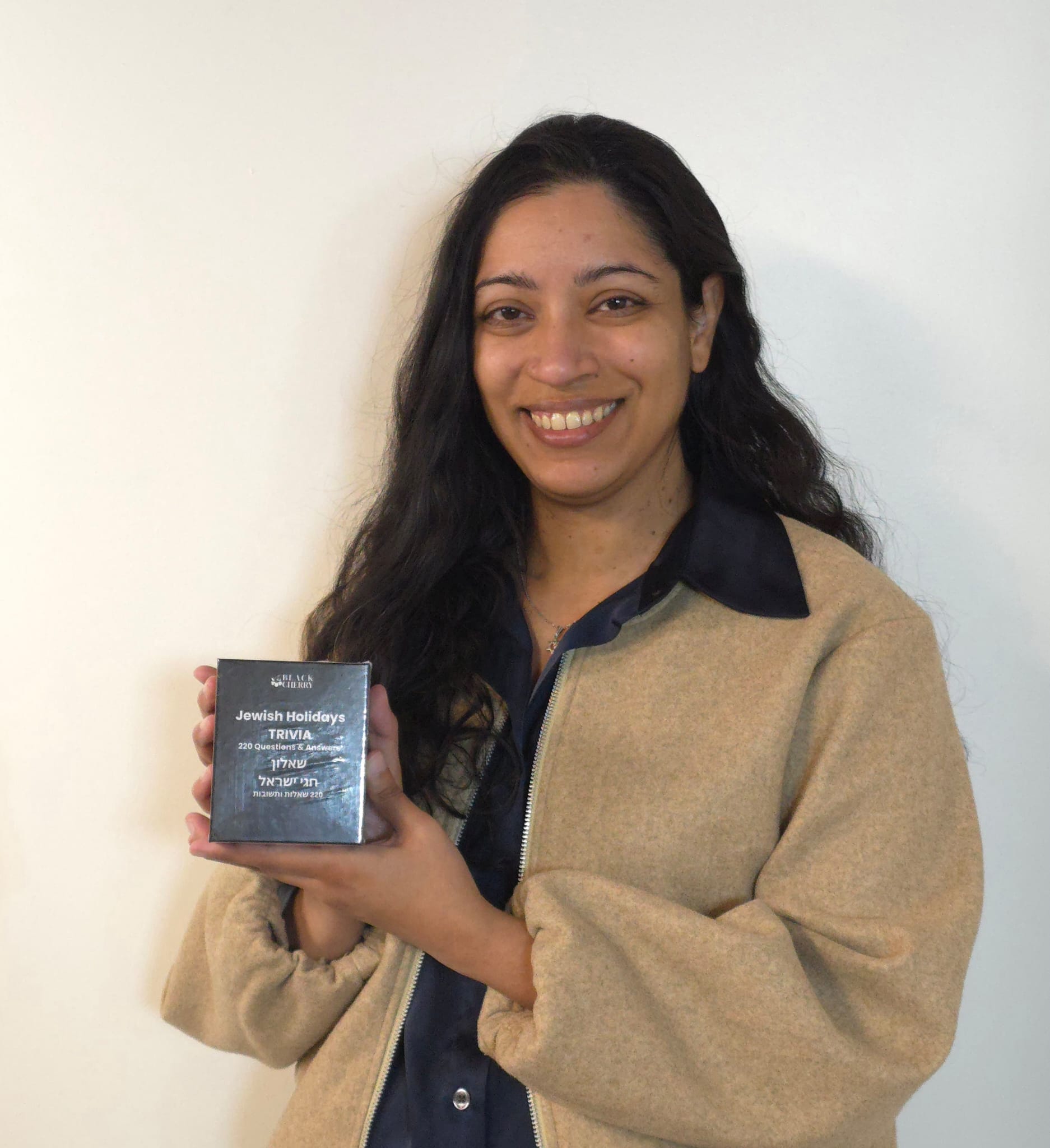
To try to address this lack of Judaic knowledge in the Diaspora at least to some degree, the Israeli-born Benjamin has developed a new educational tool – a game – called “Jewish Holidays Trivia” – based on the popular Trivial Pursuit.
A financial planner and analysis manager for Winnipeg-based insurance company People Corporation, Benjamin and her husband, Assaf, arrived in our city six years ago. She notes that she grew up in Rosh Ha’ayin in central Israel, the daughter of parents who came to Israel from Bombay around 1970. She earned her BA and MBA from Tel Aviv University. She adds that she worked as a flight attendant while attending university.
Benjamin and her husband, she notes, came to Winnipeg because they were looking for a home that was peaceful and they are quite happy in Winnipeg. In this, their adopted community, she says, they take part in different communal activities. Most notably, they were regular participants in the weekly rallies on Kenaston on behalf of the Israelis who were held hostage in Gaza up until a few months ago.
Benjamin reports that it took her about six months to develop Jewish Holidays Trivia. She finished – fittingly – around the time of Yom Hatzmaut. The game – which comes in a small, square box – consists of 220 cards – colour-coded – divided into six categories – with questions and answers in English and Hebrew – testing participants’ knowledge about Rosh Hashonah, Sukkot, Chanukah, Purim, Pesach and Shavuot.
Some sample questions:
What agricultural aspect is celebrated on Shavuot?
Which portion of the Torah recounts the story of Pesach?
Who replaced Haman after his execution?
In which country is Chanukah a national holiday?
In what month of the Jewish calendar is Sukkot?
Which eastern European Jewish dish is associated with Rosh Hashonah?
The rules of the game are printed on the side of the box – choose teams and appoint a moderator to ask questions and keep score. Each question is worth one point.
I warn you that not all the answers can be found in traditional sources. Some general knowledge is also required, e.g., Which Jewish astronaut celebrated Chanukah in space?
“I created the Jewish Holidays Trivia Game,” notes Benjamin on her website, “because I wanted to bring something joyful, meaningful, and just a little bit competitive to the Jewish table—especially for kids growing up outside of Israel.
“Jewish holidays are full of rich stories, beautiful traditions, and incredible moments worth celebrating. I wanted to capture all of that in a game that’s fun, easy to play, and full of surprises.”
Benjamin suggests that playing Jewish Holidays Trivia is an ideal way to spend family time and also engage the younger generation in learning about our traditions.
She reports that so far she has sold about 150 copies of her game – largely to fellow Winnipeggers – with a few buyers further afield in Canada and the United States.
Readers who may be interested in acquiring a copy of the game can go online to blackcherryplay.com. She is selling each game for $29 Canadian.