
Features
The new world of octogenarianism
By GERRY POSNER Recently, a group of six old time friends whose roots were in Winnipeg, reunited in Palm Desert, California to celebrate a new digit for them in their age as in an “8.” To their dismay a zero came after it. They never contemplated that when they were eight. The years seemed to have gathered steam and as some of them say, they are now on the slope heading down ever faster. Confession – I am part of this group of octogenarians.
Now, to be exact, of the six of us, one of us turned 80 in 2022 and another will not reach that lofty status until August. But in the big picture, it is 480 years all together. The six of us include: Dr. Ted Lyons a name familiar to many readers; Michael Nozick, another well known name; Larry Booke, whose name is the name of the accounting firm he led for many years as in Booke and Partners; Sheldon Gilman of Los Angeles, whose father was also a prominent accountant in Winnipeg before moving in the 1960s to Kansas City, Missouri, where he and his wife Helen remained; Dr. Irv Tessler, a psychiatrist living up in northern California in the redwood country and me. The picture accompanying the article identifies the faces to the names. Yes, I suppose you are saying to yourself or anyone around you, whatever happened to these guys? When I knew them, they were young and looked good ( well, if not good, at least decent).
The good news is that we are all still in the game and we know it. We all recognize that we were privileged to have grown up in the best of times and in the best of places. We knew a time when television only made its way into the Winnipeg world in 1954, when we were only 11. We, of course, knew not of computers, iPhones, or social media. Our social media was gathering together after school, AZA and USY. We grew up when crime in Canada was relatively minor and infrequent, when people left their keys in the car, when we were allowed to stay outdoors alone until the street lights came on and when the closest we came to a weapon was playing “Knifey.” Our bonds were strong as that was the foundation for friendship with no real distractions. We were far from the only group to have and maintain this kind of a relationship over the years. I know of others, older and younger, who have had similar close friendships as they too were part of this golden era.
For about the last ten years, we have assembled in the Palm Springs area, sometimes with spouses and sometimes not, and have spent about five days together at the very least. We are not so steeped in the past that we do not make it to the present – far from that realm. Yet, we do spend a great deal of time remembering what was both good and bad. Mostly our memories of the past are filled with nostalgia for what we had and worry for what the future holds for our grandkids. That subject is good for many lively discussions. What is impressive is that we try to stay away from political topics as we have within our group, a wide range of opinions ranging from a lover of Tucker Carlson and company to a supporter of MSNBC. The two views, from right to left are far removed from one another with the rest of the group somewhere in between. Wisely, we change subjects when we veer into the political arena.
The area most talked about when we meet seems to be health related. There is no lack of discussion on that subject. In the big picture, we are doing ok, but there are issues for us, a not so surprising circumstance for six AK’s. Surgeries we have had – from back to hip to knee to heart, not to forget my two hernia operations. Still, we are out there and we even had three of us playing Pickleball in Palm Springs this year at a decent level, so we have life in us still. In fact, three of the group still suits up for work every day or close to it.
When it it all said and done, probably our greatest accomplishment is that collectively we have 15 kids and those 15 kids have added 26 grandchildren to the total. I suspect these grandchildren will never meet or in fact even know of one another for the most part. But, at age 80, it is comforting to know we have had some usefulness in at least one area of life.
One might expect that at this so called advanced age, we might have words of wisdom emanating from our lips. My contribution to that topic was my ability to spell the word octogenarian without help from the computer. One of the group suggested that we should recognize that 80 is the new 40, but the aches and pains we suffer when we awaken would belie that thought. Probably our greatest insight is the recognition of just how little we know, irrespective of an ability to do a New York Times Spelling Bee every day and get all the correct answers.
What drives us in part is the desire to keep these California gatherings going for as long as we can. The time together rejuvenates all of us. We know each other well enough that one of us can often finish sentences that somebody else starts. We are linked, bonded and tied in friendships in a way our parents never knew and our grandkids will never know. I told the group I will aim to be there at age 90, if they agree to meet me at this same spot.
Features
Winkler nurse stands with Israel and the Jewish people
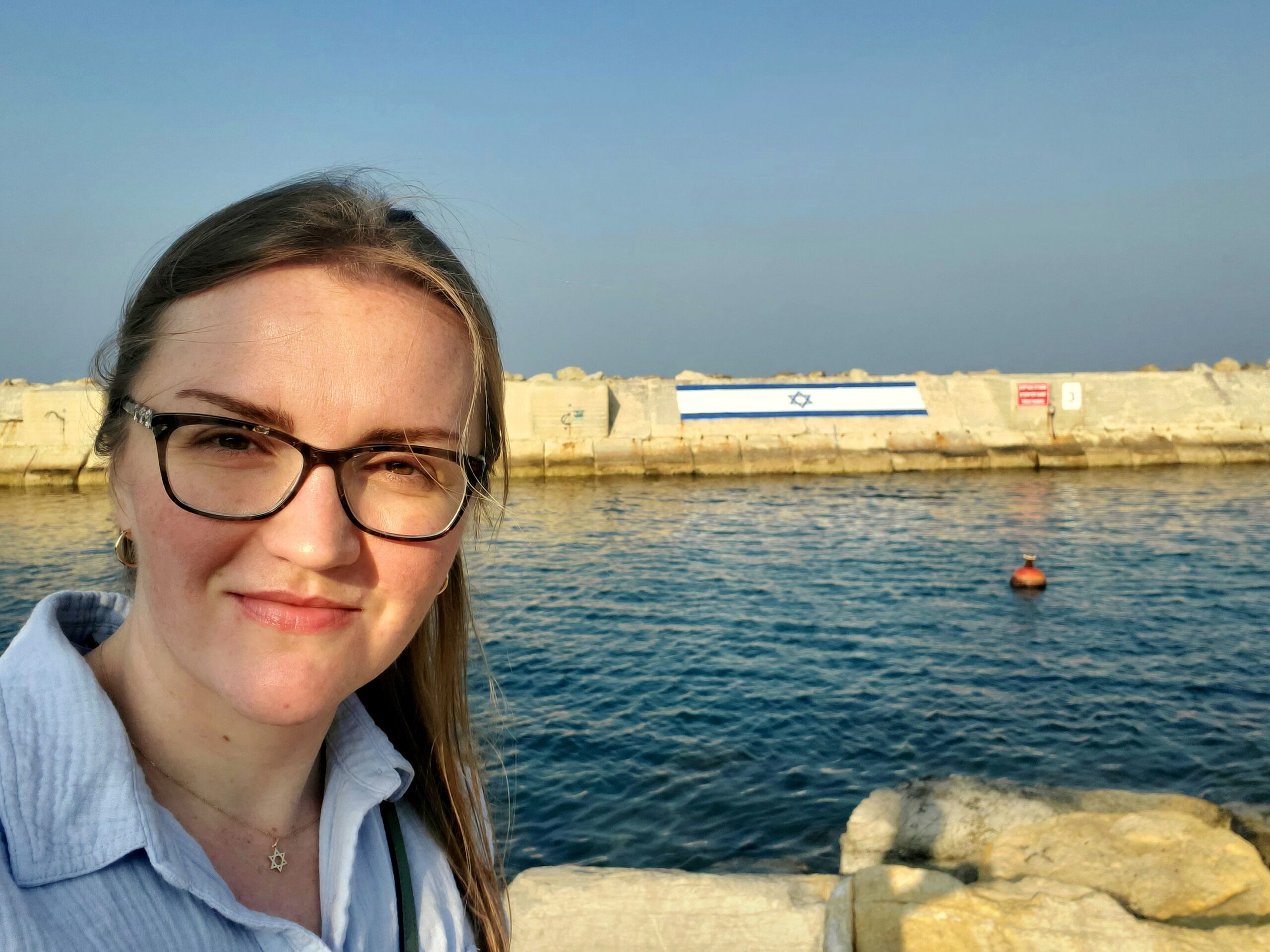
By MYRON LOVE Considering the great increase in anti-Semitic incidents in Canada over the past 20 months – and the passivity of government, federally, provincially and municipally, in the face of this what-should-be unacceptable criminal behaviour, many in our Jewish community may feel that we have been abandoned by our fellow citizens.
Polls regularly show that as many as 70% of Canadians support Israel – and there are many who have taken action. One such individual is Nelli Gerzen, a nurse at the Boundary Trails Health Centre (which serves the communities of Winkler and Morden in western Manitoba). Three times in the past 20 months, Gerzen has taken time off work to travel to Israel to support Israelis in their time of need.
I asked her what those around her thought of her trips to Israel. “My mother was worried when I went the first time (November 2023),” Gerzen responded, “but, like me, she has trust in the Lord. My friends and colleagues have gotten used to it.”
She also reports that she is part of a small group of fellow believers that meet online regularly and pray for Israel.
Gerzen is originally from Russia, but grew up in Germany. Her earliest exposure to the history of the Holocaust, she relates, was in Grade 9 – in Germany. “My history teacher in Germany in Grade 9 went into depth with the history of World War II and the Holocaust,” she recalls. “It is normal that all the teachers taught about the Holocaust but she put a lot of effort into teaching specifically this topic. We also got to watch a live interview with a Holocaust survivor.”
What she learned made a strong impression on her. “I have often asked myself what I would do if I were living in that era,” she says. “Would I have been willing to hide Jews in my home? Or risk my life to save others?”
Gerzen came to Canada in 2010 – at the age of 20. She received her nursing training here and has been working at Boundary Trails for the last three years.
“I believe in the G-d of Israel and that the Jews are his Chosen People,” she states. “We are living at a time of skyrocketing anti-Semitism. Many Jews are feeling vulnerable. I felt that I had to do something to help.”
Gerzen’s first trip to Israel was actually in 2014 when she signed onto a youth tour organized by a Christian group, Midnight Call, based in Switzerland. That initial visit left a strong impact. “That first visit changed my life,” she remembers. “I enjoyed having conversations with the Israelis. The bible for me came to life. Every stone seemed to have a story.”
She went on a second Midnight Call Missionaries tour of Israel in 2018. She went back again on her own in the spring of 2023. After October 7, she says, “I couldn’t sit at home. I had to do something.”
Thus, in November 2023, she went back to Israel, this time as a volunteer. She spent two weeks at Petach Tikvah cooking meals for Israelis displaced from the north and the south as well as IDF soldiers. She also spent a day with an Israeli friend delivering food to IDF soldiers stationed near Gaza. She notes that she wasn’t worried so close to the border.
“I trusted in the Lord,” she says. “It was a special feeling being able to help.”
Last November, she found herself at Kiryat Shmona (with whom our Jewish community has close ties), working for two weeks alongside volunteers from all over the world cooking for the IDF.
On one of her earlier visits, she recounts, a missile struck just a few metres from the kitchen where the volunteers were working. There was some damage – forcing closure for a few days while repairs were ongoing, but no injuries.
In January, she was back at Kiryat Shmona for another two weeks cooking for the IDF. She also helped deliver food to Metula on the northern border. This last time, she reports, there was a more upbeat atmosphere, “even though,” she notes, “the wounds are still fresh. It was quieter. There were no more missiles coming in.
“Israelis were really touched by the presence of so many of us volunteers. I only wish more Christians would stand up for Israel.
“It was really moving to hear people’s stories first-hand.”
She recounts the story of one Israeli she met at a Jerusalem market who fought in the Yom Kippur war of 1973, who was the only survivor of the tank he was in.
“This guy lost so much in his life, and he was standing there telling the story and smiling, just trying to live life again,” she says. “The people there are so heartbroken.”
Back home, she has been showing her support for Israel and the Jewish people by attending the weekly rallies on Kenaston in support of the hostages whenever she can.
She is looking forward to playing piano at Shalom Square during Folklorama.
Nelli Gerzen doesn’t know yet when she will be returning to Israel – but it is certain to be soon. “This is my chance to step up for the truth,” she concludes. “I know that supporting Israel is the right thing to do. When I am there, it feels like my heart is on fire.”
Features
Antisemitism in the Medical Profession in Canada
By HENRY SREBRNIK (June 27, 2025) Antisemitism in Canada now flourishes even where few would expect to confront it. Since the Hamas attack on Israel on October 7, 2023, there has been a resurgence of antisemitism noticeable in the world of healthcare.
When Israeli Gill Kazevman applied to medical school, and circulated his CV to physician mentors, their most consistent feedback was, “Do not mention anything relating to Israel,” he told National Post journalist Sharon Kirkey in an Aug. 10, 2024, story. As a student at the University of Toronto’s Temerty Faculty of Medicine, “I began to see all kinds of caricatures against Jews. I saw faculty members, people in power, people that I’m supposed to rely on, post horrible things against Jews, against Israelis,” he added. The faculty created a Senior Advisor on Antisemitism, Dr. Ayelet Kuper, who in a report released in 2022, confirmed widespread anti-Jewish hatred.
The Jewish Medical Association of Ontario (JMAO) conducted a 2024 survey of 944 Jewish doctors and medical students from across Canada. Two thirds of respondents were “concerned that antisemitic bias from peers or educators will negatively affect their careers.” Dr. Lisa Salomon, JMAO’s president, reported that at the University of Toronto medical school only 11 Jewish students were completing their first year of medical school out of a class of 291. The medical school in 1974 saw 46 Jews in a class of 218.
Also in Toronto, Hillel Ontario called on Toronto Metropolitan University to investigate Dr. Maher El-Masri, who has served as the director of the Daphne Cockwell School of Nursing, because, the group contended, he has “repeatedly engaged with and spread extreme, antisemitic, and deeply polarizing content on his social media account.”
The National Post’s Ari Blaff in an article on June 12, 2025 quoted social media posts from an account Hillel claimed belongs to Dr. Maher El-Masri, who has been the director of the Daphne Cockwell School of Nursing. One message concerned a post about Noa Marciano, an Israeli intelligence soldier abducted by Hamas on Oct. 7, 2023, who later died in captivity. “This is what is so scary about people like her,” the TMU professor wrote. “They look so normal and innocent, but they hide monstrous killers in their sick, brainwashed minds.” Israel, he asserted a day after the Hillel notice, “is a baby killer state. It always has been.”
The Quebec Jewish Physicians Association (AMJQ) is fighting antisemitism in that province. Montreal cardiologist Dr. Lior Bibas, who also teaches at Université de Montréal, co-founded the group in the weeks following the October 7 terrorist attack. They feel young doctors have been bearing the brunt of anti-Israel sentiment since then. “We heard that trainees were having a hard time,” he told Joel Ceausu of the Canadian Jewish News Feb. 3. “We saw a worsening of the situation and were hearing stories of trainees removed from study groups, others put on the defensive about what’s happening,” and some saw relationships with residents deteriorating very quickly.
Dr. Bibas thinks there are similarities with Ontario counterparts. “Trainees are getting the brunt of all this. Their entire training ecosystem — relationships with peers and physicians — has changed.” Whether anti-Zionist remarks, blaming Jews for Israel’s actions, or other behaviour, it can be debilitating in a grueling academic and career setting. The fear of retaliation is so strong, that some students were unwilling to report incidents, even anonymously.
Jewish physicians have now founded a national umbrella group, the Canadian Federation of Jewish Medical Associations (CFJMA), linking the provinces, and representing over 2,000 Jewish physicians and medical learners, advocating for their interests and promoting culturally safe care for Jewish patients. And “it’s really been nonstop, given that we have a lot of issues,” Dr. Bibas told me in a conversation June 17. “People have been feeling that there’s been a weaponization of health care against Israel.”
He stressed that health care should remain politically neutral – meetings are an inappropriate venue in which to talk about the war in Gaza, he stated, and “this will just lead to arguments.” Nor should doctors, nurses and hospital staff wear pins with Palestinian maps or flags. And no Jewish patient being wheeled into an operating room should see this “symbol of hate.”
On Jan. 6, a group of Montreal-area medical professionals walked off the job to protest outside Radio-Canada offices, calling for an arms embargo, ceasefire and medical boycotts of Israel. Those who could not attend were encouraged to wear pins and keffiyehs to work. When asked if such a walkout should be sanctioned, Quebec Health Minister Christian Dubé’s office had no comment. Neither did the Collège des médecins (CDM) that governs professional responsibilities. The leadership of many institutions have remained passive.
B’nai Brith Canada recently exposed a group channel, hosted on the social media platform Discord, in which Quebec students engaged in antisemitic, racist, misogynistic and homophobic rhetoric. More than 1,400 applicants to Quebec medical schools, as well as currently enrolled medical school students, were in the group, which was ostensibly set up to support students preparing for admission to Quebec’s four medical programs. “I saw it, and it’s vile,” remarked Dr. Bibas, noting how brazenly some of the commentators expressed themselves, using Islamist rhetoric and Nazi-era imagery, such as referring to Anne Frank as “the rat in the attic.”
Doctors Against Racism and Antisemitism (DARA) said in a statement, “These messages are the direct result of the inaction and prolonged silence of medical school and university leaders across Canada since October 7, 2023, in the face of the meteoric rise of antisemitism in their institutions. Silence is no longer an option. Quebec’s medical schools and universities must act immediately. These candidates must not be admitted to medical school.” DARA member Dr. Philip Berger stated that “there’s been a free flow, really, an avalanche of anti-Israel propaganda, relentlessly sliding into Canadian medical faculties and on university campuses.”
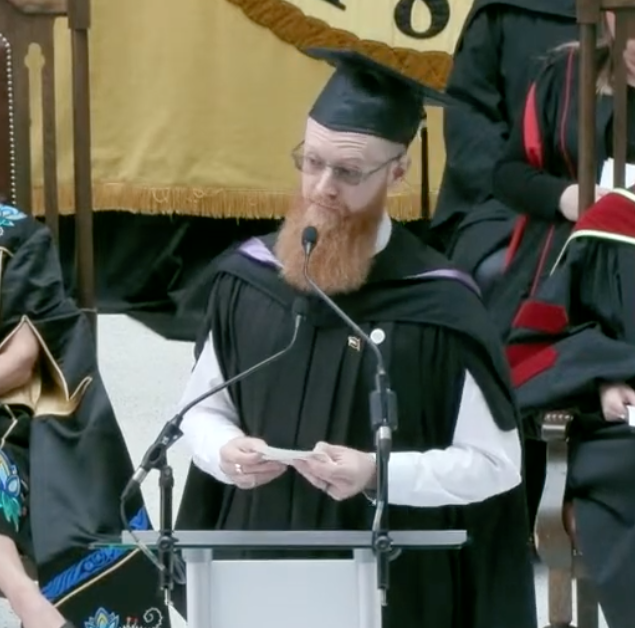
In Winnipeg, a valedictory speech delivered to the 2024 class of medical school students graduating from the Max Rady College of Medicine at the University of Manitoba on May 16, 2024 set off a storm of controversy, as reported by Bernie Bellan in this newspaper. It involved a strongly worded criticism of Israel by Dr. Gem Newman. “I call on my fellow graduates to oppose injustice -and violence — individual and systemic” in Palestine, “where Israel’s deliberate targeting of hospitals and other civilian infrastructure has led to more than 35,000 deaths and widespread famine and disease.” The newspaper noted that “loud cheers erupted at that point from among the students.”
The next day, the dean of the college, Dr. Peter Nickerson, issued a strongly worded criticism of Dr. Newman’s remarks. On Monday, May 20, Ernest Rady, who made a donation of $30 million to the University of Manitoba in 2016, and whose father, Max Rady, now has his name on the school, sent an email in response to Dr. Newman’s remarks.
“I write to you today because I was both hurt and appalled by the remarks the valedictorian, Gem Newman, gave at last week’s Max Rady College of Medicine convocation, and I was extremely disappointed in the University’s inadequate response. Newman’s speech not only dishonored the memory of my father, but also disrespected and disparaged Jewish people as a whole, including the Jewish students who were in attendance at that convocation.”
In subsequent weeks Jewish physicians in Manitoba organized themselves into a new group, “The Jewish Physicians of Manitoba.” As Dr. Michael Boroditsky, who was then President of Doctors Manitoba, noted, “Jewish physicians in cities across Canada and the U.S. have been forming formal associations in response to heightened antisemitism following the Hamas massacre of October 7.”
After October 7, Jewish students at the University of Calgary’s Cumming School of Medicine reported exposure to repeated antisemitic posts by peers on social media, being subject to antisemitic presentations endorsed by faculty during mandatory classes, social exclusion and hateful targeting by university-funded student groups, and removal from learning environments or opportunities subsequent to antisemitic tirades made by faculty in public spaces.
In addition to online vitriol, medical students have been subject to antisemitic actions coordinated by university-funded student groups with physician-faculty support under the guise of advocating against the actions of the Israeli government. All instances of discrimination, they stated in a brief, have been witnessed by and/or reported to senior leadership of the medical school without incurring condemnation of the discrimination.
In Vancouver, social media posts vilifying Israel and espousing Jew hatred were circulated by physicians at the Faculty of Medicine of the University of British Columbia, noted an article in the National Post of May 25, 2025. Allegations included Christ-killing, organ trafficking, and other nefarious conspiracies supposedly hatched by Jewish doctors. Some asserted that Jewish faculty should not be allowed to adjudicate resident matching because the examining doctors were Jewish and might be racist.
In November of 2023, one-third of all UBC medical students signed a petition endorsing this call. Jewish learners who refused to sign were harassed by staff and students on social media. When challenged, the Dean of the medical faculty refused to recognize antisemitism as a problem at UBC or to meet with the representatives of almost 300 Jewish physicians who had signed a letter expressing concern about the tolerance of Jew hatred, and the danger of a toxic hyper-politicized academic environment. This led to the public resignation of Dr. Ted Rosenberg, a senior Jewish faculty member.
Here in the Maritimes, things seem less dire. I spoke to Dr. Ian Epstein, a faculty member in the Division of Digestive Care & Endoscopy at the Dalhousie University Faculty of Medicine. He helps coordinate a group supporting Jewish and Israeli faculty, residents and medical students.
“Our group is certainly aware of growing antisemitism. Many are hiding their Jewish identities. There have been instances resulting in Jewish and Israeli students being excluded and becoming isolated. It has been hard to have non-Jewish colleagues understand. That said our group has come together when needed, and we have not faced some of the same challenges as larger centres,” Dr. Epstein told me. Dalhousie has also taken a stand against academic boycotts of Israel, which some view as a form of antisemitism. The University of Prince Edward Island in Charlottetown has just opened a new medical school. Let’s hope this doesn’t happen here.
Lior Bibas in Montreal indicated that his group is worried “not only as Jewish doctors and professionals, but for Jewish patients who are more than ever concerned with who they’re meeting.” Can we really conceive of a future where you’re not sure if “the doctor will hate you now?”
Henry Srebrnik is a political science professor at the University of Prince Edward Island.
Features
One Epic Trip From Rugged Roads to Remote Lakes
There are road trips you plan for leisure and then there are road trips that change you. For Alexia Krizia La Palerma, what started as a multi-day drive from Montreal to a frozen lake in Thetford Mines turned into something far more meaningful. With her toddler son Leone in the backseat and a car full of diving gear, she embarked on a trip that blurred the line between motherhood and exploration.
Behind the wheel of a Mitsubishi Outlander PHEV, Alexia made her way through snow-covered landscapes and silent forests, chasing a singular goal: to freedive beneath the ice of Flintkote Quarry. It was more than just an outdoor challenge. It was an inward journey that demanded focus, courage, and a deep breath.
Gear, Grit, and a Plug-In Hybrid
Driving through Canadian winters is no small feat, especially when you’re hauling sensitive equipment, handling unpredictable road conditions, and taking care of a toddler. The Mitsubishi Outlander PHEV turned out to be an ideal travel partner, combining electric power with rugged capability. Super All-Wheel Control gave Alexia confidence behind the wheel, and the generous cargo space meant there was room for everything from Leone’s essentials to fins, wetsuits, and oxygen kits.
This trip wasn’t about rushing to the finish line. It was about having a vehicle that could keep up, adapt, and support the type of journey where the road itself is as important as the destination.
A Pause in the Trees
Before heading to the dive site, Alexia took a detour to the Bubble Hotel at Centre de l’Hêtre near Quebec City. There, she and Leone slept in a transparent dome surrounded by trees. Under a canopy of stars, the pause served a purpose. It grounded her, helping her mentally prepare for the cold-water challenge ahead.
These intentional breaks are often the secret to making epic trips feel manageable. They offer room to breathe, especially when the final goal requires both physical endurance and emotional clarity.
Dropping Into Stillness
At Flintkote Quarry, Alexia and her team cut a triangular hole into thick lake ice. Known for its eerie underwater wrecks and unusual clarity, the quarry is one of the few places to freedive Canada in such stark, beautiful conditions.
Slipping into a 5mm wetsuit and prepping her descent line, Alexia focused on her breath. Underneath the frozen surface, the water was calm and dark, broken only by shafts of sunlight from the hole above. Every movement mattered. There was no scuba tank, no noise. Only control, silence, and the rhythm of lungs trained to perform under pressure.
Though physically intense, the dive was meditative. It reminded her why she fell in love with freediving in the first place: the quiet, the simplicity, and the sense that you’re alone with your thoughts in a way that’s almost impossible on land.
Resurfacing With Perspective
When Alexia climbed out of the water, Leone was waiting. That moment captured something powerful. It wasn’t just about completing the dive. It was about sharing the spirit of exploration with the next generation.
By choosing to bring her son along rather than leave him behind, Alexia redefined what it means to balance adventure with responsibility. For her, being a parent didn’t limit what she could experience. It added new depth to it.
A Vehicle That Moves With You
The Outlander PHEV didn’t just get them from point A to B. It was a space to decompress between stops, a gear hauler, and a climate-controlled haven after hours spent in the cold. Its hybrid engine meant fewer emissions during long drives, which aligned with Alexia’s deep respect for nature.
For anyone looking to freedive Canada or explore off-the-grid locations, the right car isn’t just useful. It’s essential. And in this case, it was an enabler of something unforgettable.
Driving Into the Unknown
This wasn’t just a trip across Quebec. It was a passage between everyday life and something more expansive. Rugged roads, quiet lakes, and frozen silence gave way to a deeper understanding of self.
Epic doesn’t have to mean extreme. Sometimes it just means choosing the kind of journey that demands more from you and gives more back.