


Uncategorized
A famed rabbi’s yeshiva reopens for students for the first time since World War II
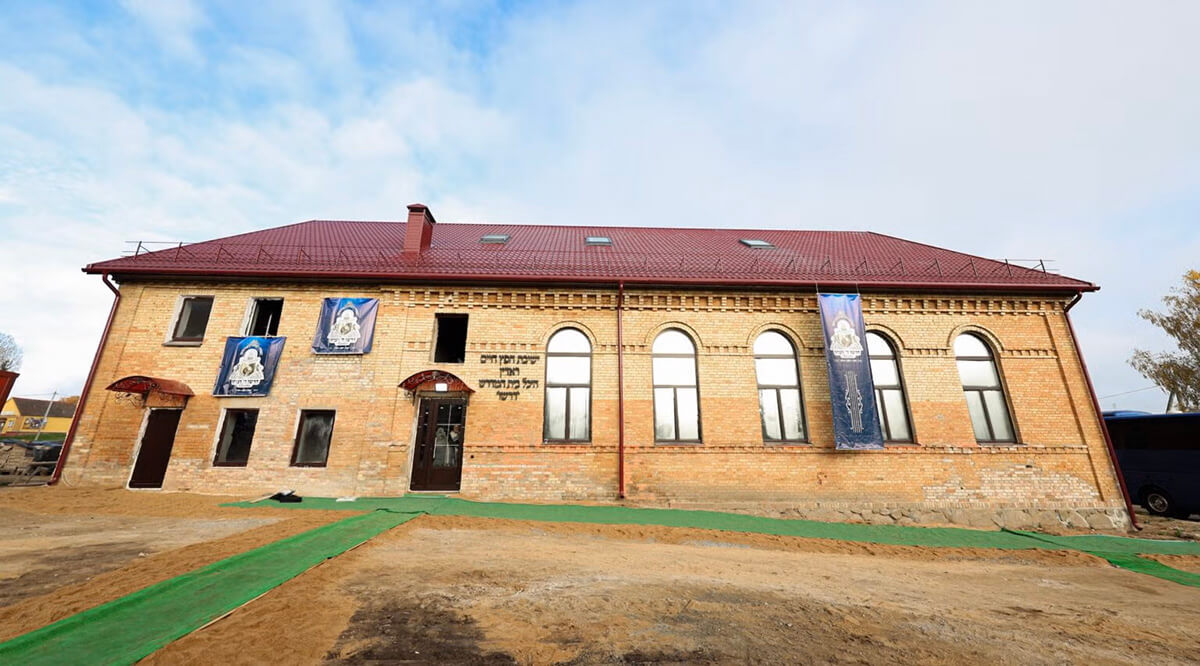
(JTA) — Dovid Hofstedter was visiting Belarus five years ago when he discovered that a historic Jewish school had turned into something else.
Hofstedter, a Canadian rabbi, was joining a group of rabbis from around the world at the Radin Yeshiva, nestled in the small town of Radun in western Belarus. The school was founded in 1869 by the famed Lithuanian rabbi Israel Meir Kagan, known as the Chofetz Chaim, and housed 300 students before World War II.
As Hofstedter delivered a lecture in the building, he was surprised to see it fill up with locals, who then gradually wandered out. He realized they didn’t know the building had once housed a yeshiva in a town where no Jews live today.
Instead, people had walked in expecting a play — and left when they didn’t get one.
The Radin Yeshiva had been converted into a theater, with a stage and red seats, Hofstedter told the Jewish Telegraphic Agency. Like many Jewish sites across Eastern Europe, where the Nazis’ annihilation was followed by decades of Soviet rule that stifled Jewish memory and communal life, the school’s history had been buried.
“In other places that I’ve been to in Eastern Europe, some yeshivas were used as a post office,” said Hofstedter. “Some were used as government buildings.”
This month, Hofstedter and another group of 100 international rabbis filled the building again, this time to inaugurate the reopened Radin Yeshiva, now fully restored to serve Torah students as a functioning school.

Yad Yisroel, a nonprofit dedicated to strengthening Jewish life in Belarus, bought the yeshiva building from the municipality of Radun (or Radin, according to its Yiddish pronunciation) in 2025. That spurred a year of planning and construction, headed internationally by Hofstedter, who founded the Torah study organization Dirshu, and locally by Moshe Fhima, who directs Yad Yisroel’s projects and leads a yeshiva in the southern city of Pinsk.
The restoration team replaced the building’s roof and windows, which had deteriorated over years of neglect. Inside, they installed a new Torah ark and recreated the wooden lecterns and chairs that filled the yeshiva before World War II. A library of books is being transported from Israel to stock the school’s shelves.
The Radin Yeshiva closed after the outbreak of World War II, when the Soviet Union occupied the region and Soviet authorities seized the building. Nazi Germany captured Radun in 1941. Some yeshiva students escaped to Japan, where they received aid from the American Jewish Joint Distribution Committee. Rabbi Mendel Zaks, the Radin Yeshiva’s then-leader and the Chofetz Chaim’s son-in-law, fled in 1941 to the United States and reestablished the yeshiva in New York City. In the 1950s, the new school moved upstate to Suffern, New York, where it remains active.
Meanwhile, more than 2,000 Jews from Radun and neighboring villages were interned in a ghetto; most were killed by the Germans and local police.

Hofstedter believes that the Radin Yeshiva will draw interest from Jewish communities across Belarus. Though the country’s 30,000 to 50,000 Jews today are largely secular, Hofstedter said a subset of the community has shown interest in reconnecting with facets of their Jewish identity that were quashed under the Soviets, and the yeshiva can serve as a focal point for that rediscovery. Many of its students will also come from abroad, as Orthodox Jews make regular pilgrimages to study the Chofetz Chaim’s teachings and visit his gravesite.
The Chofetz Chaim, who lived from 1838 to 1933 and whose sobriquet is the title of his first and most famous book, was widely hailed as the leading Jewish scholar of his generation. His establishment of the Radin Yeshiva brought the town fame in the Jewish world of Eastern Europe, where current-day Belarus and Lithuania were home to many “Litvak” Jews who followed a rigorous, anti-Hasidic religious tradition. He remains influential among Orthodox Jews globally for his works codifying Jewish law and ethics, especially his guidance on refraining from “lashon hara,” or “evil speech” about others, said Hofstedter.
There are recent signs of renewed attention to Belarusian and Lithuanian sites of Jewish heritage, according to Alena Kuliounich, the deputy chair of the Union of Belarusian Jewish Public Associations and Communities. The Volozhin Yeshiva, another jewel of Lithuanian Jewish history founded in 1803, reopened as a museum in 2024. Today, no more than a handful of Jews are estimated to live in Volozhin, now in western Belarus.
“Volozhin demonstrates that a historic Jewish site can attract considerable interest even in the absence of a substantial local Jewish community,” Kuliounich told JTA.

Hofstedter, whose parents survived the Holocaust in Auschwitz and Mauthausen before rebuilding their lives in Toronto, had a different vision for the Radin Yeshiva. He explicitly did not want it to become a museum.
“We didn’t want to just have some sort of tribute to the past,” said Hofstedter. “We wanted to be in continuity with the future, the teachings of the Chofetz Chaim for future generations.”
At the Radin Yeshiva’s rededication ceremony, he was moved to watch rabbis from the United States, Israel, Britain, France and elsewhere join to celebrate the Chofetz Chaim. The Lithuanian sage’s teachings are followed by Jews across Orthodox movements. It was rare to see rabbis with a range of backgrounds and beliefs “come together with such a feeling of solidarity,” said Hofstedter.
“There was an enormous amount of emotion at that gathering,” he said. “After almost 100 years, to be able to come back to the Chofetz Chaim’s yeshiva, to rejuvenate it and have the yeshiva functioning — it was just incredible.”
This article originally appeared on JTA.org.
The post A famed rabbi’s yeshiva reopens for students for the first time since World War II appeared first on The Forward.
Uncategorized
Police shoot dead assailant outside Israeli Embassy in Serbia
(JTA) — An assailant with knives attacked a police officer guarding the Israeli Embassy in Serbia overnight before the officer shot him dead, according to Serbian authorities.
Interior Minister Ivica Dačić called the incident a “terrorist attack.” The attacker had two knives and shouted “Allahu Akbar” at the officer 15 minutes after midnight Wednesday morning at the embassy in Belgrade. One knife hit the officer’s face.
The officer, a member of the Gendarmerie unit who was identified only by the initials D.S., killed the assailant on the spot, according to the Higher Public Prosecutor’s Office in Belgrade. The attacker, who was dressed in black and whom Dačić described as a minor, has not been identified and was believed to be from the western city of Šabac.
Dačić said he raised Serbia’s terrorism threat level to “red,” the highest degree, triggering heightened security monitoring and increased police presence around infrastructure facilities and places where large crowds gather.
Dačić added that Serbian security services had been monitoring the attacker, who was “known to be a supporter of the Islamic State” and had posted an image of the terror group’s flag on his Instagram account.
Avivit Bar-Ilan, the ambassador of Israel to Serbia, said she was “deeply disturbed and shocked by the terrorist attack.” She thanked the member of the Gendarmerie for “his courage and decisive response.”
The attack was the second on Belgrade’s Israeli Embassy in two years. In June 2024, a man seriously wounded a police officer outside the embassy by shooting him in the neck with a crossbow.
Wednesday’s incident came the day after Israel held parliamentary elections, with preliminary results suggesting that neither Prime Minister Benjamin Netanyahu’s coalition nor the opposition bloc had secured a governing majority.
Serbia had its own pivotal election on Sunday, with the country’s student-led protest movement defeating the bloc led by longtime nationalist leader Aleksandar Vučić. Under Vučić, Serbia deepened ties with Israel, including through a new joint combat drone manufacturing plant.
The victorious Student List movement said in its platform, “We will not be complicit in the systematic attempt to destroy the Palestinian people that Israel is carrying out in the Gaza Strip, and we will intensify the delivery of humanitarian aid to Palestine in order to save lives and reduce the number of casualties.”
This article originally appeared on JTA.org.
The post Police shoot dead assailant outside Israeli Embassy in Serbia appeared first on The Forward.
Uncategorized
Netherlands reverses course, will sit out Eurovision again over Israel’s participation
(JTA) — The Netherlands is withdrawing from the Eurovision Song Contest, reversing an announcement that it would join the event and citing “sensitivity” over Israel’s participation.
The Dutch organization that oversees public broadcasting, the Nederlandse Publieke Omroep, or NPO, said on Tuesday that it failed to find sufficient support from broadcasters to ensure a Dutch artist could go to Eurovision.
“We have known for some time that Israel’s participation elicits various reactions in society and causes discussion and division,” said Jurre Bosman, NPO’s media director. “This is also the case among broadcasters and staff, and we understand that sensitivity.”
NPO said last month that the Netherlands would reenter Eurovision in 2027, when the world’s largest music competition will take place in Burgas, Bulgaria. The Netherlands boycotted the contest in May 2026, alongside Spain, Ireland, Iceland and Slovenia, because of Israel’s inclusion.
NPO’s pledge to rejoin Eurovision overrode a decision by the Dutch network Avrotros, which usually oversees the Dutch entry. Avrotros withdrew from Eurovision in August, saying the event “can no longer be considered neutral” with Israel taking part amid “the severe humanitarian suffering in Gaza and the ongoing restrictions on press freedom.”
Initially, NPO believed there was “sufficient support” among public broadcasters to allow the Netherlands to return, said Jet de Ranitz, the chair of NPO’s executive board. But the decision sparked backlash. Earlier this month, about 400 public broadcasting employees signed a letter titled “#NotMyEurovision” to NPO’s management and board, urging the organization to reconsider returning to the contest.
“We only want to send an artist or artists and staff to the festival if they can count on the full support of one or more broadcasters,” Bosman said.
The contest will still be broadcast in the Netherlands by the network NOS, as it was this year.
Eurovision director Martin Green said he was “deeply sorry” that the Netherlands would not participate, adding that the organizers understood the decision and “respect the strength of feeling behind it in the Netherlands.”
Ireland will also remain absent from Eurovision next year. The country’s broadcaster RTÉ said in September that “Ireland’s participation cannot be justified given the appalling and ongoing loss of lives in Gaza and the humanitarian crisis there.” In Spain, the head of broadcaster RTVE also said he favored a continued boycott.
Czechia pulled out of the event this month, but its public broadcaster cited budget cuts as the reason.
The controversy over Israel’s inclusion in Eurovision has prompted mass protests. The 2026 contest drew 131 million viewers, down 35 million from the previous year.
This article originally appeared on JTA.org.
The post Netherlands reverses course, will sit out Eurovision again over Israel’s participation appeared first on The Forward.
Uncategorized
This time, some American Jews really do face a choice between ‘American’ and ‘Jewish’
At a United Synagogue Youth program many decades ago, I remember being asked the following question: “Are you an American Jew, or a Jewish American?” Where, in other words, do your primary loyalties lie?
Then and now, American Jews have tried to dodge this question. There is no choice to be made, we insist; our Jewish values (including, for many, our emotional ties to Israel) and our American values are aligned.
But this year, for many Jews, there is a choice.
On the one hand, the United States as we know it is under unprecedented threat from a presidential administration that, aided by a politicized Supreme Court and a rubber-stamp Republican congress, has undermined its basic foundations. This is not a matter of political ideology; it’s not about tax cuts, restrictions on abortion, or environmental regulations, subjects about which reasonable people can disagree. It is about overt efforts to undermine the 2026 election, about blatantly authoritarian actions (ICE, DOGE, the ballroom, the Kennedy Center), and about a level of vulgarity, corruption, and venality never before seen in American history.
And on top of all of that, America’s standing in the world has precipitously declined; we have simply abdicated our role as leaders, and even members, of the international community. We are not only mocked around the world, but mistrusted; we have strengthened Russia and China. Trump’s deranged tariffs and pointless war have devastated the economy, causing millions to wonder how they will pay for fuel this winter.
Again, one may prefer Republican policies to Democratic ones, but all of this is beyond the realm of ideology. America faces an existential crisis.
On the other hand, there are “our” interests — chiefly the safety of American Jews and the security of Israel.
As I have written many times, I see the threats to each of these as primarily coming from the Right. Yes, there is anti-Zionism and antisemitism on the Left, but they pale in comparison to right-wing Christian Nationalism. Numerous Republican candidates have staffers who have knowingly promoted neo-Nazi propaganda. That same genre of propaganda (e.g. “Which way, American man?”) has been used in official statements of the Trump administration. Nothing on the Left compares to this level of institutionalization and power.
Nor do I see a blank check for Israel’s farthest-right extremists as beneficial to Israel’s security. When actions as modest as conditioning military aid or opposing settler violence in the West Bank are condemned as apostasy and antisemitism, Israel is not strengthened; it is weakened.
But, obviously, a large minority of American Jews see these matters differently. Domestically, they equate anti-Zionism and antisemitism, and feel themselves under personal threat from Muslim politicians like Zohran Mamdani or Abdul El-Sayed. They experience these threats differently from how I do — as worse than the threats from the Right. And they are dismayed by the support of the Palestinian cause among some progressive Democrats.
For these American Jews — again, a minority of the population, but probably a majority among Jewish institutional leaders and donors — there is indeed a choice. Which do we care about more: America’s survival, or Israel’s? Democracy or Jewish safety?
As I have said, I disagree with the premises of this dichotomy. But it is unquestionably one faced by over two million American Jews, according to polls. And so I want to offer three responses.
The first is to remind my community of how fortunate we are to be Americans. I don’t think I’ve ever felt as patriotic as I have in the last two years; the more Trump and MAGA attack the American Dream, the more I find myself appreciating it. The America I believe in is one with its best days ahead, not behind; it is a vision of a pluralistic, multicultural democracy where everyone ought to have a fair shake, regardless of class, religion, race, sex, gender, or ethnicity. That vision has never been fully realized. But it is one worth fighting for, and working to bring into reality.
And it is one that enabled my family — and probably yours — to thrive here. Like many American Jews, my grandparents fled violence (and, in part of my family, poverty) in Eastern Europe to the goldene medineh, the golden country. Of course, they faced antisemitism and exclusion here too, but nothing like what they left behind. My parents went to great universities, enjoyed the post-war economic boom, and gave me opportunities that no one in my family had a century ago.
Do we not see how all this is worth fighting for? And how endangered it currently is? Do we really think that the MAGA nationalists even want us here? Do we not see how attacks on immigrants and minorities are wrong, categorically, based on our own lived experience?
American Jews have prospered not by being an insular minority focused on our special interests, but by being engaged, patriotic Americans, fighting for the values in which we believe. That has been our ethical and political superpower. Yes, we take care of our own, but we are also part of the American experiment, motivated by Jewish values and the Jewish experience of marginalization. Let’s not abandon that now.
Second, I beg my fellow Jews to practice discernment rather than hysteria.
Ironically, I found an example of this where I did not expect to: in the “Non-Negotiable” campaign in Michigan, which sets out five non-negotiable positions for political leaders regarding Jewish safety and support for a Jewish state. Obviously, the subtext of the campaign is the senatorial candidate Abdul El-Sayed, of whom I have written positively in these pages, and I do not agree with everything in its platform. That’s fine. The point is that by articulating positions, rather engaging in fear-mongering, hyperbole, and, let’s face it, Islamophobia, Nonnegotiable Michigan is doing something useful. They’re distinguishing between heated emotions and clear political positions.
And, by my reckoning, El-Sayed himself is on board with all five — actively supportive of three, and, he says, not opposed to two. (Many others on the Left are clearly not.) But whether he is or isn’t, the platform offers light rather than heat, in contrast with a lot of what I see on Jewish social media channels these days, which often traffics in hysteria. I would only quibble with the name; we can disagree with our politicians on some issues while supporting them on others.
Finally, and relatedly, I want to remind us all of some core political truths. Purity tests are political suicide; the perfect is the enemy of the good. The matzav (“Situation”) regarding Israelis and Palestinians is complicated; even if you think one side has acted worse than the other, both sides have done very bad things. (That is true if you’re on the Left or the Right.) Statements can feel hurtful without actually being hurtful; they may just be attacking something we care about.And when it comes to politics, emotional reactions often lead to bad results; it is far wiser to evaluate, consider, critique and reflect.
All of these facts point to the same conclusion: that oversimplifications and emotional reactivity are not our best allies when it comes to making political decisions. The Jewish tradition has bequeathed us two thousand years of legalistic parsing and multiple perspectives on even the most mundane of issues (I once spent three months learning about what makes an etrog permissible for use on Sukkot.). Let’s put those skills to use on something non-mundane: the survival of our country and our people. Consider all of what is at stake this year, yes, for our community, but also for the vibrant, flawed, but unprecedented nation that has allowed us to prosper. Both deserve better than this.
The post This time, some American Jews really do face a choice between ‘American’ and ‘Jewish’ appeared first on The Forward.
