


Uncategorized
A Hanukkah Guide for the Perplexed
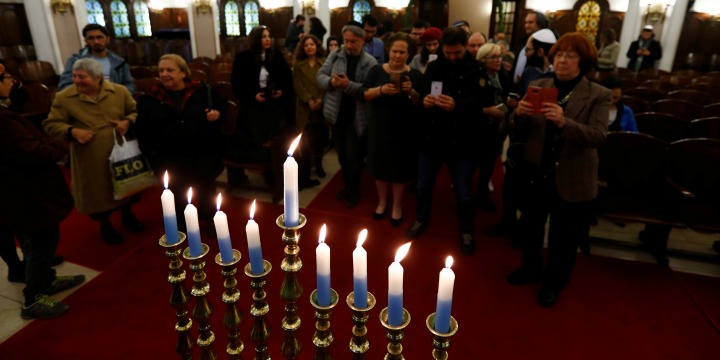
Members of Turkey’s Jewish community and visitors gather around a Hanukkah menorah during a celebration of the Jewish holiday of Hanukkah at Neve Shalom Synagogue in Istanbul, Turkey, Dec. 19, 2017. Photo: Reuters / Murad Sezer.
Ahead of this year’s celebration of Hanukkah, here are eight important facts about the holiday:
1. Hanukkah is the only Jewish holiday that commemorates an ancient national liberation struggle in the Land of Israel, unlike Passover, Sukkot/Tabernacles, and Shavuot/Pentecost, which commemorate the liberation from slavery in Egypt to independence in the land of Israel, and unlike Purim, which commemorates liberation from a Persian attempt to annihilate the Jewish people of Persia.
2. According to an NBC news report on December 13, 2022, “An ancient treasure trove of silver coins dating back 2,200 years, found in a desert cave in Israel, could add crucial new evidence to support a story of Jewish rebellion …. The 15 silver coins were hidden [during] the Maccabean revolt from 167-160 B.C., when Jewish warriors rebelled against the Seleucid [Syrian] Empire….”
3. In 1777, Hanukkah candles were lit by a Jewish soldier, during the Valley Forge encampment, the turning point of the Revolutionary War. Benjamin Rush, a signer of the Declaration of Independence and a player in the ratification of the US Constitution, wrote: “What shining examples of patriotism do we behold in Joshua, Samuel, the Maccabees and the illustrious princes and prophets among the Jews…”
4. According to Israel’s Founding Father, David Ben-Gurion: Hanukkah commemorates “the struggle of the Maccabees, which was one of the most dramatic clashes of civilizations in human history, not merely a political-military struggle against foreign oppression. … Unlike many peoples, the meager Jewish people did not assimilate. The Jewish people prevailed, won, sustained and enhanced their independence and unique civilization. … It was the spirit of the people, rather than the establishment, which enabled the Hasmoneans to overcome one of the most magnificent spiritual, political and military challenges in Jewish history…” (Uniqueness and Destiny, pp 20-22)
5. When ordered by Emperor Antiochus IV Epiphanes of the Seleucid region to end the Jewish “occupation” of Jerusalem, Jaffa, Gaza, Gezer, and Akron, Shimon the Maccabee responded: “We have not occupied a foreign land. … We have liberated the land of our forefathers from foreign occupation (Book of Maccabees A: 15:33).”
Hanukkah highlights the centrality of the Land of Israel in the formation of Judaism and the Jewish people. The mountain ridges of Judea and Southern Samaria (the West Bank) — the cradle of Jewish history, religion, culture and language — were the platform for the Maccabean military battles.
6. Hanukkah’s historical context is narrated in the Four Books of the Maccabees, The Scroll of Antiochus, and The Wars of the Jews.
In 323 BCE, following the death of Alexander the Great (Alexander III, who held Judaism in high esteem), the Greek Empire was split into three independent and rival mini-empires: Greece, Seleucid/Syria, and Ptolemaic/Egypt.
In 175 BCE, the Seleucid/Syrian Emperor Antiochus (IV) Epiphanes claimed the Land of Israel. He suspected that the Jews were allies of his Ptolemaic/Egyptian enemy. The Seleucid emperor was known for eccentric behavior, hence his name, Epiphanes, which means “divine manifestation.” He aimed to exterminate Judaism and convert Jews to Hellenism. In 169 BCE, he devastated Jerusalem, attempting to decimate the Jewish population, and outlaw the practice of Judaism.
In 166/7 BCE, a Jewish rebellion was led by the non-establishment Hasmonean (Maccabee) family from the rural town of Modi’in, half-way between Jerusalem and the Mediterranean. The rebellion was led by the head of the family and his five sons, Yochanan, Judah, Shimon, Yonatan, and Eleazar, who fought the Seleucid occupier and restored Jewish independence. The Hasmonean dynasty was replete with external and internal wars and lasted until 37 BCE, when Herod the Great (a proxy of Rome) defeated Antigonus II Mattathias.
7. As was prophesized by the Prophet Hagai in 520 BCE, the re-inauguration of the Temple took place on the 25th day of the Jewish month of Kislev, which is the month of miracles, such as the post-flood appearance of Noah’s rainbow, the completion of the construction of the Holy Ark by Moses, the laying of the foundations of the Second Temple by Nehemiah, etc. The 25th Hebrew word in Genesis is “light,” and the 25th stop during the Exodus was Hashmona (the same Hebrew spelling as Hasmonean-Maccabees).
8. Hanukkah highlights the defeat of darkness, forgetfulness, disbelief, and pessimism, and the victory of light, commemoration, faith, defiance of odds, can-do mentality, and optimism. The first day of Hanukkah is celebrated when daylight hours are equal to darkness hours — and when moonlight is hardly noticed — ushering in brighter days.
The author is a commentator and former Israeli ambassador.
Uncategorized
Talarico blames Netanyahu, not the Israeli people, for devastation in Gaza
(JTA) — James Talarico, Texas’ Democratic nominee for the U.S. Senate, said he holds Prime Minister Benjamin Netanyahu, rather than the Israeli people, responsible for civilian devastation in Gaza.
Talarico, a Texas state representative, is running neck and neck against Republican Attorney General Ken Paxton, in a race whose results could affect which party controls the Senate this November. Israel has been one of many sources of disagreement among the candidates, who have sparred on issues ranging from affordability to immigration to reproductive rights.
“I believe that Israel, like any nation, has a right to defend its people,” the candidate said while fielding questions on Wednesday at a CNN town hall. “But I don’t believe that Benjamin Netanyahu has a right to wage war against civilians or use collective punishment or restrict aid to civilians.”
A Texas Politics Project poll, issued by the University of Texas this week, showed Paxton trailing Talarico by 3 percentage points, with 47% to the Democrat’s 50% and a margin of error of 3.34 percentage points.
Talarico said in August that he supported stopping arms sales to the Netanyahu government and conditioning military aid “on ending the death and the destruction in Gaza and the West Bank.” He declined to call the crisis “genocide,” noting that the term is being litigated in the International Court of Justice. But he said he’d “use every bit of our nation’s diplomatic and financial leverage to protect the lives of Palestinians.”
When he was pressed further by Rabbi Holly Levin Cohn of Congregation Beth El Binah in Dallas during the town hall, Talarico stressed the importance of directing his criticisms “toward Prime Minister Benjamin Netanyahu and not the Israeli people.”
Addressing Israelis’ trauma, Talarico acknowledged that the Oct. 7, 2023, Hamas attack on Israel “was the deadliest day for the Jewish people since the Holocaust.”
Cohn pushed back on his comments regarding aid restrictions, noting Israeli support of humanitarian efforts and arguing that there’s much more going on in the country than the media may be projecting.
Talarico told the rabbi he recognized that his “words carry weight” and gave her his word that he’s “going to continue to listen to all sides of this conflict.” He also expressed hope that “we can all come together to fight for a two-state solution where we have security for Israel and we have freedom and self-determination for Palestinians.”
Talarico also gave a “shoutout” to a local rabbi, Neil Blumofe at Congregation Agudas Achim in Austin. “I spent my first year of my seminary studies learning the Hebrew scriptures from a local rabbi,” he said. “Shout out Rabbi Neil Blumofe!” Cohn grinned.
The post Talarico blames Netanyahu, not the Israeli people, for devastation in Gaza appeared first on The Forward.
Uncategorized
Irish Jewish leader ‘shocked’ after hotel cancels over 70 rooms for antisemitism conference
(JTA) — DUBLIN — An Irish Jewish leader said a Dublin hotel canceled rooms reserved for European delegates after learning that they were visiting for an antisemitism conference.
Maurice Cohen, the president of the Jewish Representative Council of Ireland, said he booked over 70 rooms at the Herbert Park Hotel for people attending a meeting of the Special Envoys and Coordinators Combating Antisemitism (SECCA).
The envoys, who included Jewish community leaders, diplomats and government ministers from across Europe, were invited to the conference this week organized by the World Jewish Congress and the European Commission. The event was tied to Ireland’s Presidency of the Council of the European Union, which rotates between EU member states, and included delegates meeting with Irish Prime Minister Micheál Martin. Most of the government-appointed special envoys are not themselves Jewish.
Cohen said he met with Herbert Park Hotel’s general manager in May to inspect its conference rooms and explained the purpose of the event. According to Cohen, the manager responded by asking, “Will the IDF be involved?”
That question “shocked” Cohen, he told the Jewish Telegraphic Agency.
“I said, this is about antisemitism. It’s not about Israelis, it’s not about Israel, it’s not about the IDF,” he said.
Cohen said the manager told him she had to consult with the hotel owners to determine if his booking could be accepted. The next day, he learned that the rooms were canceled without explanation. The Herbert Park Hotel did not respond to JTA requests for comment.
Cohen booked rooms for the delegates and the conference at different hotels. He described the cancellation in a speech at the SECCA meeting on Tuesday, calling it an example of “contemporary antisemitism.”
“How quickly does the word ‘Jewish’ change a conversation?” he said to the attendees. “How easily does a gathering about antisemitism become associated with the Israeli army? And how quickly can people who were welcome when they were simply 70 hotel guests become something rather different once they are known to be attending a Jewish conference?”
Yoni Wieder, Ireland’s chief rabbi, suggested that the hotel could have based its decision on fears of controversy.
“It’s possible that whoever took the decision had no objection to the conference itself,” Wieder told JTA. “They may simply have wanted to avoid the possibility of protests outside the hotel or some other backlash.”
Ireland’s government has been sharply critical of Israel. The country has recognized Palestinian statehood, barred Israeli far-right ministers from entering its borders and in July passed a law that banned imports from Israeli settlements in the Palestinian territories. Martin has said that Israel committed genocide in Gaza, a charge Israel vigorously rejects. He has also condemned rising antisemitism in Ireland, which is home to about 2,200 Jews.
Herbert Park Hotel is “actually quite familiar with Jewish guests,” according to Wieder, who said that he has overseen kosher catering at the hotel.
Cohen, who has lived in Dublin all his life, said he had fond memories of the hotel. For years it was his favored site for meetings, New Year’s Eve celebrations and his mother’s birthdays through her 93rd.
“Over time the hotel became associated in my mind with friendship, celebration and my mother,” he said in his speech. “So it was strange that, many years later, the same hotel would acquire a very different place in my memory.”
The post Irish Jewish leader ‘shocked’ after hotel cancels over 70 rooms for antisemitism conference appeared first on The Forward.
Uncategorized
Whatever you think of Ilhan Omar, these threats are unconscionable

The Trump administration is reportedly planning to build a case to strip Congresswoman Ilhan Omar (D-MN) of her citizenship and eventually deport her.
It is my hope that American Jews — even those who do not like Omar and can recite every questionable comment she has made over the past 15 years to illustrate why — will understand this as offensive and outrageous not only because they are Americans, but because they are Jews.
The Trump administration may claim that it is building a case against Omar due to paperwork (reports suggest that they are interested in whether her father listed her age as 17 on her citizenship application when she was really 18). It is similarly filing dozens of lawsuits attempting to denaturalize citizens by trying to prove they lied in the process of gaining citizenship. However, that this is happening now, ahead of the midterm elections against a sitting member of Congress, a high-profile progressive whom the president has said should “go back” to her country of origin, suggests that it is, to put it mildly, politically motivated.

Evidently, the Trump administration sees citizenship not as a right or a responsibility but as a reward, one that can be taken away if that is seen as useful to the president and his adherents. That use could be silencing political opposition or something as simple (and callous) as an opportunity to brag about the sheer number of attempted denaturalizations.
Jews, too, have found themselves on the wrong end of political denaturalization. I do not mean to compare the Trump administration to the Nazis, but the stubborn fact is that Jews were indeed stripped of their citizenship as part of a political project in Germany and elsewhere in Europe in the 1930s and 40s. And in the early 20th century in the United States, it was Jews who politicians claimed were incapable of assimilating, of ever really being a part of the United States. These arguments culminated in legislation that kept out Jews who could have found refuge here. The threat of denaturalization and the experience of perpetual otherness is a grievous part of modern Jewish history; we should be offended by its presence in our political present.
Jewish tradition as well as history encourages us to stand up to authority when that authority is wrong. Mordecai refuses to bow to Haman; Nathan yells at King David for sleeping with Bathsheba and having her husband killed; Moses famously urges Pharoah to change his oppressive ways. Even God is on the receiving end of pushback when Abraham pleads and negotiates to spare Sodom.
I do not think one needs to be Jewish to be outraged by the attempt to denaturalize Ilhan Omar. I think it is also bone-chilling as an American who believes we, including our elected officials, have the right to openly oppose our president, and I am worried as a person who thinks it would be good to continue to live in a democratic republic. And I am sure that there are Jews who will say that Omar deserves to lose her citizenship because she has said things about Israel they do not like.
But the Jewish lens through which I see this is that it is right to challenge power when it is abused, and it is wrong for the powerful to make a show of trying to cast their opponents out of the country.
The point is not whether Trump can make good on the threat to strip Omar of her citizenship and deport her, but that it is obscene to use denaturalization as punishment for being a high-profile political opponent in the first place. If he is trying to make it more dangerous to speak out while being from the “wrong” country, then the rest of us need to say that this is a fundamental misunderstanding of what it means to be an American citizen.
We should do this because we are Americans and we should do this because we are Jews. We should do this because of the ways in which our American and Jewish identities bleed into one another. And, we should do this because we may not know exactly whether it is as Americans or as Jews that we know we have to protect the right to speak truth to power, but we know we need to do it all the same.
The post Whatever you think of Ilhan Omar, these threats are unconscionable appeared first on The Forward.
