



Uncategorized
After my dad died, I discovered a lost history of Iranian Jews in the US
I was a freshman in college when my dad died. An Iranian Jew who came to the United States four years before the Islamic Revolution to study at the University of Missouri, he went both by Farzad and by his Hebrew name, David. Eventually, he became a traveling jeweler — or, as he put it, a “merchant,” a word evoking an image of independence, shrewdness and valor on the Silk Road. After each business trip, he’d return home with stories of how nice people were in Raleigh, how cold it was in Minneapolis, and how beautiful the Florida Keys were.
Growing up in an Iranian Jewish community in Great Neck, a suburb on the North Shore of Long Island, I had spent my life mostly surrounded by people just like me, and rarely ever boarded a plane. The contrast between my dad’s cosmopolitanism and my provincialism mirrored another contrast, between his capability and my incapability. These differences made me distrust and worship him.
I knew my dad was getting older. The pace of his hair growth had slowed down, making his insistence on monthly haircuts a regular source of ridicule. But he was only 62; he wasn’t supposed to die. In 2019, he had a fatal heart attack on a flight to Key West — while he was in the air.
It seemed fitting that he — a cosmopolitan who had always seemed separate from the rest of my more provincial family — would die several hundred miles away from where we all lived. In the wake of his death, my desire to better understand his life led me to discover a forgotten chapter of Iranian Jewish history.
My community’s identity, like all identities, reflects a series of choices we’ve made about which parts of our experiences we wish to keep, and which we wish to throw away in the name of self-preservation. But despite our better efforts, the things we try to discard tend to remain with us, sometimes without us even knowing it.
Roots in Mashhad
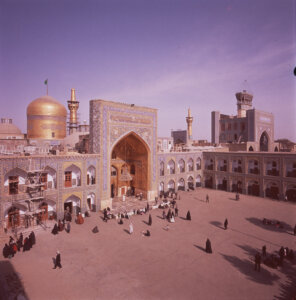
My Iranian Jewish community traces its roots back to Mashhad, a city in northeastern Iran. In 1839, a mob of Muslim Mashadis raided the Jewish ghetto and killed more than 30 people. They seized and married Jewish women, selling others into slavery. Some Jews converted to Islam to escape death; others fled the country.
My ancestors appeared to convert to Islam. But community lore goes that when no one was watching, they wore tiny tefillin, prayed in basements and kept kosher as best they could. On Saturdays, Jewish shopkeepers kept their stores open so as not to be seen keeping Shabbat — but jacked up prices so high no one would buy anything. Jewish parents arranged their children’s engagements at young ages, so that if a non-Jew came requesting their daughter’s hand in marriage, they could honestly say she was taken.

Decades later, under a new government, my ancestors slowly began practicing Judaism openly again. In the mid-20th century, my grandparents and other Mashadi Jews left the city and moved to Iran’s capital, Tehran. But they remained insular. In Tehran’s much larger Jewish community, Mashadis separated themselves, praying in Mashadi synagogues and marrying fellow Mashadis.
They did the same in the U.S., where they first settled in Queens, then later helped form the ethnic enclave where I grew up.
As a child, I learned that being Mashadi made me different from all the other Iranian Jews in Great Neck, whom we called Tehrani even though many of their families came from other cities. So, when I learned that my parents were actually born in Tehran, I was scandalized. If my parents came from Tehran, didn’t that make us Tehrani?
“Why are we Mashadi?” I asked my dad one night, a year before he died: Why was I defined by this city, and not the other Iranian cities where my ancestors lived? Why weren’t we just Iranian?
Unable to explain, my dad laughed off the question. But I know now why Mashadis are Mashadi. It’s because pretending to be Muslim while secretly continuing to practice Judaism was a defining experience, one that taught my ancestors ugly ways to survive.
“To omr-e mani,” my dad would tell me in Farsi, in lieu of a simple “I love you.” Translation: “You are my life.” He always had a flair for hyperbole. And though he didn’t intend it this way, my teenage brain twisted his words to mean: “It will kill me if you aren’t a good Mashadi girl.”
Going to Missouri
When I was little, my mom told me a version of the Mashadi immigration story that matched her own experience: It began in Tehran and ended in Forest Hills, Queens. But when my dad died, I became more invested in piecing together the parts of his life that my mom’s story didn’t capture.

I got his yearbook and attendance records from the University of Missouri; obtained his immigration records from the U.S. Citizenship and Immigration Services; pored over more than 100 old newspapers, magazines and other archival documents; read academic articles and history books; and spoke to about a dozen people who I thought might have relevant intel, including extended family members, scholars and people who attended or worked at my dad’s college.
Arriving in 1974, my dad was one of tens of thousands of Iranians who came to the U.S. in the 1960s and 1970s for college. In Iran, as in other major oil-exporting countries, economic development had led to increasing demand for skilled workers — but there weren’t enough colleges to meet this demand. So the Iranian government gave scholarships to students studying abroad.
Determined to develop allies during the Cold War, the U.S. government doled out scholarships, too. The idea was that students in Iran’s expanding middle class could study engineering in the U.S., then bring that expertise back to their home country, which needed it.
Many of these college students, seeking a lower cost of living, wound up in the Midwest. Plus, in the logic of a tight-knit ethnic community, where one person goes, others follow.
My dad followed a small group of Mashadi men to the University of Missouri in Columbia. His older brother, Behzad, had gone there for graduate school and still lived nearby. In Tehran, both he and my dad had attended an elite boys’ prep school called Alborz, named for the mountain range that stretches along the coast of the Caspian Sea. Historically run by American Christian missionaries, Alborz was considered the best high school in Iran, and American colleges knew it. Plus, if my dad’s kitchen-table bragging is to be believed, he was among Alborz’s top students in math.
Protest and persecution
By the time my dad arrived in Missouri, the tensions that would give way to the Islamic Revolution in 1979 had already emerged. Many Iranians protested the country’s then-leader, Shah Mohammad Reza Pahlavi, over restrictions he placed on democratic institutions, torture against political opponents under his leadership, and his significant expansion of the military.
The Iranian community in the U.S. — then disproportionately composed of college students — leaned into the opportunity this country gave them to express themselves politically. Articles from the Columbia Missourian, once my dad’s local paper, show that at one point in the mid-’70s, anti-Shah protests took place at least once a month at local colleges.

The protesters were embracing an American freedom: The Iranian secret police couldn’t get them, at least not while they were in the U.S. But American authorities had issues of their own.
In October 1975, police maced then arrested protesters at an anti-Shah rally at Lincoln University in Missouri. The protesters were denied food and prevented from calling lawyers because, a spokesperson for the Iranian Students Association said, “they were foreigners and had no rights.” The mayor sent the student-protesters’ names and photos to the Shah, even though students said that could get them executed or imprisoned for life.
At the University of Missouri, letters to the editor in the student newspaper, as well as classified ads, called for Iranian students to go back to where they came from. Graffiti on bathroom walls spread a similar message. Some people simply told their Iranian classmates face-to-face to return to the very place whose government they were protesting.
Many Iranian Jewish students liked the Shah, because he believed in secular government and undertook westernizing reforms. But 2,500 years of living as a minority had taught them to keep quiet. “Normally, Jews would stay out of politics,” mom’s brother Bahram, who studied in the Midwest beginning in 1969, told me. “If you were pro-Shah, you had a lot of students against you. If you were against, you had the embassy that would come after you.”
Two people I interviewed — Bahram and one of my dad’s cousins — both said something I can envision my dad also saying: that being Jewish protected them from anti-Iranian hostility on campus.
My dad’s cousin Sohrab, who went to New York’s Queens College, said that when encountering potentially hostile people, he made sure to emphasize being Jewish. “We feel like somebody’s uncomfortable, we made sure we told them first, ‘I am Jewish. I ran away from Iran,’” Sohrab said.
“We are first Jewish, then Iranian.”
What my dad and I never talked about
When my dad was 22, and a senior at the University of Missouri, his native country erupted into violence.
More than 40 years after the revolution, I sat in my college dorm, reading back issues of the Columbia Missourian, imagining my dad as a young, longish-haired man following the news from afar.
December 1978: “2 million protesters hit Tehran.” February 1979: “10,000 dead in Iran’s crisis.” March: “Firing squads execute 13 in Iran.” As the revolution took place, so did frequent earthquakes, which also claimed thousands of lives.
The college students who’d risked it all in order to advocate against the Shah seemingly got their way when he fled Iran in January 1979. But they were blindsided by the zealotry of the man who took his place: Ayatollah Ruhollah Khomeini, a Shi’ite Muslim cleric who established an Islamic theocracy. He offered a foil to Pahlavi’s friendliness with the West by preaching against the U.S., Israel and imperialism.
After the revolution, the new government tried to assure Iranian Jews that they’d be safe, yet some were executed on trumped-up charges of spying for Israel. My dad’s parents were quick enough to leave by air, landing in Queens. Those who waited too long to emigrate had to pay smugglers to help them over mountainous borders.
When the Mashadi community followed in the footsteps of its sons and immigrated en masse to the U.S., American-educated Mashadi men — now in their 20s and 30s — became informal secretaries, translators, immigration consultants, financial advisors, business consultants, and advocates for higher education, for their own families and for the wider community.
Despite what Sohrab said, de-emphasizing their Iranian origins didn’t always protect the new immigrants from bigotry. Mohsen Mobasher, an anthropologist at the University of Houston-Downtown, told me that because of anti-Iranian hostility that later grew rampant, “some Iranians developed deep feelings of anxiety, suspicion, insecurity and inferiority.”
Once, I asked my dad whether he ever experienced antisemitism or anti-Iranian hostility. He let out a hearty laugh, as though it was ridiculous for me to imagine that he had.
If the question was ridiculous, it was only because I asked it so casually; just as I might ask him to do my laundry or cut me a pineapple. It was as if I’d asked him to synthesize his whole experience of identity into some set of words that might satisfy me. My dad did not see fit to tell me, a girl he was charged with protecting, about times in his life when he may have felt small.
Singled out by the federal government
In November 1979, months after my dad graduated, a group of Iranian militant college students took over the U.S. embassy in Tehran and held 66 Americans hostage. The hostage crisis gave way to unprecedented levels of anti-Iranian sentiment in the U.S., and the animus fell hardest on college students. Members of Congress introduced resolutions calling for all Iranian students to be deported. At Mizzou, one professor announced that he would no longer advise Iranian students.

On Nov. 10, President Jimmy Carter ordered immigration checks on all Iranian college students in the U.S., saying that anyone found to be violating the terms of their student visa would be deported. More than 200 Mizzou students were told to report to an immigration office in Kansas City. To some of these students, the visa checks felt wrong, and they refused to participate.
“I would feel like a criminal,” an Iranian student who did not report told the Missourian.
“This is discrimination — singling out one nationality and investigating them,” said another, who also refused to participate in the check.
By this time, my dad had moved to St. Louis, where he was working for the chemical manufacturer Olin Corporation. But he still had to report for the visa checks. He had a visa for students and recent graduates who were gaining practical training in their field of study. In December, he received a frantic letter from Carl Leistner, the international student program coordinator at Mizzou, telling him to report to Kansas City the following week.
“I regret this delayed notice,” Leistner wrote in the letter. “However, we simply overlooked our practical training students in the rush associated with the registration of our 258 currently enrolled students from Iran.”
My dad traveled more than 200 miles for his interview, but when he arrived, he was sent home. A federal judge had ruled the visa checks were unconstitutional. If that ruling was overturned, my father was told, he might have to come back for an interview later.
Back on the Mizzou campus, some 600 students held a protest where some students advocated “deporting all Iranians from the United States.” “Deport, deport,” the crowd chanted at one point.
By being away from campus, my dad managed to evade these sorts of protests, plus other horrors that befell his collegiate counterparts. Abe Manzour, an Iranian American Jew who was my dad’s classmate at the University of Missouri, was still earning his degree.
“Sometimes, we were scared to go outside,” Abe told me over Zoom in 2021. “I almost got beat up by some guys on the street because they knew I was Iranian.”
Scared to go outside? Almost got beat up? Despite everything I had already read about anti-Iranian hostility, I was still surprised. What Abe was describing seemed a world apart from tales my dad used to tell — stories of beer, women and football games, which would’ve taken place just months beforehand.
“My dad always talked about his time in college,” I said. “He made it sound like the best thing ever.”
“For me it was, too,” Abe said.
A conservative enclave
Growing up in Great Neck, I lived a life very different from my dad’s. Our suburb was full of Iranian Jews, and until I was 18, I rarely ever left it. He was worldly; I was provincial, and in my senior year of high school, as I applied for college, I could no longer contain my jealousy.
“Can I apply to UC Berkeley?” I asked him one Sunday afternoon during my senior year, while he was making “early-bird breakfast.” I knew he’d say no, but wanted to see him squirm.
“I don’t see! I don’t see!”
“Dad!”
“Bache nazaideem ke befresteemesh Ca-lee-forn-yaw!” — “We didn’t have a child so that we could ship her off to California!”

“I know two people who sent their son to college on a different continent!”
“That was over 10 years ago!” At 61, my dad enjoyed describing events of his youth as having taken place “over 10 years ago.”
I never applied to Berkeley; instead, I stayed close to home and went to CUNY Hunter College in Manhattan. For better or worse, my life would be different from my dad’s, in ways that were tied up with the increasingly conservative nature of our community.
In Tehran, Mashadi Jews lived scattered around the city. In Great Neck, Mashadis are neighbors and attend a set of synagogues all within a mile of each other. And many Mashadi Jews in Great Neck have become more religious than their ancestors in Tehran were.
When most people think of assimilation, they envision people becoming more secular and better educated. But most Jewish people in Great Neck — Mashadi and otherwise — have assimilated into a different yet equally compelling idea of America, one that emphasizes religious freedom over other aspects of American culture.

In the Midwest, Mashadi men learned the valuable lesson that Abe Manzour expressed: that it’s possible to experience happiness and personal growth in the midst of a hostile environment. Years later, when they moved to Great Neck, their environment rendered that wisdom useless, like a vestigial organ at risk of evolutionary disappearance.
To the men who’d left Iran to study abroad, we, their children, must have at times seemed narrow-minded and irredeemably young. Especially when I think about my dad’s life, I sometimes resent that I wasn’t allowed to go to California and feel embarrassed to have attended a commuter school.
What made me want to study his life was a binary I imagined between him — worldly — and me — ignorant. But actually, I don’t really believe that a binary between cosmopolitanism and provincialism captures the nuances entailed in our father-daughter relationship. And I don’t believe that being poorly traveled is the same as being ignorant.
Regardless of where one lives or visits, there are many different ways to be ignorant, and many different ways to learn something new.
The post After my dad died, I discovered a lost history of Iranian Jews in the US appeared first on The Forward.
Uncategorized
The Jewish community accepts interfaith families in principle — but it doesn’t look that way in practice
There is a photograph from my wedding that I think about more than any other. My wife Donna and I are standing under a chuppah. But we are not in a synagogue. Or even on a beach. We are in the beautifully ornate St. Matthew’s Cathedral in Washington, D.C. — the same church where John F. Kennedy’s funeral Mass was held.
Donna is Catholic. I am Jewish. The ceremony, which took place a little more than 20 years ago, was co-officiated by a rabbi and a priest. Before we exchanged vows, we signed a ketubah — the Jewish marriage contract — on the altar, beneath the Cathedral’s great mosaic of St. Matthew, the apostle who was himself a tax collector before he was called to follow Jesus: a man of two worlds, presiding over our union with what I have chosen to interpret as equanimity.
We like to call it a “Ḥuppah in the Ḥurch.” The guttural Hebrew Ḥet — the sound that “chuppah” and “church” share when English speakers say them — makes the joke land differently out loud than it does on the page. But the feeling it captures is real: that the most Jewish act of my adult life happened inside a Catholic cathedral, and that this was not a contradiction; it was the whole point.
I did not fully understand, at the time, what that photograph meant. I understand it better now, with one child who stood on a bimah at our synagogue to become b’nei mitzvah in 2024, and a second who followed this October. The earlier wedding chuppah at St. Matthew’s was not a compromise. It was a declaration of intent of how we would define our family.
According to the 2025 Greater Boston Jewish Community Study — a comprehensive survey of Jewish communal life commissioned by Combined Jewish Philanthropies and released earlier this year — only 23% of children ages 14-17 from interfaith families have a bar or bat mitzvah, compared to 82% of children from families where both parents are Jewish. That gap — 59 points — is not a rounding error. It is a chasm. I believe it measures less a failure of Jewish identity than a failure of Jewish institutions.
The Boston study found that 65% of Jewish households with children in the greater Boston area are interfaith — a majority. Nationally, the 2020 Pew Research Center survey found that 42% of married American Jews were married to a non-Jewish spouse, with that number rising among younger and non-Orthodox Jews. Interfaith families are not an edge case in American Jewish life. They are the center of it.
Jodi Bromberg, who led 18Doors — a nonprofit dedicated to supporting interfaith families in Jewish life — for a decade before stepping down in 2024, put it bluntly: Interfaith families “aren’t a drop in the ocean. We are the ocean.” The irony is that 18Doors itself has since become a casualty of the communal prioritization it was warning against. After Oct. 7, 2023, donors shifted their giving toward Israel and antisemitism-related causes; earlier this year, according to JTA, 18Doors slashed its staff from 15 to four. Bromberg left asking: “The question it left in the minds of families like mine: whose priority are mixed heritage and interfaith families in Jewish life?”
The Jewish community has largely supported welcoming interfaith families. The language has shifted — from “intermarriage” as problem to “interfaith family” as constituency. What has not yet shifted, in too many places, is what actually happens when those families show up.
My family showed up. What happened to us is a complicated story about what Jewish continuity actually costs — and who is being asked to pay for it.
The first wall we encountered was not unwelcoming people. It was doctrine.
Matrilineal descent — the principle that Jewish identity passes through the mother — is not stated plainly in the written Torah. The rule was codified by the early rabbis, likely in the first or second century CE, and yet it functions today, in Conservative and Orthodox congregations, as a theological absolute — a sorting mechanism that places children of Jewish fathers and non-Jewish mothers in a separate category, recognized as fully Jewish by Reform and Reconstructionist movements but not by much of the rest of the Jewish world.
I grew up in a Reform congregation, but in my twenties I spent time studying at Aish HaTorah in Jerusalem — an Orthodox yeshiva — and came home with a deeper appreciation for traditional observance. When Donna and I started a family, I was drawn toward a more traditional congregation. What I found, at more than one Conservative synagogue, was that my daughters — daughters of a Jewish father and a devoted, deeply engaged Catholic mother — would need to convert to be considered fully Jewish. The synagogue said it would accept our family. But our daughters would need to be processed.
This is not outright rejection. It is something subtler: the message that your children’s belonging is conditional, something to be granted rather than inherited. You are welcome, but the rest of your family is a question we haven’t resolved yet.
I almost let it win.
Our older child started Hebrew school at a large synagogue in northern Virginia and came home crying. The environment was harsh; she was behind and everyone knew it. After several months, she asked us if she could stop. The pandemic arrived, and we let it make the decision for us.
When restrictions lifted, we found a congregation in Arlington that had built a hybrid model during the pandemic — Sunday morning religious school in person, Hebrew instruction via individual Zoom sessions during the week. What looked like an emergency accommodation turned out to be an unintended innovation: a model that removed the social pressure of being seen to struggle. Away from the eyes of their peers, our child learned and caught up. In February 2024, they led their own bat mitzvah service, then started a Jewish student cohort at their school.
What saved their Jewish education was not ideological commitment. It was an accident of pandemic logistics. That is a fragile kind of salvation. Most interfaith families do not find it. The data says so.
There is something the data does not capture: what the work actually looks like inside an interfaith home. Donna agreed, before the Ḥuppah at St. Matthew’s, to raise our children in the Jewish tradition, and she has kept that agreement with a fidelity that still catches me off guard. She runs our Jewish household calendar, ensures the girls study their Hebrew and Torah portions, has made raisin kugel and matzo ball soup from scratch, and has shown up for every bat mitzvah preparation meeting — all as a Catholic woman who continues to practice her own faith and has not surrendered anything of herself to make room for ours.
Meanwhile, I string the outdoor Christmas lights every year, drove the girls to Catholic Sunday school for years, gave Donna a diamond cross necklace early in our relationship that she still wears today. An interfaith marriage requires not one partner’s sacrifice and the other’s gratitude, but a genuine doubling of belonging.
When I asked Donna what the harder moments were, she said they were not in our own home. They were in other people’s institutional spaces — the moments when she felt regarded as a problem to be managed rather than a parent to be welcomed. The 23% is often read as a story about interfaith families failing to commit. It is at least as much a story about Jewish institutions failing to make the non-Jewish partner feel that her commitment matters.
My younger daughter stood on the bimah on Oct. 3. She is a different person than her older sibling— a social butterfly with her own questions, her own relationship to what this all means — and she was honest with me about those questions in ways that required me to listen rather than answer. She completed her bat mitzvah not because she had resolved those questions, but because she made a commitment and she was going to honor it. There is something deeply, if unintentionally, Jewish about that: a covenant is not a feeling, it is a promise kept because you said you would keep it.
She was in the 23%. She almost wasn’t.
The fear behind the continuity crisis narrative has been used to justify exclusion, to draw lines, to send signals to interfaith families about whether they truly belong. Those signals are self-fulfilling. The families who make it to the bimah found an institution that treated them as members rather than complications, had a non-Jewish partner committed enough to keep showing up anyway, and got lucky with a workaround that happened to be exactly what their child needed. That is too much to ask, and too random a path to count on.
The Jewish community has accepted interfaith families in principle. The 23% tells you what that acceptance looks like in practice. If the number is going to change, something structural has to change with it — not just the language of welcome, but the architecture of it. Not just the open door, but what’s waiting on the other side.
My daughter chanted her Torah portion with her Catholic mother who was on the bimah behind her, and her older sister in the front row, wearing a cross and a Star of David together because she has decided there is no reason she cannot wear both.
If we truly believe interfaith families are the future of American Judaism, what do we owe the 77% who never made it to the bimah?
The post The Jewish community accepts interfaith families in principle — but it doesn’t look that way in practice appeared first on The Forward.
Uncategorized
Trump’s empire is crumbling, much like the Berlin Wall in 1989
As a foreign correspondent during the Cold War, I witnessed and reported on the collapse of East Germany’s corrupt communist state. Nearly four decades later, I feel a sense of déjà vu as I watch Donald Trump’s corrupt MAGA regime crumble at an accelerating pace.
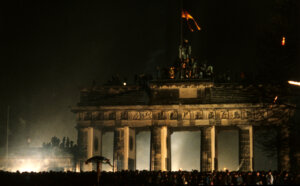
German social media influencers and national news platforms have been posting videos of American mid-term election scenes that remind me of the night the Berlin Wall cracked open in 1989 — dancing in the streets, strangers hugging, laughter spilling out of Democratic watch parties, tears of relief and disbelief.
In Austin, Texas, Sally Lisa Starken, a German journalist and influencer, stood amid a roaring crowd of James Talarico supporters when the Democrat was declared the victor over Ken Paxton. Lifting her phone to capture the eruption for her Instagram followers, Starken looked just as stunned and jubilant as the sea of people surrounding her,.
For a moment, Austin was Berlin.
“Texas is turning blue! This is insane!” Starken said in her live post. A follower back in Germany wrote: “Yeah! Fantastic! Thank you for this wonderful news this morning!” Another added: “The USA has woken up!!! Hopefully that will soon happen here.”
Since Trump’s second inauguration, his autocratic style of governing has carried echoes of the Third Reich. And now, as the politically wounded American president enters the last half of his second term, his crumbling MAGA machine is looking like the corrupt Stalinist regime that ruled East Germany for four decades.

The opening of the Berlin Wall released East Germans from repression. While Trump has another two years to go as president, American voters rescued democracy by restoring Congress to its role as a check on overreaching executive power by rejecting Republican officeholders and candidates who had turned themselves into Trumpian marionettes.
Responding to citizen demands for accountability, German authorities after reunification pursued hundreds of cases against former East German officials, charging them with offenses that spanned the system’s spectrum of abuse — from the misuse of state resources to the killing of East Germans trying to flee to the West.
Corruption was endemic within the East German leadership. Senior officials, including Erich Honecker, lived in comfort inside a walled enclave at Wandlitz outside East Berlin and vacationed on the Baltic Sea in exclusive manor homes on Vilm, an island off limits to ordinary Germans. Luxury goods for the communist elite flowed through a secretive government agency called Commercial Coordination, which trafficked in Western technology, arms deals, and hard-currency diversions to Swiss accounts.
Few of the senior officials ended up paying for their misdeeds. Many were spared because of illness or frailty. Erich Honecker initially found refuge in Moscow but in 1992 was sent back to Germany to stand trial on charges of abuse of power and manslaughter for the killing of East Germans who tried to escape to the West. The case was abandoned because Honecker was seriously ill. He died of cancer in 1994 in Chile, where he had moved to reunite with his wife and his daughter.
As sensational as the proceedings against Honecker and his comrades were, they may well pale next to the scrutiny Donald Trump, his two oldest sons, his son-in-law, and their associates could face with Democrats now in control of Congress. After the GOP’s shellacking, Rep. Robert Garcia had two words for Trump administration officials linked to corruption and abuses of power: “Lawyer up.”
Garcia, a California Democrat who is in line to become the chair of the House Committee on Oversight and Government Reform, has outlined an aggressive agenda for investigating the Trumps and their political and business circles.
“If we’re really going to take on the affordability crisis, we’ve got to take on the corruption of the Trumps because they’re stealing people’s money, their labor,” Garcia told Punchbowl News.
Garcia said his top areas of focus include Trump family corruption, alleged abuses by ICE and the Department of Homeland Security, corporate misconduct, and cover-ups in the Jeffrey Epstein scandal.
Although Trump and his allies have done little to conceal their conflicts of interest, compelling testimony under oath would force them to confront conduct they have evaded accountability for throughout Trump’s second term. We can expect hearings on the $2.2 billion in wealth Trump has accumulated as president, Eric and Donald Trump Jr.’s shady business dealings and Jared Kushner’s financial relationships with Middle Eastern governments.
Congressional hearings on Trump’s massive immigration crackdown would have the potential to become a sort of American analog to the post-unification trials of senior East German officials, mid-level commanders, and border guards in the killing of East Germans who tried to flee to the West — scaling the Berlin Wall, sprinting across the death strip along the border, or attempting other desperate escapes.
Democrats will likely try to shine a light on decision-making processes that led up to foreign university students being swept off the streets by federal agents, traffic stops in which immigrants were violently pulled from their cars, masked agents terrorizing families during raids on immigrants’ homes, the warehousing of Latinos and others in detention centers with allegedly inhumane conditions, the spiriting away of detainees to African countries with which they have no connection, and brutal tactics of the kind that resulted in the deaths of Renee Good and Alex Pretti.
Among those likely to face subpoenas are top Trump aide Stephen Miller, the former Homeland Security secretary Kristi Noem and possibly Trump himself. Oversight hearings would force senior officials to explain, under oath, how these policies were conceived, approved and carried out — a public accounting that echoes, in form if not in historical circumstance, the post-reunification scrutiny faced by East German officials responsible for the lethal border regime.
What happens if all of this ends the way East Germany’s reckoning did — with months of public testimony, thousands of pages of evidence, and almost no real accountability? Trump retains broad pardon powers, and the Supreme Court has already granted him sweeping presidential immunity. As long as he remains in office, his Justice Department is unlikely to pursue anything Congress uncovers. The result could resemble the East German experience: a great airing-out of abuses, and perhaps a sense of moral clarity, but the central figures keeping the riches and advantages they have reaped during Donald Trump’s reign and escaping any real punishment.
Even so, such an airing-out would not be meaningless. It would stand as a warning that the vast corruption of Trump’s second term will never again be tolerated — and as a record of how close America came to losing the checks that make democracy possible.
.
The post Trump’s empire is crumbling, much like the Berlin Wall in 1989 appeared first on The Forward.
Uncategorized
Eisenkot moves closer to ousting Netanyahu. Here’s what could come next.
(JTA) — Yashar party leader Gadi Eisenkot leaped ahead of Prime Minister Benjamin Netanyahu this week in the effort to secure enough support from the rest of the parliament to form Israel’s next governing coalition. But that doesn’t mean he’ll succeed in his quest to become prime minister.
Yashar won the most seats – 21 – of any party not aligned with Netanyahu in last month’s vote. But neither the prime minister’s bloc nor the opposition garnered the 61-seat minimum needed to form a governing majority.
Israeli President Isaac Herzog on Sunday will announce who is being given the first shot at forming a coalition. By the end of this week, Eisenkot was able to announce that 67 parliamentarians had endorsed giving him the first chance to do so, compared to 46 for Netanyahu.
That means Herzog is all but certain to tap Eisenkot on Sunday to form a government – but Eisenkot’s path forward remains far from clear.
Eisenkot leads a bloc of four Zionist parties that make up Israel’s so-called change bloc, united by their stated goal of replacing Netanyahu. Together, they hold 48 seats in the incoming parliament, or Knesset, which means they need to enlist the support of parties whose seats total at least 13 to reach the magic number of 61 out of 120 Knesset seats. Or, they could gain a plurality if enough other parties abstain from voting in the new coalition.
Eisenkot has 28 days to negotiate that arrangement once given the opportunity, or mandate, to do so by Herzog, plus a 14-day extension if the president allows it. If Eisenkot fails, another candidate could get a shot at forming a coalition, or another round of elections might loom.
Sixty-seven lawmakers supported Herzog giving Eisenkot the mandate. But that’s different from voting for him to actually take power. Here are the paths he could take, and why each one is fraught.
An unlikely alliance?
The first option, which has gained traction in the days since the election, is to cooperate with the ultra-Orthodox parties. These parties have a longstanding alliance with Netanyahu but have served in governments with leaders in the center and left in the past.
There are several indications that such an arrangement may already be taking shape. For starters, United Torah Judaism, one of the two haredi Orthodox parties in the Knesset, told Herzog that it would not endorse either candidate for prime minister – seemingly breaking from the alliance with Netanyahu.
During the consultations with Herzog, the party’s leaders made clear that their support would go to whichever bloc was willing to make concessions on Haredi conscription, including abandoning sanctions against those who refuse to enlist.
If United Torah Judaism with its 7 seats shifts its support from Netanyahu’s coalition to the change bloc, Eisenkot could secure a plurality, provided the Arab parties at least abstain.
Another indication that such an arrangement may be in the works came from Avigdor Lieberman, leader of the Yisrael Beiteinu party and a member of the change bloc. For years, Lieberman has been best known in Israeli politics for his fierce opposition to the haredi parties.
In a stunning change of course, Lieberman signaled in a Friday post on X that he was open to cooperating with the haredi parties to replace Netanyahu — an arrangement that would have been almost unimaginable until recently.
“The election results require all of us to rethink our approach and recognize that there are no good alternatives or magic solutions before us,” Lieberman wrote. He said politicians would need to “show flexibility and make compromises,” including on the issue of haredi military conscription.
“Our national responsibility requires us to make difficult decisions and be prepared for painful compromises,” he added.
The other leaders of the change bloc have been considerably more vague, focusing on the need to replace Netanyahu without specifying how they intend to do so.
“In recent days, I have been advancing a plan with my partners to establish a national emergency government,” Eisenkot wrote on Friday of the four parties that comprise the opposition bloc coming out of the election.
“The logic behind it is to quickly swear in a government based on the four Zionist parties of change and renewal, with any party or Knesset member who agrees to my four basic principles joining immediately or gradually,” he explained. These principles include recognizing Israel as a Jewish and democratic state, accepting the values enshrined in Israel’s Declaration of Independence, mandatory military or civilian service, and recognizing Hamas as a terrorist organization.
But in the same post in which he announced his willingness to compromise with the haredi parties, Lieberman also introduced a potential obstacle that could derail the entire effort. The veteran politician ruled out supporting any minority government, raising the number of seats the change bloc needs to secure to 61. That would require the support of both haredi parties, United Torah Judaism and Shas, rather than just the former.
That is a considerably greater challenge. Shas is considered more right-wing than United Torah Judaism, and its leader, Aryeh Deri, has maintained an especially close relationship with Netanyahu for years. The party also endorsed Netanyahu for prime minister during the consultations. So far, there has been no indication that Shas intends to abandon him, casting serious doubt on the viability of a change-bloc government backed by the haredi parties.
And that is far from the only obstacle facing such an arrangement. One of the central themes of the change bloc’s election campaign was the need to enlist haredi men in the military and change the state’s longstanding approach to their exemption from service. One of the bloc’s strongest campaign arguments was Netanyahu’s unpopular alliance with the two haredi parties. Every leader in the bloc, without exception, pledged before the election not to sit with them in government.
Forming a government with the haredi parties, likely involving significant compromises on military conscription, would be seen by many change-bloc voters as a stunning betrayal.
The first signs of a revolt have already emerged within the bloc. Dan Illouz, an elected Knesset member from Lieberman’s party, wrote on Friday that “we cannot give up on a conscription law,” making clear that he would oppose compromises on the issue.
An unprecedented partnership?
Another scenario that could theoretically allow Eisenkot to form a government would be to rely on cooperation with another minority, the Arab parties — an arrangement that has long been controversial in Israeli politics. The 19 seats won by Ra’am and the Joint List, the two Arab parties in the bloc, could provide the additional support needed for a change bloc government.
Eisenkot would need active support from Ra’am, the more moderate of the two Arab parties, which previously joined the coalition that replaced Netanyahu in 2021 and has made integration into Israeli society a central part of its platform, alongside an abstention or support from outside the coalition, i.e. not actively joining the coalition, by the Joint List. The more hard-line Arab party has signaled its willingness to engage in unprecedented cooperation with the change bloc to bring down Netanyahu’s coalition.
But here, too, cooperation is far from straightforward, and the obstacles again come from within the change bloc itself.
In addition to ruling out support for a minority government, including one backed by Ra’am, Lieberman made clear that he would oppose any government relying on the Arab parties. “We must not establish a government that relies on the abstention of the Joint List and Ra’am,” he emphasized in his Friday post.
Without Lieberman’s support, cooperation between the change bloc and the Arab parties appears unlikely. It would require the active support of both Arab parties, rather than just Ra’am, a prospect likely to create significant difficulties for members of the change bloc who may be reluctant to cooperate with a party that many Jewish Israelis view as hostile to the Jewish state and the Zionist project. Israeli media have reported that some lawmakers in the bloc have already conveyed that they would struggle to sit in a government with the Arab parties.
Here, too, such an arrangement would represent a clear breach of a campaign promise made by every leader in the change bloc. Eisenkot himself said in a late September interview with Channel 12 News that the Arab parties, including Ra’am, did not meet his conditions for joining a government. Among those conditions, he said, was recognizing Hamas as a terrorist organization.
A unity government after all?
The third possible route to forming a government would be a national unity coalition between Netanyahu and the change bloc, or at least some of its constituent parties.
So far, all the leaders of the change bloc appear to have categorically ruled out such an arrangement after the election.
In his Friday post, Eisenkot said there was an “urgent need to replace” Netanyahu’s leadership. Lieberman declared that “the Netanyahu era must come to an end.” Yair Golan, leader of the Democrats, said the bloc had a “historic responsibility” to send Netanyahu home, while Naftali Bennett, the former prime minister who leads B’Yachad, also emphasized the urgency of replacing the current government.
The underlying assumption is that Netanyahu, who will remain prime minister if neither bloc succeeds in forming a new government and new elections are called, would prefer another election to giving up the office.
That would mean any unity arrangement would likely require Netanyahu to remain prime minister, at least initially, under a rotation agreement. Some have speculated that the change bloc’s overtures to the ultra-Orthodox parties are intended to lower Netanyahu’s bargaining power ahead of potential negotiations over a unity government.
For all the momentum behind Eisenkot’s bid to replace Netanyahu, none of the available paths to a governing majority looks straightforward. Securing the mandate may have been the easy part – forming a government could prove much harder.
This article originally appeared on JTA.org.
The post Eisenkot moves closer to ousting Netanyahu. Here’s what could come next. appeared first on The Forward.
