


Uncategorized
Amid blazing heat and rising tides, artists find beauty and desperation in these biblical times
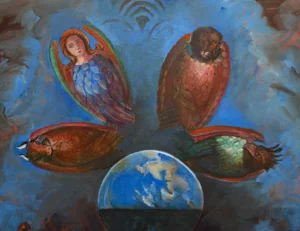
Daniel Rothbart’s floating aluminum and glass forms are at once playful and lyrical, biomorphic and other-worldly; prehistoric and futuristic. They are set in a pond and two small pools in Staten Island’s Snug Harbor, a hidden pastoral gem that once served as a safe haven for sailors.
Overflowing with colorful flowers and plants and shrubbery, the scene is idyllic, short of the oppressive, steamy heat that has settled over the landscape. But then that’s part of it too. Rothbart’s Serpentine Sibyls: A Floating Sculptural Installation, animated by winds and currents, are site-specific and immersive. He is keenly in tune with its ecology.
“No, my work has not always addressed political issues, but water is a fraught medium,” he told me over the phone. “You can’t work with water without addressing its importance to life on this planet and climate change and stewardship. Water has always fascinated me.”
Growing up in the Pacific Northwest the ocean was a constant alluring presence. And as a Jew, the water’s historical, cultural and religious traditional significance is defining, he said.
“There’s the purification ritual of the mikveh, the parting of the Red Sea, the washing of hands and feet before entering the temple in Biblical times and the casting off of sins, Tashlich on Rosh Hashanah. Water diplomacy and technology has always been central in Israel. Making the desert bloom.”
Rothbart, a multidisciplinary artist whose work has been exhibited across the globe, is the author of Jewish Metaphysics as Generative Principle in American Art, which examines how Jewish mystical traditions, especially Kabbalah, informed abstract American art in the post-World War II years.
Erudite and heady, Rothbart said that his work can be viewed through the lens of tikkun olam, the Jewish imperative to help repair a fractured world, but it also borrows from Japanese culture, outer space imagery, Marcel Duchamp’s dadaism and Greek mythology.
The title of his exhibit references Sibyls, the Greek female prophets who were consulted in catastrophic times, not unlike our current era cursed by floods and wildfires and heat waves.
Rothbart started thinking about floating sculptures in 2007 for a piece he was conceiving for the Venice Biennial. A city surrounded by water cried out for it. Japanese glass fishing floats came to mind.
“The Japanese fishing floats would wash up on shore in Oregon where I grew up,” he recalled. “I loved the fragile recycled pieces of glass that came from the orient and that I could de-contextualize a common object and in so doing create something new.”
To anchor the sculptures, Rothbart and his assistant kayaked to the middle of the pond. There, once he established where he wanted each sculpture, he dropped each form, now attached to two to five-pound iron weights.
“The sculptures are sensitive to any existing life in the water,” he said. “The pond here has turtles and fish. I’ve found that the animals adjust to the new forms. I love the relationship between life in the pond and the foreign objects.”
Three artists, one flood
The Interchurch Center in upper Manhattan is currently hosting Noah, A Future of Hope, 3 Faiths/ 3 Artists/ 1 Story. A traveling exhibit, it employs the story of Noah and the flood to gently remind viewers to save, protect and celebrate the environment. The topic is explored respectively through a Christian, Muslim and Jewish vision. The artists — Yona Verwer, a Dutch-born Jew, Brian Whelan, a British-born Christian of Irish heritage and Hady Boraey, an Egyptian Muslim — each merge their religious identity with personal aesthetics and the need to advocate for the environment.

“Each artist was invited to create eight paintings that visually inspire our imaginations to heal our world by honoring our intricate connection to the earth as our sustainer, and by maintaining a sacred balance with all her life forms,” said curator Paul G. Chandler in his introductory remarks at the exhibit’s opening night reception. “In this way, the story of the ark, its animals, and the flood, take on contemporary relevance as we face today’s climate crisis.”
Seven is a significant number in each religion, so Chandler selected seven core lessons, each reflecting some part of the Noah story, for the artists to address. The eighth painting from each artist served as a kind of synopsis of the work that was to follow.
Water is a common image throughout the exhibit; indeed, water plays a major role, not only in Judaism, but in Christian and Islamic rituals as well, from Christian baptism to the washing of feet and hands before prayer in a Mosque.
When I asked Chandler if he could guess the religion of each artist on the basis of their paintings he said he could for the Jew and Christian, but wouldn’t have had a clue that Boraey emerges from an Islamic tradition.

“His paintings have an individual aesthetic and a more universal feeling. Still, you never see the face of Noah in his work. In Islamic tradition you can only view him from the back. To see his face is idolatry. Jews have the same tradition, but may not adhere to it as rigidly.”
Some of Verwer’s work incorporates Hebraic texts and characters. In “Care for the Species,” a figure is blowing a shofar. Similarly, Chandler said, he’d know that Whelan’s paintings were made by a Christian. They are literal illustrations of key moments in the Noah story.
His depiction of Noah evokes a figure right out of vaudeville, grinning broadly, sporting a little hat and in more than one instance looking slightly confused.
“Christians turn catastrophe into a kind of children’s bedtime story,” Chandler said. “It’s very Christian to sanitize the story. Jews don’t do that.”
“My being Jewish — a religious Jew—has had a bearing on how I look at everything,” said Verwer who says that water and its preservation is deeply important to her not least because for more than 2,000 years Judaism has had many rules to safeguard water. As a Holland native, she, like Rothbart, grew up near water and so it was always part of her universe.
Verwer’s work is also exhibited in an accompanying solo show, Fluid Futures-Living Waters, which features eight paintings that explore ocean pollution through a comic sensibility. One piece, bal tashchit (prohibition against needless destruction) depicts an octopus, submerged in deep ocean waters, clutching a soda can in its mouth.
“I don’t feel a painting is finished if I haven’t laughed at least once,” Brian Whelan said. “But it also needs a message.”
His major challenge was Chandler’s insistence that the paintings embrace a note of optimism.
“I don’t see any hope in what’s happening to this planet,” said Whelan. “My work mostly follows in the tradition of East Anglican medieval narrative paintings found in churches dating back to the 14th-to-16th centuries.”

For me his strongest piece is “Humans Outside the Ark Perished,” which appears in his linked, one-man show, 40 Days and 40 Nights. Here we see desperate hands reaching towards Noah for safety. A mouse sits alongside Noah, a poignant image. It’s safe and sound compared to the desperate humans.
Of the three painters, Boraey said his work was the least likely to be connected to any one particular religion. Unable to obtain a visa to the States he spoke to me on the phone from the Northern coast of Egypt.
He said his piece “The Great Collapse” spoke most vividly to both the Noah story and the ecological precipice we’re now facing as a result of climate change.
In the foreground, we view Noah from the back gazing out across a body of water at masses of people crushed together and almost immobilized as they hopelessly struggle to move forward. In the background hangs a giant and cratered blue moon sinking below the horizon and into the ground. It is at once foreboding and exquisite.
Having participated in exhibitions in the Middle East and Europe, Boraey said he was most influenced by the surrealist art movement in Cairo in the late 30s. The marriage between folkloric and political motifs is its hallmark.
The Noah tale for him is “both pessimistic and optimistic because hope is always there and they survived at the end of the story,” he said. “Noah saved humanity. He reminds us that we have to be very careful with the earth.”
In harmony with nature

Back at Snug Harbor, the late afternoon heat dome has made the airless, sun-baked space even more relentless than it was earlier in the afternoon. Rothbart’s visitors are slowly straggling out of the park, some wiping away sweat with bits of tissue, others fanning themselves; still others pouring water from their bottles onto reddened necks and arms and legs indifferent to the water splashing on to their clothes.
“Talk about global warming and climate change,” he told me. “This weather only drives home the point of just how serious this is and how we have to learn to live in harmony with nature and our environment.”
Serpentine Sibyls will run through Sept. 28.
Noah: A Future of Hope will run at the Interfaith Center through Aug. 26 and then continues its global tour.
The post Amid blazing heat and rising tides, artists find beauty and desperation in these biblical times appeared first on The Forward.
Uncategorized
Bob Dylan is changing his lyrics and his set list; what is he trying to tell us?
Nobel Prize-winning rock poet Bob Dylan once famously wrote, “You don’t need a weatherman to know which way the wind blows” (in his 1965 song “Subterranean Homesick Blues”). That may have formerly been the case, but it didn’t stop Dylan from kicking off his “Lights of Autumn Tour” in Oslo on Saturday, Oct. 17, with a setlist chock full of warnings about floods and extreme weather — a veritable apocalypse of natural disasters. He even rewrote some lines in one of his most famous and beloved songs, “Tangled Up in Blue,” to make the weather a new character in the song.
Playing “Tangled Up in Blue” in concert for the first time since 2018, Dylan revised a few verses. Where he originally sang “I had a job in the great north woods working as a cook for a spell” to kick off the third verse, Dylan instead sang “Way up in the frozen woods, teardrops touch the sky / The leaves are falling one by one, and the moments passing by,” in keeping with the “Lights of Autumn” theme. (It should be noted that Dylan has been rewriting and changing the lyrics to “Tangled” at least since 1984, when he also included the song on his opening concert of a European tour.) “Way up in the frozen woods” may also refer to Dylan’s hometown of Hibbing, Minnesota, which is so far north that you can practically see Canada from there.
On Saturday, Dylan continued to rewrite that third verse with the line “Sometimes I get so tired, sometimes I’m getting away / Lucky you found another, tomorrow’s another day.” In a clever twist, Dylan inserts the new word “lucky” into the number, which recalls the phrase “I can’t help it if I’m lucky” from the song “Idiot Wind,” also found on the 1975 album Blood on the Tracks where “Tangled Up in Blue” originated. “Lucky” also resurfaced as a cryptic moniker for Dylan himself when, in the superstar group the Traveling Wilburys that included George Harrison, Tom Petty, and Roy Orbison — all of whom took new names ending in “Wilbury” — Dylan opted for “Lucky Wilbury.” He can’t help it, indeed!
Dylan kicked off another rewritten verse with the phrase, “Things were gettin’ to cost too much,” leaving one to wonder if this was a pre-midterm election reference to the state of the U.S. economy and therefore an implicit criticism of the MAGA leader and his acolytes. Dylan also revised the music somewhat, slowing the tempo of what was once a mid-tempo rocker to a rubato ballad; he also inserted a minor chord that doesn’t exist in the original.
As noted, Dylan’s 19-song setlist included copious references to weather disasters. “The Man in the Long Black Coast” opens with the line “Crickets are chirpin’, the water is high,” and refers to trees that are “bent over backwards from a hurricane breeze.” The aptly titled “Crash on the Levee (Down in the Flood),” which he performed for the first time in over two decades, includes the lines:
Crash on the levee, mama
Water’s gonna overflow
Swamp’s gonna rise
No boat’s gonna row….
If you go down in the flood
It’s gonna be your own fault…”
Even Dylan’s choice of cover tunes seemed oriented toward the apocalyptic theme. For the first time ever, Dylan sang a Randy Newman song in concert. Keeping with the flood theme, he chose Newman’s “Louisiana 1927,” which recounts one of the worst floods ever to strike the U.S.
What’s happened down here is that the wind have changed
Clouds roll in from the north, and it starts to rain
Rained real hard, it rained for a real long time
Six feet of water in the streets of Evangeline
River rose all day, the river rose all night
Some people got lost in the flood, some people got away all right
Dylan also covered “Share Your Love” — originally recorded by Bobby “Blue” Bland in 1963 but also recorded and performed by Dylan’s former backup group, The Band — which kicks off with the line “Well, it’s an ill wind that blows no good.”
But Dylan didn’t have to go far from his own catalog to rack up mentions of climate insanity. He performed “Tryin’ to Get to Heaven,” which includes the lines “The air is getting hotter, there’s a rumbling in the skies / I’ve been wading through the high muddy water, with the heat rising in my eyes.” In “You Ain’t Goin’ Nowhere,” Dylan sang, “Clouds so swift, rain won’t lift / Gate won’t close, railings froze / Get your mind off wintertime, you ain’t goin’ nowhere.” And on “I’ve Made Up My Mind to Give Myself to You,” the seasonally appropriate narrator says, “I saw the first fall of snow, I saw the flowers come and go.”
Dylan’s tour continues tonight (Oct. 19) in Gothenburg, Sweden, before making its way through Denmark, Germany, Belgium, Switzerland, Italy, Slovenia, and Austria, and concluding in the UK in November and early December. The forecast for Sweden tonight is clear, but later in the week, the weather report says there’s a chance of a hard rain.
The post Bob Dylan is changing his lyrics and his set list; what is he trying to tell us? appeared first on The Forward.
Uncategorized
Argentina’s Jewish gauchos museum vows to stay open amid leadership feud
(JTA) — BUENOS AIRES – A museum dedicated to the history of Argentinian Jewish ranchers, farmers and the cowboys known as gauchos remains open and operating despite months of tension between its former director and the local government, the head of the Entre Ríos Jewish community confirmed to the Jewish Telegraphic Agency,
The Villa Domínguez Jewish Museum about the Jewish Colonies drew international attention late last year after visitors reported water damage affecting walls, documents and historical objects. The concerns arose months after the resignation of Osvaldo Quiroga, the local historian who had led the museum for nearly 40 years and was widely associated with its preservation.
In an interview, community head Marina Garber acknowledged the tensions that led to Quiroga’s resignation in January 2025, and that since then a successor has not been named.
“We are resolving the situation with an agreement in which the building belongs to the municipality, while the Jewish community is in charge of safeguarding the objects. The museum is still operating,” Garber told JTA, and the partnership between the local municipality and Jewish community would continue.
Villa Domínguez is a rural town of around 2,000 inhabitants located 225 miles north of Buenos Aires, where international tourism centered on the country’s earliest Jewish agricultural colonies brings considerable visibility to the area.
The fate of the museum matters far beyond Villa Domínguez’s nine remaining Jews. The Jewish agricultural colonies of Entre Ríos are a defining chapter in Argentine Jewish history, tracing how immigrants from Eastern Europe built new lives as farmers and gauchos. Its future is a test of whether a legacy that belongs to Argentine Jewry as a whole can be safeguarded.
Although its director was a municipal employee, the museum itself belongs to the Jewish community. This hybrid arrangement, with no clear responsibilities divided between the two, created tensions when the images of damage were spread online. Suggestions that the Jewish museum had fallen into a state of neglect circulated online as far as Europe.
According to some sources, tensions appear to stem from a combination of the government’s limited attention to the site and the apparent resentment by some government officials that Quiroga had received inordinate media attention.
The Jewish colonies of Entre Ríos, established in the late 1890s by Jewish immigrants mostly from Eastern Europe, represent one of the largest waves of Jewish agricultural settlement in the Americas.
The Jewish Colonies Museum was founded in October 1985 to safeguard the region’s documentary and material heritage. Since 1996, it has been housed in the town’s former pharmacy building.
The museum attracts Argentine and international visitors interested in the stories of the Jewish gauchos — the immigrants who blended their Jewish and Eastern European roots with Argentine ranching culture. Heritage tours, family-history trips, academic researchers and Jewish community groups contribute to a steady flow of visitors exploring the landscapes where the Jewish gauchos built their rural lives, a journey that began more than a century ago.
For the descendants of the gauchos — many now scattered across Argentina, Israel and beyond — the institution serves as a touchstone for genealogical research and family history. Its stability is also of concern to Jewish communal organizations and Argentine officials who have promoted the Jewish colonies circuit as a pillar of religious and cultural tourism in the province.
The first ship carrying Jewish immigrants from Europe to Argentina, the SS Weser, arrived in 1889 after sailing from Hamburg to Buenos Aires. Its arrival inspired Baron Maurice de Hirsch, a German Jewish financier and philanthropist, to recognize the potential of agricultural migration and, in 1891, to create the Jewish Colonization Association (JCA) to institutionalize, fund and organize the colonies.
A tourist trail linking the various Jewish settlements has been operating for more than 20 years, made up of four communities: Basavilbaso, Villa Domínguez, Villa Clara and Villaguay. Two- and three-day tours of the area’s main Jewish sites include visits to synagogues, cemeteries, cooperatives, and local museums. Villa Clara — or simply Clara — is a small town founded in 1892 and named after Hirsch’s wife. Its Jewish museum is located inside an old railway station. Another settlement, Lucienville, is named after the couple’s son, Lucien.
The last agricultural colony founded in Entre Ríos by the JCA is Colonia Avigdor, visited regularly by students of Fundación Judaica, a major Buenos Aires network of schools and synagogues, which brings groups there for educational programs, supports local schools, and works on community development.
The national government includes the tourist trail as part of a religious tourism program, and the Buenos Aires Jewish center AMIA has a site dedicated to the colonies’ history in Entre Rios, including Villa Domínguez.
The national government and some local municipalities also include the Jewish colonies among their cultural offerings.
According to Pablo Soskin, the representative in Entre Ríos of the Argentine Jewish political umbrella organization DAIA, the museum’s director stepped down on Jan. 24, but municipal officials initially declined to accept his resignation. He subsequently took an extended leave to use up a large balance of accrued vacation days, with the municipality’s approval. When that time ran out, he was reassigned within the museum to a different, non-directorial role. The director position has remained vacant since then.
“We maintain a close relationship with the government, which has expressed its commitment to making the museum and the Jewish circuit part of the province’s tourist attractions for locals and foreigners,” Soskin told JTA. “We will continue to coordinate community, public, and private mechanisms to ensure the preservation of our heritage sites.
“This is key to understanding the contributions that the Jewish community has made to Argentina,” he added.
This article originally appeared on JTA.org.
The post Argentina’s Jewish gauchos museum vows to stay open amid leadership feud appeared first on The Forward.
Uncategorized
Israeli police arrest suspects in Washington Post journalist attack
(JTA) — JERUSALEM – Israel Police arrested 10 people on Monday on suspicion of involvement in violent acts over the weekend against journalists, foreign diplomats and Palestinians in the West Bank during the annual olive harvest.
The arrests came after international condemnation of the attacks, including by U.S. Ambassador to Israel Mike Huckabee, who is generally supportive of the current Israeli government. Prime Minister Benjamin Netanyahu has insisted it is just a handful of individuals and not representative of Israelis who live in the West Bank settlements.
“Following reports of acts of violence over the weekend, including the suspected assault of a foreign journalist and the suspected assault of foreign diplomats, the Judea and Samaria District and the Israel Security Agency (ISA) carried out a pre-dawn arrest operation as part of the ongoing investigation,” the police said in a statement, referring to the West Bank by its biblical name.
The statement said the suspects were arrested during a special pre-dawn operation conducted by the district’s Central Investigations Unit and transferred to police stations in the area for questioning.
“Following questioning, and subject to the findings of the investigation, they will be brought before a court for a hearing,” the police statement said.
The arrests come after Heidi Levine, a veteran photojournalist for The Washington Post, was attacked on Friday while photographing Palestinians harvesting their olive trees in the West Bank, an annual event that often sees violent clashes between Palestinian farmers and Israeli settlers who have increasingly moved into the same areas.
Video footage from the scene shows a group of masked settlers surrounding and attacking Levine before ripping off her camera and other personal gear. Palestinians can also be seen throwing stones at the settlers before another journalist arrives to help Levine leave the area.
The photographer was taken to a Palestinian hospital near Ramallah and later transferred to Beilinson Hospital near Tel Aviv, which reported that she was in moderate condition with lacerations across her body, a broken rib and four broken vertebrae. She also underwent surgery on her finger, the hospital said.
On Saturday, European diplomats from France, Belgium and Poland came under assault by masked settlers who forced their convoy off the road in the area of Taybeh, near Ramallah. Bernard Baudoux, a leftist mayor of Aulnoye-Aymeries, a town in northern France, was beaten, according to witnesses who spoke to international media.
Data collected by Israeli human rights organization Yesh Din and published on Sunday showed some 538 alleged incidents of settler and soldier violence over the 20-day period from Sept. 27 to Oct. 16, across 181 Palestinian communities in the West Bank. Some 269 of the incidents were directly related to the olive harvest, the organization said.
Israeli right-wing legal-aid organization Honenu confirmed the arrests on Monday and said its criminal law department would be providing the suspects with “initial legal assistance.”
“At this stage, it is unclear what the detainees are suspected of,” the organization said in a statement.
The Israel Police said that “items linking the suspects to the alleged offenses were seized, and several vehicles were confiscated.”
“The law in Judea and Samaria applies to everyone, regardless of identity or affiliation. The Israel Police is committed to professional, equal, and impartial law enforcement, based on evidence and in accordance with the law,” Israel Police Commissioner Daniel Levy said in the statement.
The issue of settler violence in the West Bank falls into a gray area of law enforcement between the Israel Police and the Israeli military, the latter of which is responsible for civilian matters in parts of the territory that are not legally under Israeli sovereignty. Israel’s police force is under the authority of the National Security Ministry headed by Itamar Ben-Gvir, a far-right nationalist who has not made clamping down on settler violence a priority.
Levy said that the ambiguity over which agency is responsible for what must be addressed.
“At the same time, a distinction must be made between responsibility for preventing incidents in the field and responsibility for investigating and enforcing the law after they occur,” Levy said.
“We will continue to coordinate with all security agencies to strengthen security and the rule of law and ensure that anyone found to have violated the law is brought to justice,” he added.
Huckabee on Saturday called for a full investigation into the attack against Levine and for the perpetrators to be prosecuted “to the fullest extent of the law.”
“Attacking a female photographer is a despicable act of terror carried out by masked cowards. Dishonorable act of senseless violence,” he wrote on X.
Israeli President Isaac Herzog also condemned the “shocking violence” and said he had called Levine to apologize.
“I expressed my deepest sorrow to Heidi and apologized for what she went through. The despicable behavior of the perpetrators of this attack does not represent the citizens or the values of the State of Israel,” he said in a statement.
Netanyahu, who is in the midst of a closely contested election campaign to retain power, condemned violence generally, but also stated that the circumstances of the attack “remain unclear.”
“We will not allow disputed incidents to be exploited to demonize the hundreds of thousands of law-abiding Jewish residents of Judea and Samaria,” he said in a statement, using the biblical names for the West Bank.
Israel’s Ambassador to the U.S. Yechiel Leiter, however, stated on CNN on Friday “unambiguously and unequivocally, that gratuitous violence perpetrated by anyone, be they Jews or Arabs, is completely unacceptable.”
He added, “If we have not yet reached a passing grade to bring Jewish vigilantes to justice, then we’ve got to do a better job. But I’m convinced that we are going to do it. I’ve been in government meetings. I’ve heard the prime minister speak emphatically about putting a stop to this.”
In a statement Monday following the arrests, Defense Minister Israel Katz said that it was time for the Israeli police to handle such crimes.
“The IDF should not and cannot be engaged in civilian law enforcement. Its role is to fight Palestinian terrorism and defend the country’s borders and the Jewish communities in Judea and Samaria and along the seam line,” he said, adding that he was preparing, in coordination with the prime minister, “a comprehensive plan to regulate civilian law enforcement activities in Judea and Samaria.”
“The plan distinguishes between the IDF’s authority in the field and the transfer of responsibility for carrying out civilian law enforcement in practice to the Israel Police’s Judea and Samaria District,” Katz said.
This article originally appeared on JTA.org.
The post Israeli police arrest suspects in Washington Post journalist attack appeared first on The Forward.
