


Uncategorized
An Illinois farmer thought he knew how his family survived the Nazis. Then he went to the town that saved them.
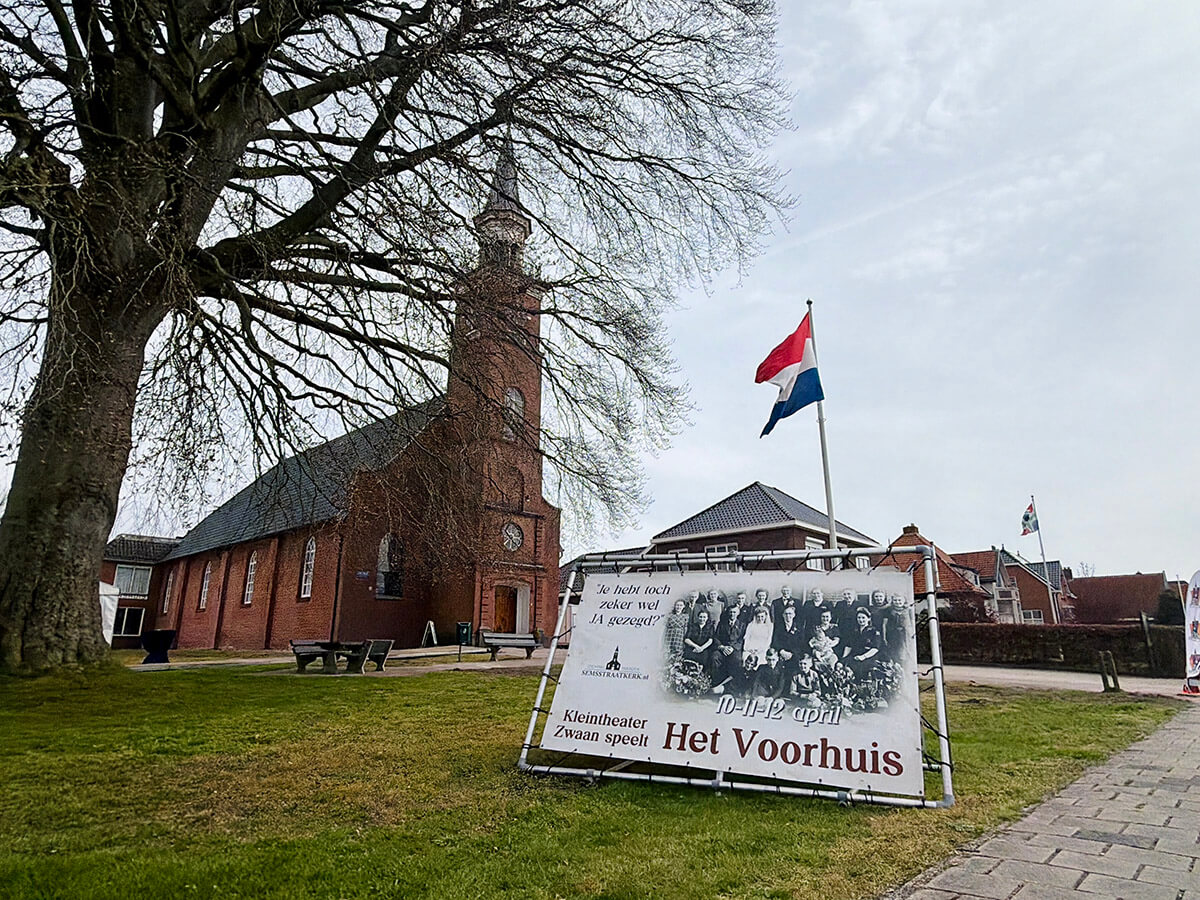
STADSKANAAL, THE NETHERLANDS — The lights dimmed and through the old church’s stained glass windows, the afternoon sun scattered color across the wooden pews. Sitting among them, Nik Jakobs watched his family’s past come to life on a stage in front of the room.
In a 90-minute play, actors reenacted what happened in this small town in the northern Netherlands during the Holocaust: A Christian farmer who hid more than a dozen Jews in a single room of his farmhouse. A village — nearly 100 people — that knew, and said nothing. A child born in hiding, to a Jewish man and the farmer’s daughter.
And an 11-year-old girl who lived in that room for nearly three years, survived, and became Nik’s grandmother.
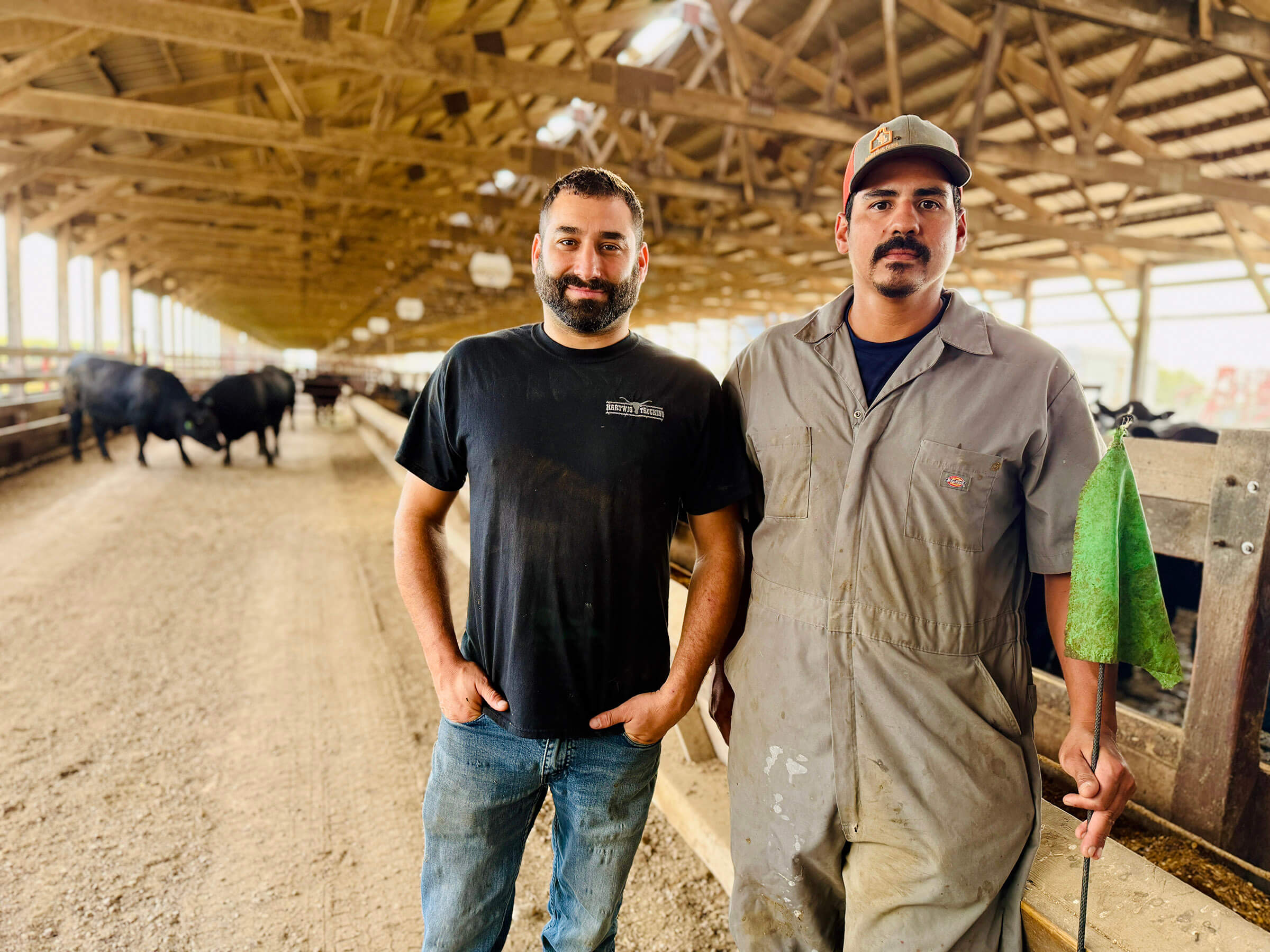
Nik, a 41-year-old cattle farmer from Illinois, thought he knew her story. He had grown up with it — hearing from his grandmother about the hiding, the silence, the survival. But sitting at one of four sold-out performances with his parents, his wife and his four daughters, he realized he was watching a version of his family’s past that stretched far beyond what he had been told.
“We only really had her lens,” Nik said of his grandmother, Edith, who at 95 was unable to travel from the U.S. to see her own story staged. “To hear it from other people, it’s like seeing the same story from different vantage points. And suddenly it’s deeper.”
Nearby, his cousin Hannah had a similar reaction: “I didn’t realize how many people were part of this.”
Even the venue was part of the story. The play was staged in the church where the Dutch farmer’s family prayed — a story of hiding, retold in the open, on holy ground.

This wasn’t just his family’s story. Non-Jews were carrying an extinguished Jewish community on their backs — a memorial, a play, a shul — because almost no Jews were left to carry it themselves. Stadskanaal’s Jewish community was erased in the war: deported, murdered, never rebuilt.
What survives of it now survives because non-Jews decided it should — historians pulling records, docents leading tours, a playwright and a cast of actors performing a story none of them lived. That’s what Nik was taking back home: the fact that Jewish presence doesn’t restore itself once it’s gone. Somebody has to keep doing the work, whether or not there are Jews left to do it.
Nik recognized the work, because it is his own. In a two-acre cornfield in Sterling, Illinois, two hours west of Chicago, he is building a synagogue from the remnants of closing congregations — gathering the scattered pieces of American Jewish communities that are themselves disappearing — alongside a museum of tolerance rooted in his family’s past. An ocean apart, a Dutch town and an Illinois farmer are doing the same thing: refusing to let a Jewish story vanish from the landscape.
He came thinking the story belonged to his family. He left knowing it belonged to a village.
A country of contradictions
The Holocaust in the Netherlands is remembered through a single image: a teenage girl keeping a diary in a secret annex in Amsterdam. The story of Anne Frank has become universal — a shorthand for innocence, for persecution, for the human face of genocide.
For decades, hers has been the defining Dutch story of hiding. Others — like the one that brought Nik to Stadskanaal — are less famous. But this story has had a life here for decades.
The story of the Stadskanaal farmhouse has been pieced back together — first by historians racing to preserve fading memories, then through a book, a museum exhibit, a memorial on the site and even a musical.
It had nearly disappeared after the war, lost as the country rebuilt and moved on. But in recent years, it has been revived and retold, a lesser-known counterpart to Anne Frank but with a happy ending, and a love story: one in which the family survives, a child is born, and generations later, a grandson returns. Nik exists because it did not end in tragedy. That effort, as much as the story itself, is what Nik came to see.

But it exists alongside a harder truth. Roughly 75% of Dutch Jews were murdered during the Holocaust — one of the highest death rates in Western Europe. And yet the Netherlands also has one of the highest numbers of people recognized by Yad Vashem as “Righteous Among the Nations” — more than 6,000 individuals, including the family that saved Nik’s grandmother.
The country’s memory has long lived in that tension: between loss and rescue, between what was done and what was not.
After the Holocaust, the national story leaned heavily toward one side of that equation. “The Dutch are very proud,” said local historian Geert Volders, “that about 25% of Jews survived because of the resistance.” He paused, looking frustrated. “But only 25%.”
What has emerged more recently is something closer to a reckoning — a shift from pride to responsibility. Geert, 37, is part of that shift. He is not Jewish, like so many others who have taken on the work of remembering.
The story they are keeping alive is one of those rescues. It begins with a bicycle.
The cast of the play warming up backstage. 🎭 pic.twitter.com/i5nu2DyzTg
— Benyamin Cohen (@benyamincohen) July 28, 2026
A rural refuge
Before the Holocaust, Stadskanaal was a peaceful place. Edith Delevie, Nik’s grandmother, remembered skating in the winter, canoeing in the summer, a small Jewish community, everyone knowing everyone else.
Then the Germans came. And then came the rules. No school. No theater. A yellow star stitched onto coats and shirts. And then, one night, there was a bicycle.
A man named Willem Drenth rode out to their house. Nathan Delevie, Edith’s father, had gone into hiding months earlier. Now it was time for his wife, Hertha, and the children — Edith, 11 years old, and Herb, just 7 — to follow.
Drenth was a socialist, shaped by working-class politics and a distrust of authority. His wife, Hindertje, was a devout Protestant. Nathan, a cattle trader who had done business with Willem, asked for refuge. When Willem relayed the request to his wife, she turned to her husband and asked a simple question: “You said yes, right?”
The Drenth farmhouse sat at the edge of town, alone, with a canal running in front of it and almost no traffic beyond the small bridge that led there. It was poor even by the standards of the time and place: no electricity, no running water, a pump outside, rainwater collected when it fell.
Inside, the house had a kitchen and a few rooms. The biggest was a formal parlor, about 215 square feet, only used on Sundays and holidays. It was here, with the windows covered, where those in hiding would live.
For a while, the Drenths were just hiding Edith’s immediate family. Then others arrived: an aunt and uncle, cousins, friends, strangers who became kin by necessity. Within a year, there were 13 Jews hidden inside. Eight adults. Five children.
The toilet was a wooden plank with a hole cut into it, set over a bucket. The children slept on straw tucked into cabinets, sheets pulled tight to soften the edges of the world.
Edith never saw the rest of the house. For two years and eight months, she lived in that single room. They woke. They kept quiet. They waited. “You were under tension most of the time because you had to repress your anger, your frustrations,” Edith recalled in a 2022 oral testimony she gave of the experience. “You took it in stride.”
No noise, no movement that could be seen from the outside, no mistakes. If someone coughed, a pillow went over their face to muffle it. If danger was lurking, someone would knock three times on the wall — a signal to freeze into stillness.
Bennie Kosses, 21, a distant relative of Edith’s who worked in the family butchering business, joined them in hiding. There was no formal school, but Bennie taught the kids arithmetic and geography, just enough to keep their minds from collapsing inward.
Books arrived, smuggled in by the Dutch resistance and by the younger of the two teenaged Drenth daughters, Fennie, who brought them home from school. Herb read constantly — thousands of books, he said years later in an oral testimony — devouring anything that entered the room.
Later, his son would recall that Herb rarely spoke of this time to his family. “He wanted us to grow up American without the albatross of things,” said Brian Delevie, a professor of visual storytelling at Vanderbilt University.
Inside that one room, the family did more than endure.
While in hiding, Edith learned to crochet, to knit, to embroider. They were skills taught out of necessity, to keep hands busy, minds occupied. One of those embroidered cloths survived. It is stitched with the Hebrew words “L’kavod Shabbat V’Yom Tov,” which means “In honor of Shabbat and the holidays,” and will now be used to wrap the Torah scrolls in the new synagogue Nik is building — a thread pulled taut across continents and generations.

They played cards, board games, anything that could pass the hours and blunt the edge of fear. Luck, chance, risk. These were not abstractions. They were daily realities.
Food was its own quiet operation.
The Drenths had a garden, and vegetables came from the soil behind the house. They butchered a hog for meat. It was, of course, not kosher. But it kept them alive. Extra ration cards, obtained through an underground network, allowed them to buy more than a household of their size should have needed.
Lammie, the eldest Drenth daughter at 17, traveled to different towns to shop so no one store would notice the excess.
She also took a job with the NSB — the Dutch Nazi collaborators — as camouflage. If people got suspicious, the focus would be less likely to fall on a household whose daughter worked for the enemy. It was the kind of moral contortion survival required: to hide Jews, you sometimes had to appear to side with those hunting them.
Still, there were moments that bordered on the surreal.
A Nazi officer’s wife once came to the house for tea, sitting casually at the kitchen table while, just beyond the wall, Edith and her family held their breath. And later, near the end of the war, a defector — a Nazi soldier who had abandoned his post — was taken in and hidden alongside the Jews he might once have been ordered to kill.
An improbable love story
And then there was the other kind of life that took root in the house, the kind no one could have anticipated.
Lammie moved between two worlds: the outside, where she worked, gathered supplies and performed a careful version of normalcy; and the inside, where more than a dozen people depended on her family for their lives.
Somewhere in that narrow space between risk and routine, Bennie and Lammie fell in love.
In a room defined by scarcity, something as expansive as love still took hold. They had no privacy, no future to plan for, no safe place even to imagine what came next.
And yet. They found ways to speak, to connect, to carve out something like intimacy in a space where even breathing too loudly could be dangerous. Lammie became pregnant.
Outside the house, that alone would have been complicated enough: the scandal of an unwed teen carrying a child. Inside the house, it was something else entirely: a risk layered on top of risk, a new life emerging in a place where survival itself was uncertain.

When the time came, Lammie gave birth there, inside the house, while the others remained hidden — a baby entering the world in a room designed, above all else, to keep death out.
That child was named Hennie. After the war, Bennie and Lammie emerged from hiding and wed in front of the house on May 8, 1945. It was Victory in Europe (VE) Day. A photo of both extended families, and baby Hennie, marks the occasion. Lammie eventually converted to Judaism.

When the story was staged this spring as a play in Stadskanaal, that moment — the birth, the love, the impossibility of it all — unfolded again, this time under lights, before an audience.
Hennie, now 81, sat in the audience with her daughter, watching the story of her own beginning play out in front of her — the room, the fear, the love that had brought her into the world.
A scene from the play about a Dutch farmer hiding Jews in his home during the Holocaust. pic.twitter.com/82i73j6B7M
— Benyamin Cohen (@benyamincohen) July 29, 2026
When the lights came up, the crowd shifted toward her. People asked for photos. They wanted to meet her, to touch the story they had just watched. She smiled and obliged, a little shy, a little overwhelmed, a reluctant celebrity.
Afterward, she walked to the stage. The young actress playing Lammie stood waiting. Hennie took her hands. Looked at her. “You’re my mother.”
After the show, performed on the 81st anniversary of Stadskanaal’s liberation, descendants of the Drenths introduced themselves to Nik’s family. “We wouldn’t be alive, standing here right now, if it wasn’t for your family,” Nik’s mom, Margo Jakobs, told two of Fennie’s daughters.

Hannah, Nik’s cousin and another of Edith’s grandchildren, moved through the church hall, embracing cast members and descendants of the Drenth family — people she had only just met, but who carried pieces of the same story.
Nik lingered by the stage, tracing the distance between the actors and the ones they had been asked to become. He kept returning to one man in particular, pulling others over to meet him.
“This,” he said, beaming, “is my great-grandfather!”
The actor had been playing Nathan Delevie. Everyone called him Nicco. It is the name Nik carries.
Later, he would struggle to explain what that moment felt like.
“It was almost like his character coming to life,” Nik said. “It was a very spiritual experience. I knew so little about my great-grandfather. And here was someone who had studied him, who had put himself into that role. It gave me a reference point I never had before.”

What stayed with him most was the choice his great-grandfather made. “When you’re named after someone, you don’t always think about it,” Nik said. “But now I look at it differently. I have a 10-year-old daughter. He had an 11-year-old. And I ask myself: Would I have had that courage? Would I have made that decision for my family?”
The gratitude he had for years, he said, had shifted into something deeper. “It was always something I understood,” he said. “But now it’s something I feel.”
Nearly 100 villagers were aware of the Jews hidden in the Drenth home — and no one betrayed them. The secret did not end with the war. Between performances, the story moved back to the place where it began. At the site of the Drenth house — long gone now — a memorial stands, built in 2021, its sculpted panels shaped like the pages of an open book. Each one represents a person who found refuge there, a life preserved not just in memory, but in form.

The cast gathered there, placing stones at the memorial’s base and singing a song from the play. Their voices carried across the field, another layer added to a story that has been told and retold in Stadskanaal.
For Moon Suijs, the actress who portrays Edith’s mom, Nik’s great-grandmother, the lesson feels unmistakable. “These people risked their lives,” she said. “Without hesitation.”
The cast of the play placing rocks at the memorial on the site of the Drenth home, where more than a dozen Jews hid during the Holocaust. pic.twitter.com/tD5XxMCsQp
— Benyamin Cohen (@benyamincohen) July 27, 2026
A history inherited
The play about the Drenths expands the frame — showing not just what happened inside the house, but how far beyond its walls the story reached.
About 45 miles north of Stadskanaal, at the lone surviving synagogue in the Groningen province, Geert, the local historian, and many of the docents guiding visitors through that sacred space are not Jewish, including a former vicar. They have, in a sense, inherited a history that is not their own. And yet they speak of it in terms of obligation. “This synagogue and museum exists because non-Jews help,” Geert said.
Geert has seen echoes of the 1930s reemerging, old prejudices resurfacing in new forms. “That’s worrying me,” he said, adding, “It’s also motivating me.”

Motivation, here, is not abstract. It looks like school groups, about 100 a year, walking through this synagogue. It looks like maps, salvaged artifacts, reconstructed ones — and plays.
For Peter Meijer, 68, the playwright and director of the Stadskanaal production, the motivation was both personal and deliberate. He grew up in a family shaped by the war — a grandfather in the Dutch resistance who rarely spoke about it — and spent decades asking the same questions: “Why do people want to hurt each other? Why do people follow a leader that is obviously bad? And most of all: How was it possible that the world allowed this to happen?”
The story of the Drenth farmhouse was one he felt compelled to tell. “They were ready to help anyone who was suffering from evil,” Peter said. “I strongly admire that and I try to live like that, too.”
When he began assembling the cast, he found no shortage of volunteers. Many had never heard the story before. All of them understood why it needed to be told. “It serves as a reminder,” said actor Luca van der Pol, “that we cannot allow something like this to happen ever again.”
The past, in the Netherlands, is not just a story of what happened. It is a story of choices: of people who said yes, and of a country still trying to understand why more did not.
Inside the Groningen synagogue hang two carved wooden signs: the Ten Commandments and a board painted with the words of the Shema prayer.

They came from the synagogue in Stadskanaal where, before the war, there were 180 Jews in the community. After, only 44 remained. When that congregation collapsed after the war, its sacred objects were dispersed. Torah scrolls and ritual items were sent to a Jewish home for the elderly in the town of Bussum. Other pieces, deemed to have little financial value, disappeared into private hands.
Decades later, those two wall hangings resurfaced at a flea market. Someone called Geert. Did he want them? Of course. When Nik saw them, he traced the lettering with his eyes. He has spent the past year rescuing pieces of closing shuls across America to include in the new one he is erecting in an Illinois cornfield. Now, he said, he wants to replicate these two pieces that once adorned the walls of the synagogue where his ancestors prayed.
As the sun set, the work of remembering extended beyond the stage. At the Jewish cemetery in Stadskanaal, Geert led Nik’s family past rows of headstones whose dates abruptly end in 1942 — a record of lives cut short, but not erased. He opened a small bag of black velvet yarmulkes, placed one on his head, then handed the rest to Nik and other men in the group.
He brought a binder he had assembled — obituaries, family trees, fragments of lives pieced back together.

At one point, he pulled out an old newspaper advertisement featuring the family’s butchering logo, preserved in print. Nik’s ancestors had been cattle traders here, the same work he and his brothers do now in Illinois. He plans to revive the historic logo and use it along with the family’s present-day one to honor their legacy.
Standing there, among the graves, Geert watched Nik’s daughters running between the stones, their voices carrying lightly in the evening air.
He thought of a line from the Talmud. “He who saves a life, saves a world.”
A banality of good
For Jan Erik Dubbelman, that world, and the decision to save it, is of central importance.
After decades working at the Anne Frank House in Amsterdam, Dubbelman, 71, who is not Jewish, launched an online mapping project of the hiding places across the Netherlands, linking stories to specific addresses. Click a house, and a story appears: sometimes a sentence, sometimes an entire book.
What he found unsettled him. “Every single house I lived in as a child,” he said, “had histories of hiding or persecution nearby.”

The Holocaust was not distant. It was embedded. And within those stories, a pattern emerged. They often began small. Can you take the baby? Then the mother. Then another relative. What started as a temporary act expanded into something larger.
“The minute people start to care,” Dubbelman said, “they continue to care.”
He said it was a counterpoint to Hannah Arendt’s “banality of evil,” describing it as “a banality of good.” Not heroes. Not saints. Just people who said yes, and then kept saying it.
While Nik was in the Netherlands, he brought his daughters to the Anne Frank House. Taylor, 10, is a few years younger than Anne was when she went into hiding.
Inside, they moved through the narrow rooms, past the bookcase that concealed the annex, the walls where Anne and her sister marked their height as they grew.
Nik watched his daughters absorb it all. “Anne’s story ends,” Nik said. “My grandmother’s didn’t.”

A new life
Stadskanaal was liberated on April 12, 1945.
When Edith stepped outside for the first time in nearly three years, the world felt impossibly large. She could not walk properly. Her legs, unused to distance, had to be retrained. Her voice, conditioned to a whisper, never regained its full volume. Her story did.
After the war, the family traveled back to their home in the Dutch countryside. The Germans had used it as an office but left it largely intact. There was a black cat waiting, still there after all that time. Some things, improbably, had endured. Others had not.
Edith’s grandparents, who had refused to go into hiding for fear of endangering the others, were murdered in the concentration camps. This, too, would become part of the inheritance.
Life resumed, or something like it. And then, in 1949, they left.
America was not a dream so much as a direction. A place to rebuild, to start again. Edith arrived at 19, stepping onto Ellis Island and into a country she did not yet understand, watching Christmas lights in New York City with the same curiosity she had once reserved for the canals of Stadskanaal. She learned English by watching television commercials.
Edith and her family settled in Madison, Wisconsin, picked up at the train station by Manfred Swarsensky, the local rabbi and a fellow Holocaust survivor. Her dad got a job in a banana warehouse; her mom, at a bridal shop. Edith found work in an Oscar Mayer sausage factory, and Herb got an after-school job delivering newspapers. They eventually pooled enough money between them to buy their first cow. And a pickup truck. Soon, Edith’s dad restarted his pre-war cattle business.
In Madison, at a synagogue dance, Edith met Norbert Jakobs, another Dutch Holocaust survivor — a man who had been hidden in a home in Nijmegen, about 100 miles south of Stadskanaal. Like Edith, he was rescued by neighbors who also chose to say yes. (Decades later, a great-granddaughter would be named Madison to honor the origin of their love story.)
Edith and Norbert married and moved to Sterling, Illinois, where Norbert started his own cattle business. Two generations later, Nik and his brothers, Alex and Ricky, run it.
In 2015, Edith and Norbert would return to visit the Netherlands and stumble upon something they hadn’t known existed: a model of the Drenth house, recreated in Amsterdam’s Dutch Resistance Museum. Seeing it — the layout, the space, the memory rendered in miniature — hit Edith, she recalled, “like a sledgehammer.”
As a child, she had never seen the full house. Only the one room. Only the limits of survival.
Years later, her grandson Nik would ask Edith a question that had lingered. Why didn’t she blame the Nazis? Why no anger, no bitterness? “What good will it do?” Edith always responds.
The model has since moved to the public library in Stadskanaal, and one afternoon during the trip, the family crowded around it. Margo’s voice shook as she looked at the tiny house. “It’s overwhelming,” she said. “This moment is divine.” Beside her, Hennie — born inside the real house — wiped tears from under her glasses.

From Stadskanaal to Sterling
The family story has been passed down, altered in the telling: some details fading, others taking their place. And now, in a two-acre cornfield in Illinois, it is taking shape again.
The 5,000-square-foot synagogue and museum they are building in Sterling is not just a house of worship. It is an attempt to gather what has been scattered — the physical remnants of communities that no longer exist, and the stories that risk disappearing with them.
Several dying congregations from American small towns have donated sacred items to Nik. An ark from a Rust Belt town in Pennsylvania. Stained glass from a Chicago suburb. Ritual objects carried across state lines, across decades, across lives. Each piece arrives with a history. Each one asks to be remembered. Nik plans to honor each with exhibits that tell their stories.
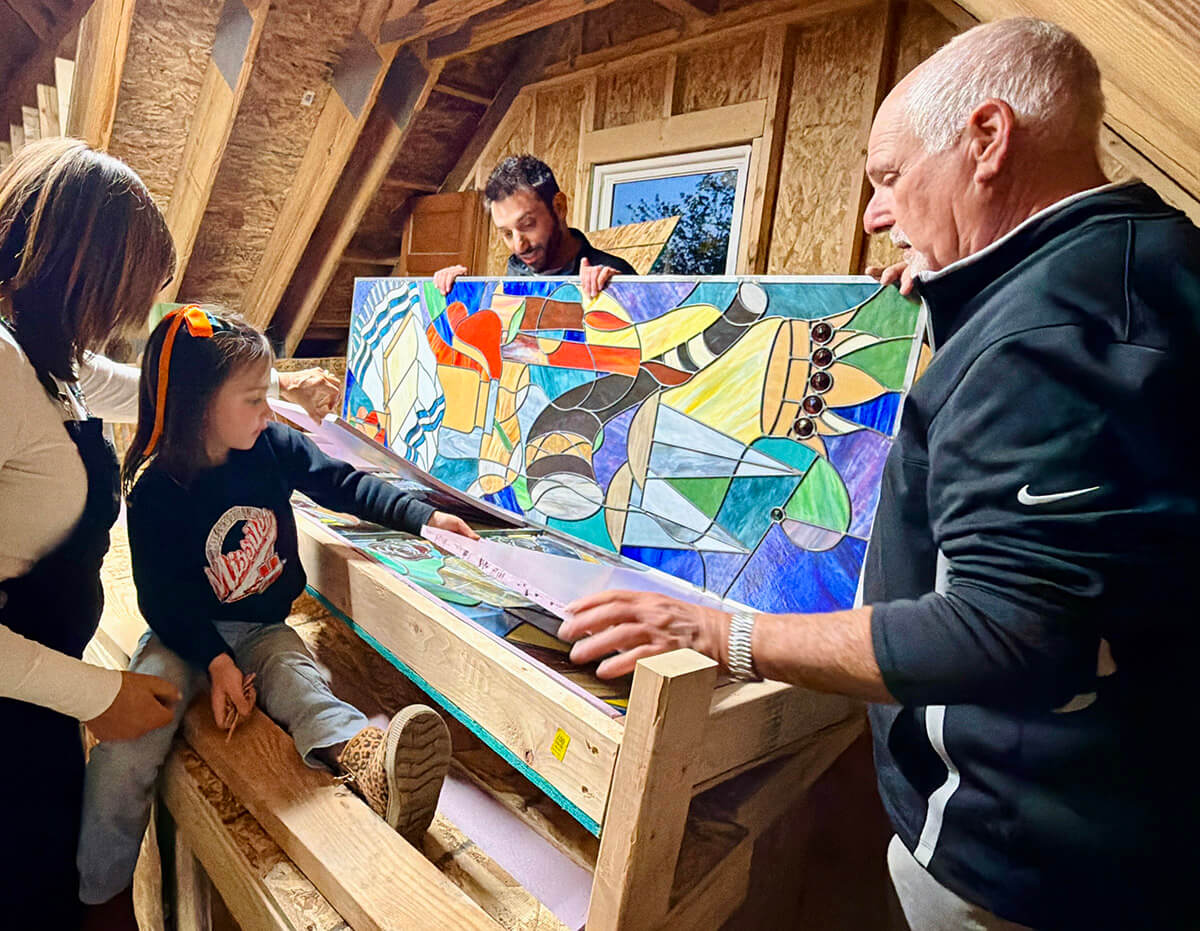
He is building the synagogue, in other words, the way his family survived: out of what other people were willing to give. When Hindertje Drenth asked her husband the simple question — “You said yes, right?” — it echoed across history. When Nik broke ground on the synagogue this spring, his neighbors — farmers of many faiths — showed up with their equipment to help.
“You go fast by yourself, you go far with others,” Nik said. “I have a community and a family and so many other people who, with their open arms, want to be part of this project.”
For Nik, the trip altered something more fundamental. “You sometimes feel like you’re on an island as a Jew, especially in rural America,” he said. “But being in the Netherlands, seeing how many people care about this story, it made me feel like you’re not running this race alone.”
When he talks about what he’s building, Nik does not describe it as preservation. He describes it as continuation. Preservation implies something fixed — a past held in place. What he is trying to do is something else: carry it forward, leave something behind so the next generation knows where to begin.
The synagogue, when it is finished, will include a museum to tell the stories of the Holocaust and of several now-shuttered shuls across America. Among the exhibits, Nik plans to recreate the room where his grandmother Edith spent nearly three years in hiding.
His childhood friend John Carroll, who is Lutheran, is the contractor on the project. “We want to allow people to transport themselves back to that time and space,” John said. “Not just to tell Edith’s story, but to feel the solemnity of it, and to walk out wanting to stand in the way of tyrants and do the human thing: be kind.”

And, like the synagogue in Groningen, it will be a place where schoolchildren come. Where the past is not just preserved, but taught. Where Holocaust stories that once survived in silence are spoken aloud.
“If you don’t share the story,” Nik’s mother, Margo, said, “it gets watered down until nothing is left.”
Nik’s cousin Hannah felt similarly. “My grandmother told the story,” she said. “My aunt Margo tells it. Nik tells it. And I’m one of the next people in line to do it.” She made it sound less like a burden than an honor. “What do you get to be responsible for? It’s really a blessing.”

In the Netherlands, Nik found himself circling the same idea. That the story he inherited is not just something to remember, but something to propel him forward. The Holocaust, for him, is not distant history. It is a presence, shaping decisions, framing urgency, making the question of what comes next feel less abstract.
For David Jakobs, Edith’s son and Nik’s father, that presence has always been harder to name. “We’re true children of survivors,” he said. “It’s something you feel inside. It’s a duty.”
In a moment when antisemitism is rising, when Jewish communities are once again thinking about safety and survival, the work they are doing takes on a different kind of weight. Not symbolic. Practical. What does it mean to build something that lasts? What does it mean to make it visible?
The synagogue will be filled. With prayer. With people. With noise. With life. Work on the site has begun and, if construction stays on track, the building could open in the fall of 2027. The first service, they hope, will be the bat mitzvah of Nik’s oldest daughter, Taylor.

It will likely be a large gathering. Members of the now-closed Temple B’nai Israel in McKeesport, Pennsylvania — the congregation that gave many of its sacred objects so that Nik’s could be built — are planning to take a bus trip to Illinois for the occasion. Their former rabbi has offered to officiate.
A congregation that no longer has a building will come to celebrate in one that does — the past arriving in the present, and continuing forward.
Nik has already begun thinking about what will happen inside the building once it is open. Among his ideas: bringing the story full circle. The play performed in Stadskanaal — the one that told the story of the Drenth family saving his own — could be staged again, this time in Illinois, inside the new sanctuary.
A Dutch story, performed for an American audience. One more thread carried across time and place.
The project, Nik said, has grown in ways he didn’t anticipate — each discovery leading to another, each story opening onto the next. “You pull a thread,” he said, “and more yarn comes.”
A tree replanted
That thread keeps unspooling. There is one more thing he hopes to plant.
Outside the synagogue, in the Illinois soil, Nik plans to grow a sapling from the chestnut tree Anne Frank saw from the attic window where she hid — the tree she wrote about as it changed with the seasons, marking time in a life suspended.
The original tree, weakened by disease, fell in a storm in 2010. But before it did, cuttings were taken and nurtured into saplings, now planted at schools, museums and memorial sites around the world, living descendants of the original.
Now, one will take root in Sterling. The offer came from Lauren Bairnsfather, the CEO of the Anne Frank Center USA — who, as it happens, grew up attending the same Pennsylvania congregation whose sacred objects are going to fill Nik’s synagogue.
For her, the connection felt unavoidable. “There are too many interwoven threads to ignore,” she said, pointing to the links between her family’s synagogue, Nik’s project and the story of Anne Frank.
Of all the work her organization does, she added, this project feels different. “This is the most hopeful,” she said. “We don’t plant a tree for ourselves. We plant it for the future.”

For Nik, the idea landed immediately. “My brothers and I, when we think about our farm, we think of ourselves as stewards — caretakers of it to pass on to another generation,” he said. “I feel the same way about this temple, and the same way about this tree.”
He views it as a responsibility. “It’s our honor to take care of the tree,” he said — to tend it, as he does his land, his livestock, his family, “and let it grow.”
When it is planted, the tree will stand just beyond the sanctuary — its branches stretching upward, its roots sunk into the same ground where a new synagogue is rising from the remnants of others.
A tree once glimpsed from hiding. A new one planted in the open.
The post An Illinois farmer thought he knew how his family survived the Nazis. Then he went to the town that saved them. appeared first on The Forward.
Uncategorized
A synagogue and Jewish-owned shops damaged in French riots
(JTA) — PARIS – Jewish-owned shops in Marseille were set ablaze and a synagogue in Paris was vandalized as part of widespread property damage caused by riots across France Saturday and Sunday, according to the Jewish Community Protection Service.
It is too early to assess the full extent of the riots protesting the rising cost of living and the damage they’ve caused, but various elements in the media have described them as civil unrest and chaos.
From Lille in the north to Marseille in the south and in the major cities in between, media estimate that nearly 800,000 people took to the streets and some 2,000 shops were vandalized or looted. Public buildings were set on fire, and hundreds of people or more were injured, including 150 police officers, with thousands arrested.
The riots followed a student uprising that blocked entrances to high schools across the country in recent weeks. Palestinian flags and keffiyas have been a recurring motif in most of the violent protests, acts of vandalism and looting.
But according to SPCJ, known as the Service de Protection de la Communaute Juive in French, there was no evidence that Jewish institutions or businesses were deliberately targeted.
Vandals broke into the Ohalei Yaakov synagogue in Paris’ 19th district overnight between Saturday and Sunday. On Sunday morning, members of the Jewish community discovered that their temporary place of worship had been broken into. The permanent synagogue building is currently undergoing renovations.
Inside the sanctuary, prayer books, tefillin, and various objects — taken from boxes and cupboards — were found scattered on the floor. The rabbi’s office was also searched. Despite the mess, the Torah scrolls appeared to be unharmed.
According to a member of the synagogue committee, the incident primarily points to an attempted theft. The suspects may have been looking for money, but nothing was believed to be missing.
This article originally appeared on JTA.org.
The post A synagogue and Jewish-owned shops damaged in French riots appeared first on The Forward.
Uncategorized
How much will Trump’s endorsement help Netanyahu?
(JTA) — JERUSALEM – Within minutes of President Donald Trump endorsing Prime Minister Benjamin Netanyahu in a post on Truth Social Sunday, Netanyahu’s campaign team had released a 30-second clip showing all the times Trump has lavished praise on the Israeli leader over the past few years.
With polls showing that Netanyahu and his governing coalition are slipping in their struggle to retain power in the upcoming Oct. 27 election and lag behind the opposition bloc, an endorsement from the president of the United States is a powerful statement.
But is it enough to tip the scales?
“I don’t think it will change anything,” said Ilana Shpaizman, a senior lecturer in the Department of Political Studies at Bar-Ilan University.
Of course, she said, “Netanyahu will say this is the proof that I’m a leader and all that, and I can speak to Trump … But so what? His followers already know that and they believe in him. They don’t need the endorsement.”
Those who oppose him, Shpaizman continued, “know that Trump forced him (Netanyahu) to accept the ceasefire in Gaza and accept the hostage deal, and that Trump runs the show around Iran. So they also don’t need the endorsement either,” Shpaizman said.
Some pundits speaking on Israeli news outlets criticized Trump for “interfering” in Israel’s election, while others put it down to the fact that Trump does not want America to return to fighting Iran alone if Netanyahu, who is hawkish on Iran, is replaced by someone less willing to act militarily. If Netanyahu loses, that is a scenario that could play out.
“This is the first time ever that the president, at least publicly, endorses a candidate in Israel’s election,” Bushinsky, a political commentator and former adviser to Netanyahu, told the Jewish Telegraphic Agency.
Bushinsky said he remembered Netanyahu complaining about U.S. intervention in previous elections in 1999 and 2001, when presidents less enamored of him were in office. He even pushed for an initiative that would block foreign funding for election campaigns.
Now, Bushinsky said, “I guess he is not complaining,” adding that the endorsement serves Netanyahu in two ways.
First, it signals that Trump thinks that Netanyahu is the most suitable guy for the job. Second, it puts Netanyahu’s election campaign back on track, refocusing attention on an issue where Netanyahu is strong – Iran.
“It lets him say ‘I can now finish a job, and I can finish a job with Trump,’ and ‘without Trump or without me, the job will not be finished,’” said Bushinsky.
He said that in the last few days, the political debate had pivoted to other issues such as Ashkenazim vs Sephardim, the draft law and the contentious efforts by the outgoing government to overhaul the judiciary.
“This [endorsement] is the ultimate campaign boost for Netanyahu,” Bushinsky said.
But that boost might not be enough.
Most of the polls taken in recent days show the opposition bloc led by former IDF chief Gadi Eisenkot pulling ahead of Netanyahu’s ruling coalition, but give neither bloc enough seats to gain the necessary 61 of 120 seats in Israel’s parliament, the Knesset, to form the next government.
“I think this might give Netanyahu one more seat, one more mandate, but not more than that,” said Bushinsky.
Prof. Tamar Hermann, director of the Israel Democracy Institute’s Viterbi Center for Public Opinion and Policy Research, said that the timing of Trump’s support for Netanyahu in this election race had come both “too late and too early.”
“It’s too late because people have already decided electoral preferences. They may shift within each bloc, but will not move between the blocs because of this,” she said. “And it’s too early because there are nine days to go to the elections, and we can already see other American leaders spilling some cold water over what he said, even on the Republican side of the aisle.”
This criticism, Hermann continued, will be transmitted to Israeli voters, and they will see that Trump is facing a huge battle in the upcoming midterm elections.
“The image of President Trump has deteriorated significantly since April 26, when he started the negotiations with Iran,” she said, pointing to one of the IDI’s recent public opinion surveys that found the president’s popularity had plummeted after he stopped the war with Iran without totally removing the threats against the State of Israel.
According to that poll, the Israeli public’s confidence in Trump as someone dedicated to Israel’s security fell from around 70% to just 42%.
“In my view, the endorsement will not make a big change,” Hermann added. “It will just strengthen Netanyahu’s political supporters, who will see it as a sign that he is still the internationally known figure that even the president of the United States is endorsing.”
She concluded, “The meaning of endorsement in Israel is totally different than in the United States … we are not that used to this kind of move, and it will not make people change their minds.”
This article originally appeared on JTA.org.
The post How much will Trump’s endorsement help Netanyahu? appeared first on The Forward.
Uncategorized
Trump endorses Netanyahu for reelection, warning Israelis against choosing another leader
President Donald Trump endorsed Israeli Prime Minister Benjamin Netanyahu for reelection, giving his longtime ally a major boost just nine days before Israel’s Oct. 27 election, which polls indicate could end without a clear winner.
“Please let this letter serve to represent my complete and total endorsement of Bibi Netanyahu in his upcoming race for re-election as Prime Minister of Israel,” Trump wrote Sunday in a lengthy post on Truth Social, praising Netanyahu as a strong leader and trusted partner in confronting Iran.
Netanyahu, Israel’s longest-serving prime minister, is seeking a seventh term after surviving political crises that repeatedly appeared likely to end his career — most significantly after the Oct. 7, 2023, Hamas attack. Recent polls suggest neither Netanyahu’s right-wing coalition nor the opposition is sure to win the 61 seats needed to form a government in the 120-member Knesset.
In his endorsement, echoing the sentiment of Netanyahu’s campaign, Trump warned Israeli voters that choosing anyone else as prime minister could put more pressure on the United States to deal with threats in the Middle East alone. “If Israel has the wrong leader, which would be anyone other than Bibi, America will have to do this work ourselves, and I am not inclined to do so,” Trump wrote. “Bibi Netanyahu has been strong, brave, and brilliant in the face of tremendous opposition, including that coming from even Israel, itself.”
Gadi Eisenkot, a former IDF chief of staff whose son was killed in the Gaza war, has emerged as Netanyahu’s chief rival. Eisenkot has floated a path to a government that does not require a majority in the Knesset. However, one of his partners in the anti-Netanyahu bloc, Avigdor Lieberman, has said in recent days he would oppose such a move. Recent polling puts Lieberman’s party at an average of eight or nine seats — enough to give Lieberman leverage in who leads the government.
Trump’s endorsement came hours after Netanyahu appeared on another program, the Fox News show Life, Liberty & Levin hosted by journalist and commentator Mark Levin. Netanyahu spoke glowingly of Trump and the importance of his battle to destroy the Iranian threat, as the American public prepares to head to the polls for midterm elections on Nov. 3. In that race, Republicans are fighting to maintain control of the House and Senate.
The U.S. war with Iran, which has slowed the flow of oil through the Strait of Hormuz causing gasoline prices to rise, has been unpopular with American voters and is often cited as one of the reasons Republican politicians could lose their races to Democrats.
Netanyahu made the case on Fox that the defeat of the Islamic Republic and the elimination of its nuclear program was critical to ensuring a safe American future. In the U.S., some lawmakers have insisted that the war was unnecessary.
If Iran can destroy Israel, it will conquer the Middle East, control world waterways and oil supplies and proceed to Europe and proceed “to the next target, which is you,” Netanyahu said, addressing a U.S. audience in his Fox News appearance.
A boost for Netanyahu in the final stretch
Trump has taken a personal interest in Israel’s election, but he held off on endorsing Netanyahu for months, raising questions about whether he was keeping his options open in case the longtime Israeli leader lost. “I’m not involved in [Israeli] politics anymore,” Trump told Time magazine in September. In an interview with Newsmax on Thursday, when asked whether he trusted Netanyahu, Trump said he did not trust anybody.
Sunday’s endorsement comes as Netanyahu steps up his campaign to rally his base and convince undecided voters that his close relationship with Trump is essential to Israel’s security. Trump remains popular in Israel, though his approval has declined in recent months following the ceasefire agreement with Iran. But the move could also complicate the president’s ability to influence what happens after the election, if neither political bloc wins a majority.
Trump has previously shown a willingness to pressure Israeli political leaders, including his public campaign last year for President Isaac Herzog to pardon Netanyahu of corruption charges.
Nonetheless, by declaring that Netanyahu is the only acceptable leader for the U.S. administration, Trump may have made it harder to persuade opposition parties to join a unity government led by Netanyahu if the election produces a political stalemate. It also gives Netanyahu another reason to resist stepping aside in post-election negotiations, knowing that the American president has publicly declared him the only alternative.
Netanyahu has already begun sharpening that message, arguing that he and Trump have unfinished business and only two more years to accomplish their shared goals before Trump’s term ends in January 2029. The messaging carries an implicit warning about Israel’s relationship with Washington after Trump leaves office. Whether the next president is Republican or Democrat, any Israeli leader may find it harder to maintain the same level of personal access and cooperation.
The election also carries broader consequences for American Jewry. Netanyahu has become increasingly unpopular among American Jews and Democrats, many of whom oppose his alliance with far-right and religious parties. A change in leadership could allow Israel to rebuild ties with Democrats and reconnect with parts of the American Jewish community — even without bringing nearly as much change in Israeli policy as some might hope.
Rep. Dan Goldman, a Jewish Democrat from New York who was defeated earlier this year in a primary that focused on his support for Israel, posted on X that the U.S.-Israel alliance “will suffer permanent damage if this Israeli government continues to hold power after the election on October 27.”
Polls point to another deadlock
The latest polls show that Netanyahu faces a difficult path to reelection.
Surveys published over the weekend show Eisenkot’s Yashar party ahead of Netanyahu’s Likud, with the opposition parties holding a combined 55 seats. The two Arab lists — the United List, a coalition of three Arab Israeli parties, and Ra’am led by Mansour Abbas — are generally counted outside either bloc.
Those numbers help explain why Trump’s endorsement matters.
A few additional seats could change the balance of power and determine who gets the first opportunity to form a government. And even if Netanyahu fails to secure a majority, he could still benefit from a political deadlock if his bloc wins enough seats to prevent the opposition from forming a government.
In that scenario, Netanyahu would remain prime minister until a new government is sworn in, potentially setting the stage for another election.
JTA contributed to this report.
The post Trump endorses Netanyahu for reelection, warning Israelis against choosing another leader appeared first on The Forward.
