


Uncategorized
Anyone saying Jews face a simple choice in the NYC mayoral election is not paying attention

(JTA) — As a New York City voter, I’m preparing to cast my ballot in the upcoming mayoral election. But as a congregational rabbi and now the head of the largest Jewish movement in North America, I’ve never told congregants for whom they should vote.
I won’t start now, despite the Trump administration’s misguided efforts to weaken the Johnson Amendment, the longstanding rule that bars congregations and their leaders from endorsing or opposing candidates from the pulpit. Keeping partisan politics out of our politically diverse congregations feels more essential than ever in today’s polarized climate.
I respect rabbinic colleagues who have added their names to the letter “A Rabbinic Call to Action: Defending the Jewish Future” — as more than 1,100 from across the country have now done. Similarly, I respect colleagues who have principled reasons for not signing on. The fact is that there is more than one way for rabbis to express moral clarity and to speak about urgent issues facing our community.
Addressing moral issues has always been part of the art of preaching sermons. And as always, clergy can do this during campaign season without crossing the line into electioneering.
As a rabbi, I am deeply committed to living Jewish values and looking at contemporary issues through the prism of Jewish tradition and values. Matters of Jewish safety and security are of paramount importance to me, especially now with rising incidents of antisemitism. Following the Anti-Defamation League’s report of a record-breaking 976 antisemitic incidents in New York City in 2024, the highest count in any U.S. city last year, this year has also seen an alarming increase in antisemitism including harassment, vandalism and physical violence.
Given these increasing threats to our community, we need a mayor who will work tirelessly to protect us. This includes making sure that the NYPD continues to provide extra protection for our community on Jewish holidays and at other moments of Jewish gathering.
I can attest that Zohran Mamdani is not lacking in empathy for the Jewish community’s anxiety over regular threats to our safety. In public interviews and in a personal meeting, I’ve heard him pledge to protect the Jewish community. But his many comments about the intersection of antisemitism and anti-Zionism — issues that are not synonymous but do overlap — have been problematic.
Expressing criticism of the Israeli government’s policies is not foreign to me or to many other ardent Zionists. However, denying Israel’s right to exist as both a Jewish and democratic state crosses the line from criticism of Israeli policy to a rejection of Israel and the 3,000-year-old identification of Judaism with Israel as the Jewish people’s homeland. And in an atmosphere where Israel is regularly and harshly demonized, Jewish safety is threatened.
Mamdani has been consistent in saying that he believes Israel has a right to exist as a state of all its citizens, but not as a Jewish state. This argument might sound tidy in a seminar; in the real world it is cause for grave concern. Given centuries of global antisemitism — from age-old accusations of deicide to the Inquisition to the Holocaust to Oct. 7 — as well as the many wars and terrorist attacks emanating from Israel’s neighbors over the last seven decades, the “one-state” solution Mamdani espouses would put the lives of the 7 million Israeli Jews at great risk and end Israel’s identity as the Jewish people’s homeland.
While this is a moment when our vulnerable Jewish community is rightfully lifting up the needs and dangers before us, our tradition forbids us from ignoring the many other compelling areas of vital concern for the Jewish community. Primary among them is addressing the many threats to the core pillars of our democracy that have given Jews the rights and freedoms that have allowed us to flourish in America and in New York City. These are the very pillars that promise hope for groups facing discrimination, barriers, and threats to their safety and well-being. Those priorities also include the moral responsibility to reverse the ever-widening gap between rich and poor New Yorkers.
Judaism has never been about caring only for our own community or just personal piety but rather, as the prophet Isaiah reminds us, a societal commitment to:
To let the oppressed go free;
To break off every yoke.
It is to share your bread with the hungry,
And to take the wretched poor into your home;
When you see the naked, to clothe him,
And not to ignore your own kin.”
— Isaiah 58:6-7
And when we are considering whom to elect as leaders, a candidate who has been morally compromised should not easily collect our votes. As I have questioned what Mamdani might do based on his statements, so too I question what Andrew Cuomo might do in light of past findings of his pattern of harassment, as documented in the New York Attorney General’s 2021 report. According to Psalm 15, a person of moral character is someone:
whose tongue is not given to evil;
who has never done harm to his fellow,
or borne reproach for [his acts toward] his neighbor;
who has never lent money at interest,
or accepted a bribe against the innocent. (Psalm 15:3, 5)
If you think the choice for mayor is simple, I respectfully suggest that you are not paying attention. I implore our Jewish community and all New Yorkers to carefully consider the many urgent issues our city faces before casting your vote. The stakes couldn’t be higher.
The views and opinions expressed in this article are those of the author and do not necessarily reflect the views of JTA or its parent company, 70 Faces Media.
The post Anyone saying Jews face a simple choice in the NYC mayoral election is not paying attention appeared first on The Forward.
Uncategorized
In ‘Fatherland,’ Thomas Mann finds a Germany divided
Speaking at the Library of Congress, just before the end of World War II, Thomas Mann insisted “that there are not two Germanies, a bad and a good one, but only one whose best qualities were perverted by devilish cunning into evil.”
Two years later, in 1947, he would publish Doctor Faustus, a meditation on his homeland’s slide into fascism in the idiom of Germanic legend. Two years after that, accepting the prize named for Goethe, the Faust legend’s greatest chronicler, he would return to Germany, which, by then, had split in two.
Paweł Pawlikowski’s Fatherland, is about the 1949 trip Mann took with his daughter Erika from American-administered Frankfurt to East German Weimar, then in the grips of Soviet control. They glide through bombed-out streetscapes in a black, all-American Buick. During the tour, dignitaries try to win Mann over to one of two ideologies vying to replace the fascist model: that of the free market, or that of Communism.
By the time the film takes place, Mann was an American citizen who had lived outside of Germany for over a decade. He railed against the Nazis and appealed to the conscience of his countrymen in radio broadcasts from exile in California. He had married into a Jewish family, and his anti-Nazi credentials were beyond reproach. But at a press conference in Frankfurt, when an AP reporter asks “where is home,” he responds in English with a German word that English can only approximate.
“I am an American citizen,” Mann, played by Hanns Zischler, answers. “I am also a German writer. Where my heimat is, where I belong, is a much more difficult question.”
His country no longer exists.
Pawlikowski, a Polish director whose silken, black-and-white films excel in painting the surreality of the Iron Curtain, plucked this compelling episode from Colm Tóibín novel of Mann’s life, The Magician. Zeroing in on the 1949 tour, he’s crafted an intimate story of a father and daughter navigating a new political order where one’s allegiance, as summed up by Mann’s son Klaus, is either to “Stalin or Mickey Mouse.”
When Klaus (August Diehl) dies by suicide while Erika and Mann are in the middle of the excursion, and Mann insists on sticking to the itinerary, the Great Man’s faults are blown open: He believes his lecture tour, and the power of words, can improve conditions for a nation, but he had long ago declared his son a lost cause.
Zischler’s performance is at once understated and monumental. His response to Richard Wagner’s glad-handing grandchildren, who want him to put in a good word for reviving his festival in Bayreuth, is a punchy quotable: “The opera should be razed to the ground and your mother should be put on trial.” His mystified look when a Soviet colonel asks him to discuss “Mephistophelian dialectics,” is better than any bon mot.
Hüller is dependably excellent, glowering at the supposedly de-Nazified guests at a banquet and musing to a former war correspondent comrade about “what they were up four years ago.”
Mann’s controversial visit to Weimar is marked by a perfunctory pilgrimage to Goethe’s final home for a photo op. Among the effects are Goethe’s death mask, a blunt-force metaphor following Mann’s speeches, to East and West Germans, extolling how the great poet “rejected the German Romantic death cult.”
When Goethe’s dead, can the winner of his eponymous prize make the rejection last?
History has a verdict. While Mann rejects his own Faustian bargains — the invitation to put in a good word for Wagner or take a job as president of the Arts Academy in East Germany — his fate is teased when Erika sees a catalogue of “Fifth Columnists,” which has his headshot near Einstein and Arthur Miller.
Mann was a victim of McCarthyism, and left his adopted country in 1952 to settle — and die — in the neutral environs of Switzerland.
The film has enough restraint to spare us this epilogue. It ends with a father, a daughter and a sublime expression of grief and untainted German art. (Fitting for Pawlikowski, whose films so often center music, it is a Bach composition that delivers the final beat.)
Mann never did make his homecoming permanent, but on this score, he had a properly self-aggrandizing, if apt credo: “Where I am, there is Germany.”
The post In ‘Fatherland,’ Thomas Mann finds a Germany divided appeared first on The Forward.
Uncategorized
This deli serves ham and calls itself Jewish. New Jersey says it’s not kosher.
The Kibitz Room in Cherry Hill, New Jersey, just outside of Philadelphia, serves shrimp salad. It also has a ham sandwich, and its doors are open on Saturdays.
So the people who run it were surprised this month when a state investigator walked in carrying a notice saying a deli with a “Jewish cheesesteak” on the menu needs to tell customers, in writing, that it isn’t kosher.
The backstory and fallout involve a brisket-boosting talk radio host, a rock-and-roll dive bar in Los Angeles, a historian known as Dr. Pastrami, a famous rye bread ad, and a question Jewish diners have been fighting over for the better part of a century: Can a deli be Jewish if it isn’t kosher?
Here’s the beef. The New Jersey Division of Consumer Affairs, which, yes, has a kosher fraud enforcement unit, sent an investigator to the Kibitz Room with a simple message. If you call yourself a Jewish deli, state consumer-fraud rules say you also have to post a sign, or otherwise let customers know, that your food isn’t under kosher supervision. The state isn’t accusing the deli of passing itself off as kosher, and it isn’t banning the word “Jewish.” It just wants a disclaimer next to it.
Neil Parish, 62, who runs the Kibitz Room with his son, Brandon, wasn’t having it. He told the investigator, “You’re not going to come in here and dictate to me the verbiage that I’m going to put on my menu,” he said in an interview with the Forward.
Parish grew up working in delis, first as a dishwasher at 14, and then he was slicing meat by 16. Apart from a six-year stretch in a job with health insurance (“I wasn’t cut out for that,” he says), he’s been in delis ever since.
Which is why the notice struck him as absurd. In Parish’s telling, no observant customer has ever mistaken the Kibitz Room for a kosher deli.
The state is proposing a $1,000 penalty and wants a sign that’s visible to customers saying the deli isn’t kosher. For Parish, it’s the principle, and what he calls government overreach. He says he told the investigator, “I’ll see you in court. I hope the Supreme Court,” adding that “we’re taking this thing to the end. Period. I’m not stopping.”
The fraud squad
New Jersey’s kosher unit spends most of its time on businesses that say they’re kosher.
The biggest cases involve packaging. In 2014, ShopRite’s supplier cooperative agreed to pay a $35,000 penalty for putting a kosher symbol on private-label coffee bags without the certifying agency’s approval. The state leaves the definition of kosher to rabbis. Its job is to check that sellers are telling the truth.
Delis that call themselves Jewish without claiming to be kosher are a smaller slice of the caseload, but not an unheard-of one.
The spark seems to have been lit on Sept. 14, when NJ.com published “New Jersey’s 15 best Jewish delis, ranked for 2026.” The Kibitz Room came in eighth.
Shortly after, the state investigator walked into Radin’s Delicatessen, a mile down the road and ranked No. 7, to see whether it was passing itself off as kosher.
Radin’s owner is Russ Cowan, a fourth-generation deli man, and the original owner of the Cherry Hill Kibitz Room, which he opened in 2001. He was happy to schmooze with the inspector. “Jewish does not mean kosher, and kosher style does not mean kosher,” he said in an interview with the Forward. “But for me personally, I avoid saying either because I don’t want to confuse a customer that might think we are kosher.” His shop sells bacon, ham and cheeseburgers.
When people ask what line of work he’s in, he replies, “the corned beef and pastrami business.” He had replicas made of the neon signs from his family’s old Brooklyn delis, and he says he took the word “kosher” off them.
Rabbi Chaim Dovid Zwiebel, executive vice president of the Orthodox advocacy group Agudath Israel of America, has been watching these fights for more than 20 years. His group supported New York’s kosher fraud law back when it was battling for survival in court. He argues kosher claims should be policed like any other: “From a perspective of consumer fraud,” he said, “the fact that we happen to be speaking about religious items shouldn’t make a difference.”
He isn’t bothered by what New Jersey is asking of the Kibitz Room. “The least you can do is put the disclaimer,” he said, referring to a sign saying the deli isn’t under kosher supervision, posted where customers can see it.
But he sees another problem. The word “Jewish,” Zwiebel says, “kind of implies there are certain foods which are reserved exclusively for Jews.” The current controversy reminds him of an iconic ad campaign, he says.
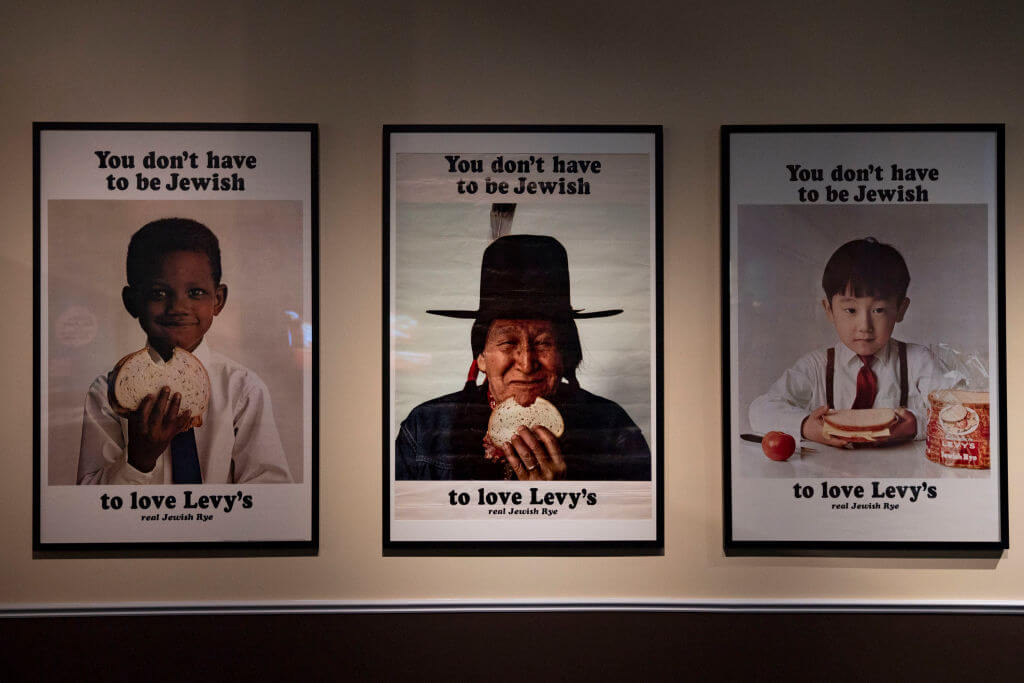
Starting in 1961, subway posters around New York showed an Italian grandmother, a Black child, an Asian kid and a Native American man, each enjoying a sandwich on Levy’s Real Jewish Rye, with the tagline: “You don’t have to be Jewish to love Levy’s.” The Brooklyn bakery had been losing customers as Jewish families moved to the suburbs. The campaign made Levy’s the top-selling rye in the city.

But Zwiebel takes umbrage with the larger concept. “Forget about the misleading nature that a phrase of ‘kosher style’ might be,” he says. “Jewish style is not so much misleading; it’s just deeply offensive.”
Offensive to whom, and why, depends on who you ask. And whether a deli can call itself Jewish without being kosher has been a fight for a long time.
‘A secular synagogue’
Ask people who’ve spent their careers thinking about Jewish delis what they make of the New Jersey news, and the first response is surprise.
To Jeffrey Yoskowitz — host of the podcast Meet Me at the Deli and co-founder of Gefilteria, which reimagines Eastern European Jewish cooking — the notice “clearly comes from a place of ignorance or not understanding.”
To understand the fight, start with how the Jewish deli began. In the 1880s, a wave of Jewish immigrants from Eastern Europe began arriving on the Lower East Side. They borrowed the format of the German delicatessen to sell the foods they’d left behind. Pastrami came from Romanian Jews. But hot pastrami on rye, says Yoskowitz, “is an entirely American innovation.”
Then the deli became a place to sit. Yoskowitz says it turned into what’s sometimes called a “secular synagogue,” where immigrants could feel Jewish, speak Yiddish and become American at the same time.
Kosher was part of the story, never all of it. In 1915, New York amended its false-labeling law to punish fraud in the sale of kosher meat, but that didn’t solve the problem. According to “I’ll Have What She’s Having,” a traveling deli exhibit, an estimated 40 percent of the meat sold as kosher in New York in 1925 wasn’t. Meanwhile, delis multiplied. By the early 1930s, the city had roughly 5,000 of them.
Lara Rabinovitch, who was a co-curator of the exhibit, isn’t sure the question can be answered. To really answer it, she says, “you have to get to the question of what is a deli, what is Jewish? What do those two words even mean?”
Rabinovitch has a PhD in Jewish food history from New York University. Back in grad school, her husband got tired of her long academic answers about her work and told her to “just say you have a PhD in pastrami.” The nickname stuck. She’s now Dr. Pastrami, and has a Substack newsletter.
The only part of the story that really troubles Rabinovitch is “whether the deli pays explicit homage to its namesake, the original Kibitz Room attached to Canter’s Deli” in Los Angeles. Missing that, she said, “would be a shanda.”
That Kibitz Room is a legend. It opened in 1961 as a cocktail lounge next to the dining room at Canter’s Deli. It has a full bar and a small stage, with live music or comedy most nights that often turns into a jam session by midnight. Everyone from Joni Mitchell to members of Guns N’ Roses and the Red Hot Chili Peppers has passed through. (Cowan, who founded the Cherry Hill Kibitz Room, says he was inspired by the Kibitz Rooms at Canter’s and at Attman’s in Baltimore.)

David Sax, author of Save the Deli, has been in the middle of this argument for years. He heard it constantly after his book came out, he says: deeply kosher people insisting a deli can only be Jewish if it’s kosher, and everyone else saying it’s Jewish if it serves kosher-style food.
“The same fight, the same battle, has been going on for the better part of a century,” he says. Can a deli be Jewish without being kosher? “Yeah, 100 percent.” Ban the non-kosher ones, he says, and you lose Katz’s, Carnegie, Canter’s and Langer’s, “almost every single famous and well-known Jewish deli” in the U.S.
“Does it make it less Jewish? Sure, if that’s your definition of Jewish,” Sax says. “But how do you define Jew? Who is a Jew?”
Brisket boosterism
By the second week of October, the notice to the Kibitz Room had found its way onto New Jersey 101.5, the statewide talk radio station, where host Bill Spadea spent most of his show pontificating about it.
Spadea grew up in Cherry Hill. Friday nights meant pizza from a shopping center in the Woodcrest neighborhood, next to a Jewish deli where his dad ordered the chicken livers and chopped egg. He admitted on the air that he had never been to the Kibitz Room. He wanted his listeners to go anyway. “Get them sold out today,” he said. Then, in case that was too vague, he added: Buy the brisket.
His theory of the case was that nobody was fooled. “No consumer was harmed in the creation of a kosher-style Kibitz menu item,” he argued. No observant diner, he figured, would see pastrami with Swiss and think they were in a kosher kitchen. A listener texted in that Little Caesars isn’t Italian food, it’s Italian-style.
Parish agreed with that logic. “When I go into an Italian restaurant, it doesn’t say ‘not authentic Italian American,’” he says.
What really got to him was the adjective. “You want a Jew to change his menu to not use the word Jewish,” Parish says. (The state isn’t asking the Kibitz Room to drop the word. It wants a disclaimer next to it.)
Parish says he is not planning to pay the penalty and that “a very powerful Washington D.C. law firm” will represent him at a hearing scheduled in the coming weeks.
To Parish, the notice didn’t arrive in a vacuum. He says it landed at a moment when Jews feel under threat, around the world but “especially in this country and in my community.” He says he has customers in Cherry Hill who have taken the mezuzahs off their doors “because they’re scared.” His daughter and son-in-law live on the Upper East Side, and the stories he hears from them about rising antisemitism in New York City are worse, he says.
So when the state investigator — who is Jewish — showed up to talk about his menu, Parish says he lost his temper. Echoing a quote from Israeli Prime Minister Menachem Begin, Parish says, “I’m not the trembling Jew. I’m not going to take this anymore.”
Which may explain the Kibitz Room’s Instagram bio, which now reads: “Not kosher. Still Jewish.”
The post This deli serves ham and calls itself Jewish. New Jersey says it’s not kosher. appeared first on The Forward.
Uncategorized
AIPAC to halt direct campaign contributions and candidate endorsements
(JTA) — The American Israel Political Affairs Committee has announced that it will no longer make direct campaign contributions or endorse candidates, instead focusing on mobilizing individual donors.
The pro-Israel lobby disclosed the change in a letter to its members on Wednesday, as first reported by Jewish Insider. The letter stated that the lobby would still operate its super PAC, the United Democracy Project, which was launched alongside AIPAC’s PAC in 2021, ahead of the 2022 midterms.
The strategy shift occurred in an increasingly tense environment in which AIPAC has become a boogeyman among many progressive politicians – particularly among members of the Democratic Socialists of America in their Democratic congressional campaigns.
“We will prioritize increasing direct, organized contributions from individual Americans to candidates – expanding upon our current efforts – and maximizing the emerging political fundraising tools,” the AIPAC letter stated.
“Endorsements, direct PAC contributions, and earmarking will no longer be part of our approach so we can expand individual giving and utilize new tools to help our friends win,” the lobby added.
The letter detailed the lobby’s accomplishments in this political cycle, saying it helped 290 pro-Israel candidates secure election wins nationwide and prevented 29 “detractors” from winning.
Looking ahead, the letter noted that “the 2028 cycle will demand an even stronger commitment by our activists to pro-Israel politics.” As a result, the lobby said it would be important to adopt new fundraising strategies and ensure that individual member contributions are being used as effectively as possible.
“Our mission and strategy remain the same,” AIPAC spokesperson Deryn Sousa told the Jewish Telegraphic Agency in a statement.
“Our goal is to build support for the U.S.-Israel relationship,” Sousa added. “AIPAC members gave more than $90 million directly to candidates this cycle, and that organized, direct giving from our members will continue and increase.”
This article originally appeared on JTA.org.
The post AIPAC to halt direct campaign contributions and candidate endorsements appeared first on The Forward.
