


Uncategorized
US soldiers stationed in Kiryat Gat turn sleepy Israeli city into an unexpected hotspot
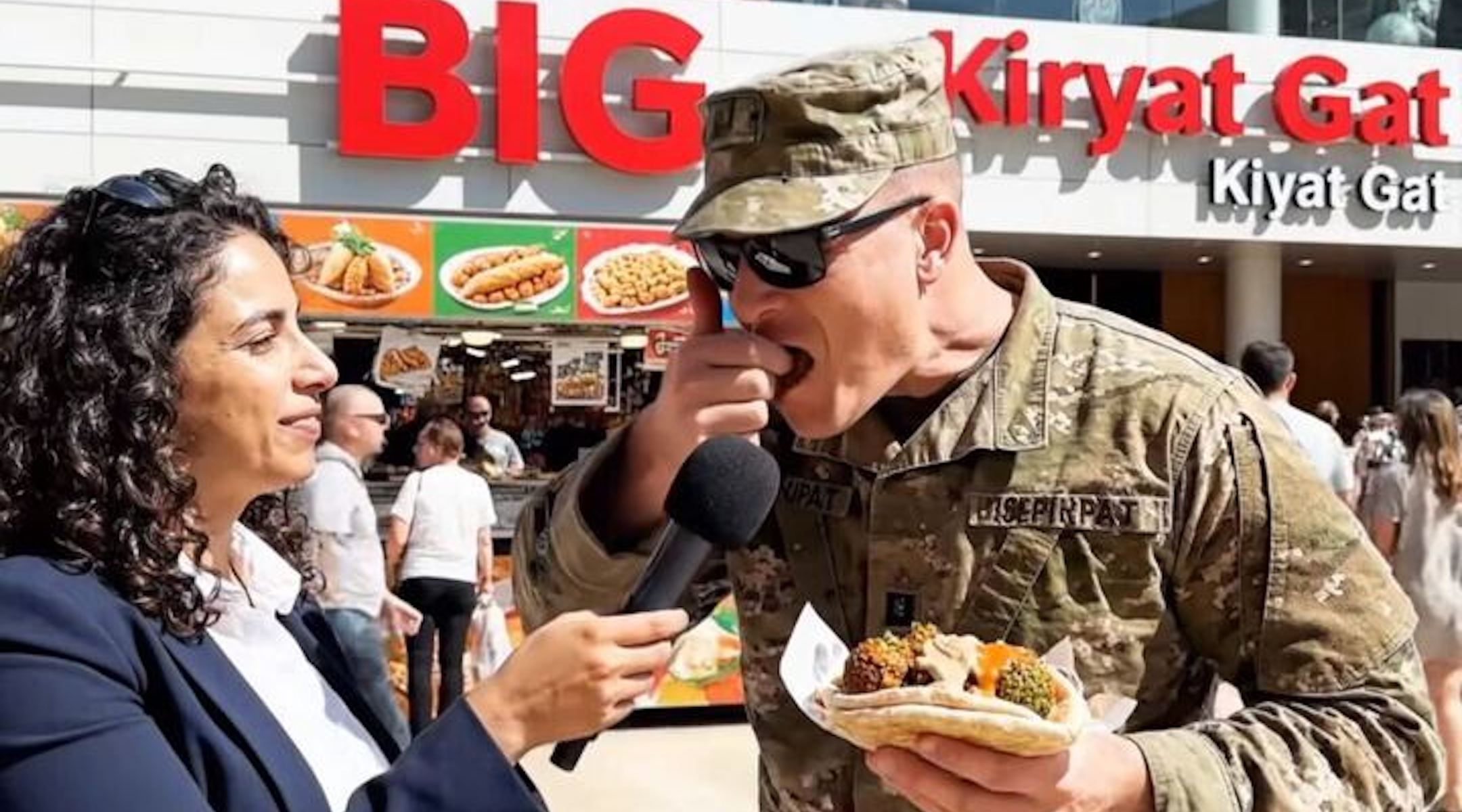
At one of Kiryat Gat’s main shopping complexes, U.S. Army camouflage does everything but blend in.
American troops in fatigues move between shawarma stands and sports-shoe stores, a new presence in the southern industrial city, part of a multinational civil-military coordination center set up to monitor the Gaza ceasefire. The center, housed in a converted logistics building about 15 miles from the Gaza border, opened last week with roughly 200 American personnel as well as smaller contingents from at least eight other countries.
By the weekend, the sight of Americans in uniform had become routine. “Big guys, all in perfect formation,” one shopkeeper at the BIG mall told the Walla news site, “like they came out of a Hollywood movie.”
Cafes, restaurants, and food delivery services have been “working around the clock” to accommodate the city’s new foreign guests. On social media, commenters called the deployment “a new world order,” noting that Kiryat Gat was trending for the first time in years — and not because of pop star Ninet Tayeb, still the city’s most famous export.
City officials have leaned into the moment. Mayor Kfir Swisa publicly welcomed the deployment, telling residents the personnel were “received with open arms,” framing the center as both a security asset and an unexpected local boon. Senior U.S. officials have visited the site in quick succession, including Vice President JD Vance and Secretary of State Marco Rubio, who said U.S. ambassador to Yemen Steven Fagin would oversee the civilian side of operations, while U..S Central Command’s Adm. Brad Cooper would handle the military track, including Hamas’s disarmament.

U.S. Vice President JD Vance speaks alongside Steve Witkoff, U.S. Special Envoy to the Middle East, Admiral Brad Cooper, commander of the United States Central Command, and Jared Kushner, during a press conference following a military briefing at the Civilian Military Coordination Center in Kiryat Gat Tuesday, Oct. 21, 2025. (Nathan Howard for The New York Times)
During an interview on Channel 12’s current-affairs program, host Avri Gilad asked Swisa whether the arrival of the Americans had changed life in the city. Swisa replied that it “puts Kiryat Gat on the map,” adding that “now the Americans have also realized what many young Israelis already know” — that the city’s location near the cross-country Highway 6, its rail link, and its “rich cultural and sports scene” make it an appealing place to be.
Gilad cut in, “They didn’t come here for the sports life.” He went on to ask if there had been “any new love interests,” echoing online chatter about whether romances might bloom between U.S. soldiers and local women, before inquiring how many McDonald’s branches Kiryat Gat has.
“They haven’t asked for a hamburger yet,” Swisa said. “They’re enjoying the local Kiryat Gat food.”
US troops that are the core of Gaza implementation framework shopping near base inside Israel (Kiryat Gat).
VP @JDVance enroute for photo-op. But remote control Hamas disarmament is a longshot and beyond. Watch this space pic.twitter.com/PiX4vlrj1V
— Prof Gerald M Steinberg (@GeraldNGOM) October 21, 2025
The BIG shopping complex where the American soldiers have been spotted is in Carmei Gat, a neighborhood whose rapid growth prompted one mainstream Israeli newspaper to dub Kiryat Gat as the new capital of the Negev, overtaking Beersheba as the region’s commercial hub. A new housing agreement set to be signed later this week in the presence of Prime Minister Benjamin Netanyahu will add 21,000 apartments in Carmei Gat, doubling Kiryat Gat’s size and making it one of the 10 largest cities in Israel.
The neighborhood is also home to evacuees from Nir Oz, the Gaza envelope kibbutz that was relocated there after being attacked on Oct. 7. One convenience store owner, Shai Avisror, himself displaced from Kibbutz Zikim, said anyone arriving in uniform gets a free coffee or cold drink.
“Soldiers are the holy of holies,” he told one reporter, though it’s unclear if the same rule applies to the Americans.
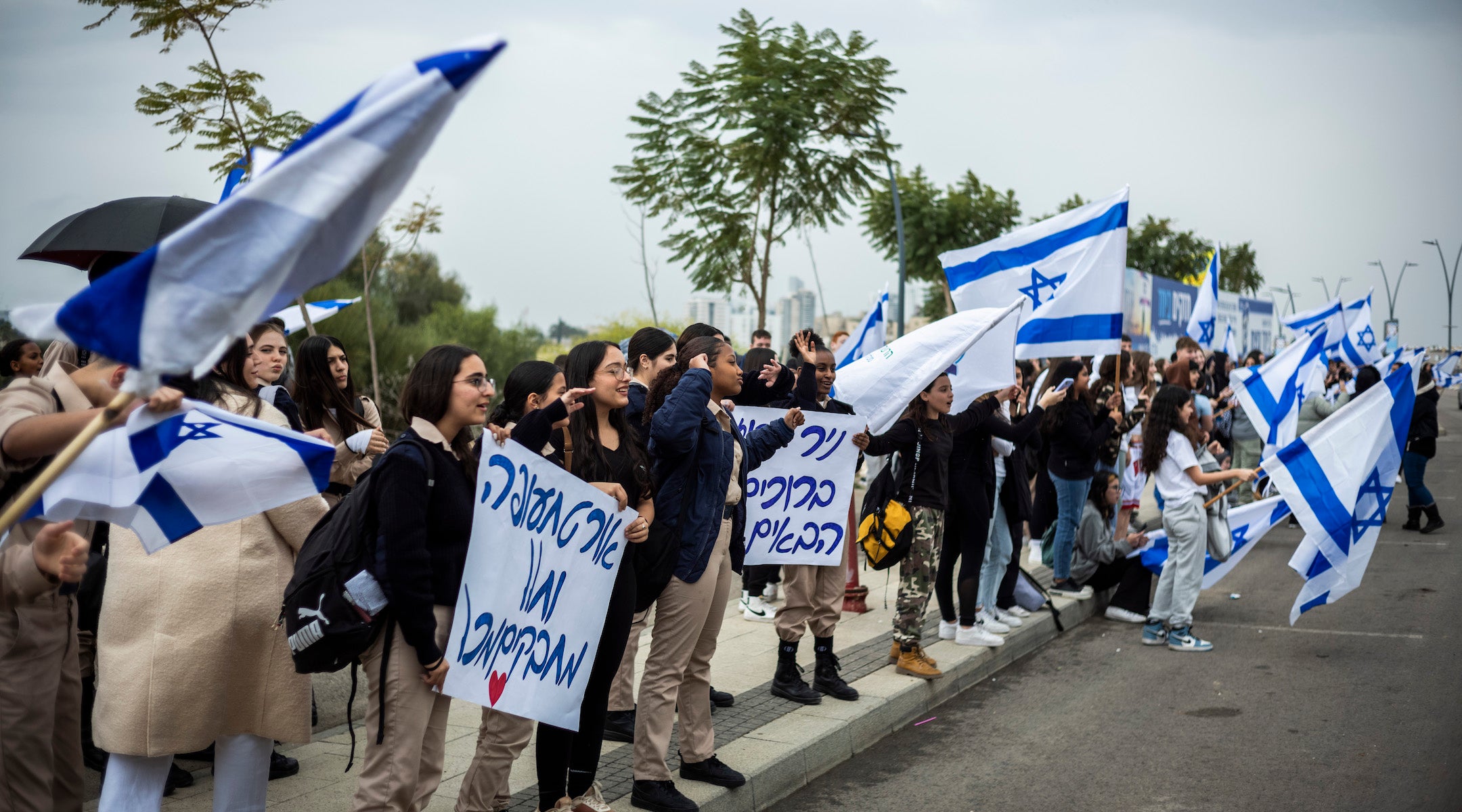
School kids welcome residence of Nir Oz as they arrive at the temporary housing location in Kiryat Gat on Jan. 2, 2024. (Ilia Yefimovich/picture alliance via Getty Images)
Not everyone shared Swisa’s enthusiasm, with some residents warning that the American presence would endanger the city. “Until now it was relatively quiet here, and now we have become a strategic target,” one commenter wrote. Another wrote that the deployment would give “Hamas, Iran and the Houthis a reason to launch missiles” at the city, and advised homeowners to start selling apartments quickly because “Kiryat Gat is about to become Ofakim” — a reference to the Gaza envelope town that was attacked on Oct. 7. A third commented that while the city now boasted “a U.S. command center,” it still lacked “a cinema, a vehicle-testing station, a pub or even one good restaurant open on weekends.”
He added, “Thank God we are on Highway 6 and can get away fast.”
One commenter went further, alleging that the Americans were “FEMA soldiers” forming a multinational force that would eventually replace the IDF and police “in preparation for a single world government,” a conspiracy theory tied to claims about “Agenda 2030.”
Much of the commentary reflected a broader unease over who is now directing events in Gaza. One user warned that “the Americans are only the beginning,” predicting “an airlift of Turkish and Indonesian soldiers soon and God knows who else they’ve sold us to.” Referring to Netanyahu as “Trump’s prime minister,” one commenter tied the moment to the dispute over the haredi draft, writing that with ultra-Orthodox men refusing to enlist, “there’s no choice now but to bring in American reinforcements.”
Netanyahu has said he would not allow the deployment of Turkish troops in Gaza and insisted that Israel remains fully sovereign, telling his cabinet that it “does not seek anyone’s approval” for actions carried out there.
Critics say the Kiryat Gat command center reflects a mismatch between its stated purpose and Israel’s main security priorities, focusing on humanitarian coordination and ceasefire maintenance rather than disarmament and anti-smuggling operations. Meir Ben Shabbat, head of the Misgav Institute for National Security and Zionist Strategy and a former national security adviser, wrote in the Israel Hayom daily that Israel “must eliminate the vagueness concerning headquarters and mediation and coordination entities” and explain what the center will actually contribute toward achieving Israel’s objectives in Gaza.
But for now, the relationship between the U.S. soldiers and their newly adopted city is still in a honeymoon period. An AI-generated video circulating on social media and shared by the city showed an American soldier speaking fluent Hebrew and praising Kiryat Gat’s “falafel, with tahina and amba — just delicious.”
—
The post US soldiers stationed in Kiryat Gat turn sleepy Israeli city into an unexpected hotspot appeared first on Jewish Telegraphic Agency.
Uncategorized
A Chabad Jew was stabbed in NYC. He returned the next day to continue wrapping tefillin.
(JTA) — Less than 24 hours after he was stabbed in midtown Manhattan, Yosef, a Chabad-Lubavitch man from Crown Heights, was back on the same street where he’d been assaulted, popping into Diamond District businesses as usual to help employees wrap tefillin.
Yosef, 26, who did not share his last name to maintain his privacy, told the Jewish Telegraphic Agency that he was back on 47th Street on Thursday afternoon, the day after the stabbing, without missing a beat in his Monday-through-Thursday rounds even as police investigate the incident as a possible hate crime.
A number of the people he visited pieced together that the widely circulated footage of a man being stabbed the previous night was of him.
“They were in shock. They were obviously scared for me,” said Yosef, who has been wrapping tefillin and distributing Shabbat candles to Jewish Diamond District employees for about three years. He started that routine when his father, a Chabad Jew who works in the jewelry business, realized he needed his son’s help to handle the demand for those acts. Yosef told Chabad.org that he was “still shaken” by the attack a day later.
Still, he told JTA, “We can’t allow some hate to stop us.”
Yosef said he felt it was important to communicate that message because “we need more mitzvahs in the world, we need more light in the world.”
Yosef was taken to Bellevue Hospital on Wednesday evening around 6 p.m., where medical staff assessed that he had no internal bleeding and would not need stitches. No arrests have been made, but the assailant has been described as a woman in her 40s.
The attack has renewed concerns about security that have faced Chabad adherents and institutions, which often host public events and maintain a visible street presence. But the threat didn’t diminish their presence in midtown Manhattan on Friday.
Multiple Chabad men stood under a bright yellow tent on the sidewalk wrapping tefillin for a steady stream of workers in the heavily Jewish Diamond District.
“The Rebbe says that the way to defeat darkness is only through the addition of light,” said Shmuel Cohen, who was handing out small photographs of the movement’s late leader, the Lubavitcher Rebbe Menachem Mendel Schneerson.
Cohen told JTA that he had not heard about the attack that took place just down the block two days earlier, though his partner under the sidewalk tent had. Cohen said that the best way to respond is through “the observance of Torah and mitzvot without being ashamed of our Judaism but presenting it to everyone.”
Also on Friday, Chabad officials met with New York Police Department representatives for their annual meeting about security ahead of Chabad’s international conference in Crown Heights, the Brooklyn neighborhood where the movement is headquartered. The conference begins on Nov. 5.
Chabad has been targeted in multiple high-profile attacks in the past year, including the deadly Bondi Beach shooting in Australia in December. The following month, a man rammed a car into the doors of the Chabad-Lubavitch headquarters in Brooklyn, raising further questions over how the movement should balance its commitment to making its events accessible with security.
Meanwhile, Jews have been targeted in more than half of hate crimes committed in New York City in 2026, despite making up about 12% of the city’s population.
“Security is our top priority. Our goal is to provide an environment where every participant feels safe and can fully experience the purpose and spirit of the gathering,” said Rabbi Mendy Kotlarsky, a top organizer of the upcoming conference.
In the wake of the attack, Yosef said he is not concerned about going out in public as a visibly Jewish person and doesn’t plan to change how he approaches the world.
“I was wearing the same clothes on Tuesday and Wednesday and Thursday,” he said. “I didn’t change my routine.”
This article originally appeared on JTA.org.
The post A Chabad Jew was stabbed in NYC. He returned the next day to continue wrapping tefillin. appeared first on The Forward.
Uncategorized
They met on a Birthright trip then married. Now this American Israeli couple’s internet fame has turned to infamy.
Ethan and Hila Klein first met at Yad Vashem — Israel’s Holocaust museum — in 2007, a meet-cute they recounted, giggling, years later for their millions of YouTube followers.
“I think I went up to her and said something like, ‘They had it coming, don’t you think?’” said Ethan, known for his edgy humor and infamous internet trends, including Vape Nation and Papa Bless. “No I didn’t say that. I wonder if you would have laughed though.”
They were on a Birthright trip, Ethan an American and Hila an Israeli soldier on leave to join the group. Soon after the trip ended, Ethan moved to Israel to be with Hila, and the two began making videos under the name H3H3 Productions (the H for Hila and the 3 standing in as an E for Ethan). They married, moved to America, and started a popular podcast.
A Jewish love story, until Thursday, when Hila, now mother to their three children, accused Ethan publicly of having a months-long affair.
“The betrayal I feel is immeasurable,” Hila said in an Instagram post. “My only family on this side of the world. How do I even begin to make sense of this?”
Ethan reposted her statement.
Their podcast is run by a handful of crew members who often chime in and participate in various skits and bits. The crew also shared a statement saying they stand with Hila and refuse to work with Ethan, though they added they don’t know what this will mean for the future of the show.
A couple roiled by Oct. 7
The left-leaning, secular couple’s videos and podcasts focused primarily on pop culture, internet drama and general politics, not Jewish or Israeli issues.
Both Ethan and Hila would make statements sometimes when tensions in Israel flared, and they would occasionally speak out against IDF actions that upset them.
In 2021, Ethan started a podcast with political commenter Hasan Piker, a controversial left-wing influencer, called Leftovers, a nod to their leftist politics.
Then came Oct. 7.
Ethan, an American Israeli dual citizen like Hila, was horrified by the attacks but quick to call the IDF genocidal in the aftermath. In their first episode together after Oct. 7, Ethan and Piker said the show would continue through their disagreements. The episode was tense, and it was their last.
As Piker’s rhetoric on Israel intensified and became at times antisemitic, the two began a nasty internet feud, culminating in a nearly five-hour livestreamed debate.
Piker posted about the news of the affair on X, sharing a video of Ethan and expressing disgust for men who cheat.
“Now this is a high caliber man [with] good morals,” Piker said sarcastically. He also posted “Judge me by my enemies” after sharing Hila’s statement.
Hila, who owns a makeup and clothing company, increasingly came under scrutiny by Piker and others after Oct. 7 for her service in the IDF. Artists refused to work with her. One model she hired publicly disavowed her after finding out she was Israeli.
The couple was harassed, sometimes online, sometimes in-person, as they attempted to take what they viewed as a nuanced stance in the aftermath of Hamas’ attack on Israel and the ensuing war in Gaza. The united front seemed to fortify their relationship, as Ethan, ever outspoken, routinely came to his wife’s defense.
Their show lost thousands of subscribers, but loyal fans stuck with them — fans who now say they are gutted and confused by the news of the affair. Many in disbelief noted that Ethan had Hila’s face tattooed on his arm less than two years ago as a surprise for her.
“The greatest thing a man can do for his children is to love their mother,” says the quote surrounding the tattoo.
The Forward attempted to contact the Kleins through their work emails and did not immediately hear back.
The post They met on a Birthright trip then married. Now this American Israeli couple’s internet fame has turned to infamy. appeared first on The Forward.
Uncategorized
These Jewish college students have some ‘nonnegotiables’ for El-Sayed
At the University of Michigan, first-year student Robert Kashan, 18, and sophomore Jacob Reich, 19, sat behind a large blue sign. “Some things are nonnegotiable,” it declared in all caps.
The sign laid out their requirements for any candidate seeking their support: a commitment to Jewish safety, “including for Zionist Jews,” and supporting Jewish statehood in Israel, among other positions.
“Zionism is a legitimate part of the Democratic coalition, and a lot of us are feeling less represented by the Democratic Party,” Kashan told the Forward.
The students are part of a broader “Nonnegotiable” movement in Michigan, a coalition of Jewish Democrats who are spelling out their dealbreakers for candidates ahead of the Senate election between Democratic nominee Abdul El-Sayed and Republican nominee Mike Rogers.
The movement has attracted national attention, with hundreds of rabbis across 34 states signing on to the “Nonnegotiable” demands. Meanwhile, about 20 students at the University of Michigan have publicly signed, while hundreds more offered support anonymously, according to Reich.
The “Nonnegotiable” supporters aren’t saying whom they’ll vote for if their concerns aren’t addressed — or whether they’ll vote at all. But they are pushing back against the assumption that Jewish voters will, as the saying goes, “vote blue no matter who,” urging El-Sayed to engage with their demands if he hopes to earn their support.
That’s in contrast with two other Jewish political camps, including a group called Michigan Jews for Democracy that endorsed El-Sayed. Their petition, which has garnered almost 1,000 signatures, notes that some signatories hold reservations about El-Sayed but are voting for him nonetheless as a check on President Trump.
“We understand that a vote is not a valentine; it’s a strategic chess move,” the petition reads.
A competing petition, dubbed “Michigan Jews Against Extremism,” has drawn hundreds of signatures from Michigan Jews who plan to vote for Rogers. That petition similarly emphasizes that Rogers voters may still have reservations about the candidate: “Our vote for Mike Rogers does not require that we agree with him on every issue or that we support President Trump,” it reads.
“Nonnegotiable,” meanwhile, rejects the idea that Jewish voters would have to choose between Zionist and Democratic values. Some have criticized the nonnegotiable movement for ignoring the reality of the electoral choice at hand. Others have called it “a veiled attempt to excuse the actions of Jewish Democrats who want to feel validated about voting for Mike Rogers.”
But Kashan and Reich, who met at Hillel and plan to major in political science, said the “Nonnegotiable” movement was the only way they could see themselves engaging in the election, as they felt increasingly pulled between their identities as Democrats and as Jews.
Some Michigan Jews have expressed alarm at El-Sayed’s questioning of whether Israel should exist as a Jewish state and his decision to campaign alongside controversial Twitch streamer Hasan Piker, who has been accused of antisemitic rhetoric. Rogers, who Trump has endorsed, earlier this week called El-Sayed “anti-Jew.”
In a letter to Michigan Jews, El-Sayed has vowed to “stand up against antisemitism and take the threat of violence against our Jewish community incredibly seriously.” He has also hired a Jewish liaison in the final weeks leading up to the election.
This will be the first election when Kashan, who just turned 18, is eligible to vote, and Reich’s first national election after voting in a local primary in his hometown of Palo Alto, California. For both, voting Democratic in their first major election had once seemed like a given.
“I’m a Jewish Democrat, and I want Democrats to take the Senate,” Reich said. “I want to vote for a Democrat in my own state.”
They’re still holding out hope that will happen — and that, with less than two weeks until the Nov. 3 election, El-Sayed will sign on to their petition.
And if he doesn’t? Neither student is ready to say.
The post These Jewish college students have some ‘nonnegotiables’ for El-Sayed appeared first on The Forward.
