


Uncategorized
As 1000+ rabbis sign anti-Mamdani letter, others decry mounting ‘red lines’ in Jewish communities
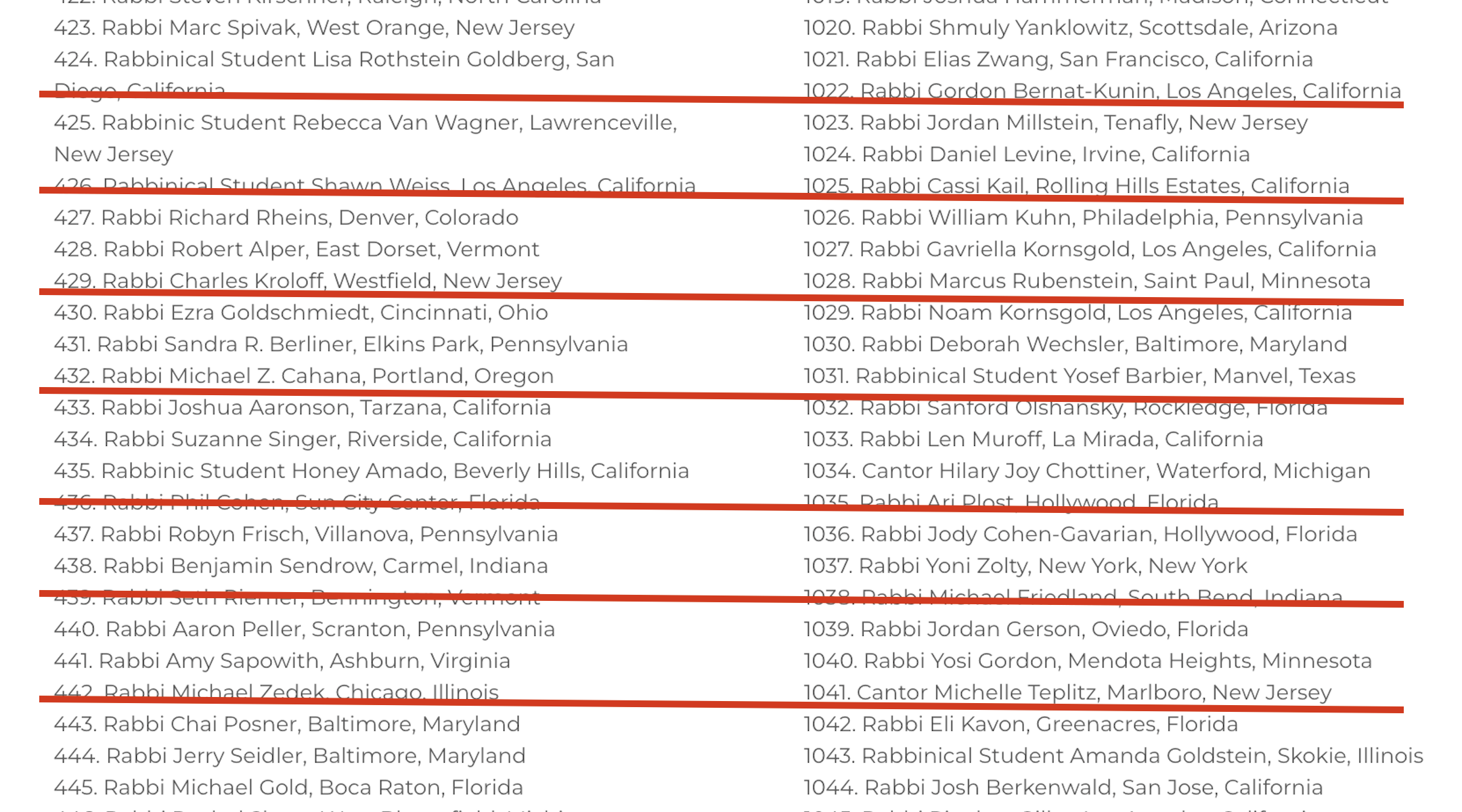
Two days after Rabbi Elliot Cosgrove delivered a sermon urging congregants to vote against Zohran Mamdani, rabbis across the country were asked to sign a letter quoting him.
By the time it was published Wednesday, 650 rabbis and cantors had done so, adding their names calling out the “political normalization” of anti-Zionism among figures like Mamdani, the New York City mayoral frontrunner.
By Friday, the letter had more than 1,000 signatories, making it one of the most-signed rabbinic letters in U.S. history.
But Cosgrove, the senior rabbi of Park Avenue Synagogue on the Upper East Side, was not one of them.
“As a policy, I do not sign group letters,” he said in an interview.
“My fear of such letters is they can flatten subjects and reduce complex issues to ‘Who’s on a letter and who’s not on a letter?’” he added. “There are other platforms that rabbis can give expression to their leadership.”
As the letter has ricocheted across the country and escaped from rabbis’ inboxes to their congregants’ social media feeds, it has ignited a wave of scrutiny, plaudits and recriminations. Some people have voiced relief or disappointment in seeing their rabbi’s name on the list — or on not seeing it.
“Jewish communities are circulating spreadsheets of who signed and who didn’t,” wrote Rabbi Shira Koch Epstein in an essay describing what she said was “a painful public reckoning” taking place both publicly and privately.
“I am not sleeping. These red lines are so dangerous,” responded Rabbi Lauren Grabelle Hermann, of Manhattan’s Society for the Advancement of Judaism, in one of dozens of comments representing a wide range of views. Hermann devoted her Yom Kippur sermon earlier this month to calling on her community to “become an antidote to the polarization and fragmentation in our broader Jewish community and society.”
Now, facing renewed pressure from their congregants over the letter, some New York City rabbis are articulating alternative strategies for responding to a political moment that many Jews are experiencing as fraught and high-stakes.
Rabbi Angela Buchdahl wrote to all members of Central Synagogue, the Manhattan Reform congregation where she is senior rabbi, to explain why they would not find her among the letter’s signatories.
“As a Central clergy team, we have spoken from the pulpit in multiple past sermons and will continue to take a clear, unambiguous position on antisemitism, on anti-Zionist rhetoric, and on sharing our deep support for Israel,” she wrote.
But, citing the importance of “separation of church and state,” Buchdahl wrote that “it is up to each of us to vote our conscience.”
“There are political organizations, including Jewish ones, where electoral politics is the core mission. Get involved,” she wrote. “Central Synagogue, however, is a Jewish spiritual home and we want to keep it that way. It remains our conviction that political endorsements of candidates are not in the best interest of our congregation, community, or country.”
Rabbi Jeremy Kalmanofsky of the Conservative synagogue Congregation Ansche Chesed on the Upper West Side sent out a letter of his own to congregants. He said he would not be voting for Mamdani but did not believe it was his role to tell them how to vote. And he raised concerns about what he said was the “shearing off of liberal from conservative liberal communities,” saying that Jews of all political outlooks should be able to pray and act together.
“The Torah commands lo titgodedu, traditionally interpreted to mean, don’t fragment yourselves into factions,” Kalmanofsky wrote. “I fear this happening to Jews. Frankly, I fear it more than I fear an anti-Zionist mayor.”
Rabbi Adam Mintz, who leads the recently rebranded Modern Orthodox congregation Shtiebel @ JCC, said he’d signed a smaller letter from Manhattan Orthodox rabbis urging the importance of voting. But Mintz felt this letter was outside his role.
“I’m a rabbi. I don’t want to take a political stand,” he said. “I understand that some people feel strongly and they want to take a political stand. I think that’s OK, but that’s not my role.”
Rabbi Michelle Dardashti of Kane Street Synagogue, an egalitarian Conservative synagogue in Brooklyn, did not sign the letter, either. She instead took a different approach to addressing her congregants in the lead-up to the election, hosting about 80 of them Tuesday night for an evening of dialogue.
Members representing a spectrum of views took turns sharing questions and concerns ahead of the election. Dardashti said congregants, despite conflicting views, were “deeply engaged and passionate, and spoke beautifully and respectfully.”
“I understand my rabbinic role to be one that creates space for people to learn from each other’s different experiences, and therefore perspectives,” she said.
Some Jewish leaders and groups outright opposed the letter and its message, rather than considering it an ill-advised strategy. Bend the Arc, a progressive Jewish organization that endorsed Mamdani, released a statement excoriating the letter and its signatories for distracting from what it said was the real issue: Donald Trump.
“These Jewish leaders are doing Trump and the MAGA movement’s work for them: dividing our pro-democracy movement at a time when we need to be united to beat back fascism,” the statement read.
Josh Whinston, a rabbi in Ann Arbor, Michigan, expressed skepticism on social media about the letter’s origin and intentions, and noted that he did not sign it.
“This was not a call for moral clarity; it was a political move aimed at influencing a local race in New York City,” he wrote.
Upon first reading it, Whinston wrote that he “agreed with parts of what it said,” and that he “considered signing.” But, hoping to learn more about the Jewish Majority, the group behind the letter, Whinston wrote, “The site offered no substance. There was no mission, no vision, no leadership, no staff.”
The Jewish Majority’s goal, as stated on its website, is to counterbalance left-wing “fringe groups” like Jewish Voice for Peace and Jews for Racial and Economic Justice, which they say “weaponize the Jewish identity of some of their members to call for policy recommendations that are rejected by the overwhelming majority of the Jewish community.”
The executive director of the Jewish Majority, Jonathan Schulman, is a former longtime AIPAC staffer. In an interview, Schulman said he wrote the letter’s first draft before it underwent rounds of edits from about 40 rabbis of different denominations.
The inspiration came when “Rabbi Cosgrove’s sermon started making the rounds,” he said, adding, “By Sunday morning, rabbis were reaching out to me saying, ‘This is the kind of sentiment we’re feeling all over the country.’”
Unlike Cosgrove’s sermon, which included an endorsement of Andrew Cuomo, the letter does not mention either of Mamdani’s opponents. It does, however, say that political figures like “Zohran Mamdani refuse to condemn violent slogans, deny Israel’s legitimacy, and accuse the Jewish state of genocide,” and calls on Americans to “stand up for candidates who reject antisemitic and anti-Zionist rhetoric, and who affirm Israel’s right to exist in peace and security.”
Schulman recalled being told, “‘There’s the issue of Zohran Mamdani and calls to globalize the intifada and all this, but there’s anti-Zionist candidates running for mayor in Somerville, Massachusetts, in Minneapolis, Seattle — this is becoming normalized, this is becoming mainstream.’”
Rabbi Mark Miller of Temple Beth El in Bloomfield Hills, Michigan, is one of the rabbis who helped edit the letter. He said part of his goal was to help clarify its nature as being national rather than local.
“This was not an attempt for the rest of us to get involved in New York politics,” Miller said. “It’s highlighting it, but the issue is that everywhere we are, this is a concern.”
Signatories on the letter include rabbis from across the United States, and even outside the country.
Rabbi Brigitte Rosenberg, the senior rabbi of a Reform congregation in St. Louis, signed the letter, and said the message about anti-Zionism resonated with her on a national level.
“Mamdani was the big race that was talked about in this, but it’s come up in other races, right?” Rosenberg said, pointing to the comeback bid of “Squad” member Cori Bush to represent St. Louis in Congress.
Rabbi Jeremy Barras from Miami said a number of his congregants have residences in New York, and “they’re just terrified.”
“But I would’ve signed it if it was the same issue in any city in America,” Barras said. “It just happens to be true that we’re a little more sensitive because so many of our families have connections in New York.”
Both Barras and Rosenberg said they couldn’t remember an open letter signed by this many rabbis. There have in fact been examples of open letters being signed by 1,000-plus rabbis, including an appeal to open Palestine to Jews in 1945; a 2017 letter calling on Trump to support refugees and a letter from earlier this year demanding Israel stop “using starvation as a weapon of war.”
Yehuda Kurtzer, co-president of the Shalom Hartman Institute, affirmed that open letters like the one distributed by the Jewish Majority are nothing new, and said there is “definitely a tension that emerges” for those expected to sign. Endorsements from the pulpit, on the other hand, are “new terrain,” he said, noting the Trump administration’s decision to stop enforcement of an IRS rule barring political endorsements from religious institutions.
“We felt pretty strongly that rabbis should not generally do this, and there’s a whole variety of reasons,” Kurtzer said. “It’s a plausible scenario that politicians will start doing quid pro quos with religious leaders around their needs. Once you do it once there’s an expectation that you’ll do it all the time.”
Some of the rabbis who signed say they weren’t making a partisan political statement. Ammiel Hirsch, senior rabbi of Stephen Wise Free Synagogue on the Upper West Side and the leader of a Zionist organization within the Reform movement, acknowledged “worries” about alienating some congregants. But, like others who’ve come out against Mamdani, Hirsch said it was non-partisan to speak out against someone whose rhetoric could compromise Jewish safety.
“There’s always the risk that people will understand you in a partisan way, especially since we’re living in such a hyper-partisan atmosphere now,” Hirsch said. “But it’s a risk that we have to take because the stakes are so high.”
Rabbi Joshua Davidson of Manhattan’s Temple Emanu-El made a similar point. “I’m not going to tell people who they ought to vote for. But I do think it’s important for me to let them know what I think they ought to be thinking about when they vote,” he said, pointing to issues like “the well-being of the State of Israel and the safety of the Jewish community.”
For Cosgrove, whose synagogue is located 20 blocks from Davidson’s, the division that’s arisen since his sermon is something to grieve.
“It deeply saddens me that, in a moment where the Jewish community should be thinking about the external threats that our community faces, that we should be spending an iota of energy on that which exacerbates any fault lines,” Cosgrove said.
—
The post As 1000+ rabbis sign anti-Mamdani letter, others decry mounting ‘red lines’ in Jewish communities appeared first on Jewish Telegraphic Agency.
Uncategorized
High-Stakes US Special Forces Mission Rescues Airman From Iran After F-15 Crash

FILE PHOTO: A U.S. Air Force F-15E Strike Eagle aircraft takes off for a mission supporting Operation Epic Fury during the Iran war at an undisclosed location, March 9, 2026. U.S. Air Force/Handout via REUTERS/File Photo
US forces staged the audacious rescue of an airman behind enemy lines after Iran downed his fighter jet, officials said on Sunday, resolving a crisis for President Donald Trump as he weighs escalating the war, now in its sixth week.
The airman rescued by special operations forces, who Trump said was a colonel, was the weapons-systems officer on the downed F-15, a US official told Reuters.
“Over the past several hours, the United States Military pulled off one of the most daring Search and Rescue Operations in US History,” Trump said in a statement, adding that the airman was injured but “he will be just fine.”
The officer was the second of two crew members on the warplane that Iran said on Friday had been brought down by its air defenses. Iran’s Revolutionary Guards said several aircraft were destroyed during the US rescue mission, Tasnim news agency reported.
Reuters reported on Friday that the first crew member had been retrieved, triggering a high-profile search by both Iran and the United States for the remaining airman.
Iranian officials had urged citizens to help find him, hoping to gain leverage against Washington in the war Trump and Israel launched on February 28.
Trump has threatened to escalate the conflict in the coming days with attacks on Iran’s energy infrastructure.
Had Iran captured the airman, the ensuing hostage crisis could have shifted American public perception of a conflict that opinion polls show was already unpopular.
Trump said the airman was rescued “in the treacherous mountains of Iran” in what he said was the first time in military memory that two US pilots had been rescued, separately, deep in enemy territory.
The official told Reuters that as the weapons-systems officer was moved from near a mountain to a transport aircraft parked within Iran, US forces had to destroy at least one of the aircraft because it had malfunctioned.
U.S. AIRCRAFT HIT
The rescue effort, involving dozens of military aircraft, encountered fierce resistance from Iran.
Reuters reported on Friday that two Black Hawk helicopters involved in the search were hit by Iranian fire but escaped from Iranian airspace.
Separately, a pilot ejected from an A-10 Warthog fighter aircraft after it was hit over Kuwait and crashed, the officials said, though the extent of crew injuries was unclear.
Still, Trump was triumphant.
“The fact that we were able to pull off both of these operations, without a SINGLE American killed, or even wounded, just proves once again, that we have achieved overwhelming Air Dominance and Superiority over the Iranian skies,” he said in his statement.
US air crews are trained in what to do if they go down behind enemy lines, measures known as Survival, Evasion, Resistance and Escape, but few are fluent in Persian and face a challenge in staying undetected while seeking rescue.
The conflict has killed 13 US military service members, with more than 300 wounded, US Central Command says. No US troops have been taken prisoner by Iran.
While Trump has repeatedly sought to portray the Iranian military as being in tatters, they have repeatedly been able to hit US aircraft.
Reuters reported on US intelligence showing that Iran retains large amounts of missile and drone capability. Until just over a week ago, the US could only determine with certainty that it had destroyed about one-third of Iran’s missile arsenal.
The status of about another third was less clear, but bombings probably damaged, destroyed or buried those missiles in underground tunnels and bunkers, Reuters sources said.
The US and Israeli war on Iran has spread across the Middle East, killing thousands and hitting the global economy with soaring energy prices that are fueling fears of inflation.
Uncategorized
On Easter, Pope Leo Urges World Leaders to End Wars, Renounce Conquest

Pope Leo XIV waves from the main balcony of St. Peter’s Basilica after delivering his “Urbi et Orbi” (To the city and the world) message, on Easter Sunday at the Vatican, April 5, 2026. Photo: REUTERS/Remo Casilli
Pope Leo urged global leaders in his Easter message on Sunday to end the conflicts raging across the world and abandon any schemes for power, conquest or domination.
The pope, who has emerged as an outspoken critic of the Iran war, lamented in a special message to the thousands gathered in St. Peter’s Square that people “are growing accustomed to violence, resigning ourselves to it, and becoming indifferent.”
“Let those who have weapons lay them down!” the first US pope exhorted. “Let those who have the power to unleash wars choose peace!”
Leo did not mention any specific conflicts in the message, known as the “Urbi et Orbi” (to the city and the world) blessing. It was unusually brief and direct.
The pope said that the story of Easter, when the Bible says Jesus rose from the dead three days after not resisting his execution by crucifixion, shows that Christ was “entirely nonviolent.”
“On this day of celebration, let us abandon every desire for conflict, domination, and power, and implore the Lord to grant his peace to a world ravaged by wars,” Leo urged.
Leo, who is known for choosing his words carefully, has been forcefully decrying the world’s violent conflicts in recent weeks and ramping up his criticism of the Iran war.
In a sermon for the Easter vigil on Saturday night, he urged people not to feel numbed by the scope of the conflicts raging across the world but to work for peace.
The pope made a rare direct appeal to US President Donald Trump on Tuesday, urging him to find an “off-ramp” to end the Iran war.
In his address from the balcony of St. Peter’s Basilica on Sunday to the Square below, decorated with thousands of brightly colored flowers for the holiday, Leo offered brief Easter greetings in ten languages, including Latin, Arabic and Chinese.
The pope also announced he would return to the Basilica on April 11 to host a prayer vigil for peace.
Uncategorized
Temple Mount Set for Limited Reopening to Jews and Muslims

Israeli National Security Minister and head of Jewish Power party Itamar Ben-Gvir gives a statement to members of the press, ahead of a possible ceasefire between Israel and Hamas, in Jerusalem, Jan. 16, 2025. Photo: REUTERS/Oren Ben Hakoon
i24 News – Israeli authorities are preparing to partially reopen the Temple Mount in Jerusalem to both Jewish and Muslim worshipers for the first time since the start of the war with Iran, under a tightly controlled and highly restricted security arrangement, i24NEWS has learned.
According to details obtained by i24NEWS, the Israeli police, backed by National Security Minister Itamar Ben-Gvir, are also expected to permit limited access for Jewish worshipers to the Western Wall as part of the same phased plan.
Under the framework, access to the Temple Mount and surrounding holy sites would be restricted to small groups of up to 150 people at a time. In the event of a missile alert, all visitors would be immediately evacuated in accordance with emergency protocols.
The decision follows a recent Supreme Court ruling allowing demonstrations in a limited format. Police argue that a consistent standard must apply across both civic gatherings and religious sites, with Ben-Gvir insisting that “there cannot be one rule for demonstrations and another for the Temple Mount.”
However, the reopening contradicts recommendations from the Home Front Command, which has advised keeping sensitive sites closed due to the ongoing risk of missile attacks.
Israeli Justice Minister Yariv Levin has proposed transferring authority over such security-related decisions exclusively to defense officials, an initiative that could reshape the balance between the judiciary and security establishment regarding restrictions on public access.