


Uncategorized
At Chabad Hanukkah party in California, hours after Bondi Beach massacre, joy defied grief’s shadow

PACIFIC PALISADES, CALIFORNIA – A familiar sight at public gatherings, especially Jewish ones — young men in Hasidic garb wrapping black leather tefillin straps around the arms of strangers — felt different here Sunday evening as Rabbi Shimon Goldberg helped Rick Entin fulfill the commandment at a Hanukkah block party in the Palisades. The mitzvahs of tefillin and lighting candles had become acts of defiance and joy as the gathering grieved the 15 people killed at a Chabad Hanukkah event in Sydney.
The attack cut deeply in the close-knit Chabad community, whose brand — and vulnerability — lies in the proud public practicing of Jewish rituals. Some of them were personally connected to Rabbi Eli Schlanger, the Chabad emissary who had organized the Sydney event, and died in the attack.
Yet they were celebrating Hanukkah on Sunday with a group that knew something about resilience: 11 months earlier, the Palisades fire tore through this area, destroying thousands of homes, including Entin’s just up the street. For many, the Hanukkah event was the first time they had been in Jewish community in the Palisades since the inferno. This was the occasion the Palisades Chabad — whose campus was damaged in the fire — had planned to commemorate, and from which its leaders would not be deterred.
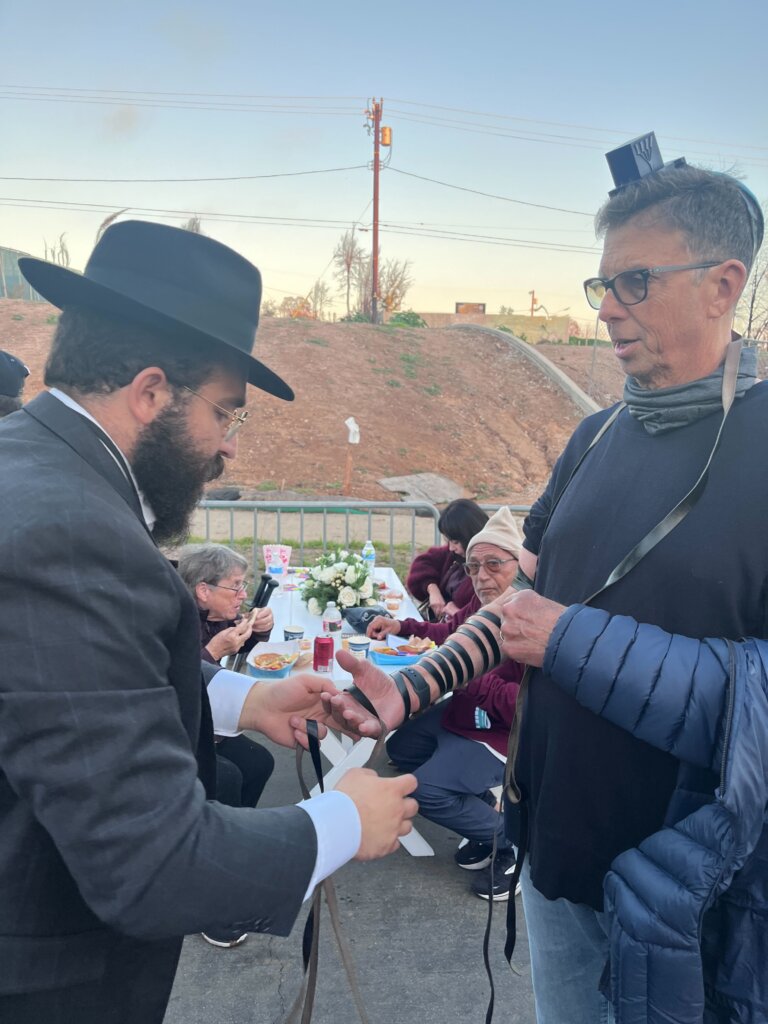
“Whoever was strategizing this terrorist attack, they want the Jews not just in Sydney, but even in Los Angeles to fear showing up for a Hanukkah event,” said Goldberg, head of a local Chabad-affiliated nonprofit, as he placed a tefillin box atop Entin’s forehead. “This we won’t allow them to do.”
The 38th annual Palisades candlelighting was always going to be bittersweet; many there remained displaced by the fire, and some remain unsure whether they will rebuild. Jewish leaders who planned the event said they did not need to change the program due to the terrorist attack — it was already about celebration in the face of loss.
So, too, is Hanukkah, a holiday that tells of a miraculous jug of oil found amid great ruin. And both Chabad and Kehillat Israel, a Reconstructionist synagogue in the Pacific Palisades that co-sponsored the event, had, miraculously, found the spark on an otherwise gloomy day.
Overlooking the street that had been blocked off for the event were vacant lots where homes had stood a year earlier. But melancholy was hard to come by as one walked through the teeming masses at the event. Kids sat for glitter tattoos and balloon animals; lines snaked for latkes and jelly donuts and hot chocolate, all free. Old friends exchanging long-overdue hugs could be heard saying I’m so sorry about your house. On stage before the candlelighting, a gaggle of youngsters delivered a spirited rendition of “I’m a little latke.”
“It’s almost like the Maccabees,” said Chayim Frenkel, Kehillat Israel’s longtime cantor. “They went into the Temple, cleaned it up, found the menorah, found the oil. And surrounded by the rubble of what the Greeks did, we brought light and hope.”
The Palisades Chabad members in attendance were putting on a doubly brave face: The fire had damaged part of the school on the campus of Chabad of Pacific Palisades, according to Rabbi Zushe Cunin, its director. Classes have still not returned to the building.
“It’s been hard,” Cunin said. “So much trauma, a lot of people have not resolved things, their house, their insurance, their struggles. But Hanukkah is a time to rise above that. Tonight is about strengthening our resolve.”
Cunin’s son, Mordechai, was among the group channeling that resolve through tefillin. The mitzvah — which is required only of Jewish men — was one the late Rabbi Menachem Mendel Schneerson, the last Lubavitcher Rebbe, had implored his followers to promote in order to hasten the arrival of the Messiah. Mordechai and his yeshiva buddies reported having wrapped at least 10 men that day, including three first-time wearers.
It was not lost on the tefillin crew that Schlanger — whose nephew is Mordechai’s classmate — died doing what they were doing now — helping Jewish people from all walks of life connect to Judaism. But to Goldberg, that was only reason to lean in.
“When someone leaves this physical world, their soul is still there, but they can’t do mitzvos,” Goldberg said. “When we think of Rabbi Eli, we are his hands and feet. He can’t put on tefillin today — but we can put on tefillin for him.”
The post At Chabad Hanukkah party in California, hours after Bondi Beach massacre, joy defied grief’s shadow appeared first on The Forward.
Uncategorized
These Jewish college students have some ‘nonnegotiables’ for El-Sayed
At the University of Michigan, first-year student Robert Kashan, 18, and sophomore Jacob Reich, 19, sat behind a large blue sign. “Some things are nonnegotiable,” it declared in all caps.
The sign laid out their requirements for any candidate seeking their support: a commitment to Jewish safety, “including for Zionist Jews,” and supporting Jewish statehood in Israel, among other positions.
“Zionism is a legitimate part of the Democratic coalition, and a lot of us are feeling less represented by the Democratic Party,” Kashan told the Forward.
The students are part of a broader “Nonnegotiable” movement in Michigan, a coalition of Jewish Democrats who are spelling out their dealbreakers for candidates ahead of the Senate election between Democratic nominee Abdul El-Sayed and Republican nominee Mike Rogers.
The movement has attracted national attention, with hundreds of rabbis across 34 states signing on to the “Nonnegotiable” demands. Meanwhile, about 20 students at the University of Michigan have publicly signed, while hundreds more offered support anonymously, according to Reich.
The “Nonnegotiable” supporters aren’t saying whom they’ll vote for if their concerns aren’t addressed — or whether they’ll vote at all. But they are pushing back against the assumption that Jewish voters will, as the saying goes, “vote blue no matter who,” urging El-Sayed to engage with their demands if he hopes to earn their support.
That’s in contrast with two other Jewish political camps, including a group called Michigan Jews for Democracy that endorsed El-Sayed. Their petition, which has garnered almost 1,000 signatures, notes that some signatories hold reservations about El-Sayed but are voting for him nonetheless as a check on President Trump.
“We understand that a vote is not a valentine; it’s a strategic chess move,” the petition reads.
A competing petition, dubbed “Michigan Jews Against Extremism,” has drawn hundreds of signatures from Michigan Jews who plan to vote for Rogers. That petition similarly emphasizes that Rogers voters may still have reservations about the candidate: “Our vote for Mike Rogers does not require that we agree with him on every issue or that we support President Trump,” it reads.
“Nonnegotiable,” meanwhile, rejects the idea that Jewish voters would have to choose between Zionist and Democratic values. Some have criticized the nonnegotiable movement for ignoring the reality of the electoral choice at hand. Others have called it “a veiled attempt to excuse the actions of Jewish Democrats who want to feel validated about voting for Mike Rogers.”
But Kashan and Reich, who met at Hillel and plan to major in political science, said the “Nonnegotiable” movement was the only way they could see themselves engaging in the election, as they felt increasingly pulled between their identities as Democrats and as Jews.
Some Michigan Jews have expressed alarm at El-Sayed’s questioning of whether Israel should exist as a Jewish state and his decision to campaign alongside controversial Twitch streamer Hasan Piker, who has been accused of antisemitic rhetoric. Rogers, who Trump has endorsed, earlier this week called El-Sayed “anti-Jew.”
In a letter to Michigan Jews, El-Sayed has vowed to “stand up against antisemitism and take the threat of violence against our Jewish community incredibly seriously.” He has also hired a Jewish liaison in the final weeks leading up to the election.
This will be the first election when Kashan, who just turned 18, is eligible to vote, and Reich’s first national election after voting in a local primary in his hometown of Palo Alto, California. For both, voting Democratic in their first major election had once seemed like a given.
“I’m a Jewish Democrat, and I want Democrats to take the Senate,” Reich said. “I want to vote for a Democrat in my own state.”
They’re still holding out hope that will happen — and that, with less than two weeks until the Nov. 3 election, El-Sayed will sign on to their petition.
And if he doesn’t? Neither student is ready to say.
The post These Jewish college students have some ‘nonnegotiables’ for El-Sayed appeared first on The Forward.
Uncategorized
Does anyone in Jerusalem care what happens to us?
An Israeli think tank has put on paper what most American Jews know in their kishkas: Israel’s actions over there affect our safety here.
So here’s my question: Does anybody over there care?
The report, published by The Institute for National Security Studies (INSS), drew on the input of 20 Jewish leaders from five countries. It concluded that Israel’s actions since the Hamas attack on Oct. 7, 2023 have normalized hostility toward Israel, divided Jewish communities, sapped the political influence of pro-Israel organizations and fueled antisemitism.
Those actions include damaging statements by government officials, limits on humanitarian aid to Gaza at the height of the war, widespread damage to civilian infrastructure in Gaza and unchecked settler violence in the West Bank. The authors also cited as inflammatory “the proliferation of images of civilian death and suffering in Gaza” — though the actual civilian death and suffering has also alienated and enraged many outside Israel, including Jews.
“The conflict is not only over there in the Middle East, it is local all over the Jewish world now, and Diaspora Jewry has skin in the game,” said Theodore Sasson, one of the report’s authors, in an interview with JTA’s Andrew Silow-Carroll, who first wrote about the study.
To be clear, the report doesn’t excuse, exonerate or rationalize people who commit antisemitic acts. “Jews and Israelis are not to blame for antisemitism,” the report states.
“What we’re saying is that Israel is not the cause” of antisemitism, Sasson said, “but enlightened Israeli policy can seek to maintain robust Diaspora support for the state of Israel and can deny the antisemites the material that fuels their mostly spurious claims.”
This is not a novel connection. Three previous academic studies, in Belgium, Australia and the U.S. found statistically significant links between Israeli military operations that result in high Palestinian casualties and spikes in reported antisemitic incidents abroad. Not surprisingly, a Mellman group poll found that 56% of U.S. Jewish voters believe Israel’s policies have fueled antisemitism.
None of this means Israel shouldn’t act in its own interest and put the security needs of its own population first. Antisemites would continue to exist even if Israelis did nothing but play backgammon and sip arak. The report is not about eradicating antisemitism, but about Israeli actions that provoke and endanger Jews abroad — and what Israel can do about those.
I get the principled resistance to a report that seems to shift some of the burden of antisemitism onto the Jews. David Bernstein of the North American Values Institute told Silow-Carroll that American Jews aren’t agents of Israel, and that nobody would say an African country’s actions endanger African Americans. That’s not entirely true — the 9/11 attacks increased hate crimes against American Muslims and bigots targeted random Asian Americans during the COVID-19 pandemic. Pretending actions have no consequence even if the reaction is illegitimate is principled, but naive. If Israel can lower the temperature, it should.
But here’s the sad fact about the current Israeli government: it doesn’t even lower the temperature for its own citizens.
Exhibit A is Oct. 7. This is the government on whose watch that horror happened, and Prime Minister Benjamin Netanyahu has never engaged in a full, independent accounting of what went wrong. How do you prevent future Oct. 7s when you don’t know the weaknesses that enabled it in the first place?
Exhibit B is the flydubai near-disaster, which we in the Diaspora have already mythologized as yet another example of Israeli courage and pluck. It was that, but also a result of a complete breakdown of government responsibility. Israel’s rules should have kept the Omani pilot out of that cockpit, but, as Channel 12 reported, Minister of Transportation Minister Miri Regev took no action despite multiple warnings. Regev, a close ally of Netanyahu, remains in her job.
Finally, Exhibit C: Police under National Security Minister Itamar Ben Gvir have failed to curb violent crime in Israel’s Arab communities which recorded 252 murders in 2025 — and 2026 is on track to surpass that record.
Israel’s supporters often comfort themselves with the mantra that Israelis love life while their enemies love death. But this government has been pretty cavalier about life.
If that’s how Israel’s leaders treat their own citizens, is it so surprising they fail to be overly concerned about Jews abroad? Last year saw the highest death toll from antisemitic attacks in 30 years, while the agency Israel created specifically to deal with such calamities has been AWOL. The Ministry for Diaspora Affairs and Combating Antisemitism, a Tel Aviv University report found, has “not contributed in any meaningful way to the cause, and in some cases has been an embarrassment.”
All this is happening as the screws are tightening on Jewish communities in Australia, France, Italy, Canada and elsewhere. But Israel, established in part to keep Jews safe, has, under this government, too often increased or ignored the dangers. Zionism is supposed to be the Diaspora’s Iron Dome, but this government, by inexorably, deliberately foreclosing on the possibility of a democratic Jewish state, is functionally anti-Zionist.
The report listed several measures Israel could take to reduce the threat to Diaspora communities, among them controlling the incendiary rhetoric of government ministers and opening a diplomatic path with the Palestinians that stops the slide toward a single, non-democratic state.
One of the report’s recommendations is that Israel set up procedures to assess how its policies affect Jews abroad. In other words, the think tank is asking the government to start caring, formally.
It’s hard to imagine any of that happening unless, on Oct. 27, Israelis vote the current government out.
“Netanyahu cannot be part of the healing process. It is Netanyahu from whom we must be healed,” David Horovitz, the far-from-radical founding editor of The Times of Israel, wrote this week in an editorial titled, “For Israel’s Sake, Netanyahu Has to Go.”
As it turns out, it’s for all our sakes.
The post Does anyone in Jerusalem care what happens to us? appeared first on The Forward.
Uncategorized
How schools are teaching about Israel now, and winning back Jewish donors
Silicon Valley philanthropists Eli and Jeanette Reinhard are known for their generosity to Jewish causes, from the local Jewish federation to the counterterrorism project at the Washington Institute for Near East Studies. They are especially generous on the campus of their alma mater, Stanford University, where Eli Reinhard helped found the Jewish Studies department and the Hebraic book section at the university library.
But that was before the Hamas attacks on Israel on Oct. 7, 2023, and the anti-Israel protests that followed on U.S. college campuses, including Stanford. When the couple was asked to help fund the university’s new Israel Program, they thought long and hard.
“We have had to answer the question internally within our family: Why are you doing this? Why here?” Jeanette Reinhard told the Forward.
“We like investing in meaningful change. We felt we could have it here.”
But they did have one condition: they wanted to shake hands with University President Jonathan Levin.
“We wanted to look in his eyes and say, ‘Are you behind this?’” Reinhard said.
At a time when private donors seem to have grown wary of endowing university professorships or programs in Jewish or Israel Studies, for fear their name will one day be attached to a problematic curriculum, universities are rethinking how to frame and where to house their courses of study about Israel.
“The splits are real and they go across the country,” said Indiana University Professor Alvin Rosenfeld. “A lot of donors giving good money to some of these universities are really very angry about the way the money is being spent and they are reassessing.”
Rosenfeld founded Indiana’s Institute for the Study of Contemporary Antisemitism, the oldest such institute in the country and one of several models that schools have recently adopted either to assuage donors’ concerns, address an urgent gap after Oct. 7 or both. Schools including New York University, University of Michigan and Brandeis followed Indiana’s approach.
Other campuses have tried different models. This fall, the Harvard Kennedy School folded Israel into its Middle East Initiative, and Stanford University inaugurated the Jan Koum Israel Studies Program within its Center on Democracy, Development, and the Rule of Law. The Stanford program was supported by an endowment from the family foundation of the founder of What’s App plus additional support from the Reinhards.
“I think our track record has convinced a number of donors and potential donors of our intellectual independence and seriousness of purpose,” said Larry Diamond, Stanford’s Mosbacher Senior Fellow in Global Democracy at the Freeman Spogli Institute for International Studies, where the Israel program is housed. “The proof has been in what we have done and the credibility that we have built.”
Israel as one among many
Harvard has received only “modest” financial support for its Israel program, but its necessity prompted Middle East Initiative Director Tarek Masoud to launch it anyway.
Israel joins other country-specific programs at the Kennedy School dedicated to studies of Kuwait, the United Arab Emirates and Syria and fulfills Masoud’s longtime goal of expanding the initiative beyond Arab countries. Two major gifts financed the Kuwait Foundation for the Advancement of Science and the Emirates Leadership Initiative. The Syrian Transition Lab and Israel Program do not have the same kind of backing.c
But the Israel program also meets a demand, Masoud said. When he taught a course last spring titled “Arguing the Israel Palestinian Conflict,” he said students camped out in the hall to plead their case for admission.
The program grew out of Masoud’s Middle East Dialogues series, which over the years has welcomed a wide range of speakers, from President Trump’s son-in-law Jared Kushner, who helped broker the Abraham Accords, to Arab American University associate professor Dalal Saeb Iriqat, whose social media posts calling the Oct. 7 Hamas attack a “normal struggle 4 #Freedom” sparked outrage.
“This is not going to be a place where Israel is protected,” Masoud said. “It’s a place where Israel and Israelis will be engaged, fully and openly, without bias or animus.”
In other words, the mission is scholarship and critical thinking, not advocacy. The only political stance the Harvard program takes is that it does not exclude or boycott any country, including Israel.
The addition of Israel to the initiative comes amid Harvard’s ongoing fight with the Trump administration over research grants, international student enrollment and a newly launched Department of Labor investigation into foreign visas. Other schools such as Columbia University have struck agreements with the Trump administration to review regional area programs, starting with the Middle East. Though a year later, there had been no reforms.
But the Harvard program is not a response to the conversations on campus or an effort to appease the administration, said Israel Program Director Barak Sella. It is a response to the critical role of Israel in the region, he said. A senior research fellow at the Harvard Kennedy School’s Belfer Center for Science and International Affairs, Sella focuses on U.S.-Israel relations and the evolving relationship between American Jews and Zionism.
“With all due respect to the complicated conversations we’re having on campus, which deserve the highest level of respect, the real issues are the people in that world, these economies, these societies,” Sella said. “That is our focus. How do I support making the Middle East a more prosperous and safer place to all the people who inhabit it?”
As a student at the Kennedy School during Oct. 7, Sella witnessed firsthand the disinformation and discourse on campus. He admired Masoud’s courage to platform different points of view, “but opinions that have serious intellectual capacity behind them, not just driven by who is the loudest on social media.”
“The role of Middle East studies at universities it’s not to import the conflicts of the Middle East into American society,” Sella said. “Our role is to use the resources we have, the privileges, opportunities and platform to export solutions to the Middle East.”
To do that effectively, Israel can’t be isolated from the other countries. It must be treated as part of the region, he said.
“The issue is that when you look at the Middle Eastern studies centers, unfortunately in many cases, you see Israel excluded and not treated in the lens we want to treat it — another country in the Middle East that has its advantages, its setbacks, its good actors, its bad actors,” Sella said.
Israel as democracy
Stanford intentionally took a different approach when launching its Israel program. At the time its pilot was launched, there was no Middle East Studies department in which to integrate. But even if there had been, Diamond said, that was not an option.
“The record of Israel studies programs being located in that type of center at other campuses has raised a number of issues and problems,” Diamond told the Forward, though he didn’t specify where it has been an issue or how.
Though schools like University of Maryland and Boston University offer Israel Studies minors as part of their Jewish Studies departments, that didn’t seem to be a viable home at Stanford, as that department more often partners with religious studies, history and comparative literature. That gap sparked the Reinhards’ interest.
“After Oct. 7, Stanford was certainly not immune to some of the stuff we saw on various college campuses,” Jeanette Reinhard said. “And the question was raised in our heads, ‘Well, where is Jewish studies in all of this? Why is Jewish studies not there to be actively countering the misinformation?’ And that’s when we realized that’s not really what Jewish Studies is designed to do.”
Instead, Diamond proposed studying Israel among other democracies, which is why Stanford launched the pilot within its Center on Democracy, Development, and the Rule of Law (CDDRL) in Fall 2022. During this period, the program hosted webinars and events, including a revival of the annual Daniel Pearl Memorial lecture, which it co-sponsored with the campus Hillel. The program also organized a conference comparing Israel and California’s responses to climate challenges.
“We went from strength to strength and more than proved proof of concept,” Diamond said. “As a result, we raised considerable money in the annual gifts, and we eventually attracted the confidence of two endowment donors,” referring to the Reinhards and the Koum Family Foundation.
Amichai Magen, director of the Jam Koum Israel Studies Program, said the program has broad appeal across campus. Classes include students from East Asia, Southeast Asia and the Middle East, and more than three-quarters of those enrolled have no family or personal history in Israel. At least one of his courses, titled “Israel: Society, Politics, and Policy,” is cross-listed with political science, international relations and Jewish Studies.
“Israel has so much to offer in terms of its history, culture, society, legal field, politics, external relations, innovation, and security (to name just a few) that, in our courses and other programming, we mainly focus on the lived experience of Israelis,” Magen said.
While there are no courses reserved to study anti-Zionism and antisemitism, those topics naturally come up in class conversations as students discuss the Jewish historical experience.
“Inevitably, when you teach and program about Israel, you also wind up having to address the attempts to stigmatize and isolate the state of Israel, and the complex relations between antisemitism and anti-Zionism,” said Diamond, who also cofounded the Stanford Community Forum on Antisemitism and Anti-Israeli Bias.
Anti-Zionism question
Addressing Israel through the lens of those who hate it is yet another approach universities have adopted. Indiana’s Institute for the Study of Contemporary Antisemitism has made anti-Zionism a central focus of research at the institute, which just secured a $6 million grant from the National Endowment of the Humanities.
Over the next three years, five working groups of a dozen scholars each will study various aspects of what drives contemporary antisemitism – including religion, digital communication, political culture and rhetoric – how it manifests and how to curb it. Anti-Zionism will be a theme that runs through all five. The institute will work with the Wilson Center, a public policy think tank in Washington D.C., which will formulate public policies to address it.
“There’s no way to address today’s hostility toward today’s Jews without understanding hostility toward the Jewish state,” Rosenfeld told the Forward.
While there is no Israel Studies program per se at Indiana, the Jewish Studies department does house the Olamot Center, which hosts Israeli scholars and teaches some classes about Israel.
Günther Jikeli, the associate director of the institute, who is known as one of Israel’s fiercest defenders on campus, has secured funding for a partnership with the business school focused on entrepreneurship and innovation in the Start-Up Nation. Students will explore how such a resource-scarce nation blossomed into a global hub for technological innovation.
Jikeli and Rosenfeld hope the partnership sparks curiosity among students to learn more. Jikeli recently stepped down from a controversial stint as interim director of Indiana’s Jewish Studies program. Shortly after his appointment, he stripped travel funding from an anti-Zionist graduate student in the program and declined to say whether he would allow the department to support any research that was critical of Zionism. Interim co-directors have taken his place after an unsuccessful yearlong search for a permanent replacement.
“Numbers of Jewish Studies programs have appointed faculty members who don’t line up with the donors when it comes to Jewish values, and especially when it comes to Zionism and anti-Zionism,” Rosenfeld said. “Is there unanimity of opinion among faculty? No. Is it hampering the work we need to do? No.”
Jeanette and Eli Reinhard understand the anger and wariness of their peers, but to them, it doesn’t make sense to withhold money from education that could help solve the problem.
“There are no guarantees in life,” Jeanette Reinhard said. “Fifty years from now, who knows? You have to say what’s here right now that we have reasonable hope in.”
The post How schools are teaching about Israel now, and winning back Jewish donors appeared first on The Forward.
