


Uncategorized
‘Faust’ author Goethe’s fascination with Yiddish
Johann Wolfgang von Goethe is usually remembered as a towering figure of European culture: poet, playwright, scientist, and all-around genius of the Enlightenment.
His drama Faust opens with a scene that echoes the Book of Job, where God makes a wager with the devil over whether a good man can be led astray. What far fewer people know is that Goethe’s connection to the Bible was not just literary. He actually learned Hebrew so he could read it in the original — and his path to Hebrew ran straight through Yiddish.
Goethe was born in 1749 in Frankfurt am Main into a well-to-do Christian family. Frankfurt was also home to a densely packed Jewish quarter, the Judengasse (German for “the Jewish street”). As a boy, he ventured there, feeling both nervous and curious. In his autobiography, Poetry and Truth, published in 1833, he recalled what it was like for a German boy to step into a crowded world of people who dressed differently and spoke a strange-sounding German he called Judendeutsch (Jewish German).
But instead of fear or disdain, what stayed with him was fascination. He remembered friendly people and beautiful girls, and he was struck by the sense that the Jews carried ancient history with them into everyday life. They were, he wrote, “the chosen people of God … walking around in memory of the earliest times.” Even their stubborn attachment to tradition, he felt, deserved respect.
Goethe wanted to see more. He described how he insisted on visiting Jewish schools, attending a circumcision and a wedding, and getting a glimpse of Sukkot. Everywhere, he recalled, he was welcomed, entertained, and invited back. For an 18th-century German boy, this kind of contact with Jewish life was unusual — and it clearly made a lasting impression.
At home, Goethe was buried in languages. His father hired tutors to teach him Latin, Greek, English, French and Italian. Goethe learned quickly but soon grew bored with endless grammar drills. So he did what any restless young writer might do; he turned language learning into a game.
He invented a novel made up of letters exchanged by seven siblings scattered across Europe. Each sibling wrote in a different language: A music historian in Rome wrote in Italian, a Hamburg businessman in English, while a theology student wrote Latin and Greek. The youngest sibling stayed home and wrote in Yiddish. The effect, Goethe later suggested, was both amusing and confusing for the other characters.
That detail is telling. Goethe treated Yiddish as something playful and odd, a kind of Jewish-flavored German. But he knew it well enough to use it creatively.
In his autobiography, he describes the seven-language novel but doesn’t give it a title. We can guess, though, that his Yiddish was the Western Yiddish spoken by Frankfurt Jews at that time. A sentence like ikh vil kaafen flaash (“I want to buy meat”) would have sounded close to the local German dialect, but not quite the same.
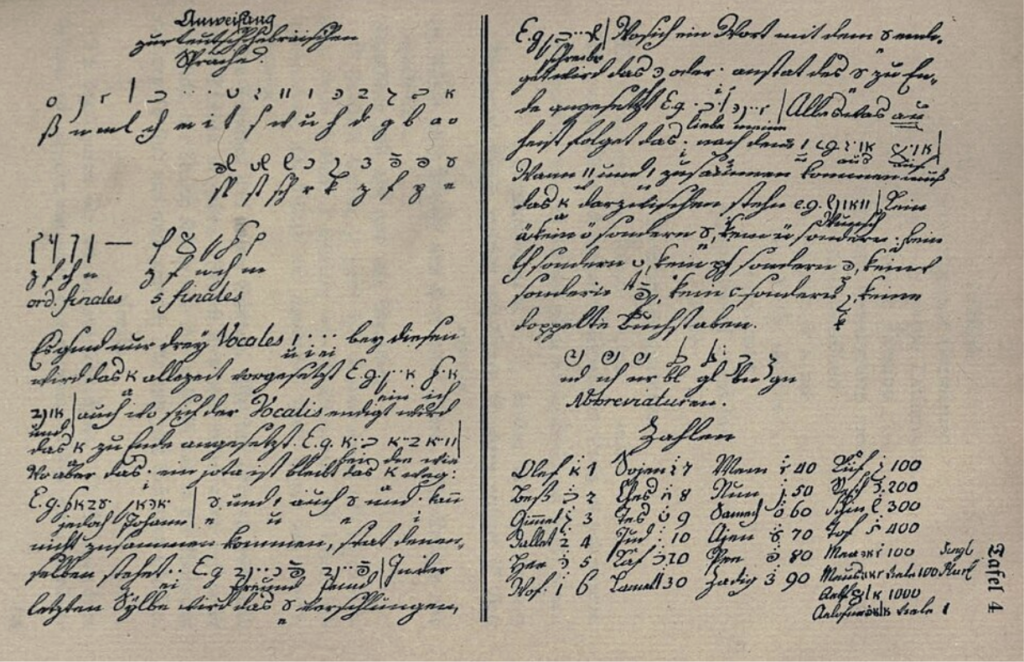
Goethe soon realized that if he wanted to understand Yiddish properly, he would have to learn Hebrew. His father arranged a tutor, and young Goethe plunged into a whole new alphabet. Although the location of his childhood notebooks are unknown, two of its pages are located online. On them, he carefully writes out the Hebrew letters, their names, sounds and even their numerical values. His notebook contains reminders to himself that Hebrew words are built from three-letter roots and urges himself to practice again and again so the forms would stick in his memory.
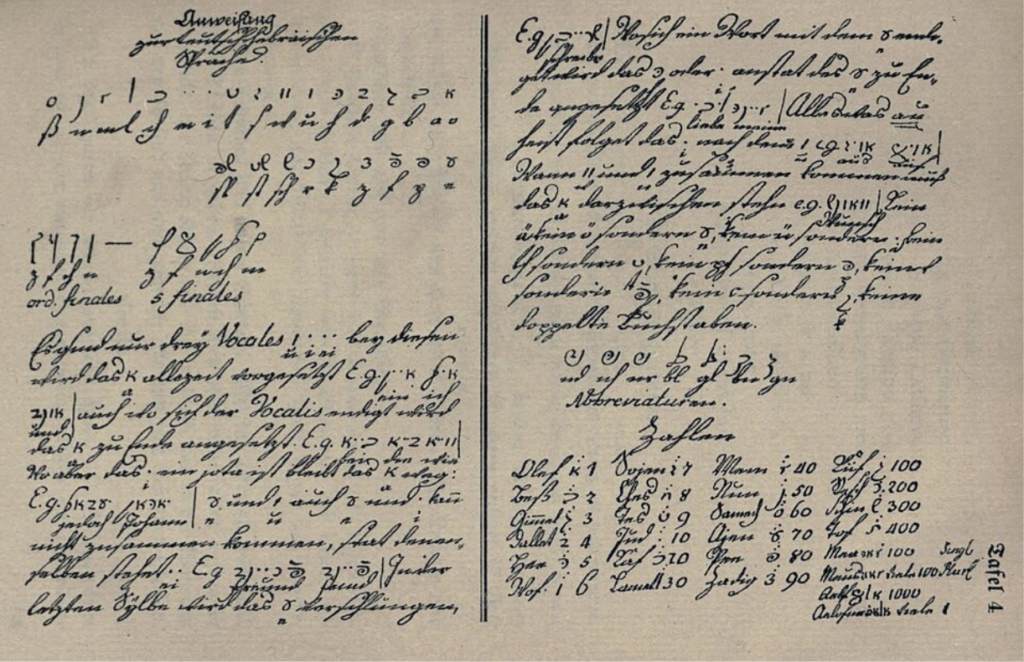
It wasn’t easy. Goethe later wrote that he got used to reading from right to left and identifying the letters, but was confused by all the dots and dashes — the vowel points, that seemed to complicate things even further. Still, he pushed on. He learned to read the Hebrew Bible and even tried his hand at writing a German epic based on stories from Genesis.
His interest in Yiddish didn’t disappear with childhood. When he was 17, Goethe apparently wrote a Purim play in Judendeutsch, written in Hebrew letters, complete with a translation into High German. Years later, he translated King Solomon’s Song of Songs into German. The Bible became a lifelong companion — not just as literature, but as a moral guide. “I loved and valued the Bible,” he wrote, “and owed my moral education almost entirely to it.”
As Goethe grew older, his ideas expanded in many directions. Influenced by the Jewish philosopher Baruch Spinoza, as well as Persian, Sufi and Buddhist writings, he developed a broad, inclusive worldview. He dreamed of something he called Weltliteratur — world literature — a shared cultural space where the works of all peoples could speak to one another.
Near the end of his life, Goethe said that the age of world literature had arrived, and that everyone should help bring it about. Seen this way, his childhood journey — from the Judengasse, through Yiddish, to Hebrew — was more than a youthful curiosity. It was an early step toward a vision in which cultures, languages and traditions are not sealed off from one another, but connected.
For Forward readers, there is something especially satisfying in this story. Yiddish appears here not as a joke or a dead-end dialect, but as a bridge — linking everyday Jewish life to the Bible, and even carrying one of Europe’s greatest writers toward a deeper engagement with Jewish tradition and, ultimately, with the idea of world culture itself.
The post ‘Faust’ author Goethe’s fascination with Yiddish appeared first on The Forward.
Uncategorized
Herzog calls for crackdown on violent West Bank settlers as olive harvest tensions mount
(JTA) — BUDAPEST, Hungary — Israeli President Isaac Herzog is backing senior Israel Defense Forces commanders in taking decisive action against violent settler attacks in the West Bank, he told the Jewish Telegraphic Agency.
His comments came a day before Israeli forces detained New York Democratic congressional candidate Brad Lander along with 90 rabbis and activists accompanying Palestinian farmers during the olive harvest.
At a press briefing in Budapest, JTA asked Herzog what action had been taken to curb settler violence following his previous calls for a stronger government response. Herzog pointed to a meeting he held earlier this month with the IDF’s West Bank division commander and other senior officers.
“I looked them in the eye and I gave them full backing to do whatever it takes to stop this terrible phenomenon,” he said.
The goal was to end the settler violence “at its roots,” Herzog said, adding that “major efforts” were underway.
Israeli police arrested 10 suspects following a series of settler attacks over the weekend, including a violent assault on Washington Post photojournalist Heidi Levine. Nine of those suspects were released from custody, Haaretz reported on Wednesday.
IDF Chief of Staff Lt. Gen. Eyal Zamir ordered the deployment of an additional Border Police company to the West Bank to combat extremist violence. The unit is expected to begin operations in late November.
Herzog had personally called Levine on Saturday to apologize for the attack, which left her with four broken vertebrae and other injuries. “I was morally tormented during Shabbat when I thought about it, and I express deep sorrow and apologize for what you went through,” he told her.
The attacks have drawn condemnation from the U.S. and European governments. On Sunday, the European Union called for Israel to take “full accountability” in preventing further violence against Palestinians, journalists and diplomats.
During his visit Tuesday, Herzog met with Hungarian President András Baka and Prime Minister Péter Magyar, whose government ended its predecessor’s opposition to EU sanctions against extremist Israeli settlers.
Herzog’s visit was the first by a senior Israeli leader since Magyar defeated longtime Prime Minister Viktor Orbán, a close ally of Israel and Prime Minister Benjamin Netanyahu, in April. At a joint appearance, Baka described relations with Israel as “cordial and stable,” while Herzog called Hungary a “friend and an ally.”
Asked later at the press briefing whether he had received a cooler reception than under Orbán, Herzog dismissed the suggestion, describing his meetings with both leaders as “fantastic.”
Pressed on Baka’s reference to the Palestinians, Herzog said the issue had been discussed “very politely” but had not dominated the talks, adding that it was “a perfectly legitimate subject to discuss.”
Herzog called the new prime minister “a brilliant person, a very impressive leader.”
The Hungarian leaders had “opened their hearts” to him, Herzog said, citing the attendance of several senior ministers at a lunch hosted by Magyar among other gestures that he said went beyond diplomatic protocol.
The visit also had personal significance for Herzog, whose father, former Israeli President Chaim Herzog, made the first state visit to Hungary by a sitting Israeli president in 1991, shortly after the restoration of diplomatic relations between the countries.
Herzog also addressed the closing gathering of Voice of the People, his initiative bringing together 150 Jews from Israel and the diaspora. He warned that combating antisemitism would be a “long-range battle” and stressed the need to engage millions of unaffiliated Jews.
“Ask the average Israeli – he has no clue about the diversity of Jewish life,” Herzog said, adding that many Jews in the Diaspora were similarly unfamiliar with Jewish life in Israel.
The post Herzog calls for crackdown on violent West Bank settlers as olive harvest tensions mount appeared first on The Forward.
Uncategorized
El-Sayed campaign hires Jewish liaison
(JTA) —
DETROIT – Abdul El-Sayed’s campaign for Michigan’s U.S. Senate seat has hired a Jewish liaison in the final weeks of the election season, part of a new push to swing undecided Jewish voters as the contentious race enters its homestretch.
Lenore Goldman is a veteran political consultant with Michigan ties whose work has included One Fair Wage, a national movement to raise the minimum wage that has prompted years of back-and-forth in the Michigan state legislature and courts.
She also consulted on Voters Not Politicians, a 2018 Michigan campaign that successfully passed a ballot measure to create a nonpartisan redistricting commission in the state. She has also consulted for Jewish groups, including the Jewish Community Federation of San Francisco.
Multiple figures close to the campaign confirmed her hire to the Jewish Telegraphic Agency on Wednesday. The El-Sayed campaign did not immediately make Goldman available for comment, but she has already been a presence at some local events staged by Jewish supporters.
News of her hire comes nearly two months after the Democratic candidate’s campaign first told JTA they were interviewing for a Jewish liaison position.
Goldman enters the campaign at a precarious moment for El-Sayed, who has struggled to win over skeptical Jewish voters in his tight race with his Republican opponent, former U.S. Rep. Mike Rogers.
Recent polls show a tight race, with El-Sayed holding a narrow advantage. A Marist poll released Wednesday put him ahead of Rogers, 50% to 48% among likely voters, within the survey’s margin of error.
Jews have bristled at the former county health director’s strong criticism of Israel, including when he stated earlier this week that the country is “not an ally.” They have also objected to his campaign’s prior association with left-wing streamer Hasan Piker, whose remarks about Jews have drawn accusations of antisemitism. El-Sayed has since distanced himself from Piker.
Some Jews have criticized El-Sayed’s initial remarks to this spring’s Temple Israel attack, which he has since apologized for. Rogers called his opponent “anti-Jew” in a JTA interview this week.
A new letter from El-Sayed to Jewish Michiganders is also being circulated as part of an effort to warm relations.
“I care deeply about the threat of antisemitism to our communities, and I am committed to protecting all Michigan Jews against hatred and injustice,” El-Sayed writes in the letter, which was shared on social media.
A spokesperson for the Michigan Democratic Party, which is named as a sponsor in the letter, did not respond to JTA requests for comment by press time. The El-Sayed campaign also did not respond to a request for comment about the letter.
Michigan Democratic U.S. Senate candidate Abdul El-Sayed meets with concerned Jewish voters during the state Jewish Democratic caucus’s “Summer Simcha” event, Birmingham, Mich., Aug. 30, 2026. (Andrew Lapin/JTA)
In the campaign’s final days, Jewish surrogates for El-Sayed are hitting the pavement hard. A new Jewish canvassing initiative led by the progressive voter-mobilization group Seed the Vote hopes to engage voters in an effort to boost support for El-Sayed. Seed The Vote is working with the Jewish advocacy groups Bend the Arc Action and IfNotNow.
Most of the Jewish canvassers have come from out of state. One Jewish Michigander who is canvassing, Ronit Wagman, said the activists have sometimes experienced hostility from Jewish households.
“People just don’t want to put themselves on a limb and open themselves up to name-calling,” Wagman, who lives in the Detroit suburb of Oak Park and has canvassed in the nearby, largely liberal town of Huntington Woods, told JTA. “So I’m not too surprised that local Jews don’t really want to door-knock.”
In her own family, Wagman said she has been an El-Sayed supporter for a while but that her parents “took some convincing” to vote for him.
The argument that worked on them, she said, was pulling back from the candidate’s remarks about Israel and the Temple Israel attack. Instead, she asked them to consider the prospect of how Jews would fare long-term under what she described as continued Republican attacks on “constitutional democracy and civil rights.”
“Ultimately, we talked about how Jews have been able to enjoy so much safety and security in America because of the protections offered to all people by our constitution,” she said. “And when you start to erode that, nobody is safe.”
Conversations like the Wagmans’ could prove the tipping point for a Jewish population that largely considers itself liberal but has often been troubled by El-Sayed. Jewish organizers for him have also staged a series of small-room meet-and-greets with progressive politicians who are either Jewish, or who have close ties to the Jewish community. These figures have made their own pitches for the senate candidate.
One of those surrogates, Jewish Illinois congressional candidate Daniel Biss, spoke at a Detroit private Jewish residence on Monday to about 50 people. Goldman was also present at the event.
Biss was targeted by far-left activists during his own primary this spring, some of whom accused the candidate of being AIPAC-aligned himself. In fact, he is backed by the liberal Zionist lobby J Street and he fended off millions in spending that the pro-Israel group dropped in favor of an opponent.
Yet Biss told JTA he had no qualms about supporting El-Sayed, some of whose followers have targeted Jewish Democrats in the state in similar fashion.
“I don’t think it is ever healthy to associate any leader with the ugliest thing that anyone who supports them does,” Biss told JTA. “I absolutely never saw anything like that from Abdul himself.”
He continued, “It is possible to fight for Jewish safety in America with a variety of different positions on foreign policy. I think if we don’t accept that, we make ourselves vulnerable unnecessarily.”
To the group, he also argued that some Jewish concerns regarding El-Sayed were misplaced, particularly concerns about his language around AIPAC, which spent heavily against El-Sayed in his primary.
The lobbyists also spent heavily against Biss in his own primary, and, according to Biss, are fair game for criticism because they employed pernicious tactics in hiding their ad spending and paying for ads that often obscure their pro-Israel motivations.
“To be a little bit cheeky, I would say you can’t perform an antisemitic trope and then accuse me of antisemitism when I describe the thing you just did,” Biss told the Jewish crowd.
AIPAC announced Wednesday that it would cease endorsing and soliciting donations for its preferred candidates, though its associated super PAC, United Democracy Project, would continue operations.
El-Sayed will campaign in Detroit this weekend with former President Barack Obama. He and Rogers face off in their final scheduled debate tonight.
The post El-Sayed campaign hires Jewish liaison appeared first on The Forward.
Uncategorized
Why many Israelis are silent on West Bank violence even as it escalates
In the last month, Jewish terrorists in the occupied West Bank boasted on Telegram and in Whatsapp groups that they burned 56 Palestinian vehicles, torched 13 buildings, injured 146 Palestinians, smashed numerous windshields, cut down thousands of olive trees and burned hundreds of dunams of fields and orchards. The tally was accompanied by a video with upbeat music showcasing the violence and injured Palestinians.
This escalation of Jewish terrorism in the West Bank is hardly invisible in Israel. Israeli security data show a sharp rise: Serious incidents of “nationalistic crime” increased 63% in the first half of 2026 compared with the same period a year earlier. Israeli newspapers report attacks, arson and assaults with depressing regularity. Prime Minister Benjamin Netanyahu himself reportedly described the phenomenon in a closed cabinet discussion as a “metastasizing cancer.”
And yet, as Israel heads toward elections, the scale and severity of this violence have not been matched by serious political attention. Why?
The easiest explanation would be that Israelis approve of it. Some do. There is an ideological minority for whom the answer is straightforward: the land belongs exclusively to the Jewish people, Palestinian claims to it have no legitimacy, and violence that drives Palestinians from contested areas can be understood as serving a national and religious purpose.
But that does not explain the broader silence or caution among the majority of Israelis who don’t share this ideology, including most mainstream political leaders and a growing number of rabbis and settlement figures who have explicitly condemned violence against and theft from Palestinians.
There are three primary reasons why mainstream Israelis who oppose the violence have nevertheless been cautious about making it a central political issue.
The first and perhaps most important reason is distrust. In mainstream Israeli discourse, there is widespread skepticism about the way settler violence is described by international organizations and parts of the media. That skepticism does not amount to denial of the phenomenon itself: a 2026 INSS poll found that 65% of Israelis viewed nationalist violence by Jews as either Jewish terrorism that must be stopped or serious violence requiring prevention. Still, many Israelis believe its scale is vastly inflated, stripped of context and folded into a larger campaign to portray Israel as uniquely monstrous. Palestinians, in this view, are perceived not as isolated civilians but as part of a hostile population, and the international institutions, NGOs and media documenting their victimization are themselves viewed with profound suspicion.
That reaction is not without cause. Israelis have spent three years hearing accusations they experience as grotesquely false, from sweeping charges of genocide to rhetoric questioning whether a Jewish state should exist at all, alongside repeated minimization or erasure of what Israelis endured on October 7. When many accusations really are distorted, it becomes instinctive for Israelis to dismiss all accusations. Suspicion of the accusers thus replaces the need to examine their claims, tragically removing any responsibility for self-reflection or the need to acknowledge wrong-doing.
The second reason is trauma and security. Palestinian terrorism in the West Bank has declined dramatically in recent years. According to IDF figures reported in the Israeli press, attacks fell from roughly 850 in 2023 to 260 in 2024 and about 60 in 2025. The security establishment attributes much of that decline to aggressive Israeli counterterrorism operations and unprecedented freedom of military action in Palestinian cities. But many Israelis draw a broader, less provable conclusion: Palestinian terror has declined because Jewish settlers became more aggressive and Palestinian communities more intimidated.
The implied logic is uncomfortable but powerful — lawlessness is ugly, but perhaps it is also keeping us alive. There is no good evidence that settler violence caused the decline. In fact, senior Israeli officials have argued the opposite: that Jewish rioters divert troops and damage counterterrorism efforts. But elections are shaped by perceptions, not causal studies. For a society still traumatized by Oct. 7, the possibility that confronting Jewish extremists might somehow weaken Jewish security is enough to make many voters reluctant to look too closely.
The third explanation is electoral politics. The Israeli left talks about Jewish terrorism frequently. The Democrats have sent lawmakers and activists to provide “protective presence” for Palestinians under threat. Different Israeli groups, including Rabbis for Human Rights, Bnei Avraham, Reservists Against Terrorism, and others, regularly accompany Palestinian farmers and shepherds; some of their activists have themselves been beaten by settlers. There are also, increasingly, leaders inside the settlement movement who have condemned the violence, issued halachic rulings against it, and demanded enforcement by the state.
But for much of the opposition bloc, making Palestinian victimization a central campaign issue carries a political risk. The opposition is trying to reach beyond its existing base, especially toward softer right-wing voters, while avoiding being cast as “the left.” In that political environment, condemning Jewish terrorism is one thing; centering Palestinian suffering is another. That does not mean opposition leaders are unaware of the problem of settler violence or unwilling to confront it. It means they are reluctant to make wrongdoing against Palestinians a defining campaign issue.
None of this should excuse the silence. Explaining why Israelis look away is not the same as justifying it. Violence against innocent Palestinians is a moral corruption before it is a diplomatic problem.
The attacks – and the lack of consequences that follow – corrode Israeli democracy and the rule of law, and undermine the conviction that Jewish power must remain bound by morality and the sanctity of human life. But the growing number of settlers, rabbis, reservists and activists who refuse to look away is also part of the Israeli story. After the election, those voices need to move from the margins toward the center.
The post Why many Israelis are silent on West Bank violence even as it escalates appeared first on The Forward.
