


Uncategorized
How New York Jews made pickles a big dill
The Pickled City: The Story of New York Pickles
By Paul van Ravestein and Monique Mulder
Chronicle Books, 224 pages, $27
“Pickles are a favorite food in Jewtown,” muckraker Jacob Riis, referring to the Lower East Side, wrote in How the Other Half Lives, his seminal exposé on poverty. “They are filling and keep the children from crying with hunger. Those who have stomachs like ostriches thrive in spite of them and grow strong — plain proof that they are good to eat.”
Other thinkers from the turn of the last century disagreed, one lamenting, of the children of New York who got their meals from pushcarts, “it speaks volumes for their digestive powers that they don’t die at once.” That was Teddy Roosevelt.
But appropriately for a preserved foodstuff, pickles have had a remarkably long cultural shelf life. The Pickled City: The Story of New York Pickles, a new coffee table book about the ubiquitous cukes, reaches deep into the barrel to chronicle the rise of the pickling industry, giving pride of place to the Jewish immigrants who sealed the business for posterity.
The book is the work of Paul van Ravestein and Monique Mulder of the Dutch branding company Mattmo, and is a successor to their previous book De Zure Stad (The Sour City) about the pickle history of the Netherlands, pioneered by a different set of Jewish immigrants who were, overwhelmingly, murdered in the Shoah.
The Pickled City is a brighter work, though in the early going its emphasis on Jews, stated early and often, is a bit of a head scratcher. Going back to Mesopotamia for early pickling practices, and outlining the largely gentile-owned pickle businesses in the U.S. (the first American pickle outfit, the William Underwood Company, trademarked devilled ham) the Jews appear to be relative latecomers. It was Dutch settlers in what was then New Amsterdam who kickstarted the process of farming and preserving cucumbers.
An earlier wave of German immigrants brought pickle culture to Manhattan before Eastern European Jews took to their pushcarts. But the Jews brought a piquant innovation to their pickles, brining them not in vinegar, but salt water with dill and garlic: the kosher pickle we all know. That variety soon became a bestseller even among the goyische operations like Heinz, a business that was early to apply for kosher certification.
The Jewish love affair with pickles was itself not novel. The Talmud mentions pickled veg as a symbol of abundance and survival and, per van Ravestein and Mulder, the “transformation through pickling — turning a simple, earthy root into a tangy, vibrant dish — was often seen as a metaphor for renewal and the endurance of the Jewish people through adversity.”
We see the enterprise, in pages of archival photos and maps of the pickle shops of yesteryear alongside long-running institutions like Russ & Daughters and Katz’s.
At times, beyond the handsome packaging of the book, the branding agency origins of the authors stick out: A primer on B&G pickles reports their $2.16 billion in net sales, and calls it a “testament to entrepreneurial spirit and innovation in the food industry.” But there are just as many colorful stories that don’t read like investor reports.
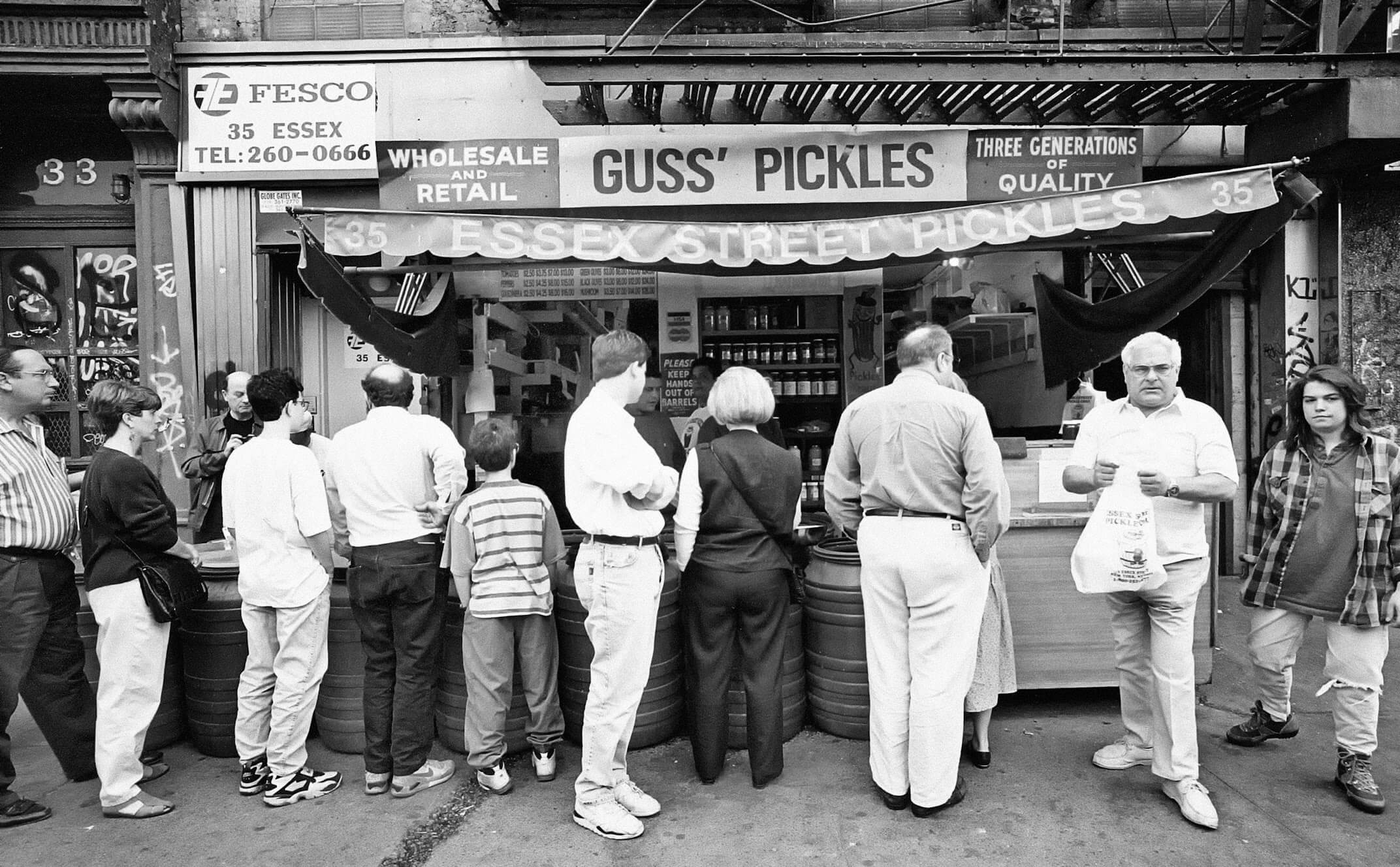
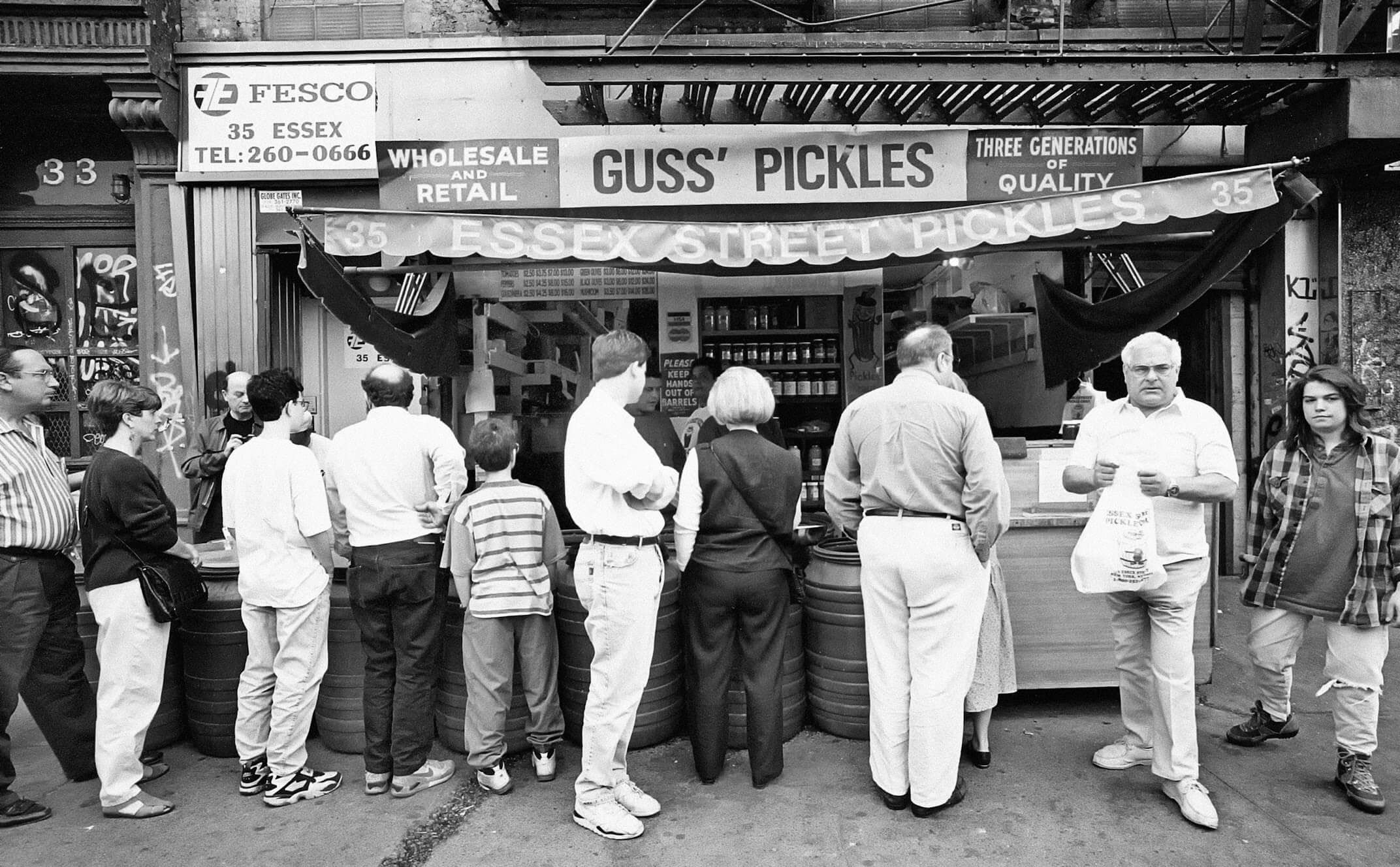
We learn, for instance, that Izzy Guss, of Guss’ pickles, beat out the competition after a neighbor in his tenement offered to hook his cart up to electricity with an extension cord, giving the cart a light and allowing Guss to sell at night. (We’re told the cord was cut when Guss refused to marry the neighbor’s daughter.)
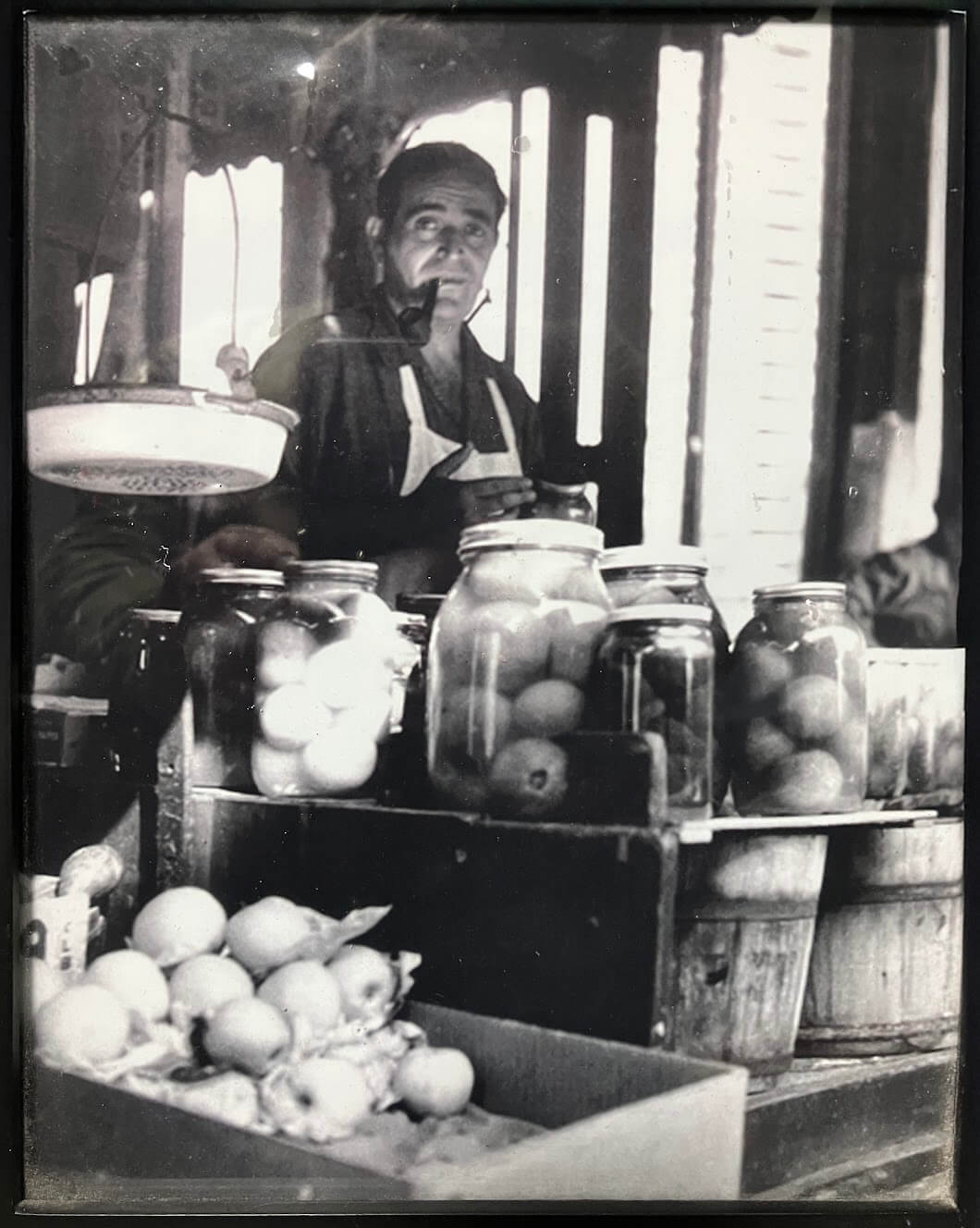
The book also touches on the pickling history of Long Island, with a mention of a Samuel Ballton — Pickle King of Greenlawn, a formerly enslaved man and Union veteran who produced 1.5 million pickles in a single season. The industry in Syosset was dealt a major blow with a blight called the “white pickle” disease, and subsequently pivoted to potatoes.
Even with these New York histories, the book often crosses Delancey into a wider world, making a kumbaya case for pickles as a conduit for cultural exchange.
Japanese pickled plums, Indonesian atjar and Indian chutneys are given space toward the back, but their current imprint in New York, on the same streets that once held tenements and peddlers, is oddly glossed over. (I could have tipped them off to the Astoria bagel shop that serves beef bulgogi and kimchi sandwiches.)
“For Jewish families fleeing persecution, pickling was more than a way to save food — it was a way to preserve identity and heritage,” the authors write.
This is not an exclusively Jewish phenomenon. There are 8 million stories in the pickled city. This book cracks the lid, but only skims the surface.
The post How New York Jews made pickles a big dill appeared first on The Forward.
Uncategorized
UK adopts sweeping measures against antisemitism in schools
(JTA) — The U.K. has adopted sweeping measures to combat antisemitism in English schools, prompting pushback from the country’s largest teachers’ union.
The move came after a new government-commissioned review found that three in five Jewish students reported experiencing antisemitism in English schools. The most common incidents were jokes, stereotypes and comments about Jewish people. About half of respondents who witnessed or experienced antisemitism said the incidents were not reported, most often because they did not think they would be taken seriously.
The government on Wednesday accepted 27 recommendations from the report, including dedicated antisemitism training for leaders and staff, improved recording of antisemitic incidents and moves to build a better understanding of Jewish life, identity and contemporary antisemitism.
The government commissioned the report following a spate of high-profile attacks on Jews in Britain, including an attack on a synagogue in Manchester last year that left two men dead.
The report’s author, Sir David Bell, the vice chancellor of the University of Sunderland and former chief inspector of schools in England, recommended addressing antisemitism distinctly from other forms of racism. He argued that antisemitism was a “uniquely complex” problem because of intertwined racial and religious dimensions, since Jewish identity can encompass both an ethnicity and a religion, along with expressions of prejudice that hold all Jews responsible for the actions of Israel.
The government will also encourage English schools to adopt the International Holocaust Remembrance Alliance (IHRA) working definition of antisemitism. The definition is supported by many mainstream Jewish organizations and has been adopted by 47 countries, including the U.K., but critics say that it conflates some forms of antisemitism with criticism of Israel.
British Education Secretary Lucy Powell called Bell’s review a “generational moment” and said that “implementation is now my priority.”
However, the National Education Union, the largest union representing teachers, lecturers, teaching assistants and support staff in the United Kingdom and Europe, raised concerns on Wednesday about recommending the IHRA definition for schools. NEU general secretary Daniel Kebede said in a statement that the definition “risks deepening the problem rather than tackling it, and actively undermining efforts to confront antisemitism.”
“The IHRA’s contested framing risks blurring the line between antisemitism and legitimate criticism of the Israeli government and the genocide in Gaza, leaving teachers with uncertainty when they need clarity,” said Kebede. He cited a risk that “children who cannot critically explore issues through classroom discussion will instead seek their answers in online and unsafe groups.”
Kebede also encouraged Britain’s Department for Education to strengthen guidance on all forms of racism, not only antisemitism, saying that 65% of teachers report they have not received any antiracism training in the past year.
The Board of Deputies of British Jews, an umbrella organization for British Jewish communities, celebrated the antisemitism report and the government’s adoption of its proposed measures. The group specifically praised the report’s “clear recommendations that schools and local authorities follow government guidelines by adopting the IHRA Working Definition of Antisemitism as a tool to deepen understanding of contemporary antisemitism.”
“We remain concerned about undue external influence on schools driven by narrow political agendas, and tendentious materials seeping into schools and increasing disharmony, and we will continue to press for vigilance against this,” said the Board of Deputies.
The post UK adopts sweeping measures against antisemitism in schools appeared first on The Forward.
Uncategorized
Orthodox Jewish man stabbed in midtown Manhattan
(New York Jewish Week) — An Orthodox Jewish man is in stable condition after being stabbed on Wednesday evening in the Diamond District of midtown Manhattan. Police are investigating the attack as a possible hate crime.
Police told the Jewish Telegraphic Agency that the NYPD’s Hate Crimes Task Force is investigating the incident as a possible antisemitic attack, and Manhattan Shomrim — the Jewish community watch group — has asked people to share footage as police search for the suspect. No arrests have been made.
The victim was identified by police as a 26-year-old man, and Orthodox Jewish outlet COLLive identified him as a resident of Crown Heights, the neighborhood that is home to the Chabad-Lubavitch Hasidic movement’s headquarters.
He was taken to Bellevue Hospital in stable condition. Police said they were called at about 5:50 p.m. on Wednesday after the man was stabbed in the back with “an unknown sharp object” on 47th Street near Fifth Avenue. ABC7 reported that the victim told investigators he believed he was stabbed with a needle or syringe.
According to the Chabad website, which published an interview with the victim, he is a recently ordained Hasidic rabbi named Joseph, who commutes to Midtown each day to wrap tefillin with Jewish merchants. The attacker, Joseph told the website, was a woman who seemed to be following him prior to the stabbing.
The attack comes as Jewish New Yorkers have been targeted in more than half of the hate crimes committed in New York City this year, despite making up about 12% of the city’s population.
In July, an assailant stabbed two men on the Upper West Side, including one who was leaving a synagogue, while yelling “Allahu akbar,” and was charged with committing hate crimes.
Louis Keene contributed reporting.
The post Orthodox Jewish man stabbed in midtown Manhattan appeared first on The Forward.
Uncategorized
VIDEO: A Hasid gives us a tour of Morocco in Yiddish
דער ירושלימער יוטוב־שטערן וועלוול קירשנבוים האָט לעצטנס אַרויסגעשטעלט אַ ווידעאָ אויף ייִדיש פֿון אַ פּרעכטיקן וויזיט, וואָס ער האָט געמאַכט אין מאַראָקאָ. עס באַגלייט אים זײַן חבֿר אַבֿרהם פּרץ.
אינעם ווידעאָ זעט מען ווי קירשנבוים דאַוונט שחרית מיט די אָרטיקע ייִדן און באַזוכט אַ גוט אָפּגעהיטענעם בית־עולם, וווּ עס ליגן באַערדיקט גרויסע צדיקים ווי למשל הרבֿ חיים בן עתר (1696–1743), באַקאַנט ווי דער „אור החיים“. „מענטשן מיינען, אַז נאָר אין אייראָפּע זענען דאָ קבֿרים פֿון צדיקים!“ זאָגט קירשנבוים.
מיר זעען אַ גרויסע, שיינע שיל מיט אַ פֿײַנער אַרכיטעקטור אין קאַזאַבלאַנקאַ; דעם גרויסן אַראַבישן שוק, וווּ קירשנבוים קויפֿט זיך אײַן מלבושים פּונקט ווי די מאַראָקאַנער גייען אָנגעטאָן. ער באַוווּנדערט אויך די שיינע טיי־גלעזער און טשײַניקן, וואָס מע פֿאַרקויפֿט דאָרט, און באַקענט זיך מיט אַ ייִדישן סוחר וואָס האַנדלט מיט זילבער און גאָלד, פּונקט אַזוי ווי זײַן טאַטע און זיידע האָבן געטאָן פֿאַר דור־דורות.
The post VIDEO: A Hasid gives us a tour of Morocco in Yiddish appeared first on The Forward.
