


Uncategorized
Human Rights Watch Finally Draws the Line
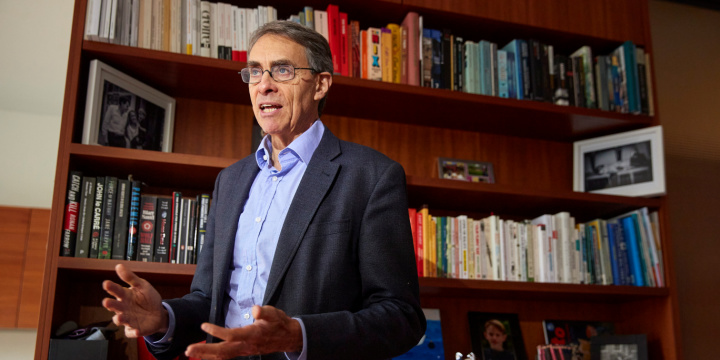
Kenneth Roth, former executive director of Human Rights Watch, gestures during an interview with Reuters in Geneva, Switzerland, January 12, 2021. Picture taken January 12, 2021. REUTERS/Denis Balibouse
Omar Shakir has served as Human Rights Watch (HRW)’s Israel/Palestine director for the past decade. In 2018, Israel revoked his work visa due to his support for the Boycott, Divestment, and Sanctions (BDS) movement, claiming that such activism conflicted with the neutrality expected of a human rights investigator. He has worked from abroad ever since.
In 2021, he wrote a report accusing Israel of apartheid, and I went to one of his presentations at an interfaith conference to hear his case firsthand. He then went on to author another report accusing Israel of genocide.
Recently, Shakir and a colleague drafted a new document advancing an even more far-reaching claim: that Israel is committing a crime against humanity by denying the descendants of Palestinians uprooted in Israel’s War of Independence the “right of return.”
Crimes against humanity are among the gravest offenses in international law, typically defined as persecution, torture, or enslavement. Yet Shakir argues that Israel’s denial of a right of return to descendants should fall under the statute’s vague catch-all category of “other inhumane acts that cause great suffering.”
The Geneva Conventions prohibit the forcible displacement of civilians in war and recognize claims for return or compensation. Anyone, whether Arab or Jew, who was driven from their home illegally in Israel’s 1948 War of Independence should have been allowed back or compensated. But that debate is not the real issue here.
Omar Shakir is not concerned with the plight of people actually displaced way back then, as the vast majority are no longer living. Rather, he is referring to their descendants, often after three or four generations. This is a different claim entirely.
Under ordinary international practice, refugee status is temporary. It ends once a person either returns home or resettles with legal permission to live and work in a new place. At that point, refugee protections are no longer needed, and refugee status is therefore not inherited indefinitely across generations.
But the United Nations created a unique framework which it applies only to Palestinians. Unlike every other refugee group in history — including Jews murdered by the millions during the Holocaust — Palestinians uprooted in 1948 pass their refugee status along to their descendants without limit, even after they have successfully resettled. And that’s even though it’s questionable how many of the original descendants were actually forced out — something that also happened to large numbers of Jews in the Middle East at exactly the same time.
UNRWA, the United Nations agency dedicated to assisting Palestinian refugees, has also added additional eligibility categories. These include individuals who experienced poverty or hardship they attribute to the 1948 war, along with their descendants as well. When a Palestinian descendant living in the United States recently asked UNRWA to remove him from its rolls because he no longer considered himself a refugee, the agency refused. It said there was no mechanism to do so, and that names are typically removed only upon death.
These are the individuals whom Shakir says are victims of Israel’s new crime against humanity. But there are two problems. First, since most, if not all, were born in countries that grant them citizenship, they are not refugees in any ordinary sense of the word. They therefore have no right to demand to immigrate to a different country based solely on ancestral ties to a land they have never lived in.
Second, international criminal law does not treat the hardships of third- and fourth-generation descendants as the continuing legal responsibility of states decades later. If it did, nearly every country on earth would stand accused of slavery, colonialism, and crimes committed in centuries-old wars. Crimes against humanity would cease to denote deliberate, large-scale atrocities and instead be stretched to cover political and historical disputes that international criminal law was never meant for.
To its credit, this new report was a step too far even for Human Rights Watch, which did not allow its publication. While current HRW officials are reticent to comment, former HRW executive director Kenneth Roth stated that Shakir’s report, “was indefensible and would have been deeply embarrassing if given a Human Rights Watch imprimatur.”
This refusal prompted Shakir and his colleague to resign. They’ve since been outspoken in the press and social media, alleging that HRW has double standards when it comes to Israel, and questioning the organization’s integrity.
But for those of us who have long criticized Human Rights Watch for its scathing treatment of Israel — but the group’s pulled punches regarding Hamas — its decision not to publish Shakir’s report may be what is surprising. Human Rights Watch recognized that not every injustice is genocide, and historical grievances are not crimes against humanity. When advocacy groups stretch legal terms to score political points, they cheapen the very concepts meant to prevent atrocities. In this case, Human Rights Watch acted properly in drawing the line.
Shlomo Levin is the author of the Human Rights Haggadah, and he uses short fiction to explore human rights at https://shalzed.com/
Uncategorized
Romania’s secret police trailed a Jewish photographer. Decades later, their files have become a film.
(JTA) — BERLIN — He had wild hair and wore jeans. He was American — and Jewish. He had a camera.
That was enough to trigger surveillance by the notorious secret police of communist Romania, the Securitate.
Now, 41 years after photojournalist Edward Serotta boldly stepped behind the Iron Curtain, we can see just how obsessed the Romanians were with him, thanks to a short documentary by renowned Romanian director Radu Jude and historian Adrian Cioflâncă.
“Plan contraplan/Shot Reverse Shot,” which had its world premiere at the Berlinale international film festival last month, gives equal time to Serotta’s reminiscences about Romania in the 1980s, and to the Securitate’s observations of him.
And of course, to the photos: After his Romania adventure, Serotta put down new roots in Europe, and has spent decades documenting the Jewish life that was nearly obliterated in the Holocaust. He has published several books of photographs documenting Jewish communities. He also documented the fall of the communist regimes in which he’d set foot as a young man.
Twenty-two minutes long, the film was one of several shown at the festival with themes related to Jewish life and history, or to the Israeli-Palestinian conflict.
The obsessive spying of the communist regime, as documented here, appears absurd today. But it was fully serious at the time.
In his narration, Serotta — born in 1949 in Atlanta — recalls how communist authorities in 1985 “had given me the permission to come to Romania under the idea that they would have glowing and fine articles and positive articles about Romania.” His stated intention was to document World War II memorials, of which at the time there were only a handful. Today, there are many more.
“He will be put under surveillance,” declares the spy, narrated in the film’s second half by Romanian political scientist Diana Mărgărit, “in order to prevent contact with parasitic protest elements.”
While Serotta was aiming his lens, the informants were sneaking around, snapping quick shots and jotting down observations. They also slipped into his hotel room one day, and exposed a roll of film.
The things they frantically recorded are “funny right now,” a reminder of a bygone regime that at the time was deadly serious, said Cioflâncă in an interview. Cioflâncă is on the advisory college of the National Council for the Study of the Securitate Archives, a state institution that deals with the history of communism. “I lived for 15 years when I was a child under communism. And it was not fun.”
For 41 years, until the regime’s fall and the execution of president Nikolae Ceaușescu and his wife, Elena, in 1989, the Securitate spied on and terrorized citizens of Romania, suppressing dissent. According to the virtual Cryptomuseum, based in the Netherlands, the Securitate had up to 11,000 agents and 500,000 informants monitoring a population of 22 million.
In 2006, a governmental commission reported that more than 600,000 Romanians — and potentially around 2 million — were incarcerated for political crimes, and more than 100,000 died.
Western journalists, though suspect and surveilled, were to some extent wooed — at least in the 1980s. When Serotta requested to visit in 1985, Ceaușescu had been president for some 11 years (after heading the communist party from 1965). Ceaușescu was seen as more friendly to the west: He had refused to contribute troops to invade former Czechoslovakia in 1968; and he kept up relations with Israel when other communist countries severed their ties.
At the time, the regime wanted to gain “most favored nation” economic status from the United States, which depended on their allowing some freedom of movement to its population.
“There were 855 western journalists coming to Romania during the Ceaușescu period, and 80 of them were American,” said Cioflâncă, who also directs the Bucharest-based Center for the Study of Jewish History, under the Federation of Jewish Communities in Romania.
“Many of these visits were organized as a propaganda instrument. In all the cases, they wanted to interfere with the journalist and to influence his work. They tried something similar with Edward when he came,” he added.
“They felt that the Jews are so influential, especially in the relationship with the United States,” Serotta said in an interview.
“In their mind, everything that was Israeli, Jewish, or American Jewish was deemed like an important piece of influence to use for their political PR at that time,” said Serotta, who eventually moved to Europe and in 2000 founded the Centropa nonprofit archive aimed at preserving Jewish memory in Central and Eastern Europe, the Balkans, the Baltics, and the former Soviet Union.
Centropa was purchased by the US Holocaust Memorial Museum in 2024.
Given Serotta’s obsession with documenting history, Cioflâncă said he was surprised to learn that his friend had never viewed his Securitate files. Several years ago, he asked Serotta if he’d like to see them.
“The funny thing is, I didn’t think I was important enough to have any,” Serotta recalled.
Cioflâncă found some 300 pages of documents. The informants had tried to influence the photojournalist, saying that the World War II killings of Jews in the region were “a marginal moment,” Cioflâncă noted. “They wanted to make sure that their reputation remained clean, that they were not collaborators” with the Nazis.
According to the US Holocaust Memorial Museum and Yad Vashem, at least 380,000 Romanian Jews were killed during the Holocaust.
“I was there for a matter of several weeks,” Serotta said. He recalled “a very tense atmosphere. Nothing worked properly. We barely found food in stores. It was awful.”
And he is still astonished that the Securitate spent so much time following him. “It’s funny stuff.”
“Many Securitate officers were pretty stupid,” Serotta said in the interview. “They were so distorted in doing their job that they didn’t have this sense of [the] ridiculous and humor.”
Moreover, “their [photo] equipment, first of all, was not very good. Secondly, they were usually doing it surreptitiously: behind a wall or a door or something or something like that. But as the old expression goes, the pictures are great because I look young. I look like a casting reject from ‘Flashdance.’”
Serotta, for the most part, ignored or was unaware of the surveillance, except for when the only two cars on remote roads, hour after hour, were his and that of a spy on his tail.
And yet the trip to Romania was priceless. On one of his first visits to a Jewish community in Romania, he said to himself, “Wow, this is interesting. This is like the old country.”
“Then I said, ‘It’s not like the old country. It is the old country, and I’m in it,’” he added. “From that moment on, I felt like I had opened a door, and I’ve never come back through it.”
The post Romania’s secret police trailed a Jewish photographer. Decades later, their files have become a film. appeared first on The Forward.
Uncategorized
Avraham Burg, longtime fixture of Israeli left, meets Tucker Carlson on his own turf
(JTA) — Tucker Carlson has set off alarm bells among many Jewish groups and even some conservative allies by hosting conspiracy theorists, grilling the U.S. ambassador to Israel and dabbling in sinister-sounding theories about Benjamin Netanyahu and Chabad.
But on Monday a notable Israeli opted to appear on Carlson’s show: former politician and left-wing figurehead Avraham Burg. And their talk was demonstrably cordial — though not without some gentle ribbing.
“Listen, Tucker, I cannot stand you,” Burg told his interviewer over a video call. “But you’re a nice person, so I talk with you.”
“I’ll take that as a half compliment,” Carlson responded, laughing.
A former speaker of the Knesset, interim Israeli president and onetime chair of the Jewish Agency for Israel and World Zionist Organization, Burg today remains an outspoken member of Israel’s dwindling left. A proponent of positions like post-Zionism and the Palestinian right of return that are deeply unpopular in Israel, he is also a frequent Netanyahu critic and current member of Hadash, an Israeli far-left party with Communist roots.
In his newsletter, Burg explained his decision to appear on Carlson’s show by saying the influential podcast host was “one of the most powerful voices in today’s American Right.”
“This interview was born out of a genuine desire to step outside familiar patterns and meet the person behind the public image that has been built around him, not out of prior agreement and not out of any need to adjudicate, but out of a willingness to seriously engage with the challenges he poses to the political and cultural discourse of our time,” Burg wrote in his Substack.
In a veiled swipe at other Jewish groups and Israeli leaders that have denounced Carlson, he added, “Carlson manages to touch a raw nerve of an American society whose doubts are deepening, and the temptation is to dismiss that with slogans. I chose not to do that.”
Indeed, throughout their 90-minute conversation, Burg did not push Carlson on the more outlandish claims the pundit has made on his shows in the past, even as he noted he watched the show frequently. He did object to Carlson’s past contentions that Israel would consider using nukes against Iran, as well as to Carlson’s rejection of the question of whether Israel “has the right to exist.”
Another area of pushback came when Burg insisted that, contrary to Carlson’s claims, Israel doesn’t have a consistent security policy, let alone a grandiose religious or conspiratorial vision.
“I listened to you very carefully in the last couple of weeks, and the way you try to conceive the Israeli strategy, from Netanyahu’s 40-year life mission to the greater land of Israel,” as biblical, “Messianic” or “eschatological,” said Burg. “I envy you that you really believe that we have something like that.” However, he added, “It doesn’t work that way.”
He instead focused on what he referred to as the Israeli mindset, which he called “a very, very hard, stiff-necked” one. Israelis, Burg said, do not believe in a “win-win” solution to their conflicts with their neighbors: “We live in a zero sum game.”
“‘I want to win alone. I want you to be dead. I want to humiliate you. I want to cancel you,’” Burg said, explaining that mindset. “‘Whomever you are, you are my enemy.’ And when you look at this philosophy, you understand where comes the political rhetoric that every adversary, never mind who [he is], minor or major, but at the end of the day, he is a Hitler.”
Israelis, Burg claimed, are also isolated from much of the English-language media, and reflexively dismiss any media criticism of their actions as antisemitic, creating “a thick filter that enables us to reject any kind of legitimate criticism.”
Carlson, who himself has offered various denunciations of the Israeli mindset on other episodes, took a soft approach to interviewing Burg. He praised Burg as “a pretty brave guy,” citing a recent op-ed in which the Israeli had opposed war with Iran, and ended by stating, “This conversation has really been a blessing for me.”
He avoided testier subjects he had raised with U.S. Ambassador to Israel Mike Huckabee and other guests in recent episodes, such as suggesting genetics testing for all Israelis to test the Jewish claim to the Holy Land, or musing that the Chabad Hasidic movement orchestrated the war as a means of building the Third Temple.
Whether his audience appreciated the apparent sincerity is an open question. On YouTube, commenters variously described Burg as complicit in Israel’s failings despite his politics or offered backhanded praise for the ways he confirmed their worst suspicions about Israelis. “If what he’s saying is true then what an unbearable group of people,” read one comment.
On X, Carlson’s other main platform, prominent pro-Israel Jews denounced Burg as a Communist and traitor to Israel.
Burg’s willingness to find common cause with Carlson was the latest sign of how some on the Jewish left, finding little appetite among institutional Jewish groups and Israeli society for sustained pushback against Israel’s actions in Gaza and Iran, may be looking instead to fringe voices on the right, where anti-Israel sentiment is also growing.
American Jewish left-wing intellectual Norman Finkelstein has appeared on Candace Owens’ podcast, while Israeli left-wing activist Miko Peled has aligned with Carrie Prejean Boller, a former religious liberties commissioner under Trump who was ousted over her stated Catholic opposition to Zionism.
Also this week Jewish journalist Peter Beinart, a leading progressive critic of Israel, praised former Trump counterterrorism director Joe Kent — another recent Carlson guest — as “a brave man” for resigning from his post while citing his opposition to war with Iran. Kent’s resignation letter accused Israel not only of manipulating Trump into war but also of having started the Iraq War and the Syrian Civil War, raising concern among American Jewish groups and providing further fodder for antisemitic elements on the right. (Beinart criticized aspects of the letter as “faulty” in his Jewish Currents essay, which was publicly assailed by a former magazine board member.)
For Burg and Carlson, the meeting revealed more similarities than differences in their worldviews. Toward the end of their talk, Burg expressed optimism that his grandchildren’s generation “will stand up and say, ‘We are ready to defend the legitimate Israel, but we’re not ready to sacrifice our life or to sacrifice the life of others on the altar of this craziness.’ This day is close.’”
“That’s a very reassuring thing to hear,” Carlson responded, in agreement.
The post Avraham Burg, longtime fixture of Israeli left, meets Tucker Carlson on his own turf appeared first on The Forward.
Uncategorized
King Charles named patron of British Jewish security nonprofit following ambulance attack
(JTA) — King Charles has been named the first-ever patron of a British Jewish security nonprofit, a move announced in the wake of an arson attack that targeted four ambulances owned by a Jewish volunteer emergency service in north London.
The Community Security Trust, Britain’s main antisemitism watchdog, announced that King Charles had accepted the role — indicating a royal’s endorsement of a cause — during an annual fundraising dinner Monday night, where British leaders condemned the attack.
“His Majesty’s longstanding commitment to promoting tolerance, inclusion and interfaith understanding align closely with CST’s mission to protect British Jews and CST is honoured by this recognition and looks forward to working under His Majesty’s patronage to further its vital work across the country,” CST wrote in a statement.
While the attack is being investigated as an antisemitic hate crime but not a terrorist incident, counterterror officers have been leading the investigation after an Islamist group claimed responsibility for the attack. (The same group also claimed responsibility for synagogue bombings in Belgium and the Netherlands.)
“It is too early for me to attribute last night’s attack in Golders Green to the Iranian state … but whoever was responsible, the impact is serious,” London police chief Mark Rowley said at the annual dinner on Monday.
Police believe three suspects were involved in the attack, although no arrests have been made yet. Security footage of the scene of the attack in Golders Green, a heavily Jewish neighborhood of London, appeared to show three individuals approaching the ambulances parked outside the Machzike Hadath Synagogue.
In the wake of the attack, Rowley pledged to deploy over 250 additional police officers to protect Jewish communities and the British government announced it would provide four replacement ambulances to Hatzola.
In a speech at the dinner, British Home Secretary Shabana Mahmood said that antisemitism was on the rise and vowed that those responsible would be “pursued and made to face the consequences of their vile actions.”
“It is so warped it defies words,” Mahmood said of the arson attack. “This was more than an attack on four ambulances; it was more than an attack on one organisation or on one community. It was an attack on this country and on us all.”
In the days following that attack, donations to fundraising campaigns on behalf of Hatzola reached nearly $2 million following a plea from the organization for urgent support.
“We are launching an urgent appeal to rebuild what has been lost — we cannot to afford to let our life-saving work be put on pause,” Hatzola said in a statement. “We need immediate support so we can source: new ambulances, strengthening security, equipping the teams, restocking and ensuring we can continue to respond safely and effectively in every emergency.”
The post King Charles named patron of British Jewish security nonprofit following ambulance attack appeared first on The Forward.