


Uncategorized
I know exactly why leftists aren’t celebrating this ceasefire
“We can’t hear you, Zohran,” read one New York Post headline this week: “Pro-Hamas crowd goes quiet on Trump’s Gaza peace deal.”
“It seems awfully curious that the people who have made Gazans a central political cause do not seem at all relieved that there’s at least a temporary cessation of violence…Why aren’t there widespread celebrations across Western cities and college campuses today?” the article asked.
The Post wasn’t alone in voicing that question. A spokesperson for the Republican Jewish Coalition posted on X that “The silence from the ‘ceasefire now’ crowd is shameful and deafening.” Others went so far as to imply that the protesters had been lying and never actually wanted a ceasefire — because what they really wanted wasn’t freedom and security for Palestinians, but the ability to blame Israel. If pro-Palestinian voices had really wanted a ceasefire, the thinking went, they would be celebrating.
I read these various posts and articles and thought of Rania Abu Anza.
I have thought of her every day since I first read her story in early March 2024. Anza spent a decade trying to have a child through in vitro fertilization. When her twins, a boy and a girl, were five months old, an Israeli strike killed them. It also killed her husband and 11 other members of her family.
A year and a half later, a ceasefire cannot bring her children, her husband, or her 11 family members back. They were killed. They will stay dead. What is there to celebrate?
This does not mean that the ceasefire is not welcome, or that it is not a relief. On the contrary: It is both. Of course it’s a relief that the families of hostages don’t need to live one more day in torment and anguish. Of course it’s a relief that more bombs will not fall on Gaza.
But celebration implies, to me anyway, that this is a positive without caveats. And in this situation, there are so many caveats.
The families of the surviving hostages will still have spent years apart from their loved ones, in no small part because their own government did not treat the hostages’ return as the single highest priority. The families of those hostages who were killed in the war will never again sit down to dinner with their loved ones, who could have been saved. And it is difficult to fathom what’s been taken from the hostages themselves: time spent out exploring the world, or with family and friends, or at home doing nothing much at all but sitting safely in quiet contemplation.
And a ceasefire alone will not heal Israeli society, or return trust to the people in their government. It will not fix some of the deep societal problems this war uncovered. A Chatham House report this August found that, “Israeli television ignores the suffering of Palestinians in Gaza, while the rhetoric is often aggressive. Critical voices, from inside Israel or abroad, are attacked or silenced.” If the country is ever going to find its way back from Oct. 7 and this war, a ceasefire is a necessary precondition, but not a route in and of itself.
In Gaza, Palestinian health authorities have said that about 67,000 people — not distinguishing between combatants and civilians — have been killed by Israel’s campaign in response to Oct. 7. A full third of those killed were under the age of 18. The ceasefire cannot bring those children back to life.
It cannot turn back time and make it such that Israel admitted more than minimal aid to the embattled strip. It will not undo the damage that has been done to the people of Gaza who were denied enough to eat and drink and proper medical care. It will not give children back their parents, or parents back their children. It will not heal the disabled, or make it so that they were never wounded.
It will not change that all of this happened with the backing of the United States government. (This is to say nothing of the West Bank, which has seen a dramatic expansion of Israeli settlements and escalation of settler violence over the course of the war). And as American Jewish groups put out statements cheering the ceasefire, we should also remember that it does not reverse the reality that too many American Jews were cheerleaders for all this death.
Protesters calling for a ceasefire have regularly been denounced as hateful toward Jews or callous toward the plight of Israelis; American Jews who called for one were called somehow un-Jewish. (Yes, some pro-Palestinian protesters also shared hate toward Jews; the much greater majority did not.) The charge of antisemitism — toward those calling for a ceasefire, those calling for a free Palestine, and those who called attention to Israel’s abuses during this war — was used to silence criticism of Israel and of U.S. foreign policy. Some American Jews went so far as to call for the deportation of students protesting the war.
A ceasefire doesn’t change any of that. It can’t.
I have hopes for this ceasefire. At best, it will allow people — Israelis and Palestinians and, yes, diaspora Jews — to chart a new, better course going forward. But it almost certainly will not do that if we delude ourselves into thinking of this as a victory or a kind of tabula rasa, as though the lives lost and hate spewed are all behind us, forgotten, atoned for. The last two years will never not have happened. What happens next depends on all of us fully appreciating that.
The post I know exactly why leftists aren’t celebrating this ceasefire appeared first on The Forward.
Uncategorized
Louise Nevelson designed a work of art and of worship. Now, as its congregation downsizes, it is seeking a museum home.
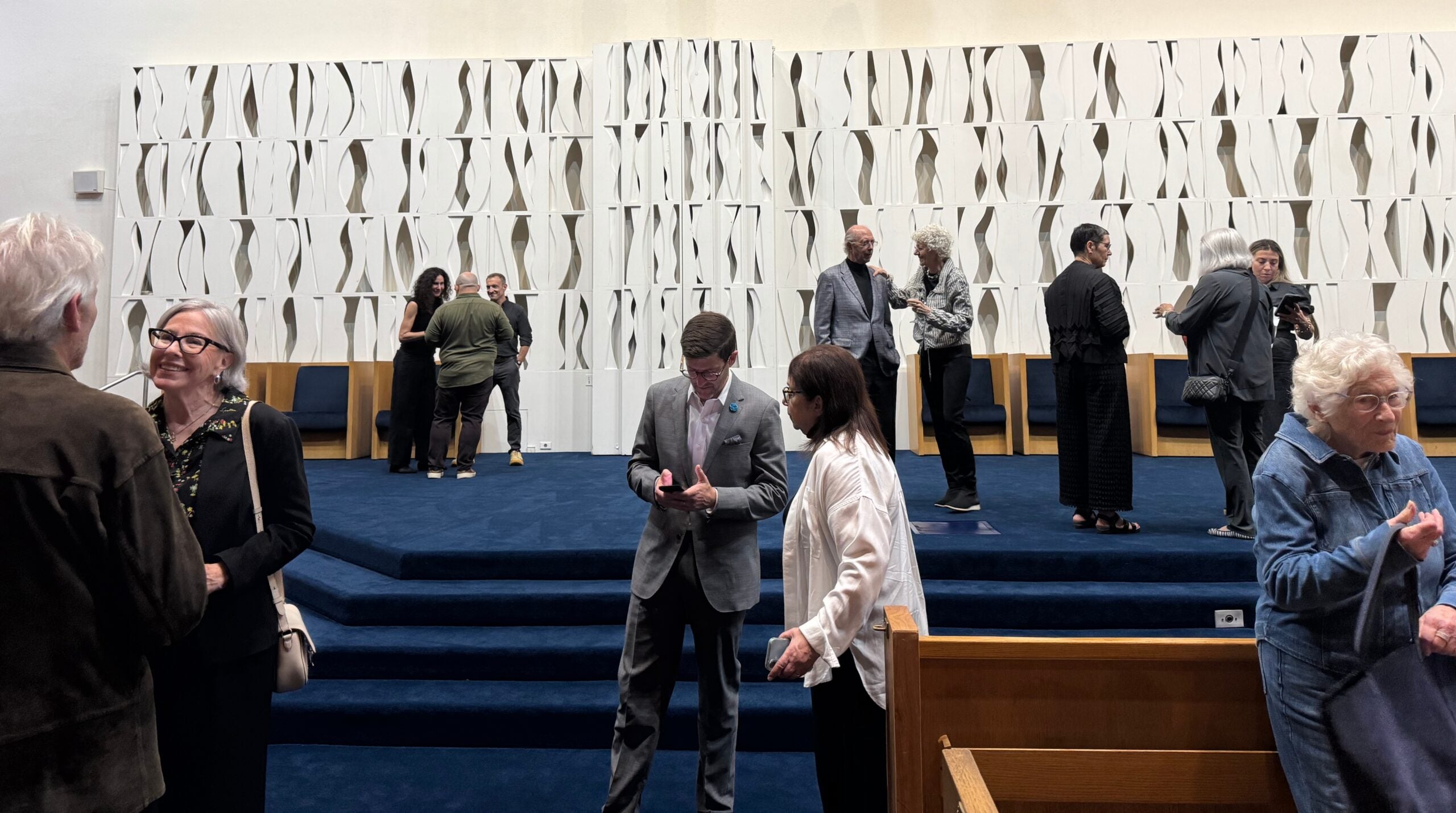
(JTA) — Louise Nevelson, the storied American sculptor, created “The White Flame of the Six Million,” a 50-foot-long, 11-foot-high bimah sculpture incorporating a Torah ark and serving as a Holocaust memorial, for Temple Beth-El in Great Neck, New York, where it has remained for more than 50 years.
Now, due to demographic change in suburban Long Island, the work has been deconsecrated.
In September, immediately after Neilah, the closing prayers on Yom Kippur, the Torah scrolls were removed from the ark. The sculpture itself will soon be disassembled and put into storage, its new home to be determined.
Beth-El’s congregation once had an active membership of 1,500 families and a long waiting list. But because of shifts in the makeup of Great Neck’s Jewish community, that number has fallen to 400 families. The Reform congregation sold its property to Yeshivat Kol Yaakov, an Iranian/Sephardic Orthodox yeshiva. Beth-El is currently leasing its original chapel from the yeshiva.
On Oct. 1, members of the synagogue bid a “sacred farewell” to the Nevelson at a reception attended by Maria Nevelson, the artist’s granddaughter and founder of the Louise Nevelson Foundation. Curators from the Jewish Museum in New York and the North Carolina Museum of Art in Raleigh also attended. Both have major Judaica collections and have expressed interest in the piece. The synagogue has hired an agent to raise funds to facilitate the donation of the sculpture to a museum.
“Through my foundation work, I have an eye on what I leave for future generations, so they have quality information,” said Maria Nevelson, wearing a silver reproduction of a necklace her grandmother made. “I look at Temple Beth-El’s passing ‘The White Flame’ in this regard and I love that the lucky museum will always acknowledge the temple’s role in bringing this impressive sculpture into being… My grandmother lived in the present and I’m sure she would nod her head in approval for this transition.”

It was a bittersweet evening, with many longtime congregants expressing their love for the Nevelson, telling stories about its place in their lives, and sharing their enthusiasm for its next chapter. The piece played an integral role in services and events, appearing in many b’nai mitzvot and wedding photos.
Roger Tillis, whose parents were involved in the 1970 acquisition of the bimah, recalled that when he was 10 years old, his parents invited Louise Nevelson for dinner. “I met her in the living room,” he said. “She was wearing a babushka. It was a very exciting time.”
Louise Nevelson, born Leah Berliawsky in 1899 in Ukraine, is known for monumental, monochromatic wood assemblages made from scavenged everyday objects and discarded architectural fragments. Some of her sculptures were made from metal, including “Night Presence IV,” which can be seen on Park Avenue and 92nd Street in New York.
Her art is in the collections of over 250 museums and public spaces worldwide, according to her foundation. Nevelson created sculptural pieces for other houses of worship, including Temple Israel in Boston in 1973 and the Chapel of the Good Shepherd in St. Peter’s Lutheran Church in New York in 1977. “The White Flame” is the longest contiguous wall sculpture Nevelson ever made. The New York Times, in its 1988 obituary, called her a “pioneer creator of environmental sculpture who became one of the world’s best-known artists.”
Her connections in Great Neck dated back to the 1950s, when she gave sculpture classes in the town and became known to the Jewish community. In 1970, real estate developer Wilfred Cohen and his wife Rose, Beth-El congregants, commissioned her to create a bimah sculpture for a new 1,900-seat sanctuary, an addition to the congregation’s original 250-seat chapel from 1932. Nevelson also designed the sanctuary’s ner tamid, the eternal flame.
“For those of us who have been a part of Temple Beth-El for many years, this ark is much more than a remarkable work of art,” board president Jordana Levine said at the Oct. 1 event. “It has been at the heart of our sanctuary and has been part of the life of this congregation for more than 50 years. Generations of our members have prayed before it, celebrated alongside it, and found comfort and meaning here.”
Records for how much Nevelson was paid for her work no longer exist, but a six-foot-long model of “The White Flame” sold for $327,600 at Sotheby’s in 2022. Ann Freedman of FreedmanArt, who has an exclusive contract to find a new home for the bimah sculpture, is working to raise funds so that the piece can be donated to a museum for permanent placement.
Congregant Andy Aaron, who has been a member at Beth-El for 50 years, said he perceives the bimah’s wavy cutouts as people. “The smaller ones at the bottom are children,” he said. Other members reported seeing flames or souls rising up in the all-white work — an unusual color for Nevelson, who mostly painted her sculptures black. Several congregants mentioned how the piece operated like a sundial during services, as beams of light moved across its surface.
Temple Beth-El was one of the most prominent Reform synagogues in the country in the 1960s, welcoming visitors like Martin Luther King Jr., Robert F. Kennedy, Gov. Nelson Rockefeller, and pianist Peter Nero, who played at the new sanctuary’s dedication.
This article originally appeared on JTA.org.
The post Louise Nevelson designed a work of art and of worship. Now, as its congregation downsizes, it is seeking a museum home. appeared first on The Forward.
Uncategorized
A renewed Iran war is only a matter of time, Israeli experts warn
(JTA) — President Donald Trump and Israeli Prime Minister Benjamin Netanyahu have said they don’t want to see a renewal of the war against Iran – but they are issuing stark public warnings to Tehran that could bring the simmering conflict to a boil.
Trump endorsed Netanyahu for Prime Minister on Sunday, explaining that his leadership was critical to any renewed Iran campaign.
A third U.S. aircraft carrier is expected to arrive in the Middle East soon, amid signs that Washington is preparing for a possible resumption of hostilities, even though Israel’s Oct. 27 election and the American midterms on Nov. 3 are looming.
In multiple interviews, including with Channel 14, Netanyahu stressed that, “If Iran makes a mistake and tries to attack us, it will simply make the mistake of its life.” But he added, “It’s not convenient for us” for war to resume weeks before a national election in a country with no absentee voting.
Trump, for his part, told reporters in Atlanta last week, “Wait til you see what we do to Iran.”
Israeli experts have warned that renewed conflict is only a matter of time as an uneasy standoff has continued, with Iran disrupting shipping through the Strait of Hormuz from where 20% of the world’s oil flows. At the same time, the U.S. is maintaining its economic pressure on Tehran.
High oil prices have risen 46% to $104 per barrel since the Feb. 28 attacks, pushing gasoline prices up 46% to $4.36 per gallon.That increase could give Trump another incentive for another strike, which would renew the war that was paused in April.
“Without a diplomatic settlement, the chances of escalation are very high,” Danny Citrinowicz, a senior researcher at the Institute for National Security Studies, told JTA.
Trump has been unable to achieve a diplomatic agreement. Both Tehran and Washington believe they won the two-month war earlier this year. In practice, however, the Islamic regime is still in power with capacity to recoup its nuclear and ballistic missile losses and continues to exert some control in the Strait. All of which makes it difficult for Israel and the U.S. to show that they won.
“Trump cannot declare victory now, but he also cannot leave without doing something,” said Citrinowicz, who was also the former head of the Iran branch in the Israeli military intelligence directorate’s Research and Analysis Division. “On the other hand, the Iranians cannot allow the naval blockade to continue, so they will keep attacking tankers.”
Avner Vilan, a former senior Israeli security official and an expert on Iran, said “Trump has said he won’t attack before the midterm elections, and I think he has good reasons to hold off.”
He stressed, however, that the risk of escalation certainly exists. “We’re in a situation where both sides continue to exert pressure on each other, without any lasting agreement in place,” he said. “Everyone is on edge, and all it would take is one significant incident to send things spiraling out of control.”
Gil Murciano, CEO of Mitvim, the Israeli Institute for Regional Foreign Policies, said the unpopularity of the war with Iran among the American public makes a U.S.-initiated escalation before the midterm elections less likely. A Pew Research Center poll released last week found that 64% of Americans disapprove of how President Donald Trump is handling U.S. military action against Iran.
A poll conducted by the Institute for National Security Studies last month found that Israelis are divided over whether Israel should launch a preemptive strike on Iran, with opponents slightly outnumbering supporters.
The New York Times reported that officials in the Trump administration had discussed a short, intense campaign lasting about three days, focused on Iran’s missile and drone arsenal, potentially alongside strikes on energy infrastructure and Islamic Revolutionary Guard Corps headquarters.
The Atlantic reported that the White House has asked the Pentagon to develop strike options against Iranian targets that could be carried out ahead of the midterm elections.
“A three-day campaign that would, for example, include a strike on Pickaxe Mount would allow Trump to say that he had obliterated Iran’s nuclear project, won the war and was ending the conflict,” Citrinowicz said. “That is one option. Another is to strike Iranian infrastructure facilities.” He cautioned, however, that even a planned three-day campaign could lead to a much broader and more prolonged escalation.
Mitvim’s Murciano said the main factor that could lead the Trump administration and Israel to launch another military campaign is the concern that “Iran could rebuild its capacity to produce surface-to-surface missiles and restore its drone capabilities in a way that would allow it to attack Israel and other countries in the region, as well as strengthen its ability to disrupt shipping in the Strait of Hormuz.”
He added that another key concern for Israel and the U.S. is the possibility of Iran making a breakthrough toward developing a nuclear weapon.
Vilan, the former Israeli security official, stressed that Israel’s interests do not fully align with those of the U.S.. “For Israel, a nuclear-armed Iran would pose a paramount strategic threat, and Iran must not be allowed to acquire nuclear weapons,” he said.
“For Trump, preventing Iran from obtaining a nuclear weapon is an important goal, but he also wants to end the war, reopen the Strait of Hormuz and bring down energy prices,” he added. “Another military campaign could actually take him further away from those objectives.”
Trump and other administration officials have said publicly they believe Iran is at a point of weakness. “Trump may think that Iran is so weak that just one more push will make it collapse. I think that is a mistake,” Citrinowicz said.
The analysts believe an escalation is more likely after the midterm elections.
Murciano noted that if Trump loses the midterm elections and loses his ability to shape domestic policy without control of Congress, he may shift his focus toward cementing his foreign policy legacy.
Vilan cautioned that while some of the political constraints on Trump may ease after the midterm elections, that does not necessarily make another military campaign against Iran worthwhile.
“If the goal is to force Iran into a nuclear deal, it needs to be explained why another round of strikes would achieve what previous strikes have not,” he said. “It is hard to see how additional military force would change Iran’s position. If the goal is to bring down the regime, it is equally unclear how another round of strikes would bring that about — and, in particular, whether it could be achieved in the next two years, before a new president takes office in the White House,” the former senior Israeli security official said.
Iran could also initiate an escalation itself if it believes that Israel or the U.S. is preparing to attack, said Citrinowicz.
“It does not want to be caught by surprise for a third time. The likelihood of that happening is higher than it was in the past, but the Iranians still prefer a gradual escalation over a broad and immediate one,” he said.
Vilan added that “the Iranian regime is facing a dilemma. On the one hand, the economic pressure on it is immense, and time is not necessarily on its side. On the other hand, it knows that an all-out war could threaten its survival.”
Another factor that could come into play is the Houthis, Iran-backed rebels in Yemen who have seized significant territory along the Red Sea coast in recent weeks and disrupted shipping through the Bab el-Mandeb Strait, adding to pressure on the global economy.
“The Houthis are a very important factor in the regional conflict, and their recent gains illustrate the limits of American military superiority,” Vilan said.
Their impact on the prospects of another campaign against Iran could cut both ways, he added. “As the campaign in Yemen becomes more complicated, the Americans have less incentive to open another front. On the other hand, a major escalation by the Houthis could draw the U.S. into a broader military engagement, potentially bringing an escalation with Iran closer.”
Meanwhile, diplomatic contacts between the U.S. and Iran continue through intermediaries. The New York Times reported that the White House believes progress has been made in the talks.
This article originally appeared on JTA.org.
The post A renewed Iran war is only a matter of time, Israeli experts warn appeared first on The Forward.
Uncategorized
Antisemitic terror rattled the Rockies last year. Now Boulder could have a mayor who won’t say whether Israel should exist.
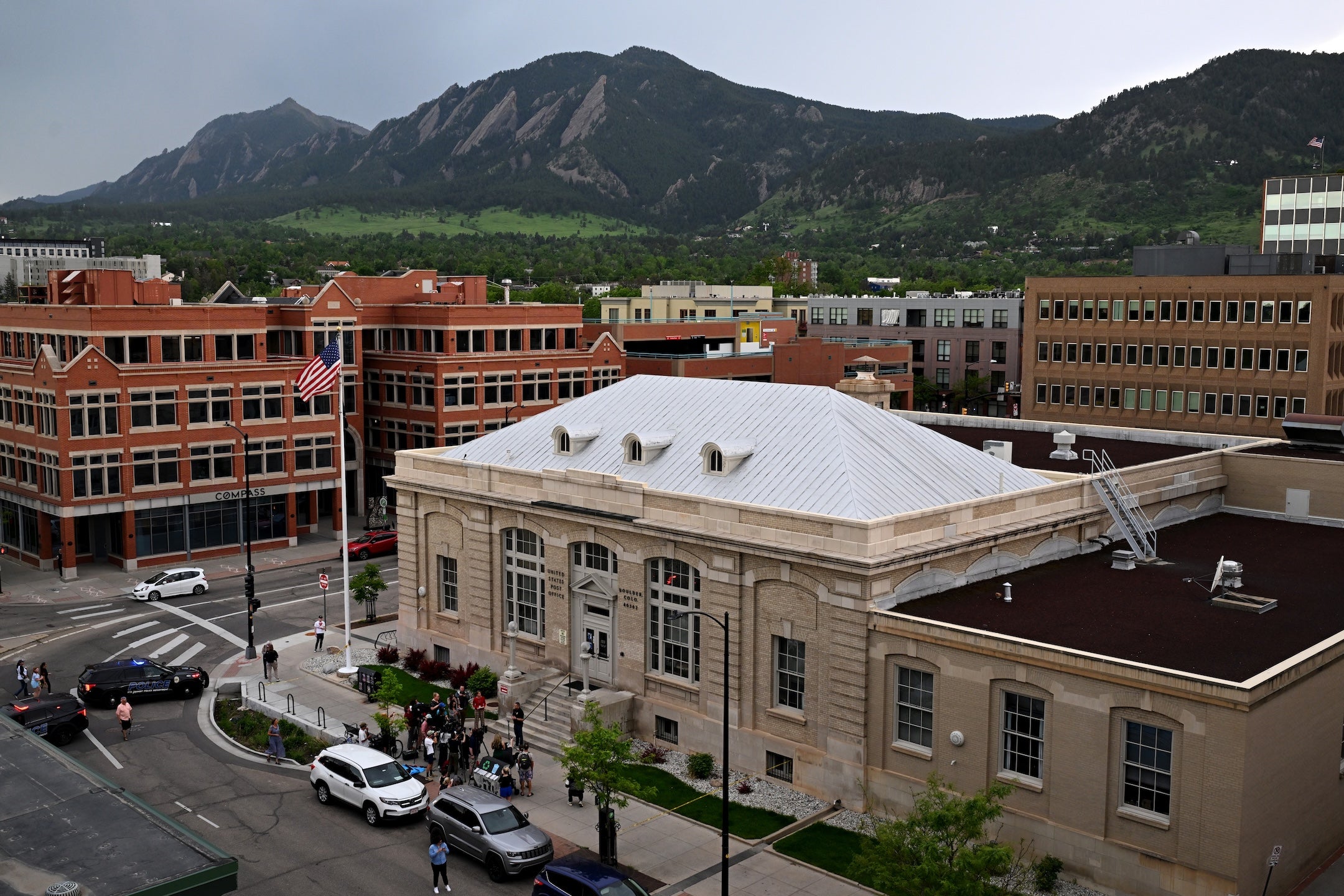
(JTA) — BOULDER, Colo. – Voters in this Rocky Mountain foothills college town could soon elect a mayor who won’t affirm that Israel should exist, just a year and a half after an antisemitic terror attack struck the city’s historic downtown.
Protests against Israel’s operations in Gaza cropped up in Boulder in the months following the Oct. 7, 2023, Hamas attacks on Israel. Such rallies not only became a fixture on street corners, but they also seeped into the chambers of City Council – transforming public comment periods about local issues into heated clashes about a conflict 7,000 miles away. At the center of these clashes was often Taishya Adams, a council member who had primarily run on climate resilience and affordability issues during her 2023 campaign.
But the Israel-Palestinian conflict hit much closer to home after a June 2025 firebombing on Boulder’s Pearl Street Mall. The attack killed one person and injured a dozen others who were participating in a Boulder Run for Their Lives walk, aimed at drawing attention to the Israeli hostages who were still being held by Hamas in Gaza at that time. The day after the attack, Adams was the sole council member who refused to sign a collective statement condemning it.
“The Israel genocide has been one of the defining moments of my tenure,” Adams, who is now running for mayor, told the Jewish Telegraphic Agency.
Asked whether she believes the state of Israel should exist, she said, “I know that people want to hear this easy yes/no, but I don’t believe that creating false binaries is going to lead to our collective liberation.”
Adams, who joined the council just two months after the Oct. 7 attacks, added that it doesn’t matter whether she believes Israel should exist.
“Any state that exists has the responsibility to administer equal rights, whether that’s Israel or the United States or any state,” she said.
Although she shares similar positions on issues such as climate change and affordable housing with many of her fellow council members, Adams has split from her colleagues – including her top opponent, incumbent Mayor Aaron Brockett – on Israel.
When asked by JTA if he believes Israel should exist, Brockett replied, “I do,” noting that this is his personal belief and not relevant to his role as a city councilor.
Adams earned the endorsement of Boulder County Democratic Socialists of America soon after announcing her candidacy for mayor this summer. But another powerful local faction, Boulder Progressives, chose to back Brockett, listing Adams as a second option in the city’s ranked-choice voting system.
While internal city council divisions on Israel-Gaza were apparent from the get-go, tensions escalated following the Pearl Street Mall attack.
The day after the attack, city council members formally denounced it as an “act of violence and terror.” Their statement, issued with the mayor and city manager, recognized “in the strongest possible terms that this was a targeted, antisemitic attack.” The authors stressed that such “dread and insecurity, backed by a history of persecution, are all too familiar” to Jewish residents.
“We cannot – and will not – allow antisemitism to become normalized here,” their statement added, stressing a need to “refrain from any commentary or speculation about the suspect.”
Rather than sign the statement, Adams issued her own the next day, explaining that her decision “did not reflect any lack of empathy or support for Jewish community members – or an attempt to somehow justify the horrific act committed by this individual.”

Instead, she said she withheld her signature because her colleagues wouldn’t link the attack to both antisemitism and “anti-Zionism.” Stating that the attacker had used the latter term in previous remarks, Adams argued that its inclusion would allow them “to be real about the possible motivations for this heinous act.”
“Denying our community the full truth about the attack denies us the ability to fully protect ourselves and each other,” she stated. “I would have been eager to sign the statement if my colleagues could agree to my edit.”
Asked by JTA why this was a dealbreaker, Adams again referenced previous comments made by the attacker, Mohamed Sabry Soliman. Videos that described God as “greater than Zionists,” allegedly recorded by Soliman before the firebombing, circulated on an Arabic-language Telegram channel named for Hamas’ attacks on Israel, according to the Anti-Defamation League. (Channel moderators posted the videos, but the ADL said it had not authenticated them.) Separately, an FBI affidavit said Soliman told investigators “that he wanted to kill all Zionist people and wished they were all dead.”
In retrospect, Adams said that she would have preferred if Soliman’s language had focused on “the actions of the Israeli government” rather than on Zionism, thereby “uncoupling the actions of a state from the actions of a people.” She said that at his May 7 plea and sentencing hearing, he apologized to the Jewish people and was specific about his stance against “allowing any state to commit war crimes and to commit a genocide.”
“I was raised that a half truth is a lie,” Adams added. “And the full truth of what he said and what he did was not exclusive to people who identify as Jewish.”
Regardless of his motivation, Adams said she condemned Soliman’s actions and stressed that “an eye for an eye is a no.” But standing with the victims, she explained, means telling them “the potential causes for the harm that was done to them.”
Brockett, who was mayor at the time, disputed his opponent’s approach, recalling how in the difficult aftermath of the attack, he and most of his colleagues wanted to “make a very strong, unequivocal statement” that condemned the incident as antisemitic.
“We were reeling from the magnitude of that and how incredibly awful it was, and how badly people were injured,” he said, noting that he was unwilling to include the term “anti-Zionist,” because he felt that this would be speculative about the attacker’s motives.
Rabbi Fred Greene, of Congregation Har Hashem, offered a similar perspective, stressing that this “turning point for our community” required moral clarity from elected officials: namely, an “unequivocal statement that antisemitism has no place in Boulder.”
“Most of the council rose to that moment,” Greene said. “But when even one member of the council cannot sign a joint condemnation without attempting to relitigate the definition of antisemitism, that sends a painful message to Jewish residents about where they stand.”
Conflict-fueled chaos seized City Council
The dispute over the condemnation statement followed about 20 months of council meetings that included contentious public comment sessions about the Gaza war.
Demonstrators began disrupting these sessions in late 2023, protesting the war and urging members to consider a ceasefire resolution. Comments at times included antisemitic hate speech, particularly against Jewish council member Tara Winer, according to Boulder Reporting Lab. Officials suspended some individuals and limited poster sizes, as they struggled to maintain both order and free speech.

Brockett said that he still could not comprehend “why people have directed so much energy at the Boulder City Council on these topics for so long, given our complete lack of influence or involvement with the Middle East.”
Rabbi Marc Soloway, of Boulder’s Congregation Bonai Shalom, expressed similar bewilderment at this phenomenon, questioning how “a so-called liberal place has become so poisoned.” He balked at the idea that people are “willing to somehow stand behind Hamas as a liberation movement and not acknowledge what’s really happened.”
Adams was one of just two council members who voted in February 2024 to consider the ceasefire resolution. The proposal did not advance. Opponents, including the mayor, cited a need to focus on local matters, while also referring to a city code that limited action on foreign issues, according to the Boulder Reporting Lab.
Then in February 2025, Adams was one of three council members who supported revisiting the city’s investment policy to consider excluding more weapons manufacturers. Some opponents viewed the proposal as a veiled attempt to push potential Boycott, Divestment and Sanctions policies against Israel. Before the informal vote, Adams cautioned against “investing in weapons,” saying she wanted “a peacemaking community” and not a “war-enabling community.”
Six months later, Adams was the only council member to support reopening the investment policy discussion. Her new request, she explained in a statement, stemmed from a U.N. Special Rapporteur report that accused certain companies, including Microsoft, of being “directly involved in Israel’s occupation and genocide.”
The U.N. report had cited findings from The Guardian alleging that Israel used Microsoft’s cloud technology and artificial intelligence during intense bombardments of Gaza. In response, Microsoft at first said internal reviews showed no evidence that its tools were “used to target or harm people.” But several months later, the company launched a formal review of new allegations regarding mass surveillance of civilians.
The U.N. report, Adams told JTA, showed that Boulder was investing in firms that “have committed war crimes,” when the city should spend its money on bolstering projects like renewable energy initiatives or regenerative agriculture.
Brockett said Boulder already had investment rules addressing social and environmental concerns, including changes adopted in 2017 while he was a council member. He opposed divesting from Microsoft, citing the ubiquity of its products and the difficulty of excluding every company whose tools might be used in ways residents opposed.
Asked if there was any further update or response to this issue, a spokesperson for Microsoft directed JTA to a September 2025 communication written by Brad Smith, the company’s vice chair and president. Smith stated that following a review, Microsoft had “ceased and disabled a set of services to a unit within the Israel Ministry of Defense,” including “specific cloud storage and AI services and technologies.”
Smith credited The Guardian for its reporting, noting that the outlet had access to external information that Microsoft did not due to its “customer privacy commitments.” He stressed that Microsoft prohibits the use of its tools for mass surveillance of civilians.
Assessing antisemitism in ‘the court of public opinion’
In the weeks following the Pearl Street attack, tensions over the Israel-Gaza war boiled over, prompting Boulder City Council members to approve new rules for open comment periods at their meetings.
The new rules, approved by all council members except Adams, included an earlier meeting start time, a shorter open comment window and an audio-only broadcast. Brockett said that just a few meetings after enacting these measures, the chaos calmed down.

“People get the same amount of time to speak as they did before,” he said, referring to a two-minute limit allocated to each speaker. “They still are allowed to say whatever they would like, within the limits of the First Amendment.”
Adams, on the other hand, expressed concern about the impact of an earlier start time on working families, as well as the lack of video during virtual testimony. Instead, she said she would have preferred the “consistent implementations” of existing rules.
A few days after the council passed the rules, Adams reportedly published multiple Instagram stories that two colleagues, Matt Benjamin and Mark Wallach, characterized as “offensive and antisemitic social media posts.” Because these posts were “stories,” they ordinarily would have disappeared after 24 hours unless saved as highlights, but Facebook users posted links to screenshots and recordings in the comments of Benjamin and Wallach’s statement.
One such story declared that “the biggest genocide in human history didn’t occur in Nazi Germany, but on American soil,” set to music from Schindler’s List. She was referring to tribal nations, stressing that “unlike Jewish people who received repatriation,” they “lost generations.” Another story accused Boulder of funding genocide.
Benjamin and Wallach said that her stories “crossed a serious line into antisemitism,” adding that “language in these posts reflects a more insidious, modern form of antisemitism, one that avoids explicit slurs but relies instead on double standards, dog whistles and coded messages.”
Adams responded to her colleagues by accusing them of releasing “misinformation” in what she described as “an attempt to distract from the real work and conversations our council has ahead of us.” She stressed that “injustice to any individual or group of people is wrong and must be followed by repair and restitution.”
“If the shoe was on the other foot and I thought they were being antisemitic, I would have put proper paperwork together and launched an investigation,” Adams told JTA, criticizing their reliance on “the court of public opinion.”
Reflecting on this dispute, Greene, the rabbi from Har Hashem, said it’s not “particularly useful to declare whether someone is or isn’t antisemitic.” He noted, however, that some of the “posts have traded in antisemitic tropes: drawing false equivalencies with the Holocaust, implying that Jewish people have received undue reparations and framing Jewish concerns as obstacles to collective liberation.”
“Whether intentional or not, those tropes cause real harm,” Greene said. “When someone in a position of public trust continues to deploy them after being told – repeatedly and directly – how hurtful they are, that matters.”
A few weeks following the social media showdown, police arrested anti-Israel activist Laura Gonzalez for shouting profanities at a Jewish resident and confronting Benjamin. She was charged with felony retaliation against an elected official, as well as verbal and physical harassment misdemeanors. While the first two charges were dropped in May, Gonzalez is expected to face trial for the physical harassment misdemeanor, to which she has pleaded non guilty.
Asked for her opinion on the Gonzalez case, Adams acknowledged a spike in aggressive incidents, but she focused on the increase in such behaviors against participants at pro-Palestine events, where she said someone was recently pushed.
“It’s important that we investigate any situation where there’s allegations of physical harm,” Adams added. “Those investigations should be equal in strength and integrity.”
‘A very toxic environment for Jewish people’
The disagreements on Israel reflect a broader dispute over just how much the city council should be involving itself in foreign affairs.
Already in February 2024, Adams told fellow council members that the city has “skin in the game,” urging them to consider the ceasefire resolution. Citing the footprint of global technology, medical and defense firms in Boulder, she warned against behaving “like we do not have implications internationally.”
Adams criticized those who support “the actions of an ethno-state,” explaining that during a May 2025 trip to the West Bank – as part of the Boulder-Nablus Sister City Project – she “saw firsthand different roads for different people.” That trip, she said, resulted in a creative project called Uprooting Qahr, an Arabic word she defined as “anger that’s caused by oppression and displacement and dispossession.”
Asked if she also visited Israel, she said that she “landed in Israel, in Tel Aviv.” She said that she had intended to spend more time in Israel after her West Bank tour, but that her plans changed after the Yemen-based Houthis fired a ballistic missile at Ben Gurion Airport. After speaking with a few Israeli Jews in the West Bank, she credited them for “some solidarity and understanding that we are one human species on one planet.”
Brockett said that he, too, has visited Nablus as part of the Sister Cities project, but that on his trip, he also visited Boulder’s Israeli sister city, Ramat HaNegev. He has long argued the council should focus on local issues rather than take up a ceasefire resolution or devote formal meeting time to foreign policy matters.

“City councils exist to serve their residents — housing, transportation, public safety, local services,” Greene, of Har Hashem, told JTA. “Those are the responsibilities Boulder voters entrust their council with.”
Greene acknowledged “that elected officials are human beings with moral convictions” who might make value statements. But he noted that the war has “consumed meeting after meeting, month after month, at the expense of local needs.” That fixation, he added, became “a vehicle for rhetoric that made Jewish residents feel targeted and unsafe.”
Soloway, from Bonai Shalom, likewise described “a very toxic environment for Jewish people,” recognizing that this feeling is “not coming directly from City Council.”
“But I would say that some of the rhetoric and the posts of Taishya Adams [have] definitely fostered that,” Soloway said.
‘Jewish identity, love for Israel, grief over Gaza’
Discussing the “compromises made for the establishment of nation states” – including the U.S. and Israel – Adams emphasized that she isn’t asking anything of others that she isn’t willing to do herself, explaining that she has been working on right-of-return policies for Indigenous people whose land was stolen in Boulder.
“I know what segregation looks like as a descendant of enslaved Africans,” she said. “I understand what apartheid looks like.”
Soloway expressed concern about such comparisons. He said that Adams “presents herself as a real student of history” but then equates the U.S. to Israel, whose “history is so utterly different.”
“The original colonizers of America were not indigenous in any way, and no one would ever claim they are,” he added. “But Jews have been indigenous to the Middle East.”
Adams discussed her recent attempts to engage with Boulder’s Jewish community, noting that over the past year, she “made a stronger effort to reach out directly and really left the ball in their court.” She said she met with some local rabbis one-on-one and also made connections through the Denver/Boulder Jewish Voice for Peace.
The JVP chapter did not respond to a request from JTA for comment.
As for her opponent, Brockett said that if he wins another term, he would “offer full support” to Jewish residents and “speak out if anything antisemitic occurs.”
“We don’t have the ability to prevent some speech like that from occurring, but we can show that it’s unacceptable and that the leadership of the city stands in solidarity with the Jewish community in Boulder,” Brockett said.
Addressing the current morale, Greene said that his congregants “feel less safe, more on edge, more vulnerable.” For example, he observed that those who have devoted their lives to “tikkun olam” – repairing the world – now “find themselves cast as complicit in something they abhor.”

Soloway, meanwhile, noted that “Jews were integral in a lot of movements that have stopped fascism, and now we’ve become the fascists in the eyes of so many.”
“It’s extraordinary how so many examples of Jewish involvement in civil rights have just somehow been conveniently erased,” he said. “We’ve just become the demons because of our connection to Israel and Zionism.”
Such unease has affected other institutions in Boulder, including parts of the school system. The Boulder Valley School District this summer settled a federal civil rights lawsuit with the Anti-Defamation League, after the parents of a Jewish middle schooler alleged that their child had endured years of bullying and antisemitic harassment.
In its settlement, the district announced plans to address antisemitic discrimination and harassment in schools, conduct training for staff, provide educational programming for students and create an advisory council to address antisemitism.
Other young Jews in Boulder, including those who attend the University of Colorado, are also struggling with a palpable uptick in hostile rhetoric. At the beginning of the school year, Boulder Students for Justice in Palestine released their “2026 Statement of Commitment,” demanding one state “from the Jordan River to the Mediterranean Sea.” And on Oct. 7, as CU Boulder Hillel hosted a memorial event, Boulder SJP held a “vigil for the martyrs of Palestine” on campus as well.
Elyana Funk, the Hillel chapter’s executive director, said she has increasingly needed to advocate for the students, but she also noted some positives amid the pain. Hillel, she explained, has “been bursting at the seams and growing,” with a 30% participation surge in the past couple years and an 80% jump in Shabbat attendance.
Funk estimated that about 2,500 to 3,000 Jewish students – out of about 32,600 total undergraduates – are enrolled at the university, but she had no records of how many students are registered to vote in this city, as opposed to in their hometowns.
But when Boulder’s Jewish voters do head to the polls in November, they will do so with the possibility of electing a mayor who won’t confirm if Israel should exist.
When considering that prospect, Greene declared that “Israel’s right to exist is not a partisan position.” People can raise concerns about Israel’s government, humanitarian issues in Gaza and rights of Palestinians while also maintaining “that Israel has a right to exist as a Jewish state,” Greene argued. An unwillingness to do so, he said, should be “disqualifying for someone seeking to lead a city with a substantial and deeply connected Jewish community.”
“Jewish identity, love for Israel, grief over Gaza, fear of antisemitism — these things can coexist in a single Jewish heart,” Greene added. “When the public discourse flattens all of that into a binary, it erases us.”
This article originally appeared on JTA.org.
The post Antisemitic terror rattled the Rockies last year. Now Boulder could have a mayor who won’t say whether Israel should exist. appeared first on The Forward.
