



Uncategorized
Israeli-Arab influencer behind ‘Nas Daily’: Anti-Zionism is antisemitism
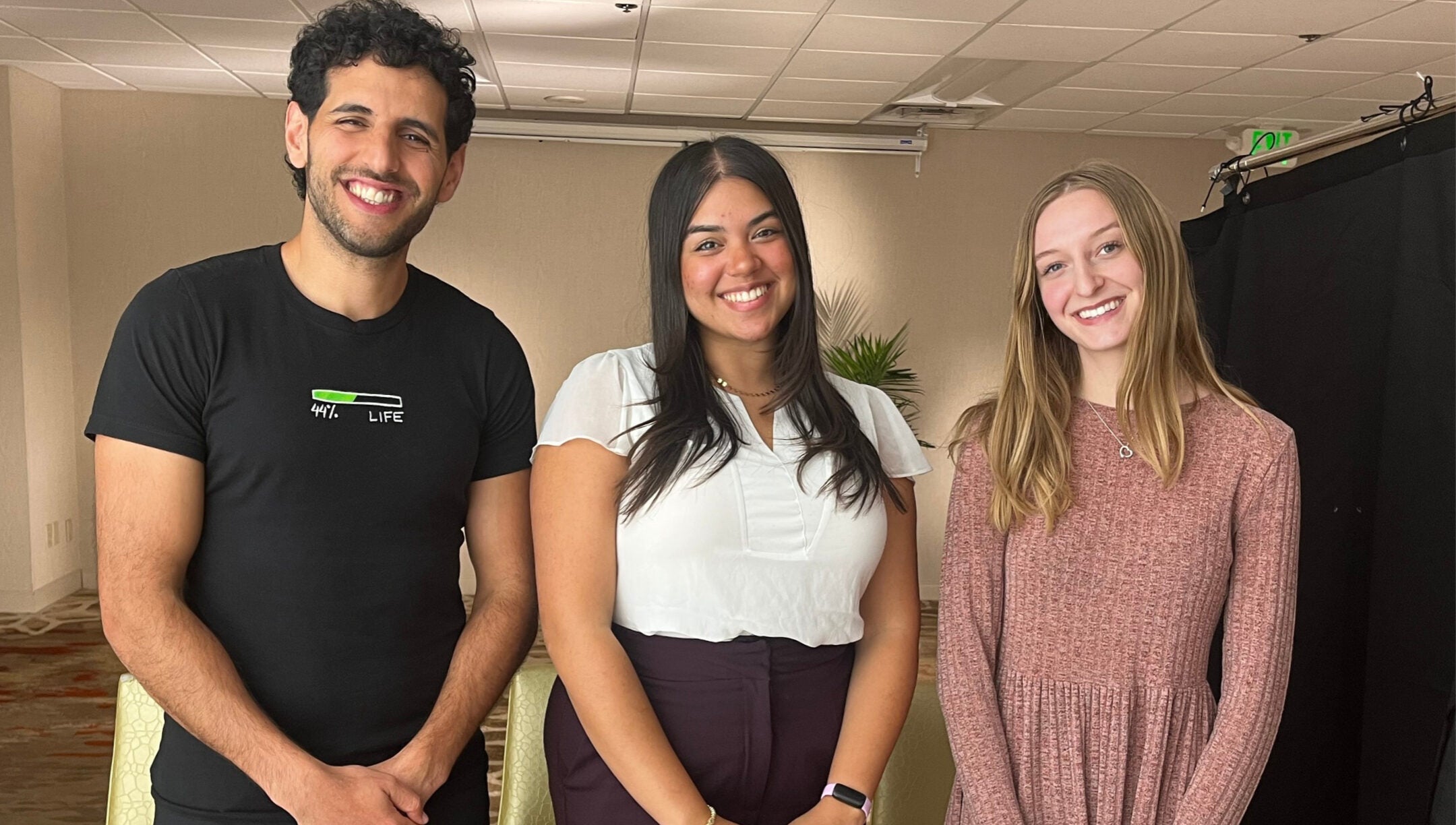
(JTA) — DENVER – Israeli-Arab social media entrepreneur Nuseir Yassin, of the viral vlog “Nas Daily,” said he believes “anti-Zionism is a form of antisemitism” and stressed his commitment to overturning “misguided hate” against Jews, at a conference devoted to the subject this week.
Yassin, 34, was speaking with the Jewish Telegraphic Agency on the sidelines of the conference, hosted by the David Merage Foundation for Confronting Antisemitism. A self-described “village boy” from the Lower Galilee town of Arraba in Israel, he achieved massive success through viral short-form videos that attracted viewers from all over the world. Today he boasts more than 68 million followers across numerous social networks.
Yassin is a Muslim of Palestinian origin, although he said he is not religious. Asked why it was important for a non-Jewish person to participate in a conference about combatting antisemitism, Yassin equated this battle to fighting for his family, noting that “the success of Israel and the Jewish people is also my success as an Israeli citizen.”
“I’m not a fan of the Israeli government, and I’m not here to defend it, just like I’m not a fan of many governments,” Yassin noted, but he asserted that the reaction to the government “is absolutely fueled by antisemitism.”
“I do believe anti-Zionism is a form of antisemitism,” he added.
He said he views Zionism as “the most vanilla thing in the world – a group of people wanting a place to live,” and has therefore concluded that Israel’s detractors “just really don’t like Jews.”
Yassin, who first broke through in 2016, has become increasingly outspoken in recent years about his combined Israeli and Palestinian identity. During the conference, he recalled that he grew up labeling himself Arab-Israeli. After the Hamas attacks of Oct. 7, 2023, he started listing Israeli first and Palestinian second.
“I could not relate to the extremism that I saw, and I wanted to distance myself from it without erasing my identity connected to it,” Yassin said. “I’m not just Israeli because I think it removes a little bit of spice, but I’m also not just Palestinian anymore.”
“A lot of Israeli culture is inside me,” he continued. “I never agree with people. I’m always disagreeable. That’s Israeli. I speak up.”
Yassin noted that he was “the first guy to go study in the United States out of my entire lineage,” graduating from Harvard University in 2014 with a degree in economics and a minor in computer science. Despite having grown up in Israel, Yassin said that Harvard was the place where he made his first Jewish friend.
After working as a software developer for Venmo in New York, Yassin left his job in 2016 to travel and document his journeys. Ultimately, he launched a Facebook page called Nas Daily – using the word for “people” in Arabic – where he posted one-minute videos for 1,000 days, telling the stories of communities around the world.
What was once a personal brand has since expanded into the parent Nas Company, which offers platforms for solo entrepreneurs to build and monetize their online businesses.
Yassin earned an honorary degree from Ben-Gurion University of the Negev in 2025 in recognition of his advocacy work for Israeli and Palestinian coexistence. This past August, he also joined the advisory board for the Genesis Prize Foundation, which each year celebrates inspiring Jewish individuals for their achievements.
“I do not relate to hundreds of men on the street shouting ‘Allahu Akbar,’” Yassin told JTA, adding that there needed to be more women and fewer religious fanatics participating in the Israeli-Palestinian conversation.
Yassin argued that he’s “not a weird Arab for saying this” and that “the entire country of the UAE says the same thing,” referring to one of the Gulf countries that signed onto the Abraham Accords normalizing relations with Israel. He also challenged “Free Palestine” activists to envision a concrete future for Palestinians rather than fixating on Israel’s transgressions.
“We should all be ‘Free Palestine’ – but from what?” Yassin asked. “We disagree on the solution, not on the problem. We don’t want suffering. Nobody wants suffering.”
“I’m a free-Palestine-from-Hamas guy,” he continued. “Just free Palestine,” he said, ”is not an answer. I’m free-Palestine-from-extremism.”
Yassin affirmed that there is room for criticism of Israel’s government, noting, for example, that he would like to see an Israeli-Arab presence in the government.
But he marveled at the notion that an alien visiting Earth would likely guess that the most hated country in the United Nations is North Korea, when in fact “It’s not – It’s Israel.”
That struck him as absurd because “the Israel-Palestine conflict is not a big deal when you compare it to everything else that’s happening on planet Earth. The only thing that makes it a big deal is that we, as Palestinians, have the perfect enemy.”
That enemy, he continued, is “the most hated type of enemy, which is the Jews.”

As part of his appearance at the conference, Yassin presented a recap of a fellowship he launched this past spring in partnership with the David Merage Foundation to help 50 content creators – 25 Jewish and 25 Muslim – produce meaningful material.
Participants received $1,000 and spent a month learning from the Nas Daily team about viral and impactful storytelling during the fellowship, named for Yassin’s first Jewish friend, Zaki Djemal, who recently died of a sudden heart attack.
To Laura Merage, the Iranian-born Jewish co-founder of the foundation, Yassin was a natural partner for this bridge-building effort. Given his social media following and “infectious personality,” Merage said she felt “that’s what we need more of in the world.”
At the conference on Tuesday, Yassin announced two winners of the fellowship’s influencer competition: recent McGill University graduate Raihaana Adira, a Canadian Muslim, and Grace, a Jewish-American digital content creator who preferred to use only her first name for privacy reasons. Grace tells stories about unique public figures, such as the first Arab “Miss Israel.” Adira, meanwhile, began posting about antisemitism and Muslim-Jewish relations after witnessing anti-Zionist protests at McGill.
“When I see a Jewish person being attacked on campus or online, it feels like I’m watching someone from my own community hurt,” Adira told JTA, noting that she started posting because no one believed her when she talked about incidents on campus.
“I wanted the protests and the graffiti on the walls that said ‘Death to the IDF’ to be seen,” she continued. “I am a Canadian, I am a Muslim, and when people at school on the streets say, ‘Death to Canada, We are Hamas, Hamas is heroic’ – that is not me.”
Adira said she received many death threats when she first started posting. While acknowledging how difficult that was, she also emphasized an influx of support that has helped “drown out the hate.”
Yassin offered a similar perspective, noting that at the beginning of his career, he “used to amplify the blowback and talk a lot about it,” referring to the criticisms he’d receive for promoting coexistence and calling out antisemitism. But after realizing that this deterred others from speaking out, he deemed the threats insignificant, calling them “the smallest price to pay for the largest outcome you can possibly imagine.”
During his travels around the world, Yassin said he has witnessed how flawed people’s perceptions of Jews can be and that he feels “a responsibility to set the record straight.” He also noted that he is dating a Jewish woman, author and influencer Aija Mayrock, whom he is marrying next year and with whom he expects to have children.
“They’re going to be Jewish, so that’s my family – literally, my family,” Yassin said.
This article originally appeared on JTA.org.
The post Israeli-Arab influencer behind ‘Nas Daily’: Anti-Zionism is antisemitism appeared first on The Forward.
Uncategorized
Sam Bankman-Fried was caught stealing billions — why did Netflix make it a crime of the heart?

Sam Bankman-Fried’s Jewfro preceded him.
Spun up like cotton candy, it made a silhouette that, along with his uniform of a t-shirt and cargo shorts, somehow won the trust of millions of people and the stewardship of billions of their dollars. Whether or not this presentation was affected — a messy, Einsteinian mien cultivated to prove his genius and Casual Monday-Friday dress to out-Zuck Zuckerberg — is much contested. In time this shambolic appearance would seem to give Bankman-Fried plausible deniability for an $8 billion financial scheme. (The jury wasn’t convinced; in 2023, he was quickly found guilty and is now serving 25 years in jail, where Diddy was briefly his cellmate.)
Did the founder of FTX, a major crypto trading platform, mean to defraud investors and customers? Was he simply sloppy? Or did he, for all his lofty promises to donate 99% of his company money to charity, not really care?
The new Netflix series The Altruists believes he began with the best of intentions, and gives him a co-conspirator, presenting a folie à deux between Bankman-Fried and his on-again-off-again girlfriend Caroline Ellison, a fellow math prodigy who he picked to run the first company he founded, Alameda Research.
Showrunners Graham Moore (an Oscar winning screenwriter for The Imitation Game) and Jacqueline Hoyt (The Leftovers), working off reporting from New York magazine, have made Bankman-Fried and Ellison’s love story the crux of their true crime. In these misfits were two souls who could only understand each other. The approach seems to go beyond the credulous, and, in its play for pathos, occasionally tips into the obscene.
As a dramatic device — toggling between Sam and Caroline’s courtship, early days in arbitraging “shitcoin,” the runaway growth of FTX and a mounting crisis when their malfeasance goes public — the romance only makes sense. It was, in the end, an inappropriate, overly-intimate relationship between FTX and Ellison’s crypto trading firm Alameda that led to the implosion of an enterprise valued at its peak at $32 billion.
While they started Alameda with an eye toward affecting change in line with Effective Altruism, a philosophy that believes in making obscene amounts of money and giving as much as possible away, by 2022, FTX, designed to “democratize” crypto, was covering Alameda’s losses with money from its own customers.
This, it goes without saying, is not an ethical business practice, and is all the more ironic given Bankman-Fried’s parents, a beloved tax law professor father (played by Paul Reiser) and an ethicist mother (Robin Weigart), both faculty at Stanford.
This background, and Bankman-Fried’s early penchant for strategic betrayal, developed in a board game called Diplomacy, are largely glossed over to present a more conventionally awkward portrait of our lovers.
Bankman-Fried and Ellison, played by the Irish actor Anthony Boyle (The Plot Against America and Say Nothing, sporting his version of the wunderkind’s unruly mop of curls) and Julia Garner (Ozark, Inventing Anna, here with crooked teeth and frizzed up hair), can be reduced to a litany of eccentricities.
Bankman-Fried would munch on frozen vegan meals, go shoeless and play video games during interviews and pitch meetings. Ellison maintained a confessional blog and likened her ideal of polyamory to a Chinese imperial harem. (Sam developed mathematical formulas on how to proceed with his romantic relationships, a quality that is transferred to Caroline in the series.)
But in a defiant commitment to, in the words of Moore, “show you things that by definition couldn’t have been filmed before,” the show’s creators have replaced these idiosyncrasies with cliches.
Sam rehearses small talk in a mirror; Ellison was a pity-invite to a friend’s bachelorette party, where she has a fateful encounter with Bloomberg reporter Hannah Miller (the fact Ellison was actually a bridesmaid, and had previously hosted the bride’s engagement party, is evidently inconvenient for the nerd tropes they’re aiming to deploy.).
In the early offing, the show suffers from what I’ll call a Big Bang Theorification of the startup-blowup genre that proliferates on streaming services. The word “noob” is used with abandon. Bankman-Fried is defined largely by his sexual inexperience — Caroline is his first, and his efforts to keep her in his life spell his doom.
“Both of us are clearly not normal people,” he tells her at one point, “so maybe we don’t have to do normal things that normal people do.”
Later he muses, “I’m not normal, so I can be special,” but laments that if he falls short, others may “see me for who I really am.” You see we have a flair for subtext.
The series finally hits its stride in episode six, which Moore wrote and directed. Anchored by a dynamic performance by Alex Lawther, playing erstwhile Alameda CEO Sam Trabucco, it gives us the first credible insight into what made Bankman-Fried crypto’s major player: a blind spot for consequences, dramatized in his sneaking liquid nitrogen into his frat house to make instant ice cream.

Previous accounts of Bankman-Fried’s rise and fall point to a bigger blind spot that challenges the core of the miniseries.
Bankman-Fried appears to have been an emotionally distant, at times indifferent partner to Ellison, who, despite her interest in polyamory, ultimately wanted a more conventional arrangement. In the show, the roles are often reversed, making Bankman-Fried more sympathetic and their eventual he-said-she-said in the court of the Southern District of New York all the more poignant. It would be less sad and romantic if it, even for a moment, considered the professional power imbalance between them or the list of pros and cons SBF drew up about the prospect of them dating. Moore and Hoyt claim their own sources on the duo’s dynamic, so perhaps there’s more to what’s been reported elsewhere.
Chroniclers of FTX’s demise are divided on whether Bankman-Fried was an arrogant upstart who was out-of-his-depth, or a maximalist utilitarian, who used EA philosophy as a permission structure to flout the rules and advance his own ambition.
The Altruists suggest something else entirely: He was a good person, who meant to do the most good possible, but out of a commitment to his lover, took his eye off the ball. This may ring familiar to those who may have come off a screening of the Elizabeth Holmes doc You Can See Everything, and for me the apologia is just as hollow.
That the showrunners still buy the hype about earn to give, when Bankman-Fried entered into a $135 million deal for stadium-naming rights (not shown — it was filmed before, after all), put up $210 million for an esports partnership and blew $30 million for a Super Bowl spot with Larry David months before declaring bankruptcy, is gobsmacking.
The doomed romance intermittently makes for good drama — despite ostentatious camerawork, including an extended sequence shot through vertical bars at a Margaritaville, because foreshadowing — but it feels fundamentally dishonest given so much of what emerged about the couple after the company went bust.
That Bankman-Fried, who has a documentary series coming out later this month, composed mostly of Zoom interviews from prison, is continuing to be reevaluated shows there’s room for ambiguity. Michael Lewis gives him some grace, and gets flack for it. But while buying the EA impetus, The Altruists falls victim to the very same solipsism of its main characters.
In the end, the tragedy it presents isn’t about the people who lost everything to Sam and Caroline’s hubris, it’s that the vagaries of business — and the law — got between their love.
That this is the focus makes it a new twist on a familiar story; whether The Altruists is effective, or ethical, is another matter.
The post Sam Bankman-Fried was caught stealing billions — why did Netflix make it a crime of the heart? appeared first on The Forward.
Uncategorized
Italy passes antisemitism law amid flaring debate over criticizing Israel
(JTA) — Italy has passed a bill aimed at combating antisemitism, prompting backlash from opponents who say that it could restrict criticism of Israel.
The legislation, which enshrined a contentious definition of antisemitism, was approved on Tuesday in the Italian parliament’s lower house. It received 147 votes, with 93 lawmakers against it and five abstaining.
The measure incorporates a working definition of antisemitism from the International Holocaust Remembrance Alliance (IHRA) into national law. This definition is supported by many mainstream Jewish organizations and has been adopted or endorsed by 48 countries, though many have not made it legally binding.
Opponents say the definition conflates antisemitism with some forms of Israel criticism. The IHRA framework lists contemporary examples of antisemitism that include denying Jewish people the right to self-determination, calling Israel a “racist endeavor” and comparing “contemporary Israeli policy to that of the Nazis.”
While Italy’s new law codified this definition as a reference for combating antisemitism, it did not define new criminal offenses or penalties.
The legislation also established the role of a national coordinator for fighting antisemitism. This official will oversee a three-year strategy that spans monitoring antisemitic incidents, combating online hate and boosting education while strengthening the security of Jewish communities and promoting Jewish culture.
Italy’s Antisemitism Observatory, part of the Jewish Contemporary Documentation Center in Milan, recorded 963 antisemitic incidents in 2025 — about four times higher than in 2022.
Livia Ottolenghi, the president of the Union of Italian Jewish Communities, said in a statement that she was “very satisfied” with the law, adding that it was “unfortunate that there wasn’t broader participation.”
Meanwhile, the measure was condemned by Erika Guevara Rosas, Amnesty International’s senior director for research, advocacy, policy and campaigns. She said Tuesday marked “a bleak day for freedom of expression” as the law “heightens the risk of far-reaching forms of censorship and self-censorship.”
Italy’s center-left opposition, a group that ranges from moderate to left-wing parties, was divided over the legislation. Their loose alliance wants to unseat Prime Minister Giorgia Meloni’s right-wing government in the country’s 2027 elections.
Laura Boldrini, a member of the center-left Democratic Party, backed an amendment to the law that would have replaced the IHRA definition with the Jerusalem Declaration, an alternate framework that she said did not conflate antisemitism with opposition to Israel’s actions. The Jerusalem Declaration devotes considerable space to defining what is not antisemitic in Israel discourse.
“The majority does not really want to fight antisemitism,” Boldrini said on X. “It wants to censor criticism of the Israeli government, which is committing genocide and war crimes and crimes against humanity.”
This article originally appeared on JTA.org.
The post Italy passes antisemitism law amid flaring debate over criticizing Israel appeared first on The Forward.
Uncategorized
Australia announces new sanctions on West Bank settlers and organizations
(JTA) — Australia imposed new sanctions on those it maintains are involved with illegal settlement expansion and human rights abuses against Palestinians in the West Bank, the country’s foreign ministry said on Wednesday, a day after Britain enacted restrictions on Israeli settlement construction firms and an activist group.
Australians will be prohibited from trading with, funding or providing other support to three individuals and four organizations linked to West Bank settlement expansion, according to Foreign Minister Penny Wong’s office.
The measures build on existing sanctions on senior Israeli ministers, extremist settlers and settlements, and follow a September pledge to pursue further sanctions.
“We are taking these actions because the rapid expansion of settlements and settler violence are extinguishing the possibility of a two-state solution,” the statement continued, noting that Israeli West Bank settlements “are illegal under international law.”
In addition to banning trade with individuals and organizations linked to settlement expansion efforts, Wong’s office said that the new sanctions for the first time “are targeting a construction company involved in the building of settlements.”
“Australian businesses should not bid for construction tenders for illegal settlement developments,” the statement added.
Britain on Tuesday imposed sanctions on eight Israeli companies involved in West Bank settlement construction and the activist group Tzav 9, which has repeatedly blocked Gaza-bound humanitarian aid convoys.
The individuals cited in Australia’s updated Sanctions Consolidated List on Wednesday included Daniella Weiss, Eliav Libi and Itamar Yehuda Levi, while the organizations named were Amana, the Nachala Movement, Guardians of Judea and Samaria and the Eyal Judaean Mountains Company. The individuals also incurred travel bans to Australia.
The document asserted that Weiss, a veteran settler leader, is the person who “plans, directs and oversees” the Nachala Movement’s operations, adding that she “has publicly supported and advocated for its actions” to promote settlements and illegal West Bank outposts.
Responding to the news, the Nachala Movement described the sanctions on both the organization and its leader as “a badge of honor,” in a statement on X.
“No antisemitic decision can sever the eternal bond between the Jewish people and their heritage,” the statement said. “Powers far stronger than Australia have attempted to impose edicts” but these efforts have failed, the statement said.
“The People of Israel continue to build on their land,” the post added.
As for Libi, the sanctions list simply noted his role as a “settler and director of Libi Construction and Infrastructure Ltd.” The document named Levi as the owner of Eyal Judaean Mountains, a West Bank construction and demolition firm. He was also listed as the “older brother of Yinon Levi,” whom Australia sanctioned in July 2024.
The list accused the Amana organization of involvement “in illegal settlement and outpost development in the West Bank” and accused the Guardians of Judea and Samaria of recruiting volunteers to work at West Bank outposts.
In response to the sanctions, the Guardians, also known as Hashomer Yosh, released a short reel depicting settler farming and shepherding activities, saying in a caption that “this is how antisemitism looks in the year 2026.”
Penalties for Australians who violate the new rules include up to 10 years in prison and fines of up to 910,000 Australian dollars (US$612,000) or three times the value of a specific deal, Wong’s office warned. Businesses can incur fines up to US$2.4 million or three times the transaction value.
“Australia remains steadfast in its commitment to the two-state solution as the only pathway to enduring peace and security for both Israelis and Palestinians,” her office added.
This article originally appeared on JTA.org.
The post Australia announces new sanctions on West Bank settlers and organizations appeared first on The Forward.
