


Uncategorized
Jeremy Carl is latest Trump nominee facing Senate pushback over history of antisemitic remarks
(JTA) — A key GOP senator is opposing the appointment of a Trump nominee over his past remarks about Jews, the Holocaust and Israel, potentially dooming Jeremy Carl’s bid for a top State Department post.
Carl, who is seeking the role of Assistant Secretary of State for International Organization Affairs, drew scrutiny during his Thursday confirmation hearing for past writings and statements about Jews. Those included a 2024 interview on a podcast called “The Christian Ghetto” in which the first-term Trump official said, “Jews have often loved to play the victim rather than accept that they are participants in history.” On the same podcast, he opined that there was “an extent to which the Holocaust kind of dominates so much of modern Jewish thinking, even today.”
Following his appearance, Utah Sen. John Curtis, who chairs the Senate Foreign Relations subcommittee, announced he would not be supporting Carl’s nomination.
“After reviewing his record and participating in today’s hearing, I do not believe that Jeremy Carl is the right person to represent our nation’s best interests in international forums, and I find his anti-Israel views and insensitive remarks about the Jewish people unbecoming of the position for which he has been nominated,” Curtis said in a statement.
Carl, however, is continuing to push for the post on X. Since the hearing, he has used the platform to defend his performance and repost allies, including some who responded directly to Senate accusations of his antisemitism. Vice President JD Vance this week also shared a post of Carl’s, though not one directly related to his confirmation bid.
Carl also denied accusations from Democratic Sen. Chris Murphy that he is a white nationalist, though he continued to insist that “white culture” is under threat.
A Claremont Institute fellow, Carl was born Jewish but has since converted to Christianity. He served in the first Trump administration’s Interior Department and has argued that “white Americans are increasingly second-class citizens in a country their ancestors founded.”
The White House also continued to defend its pick of Carl after the hearing in a statement to the New York Times late Friday.
And at least one of Carl’s defenders is Jewish: Michael Rubin, a conservative historian and longtime government advisor on Middle East affairs, called the campaign against his former Yale classmate a “lynch mob” in the Washington Examiner on Tuesday.
Carl, Rubin wrote, “is a man whose record of action and allies belie any serious consideration that he is antisemitic, anti-Zionist, or racist.”
Carl’s grilling came days after Republicans booted another Trump appointee from the administration’s religious freedom commission over her remarks about Israel and Zionism during an antisemitism hearing.
If Carl’s bid fails, he would not be the first Trump nominee with a history of questionable comments about Jews to fail to clear the Senate — though other Trump officials remain in their positions despite histories of antisemitic posts.
On the “Christian Ghetto” podcast interview, Carl also gave advice to Christians “looking to convert Jews” like him. He did, however, reject certain conspiracy theories about cabals of Jewish power. “I’m very critical of, overall, the political stance and the sociology of the Jewish community, particularly in this century. It’s been very destructive overall. But I don’t think that that’s a result of a conspiracy,” he said. His other podcast appearances include Tucker Carlson in 2024.
His new role — if confirmed — would put him in a critical position of influence over U.S. policy related to the United Nations, at a moment when both Israel and the U.S. are highly critical of that governing body over its perceived anti-Israel bias.
That concerned Curtis, who said that Carl’s past comments that the U.S. “spends too much time and energy on Israel, often to the detriment of our own national interest” would damage his credibility at the UN.
“Share with me specifically, what in the US interest has been harmed by sustained American support of Israel?” Curtis asked. Carl did not directly answer the question, instead pivoting to criticizing the UN for antisemitism.
“In the UN context, I wish the UN would stop being antisemitic all the time, and so therefore we could stop — there’s a million other problems, like the Rohingya,” he said. Upon Curtis’s repeated questioning, Carl added, “I think diplomatic support of Israel in the UN context is absolutely critical.”
Curtis also noted that Carl seemed to agree with a podcast host’s remarks that Jews were “claiming special victim status because of the Holocaust” and that “the state of Israel is not a victim but instead a perpetrator,” among other remarks.
“This was your response: ‘Right, right, yeah, no, I mean, I think that’s true,’” Curtis said, of Carl’s appearance on the “Christian Ghetto” podcast.
“I do a lot of podcasts,” Carl responded, adding that he was “sure” his quotes were “accurate.”
Democratic Senators, including some Jews, were more forceful in condemning Carl’s remarks about Jews.
Sen. Jacky Rosen of Nevada, quoting a recent American Jewish Committee study that one in three Jewish Americans have experienced antisemitism, produced placards of some of Carl’s past pronouncements on Jews, including that “the Jews love to see themselves as oppressed.”
“To my colleagues that may consider voting for Mr. Carl’s nomination, understand what the vote signals,” she said. “It tells Jewish Americans they simply don’t matter.”
The post Jeremy Carl is latest Trump nominee facing Senate pushback over history of antisemitic remarks appeared first on The Forward.
Uncategorized
Brad Lander detained by Israeli police in the West Bank while helping Palestinians harvest; dozens of rabbis and activists arrested
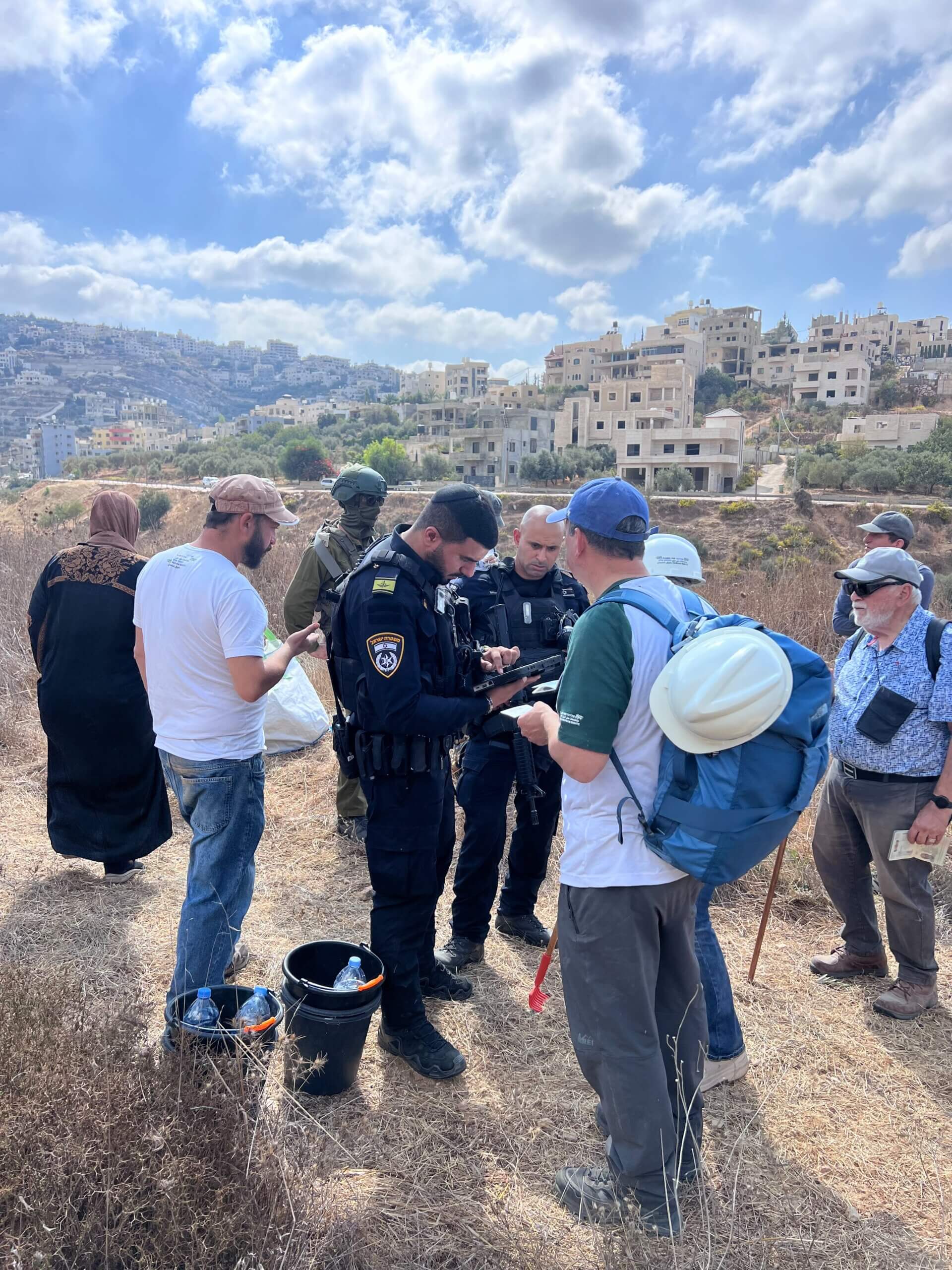
Dozens of Israeli and international activists, including U.S. congressional candidate Brad Lander, were detained by Israeli authorities in the occupied West Bank on Wednesday morning while accompanying Palestinian farmers harvesting olives. After Landers was released, the Israeli activists were later placed under arrest, and the foreign citizens were reported to be awaiting interrogation.
The delegation was hours into their work when they were told they were unlawfully inside a closed military zone, according to Anton Goodman, acting CEO of Rabbis for Human Rights. Authorities detained the group even after he agreed they would leave immediately, he said.
Goodman told the Forward that 42 Israeli members of his delegation and another 28 foreign citizens were being held at the police station in nearby Beitar Illit.

“Those of us with Israeli citizenship are being detained outside of the police station,” Goodman said by phone while he was detained. “The foreign passport holders have been separated from us, and I have been told by a senior security officer that they will be interrogated by Army personnel.”
Shorty after speaking to Goodman, Tamar Glezerman, an activist from New York who holds Israeli citizenship, informed the Forward that the detainment had been converted to arrests “because you cannot detain people for more than three hours.” Glezerman also said the foreign citizens had been taken to a military base for interrogation.
According to Goodman, the delegation was helping Palestinians who have faced severe restrictions on access to their land since Oct. 7, 2023, when authorities informed the group that the area had been declared a closed military zone.
“There is no possible way we could have known that this morning,” Goodman said. “And even so, I told them we would respect the decision and leave immediately.
“But that was not good enough for them,” he continued. “I was informed that the entire group was being detained for ‘identification purposes.’”
At the time of the interview, Goodman said, only Lander had been released. The others remained detained, including a Palestinian woman whose family owned the olive grove where the harvest took place. Lander, a progressive Democrat running for Congress this year, has been vocal in his criticism of both settler violence and Israel’s actions in Gaza.
Rabbi Jill Jacobs, CEO of T’ruah: The Rabbinic Call for Human Rights, also confirmed that she and dozens of other Americans, along with Canadian and British citizens, had been detained, their passports confiscated. They were being taken by bus to the same police station, she said at the time.
“There is a Jewish principle of accompaniment of those in danger,” Jacobs told the Forward. “We were living that out, in contrast to the settlers who justify stealing olives and carrying out violent acts contrary to Jewish law.”
Despite the uncertainty over what would happen to her delegation, Jacobs said they remained in good spirits.
“We are currently on the bus saying divrei Torah and singing niggunim and religious songs,” she said, referring to Torah teachings and wordless melodies.
“It is a sad comment on the current state of Jewish affairs that they are arresting rabbis picking olives, and not the settlers who steal them, poison trees, and violently attack human beings,” Jacobs added.
The detentions follow an especially brutal week in an already escalating wave of settler violence in the West Bank. On Friday, settlers severely beat Washington Post photojournalist Heidi Levine while she covered the olive harvest in Abu Falah, leaving her with fractured vertebrae and a broken rib. The following day, settlers attacked a delegation of European diplomats and other visitors near Taybeh. Palestinian residents have also faced repeated assaults, with dozens reported injured, several seriously.
Goodman called the mass detention “insane,” criticizing both its scale and the deployment of security forces against volunteers.
“This is the largest mass detainment we have ever seen,” he said. “But it’s not just that. All across the West Bank we have seen a complete deterioration of the rule of law as settler terrorists rampage through Palestinian villages with little consequence or deterrent. Now you have a completely peaceful delegation who are only here to help with the olive harvest and 100 security personnel are dispatched to detain them?
“What a complete and utter waste of public resources.”
The post Brad Lander detained by Israeli police in the West Bank while helping Palestinians harvest; dozens of rabbis and activists arrested appeared first on The Forward.
Uncategorized
Christiane Amanpour exits CNN with a legacy shaped by the debate over Israel
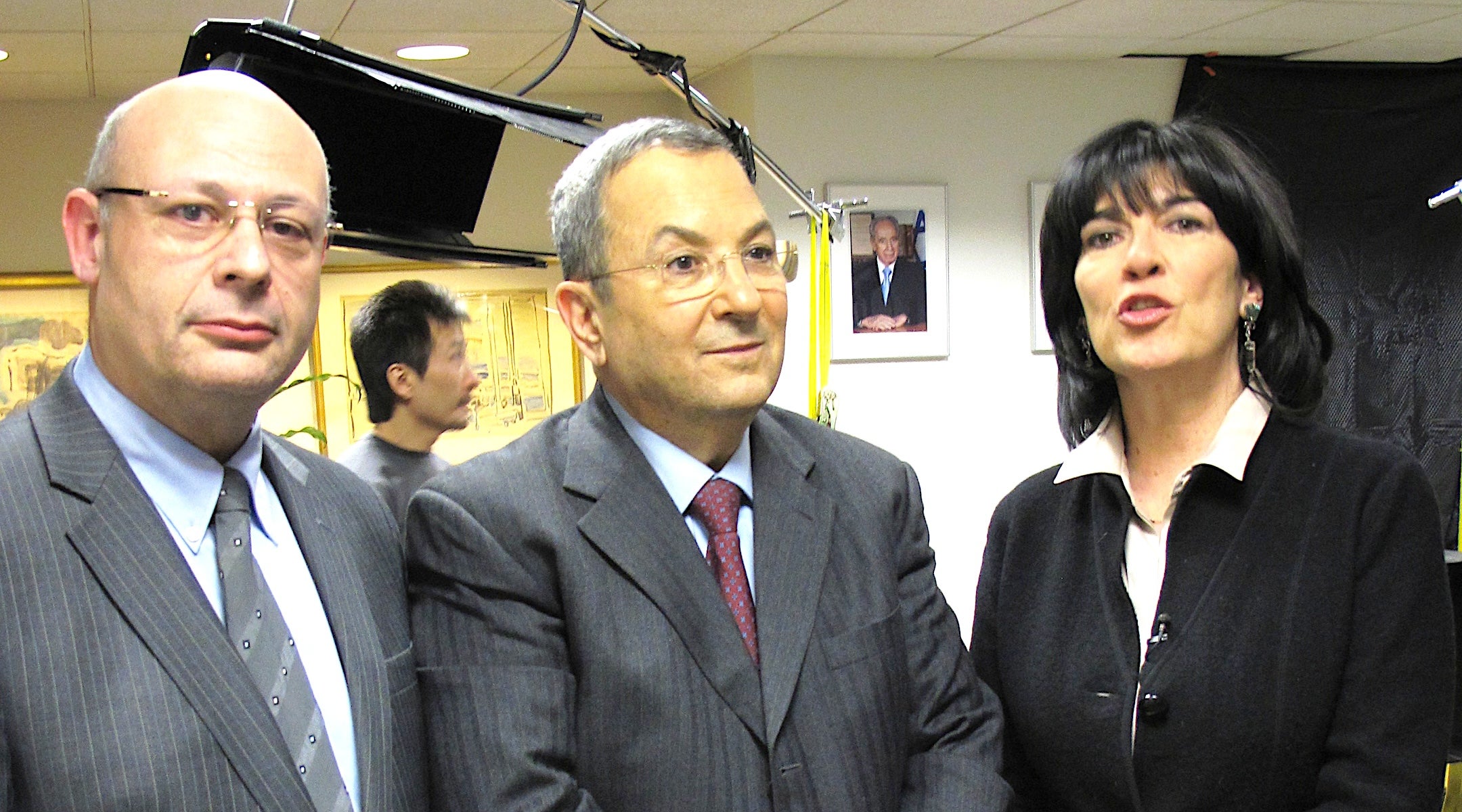
(JTA) — Christiane Amanpour, CNN’s chief international anchor, is leaving the network after 43 years, closing a chapter in a career that made her one of television journalism’s most celebrated war correspondents — and one of its most controversial figures among Jewish and pro-Israel viewers.
For many viewers, Amanpour’s legacy is that of a fearless correspondent who brought the human costs of war into American living rooms, from the first Gulf War to Bosnia, Rwanda and Ukraine.
But her coverage of Israel and the Palestinians has long drawn sharp criticism from some Jewish viewers, who accused her of giving insufficient weight to Israeli security concerns, mischaracterizing events and disproportionately presenting Israeli religious nationalism in an especially unflattering light.
Amanpour, 68, announced Monday that she will wind down her daily CNN International program early next year, conclude its weekly successor in May and leave the network in June 2027. Her PBS program, “Amanpour & Company,” will end at the close of this year. However, she will continue her podcast, “The Ex Files,” with her ex-husband, Jamie Rubin, a former State Department official.
Amanpour did not give a specific reason for her departure, which comes as CNN enters a new era under Paramount Skydance ownership.
“Always be truthful, not neutral,” Amanpour wrote in her farewell message, summing up a philosophy that has animated her reporting — and helped make her a polarizing figure.
Amanpour’s admirers would argue that the same qualities that make her coverage uncomfortable for some Jewish viewers — skepticism toward official accounts, attention to civilian suffering and willingness to challenge powerful governments — are essential to journalism.
When the National Press Foundation honored her in 2025 with its Sol Taishoff Award for Excellence in Broadcast Journalism, its judges called her “a gold standard for international broadcast journalism” and praised her tough questioning of world leaders. The Committee to Protect Journalists, which honored her in 2016, likewise celebrated her commitment to press freedom.
Amanpour, who was raised in Iran and England by her Iranian Muslim father and British Roman Catholic mother, joined CNN in 1983 as a desk assistant and rose through the ranks to become one of its most prominent correspondents. Her reporting from the Bosnian war in the 1990s helped establish her reputation for confronting officials and challenging the language governments use to justify military action.
Some of the sharpest criticism of her work came in 2007, when Amanpour hosted “God’s Jewish Warriors,” the opening installment of a three-part CNN documentary series examining the role of religion in politics and conflict.
Andrea Levin, president of the Committee for Accuracy in Middle East Reporting and Analysis, or CAMERA, condemned the program as a biased portrayal of Jewish religious life and Israeli settlers. A 2010 Jewish Telegraphic Agency commentary revisited the controversy, with Ron Kampeas noting that “the only explicitly religious people she interviewed were ultranationalist settlers,” and that Amanpour ignored religious Jews who opposed the settlements.
Kampeas also said the program’s treatment of the pro-Israel lobby in Washington exaggerated the power of groups like AIPAC and downplayed the shared strategic and moral imperatives that drove the U.S.-Israel alliance.
“God’s Jewish Warriors” became Exhibit A in the case against Amanpour’s work. Legitimate criticism of Israeli policy, her detractors asserted, was framed in a way that left Jewish viewers feeling that Jewish religious identity, political advocacy or national aspirations were inherently suspect.
Reporting from Lebanon during the 2006 war between Israel and Hezbollah, Amanpour was part of a CNN team whose work rekindled a longstanding debate over how journalists should cover conflicts in which a state military fights an armed group embedded in civilian areas.
Even as Amanpour at times acknowledged the difficulty of covering such “asymmetrical warfare,” Israeli officials and supporters argued at the time that images of destruction and civilian suffering in Lebanon obscured Hezbollah’s role in initiating and sustaining the conflict. Those objections anticipated similar complaints, aimed at CNN and other outlets, over coverage of Israel’s devastating war in Gaza after the Hamas attacks of Oct. 7, 2023.
Critics have continued to document what they see as a pattern. CAMERA has maintained a collection of complaints about Amanpour’s reporting, while HonestReporting, another pro-Israel media-monitoring organization, has accused her of repeated anti-Israel distortions.
Although both organizations have a clear advocacy perspective, they often provide specific examples of errors, and often extract corrections.
One example came in April 2023, when Amanpour described the killing of Israeli Lucy Dee and her daughters Maia and Rina in a Hamas-linked West Bank terrorist attack as a “shootout.” The women were driving on a highway when Palestinian gunmen opened fire on their vehicle. Amanpour subsequently apologized on air for her inaccurate characterization.
In 2024, Amanpour also drew criticism for a social media post about Marwan Barghouti, the imprisoned Palestinian political leader convicted by an Israeli court of involvement in deadly attacks. “To many Israelis, he’s a terrorist. To many Palestinians, he’s their Mandela,” she wrote.
The comparison accurately captured Barghouti’s sharply different reputations among Israelis and Palestinians, but critics argued that it risked reducing the gravity of the attacks for which he was convicted.
Complaints about CNN’s Gaza coverage gained a striking new dimension in February 2024, when Amanpour reportedly joined CNN colleagues in accusing the network of a pro-Israel bias in its coverage of the Israel-Hamas war.

According to reporting by The Intercept and The Guardian, journalists at an internal CNN meeting raised concerns that the network’s editorial procedures were favoring official Israeli narratives and making it harder to convey Palestinian perspectives. CNN’s process required coverage of the conflict to pass through its Jerusalem bureau; Amanpour was heard on tape saying that the process led to “changing copy, double standards, and all the rest.”
At the same time, some pro-Israel viewers saw CNN and Amanpour as too willing to accept Palestinian claims and too quick to foreground Gaza’s devastation.
In response to the reports, CNN defended its coverage of the conflict. “We remain absolutely committed to reporting all sides of this immensely challenging, complex and emotive story,” it said in a statement. “We absolutely reject the notion that any of our journalists treat Israeli officials differently to other officials.”
Amanpour again apologized on air in October 2025 for having said that surviving Israeli hostages released from Hamas captivity were “probably being treated better than the average Gazan, because they are the pawns and the chips that Hamas had.” Following backlash from political figures and organizations, Amanpour retracted the statement, calling her remarks “insensitive and wrong.”
Last month, in a rare long-form interview about her career with the podcaster Sam Fragoso, Amanpour discussed CNN’s coverage of the Gaza war. In the immediate aftermath of the Oct. 7 attacks, she said, the network was “practically wall to wall with horrendous stories from the victims in Israel. I mean, just horrendous.”
But as Israel’s military response ground on, “the story flipped,” she said. “As the destruction of Gaza took place and the bodies piled up, most particularly the women and the children, the tone of the coverage reflected the reality.” At the February 2024 meeting with CNN executives, she said, her colleagues expressed frustration that the network took too long to cover the Palestinian side.
In the same interview, Amanpour also walked back an apology she made in 2020 — not about CNN’s Mideast coverage, but for a commentary on the 82nd anniversary of the Kristallnacht attacks. In that segment, she juxtaposed the Nazis’ anti-Jewish pogrom with what she called President Donald Trump’s “attacks on history, facts, knowledge and truth.” After Jewish groups, including the American Jewish Committee, complained that she had “instrumentalized” the Holocaust with a faulty comparison, Amanpour said on air that she regretted any pain her statement may have caused.
Speaking last month with Fragoso, Amanpour said that she stands by her assertion that Kristallnacht demonstrated how quickly “democratic values can slowly slip away.” She also suggested that her employers had bowed to outside pressure and instructed her to apologize.
“There were people, you know, in various communities in regard of this,” she said, referring to her critics, “who decided that I need to be slapped around and pull[ed] down a peg. But I think that’s just because some people are afraid of the truth.”
Amanpour’s departure comes at a moment of uncertainty about CNN’s future under its new corporate owner. Paramount Skydance’s $110 billion merger with Warner Bros. Discovery, CNN’s parent company, has raised concerns among journalists about political influence and editorial independence, particularly given new owner David Ellison’s ties to Trump and the changes he has overseen at CBS News.
Amanpour herself expressed concern in May about what she called an “ideological realignment” at CBS News under its new leadership. “So clearly, obviously, I’m concerned,” she said, speaking at an investigative journalism conference in London. “I would like to think that we would have the very basic, which is editorial independence. I’m hoping for that. I know many of us at CNN are incredibly — including leadership — are very, very committed to that, clearly.”
For some Jewish and pro-Israel observers, however, the same changes have raised hopes that CNN’s coverage of Israel might become more favorable. Bari Weiss, who became CBS News editor in chief after Paramount acquired her strongly pro-Israel publication, The Free Press, has long argued that mainstream news organizations have mishandled Israel and antisemitism.
Amanpour didn’t mention the merger in her announcement. But she noted how her background shaped her perspective.
“Because of my upbringing — I’m half-Iranian and half-British — I’ve had the great privilege of being able to see the world from two very distinct perspectives,” she said. “I’ve always spoken out about the need to bridge gaps. I know we can live in a world that’s not 100% tribalized.”
This article originally appeared on JTA.org.
The post Christiane Amanpour exits CNN with a legacy shaped by the debate over Israel appeared first on The Forward.
Uncategorized
Former Edmonton journalist admits to vandalizing monuments of Ukrainian Nazi collaborators
(JTA) —
EDMONTON, Canada – Duncan Kinney, a former journalist with the left-wing website Progress Report, pleaded guilty to criminal mischief on Monday, four years after he was arrested for vandalizing monuments to Ukrainian Nazi collaborators in Edmonton, Alberta.
Monday’s guilty plea was an anticlimactic not-quite-end to a case that appeared to be run-of-the-mill vandalism but was so culturally charged that it drew the attention of everyone from the Premier of Alberta to Friends of the Simon Wiesenthal Center in Toronto.
In 2021, Kinney broke the news story that someone had spray-painted “Actual Nazi” on a bust erected to honor WWII military commander and Nazi collaborator Roman Shukhevych and then painted “Nazi Monument” and “14th Waffen SS” on a memorial to the SS Galizien, a Ukrainian military unit that was part of the Nazi Party’s military wing.
According to court documents, Kinney was caught on a security camera spray-painting the Shukhevych monument shortly after midnight on Aug. 10, 2021, and caught again eight hours later photographing his handiwork. He then sent an email to the staff of the Ukrainian Youth Unity Complex, where the monument was located, explaining that Progress Report had received photos of the defaced monument. The brief email concluded with “Do you have any statement or information on this matter? Was Roman Shukhevych a Nazi or Nazi collaborator? Our deadline is 3:15 pm. Thank you.”
Kinney initially pleaded not guilty to one count each of criminal mischief and mischief relating to a war memorial. He suggested he’d been targeted because he was critical of the Edmonton Police Service and alleged that they were trying to silence him.
He is due to be sentenced Jan. 25, 2027, at which time the crown prosecutor is expected to drop the more serious charge of defacing a war memorial, which carries a sentence of up to 10 years in prison.
Neither Kinney nor his defense attorney, Tom Engel, would comment after the court appearance. However, the board of Progress Report issued a statement decrying its former employee’s actions, calling committing a crime and reporting that somebody else did it “a cardinal breach of journalistic ethics and not acceptable behavior within any media organization. Mr. Kinney has always maintained his innocence in this matter and we trusted him; today’s news was an unpleasant surprise for us.”
Ultimately, the case exposed deep divisions in the Ukrainian diaspora about the role that Ukraine played in the Holocaust.
Shukhevych was a leader in both the Organization of Ukrainian Nationalists (OUN) and its armed force, the Ukrainian Insurgent Army (UPA). He was also an officer in a Third Reich auxiliary battalion. During World War II, he commanded troops that murdered Jews, Polish civilians, other national minorities, communists and his countrymen from Ukraine. And he helped marshal the fight for Ukrainian independence from the Soviets.
The monument to the SS Galizien is located at St. Michael’s Cemetery, less than two miles from the complex housing the Shukhevych bust. Among the unit’s members was Yaroslav Hunka, who, at age 98, received two standing ovations for his service in WWII and fighting for Ukrainian independence when he appeared in the House of Commons alongside visiting Ukrainian President Volodymyr Zelensky in September 2023.
Nobody in Parliament, it seemed, was aware of Hunka’s Nazi past. When the news became public, the incident became a national embarrassment. At least temporarily, the country was forced to examine how it dealt with WWII war criminals.
In Edmonton, however, the blunder appeared to have no impact on Kinney’s case. For his alleged vandalism to the SS Galizien monument, he had been charged not with simple mischief, but with vandalizing a war monument.
“We do not consider a statue honoring a Nazi to be a war monument,” says Jaime Kirzner-Roberts, senior director of policy and advocacy at the Friends of Simon Wiesenthal Center in Toronto. “When we talk about veterans’ monuments, we are talking about Canada’s veterans. We are not talking about Nazi veterans.”
Kirzner-Roberts’ organization, B’nai Brith Canada and the Jewish Federation of Edmonton, as well as local politicians and academics, have been asking for years for the monuments to be removed.
“I think that in the case of the Shukhevych monument, you shouldn’t put up monuments to people responsible for mass murder,” says John-Paul Himka, a University of Alberta professor emeritus of history, whose 2021 book “Ukrainian Nationalists and the Holocaust” examines the role that the OUN and UPA had in destroying Ukraine’s Jewish population during WWII.
“As for the Waffen-SS memorial, Austria has also been trying to get rid of their Waffen-SS memorials and it’s an issue around the world, really, how much you want to put up memorials to SS men or to people who collaborated with the Nazi state.”
Less than six months after the Hunka debacle in Parliament, the monument to the SS Galizien at the St. Volodymyr Ukrainian Cemetery in Oakville, Ontario, was permanently removed. Himka doesn’t see anything like that happening in Edmonton, a city with the largest population of people with Ukrainian descent in a country with one of the largest populations of people with Ukrainian descent outside of Ukraine.
“The diaspora community doesn’t want to hear about this,” he says. “They don’t want to confront the history, and nobody is telling them otherwise really.”
The courtroom, though, did host one such confrontation. At the conclusion of Kinney’s appearance, two women who appeared to be in their 40s and who had spent the half-hour proceedings knitting, engaged in a conversation with two men who appeared to be at least twice their age and were sitting across the aisle.
The discussion started innocently enough, with inquiries as to what brought each of them to the courtroom. When the women said that Shukhevych was a Nazi who had killed thousands of innocent people, the temperature heated up.
When the women insisted, the men all but rolled their eyes. “That’s Russian propaganda,” they scoffed, then got up and marched together out of the courtroom.
The post Former Edmonton journalist admits to vandalizing monuments of Ukrainian Nazi collaborators appeared first on The Forward.
