



Uncategorized
Jewish students were not interviewed for University of Pittsburgh campus antisemitism report
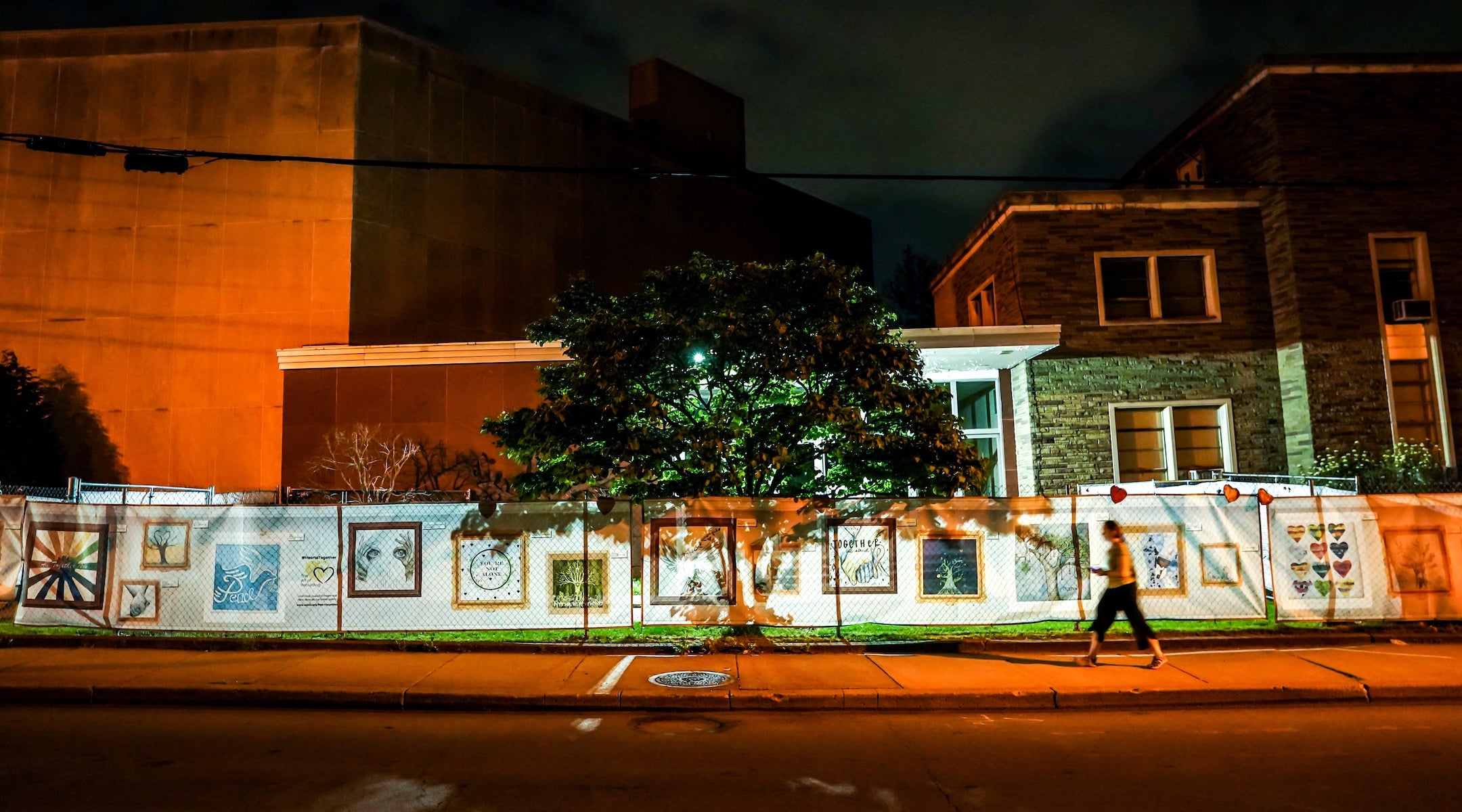
(JTA) — Can a college campus accurately assess its antisemitism problem without talking to Jews?
That’s the question facing the University of Pittsburgh, where an internal working group on campus antisemitism recently published a report that did not include, nor appear to have solicited, the perspectives of the school’s estimated 1,400 Jewish students — nor any other members of the campus Jewish community beyond the group itself.
The July report by Pitt’s working group on campus antisemitism, which is made up of Jews, has divided the campus, drawing criticism from the left for what they perceive as recommendations that would limit speech, and from within the campus Jewish community for not adequately consulting with Jewish students and faculty. Even before its publication, one author of the report said her home was targeted after she was named to join the working group.
The report has also resurfaced questions about the most effective methods for universities to address antisemitism for Jewish students three years on from the Oct. 7, 2023, Hamas attacks that prompted so much uproar across campuses.
The report’s omission of any research on its Jewish community was by design, the working group’s chair recently told the Jewish Telegraphic Agency.
“Our charge from the chancellor and provost was not to provide data as part of our report,” Katherine Blee, a sociologist and the faculty chair of the Pitt working group, said in an interview.
Instead, she said, the recommendations came out of discussions between the group members, whom she characterized as “a very diverse group with a very diverse set of opinions, which is representative of the university.”
The school immediately agreed to take action on the group’s recommendations, which include strengthening its Title VI civil rights law compliance; giving “clear guidance” on free speech and protest policies; reviewing its bias training; and committing to new “Dialogue and Discourse” programming to facilitate constructive conversations around Jews and Israel.
The issue of antisemitism at Pitt became particularly urgent after two Jewish students wearing kippahs were wounded in a violent off-campus attack in 2024 in an incident that preceded the announcement of the working group. The perpetrator, who wore a keffiyeh and had no apparent university affiliation, attacked the students with a bottle as they were on their way to a Hillel Shabbat dinner.
“We recognize that members of our Jewish community have experienced harm, and we take that seriously,” the university said in its press release following the report. The school’s statement went on to quote the Mishnah-era rabbinic sage Rabbi Tarfon: “It is not your duty to finish the work, but neither are you at liberty to neglect it.”
This was a heartening development for some of the committee members. But the finished report, as well as a strict confidentiality agreement agreed upon by its authors, have sparked local controversy.
The university’s Jewish Studies program director, initially a member of the working group, didn’t sign the final document.
And some non-Jewish campus faculty writ large have criticized the report’s recommendations for, they claim, potentially threatening shared governance principles at the university. The university’s chapter of the American Association of University Professors, the national faculty union that in 2024 ended its longstanding opposition to academic boycotts to allow members to boycott Israel, called for the report to be withdrawn.
Blowback among a more progressive contingent of Jewish personnel at Pitt has led to the proposal of an alternative set of recommendations for tackling antisemitism, including creating a joint Kosher/Halal dining area and emphasizing teshuvah, or the Jewish tradition of repentance, “when a member of the university community does harm.”
This cohort has stronger, more ideological concerns with the report than whether it surveyed Jewish students. “We refuse to let anyone use the pain of antisemitism to dismantle academic freedom, free speech, and open engagement within our university community,” an open letter proposing the new plan reads.
Proponents of the second plan stressed the importance of soliciting perspectives from the broader Jewish community.
“If you’re going to really talk about this, you need to be really thinking more broadly about what does the rest of the community think,” Harry Hochheiser, a Jewish biomedical professor at Pitt and critic of the report who has helped push the alternative set of recommendations to the university, told JTA.
Pitt’s report, and the response to it, comes as the question of how to respond to campus antisemitism feels less settled than ever. Some campuses are continuing to see fresh threats to Jewish safety: Recent flyers at the University of Oregon targeted that school’s Hillel director, by name, as an “enemy of the people.”
At the same time, the Trump administration’s aggressive response to the issue is starting to see pushback. A recent bipartisan report from the federally mandated U.S. Commission on Civil Rights criticizes the administration’s handling of campus antisemitism cases, as well as its withholding of documents related to the investigations.
In response to a series of emailed questions from JTA, a Pitt spokesperson said the working group “drew on perspectives from across the University community rather than establishing a faculty-only process,” and that the school is “taking next steps on a number of the Working Group’s recommendations.”
The working group’s members include administrators, a student Hillel president — the lone student whose name appears on the final report — and a former director of Pittsburgh’s Jewish Community Relations Council.
The Pitt spokesperson, Jared Stonesifer, also said the school “is in frequent and ongoing discussions with Jewish students about their experiences and their views on the campus environment, and student input was included on the Working Group that produced the report.”
Both Blee and Stonesifer framed the report as the first of many future steps to help Pitt confront campus antisemitism, and expressed hope that future steps would involve talking to Jewish students. One of the report’s recommendations is to “survey antisemitism in the campus environment regularly.”
Pitt’s undergraduate student body is home to around 1,400 Jews, just under 7% of the 21,000 total students, according to Hillel International estimates. The school is served by Hillel Jewish University Center, a local Hillel that also tends to Jewish students at other Pittsburgh colleges, as well as a dedicated Chabad house and a Jewish Studies program that grants an undergraduate certificate.
Julia Jassey, co-founder and CEO of the national Jewish student advocacy group Jewish on Campus, offered a mixed assessment of the Pitt report and of the school’s promise to include students in future decisionmaking.
“Students should be a part of the process in the implementation, not looking at it as a postmortem,” Jassey told JTA, noting that student input is valuable because “no two campuses are exactly the same.”
Yet, Jassey added, “That doesn’t mean that the report itself is inherently not helpful.”

A sensitive climate
That Pitt would commission a campus antisemitism report was, on its own, not unusual.
In addition to the attack on the two Jewish students in 2024, Pitt’s Jewish community also continues to live in the shadow of the 2018 shooting at the Tree of Life worship center, two miles from campus. Many of the university’s Jewish students and faculty have personal connections to it; Pitt has also hosted exhibits about the attack. A local memorial and museum commemorating the attack, now under construction, is scheduled to open to the public in 2028.
Both the 2024 attack and the Tree of Life massacre were part of “the context in which we were writing,” Blee said.
Blee is a longtime member and past president of Congregation Dor Hadash, the Reconstructionist synagogue located inside the Tree of Life building. One Dor Hadash congregant was among the 11 killed in the attack.
In addition, her research specialty is white nationalism and far-right antisemitism: When the perpetrators of the deadly 2017 “Unite the Right” rally in Charlottesville, Virginia, were charged with violations of federal law, Blee was called to the stand as an expert witness.
So when her synagogue became the site of the deadliest antisemitic attack in U.S. history, Blee recalled, “my work and my Jewish life intersected in a really terrible way.”
Blee’s 2025 appointment to chair the antisemitism working group, the Pittsburgh Jewish Chronicle reported, marked the moment the working group “begins to take shape.”
The final report recommends the university form an “advisory group” on Jewish issues, and suggests that the local Hillel and Chabad-Lubavitch house, as well as the Pittsburgh Jewish federation, should be represented — a recommendation that spurred criticism from pro-Palestinian groups on campus who objected to the federation’s presence.
Additional members of the working group contacted by JTA for this story, including the former JCRC staffer, directed requests for comment to Blee or declined to comment. The director of the Hillel serving Pitt’s campus, after requesting questions from JTA by email, did not respond by press time.
In a statement accompanying the report’s publication, the working group’s vice chair, Jennifer Murshatashvili, wrote, “My goal was to contribute to outcomes that would improve life for everyone at Pitt, not only Jewish and Israeli members of our community.”
Murshatashvili, a professor of Eurasian studies at Pitt, also told the university community that after she was named to the working group, “my home was targeted, and I was subjected to extensive online hatred and harassment.”
Even though the working group was not charged with gathering data, Blee told JTA, one of its instructions was to investigate “how effective” the university’s existing policies on antisemitism were after the Oct. 7, 2023, Hamas attacks in Israel strained relationships on the campus. There was disagreement among the group about how seriously to take the encampments mounted by pro-Palestinian groups at Pitt, she said.
“Some people were more concerned about the encampments than others,” she told JTA. Drawing on her own research into the far right, she explained, “Everybody would agree that a Nazi rally is antisemitic. Not everyone on the committee, and not everyone at the university, and not everyone in the United States Jewish community, would agree that the totality of the protests after October 7 were antisemitic.”
Blee declined to elaborate on how the working group determined policy effectiveness without gathering data. The confidentiality agreement brokered by the group members also prevented her from sharing more detail on their internal deliberations, she said.
“I can tell you that the committee gathered information that was needed,” she said. “But under that confidentiality agreement, I don’t want to go into exactly how that was done.”
Rachel Kranson, the director of Pitt’s Jewish Studies program, was announced as a member of the working group in 2025 but does not appear on its final report. Kranson declined to comment to JTA.
A flood of reports
Internal reports chaired by Jewish university faculty, officials and students have become part and parcel of the standard university response to campus antisemitism since Oct. 7.
At public and elite private schools alike, the formation and release of an internal antisemitism report has been greeted with considerable fanfare — and no small amount of controversy, directed at everything from the political makeup of committee members to the data-gathering process and final recommendations.
Yet one consistency among such reports has been the presence of at least some polling of the experiences of that school’s Jewish students — which many Jewish groups and Jewish leaders have agreed is a crucial component of any successful campus antisemitism response.
Committees at Harvard and Columbia, two schools figuring prominently into the national conversation on campus antisemitism, each conducted reports with more than 500 Jews on campus to inform their findings. Harvard’s final report runs 311 pages, while Columbia released multiple reports on the subject.
Stanford’s antisemitism committee report, released in 2024, runs nearly 150 pages and was informed by listening sessions with more than 300 people, as well as additional one-on-one interviews with students, administrators, and representatives of national Jewish groups.
The University of Washington and the University of California, Los Angeles, both public universities like Pitt, also surveyed and interviewed Jewish students to inform their own reports. The data itself can sometimes lead to controversy: A contingent of progressive Jews at UW criticized that school’s report for conducting focus groups with only a few dozen Jewish students, among other objections.
Pitt’s report — published two years after the administration committed to forming the working group — runs eight pages and includes no references to interviews or focus groups. It largely praised the university for, its authors said, already taking meaningful steps to combat antisemitism.
“I was surprised at the brevity of the report as the culmination of 1.5 years of work,” Andrea Goldschmidt, a psychiatry professor at Pitt and member of the Pitt Jewish Community affinity group, wrote in an open letter. “This stands in sharp contrast to the very lengthy and thorough reports I have seen come out of other universities.”
Goldschmidt also criticized the lack of “listening sessions or focus groups with the Jewish community during the course of the task force’s work.” She suggested that the lack of such conversations “reflects either that there was so much internal disagreement on the task force that the short report reflects the only areas of confluence among its members, or that the task force was somehow hobbled in its work before it even began.”
The Pitt Jewish Community affinity group’s president, Vicky Davide, echoed those concerns in comments to the student newspaper, telling the Pitt News that she and her colleagues had trouble accessing information about the group’s inner deliberations. They were “really disappointed” by the finished report, Davide, who leads engagement programs at Pitt, said.
Some suggested that, despite the lack of input from Jewish students, the recommendations themselves could still be useful. Jassey claimed that Pitt’s recommendations generally enjoy a “consensus” among Jewish students more broadly, and expressed hope that students would be included in the implementation step.
“I guess the question now is, what’s next,” she said.
This article originally appeared on JTA.org.
The post Jewish students were not interviewed for University of Pittsburgh campus antisemitism report appeared first on The Forward.
Uncategorized
The Jewish community accepts interfaith families in principle — but it doesn’t look that way in practice
There is a photograph from my wedding that I think about more than any other. My wife Donna and I are standing under a chuppah. But we are not in a synagogue. Or even on a beach. We are in the beautifully ornate St. Matthew’s Cathedral in Washington, D.C. — the same church where John F. Kennedy’s funeral Mass was held.
Donna is Catholic. I am Jewish. The ceremony, which took place a little more than 20 years ago, was co-officiated by a rabbi and a priest. Before we exchanged vows, we signed a ketubah — the Jewish marriage contract — on the altar, beneath the Cathedral’s great mosaic of St. Matthew, the apostle who was himself a tax collector before he was called to follow Jesus: a man of two worlds, presiding over our union with what I have chosen to interpret as equanimity.
We like to call it a “Ḥuppah in the Ḥurch.” The guttural Hebrew Ḥet — the sound that “chuppah” and “church” share when English speakers say them — makes the joke land differently out loud than it does on the page. But the feeling it captures is real: that the most Jewish act of my adult life happened inside a Catholic cathedral, and that this was not a contradiction; it was the whole point.
I did not fully understand, at the time, what that photograph meant. I understand it better now, with one child who stood on a bimah at our synagogue to become b’nei mitzvah in 2024, and a second who followed this October. The earlier wedding chuppah at St. Matthew’s was not a compromise. It was a declaration of intent of how we would define our family.
According to the 2025 Greater Boston Jewish Community Study — a comprehensive survey of Jewish communal life commissioned by Combined Jewish Philanthropies and released earlier this year — only 23% of children ages 14-17 from interfaith families have a bar or bat mitzvah, compared to 82% of children from families where both parents are Jewish. That gap — 59 points — is not a rounding error. It is a chasm. I believe it measures less a failure of Jewish identity than a failure of Jewish institutions.
The Boston study found that 65% of Jewish households with children in the greater Boston area are interfaith — a majority. Nationally, the 2020 Pew Research Center survey found that 42% of married American Jews were married to a non-Jewish spouse, with that number rising among younger and non-Orthodox Jews. Interfaith families are not an edge case in American Jewish life. They are the center of it.
Jodi Bromberg, who led 18Doors — a nonprofit dedicated to supporting interfaith families in Jewish life — for a decade before stepping down in 2024, put it bluntly: Interfaith families “aren’t a drop in the ocean. We are the ocean.” The irony is that 18Doors itself has since become a casualty of the communal prioritization it was warning against. After Oct. 7, 2023, donors shifted their giving toward Israel and antisemitism-related causes; earlier this year, according to JTA, 18Doors slashed its staff from 15 to four. Bromberg left asking: “The question it left in the minds of families like mine: whose priority are mixed heritage and interfaith families in Jewish life?”
The Jewish community has largely supported welcoming interfaith families. The language has shifted — from “intermarriage” as problem to “interfaith family” as constituency. What has not yet shifted, in too many places, is what actually happens when those families show up.
My family showed up. What happened to us is a complicated story about what Jewish continuity actually costs — and who is being asked to pay for it.
The first wall we encountered was not unwelcoming people. It was doctrine.
Matrilineal descent — the principle that Jewish identity passes through the mother — is not stated plainly in the written Torah. The rule was codified by the early rabbis, likely in the first or second century CE, and yet it functions today, in Conservative and Orthodox congregations, as a theological absolute — a sorting mechanism that places children of Jewish fathers and non-Jewish mothers in a separate category, recognized as fully Jewish by Reform and Reconstructionist movements but not by much of the rest of the Jewish world.
I grew up in a Reform congregation, but in my twenties I spent time studying at Aish HaTorah in Jerusalem — an Orthodox yeshiva — and came home with a deeper appreciation for traditional observance. When Donna and I started a family, I was drawn toward a more traditional congregation. What I found, at more than one Conservative synagogue, was that my daughters — daughters of a Jewish father and a devoted, deeply engaged Catholic mother — would need to convert to be considered fully Jewish. The synagogue said it would accept our family. But our daughters would need to be processed.
This is not outright rejection. It is something subtler: the message that your children’s belonging is conditional, something to be granted rather than inherited. You are welcome, but the rest of your family is a question we haven’t resolved yet.
I almost let it win.
Our older child started Hebrew school at a large synagogue in northern Virginia and came home crying. The environment was harsh; she was behind and everyone knew it. After several months, she asked us if she could stop. The pandemic arrived, and we let it make the decision for us.
When restrictions lifted, we found a congregation in Arlington that had built a hybrid model during the pandemic — Sunday morning religious school in person, Hebrew instruction via individual Zoom sessions during the week. What looked like an emergency accommodation turned out to be an unintended innovation: a model that removed the social pressure of being seen to struggle. Away from the eyes of their peers, our child learned and caught up. In February 2024, they led their own bat mitzvah service, then started a Jewish student cohort at their school.
What saved their Jewish education was not ideological commitment. It was an accident of pandemic logistics. That is a fragile kind of salvation. Most interfaith families do not find it. The data says so.
There is something the data does not capture: what the work actually looks like inside an interfaith home. Donna agreed, before the Ḥuppah at St. Matthew’s, to raise our children in the Jewish tradition, and she has kept that agreement with a fidelity that still catches me off guard. She runs our Jewish household calendar, ensures the girls study their Hebrew and Torah portions, has made raisin kugel and matzo ball soup from scratch, and has shown up for every bat mitzvah preparation meeting — all as a Catholic woman who continues to practice her own faith and has not surrendered anything of herself to make room for ours.
Meanwhile, I string the outdoor Christmas lights every year, drove the girls to Catholic Sunday school for years, gave Donna a diamond cross necklace early in our relationship that she still wears today. An interfaith marriage requires not one partner’s sacrifice and the other’s gratitude, but a genuine doubling of belonging.
When I asked Donna what the harder moments were, she said they were not in our own home. They were in other people’s institutional spaces — the moments when she felt regarded as a problem to be managed rather than a parent to be welcomed. The 23% is often read as a story about interfaith families failing to commit. It is at least as much a story about Jewish institutions failing to make the non-Jewish partner feel that her commitment matters.
My younger daughter stood on the bimah on Oct. 3. She is a different person than her older sibling— a social butterfly with her own questions, her own relationship to what this all means — and she was honest with me about those questions in ways that required me to listen rather than answer. She completed her bat mitzvah not because she had resolved those questions, but because she made a commitment and she was going to honor it. There is something deeply, if unintentionally, Jewish about that: a covenant is not a feeling, it is a promise kept because you said you would keep it.
She was in the 23%. She almost wasn’t.
The fear behind the continuity crisis narrative has been used to justify exclusion, to draw lines, to send signals to interfaith families about whether they truly belong. Those signals are self-fulfilling. The families who make it to the bimah found an institution that treated them as members rather than complications, had a non-Jewish partner committed enough to keep showing up anyway, and got lucky with a workaround that happened to be exactly what their child needed. That is too much to ask, and too random a path to count on.
The Jewish community has accepted interfaith families in principle. The 23% tells you what that acceptance looks like in practice. If the number is going to change, something structural has to change with it — not just the language of welcome, but the architecture of it. Not just the open door, but what’s waiting on the other side.
My daughter chanted her Torah portion with her Catholic mother who was on the bimah behind her, and her older sister in the front row, wearing a cross and a Star of David together because she has decided there is no reason she cannot wear both.
If we truly believe interfaith families are the future of American Judaism, what do we owe the 77% who never made it to the bimah?
The post The Jewish community accepts interfaith families in principle — but it doesn’t look that way in practice appeared first on The Forward.
Uncategorized
Trump’s empire is crumbling, much like the Berlin Wall in 1989

As a foreign correspondent during the Cold War, I witnessed and reported on the collapse of East Germany’s corrupt communist state. Nearly four decades later, I feel a sense of déjà vu as I watch Donald Trump’s corrupt MAGA regime crumble at an accelerating pace.
German social media influencers and national news platforms have been posting videos of American mid-term election scenes that remind me of the night the Berlin Wall cracked open in 1989 — dancing in the streets, strangers hugging, laughter spilling out of Democratic watch parties, tears of relief and disbelief.
In Austin, Texas, Sally Lisa Starken, a German journalist and influencer, stood amid a roaring crowd of James Talarico supporters when the Democrat was declared the victor over Ken Paxton. Lifting her phone to capture the eruption for her Instagram followers, Starken looked just as stunned and jubilant as the sea of people surrounding her,.
For a moment, Austin was Berlin.
“Texas is turning blue! This is insane!” Starken said in her live post. A follower back in Germany wrote: “Yeah! Fantastic! Thank you for this wonderful news this morning!” Another added: “The USA has woken up!!! Hopefully that will soon happen here.”
Since Trump’s second inauguration, his autocratic style of governing has carried echoes of the Third Reich. And now, as the politically wounded American president enters the last half of his second term, his crumbling MAGA machine is looking like the corrupt Stalinist regime that ruled East Germany for four decades.

The opening of the Berlin Wall released East Germans from repression. While Trump has another two years to go as president, American voters rescued democracy by restoring Congress to its role as a check on overreaching executive power by rejecting Republican officeholders and candidates who had turned themselves into Trumpian marionettes.
Responding to citizen demands for accountability, German authorities after reunification pursued hundreds of cases against former East German officials, charging them with offenses that spanned the system’s spectrum of abuse — from the misuse of state resources to the killing of East Germans trying to flee to the West.
Corruption was endemic within the East German leadership. Senior officials, including Erich Honecker, lived in comfort inside a walled enclave at Wandlitz outside East Berlin and vacationed on the Baltic Sea in exclusive manor homes on Vilm, an island off limits to ordinary Germans. Luxury goods for the communist elite flowed through a secretive government agency called Commercial Coordination, which trafficked in Western technology, arms deals, and hard-currency diversions to Swiss accounts.
Few of the senior officials ended up paying for their misdeeds. Many were spared because of illness or frailty. Erich Honecker initially found refuge in Moscow but in 1992 was sent back to Germany to stand trial on charges of abuse of power and manslaughter for the killing of East Germans who tried to escape to the West. The case was abandoned because Honecker was seriously ill. He died of cancer in 1994 in Chile, where he had moved to reunite with his wife and his daughter.
As sensational as the proceedings against Honecker and his comrades were, they may well pale next to the scrutiny Donald Trump, his two oldest sons, his son-in-law, and their associates could face with Democrats now in control of Congress. After the GOP’s shellacking, Rep. Robert Garcia had two words for Trump administration officials linked to corruption and abuses of power: “Lawyer up.”
Garcia, a California Democrat who is in line to become the chair of the House Committee on Oversight and Government Reform, has outlined an aggressive agenda for investigating the Trumps and their political and business circles.
“If we’re really going to take on the affordability crisis, we’ve got to take on the corruption of the Trumps because they’re stealing people’s money, their labor,” Garcia told Punchbowl News.
Garcia said his top areas of focus include Trump family corruption, alleged abuses by ICE and the Department of Homeland Security, corporate misconduct, and cover-ups in the Jeffrey Epstein scandal.
Although Trump and his allies have done little to conceal their conflicts of interest, compelling testimony under oath would force them to confront conduct they have evaded accountability for throughout Trump’s second term. We can expect hearings on the $2.2 billion in wealth Trump has accumulated as president, Eric and Donald Trump Jr.’s shady business dealings and Jared Kushner’s financial relationships with Middle Eastern governments.
Congressional hearings on Trump’s massive immigration crackdown would have the potential to become a sort of American analog to the post-unification trials of senior East German officials, mid-level commanders, and border guards in the killing of East Germans who tried to flee to the West — scaling the Berlin Wall, sprinting across the death strip along the border, or attempting other desperate escapes.
Democrats will likely try to shine a light on decision-making processes that led up to foreign university students being swept off the streets by federal agents, traffic stops in which immigrants were violently pulled from their cars, masked agents terrorizing families during raids on immigrants’ homes, the warehousing of Latinos and others in detention centers with allegedly inhumane conditions, the spiriting away of detainees to African countries with which they have no connection, and brutal tactics of the kind that resulted in the deaths of Renee Good and Alex Pretti.
Among those likely to face subpoenas are top Trump aide Stephen Miller, the former Homeland Security secretary Kristi Noem and possibly Trump himself. Oversight hearings would force senior officials to explain, under oath, how these policies were conceived, approved and carried out — a public accounting that echoes, in form if not in historical circumstance, the post-reunification scrutiny faced by East German officials responsible for the lethal border regime.
What happens if all of this ends the way East Germany’s reckoning did — with months of public testimony, thousands of pages of evidence, and almost no real accountability? Trump retains broad pardon powers, and the Supreme Court has already granted him sweeping presidential immunity. As long as he remains in office, his Justice Department is unlikely to pursue anything Congress uncovers. The result could resemble the East German experience: a great airing-out of abuses, and perhaps a sense of moral clarity, but the central figures keeping the riches and advantages they have reaped during Donald Trump’s reign and escaping any real punishment.
Even so, such an airing-out would not be meaningless. It would stand as a warning that the vast corruption of Trump’s second term will never again be tolerated — and as a record of how close America came to losing the checks that make democracy possible.
.
The post Trump’s empire is crumbling, much like the Berlin Wall in 1989 appeared first on The Forward.
Uncategorized
Eisenkot moves closer to ousting Netanyahu. Here’s what could come next.
(JTA) — Yashar party leader Gadi Eisenkot leaped ahead of Prime Minister Benjamin Netanyahu this week in the effort to secure enough support from the rest of the parliament to form Israel’s next governing coalition. But that doesn’t mean he’ll succeed in his quest to become prime minister.
Yashar won the most seats – 21 – of any party not aligned with Netanyahu in last month’s vote. But neither the prime minister’s bloc nor the opposition garnered the 61-seat minimum needed to form a governing majority.
Israeli President Isaac Herzog on Sunday will announce who is being given the first shot at forming a coalition. By the end of this week, Eisenkot was able to announce that 67 parliamentarians had endorsed giving him the first chance to do so, compared to 46 for Netanyahu.
That means Herzog is all but certain to tap Eisenkot on Sunday to form a government – but Eisenkot’s path forward remains far from clear.
Eisenkot leads a bloc of four Zionist parties that make up Israel’s so-called change bloc, united by their stated goal of replacing Netanyahu. Together, they hold 48 seats in the incoming parliament, or Knesset, which means they need to enlist the support of parties whose seats total at least 13 to reach the magic number of 61 out of 120 Knesset seats. Or, they could gain a plurality if enough other parties abstain from voting in the new coalition.
Eisenkot has 28 days to negotiate that arrangement once given the opportunity, or mandate, to do so by Herzog, plus a 14-day extension if the president allows it. If Eisenkot fails, another candidate could get a shot at forming a coalition, or another round of elections might loom.
Sixty-seven lawmakers supported Herzog giving Eisenkot the mandate. But that’s different from voting for him to actually take power. Here are the paths he could take, and why each one is fraught.
An unlikely alliance?
The first option, which has gained traction in the days since the election, is to cooperate with the ultra-Orthodox parties. These parties have a longstanding alliance with Netanyahu but have served in governments with leaders in the center and left in the past.
There are several indications that such an arrangement may already be taking shape. For starters, United Torah Judaism, one of the two haredi Orthodox parties in the Knesset, told Herzog that it would not endorse either candidate for prime minister – seemingly breaking from the alliance with Netanyahu.
During the consultations with Herzog, the party’s leaders made clear that their support would go to whichever bloc was willing to make concessions on Haredi conscription, including abandoning sanctions against those who refuse to enlist.
If United Torah Judaism with its 7 seats shifts its support from Netanyahu’s coalition to the change bloc, Eisenkot could secure a plurality, provided the Arab parties at least abstain.
Another indication that such an arrangement may be in the works came from Avigdor Lieberman, leader of the Yisrael Beiteinu party and a member of the change bloc. For years, Lieberman has been best known in Israeli politics for his fierce opposition to the haredi parties.
In a stunning change of course, Lieberman signaled in a Friday post on X that he was open to cooperating with the haredi parties to replace Netanyahu — an arrangement that would have been almost unimaginable until recently.
“The election results require all of us to rethink our approach and recognize that there are no good alternatives or magic solutions before us,” Lieberman wrote. He said politicians would need to “show flexibility and make compromises,” including on the issue of haredi military conscription.
“Our national responsibility requires us to make difficult decisions and be prepared for painful compromises,” he added.
The other leaders of the change bloc have been considerably more vague, focusing on the need to replace Netanyahu without specifying how they intend to do so.
“In recent days, I have been advancing a plan with my partners to establish a national emergency government,” Eisenkot wrote on Friday of the four parties that comprise the opposition bloc coming out of the election.
“The logic behind it is to quickly swear in a government based on the four Zionist parties of change and renewal, with any party or Knesset member who agrees to my four basic principles joining immediately or gradually,” he explained. These principles include recognizing Israel as a Jewish and democratic state, accepting the values enshrined in Israel’s Declaration of Independence, mandatory military or civilian service, and recognizing Hamas as a terrorist organization.
But in the same post in which he announced his willingness to compromise with the haredi parties, Lieberman also introduced a potential obstacle that could derail the entire effort. The veteran politician ruled out supporting any minority government, raising the number of seats the change bloc needs to secure to 61. That would require the support of both haredi parties, United Torah Judaism and Shas, rather than just the former.
That is a considerably greater challenge. Shas is considered more right-wing than United Torah Judaism, and its leader, Aryeh Deri, has maintained an especially close relationship with Netanyahu for years. The party also endorsed Netanyahu for prime minister during the consultations. So far, there has been no indication that Shas intends to abandon him, casting serious doubt on the viability of a change-bloc government backed by the haredi parties.
And that is far from the only obstacle facing such an arrangement. One of the central themes of the change bloc’s election campaign was the need to enlist haredi men in the military and change the state’s longstanding approach to their exemption from service. One of the bloc’s strongest campaign arguments was Netanyahu’s unpopular alliance with the two haredi parties. Every leader in the bloc, without exception, pledged before the election not to sit with them in government.
Forming a government with the haredi parties, likely involving significant compromises on military conscription, would be seen by many change-bloc voters as a stunning betrayal.
The first signs of a revolt have already emerged within the bloc. Dan Illouz, an elected Knesset member from Lieberman’s party, wrote on Friday that “we cannot give up on a conscription law,” making clear that he would oppose compromises on the issue.
An unprecedented partnership?
Another scenario that could theoretically allow Eisenkot to form a government would be to rely on cooperation with another minority, the Arab parties — an arrangement that has long been controversial in Israeli politics. The 19 seats won by Ra’am and the Joint List, the two Arab parties in the bloc, could provide the additional support needed for a change bloc government.
Eisenkot would need active support from Ra’am, the more moderate of the two Arab parties, which previously joined the coalition that replaced Netanyahu in 2021 and has made integration into Israeli society a central part of its platform, alongside an abstention or support from outside the coalition, i.e. not actively joining the coalition, by the Joint List. The more hard-line Arab party has signaled its willingness to engage in unprecedented cooperation with the change bloc to bring down Netanyahu’s coalition.
But here, too, cooperation is far from straightforward, and the obstacles again come from within the change bloc itself.
In addition to ruling out support for a minority government, including one backed by Ra’am, Lieberman made clear that he would oppose any government relying on the Arab parties. “We must not establish a government that relies on the abstention of the Joint List and Ra’am,” he emphasized in his Friday post.
Without Lieberman’s support, cooperation between the change bloc and the Arab parties appears unlikely. It would require the active support of both Arab parties, rather than just Ra’am, a prospect likely to create significant difficulties for members of the change bloc who may be reluctant to cooperate with a party that many Jewish Israelis view as hostile to the Jewish state and the Zionist project. Israeli media have reported that some lawmakers in the bloc have already conveyed that they would struggle to sit in a government with the Arab parties.
Here, too, such an arrangement would represent a clear breach of a campaign promise made by every leader in the change bloc. Eisenkot himself said in a late September interview with Channel 12 News that the Arab parties, including Ra’am, did not meet his conditions for joining a government. Among those conditions, he said, was recognizing Hamas as a terrorist organization.
A unity government after all?
The third possible route to forming a government would be a national unity coalition between Netanyahu and the change bloc, or at least some of its constituent parties.
So far, all the leaders of the change bloc appear to have categorically ruled out such an arrangement after the election.
In his Friday post, Eisenkot said there was an “urgent need to replace” Netanyahu’s leadership. Lieberman declared that “the Netanyahu era must come to an end.” Yair Golan, leader of the Democrats, said the bloc had a “historic responsibility” to send Netanyahu home, while Naftali Bennett, the former prime minister who leads B’Yachad, also emphasized the urgency of replacing the current government.
The underlying assumption is that Netanyahu, who will remain prime minister if neither bloc succeeds in forming a new government and new elections are called, would prefer another election to giving up the office.
That would mean any unity arrangement would likely require Netanyahu to remain prime minister, at least initially, under a rotation agreement. Some have speculated that the change bloc’s overtures to the ultra-Orthodox parties are intended to lower Netanyahu’s bargaining power ahead of potential negotiations over a unity government.
For all the momentum behind Eisenkot’s bid to replace Netanyahu, none of the available paths to a governing majority looks straightforward. Securing the mandate may have been the easy part – forming a government could prove much harder.
This article originally appeared on JTA.org.
The post Eisenkot moves closer to ousting Netanyahu. Here’s what could come next. appeared first on The Forward.
