


Uncategorized
Jews paused Indiana’s abortion ban — by turning a religious freedom law against the evangelical right
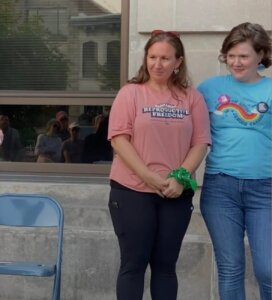
When Elly Cohen chose to terminate her pregnancy in 2022, it aligned with her understanding of Jewish law that life begins at birth, not conception.
Cohen and her husband were eager to give their then 4-year-old daughter a sibling. But her fetus had been diagnosed with Trisomy 18, a severe chromosomal disorder that, in most cases, leads to death before birth or within the first year of life. She decided to end the pregnancy.
Had she gotten pregnant just a few months later, she might not have had that choice. She lives in Indiana, one of 13 states that enacted near-total bans on abortion following the Supreme Court’s Dobbs decision, which overturned Roe v. Wade.
Indiana’s law does allow abortion for for lethal fetal anomalies up to 22 weeks, but doctors bear legal risk in determining whether a particular diagnosis meets the statute’s definition — a gray area that can lead to delays or reluctance to provide care.
That reality stirred Cohen into action. She co-founded Hoosier Jews for Choice, a Jewish group that advocates for abortion access, which joined five anonymous women of multiple faiths in a lawsuit backed by the American Civil Liberties Union. Their argument relied on a religious freedom law — the Religious Freedom Restoration Act, or RFRA — signed by former Indiana governor Mike Pence in 2015. It was one of many such state laws passed amid calls from some evangelical Christians to establish their right not to do business that violated their beliefs, such as baking a wedding cake for a gay wedding.
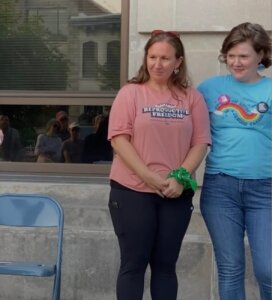
Hoosier Jews for Choice saw an opening for Jews to exercise their religious freedom under the same law, but for a purpose at odds with evangelical Christianity: to gain access to abortion. Earlier this month, Judge Christina Klineman of Marion County Superior Court agreed, permanently blocking enforcement of the state’s abortion ban for plaintiffs with sincere religious objections.
Hoosier Jews for Choice is celebrating the ruling as the biggest legal win to date in support of the argument that abortion bans violate Jews’ religious freedom. The group is hopeful that similar cases can build on the Indiana case’s success nationwide.
The ruling could still be reversed: Indiana Attorney General Todd Rokita has appealed the decision, and the case is headed to the Indiana Supreme Court, where all five justices are Republican appointees. Meanwhile, Klineman, elected to the bench in 2014 after winning a Democratic primary, has faced calls for her impeachment over her decision, in what U.S. Sen. Jim Banks (R-IN) called “one of the most ridiculous rulings I’ve seen in a long time.”
But for Amalia Shifriss, who testified on behalf of Hoosier Jews for Choice in the lawsuit, the latest ruling is a positive sign that the law will be applied consistently. If religious freedom applies to Christians objecting to baking a same-sex wedding cake, she said, then it must apply to liberal Jews, too.
“RFRA should not just be for what some lawmakers see as the religious right,” Shifriss told the Forward. “It should be for all religions.”
‘Perversion of the law’s intent’
In winning the right to an abortion, Hoosier Jews for Choice relied on a law passed by Pence, who would become Donald Trump’s vice presidential running mate on the strength of his reputation as a stalwart advocate for evangelical Christians. Pence rose to national prominence based on his unwavering opposition to abortion — and his conservative leadership as Indiana governor.
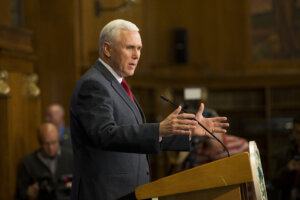
Anti-abortion advocacy organizations — including Indiana Right to Life and SBA Pro-Life America — supported the law.
Back in 2015, the debate over RFRA centered on small-business owners that sought to refuse service to LGBTQ+ people. Eric Miller, a conservative activist who was in the room when Pence signed the law, wrote then that “Christian bakers, florists and photographers should not be punished for refusing to participate in a homosexual marriage!”
Massive backlash against the law — notably by the NCAA the weekend before the Final Four basketball game was slated to occur in Indianapolis — led Pence to sign into law a clarification that businesses could not use the Religious Freedom Restoration Act to deny services to people on the basis of their sexual orientation.
But the law itself remained on the books — ripe for abortion-rights groups to wield a decade later.
Now, a little over a decade after Indiana first passed RFRA, organizations that once supported the law’s broad application have changed their tune.
“For the court to rule that taking the life of an unborn child is an exercise of religious freedom is deeply distressing — and a perversion of the law’s intent,” Indiana Right to Life president Mike Fichter said in an online statement following Klineman’s March 5 ruling. Indiana Right to Life did not respond to the Forward’s request for comment.
That shift has been part of a larger legal trend: Conservative Christian groups like Alliance Defending Freedom have long argued that the government must have a compelling reason to force someone to act against their religious beliefs — whether mandating vaccines, serving LGBTQ clients, or covering contraception in employee health care plans.
But when it came to religious plaintiffs who support abortion access, some on the Christian right didn’t think the same expansive view of religious freedom applied.
“Indiana’s religious freedom laws were passed for the purpose of protecting religious practice, not to protect the ending of a human life,”Indiana’s religious freedom laws were passed for the purpose of protecting religious practice, not to protect the ending of a human life,” Alexander Mingus, executive director of the Indiana Catholic Conference, said in an online statement after Klineman’s ruling. “Religions that preach violence are not protected by religious freedom claims.”
Mingus did not respond to the Forward’s request for an interview.
The Becket Fund for Religious Liberty, a nonprofit that has made its name arguing religious freedom cases in front of the Supreme Court, also objected to the Jewish plaintiffs’ interpretation of RFRA. In 2014, Becket successfully argued in Burwell v. Hobby Lobby Stores, Inc. that employers could refuse to cover contraception on religious grounds. Meanwhile, in the Indiana case, Becket filed a brief questioning the sincerity of the Jewish plaintiffs’ religious beliefs.
“The case fails RFRA’s test for multiple reasons, including allowing people to join Hoosier Jews for Choice by filling out an anonymous Google form with zero requirement to actually agree with Jewish religious teachings,” Lori Windham, senior counsel for Becket, said in a statement to the Forward.
Cohen disputed that characterization. She said that all members of Hoosier Jews for Choice were required to share their name and contact information, which it did not make public in order to protect members’ confidentiality. She added that group members who joined the lawsuit were asked to indicate whether they could connect their view on the abortion ban to their Jewish values and beliefs, and the vast majority of members did.
David Schraub, an assistant professor at Lewis & Clark Law School who has written about the Indiana case, said that courts do assess whether a religious belief seems genuine. But according to Schraub, the bar for establishing sincerity is low — typically an issue only in cases clearly brought in bad faith. For instance, Schraub recalled a case in which a defendant, trying to avoid paying taxes, cycled through various legal arguments before ultimately inventing “the Church of Ayn Rand.”
The Indiana case is fundamentally different, Schraub said, given the long-standing religious grounding for more permissive Jewish views on abortion.
“They tried to argue that this was not a sincerely held religious belief, which I think was really quite disrespectful, because it flies in the face of a lot of evidence about what we know about how Jews conceptualize the relationship to reproductive freedom,” Schraub said. “They’re just not willing to accept that there is such a thing as a sincere and genuine liberal religious tradition.”
Jewish beliefs, Jewish practices
A 2014 Pew Research poll found an estimated 83% of American Jews believe that abortion should be legal in all or most cases. That’s likely because Jews across denominations largely agree that life begins at birth, not conception. Sources in the Talmud say that in the first 40 days of pregnancy, the fetus is considered “mere water.” Jews value the fetus as “potential life,” gaining the legal status of nefesh, or personhood, at birth.
Still, Jews do not have monolithic views on abortion. Orthodox groups are divided, though couples generally consult rabbis on the matter and believe the choice to get an abortion should be governed by Jewish law, not personal choice.
The Conservative movement’s Rabbinical Assembly supports the right to choose abortion in cases where “continuation of a pregnancy might cause severe physical or psychological harm, or where the fetus is judged by competent medical opinion as severely defective.”
Reform Judaism emphasizes bodily autonomy, with the view that “the decision to terminate a pregnancy is one that, in all circumstances, should ultimately be made by the individual within whose body the fetus is growing.”
Rabbi Sandy Sasso — one of three rabbis the ACLU asked to give expert testimony in the Indiana case, and the first woman ordained a rabbi in Reconstructionist Judaism — told the Forward that the diversity of opinion within Judaism underscores the argument for challenging abortion bans.
“That actually is just the point — there are different religious views,” Sasso said. “The Constitution does not allow you, since there is separation of church and state, to enshrine one religious view over the other.”

Can religion and abortion coexist?
Shira Zemel, abortion access campaign director at the National Council of Jewish Women, is helping lead a national push to reframe “reproductive freedom as religious freedom.”
Each year since 2021, the Council has organized “Repro Shabbat,” which aligns with the Torah portion from Exodus Parashat Misphatim. The portion says that if a man pushes a pregnant woman, causing her to miscarry, he should pay a fine. But if any other damage results, the punishment should be according to the principle of “eye for an eye.” The portion is often interpreted as evidence that Judaism does not view a fetus as having the same legal status as a person.
The group has also backed that argument in court, filing a brief with 21 other organizations of faith in support of the plaintiffs challenging Indiana’s abortion ban — and hoping similar lawsuits will build on that case’s success nationwide.
The legal pathway exists in many places: 29 states have their own versions of the Religious Freedom Restoration Act, including at least 11 that severely restricted abortion after the Dobbs decision. According to Ken Falk, legal director of the ACLU of Indiana, the same legal reasoning used in Indiana could feasibly be applied in any of those states.
Some legal challenges are already underway, including in Kentucky and South Carolina, where litigation is ongoing. Others have faltered: In Missouri, a judge upheld the state’s abortion ban after a group of interfaith clergy sued on religious grounds. In Florida, a Jewish-led challenge to a ban after six weeks of pregnancy fizzled out after Rabbi Barry Silver, who brought the case on behalf of his synagogue, died of colon cancer in 2024.
Zemel said she hopes the Indiana case can serve as not only a legal blueprint, but also as a sign of a broader cultural shift in how religion is understood in the abortion debate.
“It’s incredible to me to see how this legal argument is bolstering what I like to think is a huge narrative shift,” Zemel said. “For far too long, it’s been weaponized that religion and abortion can’t coexist, but we know that that’s not the case.”
The post Jews paused Indiana’s abortion ban — by turning a religious freedom law against the evangelical right appeared first on The Forward.
Uncategorized
UK adopts sweeping measures against antisemitism in schools
(JTA) — The U.K. has adopted sweeping measures to combat antisemitism in English schools, prompting pushback from the country’s largest teachers’ union.
The move came after a new government-commissioned review found that three in five Jewish students reported experiencing antisemitism in English schools. The most common incidents were jokes, stereotypes and comments about Jewish people. About half of respondents who witnessed or experienced antisemitism said the incidents were not reported, most often because they did not think they would be taken seriously.
The government on Wednesday accepted 27 recommendations from the report, including dedicated antisemitism training for leaders and staff, improved recording of antisemitic incidents and moves to build a better understanding of Jewish life, identity and contemporary antisemitism.
The government commissioned the report following a spate of high-profile attacks on Jews in Britain, including an attack on a synagogue in Manchester last year that left two men dead.
The report’s author, Sir David Bell, the vice chancellor of the University of Sunderland and former chief inspector of schools in England, recommended addressing antisemitism distinctly from other forms of racism. He argued that antisemitism was a “uniquely complex” problem because of intertwined racial and religious dimensions, since Jewish identity can encompass both an ethnicity and a religion, along with expressions of prejudice that hold all Jews responsible for the actions of Israel.
The government will also encourage English schools to adopt the International Holocaust Remembrance Alliance (IHRA) working definition of antisemitism. The definition is supported by many mainstream Jewish organizations and has been adopted by 47 countries, including the U.K., but critics say that it conflates some forms of antisemitism with criticism of Israel.
British Education Secretary Lucy Powell called Bell’s review a “generational moment” and said that “implementation is now my priority.”
However, the National Education Union, the largest union representing teachers, lecturers, teaching assistants and support staff in the United Kingdom and Europe, raised concerns on Wednesday about recommending the IHRA definition for schools. NEU general secretary Daniel Kebede said in a statement that the definition “risks deepening the problem rather than tackling it, and actively undermining efforts to confront antisemitism.”
“The IHRA’s contested framing risks blurring the line between antisemitism and legitimate criticism of the Israeli government and the genocide in Gaza, leaving teachers with uncertainty when they need clarity,” said Kebede. He cited a risk that “children who cannot critically explore issues through classroom discussion will instead seek their answers in online and unsafe groups.”
Kebede also encouraged Britain’s Department for Education to strengthen guidance on all forms of racism, not only antisemitism, saying that 65% of teachers report they have not received any antiracism training in the past year.
The Board of Deputies of British Jews, an umbrella organization for British Jewish communities, celebrated the antisemitism report and the government’s adoption of its proposed measures. The group specifically praised the report’s “clear recommendations that schools and local authorities follow government guidelines by adopting the IHRA Working Definition of Antisemitism as a tool to deepen understanding of contemporary antisemitism.”
“We remain concerned about undue external influence on schools driven by narrow political agendas, and tendentious materials seeping into schools and increasing disharmony, and we will continue to press for vigilance against this,” said the Board of Deputies.
The post UK adopts sweeping measures against antisemitism in schools appeared first on The Forward.
Uncategorized
Orthodox Jewish man stabbed in midtown Manhattan
(New York Jewish Week) — An Orthodox Jewish man is in stable condition after being stabbed on Wednesday evening in the Diamond District of midtown Manhattan. Police are investigating the attack as a possible hate crime.
Police told the Jewish Telegraphic Agency that the NYPD’s Hate Crimes Task Force is investigating the incident as a possible antisemitic attack, and Manhattan Shomrim — the Jewish community watch group — has asked people to share footage as police search for the suspect. No arrests have been made.
The victim was identified by police as a 26-year-old man, and Orthodox Jewish outlet COLLive identified him as a resident of Crown Heights, the neighborhood that is home to the Chabad-Lubavitch Hasidic movement’s headquarters.
He was taken to Bellevue Hospital in stable condition. Police said they were called at about 5:50 p.m. on Wednesday after the man was stabbed in the back with “an unknown sharp object” on 47th Street near Fifth Avenue. ABC7 reported that the victim told investigators he believed he was stabbed with a needle or syringe.
According to the Chabad website, which published an interview with the victim, he is a recently ordained Hasidic rabbi named Joseph, who commutes to Midtown each day to wrap tefillin with Jewish merchants. The attacker, Joseph told the website, was a woman who seemed to be following him prior to the stabbing.
The attack comes as Jewish New Yorkers have been targeted in more than half of the hate crimes committed in New York City this year, despite making up about 12% of the city’s population.
In July, an assailant stabbed two men on the Upper West Side, including one who was leaving a synagogue, while yelling “Allahu akbar,” and was charged with committing hate crimes.
Louis Keene contributed reporting.
The post Orthodox Jewish man stabbed in midtown Manhattan appeared first on The Forward.
Uncategorized
VIDEO: A Hasid gives us a tour of Morocco in Yiddish
דער ירושלימער יוטוב־שטערן וועלוול קירשנבוים האָט לעצטנס אַרויסגעשטעלט אַ ווידעאָ אויף ייִדיש פֿון אַ פּרעכטיקן וויזיט, וואָס ער האָט געמאַכט אין מאַראָקאָ. עס באַגלייט אים זײַן חבֿר אַבֿרהם פּרץ.
אינעם ווידעאָ זעט מען ווי קירשנבוים דאַוונט שחרית מיט די אָרטיקע ייִדן און באַזוכט אַ גוט אָפּגעהיטענעם בית־עולם, וווּ עס ליגן באַערדיקט גרויסע צדיקים ווי למשל הרבֿ חיים בן עתר (1696–1743), באַקאַנט ווי דער „אור החיים“. „מענטשן מיינען, אַז נאָר אין אייראָפּע זענען דאָ קבֿרים פֿון צדיקים!“ זאָגט קירשנבוים.
מיר זעען אַ גרויסע, שיינע שיל מיט אַ פֿײַנער אַרכיטעקטור אין קאַזאַבלאַנקאַ; דעם גרויסן אַראַבישן שוק, וווּ קירשנבוים קויפֿט זיך אײַן מלבושים פּונקט ווי די מאַראָקאַנער גייען אָנגעטאָן. ער באַוווּנדערט אויך די שיינע טיי־גלעזער און טשײַניקן, וואָס מע פֿאַרקויפֿט דאָרט, און באַקענט זיך מיט אַ ייִדישן סוחר וואָס האַנדלט מיט זילבער און גאָלד, פּונקט אַזוי ווי זײַן טאַטע און זיידע האָבן געטאָן פֿאַר דור־דורות.
The post VIDEO: A Hasid gives us a tour of Morocco in Yiddish appeared first on The Forward.
