


Uncategorized
Mamdani’s progressive Jewish supporters are jubilant as they gain an ally in City Hall
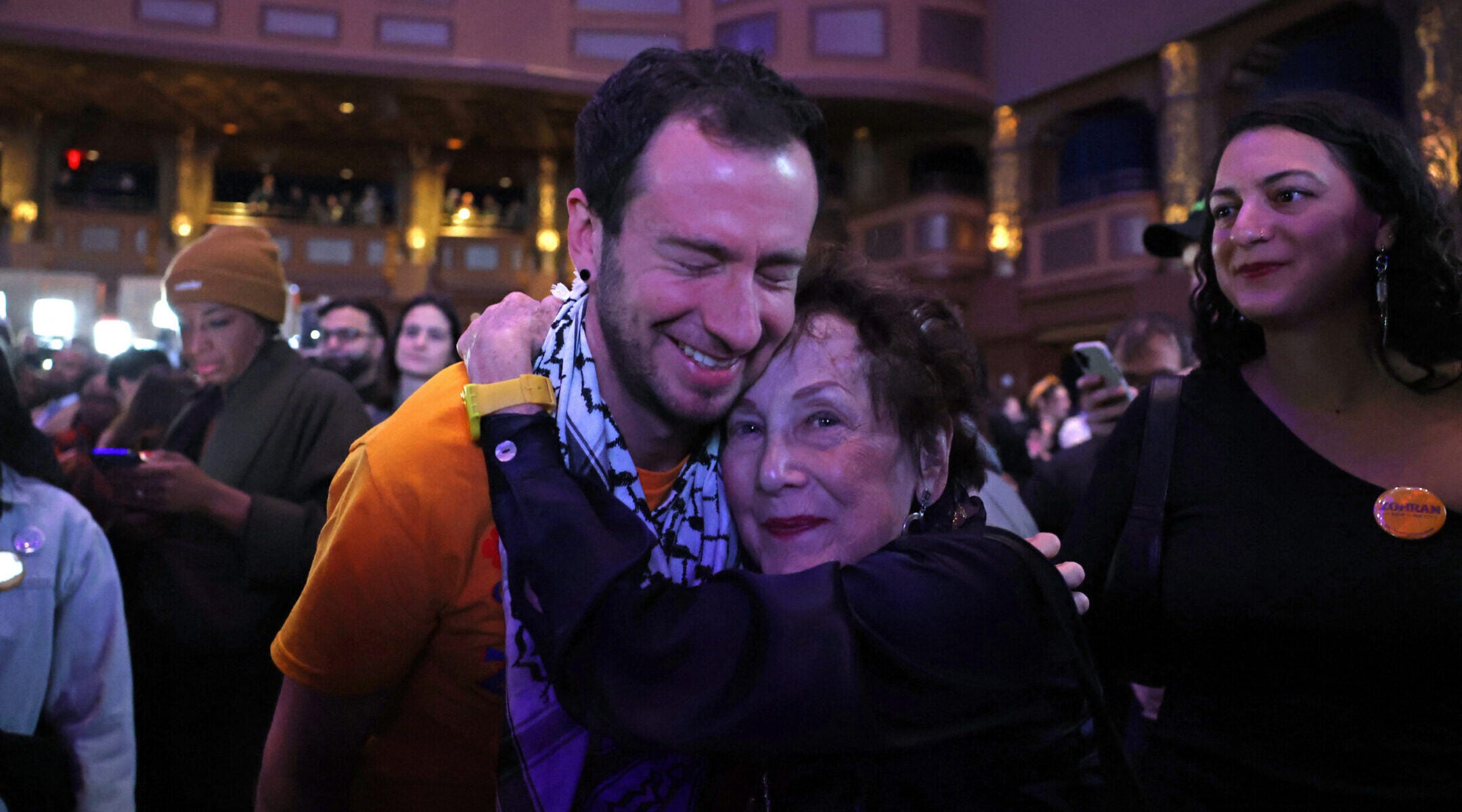
BROOKLYN — There were plenty of “Jews for Zohran” at Brooklyn Paramount, the recently refurbished music venue where Zohran Mamdani and his biggest supporters celebrated his mayoral election victory Tuesday night.
Present at the rally were many of the Jews who make up left-wing organizations like Jewish Voice for Peace and Jews for Racial and Economic Justice, whose endorsements and campaigning under the Jews for Zohran mantle became a driving force behind the democratic socialist’s support.
“This is an amazing night for Jews for Zohran and Jewish New Yorkers,” said Carlyn Cowen, co-chair of JFREJ’s board, in an interview. “This is an amazing night for everyone who has been fighting for our democracy, for housing, for childcare, for the entire vision of Zohran’s campaign, which is joy and love. Incredible.”
Mamdani’s long-held anti-Israel views made the 34-year-old democratic socialist a polarizing candidate for many Jews in the city, with the Jewish establishment and a significant majority of Jewish voters backing his main rival, former Gov. Andrew Cuomo.
“There’s going to be important bridging work to do in the Jewish community … so we can move forward and everybody can feel like their interests are being looked after and they can feel safe in the city,” said Jamie Beran, CEO of the progressive Jewish organization Bend the Arc.
But healing would need to wait for another day. On Tuesday night, the mood was jubilant as eager energy erupted into an all-out dance party celebrating Mamdani’s decisive victory. News of the race being called, only about 40 minutes after polls closed, sent the at-capacity room into a frenzy. Waves of shouts and shrieks erupted. Friends hugged and cried tears of joy, some expressing disbelief despite Mamdani’s long stretch at the top of the polls.
“New York, tonight you have delivered,” Mamdani said during his victory speech. “A mandate for change. A mandate for a new kind of politics.”
For progressive Jews in the city, the change could not be starker. Suddenly, following an Eric Adams administration largely unsympathetic to their views, left-wing groups such as JVP and JFREJ will have an ally in City Hall who’s aligned with them on an array of issues including income inequality, taking on Donald Trump and pro-Palestinian advocacy.
As his Jewish supporters gushed about what parts of Mamdani’s agenda they are most keen to see enacted, most did not bring up his longstanding, unwavering support for the Boycott, Divestment and Sanctions movement that has put a wedge between segments of the Jewish community.
“Universal childcare, number one!” said Cowen.
“All of his campaign promises around affordability are so critical for the lives of everyone who lives in New York City,” said Beran, who also said she is “really grateful” for Mamdani’s “commitments around hate crime prevention.”
“I think the fact that he was the only candidate that had a clear and specific platform, committing to an 800% increase to hate crime prevention to protect Jews and everyone in New York, is such an important part of his platform,” Beran said.
Katie Unger, who co-founded JFREJ’s political arm, the Jewish Vote, said she was most eager to see Mamdani fight back against Trump and protect immigrants.
“After 10 months of watching our immigrant neighbors getting abandoned by our mayor, I’m so glad that on day one, we’re gonna have a mayor who stands up for an immigrant city against ICE,” Unger said. “It’s been heartbreaking and appalling, particularly as a Jew, to watch this city of immigrants abandon our immigrant neighbors, from City Hall down.”
Rabbi Moishe Indig, the Satmar Hasidic rabbi who endorsed Mamdani in a split in his community, stood out for wearing a black suit and kippah, rather than the typical blue “Jews/tenants/hot girls/etc. for Zohran” T-shirt.
“We have large families, we could use affordable housing and to have a better life, hopefully,” Indig said about his community, saying he felt “great” about Mamdani’s win.
But while Stefanie Fox — JVP’s executive director who traveled from her home in Seattle for the event — said she was “thrilled about the affordability for this city,” she also emphasized that the mayor “has a tremendous role to play in defining the way that New York’s support for Israeli occupation and apartheid happens.”
She added, “So I’m really happy to see an administration where that might be possible to move.”
In a sign that pro-Palestinian activists are already geared up to lobby a mayor inclined to agree with them, Fox mentioned JVP’s new campaign, “Break the Bonds,” which is advocating for comptroller-elect Mark Levine to follow Brad Lander’s lead in not reinvesting in Israel bonds; Levine, however, has stated his intention to invest in them.
“That’s the kind of example where even though it’s the comptroller’s decision, it’s a different conversation in this New York,” Fox said.
Mamdani’s candidacy coincided with amid surging pro-Palestinian sentiments among the broader liberal electorate, and inside the hall, evidence of the cause was on vivid display. Some attendees wore keffiyehs as they embraced in celebration. Mamdani was joined on stage by his wife, an artist who was wearing a top by a Palestinian designer, and parents, a scholar and film director who are prominent supporters of the boycott Israel movement. And outside, a group of Neturei Karta anti-Zionist Jewish protesters stood holding a sign that read, “Congratulations NYC. Zohran Mamdani 0% AIPAC Funded.”
A number of Mamdani’s backers from the political and cultural worlds were in attendance, many of whom share his strongly critical views of Israel, including actress Cynthia Nixon, streamer Hasan Piker, and Jamaal Bowman, the former congressman whose name has circulated as a possible schools chancellor for Mamdani. (Mamdani has not indicated if he has a preferred chancellor.)
Brad Lander, Mamdani’s most prominent Jewish ally in city politics who cross-endorsed him ahead of the Democratic primary, was also on hand.
So was Jewish stand-up comedian and podcaster Adam Friedland, who went on a passionate rant against Israel to pro-Israel Rep. Ritchie Torres back in August.
“It’s a crap job, right?” Friedland said in an interview. “It’s really tough to be the mayor of such a big city, right? But I think he’s a genuine person. I met him and he’s kind of, like, he’s just a millennial. He likes soccer and democratic socialism.”
Mamdani did not mention Israel or Palestine during his speech, keeping his focus on New York City and the diversity of New Yorkers whom he hopes to represent as mayor.
“We will build a City Hall that stands steadfast alongside Jewish New Yorkers and does not waver in the fight against the scourge of antisemitism,” Mamdani said, drawing cheers.
As the election drew closer over the last two weeks, Jewish leaders and rabbis came out in droves to warn Jewish voters about his anti-Israel rhetoric. A letter signed by 1,100 rabbis from across the country warned of the “political normalization” of anti-Zionism, naming Mamdani.
Bend the Arc’s Beran said the election result may very well be a sign that the letter, despite its many signatures, did not achieve its intended effect.
“We’ll have to see how the actual vote shook out, but I think it’s clear that a lot of Jews saw through the fear-mongering,” she said. “I think people were able to see the complete picture of the campaign and also understand that Zohran actually cares about Jewish safety.”
An early exit poll conducted by CNN suggested that about a third of Jewish voters had cast their ballots for Mamdani, with two-thirds backing Cuomo.
Rafael Shimunov, a JFREJ member who hosts a radio show called “Beyond the Pale,” said Mamdani’s victory was proof that the tactics used by Cuomo and his mega-donors need not be successful.
“I’m feeling exhilarated and hopeful and excited about what this means for the rest of this country, every city and town in this country,” he said. “This proves tonight that even among all the attempts at dividing us, using my people, antisemitism, using the Jewish community as a wedge in the coalition — didn’t work.”
Now, Mamdani’s challenge will turn from campaigning, where he has a long track record of explosive success, to governing, which he said — slyly quoting Cuomo’s father Mario, himself a former governor — he intended to do “in prose.” He has never held an executive role.
“I don’t know if we’re going to accomplish everything, I don’t know how long it’s going to take,” said Rabbi Abby Stein, who’s closely involved with JVP and JFREJ, and was responsible for the Yiddish translations of the Mamdani campaign signs posted around Hasidic areas of Brooklyn. “But I know that we have someone who’s going to try.”
—
The post Mamdani’s progressive Jewish supporters are jubilant as they gain an ally in City Hall appeared first on Jewish Telegraphic Agency.
Uncategorized
UK adopts sweeping measures against antisemitism in schools
(JTA) — The U.K. has adopted sweeping measures to combat antisemitism in English schools, prompting pushback from the country’s largest teachers’ union.
The move came after a new government-commissioned review found that three in five Jewish students reported experiencing antisemitism in English schools. The most common incidents were jokes, stereotypes and comments about Jewish people. About half of respondents who witnessed or experienced antisemitism said the incidents were not reported, most often because they did not think they would be taken seriously.
The government on Wednesday accepted 27 recommendations from the report, including dedicated antisemitism training for leaders and staff, improved recording of antisemitic incidents and moves to build a better understanding of Jewish life, identity and contemporary antisemitism.
The government commissioned the report following a spate of high-profile attacks on Jews in Britain, including an attack on a synagogue in Manchester last year that left two men dead.
The report’s author, Sir David Bell, the vice chancellor of the University of Sunderland and former chief inspector of schools in England, recommended addressing antisemitism distinctly from other forms of racism. He argued that antisemitism was a “uniquely complex” problem because of intertwined racial and religious dimensions, since Jewish identity can encompass both an ethnicity and a religion, along with expressions of prejudice that hold all Jews responsible for the actions of Israel.
The government will also encourage English schools to adopt the International Holocaust Remembrance Alliance (IHRA) working definition of antisemitism. The definition is supported by many mainstream Jewish organizations and has been adopted by 47 countries, including the U.K., but critics say that it conflates some forms of antisemitism with criticism of Israel.
British Education Secretary Lucy Powell called Bell’s review a “generational moment” and said that “implementation is now my priority.”
However, the National Education Union, the largest union representing teachers, lecturers, teaching assistants and support staff in the United Kingdom and Europe, raised concerns on Wednesday about recommending the IHRA definition for schools. NEU general secretary Daniel Kebede said in a statement that the definition “risks deepening the problem rather than tackling it, and actively undermining efforts to confront antisemitism.”
“The IHRA’s contested framing risks blurring the line between antisemitism and legitimate criticism of the Israeli government and the genocide in Gaza, leaving teachers with uncertainty when they need clarity,” said Kebede. He cited a risk that “children who cannot critically explore issues through classroom discussion will instead seek their answers in online and unsafe groups.”
Kebede also encouraged Britain’s Department for Education to strengthen guidance on all forms of racism, not only antisemitism, saying that 65% of teachers report they have not received any antiracism training in the past year.
The Board of Deputies of British Jews, an umbrella organization for British Jewish communities, celebrated the antisemitism report and the government’s adoption of its proposed measures. The group specifically praised the report’s “clear recommendations that schools and local authorities follow government guidelines by adopting the IHRA Working Definition of Antisemitism as a tool to deepen understanding of contemporary antisemitism.”
“We remain concerned about undue external influence on schools driven by narrow political agendas, and tendentious materials seeping into schools and increasing disharmony, and we will continue to press for vigilance against this,” said the Board of Deputies.
The post UK adopts sweeping measures against antisemitism in schools appeared first on The Forward.
Uncategorized
Orthodox Jewish man stabbed in midtown Manhattan
(New York Jewish Week) — An Orthodox Jewish man is in stable condition after being stabbed on Wednesday evening in the Diamond District of midtown Manhattan. Police are investigating the attack as a possible hate crime.
Police told the Jewish Telegraphic Agency that the NYPD’s Hate Crimes Task Force is investigating the incident as a possible antisemitic attack, and Manhattan Shomrim — the Jewish community watch group — has asked people to share footage as police search for the suspect. No arrests have been made.
The victim was identified by police as a 26-year-old man, and Orthodox Jewish outlet COLLive identified him as a resident of Crown Heights, the neighborhood that is home to the Chabad-Lubavitch Hasidic movement’s headquarters.
He was taken to Bellevue Hospital in stable condition. Police said they were called at about 5:50 p.m. on Wednesday after the man was stabbed in the back with “an unknown sharp object” on 47th Street near Fifth Avenue. ABC7 reported that the victim told investigators he believed he was stabbed with a needle or syringe.
According to the Chabad website, which published an interview with the victim, he is a recently ordained Hasidic rabbi named Joseph, who commutes to Midtown each day to wrap tefillin with Jewish merchants. The attacker, Joseph told the website, was a woman who seemed to be following him prior to the stabbing.
The attack comes as Jewish New Yorkers have been targeted in more than half of the hate crimes committed in New York City this year, despite making up about 12% of the city’s population.
In July, an assailant stabbed two men on the Upper West Side, including one who was leaving a synagogue, while yelling “Allahu akbar,” and was charged with committing hate crimes.
Louis Keene contributed reporting.
The post Orthodox Jewish man stabbed in midtown Manhattan appeared first on The Forward.
Uncategorized
VIDEO: A Hasid gives us a tour of Morocco in Yiddish
דער ירושלימער יוטוב־שטערן וועלוול קירשנבוים האָט לעצטנס אַרויסגעשטעלט אַ ווידעאָ אויף ייִדיש פֿון אַ פּרעכטיקן וויזיט, וואָס ער האָט געמאַכט אין מאַראָקאָ. עס באַגלייט אים זײַן חבֿר אַבֿרהם פּרץ.
אינעם ווידעאָ זעט מען ווי קירשנבוים דאַוונט שחרית מיט די אָרטיקע ייִדן און באַזוכט אַ גוט אָפּגעהיטענעם בית־עולם, וווּ עס ליגן באַערדיקט גרויסע צדיקים ווי למשל הרבֿ חיים בן עתר (1696–1743), באַקאַנט ווי דער „אור החיים“. „מענטשן מיינען, אַז נאָר אין אייראָפּע זענען דאָ קבֿרים פֿון צדיקים!“ זאָגט קירשנבוים.
מיר זעען אַ גרויסע, שיינע שיל מיט אַ פֿײַנער אַרכיטעקטור אין קאַזאַבלאַנקאַ; דעם גרויסן אַראַבישן שוק, וווּ קירשנבוים קויפֿט זיך אײַן מלבושים פּונקט ווי די מאַראָקאַנער גייען אָנגעטאָן. ער באַוווּנדערט אויך די שיינע טיי־גלעזער און טשײַניקן, וואָס מע פֿאַרקויפֿט דאָרט, און באַקענט זיך מיט אַ ייִדישן סוחר וואָס האַנדלט מיט זילבער און גאָלד, פּונקט אַזוי ווי זײַן טאַטע און זיידע האָבן געטאָן פֿאַר דור־דורות.
The post VIDEO: A Hasid gives us a tour of Morocco in Yiddish appeared first on The Forward.
