



Uncategorized
Mike Rogers campaign event for Jews brings out Haley Stevens’ fiancée
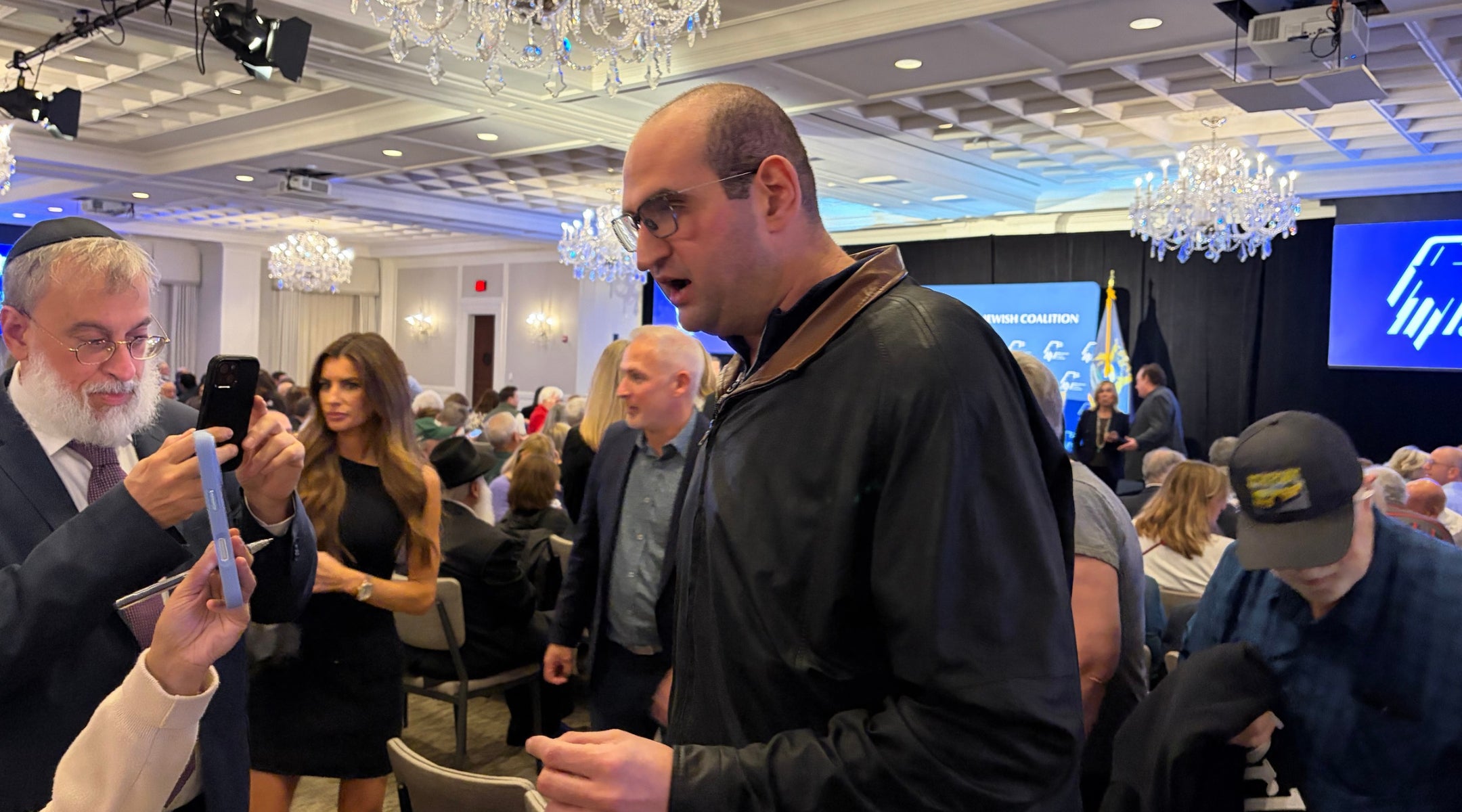
(JTA) — BIRMINGHAM, Mich. – The Republican Jewish Coalition typically isn’t known for drawing committed Democrats to its events.
But that’s what happened Wednesday night at the Townsend Hotel in suburban Detroit, when a campaign event for GOP U.S. Senate nominee Mike Rogers attracted several Jews from the other side of the aisle. Those included Jason Turkish, a Democratic lawyer and megadonor best known as the fiancé of pro-Israel Democratic U.S. Rep. Haley Stevens.
Turkish did not speak at the event. But just before it started, he had gone public with his declaration that he was voting for Rogers, and his conviction that Abdul El-Sayed, the Democratic nominee and former county health director who beat his partner in the primary, was antisemitic.
“This choice for me, in the end, was very simple,” Turkish told reporters from the sidelines. He cited recent instances of El-Sayed not answering whether Iran or Israel poses a bigger threat to the United States, and of the candidate only softly distancing himself from a PAC ad that blamed Israel for the price of groceries.
“History will remember who stands where in this moment, and it will not remember Abdul El-Sayed kindly,” Turkish said.
Turkish’s public stance against his party’s nominee, whom Stevens herself has endorsed while not directly campaigning for him, was yet another indication of the deep distrust and anger many of Michigan’s pro-Israel Jewish voters have voiced toward El-Sayed throughout this campaign. Republicans are hoping that will translate into more Jewish lifelong Democrats, like Turkish and former Stevens campaign chair David Kramer, pulling the lever for Rogers instead.
“I love it,” Rogers, a former congressman, told reporters about Turkish’s endorsement. From the stage, the candidate was clear about what he thinks of El-Sayed: “He’s beyond antisemitic. He hates Jews.”

Turkish insisted that despite his Rogers vote, he was not a Republican.
“I will vote for Democrats up and down the ballot,” he said. “This isn’t some major departure. You can support Democrats up and down the ballot and make a choice to choose country over party in one race.”
When asked by reporters at a different campaign event about Turkish, El-Sayed responded, “I’m building a movement to take on the challenges that Donald Trump is facing. If folks have issues that are more important to them than that, that’s fine.”
Most of the Jews in the RJC room were committed Republicans, who booed a mention of progressive Jewish megadonor George Soros and cheered the name of far-right Jewish U.S. Rep. Randy Fine.
The newfound Jewish discomfort with the Democratic nominee and the desire to send a message to the party were a key part of the pitch that Rogers and Texas GOP Sen. Ted Cruz made to the estimated 500 attendees at the RJC event.
“People who are lifelong Democrats who want to vote for Democrats for every other office, I’m not advocating that,” Cruz joked to the room. “But even if that’s where you are,” he urged, “say there is a line that is too far, and this is that line.”

RJC spokesperson Sam Markstein told the Jewish Telegraphic Agency that he had to fetch more chairs for overflow seating. Markstein said turnout for Wednesday’s event was double what the RJC had drawn for a similar gathering in 2024 in support of Rogers’ first, unsuccessful Senate run — when the GOP was stronger nationally than it is now.
Hundreds of Jews in the state have signed a pledge to vote for Rogers, though a rival pledge to vote for El-Sayed has nearly twice as many signatures.
El-Sayed’s comments following the March terror attack on the Temple Israel preschool, in which he stated, in part, “Hurt people hurt people,” haunt his perception among Jews months after he apologized for them. An Israeli strike in Lebanon had killed members of the attacker’s family.
At the RJC event, signs read “No, Abdul: Hurt People Help People” and “Mike Will Keep Us Safe.” Some attendees carried a parody picture book called “Hurt People Hurt People,” featuring an El-Sayed-like “Dr. Context” caricature who consoles the Big Bad Wolf instead of the Three Little Pigs.
The RJC has made a $2 million ad buy with pro-Rogers commercials featuring members of Temple Israel, some of whom spoke to the crowd. A separate Jewish organization, the Combat Antisemitism Movement, has made its own ad buy for Rogers via a new political advocacy arm, featuring one of the same Temple Israel moms.
The GOP sales pitch to Jews has also veered into darker territory, which was evident Wednesday night. Onstage, both Cruz and Rogers claimed that El-Sayed receiving Senate-level security clearance for intelligence briefings would pose a risk to national security.
“The risks are too high that he would share sensitive information with the Muslim Brotherhood,” Cruz said, echoing a growing conservative attack line against the Democrat. He also called El-Sayed a “jihadist leprechaun.”
Rogers said that Hasan Piker, the anti-Israel streamer who campaigned with El-Sayed, “should go back to Turkey, where he belongs.”
Asked later by JTA about his comment, Rogers said he was referring to Piker’s dual Turkish citizenship, and said, “I just thought if he wanted to go back there because he hates America so much, I’d pay for the ticket.”
Rogers appeared to distance himself from comments that U.S. Health and Human Services Secretary Robert F. Kennedy Jr. made at a Grand Rapids campaign event earlier this week with the candidate present. Kennedy had claimed that Arabs “don’t produce science” and “don’t win the Nobel Prize.”
“Sometimes the campaign takes lefts and rights,” Rogers told reporters, when asked about Kennedy. “What I’m concerned about is what’s happening here. Our Arab community is showing lots of support.” The substantial Arab American community in this swing state makes it a key player in elections, and Republicans have been walking a tightrope between weaponizing El-Sayed’s faith against him and keeping on board Arab Americans who voted two years ago for President Donald Trump.
Rogers sought to make clear to the Jews in the room that he was aligned with Cruz, a pro-Israel stalwart who has picked public fights with far-right commentator Tucker Carlson. Cruz, though, has been a vocal proponent of war in Iran, while Rogers recently told JTA in an interview that “we met our objectives” in Iran and should wind down the war there.
On Wednesday, Rogers took a more hawkish tone on Iran. “I’d love to see this wrapped up, but I don’t think we can leave it where they have any ability to hurt our friends and neighbors,” he said. “So their army, navy, air force has to be as diminished as they can.”
Both men also took time from the stage to denounce antisemitism from the right.
At their donor events, Rogers said, “Without fail. I would get three or four or five young, white men who would come up and say, ‘You’re not going to take Jewish money, are you?’”
Rogers chalked up the problem to college campuses, calling for efforts to “get Qatari money out of our colleges.”
This article originally appeared on JTA.org.
The post Mike Rogers campaign event for Jews brings out Haley Stevens’ fiancée appeared first on The Forward.
Uncategorized
Italy passes antisemitism law amid flaring debate over criticizing Israel
(JTA) — Italy has passed a bill aimed at combating antisemitism, prompting backlash from opponents who say that it could restrict criticism of Israel.
The legislation, which enshrined a contentious definition of antisemitism, was approved on Tuesday in the Italian parliament’s lower house. It received 147 votes, with 93 lawmakers against it and five abstaining.
The measure incorporates a working definition of antisemitism from the International Holocaust Remembrance Alliance (IHRA) into national law. This definition is supported by many mainstream Jewish organizations and has been adopted or endorsed by 48 countries, though many have not made it legally binding.
Opponents say the definition conflates antisemitism with some forms of Israel criticism. The IHRA framework lists contemporary examples of antisemitism that include denying Jewish people the right to self-determination, calling Israel a “racist endeavor” and comparing “contemporary Israeli policy to that of the Nazis.”
While Italy’s new law codified this definition as a reference for combating antisemitism, it did not define new criminal offenses or penalties.
The legislation also established the role of a national coordinator for fighting antisemitism. This official will oversee a three-year strategy that spans monitoring antisemitic incidents, combating online hate and boosting education while strengthening the security of Jewish communities and promoting Jewish culture.
Italy’s Antisemitism Observatory, part of the Jewish Contemporary Documentation Center in Milan, recorded 963 antisemitic incidents in 2025 — about four times higher than in 2022.
Livia Ottolenghi, the president of the Union of Italian Jewish Communities, said in a statement that she was “very satisfied” with the law, adding that it was “unfortunate that there wasn’t broader participation.”
Meanwhile, the measure was condemned by Erika Guevara Rosas, Amnesty International’s senior director for research, advocacy, policy and campaigns. She said Tuesday marked “a bleak day for freedom of expression” as the law “heightens the risk of far-reaching forms of censorship and self-censorship.”
Italy’s center-left opposition, a group that ranges from moderate to left-wing parties, was divided over the legislation. Their loose alliance wants to unseat Prime Minister Giorgia Meloni’s right-wing government in the country’s 2027 elections.
Laura Boldrini, a member of the center-left Democratic Party, backed an amendment to the law that would have replaced the IHRA definition with the Jerusalem Declaration, an alternate framework that she said did not conflate antisemitism with opposition to Israel’s actions. The Jerusalem Declaration devotes considerable space to defining what is not antisemitic in Israel discourse.
“The majority does not really want to fight antisemitism,” Boldrini said on X. “It wants to censor criticism of the Israeli government, which is committing genocide and war crimes and crimes against humanity.”
This article originally appeared on JTA.org.
The post Italy passes antisemitism law amid flaring debate over criticizing Israel appeared first on The Forward.
Uncategorized
Australia announces new sanctions on West Bank settlers and organizations
(JTA) — Australia imposed new sanctions on those it maintains are involved with illegal settlement expansion and human rights abuses against Palestinians in the West Bank, the country’s foreign ministry said on Wednesday, a day after Britain enacted restrictions on Israeli settlement construction firms and an activist group.
Australians will be prohibited from trading with, funding or providing other support to three individuals and four organizations linked to West Bank settlement expansion, according to Foreign Minister Penny Wong’s office.
The measures build on existing sanctions on senior Israeli ministers, extremist settlers and settlements, and follow a September pledge to pursue further sanctions.
“We are taking these actions because the rapid expansion of settlements and settler violence are extinguishing the possibility of a two-state solution,” the statement continued, noting that Israeli West Bank settlements “are illegal under international law.”
In addition to banning trade with individuals and organizations linked to settlement expansion efforts, Wong’s office said that the new sanctions for the first time “are targeting a construction company involved in the building of settlements.”
“Australian businesses should not bid for construction tenders for illegal settlement developments,” the statement added.
Britain on Tuesday imposed sanctions on eight Israeli companies involved in West Bank settlement construction and the activist group Tzav 9, which has repeatedly blocked Gaza-bound humanitarian aid convoys.
The individuals cited in Australia’s updated Sanctions Consolidated List on Wednesday included Daniella Weiss, Eliav Libi and Itamar Yehuda Levi, while the organizations named were Amana, the Nachala Movement, Guardians of Judea and Samaria and the Eyal Judaean Mountains Company. The individuals also incurred travel bans to Australia.
The document asserted that Weiss, a veteran settler leader, is the person who “plans, directs and oversees” the Nachala Movement’s operations, adding that she “has publicly supported and advocated for its actions” to promote settlements and illegal West Bank outposts.
Responding to the news, the Nachala Movement described the sanctions on both the organization and its leader as “a badge of honor,” in a statement on X.
“No antisemitic decision can sever the eternal bond between the Jewish people and their heritage,” the statement said. “Powers far stronger than Australia have attempted to impose edicts” but these efforts have failed, the statement said.
“The People of Israel continue to build on their land,” the post added.
As for Libi, the sanctions list simply noted his role as a “settler and director of Libi Construction and Infrastructure Ltd.” The document named Levi as the owner of Eyal Judaean Mountains, a West Bank construction and demolition firm. He was also listed as the “older brother of Yinon Levi,” whom Australia sanctioned in July 2024.
The list accused the Amana organization of involvement “in illegal settlement and outpost development in the West Bank” and accused the Guardians of Judea and Samaria of recruiting volunteers to work at West Bank outposts.
In response to the sanctions, the Guardians, also known as Hashomer Yosh, released a short reel depicting settler farming and shepherding activities, saying in a caption that “this is how antisemitism looks in the year 2026.”
Penalties for Australians who violate the new rules include up to 10 years in prison and fines of up to 910,000 Australian dollars (US$612,000) or three times the value of a specific deal, Wong’s office warned. Businesses can incur fines up to US$2.4 million or three times the transaction value.
“Australia remains steadfast in its commitment to the two-state solution as the only pathway to enduring peace and security for both Israelis and Palestinians,” her office added.
This article originally appeared on JTA.org.
The post Australia announces new sanctions on West Bank settlers and organizations appeared first on The Forward.
Uncategorized
The Jewish hotel on the Lower East Side that was too good to last
The Ritz with a Shvitz: The Rise and Fall of the Lower East Side’s Libby’s Hotel in Tammany Era New York
By Shulamith Z. Berger and Jai Zion
State University of New York Press, 240 pages, $27.95
When the Lower East Side was the capital of the Jewish world, the 12-story Libby’s Hotel, a glorious edifice climbing out of the surrounding tenements, was one of its brightest achievements. Until hostile forces brought it down. Literally.
As explained in a new book, The Ritz with a Shvitz: The Rise and Fall of the Lower East Side’s Libby’s Hotel in Tammany Era New York, Libby’s was the brainchild of Max Bernstein, who came to the U.S. from Slutsk, a city in the Russian Empire (Belarus today), in 1900, at age 11. He had been here just eight months when his beloved mother Libby died suddenly in childbirth.
An energetic and ambitious boy, Max seems to have channeled his grief into entrepreneurship. He hustled Yiddish newspapers on the street until, by the age of 14, he saved $75 (close to $3,000 in today’s money) and built a candy stand next to his father’s small restaurant. He moved on to a bigger business: buying, refurbishing, and selling restaurants. He was 15 years old. (As novelist L.P. Hartley put it, “The past is a foreign country; they do things differently there.”)
At 27, he took over his father’s conventional restaurant and changed it to “self-service.” It became so successful that within a year, he opened a second one a few blocks away. Then a third restaurant a year after that. And so on. He became a rich man. But he wanted more than just money; he wanted to build something to memorialize his mother.
At first he thought it would be a shvitz, a bathhouse: the shvitz was for Jews what the bar was for other ethnic groups. But ultimately he decided Libby’s would be a sumptuous, modern Jewish hotel. Such a hotel was needed at the time because many of the older hotels in New York were “restricted” — i.e., no “Hebrews” were permitted to register.
Though he was quite wealthy, Max needed to drum up outside capital, so he began advertising in the Yiddish press. His goal was to attract investment both from the moneyed classes and from ordinary working people; he wanted everyone to have a stake in the project. A single share of Libby’s stock cost $10 ($190 today), and they were bought by pushcart peddlers, grocers, janitors, and factory workers.
The hotel opened five years later, and it was worth the wait. Libby’s was spectacular, and it had everything. Live music was pumped throughout the building via a state-of-the-art PA system. It had a gymnasium, an in-house newspaper, a concert hall, a barber shop, elegant lounges, a gilded swimming pool, two kosher restaurants (one dairy and one meat), grand ballrooms, a radio studio — which broadcast the first successful ongoing Yiddish radio program — and of course the shvitz, which had an orchestra playing in its lounge.
The hotel had accommodations for people of every income level, from upper-floor luxury suites to lower-floor dormitories, and all of its amenities were available to every guest, no matter how humble. People from the neighborhood came for concerts, weddings, organizational meetings, and grand seders.
It was too good to last.
What brought down Libby’s was an evident collusion between an unscrupulous mortgage agency — villains out of an old melodrama, but real — and the city’s corrupt administration. The mortgage agency had so arranged their contract as to make it almost impossible for their loan to be repaid, and then they would foreclose.
Simultaneously, the city planned to condemn Libby’s as part of an eminent domain proceeding. The lenders would foreclose and take the hotel, then get a huge monetary award for it after it was condemned; the book describes the process in appalling detail. The administration of Mayor Jimmy Walker, controlled by the notorious Tammany Hall Democratic machine, did everything they could to help the lenders, and though there is no real evidence to prove it, it’s hard to believe it wasn’t deliberate.
It’s an incredibly dramatic story, and impeccably researched (there’s an excellent essay describing the process in the pre-internet era) — but I do have a few taynes (complaints). For one thing, there is too much detail about the long legal battle for the property; after a while we get the point. Also, the book depicts Mayor Walker, who clearly was putting his thumb on the scale, as if he masterminded the scam. But the evidence for this is thin, and it seems unlikely given Walker’s personality. It seems far more likely that Walker was just obeying his Tammany overlords, who gave him his whole political career.
Most significantly, the book has a protagonist‚ Max Bernstein‚ and at two key moments we’re not there with him. What happened on May 18th, 1926, Libby’s opening day, when Max would have watched his first guests walk in under the ten-story-tall sign with his mother’s name in colored lights? It would have been the climactic moment of his life; what did he feel?
And what went through his mind four years later, when the bad guys won? Did Max stand across the street watching as the beds, the restaurant’s plates with his name on them, the gym equipment, and the radio studio were all torn from the building and driven off? What about when the wrecking ball smashed through the building itself? Was he even there?
Of course, tracing what was in one person’s mind on a given day a hundred years ago is impossible, and if researchers as thorough as Berger and Zion can’t turn something up, it probably didn’t survive. Nevertheless, some writerly exploration of the moment is pretty much demanded, and we don’t get one.
Still, it’s a compelling, if sad, story. There are many illustrations. There’s a lot of material about life on the Jewish Lower East Side at its absolute pinnacle, before the effects of the Johnson-Reed Act of 1924, which restricted European immigration, were felt. (Another essay, maybe the book’s high point, describes how Max treated two poor neighborhood boys to a stay in the hotel.) The Ritz With A Shvitz is written in easy, clear prose — unusual for an academic press — and even shows the occasional flash of wit, as in the phrase “beware the eyes of Marx” — a reference to the picture of Karl Marx that graces the front of the old Forward building on the Lower East Side until today.
And Max himself? He picked himself up, brushed himself off, and started all over again, finding new success in the restaurant business, among other things.
He was a brave man.
The post The Jewish hotel on the Lower East Side that was too good to last appeared first on The Forward.
