


Uncategorized
NAZA exposes Israel’s crisis of credibility over Gaza

More than two decades ago, when I was the The Associated Press bureau chief for Israel, the West Bank and Gaza, the Israeli military called off an attack on a senior Hamas leader after learning at the last moment that family members and children were inside the targeted building.
What stayed with me was what happened next. The military sent a senior officer to my office to explain the decision.
This was during the Second Intifada, the murderous explosion of terrorism launched by armed Palestinians after Israel had offered the Palestinian Authority an independent state in over 90 percent of the territory it sought. Hamas leaders sent suicide bombers into Israel on a daily basis to blow up buses, restaurants, malls, cafes. I checked for explosives whenever I got into my car, perhaps with my little daughters, Maya and Noa.
Yet Israeli officials understood that demonstrating concern for civilian life was part of maintaining the country’s credibility. Maybe they also thought that concern for innocent life, even on the enemy side, was the Jewish thing to do. I want to believe this, as both a Jew and as a manager who had colleagues in Gaza, some of whom were hurt over the years.
That memory returned to me amid the uproar surrounding NAZA, the new documentary by Israeli filmmakers Yuval Abraham and Rachel Szor, who shared in the 2024 Oscar for No Other Land, a critique of Israel’s practices in the West Bank.
The new film, which premiered at the Venice Film Festival and won the Special Jury Prize, is titled after the Hebrew acronym for “collateral damage” (and is also a play on “Gaza”). It examines Israel’s targeting practices in Gaza through testimony from 24 Israeli soldiers and intelligence personnel who allege the IDF used artificial intelligence.
Some of those soldiers, the filmmakers say, operated or helped design the AI systems at the center of the film. Their identities are concealed in various ways, yet their testimony portrays a disturbing picture about how technology, intelligence and estimates of civilian casualties intersected in decisions to strike.
The reaction in Israel has been ferocious. Culture Minister Miki Zohar – from the governing Likud Party led by Benjamin Netanyahu – has called the filmmakers traitors and raised the prospect of revoking their citizenship.
Former football star and prominent television personality Eyal Berkovic has similarly argued that loss of citizenship should be the best-case scenario for Israelis who harm their country. As the film moves beyond Venice, efforts to prevent its screening in Israel seem likely.
That reaction creates a sad irony. One of the strongest criticisms of NAZA is that its highly combustible testimony comes from anonymous sources – and that is a valid criticism indeed. Yet threats directed at the filmmakers offer a fairly vivid illustration of why soldiers and intelligence officers making explosive allegations about their own military might fear speaking publicly. The filmmakers say anonymity was necessary to protect people who could face serious consequences for revealing classified information. I can credibly assess they’d end up in jail.
Nonetheless, the anonymity remains a serious weakness. Claims that are this grave demand intense scrutiny, and viewers have limited means of establishing whether the witnesses held the positions they claim, possessed the knowledge they describe or represent the targeting system accurately. The IDF has challenged precisely this aspect of the film and rejected its portrayal of Israeli targeting practices.
That said, and not for the first time, the military is more reasonable than the government and the IDF’s spokesman invited the filmmakers to screen it for the military. A detailed military response to the evidence presented in NAZA would provide an essential counterweight.
The central dispute also reaches beyond whether Israel used artificial intelligence. The IDF says decisions to select and approve strikes are made by human personnel. The more consequential question is what information those people received and what weight they gave to civilian lives when making those decisions. If a system identified a Hamas operative inside a residential building, what level of civilian harm was considered acceptable in order to kill him? To what degree was AI part of the decision-making process?
Amid a global uproar over fears of AI, and in particular systems operating independently in ways that harm humans, this film catapults such questions to a very high place in the global discourse.
The AI questions lead to others. Did the permissible number of civilian casualties change according to the importance of the target? How confident did intelligence officers have to be that the intended person was actually present? What happened when information indicated that children or other family members were inside? How frequently did commanders cancel strikes because the expected civilian toll had become too high?

NAZA offers disturbing answers, and its central concern is ultimately a human one: what values and tolerances were built into the targeting process, and how were they applied by the people responsible for approving strikes?
Israel, this time around, has provided only a limited public account of those calculations during the war. Officials have emphasized the extraordinary difficulties of fighting Hamas in densely populated Gaza, the organization’s use of civilian areas for military purposes and Israeli estimates of a civilian-to-combatant casualty ratio that they say compares favorably with other episodes of urban warfare, including Mosul. The precise civilian death toll in Gaza also remains contested, particularly the division between civilians and combatants.
There is no doubt in my mind – none whatsoever – that Hamas is the embodiment of evil. It is obvious to anyone paying attention that the jihadist group engineered the entire war to maximize casualties on its own side in order to make Israel an international pariah. But it is also rather obvious by Israel’s conduct in the war and the tens of thousands of civilians who have died, that Israel to walked into the trap laid by Hamas.
Aggregate ratios tell only part of the story. They reveal little about why a particular building was struck, how many civilians were expected to be inside, what military advantage commanders anticipated or how that anticipated advantage was weighed against the likely human cost. Repeated incidents involving substantial civilian casualties have often been followed by broad explanations rather than detailed accounts of the decision-making that produced them. Foreign journalists, of course, have not been freely allowed in.
That is where my memory from more than 20 years ago feels especially relevant. The military that sent an officer to my office understood the value of a transparent process. It understood that credibility depended partly on demonstrating, in specific cases, that civilian lives carried meaningful weight in operational decisions. During the Gaza war, amid extraordinary civilian loss of life, that instinct has been far less visible, to say the least.
Why did Israel act this way? Part of it has to do with the unspeakable trauma of the Oct. 7 Hamas invasion and massacre, which left Israelis in no mood for explanations, and placed its government in a defensive posture. Part of it is the nature of that government – an ultranationalist assemblage of highly illiberal and astoundingly cynical politicians. And part of it is the global demonization targeting Israel – so thorough and unfair that it almost explains the surrender of any serious effort at PR.
None of this was smart. The resulting information vacuum has given NAZA much of its power. A documentary built substantially around anonymous testimony carries an obvious credibility burden, particularly when its allegations concern classified practices that outsiders have little ability to examine independently. Yet Israel’s sparse public accounting of its targeting decisions has left relatively little detailed evidence against which those accounts can be measured. The filmmakers have supplied one version of what happened inside the targeting system; a detailed Israeli account could provide another.
Demonizing a couple of filmmakers based on the idea that they meant to do Israel harm will not convince intelligent people and will deepen Israel’s isolation. Israel needs to explain to its own people how it failed so utterly to protect the massacre of Jews. It needs to explain to the world what went on in Gaza. In fact, it needs to explain that to its own people as well.
All of that will await another government. This will not come from Netanyahu.
The post NAZA exposes Israel’s crisis of credibility over Gaza appeared first on The Forward.
Uncategorized
CAIR Connecticut urges Greenwich schools to stop using Eisner Camp over Israel ties
(JTA) — GREAT BARRINGTON, Mass. – Greenwich Public Schools in Connecticut said it would proceed with a planned fall trip for sixth graders at a Jewish camp in Massachusetts as planned this week, despite pressure from a Muslim advocacy organization over the camp’s Israeli symbols and Israel-related programming.
CAIR Connecticut, the state chapter of the Council on American-Islamic Relations, objected to the trip, saying that programming at Eisner Camp in Great Barrington “incorporates connections to Israel,” the chapter’s board chair Farhan Memon wrote in a letter to Greenwich Superintendent of Schools Toni Jones dated Oct. 13.
The four-day Greenwich Schools field trip was organized by the Outdoor Classroom project, which works with seven locations in New England, including Eisner. Four of the camps are affiliated with Christian organizations, and two have no religious affiliation. With its clients, Outdoor Classroom coordinates nature-related learning programs for kids.
Memon wrote that some parents in Greenwich had viewed a video and photos of previous school events at Eisner and “identified Israeli flags and yellow ribbons prominently displayed in spaces used during school visits.”
“At the very least, spaces used by Greenwich students on any school trip should be free of national and political displays,” Memon wrote.
Eisner director Paul Isserles said in a statement shared with the Jewish Telegraphic Agency: “We welcome Outdoor Classroom to use our camp facilities. Throughout the year many outside organizations rent our facilities for various programs. URJ Eisner Camp is proud to have an Israeli flag displayed for our camp programs.”
When it comes to visiting groups, “Frankly, we are not regularly asked to do anything to remove those symbols or to cover them,” said Union for Reform Judaism president Rabbi Rick Jacobs in a telephone interview with JTA. “Because to be honest, we wouldn’t.”
Answering Memon’s letter on Oct. 14, Jones wrote in an email that her school district “acknowledges that individuals and families have vastly different views regarding global events” and that it intends to “provide an inclusive and safe educational environment for all Greenwich Public School students, including when they are on field trips under our care.”
She added that she had “made it clear to a few families that we will not take a political or religious stand.” JTA has seen both the CAIR letter and the email response.
CAIR Connecticut did not respond to JTA’s query.
CAIR’s national website says the organization promotes interfaith dialogue and “condemns all acts of violence against civilians by any individual, group or state.”
The Reform movement founded the 600-acre camp in 1958 as the Joseph Eisner Camp Institute for Living Judaism. It is located in the Berkshire Hills south of the town center of Great Barrington.
It is one of more than a dozen of the movement’s overnight camps in the North America. Many of those camps are rented throughout the year by groups that have nothing to do with Judaism, URJ’s Rabbi Jacobs said. “If a group rents the camp, they come up with their own agenda,” he said.
He added, “There are flags and other symbols of Judaism and of Israel in our camps, and we’re proud of that.”
Some parents had raised concerns about the venue as early as March. CAIR urged the district to stop using the camp in the Oct. 14 letter.
Removing decorations from the camp would not be enough, he said, noting that parents were upset after seeing promotional material about Eisner bringing Jewish campers to visit Israeli army bases under the Gadna, an Israeli military youth program.
A July 2019 post on Eisner Camp’s website says a group of participants in its Israel trip chose Gadna, stayed at an army base, practiced drills and learned to shoot at a target.
“URJ Eisner Camp participants who go to Israel have not participated in Gadna since 2023,” camp director Isserles said in a statement provided to JTA. “Our Israel programming at camp and in Israel is focused on Jewish identity, community, education, and connection to Israel.”
What CAIR is saying is that “A Jewish institution can be an unfit place for public-school children because it is visibly Jewish and identifies openly with Israel,” wrote blogger and Eisner alumnus Rabbi Jeff Salkin in his “Unfiltered” Substack on Oct. 19.
“A Jewish institution should not have to hide its Jewish identity to count as a fit place for other people’s children. You would not ask a church camp to remove a cross, or a Muslim camp to take down a crescent. A standard that demands such hiding makes Jewish identity itself the problem,” Salkin wrote.
This article originally appeared on JTA.org.
The post CAIR Connecticut urges Greenwich schools to stop using Eisner Camp over Israel ties appeared first on The Forward.
Uncategorized
Israeli-Arab influencer behind ‘Nas Daily’: Anti-Zionism is antisemitism
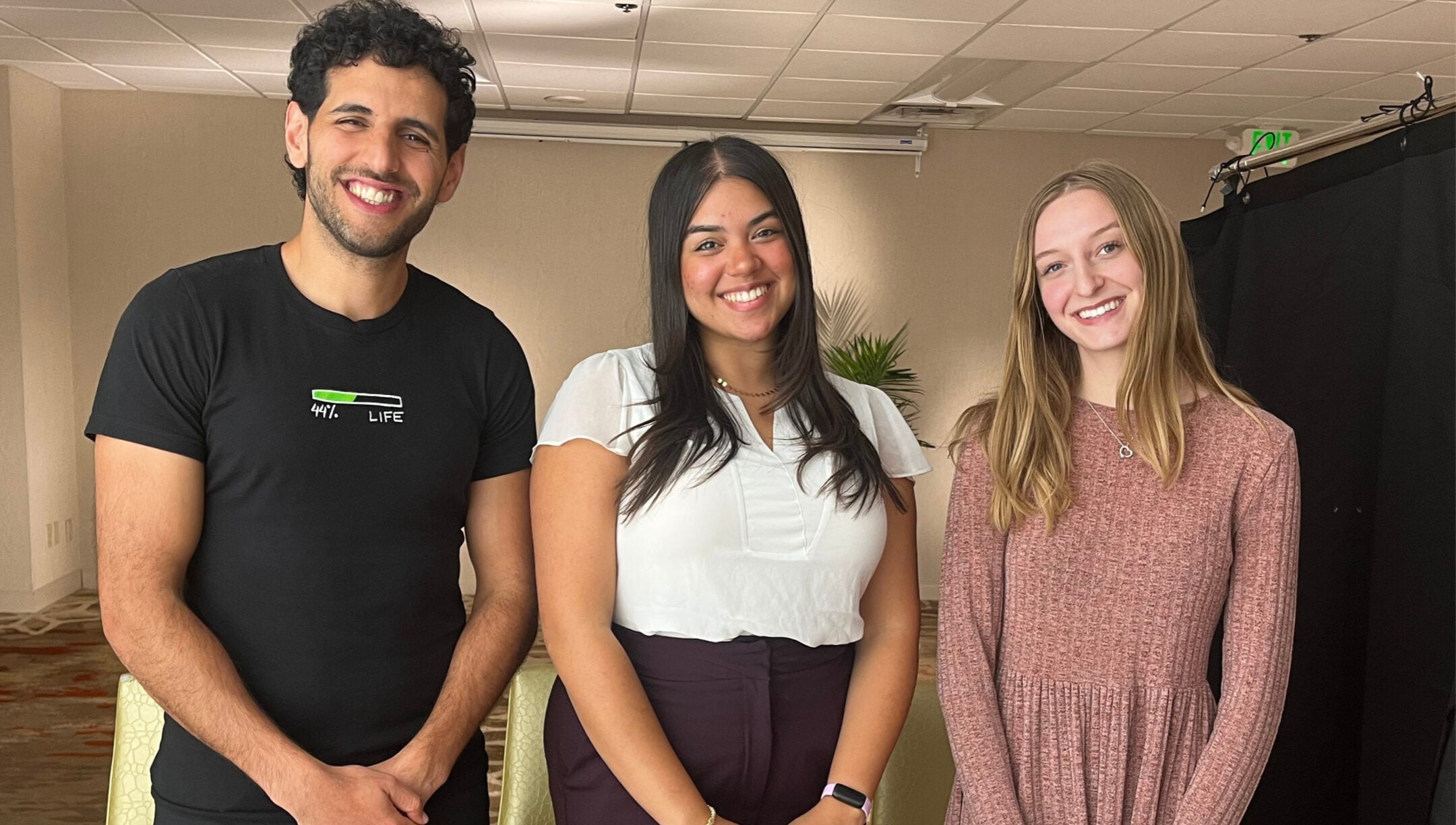
(JTA) — DENVER – Israeli-Arab social media entrepreneur Nuseir Yassin, of the viral vlog “Nas Daily,” said he believes “anti-Zionism is a form of antisemitism” and stressed his commitment to overturning “misguided hate” against Jews, at a conference devoted to the subject this week.
Yassin, 34, was speaking with the Jewish Telegraphic Agency on the sidelines of the conference, hosted by the David Merage Foundation for Confronting Antisemitism. A self-described “village boy” from the Lower Galilee town of Arraba in Israel, he achieved massive success through viral short-form videos that attracted viewers from all over the world. Today he boasts more than 68 million followers across numerous social networks.
Yassin is a Muslim of Palestinian origin, although he said he is not religious. Asked why it was important for a non-Jewish person to participate in a conference about combatting antisemitism, Yassin equated this battle to fighting for his family, noting that “the success of Israel and the Jewish people is also my success as an Israeli citizen.”
“I’m not a fan of the Israeli government, and I’m not here to defend it, just like I’m not a fan of many governments,” Yassin noted, but he asserted that the reaction to the government “is absolutely fueled by antisemitism.”
“I do believe anti-Zionism is a form of antisemitism,” he added.
He said he views Zionism as “the most vanilla thing in the world – a group of people wanting a place to live,” and has therefore concluded that Israel’s detractors “just really don’t like Jews.”
Yassin, who first broke through in 2016, has become increasingly outspoken in recent years about his combined Israeli and Palestinian identity. During the conference, he recalled that he grew up labeling himself Arab-Israeli. After the Hamas attacks of Oct. 7, 2023, he started listing Israeli first and Palestinian second.
“I could not relate to the extremism that I saw, and I wanted to distance myself from it without erasing my identity connected to it,” Yassin said. “I’m not just Israeli because I think it removes a little bit of spice, but I’m also not just Palestinian anymore.”
“A lot of Israeli culture is inside me,” he continued. “I never agree with people. I’m always disagreeable. That’s Israeli. I speak up.”
Yassin noted that he was “the first guy to go study in the United States out of my entire lineage,” graduating from Harvard University in 2014 with a degree in economics and a minor in computer science. Despite having grown up in Israel, Yassin said that Harvard was the place where he made his first Jewish friend.
After working as a software developer for Venmo in New York, Yassin left his job in 2016 to travel and document his journeys. Ultimately, he launched a Facebook page called Nas Daily – using the word for “people” in Arabic – where he posted one-minute videos for 1,000 days, telling the stories of communities around the world.
What was once a personal brand has since expanded into the parent Nas Company, which offers platforms for solo entrepreneurs to build and monetize their online businesses.
Yassin earned an honorary degree from Ben-Gurion University of the Negev in 2025 in recognition of his advocacy work for Israeli and Palestinian coexistence. This past August, he also joined the advisory board for the Genesis Prize Foundation, which each year celebrates inspiring Jewish individuals for their achievements.
“I do not relate to hundreds of men on the street shouting ‘Allahu Akbar,’” Yassin told JTA, adding that there needed to be more women and fewer religious fanatics participating in the Israeli-Palestinian conversation.
Yassin argued that he’s “not a weird Arab for saying this” and that “the entire country of the UAE says the same thing,” referring to one of the Gulf countries that signed onto the Abraham Accords normalizing relations with Israel. He also challenged “Free Palestine” activists to envision a concrete future for Palestinians rather than fixating on Israel’s transgressions.
“We should all be ‘Free Palestine’ – but from what?” Yassin asked. “We disagree on the solution, not on the problem. We don’t want suffering. Nobody wants suffering.”
“I’m a free-Palestine-from-Hamas guy,” he continued. “Just free Palestine,” he said, ”is not an answer. I’m free-Palestine-from-extremism.”
Yassin affirmed that there is room for criticism of Israel’s government, noting, for example, that he would like to see an Israeli-Arab presence in the government.
But he marveled at the notion that an alien visiting Earth would likely guess that the most hated country in the United Nations is North Korea, when in fact “It’s not – It’s Israel.”
That struck him as absurd because “the Israel-Palestine conflict is not a big deal when you compare it to everything else that’s happening on planet Earth. The only thing that makes it a big deal is that we, as Palestinians, have the perfect enemy.”
That enemy, he continued, is “the most hated type of enemy, which is the Jews.”

As part of his appearance at the conference, Yassin presented a recap of a fellowship he launched this past spring in partnership with the David Merage Foundation to help 50 content creators – 25 Jewish and 25 Muslim – produce meaningful material.
Participants received $1,000 and spent a month learning from the Nas Daily team about viral and impactful storytelling during the fellowship, named for Yassin’s first Jewish friend, Zaki Djemal, who recently died of a sudden heart attack.
To Laura Merage, the Iranian-born Jewish co-founder of the foundation, Yassin was a natural partner for this bridge-building effort. Given his social media following and “infectious personality,” Merage said she felt “that’s what we need more of in the world.”
At the conference on Tuesday, Yassin announced two winners of the fellowship’s influencer competition: recent McGill University graduate Raihaana Adira, a Canadian Muslim, and Grace, a Jewish-American digital content creator who preferred to use only her first name for privacy reasons. Grace tells stories about unique public figures, such as the first Arab “Miss Israel.” Adira, meanwhile, began posting about antisemitism and Muslim-Jewish relations after witnessing anti-Zionist protests at McGill.
“When I see a Jewish person being attacked on campus or online, it feels like I’m watching someone from my own community hurt,” Adira told JTA, noting that she started posting because no one believed her when she talked about incidents on campus.
“I wanted the protests and the graffiti on the walls that said ‘Death to the IDF’ to be seen,” she continued. “I am a Canadian, I am a Muslim, and when people at school on the streets say, ‘Death to Canada, We are Hamas, Hamas is heroic’ – that is not me.”
Adira said she received many death threats when she first started posting. While acknowledging how difficult that was, she also emphasized an influx of support that has helped “drown out the hate.”
Yassin offered a similar perspective, noting that at the beginning of his career, he “used to amplify the blowback and talk a lot about it,” referring to the criticisms he’d receive for promoting coexistence and calling out antisemitism. But after realizing that this deterred others from speaking out, he deemed the threats insignificant, calling them “the smallest price to pay for the largest outcome you can possibly imagine.”
During his travels around the world, Yassin said he has witnessed how flawed people’s perceptions of Jews can be and that he feels “a responsibility to set the record straight.” He also noted that he is dating a Jewish woman, author and influencer Aija Mayrock, whom he is marrying next year and with whom he expects to have children.
“They’re going to be Jewish, so that’s my family – literally, my family,” Yassin said.
This article originally appeared on JTA.org.
The post Israeli-Arab influencer behind ‘Nas Daily’: Anti-Zionism is antisemitism appeared first on The Forward.
Uncategorized
Four Seats or No Seats? Why Israel’s Final Polls Disagree Over Amcha Yisrael

Conflicting projections for Ofer Winter’s party illustrate the uncertainty of measuring public support near an electoral threshold.
A Channel 12 poll gives Ofer Winter’s Amcha Yisrael four parliamentary seats.
An i24NEWS survey reaches the same seat total.
Other final polls find that the party does not qualify for representation.
How can surveys conducted close to the same election produce such different results?
The answer lies partly in the difference between measuring a vote share and converting it into parliamentary seats.
A Statistical Boundary
Israel’s electoral threshold is 3.25 percent.
For a party receiving substantially more than that percentage, modest sampling fluctuations may change its expected number of seats without calling its parliamentary presence into question.
For a party whose support lies near 3.25 percent, the same type of fluctuation may change its projected representation from several seats to zero.
This does not necessarily mean the polls are measuring completely different political realities.
They may be producing estimates close to the same threshold but on opposite sides of it.
Sample Size Is Only One Factor
The i24NEWS survey conducted on October 22 included 5,124 adult respondents and reported a sampling error of plus or minus 1.4 percentage points at the 95 percent confidence level.
That is a substantial sample by conventional political polling standards.
But a larger sample does not eliminate every source of uncertainty.
Different pollsters may employ different recruitment methods, weighting systems and procedures for estimating turnout.
They may also differ in how they handle respondents who are undecided or reluctant to state their preferences.
These choices can matter particularly for smaller parties.
The Problem of Turnout
Opinion polls generally estimate voting preferences before actual voting takes place.
Election results reflect the ballots cast by people who participate.
Differences between intended and actual turnout can affect parties in different ways.
Analysts must therefore consider not only how many respondents express support for a party, but also whether the poll’s turnout model accurately reflects the eventual electorate.
Without transparent, comparable information about the methods used by each polling organization, it is difficult to identify which methodological difference is responsible for a particular disagreement.
Reading the Final Surveys
The appropriate interpretation of Amcha Yisrael’s polling is neither that its parliamentary representation is guaranteed nor that exclusion is certain.
The available surveys demonstrate uncertainty around a legally decisive boundary.
The four-seat projections reported by Channel 12 and i24NEWS are meaningful observations.
So are the below-threshold findings published by Channel 13, Maariv and Zman Yisrael.
Each survey is a measurement of electoral intentions under a particular methodology, not a count of actual votes.
For readers following Israel’s election, this makes Amcha Yisrael an instructive case study in how polling uncertainty interacts with electoral law.
The final result will provide the definitive seat allocation. The polls explain why the outcome was difficult to measure in advance.
