


Uncategorized
Qatar, Turkey Try to Circumvent Hamas Disarmament as Terror Group Escalates Crackdown in Gaza

Palestinians walk past the rubble of destroyed buildings, amid a ceasefire between Israel and Hamas, in Jabalia, northern Gaza Strip, November 6, 2025. Photo: REUTERS/Mahmoud Issa
As the United States pushes for the second phase of President Donald Trump’s Gaza ceasefire to begin, Israel is warning that Qatar and Turkey are trying to shield Hamas from disarmament as the Palestinian terrorist group seeks to reassert control over the war-torn enclave.
Qatar and Turkey have proposed alternatives to a central provision of Trump’s peace plan, according to Israeli media reports. Rather than requiring Hamas to disarm, Qatari and Turkish officials have pushed for the Islamist group either to hand over its weapons to the Palestinian Authority or place them in secure storage under international oversight.
As part of this plan, Qatar and Turkey are reportedly advocating a two‑year grace period during which Hamas could legally retain its weapons.
However, Israeli officials have rejected these options as unacceptable, arguing they would allow the terrorist group to maintain its influence in Gaza, which Hamas has ruled for nearly two decades.
Israel has made clear it will allow Hamas just a few months to give up its weapons, warning it will act unilaterally if the group is not disarmed promptly.
Turkey and Qatar, both longtime backers of Hamas, have been trying to expand their roles in Gaza’s post-war reconstruction, which experts have warned could potentially strengthen Hamas’s terrorist infrastructure.
Israeli officials have repeatedly rejected any Turkish or Qatari involvement in post-war Gaza.
The first stage of Trump’s peace plan, which took effect in October, included Hamas releasing all the remaining hostages, both living and deceased, who were kidnapped by Hamas-led Palestinian terrorists during their Oct. 7, 2023, invasion of and massacre across southern Israel. In exchange, Israel released thousands of Palestinian prisoners and detainees, including many convicted terrorists serving life sentences, and partially withdrew its military forces in Gaza to a newly drawn “Yellow Line,” roughly dividing the enclave between east and west.
Currently, the Israeli military controls 53 percent of Gaza’s territory, and Hamas has moved to reestablish control over the other 47 percent. However, the vast majority of the Gazan population is located in the Hamas-controlled half, where the Islamist group has been imposing a brutal crackdown.
The second stage of the US plan is supposed to install an interim administrative authority — a so-called “technocratic government” — deploy an International Stabilization Force — a multinational force meant to take over security in Gaza — and begin the demilitarization of Hamas.
As the international community works to implement phase two of the ceasefire deal, Qatar and Turkey are now insisting that Israel must withdraw from Gaza before Hamas can disarm — a demand Jerusalem vehemently opposes, warning it would give the terrorist group time to reassert full control over its half of Gaza and remove any incentive to disarm later on.
On Saturday, Qatari Prime Minister Mohammed bin Abdulrahman Al Thani said the international community has only achieved a “pause” in fighting, but not a full ceasefire, stressing that Israel would need to withdraw from the entire enclave to make it possible.
“A ceasefire cannot be completed unless there is a full withdrawal of the Israeli forces, there is stability back in Gaza [and] people can go in and out, which is not the case today,” Al Thani said during a press conference.
The Qatari leader also said that the mediating countries, including Turkey, Egypt, and the US, are “getting together in order to force the way forward for the next phase.”
However, Al Thani emphasized Qatar considers phase two to be “temporary,” arguing that addressing the immediate situation in Gaza alone is insufficient without tackling what he described as the underlying causes of the conflict.
“This conflict is not only about Gaza, but also the West Bank. It’s about the rights of the Palestinians for their state,” he said. “We are hoping that we can work together with the US administration to achieve this vision.”
According to the ceasefire plan, the Israeli army is required to withdraw further as the disarmament process unfolds. However, Israel has made clear that it will not pull back until Hamas disarms and other conditions are met.
“We will not allow Hamas to reestablish itself. We have operational control over extensive parts of the Gaza Strip, and we will remain on those defense lines,” Lt. Gen. Eyal Zamir, chief of staff of the Israel Defense Forces (IDF), said on Sunday. “The Yellow Line is a new border line, serving as a forward defensive line for our communities and a line of operational activity.”
Meanwhile, Turkish Foreign Minister Hakan Fidan said a credible Palestinian civil administration and a vetted, trained police force should be established before Hamas can disarm.
In a press conference, Fidan emphasized that without these conditions, expecting Hamas to disarm is neither “realistic nor doable.”
However, Hamas continues to reject full disarmament, saying the group is only open to storing or freezing its weapons in order to preserve “the Palestinians’ ability to defend themselves.”
“Hamas is willing to discuss these ideas in the context of a ceasefire or long-term truce within a political process that will lead to the establishment of a Palestinian state,” senior Hamas official Basem Naim said in a statement.
In Gaza, Hamas’s brutal crackdown has continued to escalate dramatically as the terrorist group moves to reassert control over the enclave and consolidate its weakened position.
Following the death of Yasser Abu Shabab, the leader of an armed anti-Hamas Palestinian faction, last week, Hamas has given militants a 10-day ultimatum to surrender in exchange for promises of amnesty, according to Israel’s Channel 12 and reports on social media.
Abu Shabab, a Bedouin tribal leader based in Israeli-held Rafah in southern Gaza, had led one of the most prominent of several small anti-Hamas groups that emerged in the enclave during the war that began more than two years ago.
He died last week while mediating an internal dispute between families and groups within the militia, dealing a setback to Israeli efforts to support Gazan clans against the ruling Islamist group.
Since the ceasefire took effect two months ago, Hamas has targeted Palestinians who it labeled as “lawbreakers and collaborators with Israel,” sparking widespread clashes and violence as the group moves to seize weapons and eliminate any opposition.
Social media videos widely circulated online show Hamas members brutally beating Palestinians and carrying out public executions of alleged collaborators and rival militia members.
Uncategorized
Archaeologists uncover a 300-meter section of ancient aqueduct in Jerusalem
(JTA) — JERUSALEM — Israeli archaeologists have uncovered a 300-meter (984-foot) section of Jerusalem’s ancient Lower Aqueduct, providing another window into how engineers about 2,000 years ago ensured that the city would have an adequate supply of water for residents and pilgrims.
The Israel Antiquities Authority (IAA) began the dig three months ago in advance of the planned construction of a new neighborhood in East Jerusalem, at the city’s edge. Such “salvage excavations” are often carried out prior to major construction projects in Israel to ensure that any ruins discovered at the site can be mapped and protected even if they aren’t excavated at the time.
Believed to have been built in the Hasmonean period in the second and first centuries B.C.E., this engineering system carried spring water from the Gush Etzion region of the West Bank, through Solomon’s Pools south of Bethlehem, to Jerusalem and the Temple Mount. It remained in intermittent use until the early 20th century.
Although parts of the aqueduct have been uncovered in previous excavations, this is the first time such a large section will be made permanently accessible to the public, Benyamin Storchan, an IAA archaeologist and the excavation’s co-director, told the Jewish Telegraphic Authority.
Based on earlier discoveries and a wide range of research, archaeologists had strongly suspected where the newly uncovered section was located.
“We were able to work with municipal urban planners to ensure that the shape of the new neighborhood will be determined not only by its natural topography, but based on the antiquities found there,” Storchan said.
The aqueduct, the discovery of which was made public on Sunday, will be preserved as a promenade/archaeological park at the entrance to the future neighborhood by the IAA and Israel Land Authority.
Bringing Water to Jerusalem
Before the aqueduct was built, the landlocked city of Jerusalem relied on the Gihon Spring and rainfall runoff for its entire water supply, Storchan said. Under Hasmonean rule, Jerusalem’s population grew and the need for water increased. That was especially true during Jewish festival times, when pilgrims doubled or even tripled the population.
The solution involved transporting water from springs in the Gush Etzion region, a hilly area more than 800 meters above sea level. Spring water had to be channeled to collection areas, and then toward Solomon’s Pools, an extensive water-storage complex built south of Bethlehem. From there, two major aqueducts, the Lower Aqueduct and the Upper Aqueduct, carried water toward Jerusalem – a distance of more than 20 kilometers (12 miles).
The Lower Aqueduct, which appears to predate the Upper Aqueduct, “is an engineering marvel,” Amit Re’em, the IAA’s Jerusalem district archaeologist, said in a press statement. “Even today, with all our modern technology, building such a system would require extensive planning and effort. The thought that, about 2,000 years ago, they managed to bring water to Jerusalem this way is astonishing.”
Its route had to follow the contours of the rugged topography while maintaining a gentle gradient for the water to flow by gravity alone, without mechanical pumps. Along most of its route, the water dropped just one meter in elevation per kilometer.
“The newly exposed section reveals the various stages in the history of the water system,” the IAA said. “Initially, the water flowed in a built, plastered channel. Then, about 500 years ago, during the Ottoman period, ceramic pipes were installed within the original channel, the outer face of the aqueduct wall was plastered and small stones were pressed into the plaster while still wet.”
Used for about 2,000 Years
One of the aqueduct’s most remarkable characteristics was its longevity. Believed to be constructed during the Hasmonean period, it was repaired and reused through successive eras, including the Roman, Byzantine, Umayyad, Crusader, Mamluk and Ottoman periods.
The fact that various kingdoms and rulers decided to repair and not replace the water system “is one of the most fascinating parts,” Storchan said of the waterway. Rather than repurposing an older structure for a different use, successive rulers retained the aqueduct’s original purpose.”, “here we see a single installation being reused again and again for its original function.”
The aqueduct was used until about a century ago, when modern water infrastructure, including electric pumping stations, proved more efficient. Its long history of repairs, however, complicates archaeological dating, Storchan said. Those who repaired it over the millennia added plaster, repaired collapsed sections and modified the channel, sometimes obscuring evidence of the original construction.
Utilizing modern technology
Still, the latest excavation gives researchers an opportunity to reexamine longstanding questions with advances in scientific dating methods.
“Today, technology is more advanced than it was then. We’re working with all kinds of specialists to pinpoint the dating of the original construction,” Storchan said.
One such method is optically stimulated luminescence (OSL), which can estimate when mineral grains in sediment were last exposed to sunlight. Combined with the analysis of mortar, plaster and archaeological layers, the technique may help narrow the dates associated with different stages of the system’s development.
For Storchan and his colleagues, every new insight is a cause for celebration.
“Our job as archaeologists,” he said, “is to fill in another piece of the puzzle.”
This article originally appeared on JTA.org.
The post Archaeologists uncover a 300-meter section of ancient aqueduct in Jerusalem appeared first on The Forward.
Uncategorized
Mamdani faces growing pressure over Jewish NYPD Commissioner Tisch and over Israel from left flank
(JTA) — New York City Mayor Zohran Mamdani is facing increasing pressure from some on the leftmost flank of his voting coalition, and an ICE shooting Thursday led democratic socialist allies to add their voices to a major demand: dump police commissioner Jessica Tisch.
“The NYPD’s Strategic Response Group must be disbanded as quickly as possible, and Commissioner Tisch must step down,” said Darializa Avila Chevalier, who won her Democratic primary with Mamdani’s endorsement. The democratic socialist, who is expected to join Congress next year representing Upper Manhattan and parts of the Bronx, was referring to the heavily armed police department unit that often responds to protests.
The calls for Tisch’s removal follow strident criticism of the mayor from pro-Palestinian activists on Wednesday night who called him names, including “traitor” and “Ziohran,” when he showed up at an Oct. 7 Israeli peace vigil mourning the loss of both Jewish and Palestinian lives. The demonstrators assailed him for not doing more to advance the pro-Palestinian agenda that has long been central to his political beliefs, raising questions over whether he could lose parts of his base as he pledges to be a mayor for all New Yorkers.
The demand for Tisch’s removal came after an ICE agent shot and wounded a Dominican man in his car on Thursday afternoon while his 5-year-old son was in the back seat. Avila Chevalier, who joined protests against ICE on Thursday, wrote on X that the NYPD “spent more time protecting a militia that just shot someone than protecting New Yorkers.”
Mamdani’s decision last year to retain Tisch — a self-described “proud Zionist” who comes from a prominent Jewish family — was seen as a reassuring move by moderates and establishment Jewish organizations including UJA-Federation of New York and the Jewish Community Relations Council. (70 Faces Media, the parent company of the Jewish Telegraphic Agency and New York Jewish Week, receives UJA funding.)
A number of progressives were skeptical of the decision at the time, citing her background as an appointee of Mamdani’s predecessor, Eric Adams, and her past criticism of campus pro-Palestinian protests. Some viewed her as an impediment to criminal justice reform.
Meanwhile, some on the left have dinged him for not yet following through on campaign promises 10 months into his term, including dissolving the Strategic Response Group, or backing down from his vow to arrest Israeli Prime Minister Benjamin Netanyahu, a plan which he later said he did not have the power to execute.
Anti-Zionist groups including Pal-Awda, Within Our Lifetime and a number of student organizations who rallied against Mamdani at the Oct. 7 vigil accused him of succumbing “to Zionist pressure.” Protesters called him a “traitor” and a number of chants rang out including, “Mayor Mamdani you can’t hide, we charge you with genocide,” drowning out speakers at the vigil and forcing the organizers to move it behind police barricades to keep the protesters from overrunning the event.
Among those protesters’ many gripes with the mayor was his decision to retain Tisch. One sign at the demonstration depicted Mamdani with the text, “Chief Executive of the NYPD SRG” with a Star of David in the middle, and a name tag on the mayor’s chest reading, “Ziohran.”
Criticism was also directed at Mamdani for not stopping Israeli real estate events at synagogues, and for his strategy to combat antisemitism, released last week, which allocates funds to a number of community-based organizations aimed at preventing hate crimes. Some critics have charged that some of the funding will aid Zionist organizations.
“The Jewish community is a large part of New York and it should be cherished. But you cannot fund these Anti-Defamation Leagues that prioritize Zionism over Judaism,” a John Jay College student protester, who declined to be named, told JTA during the demonstration.
On Thursday, the Democratic Socialists of America’s New York City chapter — which Mamdani has called his “political home” — wrote that Tisch “must end NYPD complicity with ICE” and that if she “cannot put a stop to these injustices, she must be fired.”
“Abolish ICE. Disband the SRG. Fire Tisch,” wrote Illapa Sairitupac, a fellow democratic socialist who won the Democratic nomination for a Lower Manhattan State Assembly district. Mamdani endorsed both Sairitupac and Avila Chevalier this past year.
While some protesters at the vigil said they were Mamdani voters — and one speaker even identified herself as a former intern for the now-mayor — some of the mayor’s allies have stressed that the crowd protesting him was not representative of his base.
“If I had to gamble, I would gamble that the vast majority of them were people who never supported him,” activist Abby Stein told JTA on Thursday night, during the Mazals gala held by left-wing group Jews for Racial & Economic Justice. Mamdani was due to attend the JFREJ event, but because of the ICE shooting was instead in the Bronx, where he denounced the federal agency and demanded that it cease its operations in New York City.
Many of the signs excoriating Mamdani at Wednesday’s protest outside of City Hall were signed with the name of the Maoist Communist Union, an organization that opposed Mamdani before he took office. Some protesters were handing out copies of Spartacist, the Trotskyist International Communist League’s journal.
“We certainly didn’t support Mamdani or vote for him,” said Erica Jones, among the Trotskyist protesters. “We knew he was running as a Democrat and he would be as big of a sellout as AOC and Bernie Sanders and all the rest of those who claim to have, at one time, stood for socialism but in reality, stand for the capitalist masters who are oppressing us all.”
Stein, a member of the DSA in addition to JFREJ, called out some of the protesters’ rhetoric and the choice to crash the Israelis for Peace Oct. 7 vigil. But she also acknowledged that there was overlap between their demands and her views, including over the police commissioner.
“There are things that people are upset over that I think are legit — like keeping Jessica Tisch on, for example,” Stein said. “A lot of us were not very happy about it.”
Ultimately, Stein said there is “always going to be something to protest” with any politician, and pointed to a quote from New York’s mayor in the 1970s and ‘80s, Ed Koch: “If you agree with me on 9 out of 12 issues, vote for me. If you agree with me on 12 out of 12 issues, see a psychiatrist.”
This article originally appeared on JTA.org.
The post Mamdani faces growing pressure over Jewish NYPD Commissioner Tisch and over Israel from left flank appeared first on The Forward.
Uncategorized
A planned non-Zionist Jewish school in Boston hopes to ride the momentum of the left
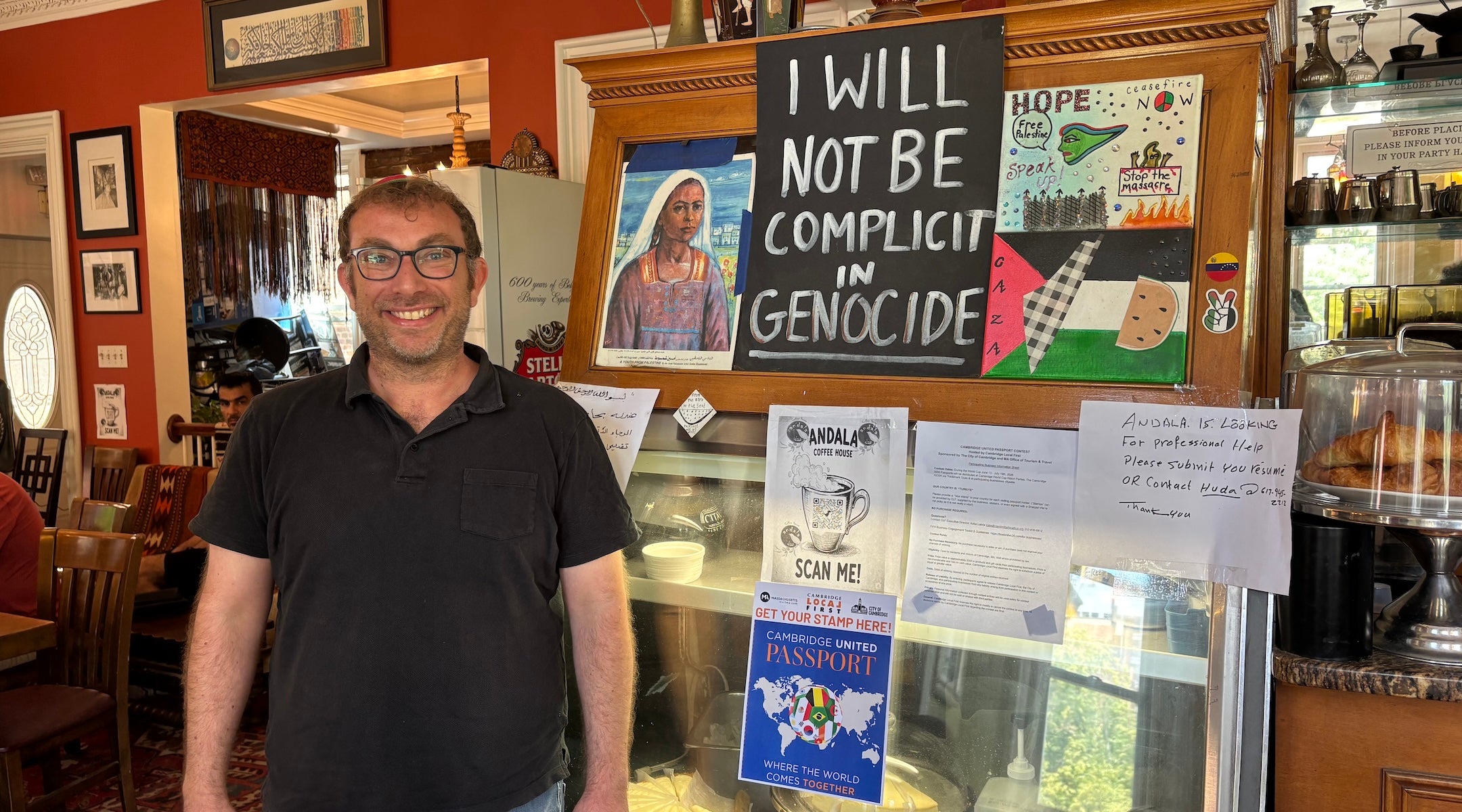
(JTA) — BOSTON — In the middle of a conversation about her future children, it dawned on Leah Robbins that the school she imagined for them did not exist.
Robbins envisioned a Jewish school where children studied Jewish texts, history and observance, as she did at the school run out of her Conservative synagogue in northern Florida. But having long ago rejected the allegiance to Israel that was entwined with her education, she could not fathom sending her children to a school that promoted Zionism — which ruled out all the Jewish day schools she knew.
“I was just overwhelmed with a sense of grief that my kids could be less Jewishly educated than I was,” Robbins, who has lived in Boston for 10 years, told the Jewish Telegraphic Agency. “I would never ever consider sending my kids to any of the local day schools because of total values misalignment.”
Four years after that conversation, Robbins is building her own institution for the children she hopes to have. She plans to open Achvat Olam, a “diasporist” day school whose name translates to “global solidarity” in Hebrew, in the Boston area in fall 2029. The school aims to launch with eight to 10 families, starting with a kindergarten and adding grade levels until ultimately becoming a K-8 school.
Achvat Olam is fiscally sponsored by Beloved Builders, a Massachusetts-based nonprofit that supports progressive Jewish projects. Robbins, who has a background in fundraising for Jewish nonprofits, hopes to raise $625,000 for the launch. She said she has met about 20 local families who expressed interest, and will start formal recruitment efforts, including focus groups and open houses, next year.
Achvat Olam will teach about Jewish history, cultures and languages outside of Israel, while engaging with Hebrew and Israel’s history from a non-Zionist perspective. The school’s website includes a page on “Israel/Palestine,” saying its community will share a belief that “the pursuit of justice, dignity, and thriving for all people is a Jewish moral imperative.”
“This includes an age-appropriate, honest confrontation with Zionism and the ongoing Nakba against the Palestinian people,” the website says, using the Arabic word for the displacement of over 700,000 Palestinians at the time of the State of Israel’s founding. The school also says that students will consider “the complicity and support of the US government and Diaspora Jews.”
Micah-Shalom Kesselman is the parent of a 4-year-old in Medford, Massachusetts, and participates in local left-wing Jewish groups such as the Boston Workers Circle. He’s disappointed that his son Oren will age out of Achvat Olam by the time it is scheduled to open as a kindergarten. “I would super want Oren to attend something like what Achvat Olam is shaping up to be,” he said.
Kesselman, who studies Yiddish with his son, explained that he would like Oren to be steeped in Jewish traditions and culture. But as a parent who is “not a supporter of Zionism,” he said he has found few Jewish educational opportunities that match his beliefs.
Diverse day school histories
Jewish day schools have historically encompassed a range of orientations toward Israel, according to Jonathan Krasner, a historian of American Jewish education at Brandeis University. The modern day school movement was born in the 1920s and initially dominated by orthodox schools, some of which did not emphasize Zionism. In the 1950s, secular Yiddishist schools taught varied attitudes toward Israel. Some yeshivas in the orthodox Haredi movement still today oppose Zionism on religious grounds, believing that Jewish sovereignty should only be established through the coming of the Messiah.
But Krasner could not name another day school that has Achvat Olam’s goal: education for Jewish families who disavow the current-day political realities of Israel and Zionism. In the aftermath of the Hamas attacks on Israel on Oct. 7, 2023, many day schools went the opposite direction, adding curricula to strengthen solidarity between Diaspora Jews and Israel.
“The initial response of the organized Jewish community was, understandably, to circle the wagons and to reinforce their connections to Israel and to the Israeli people,” Krasner said.
Jack Wertheimer, a professor of American Jewish history at the Conservative movement’s Jewish Theological Seminary, isn’t convinced that Achvat Olam will change that trend. He said he was “highly skeptical” that Robbins could attract enough families to sustain a school. According to historical data, he said, Jews who lean more politically left tend to be less engaged in Jewish life.
“From what I know, the overwhelming majority of parents who are interested in sending their children to Jewish day schools are pro-Israel,” said Wertheimer.
Nonetheless, Robbins believes that the market for her school is growing. Survey after survey has captured a drop in Americans’ support for Israel since the Gaza war, and Jews are not an exception to the trend. After decades of being treated as fringe in many of their communities, left-wing Jews who are anti-Zionist — or simply do not see Israel as part of their identity — say that instead of adapting to their congregations and Jewish schools, the institutions should adapt to them.
There are signs that this group makes up a substantial portion of Jews in the United States. About 30% of Jewish adults believe that Israel has committed genocide in Gaza, according to a June poll of 1,022 Jews from the Associated Press-NORC Center for Public Affairs Research, which had a 5% error margin. Less than 40% said that “supporting Israel” was crucial to their Jewish identity.
Younger Jews emphasize traditions
At the same time, among adults who identified as religiously Jewish, younger people said they emphasized Jewish traditions more than their older counterparts. Younger Jews were more likely than older ones to say that “celebrating Jewish holidays” and “celebrating or marking Shabbat” were important to them, while Jews over 45 placed more emphasis on “remembering the Holocaust” and “supporting Israel” than younger ones.
This finding could reflect the growing share of younger Jews who are Orthodox. It also comes amid a boom in Jewish leftist organizations that explicitly ground their activism in religious tradition. IfNotNow, an anti-occupation group that has grown from 1,000 dues-paying members in 2023 to 7,000 this year, says it is “growing a community rooted in Jewish values and ritual.” The anti-Zionist Jewish Voice for Peace, which has amassed 32,000 dues-paying members, often frames its protests through Jewish holidays, texts and prayer.
Robbins is betting that a significant pool of younger Jews, many of them now parents to young children, are seeking avenues to both protect their Jewish traditions and reset their community’s relationship with Israel for the next generation. Instead of supporting Israel, Achvat Olam says that its students will learn a curriculum of “collective liberation at home, globally, and in Israel/Palestine.”
“This is a very experimental moment in Jewish history. The Jewish left is growing by leaps and bounds,” said Robbins, referencing estimates of dozens of anti-Zionist congregations and prayer groups sprouting across the country. “There is hunger for this.”
Boston is a hub for such new organizations. Since 2024, the city has hosted the Conference on the Jewish Left at Boston University, a gathering of left-wing Jewish scholars, students, activists and faith leaders. The first annual meeting drew 300 people, the second 700, and the third in February saw more than 900 participants. A poll of Greater Boston by Combined Jewish Philanthropies, the central fundraising arm of Boston’s Jewish community, found earlier this year that 38% of Jews aged 18 to 29 identified as “anti-Zionist,” and another 30% said they were “uncommitted” to Zionism or anti-Zionism.
Rabbi Greg Hersh left his congregation at Temple Emmanuel in Wakefield, north of Boston, in 2024. He said he became increasingly alienated from his congregants after Oct. 7. Hersh felt that the congregation, focused on supporting Israel and fighting antisemitism locally, did not share his anguish about the deaths of Palestinians.

Last year, Hersh founded V’ahavtah, a mostly Cambridge-based congregation devoted to “practicing Judaism beyond Zionism.” V’ahavtah joined Jews, like him, who felt uncomfortable with the norm of Israeli flags flying inside synagogues. Their Shabbat services regularly draw 30 to 40 people, numbers he said he never saw in Wakefield. He believes that is proof of growing demand for non-Zionist Jewish institutions.
“You take Israel out of the equation and the Jews will show up, and that’s what happened with V’ahavtah,” said Hersh. “My expectation is Achvat Olam is going to be very well poised to fill that void.”
On the ground, Robbins faces formidable obstacles to funding Achvat Olam. Jewish day schools struggle across the country to attract enrollment in the face of tuition that many families can’t afford, along with budgets strained by economic uncertainty and heightened spending to ward off security threats. Earlier this year, MetroWest Jewish Day School in Framingham, a suburb of Boston, shuttered and said that its “model of highly individualized Jewish day school education is no longer sustainable.”
Heavy investments from local philanthropies have helped day schools offset high costs. Prizmah, a national network of 305 day schools, recently reported that it saw enrollment rise across denominations for the first time last year, thanks in large part to philanthropy.
But many groups that fund Jewish education hold values that are antithetical to Robbins’ — including CJP, which calls itself a “pro-Israel, Zionist organization.” Prizmah and CJP declined requests for comment from JTA.
The individual donors who fund Jewish schools also tend to be older, more conservative than Robbins and more motivated by support for Israel, according to Krasner.
“The people who are most likely to be in a financial position to support day schools with generous philanthropic gifts are demographically very different from the population that Leah is trying to attract,” he said.
Robbins admitted that funding challenges meant the success of Achvat Olam was not “any sort of inevitability.” But she believes there is inevitability to the political momentum that could drive families toward such a school. “Something I want to convey to people is that the train has already left the station,” she said. “There is no stemming the tide of the growth of the Jewish left.”
Robbins has turned to funding from left-wing organizations, which already siphon much of their resources to grassroots activism, legal defense and awareness campaigns.
“It can be hard to get in the face of people to make the case for something that requires long-game thinking,” she said. “I’m trying to make the case, when the last fire has been put out, what’s going to be left if we’re not building it right now?”
This article originally appeared on JTA.org.
The post A planned non-Zionist Jewish school in Boston hopes to ride the momentum of the left appeared first on The Forward.
