



Uncategorized
Report from Israel: What Is Normality?
By ORLY DREMAN (Jerusalem, August 12, 2024) When the media tell us to prepare lots of water and where the locations for distribution of water will be, it reminds me of my parents’ stories about austerity rations during the long War of Independence. If there is no electricity – there will be no water because the water pumps are connected to electricity. We are living with uncertainty and with existential apprehension.
It is like what we wend through during Covid times when we used to stock up on products. Today we are buying three times more; it gives us a feeling that we can control our destinies. It reduces the pressure. The waiting feels worse… let it happen and it will be over with. Our normality is that I rehearse with my husband how far from the car we have to lie down on the street when the siren sounds. Normal is having stomachaches, headaches, back pain and lack of sleep due to stress. Our normality is bringing water bottles into the shelter, canned food, transistors, batteries, flash lights and more. We go out less and order take out way more.
When our grandchildren come they always ask us to remind them where to hide in case “the bad people” come. Friends call each other to wish good luck – kind of end of the world conversations.
Children do not understand the reality; it depends on how much stress they see in the home. Their survival is being together. They ask what will happen if the siren sounds during their birthday party. We sit down and talk to them. We hug, we eat comforting food and listen to music. We worry when someone says they feel “excellent.”
People walk in the street and look at the sky for unmanned aerial vehicles. They hold their phones in their hands to hear messages from the home front command. They also look behind their shoulders for a terrorist with a knife. We are awaiting the worst.
At the end of July the JNF Canada Resilience Task Force arrived in Israel… good people, like our friend Larry Vickar from Winnipeg, who came to support and contribute. They managed to visit the kibbutzim in the south, learn what security challenges they faced, and about their strength and bravery. They saw the Nova festival sight and heard the plans how to revive the communities devastated on Oct. 7th. They were at hospitals and heard lectures from doctors and mental health professionals. They met survivors and hostages who were freed. They met evacuees from the north and heard speeches by generals. Unfortunately, they only managed to be in Israel half a week when all foreign flights were cancelled and they had to leave the country on whatever flight was possible.
Tonight is Tishah B’ Av – many more Jews will fast today. This day feels more real this year. It is a day with bad tragedies. This is the day when both our temples were destroyed; the Jews from England, France and Spain were deported; WW1 began.
When we think things cannot get worse, they get worse.
Commercials abroad are about advertising clothing, cosmetics, sports goods. Here they are about how to treat anxiety, how to deal with children…
Our four-year-old granddaughter saw an ad on a tree in Tel Aviv about a lost cat. She turned to her mother and said: “This cat is kidnapped in Gaza.”
Every realityshow deals with the subject of the hostages – be it “Big Brother,” “Survival,” or just cooking shows – the text, the songs, the missions, the yellow clothes, all have to do with talking and reminding us of the present situation in the country. The hostages who returned more than eight months ago are opening up and telling of their horror experiences. They want to make Bibi understand not to let the remaining 115 hostages die. The beatings, the sexual assaults, the starving, the terrible sanitary conditions – one toilet for dozens of people, freezing in the winter, sleeping on the floor, the stress that they threaten to kill you all the time, no air in the tunnels, darkness. Some of them were alone so they did not speak for 53 days. No windows, no light – like a grave. The legs feeling stiff. The terrorists dragging the women on the floor by the hair while pointing their rifles and hand grenades at them. The women used to faint, regain consciousness , cry and vomit and faint again. The terrorists used to tell them, “You are going to make me babies.” They felt desperate and scared. Every minute was eternity. One sees the parents here at the demonstrations – with black bags under their eyes that get bigger and bigger. Some young women and men who returned need hearing aids because they were beaten so severely on the head and ears. Now they cannot sleep at night, they cry a lot, suffer from migraines, nightmares and feel dead inside.
In this abnormal country we had some escapism: the Olympics. Each one of our seven medalists dedicated their victories to the hostages, the murdered, the fighting soldiers, and the evacuees.
Remember – a few months ago I wrote that we still had 11 people missing. It took ten months, but all of them were identified – the last one a few days ago. A woman whose house was burned to the ground – only now were they able to confirm she was killed in her home with her husband on Oct 7.
I usually listen to the radio when I drive. Every time one opens the radio there are thousands of personal tragic stories… like stories of grandparents telling how their son/daughter protected their children with their bodies and the children survived to be raised by the grandparents.
When people ask each other: “How are you?” you do not hear “Fine, thank you.” The answer is: ”Sad – like everyone.”
I would like to honor young Jewish adults who come to Israel to volunteer… like our friend Mikaila Levine from California, a 19–year-old medical student who came to volunteer with Magen David Adom – even in these dangerous times. We are very proud of her. She did not think of leaving. She took the example from her grandfather, Dr. Gerry Levine, who came from North America to volunteer in the Yom Kippur War.
In conclusion, pray for us that it will be comfortable living here again. We want our lives back. We are a country that desires life and we shall overcome – like always.
I will conclude the same way we end every conversation- “May we hear good news! Amen”!
Orly Dreman is a 10th generation Israeli. Her cousin, Ruvi Rivlin, was a former president of Israel. Orly’s father was a diplomat who served both in North America and in Europe.
By profession Orly is an English teacher. She has dealt with children suffering from ADD.
Since childhood, Orly has been involved in voluntary work with the disabled, the challenged, new immigrants, the elderly and others.
Orly is married to former Winnipeger, Solly Dreman who made Aliya.
He’s a professor of clinical Psychology at BGU and treated victims of terrorism and war.
He was Brigade psychologist in the Yom Kippur War.
To read previous posts from Orly since October 7, go to:
from-darkness-to-light-december/
life-in-israel-four-months-after-october-seventh
a-complicated-pesach
message-from-israel-a-different-planet







Uncategorized
Van Gogh painting with a complex Jewish history sells for record $190.4 million at auction
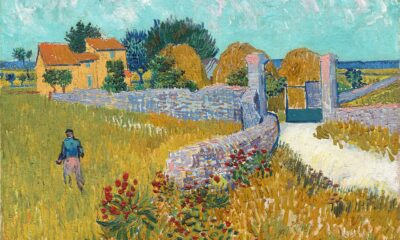
(JTA) — A Vincent van Gogh painting of blooming chestnut trees sold for $190.4 million at Sotheby’s on Wednesday night, after a last-minute dispute about its sale during the Nazi era threatened to derail the auction.
While the set a new auction record for a Van Gogh painting, the lead-up to the event was fraught with questions of ownership. The heirs of Samuel Fischer, a German Jewish publisher, last week asked Sotheby’s to postpone the sale of the 1890 piece, called “Châtaigniers en fleurs,” arguing that their ancestors sold it in 1936 under financial duress caused by the Nazis.
The family’s lawyer, Gunnar Schnabel, demanded that Sotheby’s prove that the 1936 transaction would have occurred “even without Nazi rule,” in an email shared with The New York Times.
A day before the auction, however, Sotheby’s announced in a statement that it had come to an agreement with “all of the legal descendants of Hedwig and Samuel Fischer” and the Blaquier-Arrieta family, the collectors who were selling the painting.
Noting that Van Gogh painted “Châtaigniers en Fleurs” in May 1890 during an “extraordinary period of creative intensity” in the final two months of his life, Sotheby’s described the piece as one of the most important of such works to remain in private hands.
This article originally appeared on JTA.org.
The post Van Gogh painting with a complex Jewish history sells for record $190.4 million at auction appeared first on The Forward.
Uncategorized
In rare, emotional interview, Bernie Sanders says his politics are rooted in growing up Jewish during WWII
Sen. Bernie Sanders, who rarely talks about his Jewish upbringing, appeared emotional in a new podcast interview as he recalled learning that his father’s family was killed in the Holocaust and discussed how that tragedy shaped his perspective, including his stance on the Israeli-Palestinian conflict.
“The insanity of that certainly had a big impact on my life,” the 85-year-old Vermont senator and progressive icon said when shown a photograph of a two-story house in Slopnice, Poland, where his father and relatives once lived, during an appearance on The Diary of a CEO with Steven Bartlett, recorded on Nov. 9 and published on Thursday. “If you ask me where my political views came from,” he said, “One, I’m Jewish. And when I was a kid, I was born in 1941.”
Sanders, who was born in Brooklyn, said his parents tried to shield him and his older brother, Larry, from the horrors of the Holocaust. But as he grew older, he began reading about what had happened to his relatives. None of the Jews living in the southern Polish village survived the Holocaust, according to historical accounts. “I learned, you know, the pogroms, people living in a community, and one day in Poland some people ransack your house. Horrible, horrible.”
The Sanders brothers visited the home village in 2013. “It was quite the experience,” Sanders said, adding that the local mayor “took us to a place. There was a mound, and they killed hundreds of people and dumped them into a mound.”
On the podcast, Sanders recounted a childhood memory of an unexpected telephone call the family received from Europe in the middle of the night, in which they learned that one of his father’s cousins had survived the Holocaust and was living in a displaced persons camp.
“I can still see the emotion in your face when you recount these stories,” Bartlett, a British podcaster, remarked.
“Yeah,” Sanders responded. “Well, what do you say? They are horrible stories. Period. End of discussion.”
“Difficult to talk about,” Bartlett said.
“Yeah. That is,” Sanders replied.
Sanders has rarely spoken at length about being Jewish, even during his two presidential campaigns. One of his advisers later said that Sanders took great pride in his Jewish identity and the historic significance of his candidacy.
A voice for progressives
Sanders said the memories continue to shape his political views today, including his criticism of the war in Gaza and Israel’s treatment of Palestinians. Sanders has repeatedly called for limits on U.S. military assistance to Israel and restrictions on weapons sales. During the same interview, he again said military aid to Israel “has got to end,” and be redirected toward domestic needs.
“This is why I’m so upset about what’s happening,” Sanders said. “As somebody who is Jewish, to see what Israel has done in Gaza to the Palestinian people is horrible.”
The reflections come at a moment when Sanders’ political influence appears to be growing. The Vermont senator remains one of the most recognizable progressive figures, and his calls for economic equality and a political revolution have found a new generation of supporters and leaders. The election of Zohran Mamdani as New York City’s mayor, along with recent congressional victories by democratic socialists and outspoken critics of Israel, has energized a movement that Sanders helped bring into the political mainstream through his presidential campaigns and endorsements.
In the podcast interview, Sanders invoked Rosa Luxemburg, the Polish-born Jewish socialist revolutionary who was murdered in Germany in 1919, and her warning about the choice between socialism and barbarism.
“That was before Hitler. Got it?” Sanders said. “And the struggle that we have is to bring out the better angels of people rather than the worst parts of humanity, the ugliest parts.”
The post In rare, emotional interview, Bernie Sanders says his politics are rooted in growing up Jewish during WWII appeared first on The Forward.
Uncategorized
Sarah Lawrence changes rules after J Street student group was blocked on campus
(JTA) — Sarah Lawrence College has changed policies to more easily overrule decisions made by its student senate, after the senate rejected a J Street chapter last year, likening the liberal Zionist group to white supremacists.
The private college instituted its rule change after the JTA reported in May that administrators had declined to intervene when its student senate blocked Jewish students from forming a J Street U chapter. At the time, student senators had proclaimed that J Street was akin to “a white supremacist organization.”
Now, Sarah Lawrence’s leadership says, the student senate will no longer hold that level of power.
“New organizations that meet the published requirements for membership, leadership, bylaws, nondiscrimination, and organizational purpose will be recognized by the College,” reads a September letter to select campus faculty sent by dean of students Dave Stanfield. “Recognition no longer requires a Student Senate vote.”
Yet months into the new semester, there is still no J Street U chapter at Sarah Lawrence. The leading advocate for the chapter on campus last year graduated in May. A co-organizer who remains on campus says he doesn’t have the bandwidth to restart efforts to form the chapter on his own.
“It’s quite convenient that right after our leader has to graduate and move on, they change the rules to make it easier to apply,” Asher Modell, the Sarah Lawrence student, told JTA.
The J Street controversy at the progressive college reflected how campus Israel politics have shifted in the three years since the Oct. 7, 2023, Hamas-led attacks in Israel and war in Gaza that followed. J Street itself has called for phasing out direct U.S. military subsidies to Israel, months before President Donald Trump publicly announced a similar goal.
The group has also received pushback from institutional Jewish groups to its right: This fall, the University of Michigan Hillel ended its affiliation with the campus J Street U chapter, citing a broader policy against affiliation with Israel advocacy organizations. J Street U disputed that explanation, saying the decision effectively targeted its chapter.
Yet the student senate at Sarah Lawrence, a school where liberal Jewish pundit Ezra Klein had been protested last year as a “Nazi normalizer,” viewed J Street’s Zionism as beyond the pale. Under Sarah Lawrence’s administrative guidelines, student government had enjoyed a large degree of autonomy in campus affairs.
Stanfield’s letter announcing the change did not mention J Street by name, and the dean did not immediately respond to questions from JTA. But he referenced “our conversations last year regarding the student organization recognition process,” and sent the letter to a select group of faculty and staff who he said had “engaged with us on the issue last year.”
Members of that group celebrated the rule change to JTA. Many of them had lobbied Sarah Lawrence to override the student senate after the college became the first school ever to stop a chapter of J Street U, the lobbyist’s campus arm, from forming.
“It’s about time,” Matthew Ellis, an endowed chair of Middle East studies at the college, told JTA. “After the J Street chapter was denied, many of us on the faculty felt that something was gravely wrong with the adjudication process. I’m glad that the process has now been streamlined to undercut any possibility of political discrimination.”
Joel Swanson, a Jewish Studies professor at the college, told JTA that the rule change had been in the works since before the J Street incident. The broader issue, he wrote in an email, was “student and faculty concerns about viewpoint discrimination.”
“I see it as a positive step toward ensuring that a diversity of perspectives and organizations are represented on campus,” he said.
Modell, though, is convinced the J Street controversy was central to the college’s decision to make the rule change. “They wouldn’t have done it otherwise,” he told JTA.
For Modell, the environment at Sarah Lawrence was a big part of his motivation for becoming involved in J Street. Prior to college he had called himself an anti-Zionist, he told JTA. But that changed after coming to the college and witnessing his fellow students’ responses to the Oct. 7 attacks.
“The environment itself moved me close to the center,” he said, describing hostile environments at the encampment protests and on signs posted around campus.
Modell has remained involved in J Street. He attended the organization’s recent campus conference in Washington, , the only college student unaffiliated with a campus chapter to do so. The group made an exception for him, he said. He told JTA he would still be concerned about promoting J Street U activities on campus today.
“I feel like anything of that sort would get protested,” he said.
This article originally appeared on JTA.org.
The post Sarah Lawrence changes rules after J Street student group was blocked on campus appeared first on The Forward.
