


Uncategorized
Satire on ‘Saturday Night Live’ used to be a deadly weapon; is it still enough in the Trump era?

A funny thing happened when I went to Austin last week. My youngest child, Basil, a junior at the University of Texas, and I paid a visit to the university’s Harry Ransom Center.The crown jewel of UT, the Center is named after its founder, Harry Huntt Ransom, who began as a professor of English at the university and ultimately became its visionary president. In a speech he gave to the Philosophical Society of Texas in 1956, he declared “that there be established somewhere in Texas — let’s say in the capital city — a center of cultural compass, a research center to be the Bibliothèque Nationale of the only state that started out as an independent nation.”

Nearly 75 years later, the massive stone and glass building in the heart of the campus stands as the realization of Ransom’s dream. The Center’s holdings include nearly one million books along with some 42 million manuscripts, five million photographs, and 100,000 works of art; the manuscripts of Gabriel Garcia Marquez, Doris Lessing, Jack Kerouac and Ezra Pound are here; so are the papers of Albert Einstein and Robert de Niro; even original works by Frida Kahlo and Pablo Picasso.
Three of those last four iconic figures also appear in the Ransom Center’s most recent acquisition: the papers of Lorne Michaels.
Born Lorne Lipowitz in Toronto in 1944 — and not, as some folks still believe, on a kibbutz in Israel — Michaels is, of course, the creator of Saturday Night Live, the weekly NBC television comedy show that has been running, and often stumbling, since 1975. (Now 80 and with no plans to retire, Michaels has said he would like “Uneven” inscribed on his tombstone.)
The collection begins with Michaels’ years in theater productions at the University of Toronto and his early work in television — including his stints with The Beautiful Phyllis Diller Show in 1968 and, that same year, Rowan & Martin’s Laugh-In — before moving on to the half-century of SNL as well as the dozens of films on which Michaels served as producer.
As my Longhorn and I visited the just-opened and eye-popping SNL exhibit, I noticed, with a surge of verklempt, the index cards that Michaels tacks to a bulletin board every Friday, outlining the segments of the following night’s show. The show, after all, has to go on — a huge weight for a handful of cards to carry. According to his recent biographer Susan Morrison, Michaels often shakes his head slowly as he gazes at the index cards, concluding “We have nothing.”
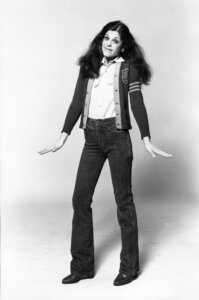
But as anyone with a good memory or, lacking that, a good pair of walking shoes knows — the exhibit covers figuratively and literally a good deal of ground — there is much ado, and much to do, with that nothing. It is impossible to exaggerate the show’s impact on American culture and politics. There are, of course, the gag lines that have bled into everyday usage where the user usually has no idea of the line’s origin, such as Gilda Radner’s Emily Litella, who ends every misunderstanding with “Nevermind” and Stuart Smalley aka Al Franken’s mantra: “I’m good enough, I’m smart enough, and doggone it, people like me.” And, of course, the motivational blast of Matt Foley, played by Chris Farley, “I live in a van down by the river” as well as, yes, Mike Myers’ Linda Richman, who punctuates her monologues with “I’m getting a little verklempt.”
Yet, while this sort of humor zeroes in on cultural fads and ethnic tics, SNL has also specialized in satire with political bite, such as Will Ferrell’s coinage “stratergery” in his brilliant impersonation of George W. Bush — which, hilariously, Dubya proudly assumed he had himself coined — or the 2016 debates between Alec Baldwin’s Donald Trump and Kate McKinnon’s Hillary Clinton. In a small theater at the exhibit, this very sketch was repeatedly replayed. As I watched and listened — not for one, but two replays — I noticed that the knots of visitors, while mesmerized, did not often laugh. The silence was especially loud when Baldwin, playing Trump, suddenly given two more minutes to talk, lurches into this hallucinatory riff:
“The thing about the Blacks is that they’re killing each other. All the Blacks live on one street in Chicago, all on one street. I just read that this morning. It’s called ‘Hell Street’. And they run Hell Street and they’re all just killing each other. Just like I am killing this debate.”
In 2016, silence from the audience in Studio 8H would have been unimaginable; a decade later, laughter seems equally unimaginable. With the events now unfolding in Chicago and other “Democrat” cities under Trump 2.0, Baldwin’s rant is more a matter for laments than laughs. Perhaps some of the visitors wondered, as I did, what the Republican state leaders, housed just a short walk away in the capitol, would have thought of their state’s premier university showcasing this sketch. (One need not wonder very long,though, given that Jay Hartzell, the university’s former president, decided to resign rather than resist pressures from crusading Republicans to enforce the state’s ban on the use of DEI.)
Perhaps more important, the sketch raises a question worthy of “Coffee Talk” as well as for our collective and growing vibe of verklempt: Is comedy, even the middle of the road satiric fare at which SNL excels, the proper response to the tragic situation our country now faces? The answers to this question, long debated by political thinkers and actors, generally fall into two camps. In the first camp are those who believe that laughter is subversive, a weapon of the weak that reveals, through mockery and, as Dubya might say, snarkery, the incoherence of their justifications for taking power and the corruption that inevitably follows.
In short, comics show us an emperor with no clothes. This is a notion that Trey Parker and Matt Stone of South Park, unlike Michael’s middle-of-the-road SNL, have taken quite literally this year.
But as those in the other camp point out, even the sight of a butt-naked Donald Trump in bed with Satan has hardly dented the standing of a man who would be emperor. This camp’s slogan, to paraphrase W.H. Auden’s famous line about poetry, is that comedy makes nothing happen. Or, even more discouraging, it makes matters even worse. Comedy distracts us from grave matters at hand and, by diluting every event through entertainment, deadens our sense of outrage at the sheer cruelty and stupidity of this administration. Amusement, the sociologist Neil Postman observed 40 years ago, is “the supra-ideology of all discourse on television.”
Even, it seems, when the entertainment might qualify as Jewish humor. The efforts that have been made to explain Michaels’ humor, and that of SNL, through the prism of Michaels’ Judaism have mostly fallen flat for a simple reason: When Lorne Lipowitz opted to become Lorne Michaels, the biographer Morrison suggests, he also opted out of his Jewish upbringing. Morrison quotes one colleague who said that Michaels’ “yeah-yeah-yeah-yeah” verbal tic “is the one bit of Jewishness still left in him.” And yet, a way of being and seeing is not so easily uprooted. In Morrison’s book, Conan O’Brien marvels at his old boss’s achievement: “A Jewish kid who started out with a furrier for a father, and he somehow makes it to this place? Our insecurities, our defense mechanisms, are what we use to survive, and they build up, like plaque.”
Those insecurities and defense mechanisms, so fundamental to Jewish humor, are no longer unique to Jews in the Age of Trump. When we left the Ransom Center, Basil and I chatted about this subject. They thought there was something Jewish, or at least Jewishy, about the show. When I asked what made for Jewish humor, they paused before replying that it was self-deprecating yet also irreverent. This observation struck me as right, but also worrying. When the target of our humor is a president whose utter lack of reverence for our nation’s laws and norms endangers us all, irreverence makes for a dubious weapon, even for the weak.
The post Satire on ‘Saturday Night Live’ used to be a deadly weapon; is it still enough in the Trump era? appeared first on The Forward.
Uncategorized
Trump endorses Netanyahu for reelection, warning Israelis against choosing another leader
President Donald Trump endorsed Israeli Prime Minister Benjamin Netanyahu for reelection, giving his longtime ally a major boost just nine days before Israel’s Oct. 27 election, which polls indicate could end without a clear winner.
“Please let this letter serve to represent my complete and total endorsement of Bibi Netanyahu in his upcoming race for re-election as Prime Minister of Israel,” Trump wrote Sunday in a lengthy post on Truth Social, praising Netanyahu as a strong leader and trusted partner in confronting Iran.
Netanyahu, Israel’s longest-serving prime minister, is seeking a seventh term after surviving political crises that repeatedly appeared likely to end his career — most significantly after the Oct. 7, 2023, Hamas attack. Recent polls suggest neither Netanyahu’s right-wing coalition nor the opposition is sure to win the 61 seats needed to form a government in the 120-member Knesset.
In his endorsement, echoing the sentiment of Netanyahu’s campaign, Trump warned Israeli voters that choosing anyone else as prime minister could put more pressure on the United States to deal with threats in the Middle East alone. “If Israel has the wrong leader, which would be anyone other than Bibi, America will have to do this work ourselves, and I am not inclined to do so,” Trump wrote. “Bibi Netanyahu has been strong, brave, and brilliant in the face of tremendous opposition, including that coming from even Israel, itself.”
Gadi Eisenkot, a former IDF chief of staff whose son was killed in the Gaza war, has emerged as Netanyahu’s chief rival. Eisenkot has floated a path to a government that does not require a majority in the Knesset. However, one of his partners in the anti-Netanyahu bloc, Avigdor Lieberman, has said in recent days he would oppose such a move. Recent polling puts Lieberman’s party at an average of eight or nine seats — enough to give Lieberman leverage in who leads the government.
Trump’s endorsement came hours after Netanyahu appeared on another program, the Fox News show Life, Liberty & Levin hosted by journalist and commentator Mark Levin. Netanyahu spoke glowingly of Trump and the importance of his battle to destroy the Iranian threat, as the American public prepares to head to the polls for midterm elections on Nov. 3. In that race, Republicans are fighting to maintain control of the House and Senate.
The U.S. war with Iran, which has slowed the flow of oil through the Strait of Hormuz causing gasoline prices to rise, has been unpopular with American voters and is often cited as one of the reasons Republican politicians could lose their races to Democrats.
Netanyahu made the case on Fox that the defeat of the Islamic Republic and the elimination of its nuclear program was critical to ensuring a safe American future. In the U.S., some lawmakers have insisted that the war was unnecessary.
If Iran can destroy Israel, it will conquer the Middle East, control world waterways and oil supplies and proceed to Europe and proceed “to the next target, which is you,” Netanyahu said, addressing a U.S. audience in his Fox News appearance.
A boost for Netanyahu in the final stretch
Trump has taken a personal interest in Israel’s election, but he held off on endorsing Netanyahu for months, raising questions about whether he was keeping his options open in case the longtime Israeli leader lost. “I’m not involved in [Israeli] politics anymore,” Trump told Time magazine in September. In an interview with Newsmax on Thursday, when asked whether he trusted Netanyahu, Trump said he did not trust anybody.
Sunday’s endorsement comes as Netanyahu steps up his campaign to rally his base and convince undecided voters that his close relationship with Trump is essential to Israel’s security. Trump remains popular in Israel, though his approval has declined in recent months following the ceasefire agreement with Iran. But the move could also complicate the president’s ability to influence what happens after the election, if neither political bloc wins a majority.
Trump has previously shown a willingness to pressure Israeli political leaders, including his public campaign last year for President Isaac Herzog to pardon Netanyahu of corruption charges.
Nonetheless, by declaring that Netanyahu is the only acceptable leader for the U.S. administration, Trump may have made it harder to persuade opposition parties to join a unity government led by Netanyahu if the election produces a political stalemate. It also gives Netanyahu another reason to resist stepping aside in post-election negotiations, knowing that the American president has publicly declared him the only alternative.
Netanyahu has already begun sharpening that message, arguing that he and Trump have unfinished business and only two more years to accomplish their shared goals before Trump’s term ends in January 2029. The messaging carries an implicit warning about Israel’s relationship with Washington after Trump leaves office. Whether the next president is Republican or Democrat, any Israeli leader may find it harder to maintain the same level of personal access and cooperation.
The election also carries broader consequences for American Jewry. Netanyahu has become increasingly unpopular among American Jews and Democrats, many of whom oppose his alliance with far-right and religious parties. A change in leadership could allow Israel to rebuild ties with Democrats and reconnect with parts of the American Jewish community — even without bringing nearly as much change in Israeli policy as some might hope.
Rep. Dan Goldman, a Jewish Democrat from New York who was defeated earlier this year in a primary that focused on his support for Israel, posted on X that the U.S.-Israel alliance “will suffer permanent damage if this Israeli government continues to hold power after the election on October 27.”
Polls point to another deadlock
The latest polls show that Netanyahu faces a difficult path to reelection.
Surveys published over the weekend show Eisenkot’s Yashar party ahead of Netanyahu’s Likud, with the opposition parties holding a combined 55 seats. The two Arab lists — the United List, a coalition of three Arab Israeli parties, and Ra’am led by Mansour Abbas — are generally counted outside either bloc.
Those numbers help explain why Trump’s endorsement matters.
A few additional seats could change the balance of power and determine who gets the first opportunity to form a government. And even if Netanyahu fails to secure a majority, he could still benefit from a political deadlock if his bloc wins enough seats to prevent the opposition from forming a government.
In that scenario, Netanyahu would remain prime minister until a new government is sworn in, potentially setting the stage for another election.
JTA contributed to this report.
The post Trump endorses Netanyahu for reelection, warning Israelis against choosing another leader appeared first on The Forward.
Uncategorized
The Supreme Court considers ‘chutzpah’ case as rabbinical and civil courts collide
Can courts instruct a rabbinical court to withdraw accusations of chutzpah? This unlikely question was posed to the U.S. Supreme Court this month when a nursing home dispute offered a rare window into how American courts and rabbinical courts operate in parallel. The case illustrates how law – and life – get messy when one encroaches on the other’s authority.
The case centers on an ownership dispute over a New York nursing home, with millions of dollars at stake.
To resolve the dispute, one of the parties — Samuel Strulovitch — turned to a beit din, or rabbinical court, in Monsey, New York. Rabbinical courts across the United States regularly resolve a wide range of business disputes like this one. Beit dins have been growing across the U.S., with more locations, increasing caseloads, and a growing number of rulings popping up in civil courts.
Their popularity reflects two legal systems working together. First, Jewish law generally requires disputes between Jews to be resolved before rabbinical courts rather than civil courts — a rule that, like any good Jewish law rule, comes with plenty of exceptions and caveats. Second, American law treats rabbinical arbitration like other forms of commercial arbitration. When parties voluntarily agree to arbitration, a civil court will generally confirm the resulting “award,” giving it the force of a legal judgment. Going to a beit din thus serves two purposes simultaneously: satisfying a religious obligation and resolving a commercial dispute.
In this case, overlapping interests of multiple investors complicated matters. Strulovitch obtained an award from the Monsey beit din granting him an ownership stake in the nursing home. But the proceeding included Strulovitch and one co-owner, while other owners never agreed to submit the dispute to that beit din. That agreement matters to American courts because arbitration rests on consent, and a beit din’s award cannot bind parties who never agreed to its authority.
The result was more than two years of litigation in two civil courts and three rabbinical courts. That litigation ultimately wound its way before Judge Linda Jamieson of Westchester County, New York. Initially, she barred Strulovitch from confirming or enforcing the original rabbinical award while the court considered whether it affected the rights of investors who had never agreed to arbitration. The bar on civil enforcement was largely uncontroversial: deciding whether a religious ruling should carry the force of an American legal judgment is the civil court’s job.
A second injunction, however, transformed this commercial dispute into a constitutional controversy worthy of the Supreme Court’s attention. After Strulovitch summoned another investor, Moshe Bain, before a Brooklyn beit din, Bain asked Jamieson to bar proceedings in any other forum, “including any beis din,” which she did. In Jamieson’s view, the new beit din proceeding could encompass the same ownership disputes already before her court.
The beit din, however, viewed the order as a form of judicial overreach into religious matters. It thus issued a seruv — a religious contempt order that can expose its target to communal shunning — against Bain, citing the “chutzpah of enjoining [Strulovitch] from pursuing his Halachic rights.” The rabbis emphasized that the beit din had acted “of its own volition,” without any request from Strulovitch or his agents following Jamieson’s injunction.
Such a contempt order, of course, carries no civil legal force, but can have reputational consequences — and trigger social sanctions — within the Jewish community. Judge Jamieson nevertheless viewed the beit din’s actions as an attempt to circumvent her injunction and draw the dispute away from her court. She therefore ordered Strulovitch to “take all steps necessary” to have the beit din withdraw it, “including withdrawing the entire proceeding.” And while Strulovitch argued that intervening in internal rabbinical court matters violated the First Amendment, Jamieson concluded that the matters before the beit din were “not religious,” but commercial disputes that her court had authority to resolve under secular law.
It is here that the judge began to veer from her lane, causing Strulovitch to seek emergency relief from the Supreme Court. By requiring Strulovitch to seek reversal of a religious contempt order that has no civil consequences, the court moved beyond determining civil legal rights and into matters of religious practice. Participation in a beit din is both a means of resolving a commercial dispute and a religious requirement, which under Jewish law is no different than observing Shabbat or keeping kosher. Its commercial subject does not erase its religious significance. And under the First Amendment, it is the believer, not the state, who defines what his faith requires.
The key constitutional question is which authority gets to decide. Courts should decide legal questions, such as whether to enforce an agreement to arbitrate before a beit din or give its award the force of a legal judgment.
But questions of whether to pursue a case in beit din or religiously sanction a party for refusing to participate generally stand beyond the court’s authority so long as those decisions do not violate an independent civil legal right.
The same holds for a religious obligation to pay: A civil court can decline to enforce a beit din’s award, but whether Jewish law nevertheless requires payment remains a matter for the beit din. By demanding Strulovitch work to withdraw the seruv, however, Jamieson crossed into determining religious matters — precisely the sphere the First Amendment protects from judicial interference. That boundary makes this case worthy of Supreme Court inquiry: a judge can decide whether a religious ruling has legal force, but deciding what Jewish law counts as chutzpah is another matter.
For now, the Supreme Court has left those questions unresolved. Justice Sonia Sotomayor required Bain to formally respond to Strulovitch’s request — a sign that it warranted closer consideration. And while she ultimately declined to intervene, she left the door open for him to return once the case played out in the New York courts.
No doubt, as the beit din system grows, harder questions will emerge. But a good rule of thumb is this: Matters of religious doctrine, or of a party’s standing in a religious community, generally lie beyond a civil court’s reach, so long as they leave the party’s rights under American law untouched. Matters that affect those rights belong to the civil courts, even if they also implicate matters that Judaism considers religious. That is how these parallel legal systems can operate alongside one another — each staying in its lane.
(Both of us are affiliated with the Beth Din of America, which is not involved in this case.)
The post The Supreme Court considers ‘chutzpah’ case as rabbinical and civil courts collide appeared first on The Forward.
Uncategorized
Huckabee calls settler attack on Washington Post photographer a ‘despicable act of terror’
(JTA) — U.S. Ambassador to Israel Mike Huckabee on Saturday condemned an attack in the West Bank by masked settlers on a Washington Post photographer. The attack, which also targeted Palestinians harvesting their olives, occurred Friday and comes amid a sharp rise in settler violence.
Heidi Levine, the Washington Post photographer who holds U.S. citizenship, described the attack to reporters from her hospital bed.
“I got jumped and I saw in the very beginning at least 25, maybe 50 of them, and I was on the ground and they were kicking me for like 10 minutes,” she said.
“We have called for a full investigation, arrest, and prosecution to the fullest extent of the law to whoever participated in this,” Huckabee wrote on X. “Attacking a female photographer is a despicable act of terror carried out by masked cowards. Dishonorable act of senseless violence.”
Israeli President Isaac Herzog also condemned the “shocking violence” and said he had called Levine to apologize. “I expressed my deepest sorrow to Heidi and apologized for what she went through. The despicable behavior of the perpetrators of this attack does not represent the citizens or the values of the State of Israel.”
Video footage from the scene shows masked settlers surrounding and attacking Levine. Some settlers at the scene were masked and carrying weapons. Palestinians can also be seen throwing stones toward the settlers.
A Palestinian was reportedly shot in additional clashes in the area. The Israel Defense Forces alleged in an official statement that soldiers “fired toward a suspect who ran toward them, carrying a sharp object and posed a threat.” Several vehicles were set on fire by the settlers.
Prime Minister Benjamin Netanyahu was equivocal in addressing the attack, stopping short of directly condemning the assailants.
He said that the circumstances in which Levine was allegedly assaulted “remain unclear,” while adding that “Israel unequivocally condemns violence against anyone.”
According to Netanyahu’s statement, “200 Arabs and far-left activists confronted approximately 40 Israeli youths.”
“We will not allow disputed incidents to be exploited to demonize the hundreds of thousands of law-abiding Jewish residents of Judea and Samaria,” the statement said, using the biblical names for the West Bank.
Netanyahu faces elections in less than two weeks and can ill afford to alienate his far-right coalition partners who are aligned with extreme settler factions.
Israeli opposition leader Yair Lapid, by contrast, issued a forceful condemnation of the attack and linked it to the policies of Netanyahu’s government.
“Jewish terror attacks, this time targeting a Washington Post photographer as well, are not a failure of the government — they are the government’s policy,” Lapid said.
“We will put an end to this. It is a disgrace to the State of Israel, a disgrace to the Jewish people, and a disaster on the international stage,” he added. Settler violence against Palestinians in the West Bank has surged since the Oct. 7, 2023, Hamas-led attack on Israel. Netanyahu’s government has sought to downplay the phenomenon, often portraying the perpetrators as a small group of violent youths. But numerous figures in Israel’s political and security establishments have warned that the violence is a broader and dangerous phenomenon.
Levine told reporters the settlers forcibly took her equipment. “All I remember afterwards is that Palestinians managed to come and rescue me and try to carry me, and then an ambulance came,” she said.
The IDF acknowledged the incident in an official statement, saying that “a female journalist was injured” during a “confrontation.” The military said troops dispersed those involved and that “details of the incident will be examined.”
“Violence against innocent civilians is a grave and intolerable phenomenon that requires a coordinated, multi-agency response. The IDF will work together with the relevant authorities to eradicate this phenomenon,” the military said.
The IDF did not announce any arrests in connection with the attack. Settler violence against Palestinians in the West Bank has frequently gone unpunished, with many such incidents resulting in no arrests.
The Foreign Press Association, which represents international media in Israel and the Palestinian territories, condemned the attack, saying Levine was “badly beaten by Israeli settlers” and had sustained moderate injuries.
“This is the latest in a long line of violent attacks by Israeli settlers against journalists and other civilians in the occupied West Bank. Yet our repeated calls for action to confront this lawlessness have been ignored by Israeli authorities,” the association said.
Matt Murray, executive editor of the Post, issued a statement calling for an investigation. “While we are relieved that Heidi has received medical care and is safe, we are outraged by this unwarranted attack on a journalist doing her job and urge a thorough investigation and follow-through from authorities,” Murray said.
The post Huckabee calls settler attack on Washington Post photographer a ‘despicable act of terror’ appeared first on The Forward.
