



Uncategorized
Texas wins case forcing Galveston school district to display Ten Commandments posters in classrooms
(JTA) — A Texas judge has ordered a Gulf Coast school district to display posters of the Ten Commandments in all classrooms, marking a victory for the state in a protracted series of legal battles over religious freedom in public education systems.
District Judge Jeth Jones ruled on Thursday that the Galveston Independent School District must comply within 10 days, while also scheduling a non-jury trial to resolve the case next June.
Texas Attorney General Ken Paxton, a Republican, had sued the school district last November after the school board voted against exhibiting the Protestant version of the Ten Commandments. Paxton’s petition argued that the board violated a June 2025 state law, SB10, which required the “conspicuous” display of Ten Commandment posters in all public school classrooms.
That law is at the heart of multiple lawsuits across the state, including one effort led by two rabbis who are seeking to bring a case to the U.S. Supreme Court. Along with non-Jewish clergy and parents, they are arguing that the mandatory inclusion of these texts in classrooms is unconstitutional and infringes upon religious freedom. Their case is separate from the Galveston case.
“These are religious documents,” Mara Nathan, the lead petitioner and senior rabbi at Temple Beth-El in San Antonio, told the Jewish Telegraphic Agency.
“They do not belong in a secular public school space,” she continued. “If people want to be in a school space where religious instruction is part of that, then they can choose to send their kids to parochial school.”
In their case, Nathan and more than two dozen parties are asking the U.S. Supreme Court to weigh in on the controversial Ten Commandments law. Their petition, filed in August, asks the court to protect the religious freedom of students by ensuring that families, rather than politicians, are able to determine what role religion plays in their children’s lives.
Joining Nathan in the case is Joshua Fixler, associate rabbi at Congregation Emanu El in Houston, as well as Jewish, Christian, Hindu, Baha’i, Unitarian Universalist and nonreligious families statewide. The defendants include a long list of school districts, such as the Alamo Heights Independent School District and the Houston Independent School District, where Nathan and Fixler send their children, respectively.
Their decision to petition the Supreme Court is the culmination of a lengthy legal process that began after Gov. Greg Abbott, a Republican, signed the SB10 bill into law in June 2025.
“When I heard about this law, I was really uncomfortable and outraged,” Nathan said. “When I found out there was an opportunity to speak up and be part of litigation to oppose it, I was like, ‘Please sign me up.’”
Fixler echoed these sentiments, with hopes of protecting children from “seeing this Protestant Christian text every day in every classroom, and having it shape their understanding of what religious freedom should look like in America.”
The Jewish and Protestant versions of the commandments differ in wording, order and emphasis, with the Jewish commandments beginning with God’s declaration that he brought the Israelites out of Egypt.
Nathan, Fixler and the other plaintiffs filed a federal lawsuit in July 2025 seeking to block the display at their children’s schools. The next month, they secured a brief victory in district court, when they won a preliminary injunction to block the displays.
Last October, Paxton issued a formal legal advisory to all Texas school districts, reiterating their obligation to exhibit the display. He warned that Texas would vigorously enforce the law, while acknowledging temporary exceptions for 11 school districts that were party to the litigation at the time.
The attorney general described the commandments as “a cornerstone of America’s moral and legal heritage,” stressing a need for “these timeless principles” in schools “now more than ever.”
The pendulum swung in Paxton’s favor in April 2026, when the U.S. Court of Appeals for the 5th District reversed the district court’s ruling. The judges, who sit on one of the most conservative federal appellate courts nationwide, determined that the law does not violate the First Amendment’s free exercise clause, which prohibits government from regulating religious beliefs.
They maintained that the SB 10 law “looks nothing like a historical religious establishment,” a bar that the judges said was set in a 2022 lawsuit. The Texas legislation, they wrote in the ruling, doesn’t “tell churches or synagogues or mosques what to believe or how to worship or whom to employ as priests, rabbis, or imams.”
“It punishes no one who rejects the Ten Commandments, no matter the reason,” they added.
Unwilling to concede defeat, Nathan and her colleagues in August asked the high court to review the case. Whether the Supreme Court will decide to take on the case is still uncertain, as four of its nine justices must agree to do so.
Fixler noted that the law requires posters of the commandments to be big enough to be read anywhere in the classroom and contain no other texts or context.
“I’m hearing from parents all over the state that their kids know that the state is elevating literally one religious tradition over all others,” he said, relating that although he prepared his kids for the displays, they “expressed a lot of anxiety” about needing “to see these words posted on the wall of their classroom.”
Fixler also expressed concern that the prominence of these posters could lead kids to ask “questions that some teachers aren’t going to want to answer,” such as, “What is adultery, and what does it mean to covet your neighbor’s wife?”
The families are represented by the American Civil Liberties Union of Texas, the national ACLU, Americans United for Separation of Church and State and the Freedom From Religion Foundation, with pro bono counsel from the Simpson Thacher & Bartlett law firm.
In their Supreme Court petition, the families accused the appeals court of defying a 1980 Supreme Court decision, Stone v. Graham, which they said “struck down a nearly identical Kentucky statute almost 50 years ago.” While the Texas appellate court had claimed that precedents set in a later case had superseded the Stone ruling, the families argued that the core principles of the Stone judgment were untouched by that later suit.
The forced display of the Protestant Ten Commandments in public school classrooms is not unique to Texas, although the Lone Star State case has emerged as one of the most prominent battlefields for the issue in recent months.
Other states that have required public schools to exhibit the Ten Commandments include Arkansas, Louisiana and Alabama, while Tennessee and North Dakota allow optional displays.
A group of complainants in Arkansas, including one Jewish family, is urging the U.S. Court of Appeals for the Eighth Circuit to block school districts from implementing a state law on the subject. Meanwhile, in Tennessee, the ACLU and other groups have sent letters seeking records relating to school district plans to begin displaying the Ten Commandments.
In Galveston, the school board president told local media on Thursday that the school district would comply with the order, as demanded in the November lawsuit. Alongside the filing, Paxton had declared that “there is no valid legal basis” to prevent schools from complying with the law, claiming that their refusal was rooted in “the misconception that a ‘separation of church and state’ phrase appears in the Constitution.”
“It does not,” Paxton stated.
While Galveston is not party to Fixler and Nathan’s Supreme Court petition, the plaintiffs cited the year-long saga as evidence. The situation in Galveston, the petition argues, demonstrates that “injuries” to families who oppose the Ten Commandments displays “are actual or imminent,” a requirement to hear a case in federal courts.
The attorney general accused Galveston’s school board of voting “to flout SB 10” in its refusal “to display the Ten Commandments in accordance with State law.” At the time, he alleged that Galveston decided to “blatantly ignore the legislature,” while emphasizing that “America is a Christian nation.”
Notably, Fixler and Nathan’s Supreme Court petition flags the Galveston case in its appendix, even though the district is not party to the case. The situation in Galveston, the petition argues, shows that “injuries” to families “are actual or imminent.”
“I hope that the Supreme Court will take our case and rule in our favor,” Nathan said, affirming that any decision made here could set a precedent for similar cases nationwide.
“It would be really exciting to be written into history in a positive way, as part of a movement to really protect our religious freedom and separation between public school spaces and the private religious lives of people,” she added.
This article originally appeared on JTA.org.
The post Texas wins case forcing Galveston school district to display Ten Commandments posters in classrooms appeared first on The Forward.
Uncategorized
How Stanley Kubrick created a Jewish universe without Jews
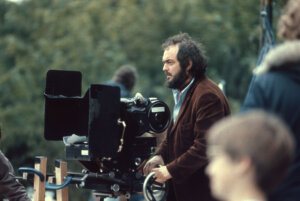
Recently, while watching the new 4K transfer of Lolita in Criterion’s enormous new Stanley Kubrick set, I found myself lingering over an exchange near the start of the film. Humbert Humbert (James Mason) has come to murder Clare Quilty (Peter Sellers), who greets the revolver pointed at the lapel of his pajama with an objection to its owner’s background. “You are either Australian or a German refugee. This is a gentile’s house. You’d better run along,” Sellers mutters with sangfroid. The remark comes verbatim from Nabokov’s novel. Kubrick, a voracious, eclectic reader and an inventive adapter, chose to keep it and put it in the mouth of a Jewish actor.
As a budding cinephile in the late 1990s, I decided to anoint Kubrick my favorite director. When I learned he was Jewish, while preparing a school report on him, I didn’t know what to make of this odd fact. His films gave me very little help. Decades later, I’m still grappling with Kubrick’s small yet profound output — 13 feature films spanning half a century — and how being Jewish helped inform his distinctive cinematic universe. As several scholars have observed, it is largely a universe without Jews, yet one created with an outsider’s suspicion, curiosity and maybe even secret knowledge.
In 7th grade, I made a Geocities website devoted to Kubrick and Peter Greenaway, another director with a baroque aesthetic who was my other favorite auteur du jour. At that time, I was drawn to directors whose films were so visually opulent that they announced themselves almost before anything happened.
My mother had forbidden me from watching A Clockwork Orange, for obvious reasons, which is why I immediately grabbed a VHS off the shelf of a video store on the Upper West Side, long gone now, whose employees were so terminally bored that an adolescent boy could have easily rented a double feature of Deep Throat and Debbie Does Dallas. A Clockwork Orange was the first Kubrick film I saw and it overwhelmed me, not only because it was brutal and disturbing, but because it looked, sounded and felt like nothing else. As I made my way through Kubrick’s catalogue, I understood that these were films to become absorbed in, to revisit endlessly and learn by heart. They helped form my sense of what I wanted from movies.

The boy who taught himself HTML to design that fansite would have wanted The Complete Kubrick very badly. Nearly three decades after the director’s death, Criterion’s lavish boxset is the first time Kubrick’s entire cinematic output, including three shorts, has been gathered in one place. It occupies 30 discs, includes over 25 hours of supplements, is housed in lavish, luxurious packaging and arrives with a ridiculous list price of $599.95. The timing is curious: Kubrick’s centenary falls in 2028; the 30th anniversary of his death in 2029.
In the decades since Kubrick’s death, the cinematic canon has been reshaped several times over. It has been particularly fascinating to follow the changing reputation of Kubrick’s films. When I was growing up, 2001 and Dr. Strangelove were considered the obvious summits; Barry Lyndon, which was hailed upon its release in 1975 but was somewhat forgotten in the home video era (watching a slow-moving historical epic on a pan-and-scan VHS on a small, boxy tube did the film few favors), is again considered one of his greatest achievements. The Shining and Eyes Wide Shut, later works which many critics treated as disappointments, are now among his most analyzed and culturally influential.
Devotion to Kubrick’s labyrinthine works can take extreme forms. Rodney Ascher’s documentary, Room 237 (2012), which would have made an excellent supplement here, brings together viewers who have found radically different films inside The Shining. The historian Geoffrey Cocks, who has studied Kubrick’s preoccupation with Nazi Germany, reads it in the shadow of the Holocaust. Elsewhere in the documentary, The Shining is treated as an allegory of the genocide of Native Americans and a confession that Kubrick helped fake the moon landing. Eyes Wide Shut has acquired a more lurid posthumous life through claims that Kubrick was trying to expose a murderous network of elite pedophiles connected to Jeffrey Epstein who secretly run the world: in this outlandish telling, Warner Bros. executives had him killed, and the evidence (the missing 20 minutes that hardcore conspiracists refer to) was cut from the film.
I confess to finding that theory as addictive as it utterly bonkers. (It’s a very entertaining rabbithole to go down.) I’ve never finished arguing with Eyes Wide Shut, albeit for very different reasons. Around the time that I discovered Kubrick, I learned that he was shooting his first movie since Full Metal Jacket, which had been, up to the point, the only Kubrick film released in my lifetime. I became obsessed with the top secret project about which little was publicly known, downloading its minute-long trailer byte by byte (an operation that took an entire afternoon in 1998) and tracking down the Arthur Schnitzler novella, Traumnovella, or Dream Story, that the film was supposedly based on. Up until his death, in March 1999, Kubrick did his utmost to tease the audience, spreading and nurturing rumors that this was going to be the most risqué and explosively, explicitly sexual film ever made. (Why this speculation appealed to a 13-year-boy doesn’t need spelling out.)
At 14, I managed to attend a sneak preview screening of Eyes Wide Shut. I expected a revelation and came away crushed. By then Kubrick was dead; this would be the only new film of his I could ever anticipate. There was something profoundly frustrating about being left with this one, with its slow, often banal conversations, solemn sexual pageantry (a far cry from the titillation we’d been promised) and New York streets that seemed to belong nowhere. I still go back and forth between thinking the film is a masterpiece and elaborate failure. (I personally doubt that Kubrick had finished tinkering with it. Could such an infamously perfectionist director have failed to notice the sound man reflected in a mirror in one of the film’s early scenes and subsequently scrubbed out digitally? What else would Kubrick have changed if he could have?)
When watching Eyes Wide Shut, it’s instructive to recall that at one point Kubrick considered casting Steve Martin in the main role. If Tom Cruise isn’t exactly the clueless simpleton of The Jerk (a film that Kubrick loved), for most of Eyes Wide Shut’s two and a half hours, his combination of confidence and obliviousness makes him something of a Candide-esque hero. Cruise’s suave, handsome assurance keeps rubbing up against things it cannot comprehend, let alone control. This is the engine of the film’s sly comedy, which crescendoes in Cruise’s “unmasking” during the glacial orgy and the campy “sacrifice” that follows. How a viewer responds to such scenes determines whether he or she will go along with the film’s weirdly ambling nocturnal set pieces or find the whole thing unbearable.

The film has stayed in my senses through years of misgivings. Its social dynamic has also become clearer. Cruise’s character is sufficiently inside the world of the rich and powerful, as personified by Syndey Pollack’s Ziegler, to be invited to his townhouse for a sumptuous Christmas party — the film’s first grand set piece — and then summoned discreetly by the host when a prostitute overdoses upstairs. He is a useful physician with a reassuring bedside manner. Two hours later, after Cruise tries and fails to infiltrate the dangerous erotic power base of the masters of the universe, Ziegler over a red billiard table, explains how little the doctor’s professional competence entitles him to know or participate in.The distinction between belonging and being admitted can seem insignificant until someone decides to enforce it. At a certain point, you run out of passwords.
Kubrick knew something about arranging those distinctions to his own advantage. The Jewish doctor’s son from the Bronx became an English country-house owner who could summon Hollywood executives across the Atlantic. Warner Bros. financed and distributed his films while granting him extraordinary freedom. The Warner Bros. chairman and CEO Terry Semel recalled flying to London to read scripts Kubrick would not send to California; a copy would arrive under his hotel-room door. Here was an outsider who had secured an unusually powerful place inside the system. He could look at its rituals with amusement while conducting elaborate rituals of his own.
That duality seems more illuminating than the familiar picture of a remote intelligence contemplating humanity from above. Kubrick’s camera is luxuriously attentive to the things his characters desire: the candlelit room, the mansion, the uniform, the beautifully appointed bathroom. Wealth and rank are seductive in these films, even when their possessors behave monstrously.
To this day, A Clockwork Orange remains my favorite among his films. Its pleasures are often on the surface: the Korova milkbar’s kinky white female statues serving as tables and dispensing drug-laced milk – they were designed by Liz Moore and inspired by the work of the British pop artist Allen Jones – the brutalist concrete glimpsed in the film’s few exterior shots, the dancing Christs in Alex’s bedroom, Malcolm McDowell’s single false eyelash and insinuating gaze. The film has a nasty lightness that still astonishes me. Everything about the film, even the shocking scenes of violence and rape, seems designed to produce in the viewer an intense pleasure — often followed by a sense of disgust for finding it all so exhilarating. Kubrick’s knack for selecting and editing to music is virtually unmatched in the history of cinema. Rossini’s The Thieving Magpie sends a gang fight skipping along; bodies collide with the precision and extravagance of a comic ballet. After A Clockwork Orange, “Singin’ in the Rain” never sounded the same.

The soundtrack of a Kubrick film bores its way into memory along with the images, until a piece of music can seem to contain a fully-realized scene. The circling spacecraft in 2001 acquires the poise of ballroom partners through Johann Strauss’s Blue Danube. Handel’s Sarabande gives the foolish, deadly business of honor in Barry Lyndon a heavy, implacable tread. His choices could be startlingly current: György Ligeti’s Requiem and Lux aeterna were completed in 1965 and 1966, barely before the film’s 1968 release. Later came Krzysztof Penderecki alongside the earlier Bartók in The Shining. Audiences entering a mainstream movie found themselves listening to some of the most adventurous, avant-garde music in Europe.
The Jewishness I didn’t know what to do with in 7th grade has acquired more texture through the books and testimony that have appeared since Kubrick’s death. Scholars like Nathan Abrams and David Mikics have traced his intellectual formation and his attachments to European Jewish writers. Kubrick tried to adapt Stefan Zweig’s Burning Secret, a 1913 novella about a rakish baron who befriends a 12-year-old boy in order to seduce his mother, before he turned his attention to Traumnovelle. His admiration for the Austrian-Jewish director Max Ophüls, who also adapted Schnitzler in La Ronde, offers another connection to the impossibly sophisticated and profoundly Jewish world of fin-de-siècle Vienna. Kubrick harnessed Ophüls’ fluid mobile camera, the unsentimental sexual bargaining, the casual (and not so casual) cruelty that supposedly civilized people inflict on each other. Kubrick’s European taste was an active part of his American filmmaking.
Since his death and the opening of his archives, even Kubrick’s unmade films have acquired remarkable solidity. In 2005 I wrote in these pages about Aryan Papers, Kubrick’s planned adaptation of Louis Begley’s Wartime Lies. Its Jewish boy and his aunt survive under Catholic identities; the question of who might pass, and who would be recognized, is a matter of life and death. The project remains among the scripts, research and photographs he left behind. His meticulous years’-long research into Napoleon received its own lavish afterlife in Taschen’s Stanley Kubrick’s Napoleon: The Greatest Movie Never Made. (Much of that exacting preparation eventually went into Barry Lyndon.)
The posthumous rediscovery of the atmospheric photographs that the young Kubrick shot for Look and other magazines in the late 1940s, has been another revelation. Already as a teenager, his eye was remarkably assured. These pictures show us a young man with a deep curiosity about what setting, atmosphere, clothing and makeup can reveal about people as well as a preoccupation with telling stories with images. One of Kubrick’s senior colleagues was Diane Arbus, to whom he would pay homage decades later with the immortally unsettling image of the Grady twins in The Shining.

Criterion’s set brings together the director’s juvenalia, including Day of the Fight, his 1951 documentary about the boxer Walter Cartier, which grew out of a Look assignment, and offers a surprising connection to his second feature, the atmospheric and pulpy noir, Killer’s Kiss. His debut feature, the existential war fable Fear and Desire, is a shakier proposition. Kubrick tried to suppress it, and its strained allegory and uncertain acting (it can feel like a discarded “Twilight Zone” episode) make his embarrassment easy to understand. It is no rediscovered masterpiece and I imagine that Kubrick would wince if he were forced to watch the 4K transfer included in the set.
In the decades since his death, Kubrick has been brought considerably down to earth through family recollections (he loved cats, low-brow cinema and was a wonderful dancer, according to widow Christiana, and his daughters) and Robert P. Kolker and Abrams’s comprehensive 2024 biography. Criterion includes a restored version of Vivian Kubrick’s Making “The Shining,” a rare glimpse of him on set, talking with his parents, working through thorny logistical problems and tormenting Shelley Duvall to force a performance of sheer terror out of her. (It’s hard to watch. At one point, he even tells the crew, “Don’t sympathize with Shelley. It doesn’t help her.”) It’s also a reminder that even the most individual and exacting of auteurs works with collaborators to bring his visions to life.
So many films now seem small by design, even when considerable money has gone into them. (Is it any wonder that Paul Thomas Anderson and Christopher Nolan, arguably today’s biggest studio auteurs, are hardcore Kubrickians?) Kubrick’s films continue to demand so much of our attention because we feel that their images contain so much. He could produce that sense of vastness and of meaning in a voyage across the universe or a jealous husband’s walk around a few city blocks. After all these years, I sometimes think I know my way around his films. Then a familiar line makes me wonder how much I’ve missed.
I’m in no hurry to run along.
The post How Stanley Kubrick created a Jewish universe without Jews appeared first on The Forward.
Uncategorized
In ‘American Doctor,’ a Jewish surgeon denounces Israel’s war. Now, a Palestinian colleague has been killed.

To much of the world, news of another deadly Israeli attack on a Gaza hospital last Thursday may have been just another grim headline of endless carnage. But for audiences who attended documentary screenings in more than 200 cities this year, the news will resonate vividly.
Among the six people killed in the airstrike on Nasser Hospital — one of at least a half-dozen direct attacks on the facility since the war began — was Dr. Rizk Abu Shaira, a Palestinian surgeon who appears briefly in the documentary American Doctor.
The film has been shown from Duluth to Copenhagen and it has picked up honors at film festivals since its January debut at Sundance. Director Poh Si Teng produced the Oscar-nominated documentary St. Louis Superman in 2020 and has a national Emmy to her credit.

The film follows three American physicians who traveled to Gaza to treat the wounded during Israel’s war with Hamas. They are Dr. Mark Perlmutter, a hand surgeon who is Jewish; Dr. Feroze Sidhwa, a trauma surgeon who practices Zoroastrianism; and Dr. Thaer Ahmad, a Palestinian American emergency physician. Abu Shaira also appears in the film and on the movie poster, operating alongside Sidhwa.
“He was quite a joy to be around,” Sidhwa told me hours after last week’s attack. “He knew the dangers very well but came back to work.”
So did Sidhwa.
“I was almost killed at Nasser on March 23 [2025],” he said. “I was on my way down to a patient’s room when it was blown up.”
That incident, which Israeli officials said was directed at a senior Hamas official being treated there, is chronicled in the film, which Teng described as a “character-driven journey through three men who couldn’t be more different.” It began with Perlmutter, whom she contacted after seeing him on a news report. He introduced her to Sidhwa and Ahmad.
The Jewish physician among the three, Perlmutter is also the most outspoken in condemning Israel’s conduct. “You can love Israel but hate the fascist right-wing government that runs it,” he says in the film.
While the other two also express criticisms, they are more restrained — though astute moviegoers may notice a plush fabric map of Palestine in the children’s book Ahmad’s wife reads to their toddler, as well as on her pendant necklace, which could be interpreted as an expression of Palestinian pride or erasure of Israel. Regardless, that aspiration is in no way comparable to the horrors shown.
“Three surgeons and four [medical fellows] are working on one little girl for 2½ hours and she’s very likely to lose her left leg and part of her arm,” Perlmutter says in the film, which is presented without narration.
Sidhwa told me of similar determination when remembering Abu Shaira, the doctor slain in last week’s attack.
“Rizk insisted that we take [a severely injured patient] to the operating room [saying], ‘Maybe we can save him,’” he recalled.
“Everybody was rolling their eyes and I said, ‘I’ll operate on him with you.’ He died anyway, but just because we didn’t have the ICU resources needed to keep such a person alive.”
That’s when they can operate.
The hospital was also hit in August 2025, when the Israeli military targeted a camera it said it believed was being used by Hamas. Five journalists were among the dead. Prime Minister Benjamin Netanyahu called that a “tragic mishap” and promised an investigation. Reuters later established that the camera belonged to its journalist.
That kind of incident is why Teng, who has her own production company after previously working at The New York Times, Al Jazeera and ABC News, says she decided to make the film.
“I was seeing people getting killed and executed, [former] Al Jazeera colleagues. That was really tough,” said Teng, a naturalized American born in Malaysia now living in New York. “I’m not Palestinian, I don’t live there, I’m not Jewish, so what is my entry point?”
That was her introduction to Perlmutter, who plotted a way to sneak her into Gaza after Israeli authorities denied her entry, as they had a return visit by Ahmad.
“He said, ‘I’m gonna train you as my scrub nurse and bring you in.’ And I said, ‘Mark, that’s never gonna happen.’”
Instead, she worked remotely with a crew from her Al Jazeera connections. Production started in late 2024 and concluded a year later — breakneck speed for a major documentary, though perhaps contributing to one structural flaw: The film jumps back and forth between 2024 and 2025, making an already confusing chronology of war more difficult to follow.
Still, that hasn’t stopped audiences around the world from responding emotionally to the film.
“American Doctor was very difficult to watch,” said activist Michele Naar-Obed of Duluth. “To see the blatant violation of laws by the Israeli government purposely targeting hospitals, civilians including children, and journalists, aided and abetted by U.S weapons, was hard enough. But we learned the day before that the hospital was hit again, and there is evidence that the bombs can be traced back to the U.S.
“The only way to change the course of these two morally depraved governments will be through the mass movements of we the people,” she added.
Teng has a connection to Duluth, though she’s never been there. The closest she’s come was the Twin Cities, which she first visited 21 years ago as an international student. I met her then and invited her to write for the Duluth News Tribune, where I was editorial page editor. Those became her first columns in a mainstream newspaper.
It would be wonderful to see her on the Oscar stage, or just to get a nod as director, or even to legitimately entertain the idea, given all the accolades the film has already received.
But it would be far better if its story never had to be told.
The post In ‘American Doctor,’ a Jewish surgeon denounces Israel’s war. Now, a Palestinian colleague has been killed. appeared first on The Forward.
Uncategorized
Sen. Elissa Slotkin is having a moment. Are Michigan’s Jews happy about it?

(JTA) — SOUTHFIELD – Ordinarily, Michigan Sen. Elissa Slotkin would seem an anodyne choice to speak at a Shabbat event for Jewish veterans.
Slotkin is Jewish and a former Defense Department official who served three tours in Iraq as a Central Intelligence Agency analyst. Emphasizing her national security background, the Democrat has also championed Israel as a U.S. ally and identifies as a Zionist.
Yet the clergy at Congregation Shaarey Zedek, a large Conservative shul in the Detroit suburbs, needed to defend their invitation to Slotkin in an email to congregants on Friday. One day before the Veteran’s Shabbat program, the synagogue’s leadership acknowledged “your concern, your offense, and even your hurt” in regards to Slotkin’s planned appearance.
The senator wound up not attending the service, with her staff citing flight trouble. The Federal Aviation Administration had ordered a four-hour ground stop for all U.S. flights late Friday stranding more than 1 million travelers.
But why were so many of the congregants at Shaarey Zedek up in arms about the prospect of their Jewish senator’s Shabbat appearance? The clergy didn’t elaborate, and a representative for Slotkin declined requests for an interview for this story.
Some Jewish former supporters of Slotkin’s summed up the biggest backlash to the Jewish Telegraphic Agency this way: She campaigned with the state’s senator-elect, Abdul El-Sayed. More broadly, Slotkin has also sought to put some distance between herself and the party’s staunchly pro-Israel wing as she has strayed left from her own moderate brand.
As Jews question their place in the Democratic Party, Slotkin’s moves — and her Jewish constituents’ reactions to them — could add further instability to the shifting ground.
Michael Horowitz, a Michigan resident and former CEO of the Jewish federation of Atlanta, is one Jewish community member who feels betrayed by her support of El-Sayed.
“I think as a leader in the party, she could have, and should have, called out some of the narrative coming from him and his supporters,” he told JTA about Slotkin stumping for El-Sayed across the state in the general election. “And I’m disappointed that she didn’t do that.”
The furor some Jews in the state have directed at their senior senator for associating with El-Sayed on the campaign trail is indicative of the deep wounds remaining in the state from the election — and a warning sign for the Jewish lawmaker in their midst hoping to rise in the ranks unscathed.
El-Sayed’s historic midterm win, and the Jewish community’s divisions over it, have grabbed the lion’s share of the national headlines from Michigan. But Slotkin’s profile has also grown — and she has teased she may run for president in 2028. If she does, some of her top former Jewish donors are signaling they see her support for the senator-elect as a problem.
El-Sayed has alienated many in the traditional pro-Israel camp with his criticism of Israel, and has had to walk back other statements of his from during the campaign that many Michigan Jews considered offensive. U.S. Rep. Haley Stevens, El-Sayed’s primary rival and a favorite of the state’s pro-Israel Jewish community, broke with her party in the race’s final days to endorse GOP nominee Mike Rogers. Slotkin took the opposite approach, campaigning with El-Sayed across the state and emphasizing the areas they agreed on.
Slotkin has built a name for herself as a bipartisan figure: She worked in both the George W. Bush and Obama administrations before running for Congress. She has sought to play a role as a bridge between El-Sayed’s progressive wing of the party and more moderate members of the voting bloc, including Jews.

“The state of Michigan can send one Jewish senator and one Muslim senator, the first time ever in history,” she told the cheering crowd at the Michigan Democratic Party’s election night watch party in Detroit, hours before El-Sayed’s victory. “That is who we are. That is the promise of America, and we are going to do it and show the whole damn world today.”
That approach speaks to some in the Jewish community. Mary Ellen Gurewitz, a vice chair of Michigan’s state board of canvassers and Jewish El-Sayed supporter, told JTA that she was glad to see Slotkin campaign with him.
The Jews who are opposed to Slokin over her support for El-Sayed, Gurewitz said, have their priorities wrong.
“That is so self-defeating. They need to be communicating with, and speaking on good terms with, their representatives in Congress,” she said. “To say, ‘We don’t want to talk to you because you supported Abdul,’ that’s just astounding to me.”
But Slotkin’s strong support of El-Sayed risks splitting her supporters rather than bringing them together. Slotkin won her 2024 Senate bid against Mike Rogers by 19,000 votes, in a year when Trump won Michigan in the presidential election. Analysts at the time chalked up her narrow win to her political identity as a moderate. Despite her background as an intelligence analyst with extensive Middle East experience, she did not make Israel a defining issue in that election.
Two years later, El-Sayed, also facing Rogers but from a progressive flank, improved on Slotkin’s margins considerably. Around 340,000 votes separated El-Sayed and Rogers as of press time, according to Associated Press tallies that have given El-Sayed a seven-point victory.
One of the major issues of the campaign was the lobbying activities of AIPAC. El-Sayed made AIPAC’s spending against him a key part of his own campaign pitch. Before then, Slotkin had already begun backing away from the group.
“I have not been endorsed by AIPAC,” Slotkin told the populist-minded show “Breaking Points” in 2025, noting that this was a shift from when she had accepted the group’s support in her first congressional run in 2018. She also hedged when the hosts asked her if AIPAC “should register as a foreign lobby.”
In the meantime, independent of El-Sayed, the senator has taken on President Donald Trump. She drew headlines last year for filming a video urging active duty military to “refuse illegal orders,” and again in recent weeks for saying she wanted to send a “deterrence message” to college graduates thinking of working for Trump’s administration.
And last week, Slotkin took on a leader of her own party, too. She joined progressive Vermont independent Bernie Sanders to announce they would not support New York Sen. Chuck Schumer for majority leader. The announcement helped to lay the table for Maryland Sen. Chris Van Hollen, a progressive Israel critic, to formally challenge Schumer, who is Jewish, days later.
“We need a new generation of leadership,” Slotkin said then.
There are other signs that Slotkin is listening more to the progressive flank of her party these days. Along with much of the Democratic Party, she has shifted on Israel. In April the senator voted to block the sale of offensive weapons to Israel, saying, “Being pro-Israel today is not about simply supporting the political or military agenda of Prime Minister Netanyahu, just like being pro-American should not be equated with loyalty to President Trump.” She continues to support funding for the Iron Dome, the country’s missile defense system.
Slotkin’s rhetoric on Israel was another concern for Horowitz, the donor who was previously much more supportive of her. A Jewish Democratic Council of America fundraising call between the two of them briefly led to accusations that she was unethically using her Congressional office to fundraise in 2022.
Now, though, he accuses her of jumping “on that AIPAC dogwhistle.”
“I know she has had criticism of some of the actions of the Israeli government, which is fine,” he said. But, he added, “What she does, and how she says it, becomes tools and ammunition because it’s coming from a Jewish leader.”
Halie Soifer, head of the Jewish Democratic Council of America, does not share the qualms about Slotkin that some Michigan Jews have.
“Senator Slotkin reflects a growing Jewish American consensus of support for Israel’s security and right to self-defense, while opposing extreme policies of the current Israeli government,” Soifer told JTA in a statement.
“We are confident that Senator Slotkin will continue to be a leader and champion on the issues that matter most to Jewish Americans, and we’re grateful for her leadership.”
Back at Shaarey Zedek, the congregation’s leaders may have dodged a scuffle thanks to the FAA. But before they realized that, the rabbis and cantor wanted to offer their own praise of the senator.
Slotkin, they told their members, would address them “with kindness and respect, with humility and empathy, and with an open mind and heart to the differing opinions and concerns of our shul.”
This article originally appeared on JTA.org.
The post Sen. Elissa Slotkin is having a moment. Are Michigan’s Jews happy about it? appeared first on The Forward.
