


Uncategorized
The Gaza hostage crisis could forever change how American Jews relate to Israel — but it’s not too late to fix that
In the aftermath of the deadly terror attack at a Hanukkah party on Australia’s Bondi Beach, Jews who have watched the global surge in antisemitism with growing dread are once again considering the need to seek refuge in the Jewish state.
It’s a conclusion many native Israelis find bewildering. Oct. 7 and everything that followed has left them feeling deeply abandoned by a government they no longer trust to protect – or rescue – them. In the past two years, they are quick to note, more Jewish lives have been lost in Israel than anywhere else in the world. This disconnect over Jewish safety was shaped in no small part by the 251 men, women, and children taken hostage on Oct. 7 — and, perhaps even more profoundly, by the long, agonizing struggle to bring them back.
What began as a unified call to “Bring Them Home” soon split into two very different narratives. In Israel, public consensus collapsed as families increasingly blamed the government for sacrificing their loved ones on the altar of political survival, creating rifts that would eventually splinter not only the hostage movement but Israeli society itself.
In the United States, that dynamic played out very differently. Amidst rising hostilities coming from outside the Jewish community and deepening divisions forming within, the hostage rallies remained a source of solidarity, a respite from conflict rather than the source. But it also left many with a distorted view of events, further widening the already-existing gap between how American Jews relate to Israel and how Israelis understand themselves.
Few people are better positioned to explain that gap than one of the people who helped create it. Israeli-born Shany Granot-Lubaton is a longtime pro-democracy activist. After moving to New York City three years ago, she led protests there against the Israeli government’s 2023 judicial overhaul. On Oct. 7, Granot-Lubaton pivoted abruptly to hostage advocacy, eventually co-founding the American version of Israel’s Hostages and Missing Families Forum.
“Right away, I understood we would need a different approach from the way we spoke during the judicial overhaul protests,” Granot-Lubaton told the Forward. Her first priority, she said, was honoring the wishes of the families themselves. While far from a monolith, the majority believed messaging outside Israel should avoid overt confrontation with the government, even as some of those same family members were among its fiercest critics at home.
One of them was Udi Goren, whose cousin Tal Haimi was killed defending Kibbutz Nir Yitzhak on Oct. 7, his body abducted to Gaza. In Israel, Goren became one of the most active figures in the struggle, managing the Forum’s Knesset operations and confronting lawmakers directly. However, he fully supported taking a more restrained approach abroad.
“An effective public campaign is about leverage,” Goren said, in an interview with the Forward. “I didn’t see how attacking the Israeli government in the U.S. would motivate anyone with power to secure a deal to do it faster.”
With American politics becoming more polarized and the prospect of a second Trump term looming, the goal was to keep the tent wide and bipartisan — without completely absolving Netanyahu of responsibility.
“It was a fine line,” Granot-Lubaton recalled. “At every rally, we made sure to say — from the stage — that the Israeli government must do everything they can to bring them home. But we didn’t want to delve too deeply into accusations.”
There were other challenges as well. An open-tent structure inevitably included voices whose priorities did not fully align with the organizers’ carefully calibrated messaging. This included a new crop of influencers who positioned themselves as champions of the hostage cause, filling their feeds with “on-the-ground reporting” from rallies, vigils, and reunions. But their content also reflected personal worldviews and financial interests, dictating which parts of the story were amplified and which were left out. While some managed to remain politically neutral, others co-opted the cause to advance their own agendas.
For Goren, those tensions mattered less than the mission. Anyone advocating for the hostages was an ally — with one red line. “If you’re using this to spread Islamophobia or hatred against Arabs, you’re damaging the cause,” he said. “But beyond that, even if you were very conservative or right-wing — as long as your priority was bringing the hostages home — then for this campaign, you and I were in the same camp.”
The approach appeared to have worked. In the United States and across much of the diaspora, the hostage campaign remained unified.
But when Granot-Lubaton moved back to Israel with her family in 2024, she came face to face with a very different reality. Unlike the apolitical movement she and others had carefully cultivated back in the States, here the hostage struggle had become deeply politicized. Netanyahu and his allies, aided by sympathetic media outlets and an ideologically entrenched base, managed to paint the Bring Them Home campaign as a “leftist” project.
Families were forcibly removed from Knesset meetings, publicly attacked and delegitimized by ministers, harassed online and confronted in the streets; some were manhandled by police or even arrested. Conspiracy theories proliferated — including claims that some families were paid agents of the anti-government movement. In one particularly bizarre case, rumors circulated that hostage Matan Zangauker was not in captivity, but hiding out in Egypt.
On Oct. 13, 2025, the infighting briefly gave way to collective joy, as Israel welcomed home the last 20 living hostages. But the unity did not last. Before the hostages had even been released from the hospital, they and their families came under renewed vitriol — criticized for speaking against Netanyahu, for failing to sufficiently praise the IDF, and for asking the public for financial assistance.
It was a bitter twist of irony. The same acts that had come to symbolize anti-Israel extremism abroad — tearing down hostage posters, accusing hostages of lying — were now being carried out by Israelis themselves. And yet, so much of that derision has remained largely unacknowledged outside of Israel.
While Hamas is still holding the body of Master Sgt. Ran Gvili, the official campaign is over. Hostage Square has been dismantled. The Forum has shuttered its Tel Aviv headquarters and ended the weekly rallies. Goren, finally able to bury his beloved cousin, and Granot-Lubaton, now resettled in Israel, have begun new chapters in their lives.
Both stand by the strategy that shaped the movement abroad — but agree that what comes next must look different. The version of Israel that proved effective in mobilizing support overseas during the crisis now risks reinforcing a status quo many inside the country are fighting to change. And they are asking the same communities that rallied so powerfully for the hostages to engage just as seriously with the struggle over Israel’s future.
For Goren, that means pushing progressive Jews past their long-standing reluctance to “get their hands dirty” with Israeli politics. “Conservative and right-wing American Jews don’t hesitate for a second to get involved,” he asserted. “They get close to the government and the people in power. And they put their money where their mouth is.” He points to the Kohelet Policy Forum, whose American donors helped drive the judicial overhaul in Israel. “These are people that never lived in Israel a day in their lives, pushing the country towards a judicial coup,” he said. “We cannot afford to have Jews who care about Israeli democracy sit this one out.”
Granot-Lubaton shares the urgency, albeit with added empathy. “I don’t judge anyone who is uncomfortable speaking out loudly right now,” she noted. “You don’t need to be protesting in the streets. But you have to educate yourself. You have to talk to one another. Reach out to people who understand what’s happening here, invite them to speak in your synagogues.”
Responsibility, she added, cuts both ways. Israel’s pro-democracy movement must do more to meet American Jews where they are. “It’s not just translating content into English,” she said. “It’s understanding what Jewish communities are experiencing — and why challenging Israel feels so risky.”
But she categorically rejects the idea that Zionism and criticism are at odds. “I chose to come back and raise my children here,” she said. “Clearly I believe in this place. But the only way we can truly flourish is if we’re honest about what we’ve done and what we’re doing. I hope American Jews will join that movement. Unconditional love and support are no longer enough.”
The post The Gaza hostage crisis could forever change how American Jews relate to Israel — but it’s not too late to fix that appeared first on The Forward.
Uncategorized
70 years ago, this Jewish choreographer predicted our epidemic of loneliness and isolation
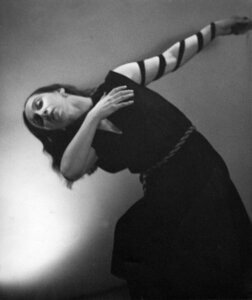
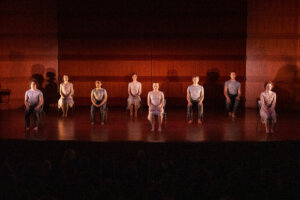
When the dance begins, they are all onstage together. But they are each very much alone. In the opening vignette of Anna Sokolow’s “Rooms,” there are eight chairs scattered across the stage and eight performers who inhabit them — like city apartments squished so close together yet keeping their occupants apart.
No one makes eye contact. They stare straight ahead. They stand and sit back down. They flop to the side and fold themselves over their thighs. They stretch out horizontally, one leg extending on a diagonal before falling to the floor with a thud. One dancer sets her chin in her palms, her gaze fixed on a corner, as though willing herself to see through a brick wall.
These are people trapped in their own tiny worlds, radiating loneliness, isolation, restlessness, fear, fantasy, desire, distress, panic.
Watching them at the Museum of Jewish Heritage in New York City last month — the day after the U.S. and Israel launched attacks on Iran, 13 months into a second Trump administration that has targeted immigrants and transgender people, among others, and in the midst of what former Surgeon General Vivek Murthy’s 2023 report deemed “our epidemic of loneliness and isolation” — one could easily imagine “Rooms” was created in 2026. Or during the global pandemic and lockdowns of recent history.
But Sokolow was long gone by the time COVID forced us into our own rooms, physically and socially distant from almost everyone else. She didn’t live to see the tiny screens and tempting apps that would degrade our attention spans and become intermediaries in so many of our conversations. She missed the rise of artificial intelligence chatbots that offer alternatives to human interaction.
Sokolow, who died in 2000 at the age of 90, created “Rooms” seven decades ago, in the wake of a world war and the Holocaust, at a time when polio was rampant, and in the midst of a nuclear arms race and the Red and Lavender Scares of the 1950s.
Yet “Rooms” still feels believable, relatable and unsettling today.
‘An incredible humanity’
The daughter of Russian Jewish immigrants who arrived in the U.S. at the turn of the 20th century, Sokolow grew up on the Lower East Side of New York City — at the time, the densely packed “capital of Jewish America.” Sokolow’s mother, Sarah, a factory worker, was active in the International Ladies Garment Workers Union and was, as Sokolow later described her, “a staunch Socialist.”
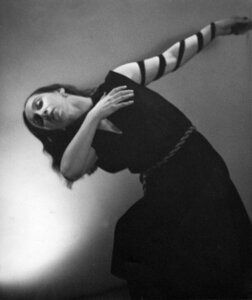
Sarah was “angered by the conditions she observed all around her,” writes Sokolow’s biographer, Larry Warren, and kept up with “socialist causes and political activities” by reading Yiddish-language newspapers such as the Forward.
Like her mother, Sokolow looked closely at what was happening around her. She took it all in and put it onstage, Samantha Géracht, artistic director of the Sokolow Theatre/Dance Ensemble, told me.
“She walked everywhere,” said Géracht, who was part of the rotation of dancers who accompanied Sokolow to rehearsals when she kept walking everywhere, slowly, into her 80s. “Every shopkeeper, every unhoused person in a doorway, everybody spoke to her, and she spoke to everyone,” Géracht said. “She looked and saw everyone and everything, and she didn’t dismiss any of them.”
Though secular, Sokolow was driven by Jewish values, Hannah Kosstrin, a dance historian at Ohio State University and director of its Melton Center for Jewish Studies, told me over Zoom. “She was most interested in making dances about the underdog,” said Kosstrin, who is also the author of Honest Bodies: Revolutionary Modernism in the Dances of Anna Sokolow. “About people who were not served by society, people who were unwanted, untouchable, and people who had been through the worst of humanitarian experiences.”
In the 1930s, she made, among other dances, the anti-fascist “Anti-War Trilogy”; “Slaughter of the Innocents,” inspired by the Spanish Civil War; and “The Exile” — which portrayed Jewish life in Europe and the arrival of Nazism. She danced “Kaddish” in 1945 as an “elegy” mourning the Jews who perished in the Holocaust, according to Kosstrin, and later choreographed “Dreams,” which Géracht describes as Sokolow’s “Holocaust nightmares onstage.”
Her work “has an incredible humanity to it,” Kosstrin said.
Kosstrin first encountered Sokolow through a film of “Rooms” as a freshman dance major. “I just remember being absolutely taken with it. It was so intense and so gritty and so real,” she said. “I felt a very particular kind of distress in a way that I had never felt watching dance before,” she added. “That was so incredibly powerful.”
“Rooms,” which had its New York premiere in 1955, was inspired by the Lower East Side tenement houses of Sokolow’s youth. It’s spare — performed with no backdrop, only lighting, chairs, and simple costumes to an original jazz score by the American composer Kenyon Hopkins. Part of its enduring potency is that it could represent any time and any place.
‘I believe you’
Introducing the performance at the museum, Géracht set the scene with one simple instruction. Picture, she told the audience, a building with its facade removed so you could peer into all the apartments and look — really look, as Sokolow would — at the people inside.
In one vignette titled “Going,” a man careens about like he’s just flipped the release valve on his pent-up energy, exploding in big jumps, sliding onto the floor, and snapping his fingers. In “Desire,” six dancers slide their feet back and forth as though caressing the ground. They reach an arm or a leg, as if yearning to entangle their limbs with a lover’s.
In “Escape,” I saw a woman dance with someone who isn’t there. She stands, arms thrown up high, spinning around herself. She flits around the stage. She pulls two chairs to face each other, sits down, and catches the air in an empty embrace. Later, she swipes at each of the chairs in turn and they clatter to the ground.
“She’s very different from me,” dancer Ilana Ruth Cohen told me of the character she embodies in “Escape.” “I do not escape easily, and I don’t tend to look for an escape.” What’s helped, she said, is “remembering the moments I do have where I am drifting or dreaming or imagining being somewhere else, and then trying to use Anna’s movement to expand my experience of those moments.”
There are no prescribed narratives in “Rooms,” just snippets of images and an urgency of emotion that might be read differently by every spectator. That’s OK, Cohen said. “I’m not trying to make sure that the audience knows what my experience is,” she explained. “I’m using my experience to make the movement true, and then the audience has an experience because they’re with me as that’s happening.”
Kosstrin focused her research around the idea of “honest bodies” in part as a way “to highlight Sokolow’s emphasis on believable, raw vulnerability in performance.” As such, Lauren Naslund, an associate artistic director of the ensemble, told me at a recent rehearsal, high praise from Sokolow would be: “You’re doing it in your own way, and I believe you.”
In the vignette “The End?” I saw a woman having a breakdown. Her left hand makes talking motions — thumb to fingers, open and shut — arguing with her right. Her fingers rise toward her ears and wiggle frantically as she extends her arms outward. She steps onto her chair, head tilted back, and flaps her arms like wings in slow motion. Her fragile psyche manifests in movement. She is, perhaps, hearing voices in her head. Feeling her thoughts slip out of her control. Wondering whether she wants to remain in this world.
“Rooms” concludes as it starts, with eight chairs and eight dancers — so close to each other, but still very much alone.
There’s a clip Géracht shows in her lectures with a voiceover from Sokolow speaking on top of footage from “Rooms.” “I don’t end it, because I don’t feel there’s any ending,” Sokolow says. “That’s the Jew in me. Ask the world a question and there’s no answer. All I do is present what I feel and you, you answer.”
‘A kind of beacon’
The Sokolow Theatre/Dance Ensemble was about four weeks away from presenting “Rooms” when the COVID-19 pandemic sent everyone home in March 2020 and cleared live performance calendars indefinitely. Suddenly, Géracht said, “we didn’t have to struggle with the idea of how to understand isolation.”
Relegated to their homes like everyone else, the dancers continued working on “Rooms” over Zoom. “You can’t go outside. There’s no classes. There’s no rehearsals. There’s nothing,” remembered dancer Margherita Tisato, who performs the challenging solo “The End?”. “Having a task and having time to dedicate to do this was definitely lifesaving on an emotional level, probably for a lot of us.”

At the same time, she said, “it was asking me to dig more and more deeply into the thing that was, at the moment, really, really hard.” The project provided a creative outlet, but also forced her to grapple with her own feelings of aloneness and isolation.
Eventually, the dancers worked with their rehearsal directors to select the right angles, propped up their computers and phones, and hit record to capture themselves navigating bookcases, coffee tables, cats, and narrow hallways. Naslund edited the footage together to create “Rooms2020,” a COVID-era interpretation of the piece they couldn’t share in person. They later partnered with Madison-based Kanopy Dance to livestream a joint production from Wisconsin and New York, offered virtual workshops to college dance students, and put on a “Rooms” symposium.
“There could not have been a better dance to stage during the pandemic than ‘Rooms’ on video in people’s apartments,” Kosstrin said. Looking back, she said, it offers a social, emotional, and aesthetic window into that moment, with so many stuck in their own bubbles and thrust into each others’ living rooms through tiny squares on their screens.
Géracht said she immersed herself so deeply in “Rooms” that she needed a break before revisiting it again. Although the lockdown experiences are still embedded in the dancers’ bodies and memories, they couldn’t let the work get stuck or stale.
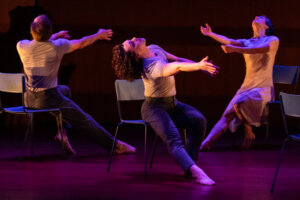
“You don’t want to replicate what you did six years ago,” said Géracht.
“It’s like going on a hike up a really high mountain. Maybe you’ve climbed that mountain,” she said. “You kind of know the way, but you still have to do the whole hike from the bottom to the top.” Every time you do it, “you’re different, the movement’s different, the world is different. And I don’t want the last version you did. I want you now. Which is why we can do the work for so long.”
Géracht is intent on breathing new life into Sokolow’s dances in 2026 and beyond. She wants audiences to experience the “wealth and range” of Sokolow’s work and “understand her genius,” Géracht said, as an artist who “shows us our entire spectrum of human emotion.”
In “Rooms,” Sokolow reminds us, in 2026 as in 2020 as in 1955, what it’s like to crave connection or touch. To conjure a loved one in our mind, only to be startled by the reality of their absence. To get lost in a daydream. To fear what’s outside our control. To feel utterly alone. To be consumed by panic. To fall apart.
Complete, live productions of “Rooms” are somewhat rare. But the ensemble has just confirmed it will perform the piece again at the Philadelphia Fringe Festival in September. Having seen — and felt — it for myself recently, I hope there will be many more shows to come.
Distressing as it may be to see this “cry of alienation and isolation” reflected back at us right now, Kosstrin said, it could also help us find our way. “We are seeing so many things happen around us that [are] making us question our humanity and other people’s humanity,” she said. Artists like Sokolow, she believes, “can give us a kind of beacon as we try to muddle through these times.”
The post 70 years ago, this Jewish choreographer predicted our epidemic of loneliness and isolation appeared first on The Forward.
Uncategorized
Gene Shalit, a mensch with a personality as big as his mustache, turns 100
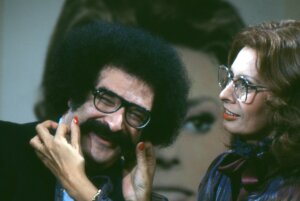
The television entertainment personality Gene Shalit, who celebrated his centenary on March 25, semaphored a Jewish appearance for decades to viewers of NBC’s early morning gabfest The Today Show.
With his Jew-fro hairstyle that fascinated celebrity interviewees and his abundant mustache that outdid Groucho Marx’s mere greasepaint simulacrum, Shalit was one of a kind. Born in New York City in 1926, he clearly aimed to be recognizable even through half-opened bleary eyes of half-asleep viewers. And audible too. Shalit’s precise pronunciation, always at a vigorous decibel level, sought to be comprehensible even during voiceovers. The Canadian comedian Eugene Levy, transfixed by this persona, imitated him on SCTV roaring at high decibel levels.
In one skit, Levy embodied Shalit with haimish affection, hawking a remedy for a migraine presumably caused by his own bellowing. In another, Levy spoofed Hollywood celebrities who were notorious fressers at local restaurants, including the American Jewish actress Shelley Winters (born Shirley Schrift). In still another lampoon, Levy-as-Shalit danced and also kibitzed with the late Catherine O’Hara as the Jewish gossip columnist Rona Barrett (born Burstein).
Shalit apparently kvelled at the notion that he was prominent enough in media culture to be affectionately kidded like other Jewish noteworthies Levy imitated, including Howard Cosell, Henry Kissinger, Menachem Begin, Milton Berle, Judd Hirsch, Jack Carter, James Caan, Lorne Greene, Norman Mailer and Neil Sedaka.
Years later, Levy recalled that when the SCTV comedy troupe was invited to appear on The Today Show, before the segment was filmed, chairs were arranged so that Catherine O’Hara was seated next to Shalit. Suddenly Shalit exclaimed: “Wait a minute, shouldn’t the person who [imitates] me be sitting beside me?” Another Jewish comedian, Jon Lovitz, would likewise attempt to imitate Shalit on Saturday Night Live, but without the zest of Levy’s indelible incarnation.
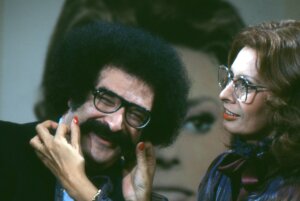
Shalit once told showbiz reporter Eileen Prose that at first, his looks limited him to radio jobs in more conventional times for TV talent. By the more liberated late 1960s, when long hair and a hirsute upper lip were more common, he was hired as quasi-permanent house Jew on The Today Show. Although his mustache fit the counterculture in the mode of Jewish activist Jerry Rubin’s, Shalit as an aspiring journalist may have grown his facial hair more in tribute to earlier literati like the playwright William Saroyan or the eminent humorist Mark Twain.
At times, Shalit’s appearance could be clown-like or cartoonish, so it was natural that characters inspired by him would appear on animated series such as SpongeBob SquarePants and Family Guy as well as The Muppet Show.
Famous interviewees like Peter Sellers were plainly at ease with Shalit’s persona. A conversation filmed shortly before Sellers’ untimely death was cordial, with the sometimes tetchy actor on his best behavior, acknowledging Shalit as a fellow entertainer. And with Mel Brooks in 1987, Shalit looked to be in paradise.
A warm-hearted empathizer and enthusiast, Shalit was more suited to promoting films than criticizing them. In 1989, a tzimmes occurred when a memo drafted by Bryant Gumbel, a Today Show colleague, deemed Shalit a “specialist in gushing over actors and directors” and added that Shalit’s interviews “aren’t very good.” To his credit, Shalit minimized the controversy, telling The Los Angeles Times that Gumbel’s disses were “not big whacks.”
“Listen, I’ve been interviewing people on the show for 17 years,” Shalit said. “I must be doing something right.”

Part of his inspiration was a sincere appreciation for humor, Jewish and otherwise. His 1987 anthology, Laughing Matters featured contributions by Jewish wits such as Dorothy Parker, S. J. Perelman, Woody Allen, Fran Lebowitz, Samuel Hoffenstein, Philip Roth, Mel Brooks, George S. Kaufman, Milt Gross, Arthur Kober, Leo Rosten, Allan Sherman, Max Shulman, Calvin Trillin, Rube Goldberg, Sam Gross, Roz Chast, B. Kliban, Robert Mankoff, J. B. Handelsman, Jules Feiffer and George Burns. The volume was dedicated to, among others, the Jewish screenwriter Samson Raphaelson, who was Shalit’s instructor at the University of Illinois at Urbana-Champaign.
His visceral reaction to Jewish parody was such that during one commuter train ride, Shalit admitted in a preface, Perelman’s story “No Starch in the Dhoti, S’il Vous Plait” caused a conductor to lean down with concern, stating: “A passenger says you’re crying.” To which Shalit retorted, choking and rubbing away tears: “I’m laughing.”
The subliminal message of Shalit’s book was that without Jews, America would have distinctly fewer tears of laughter. And he regretted not being able to include funny Jews like Jack Benny and Ed Wynn whose performances could not be transferred to the printed page.
Shalit also reviewed books for years. Sticking firmly to the content of cultural products with a few brief hints of value judgment, Shalit seemed to have neither the time nor presumably the inclination to subject new items to analysis of Freudian intensity. He clearly preferred boosting things to panning them, and when a film displeased Shalit, he could be uncomfortable saying so.
One occasion when Shalit raised hackles was his response on The Today Show to the 2005 film Brokeback Mountain. Shalit described one of the gay characters as a “sexual predator.” The LGBTQ media group GLAAD objected to Shalit’s characterization as a homophobic stereotype. Shalit’s son Peter wrote an open letter to GLAAD, identifying himself as a gay physician with a Seattle practice helping the gay community. Peter Shalit admitted that his father “did not get” the film in question, but was “not a homophobe.” He might have added that his father had even included an excerpt from Harvey Fierstein’s Torch Song Trilogy in the aforementioned humor collection.
Shalit followed up with his own apology, stating in a mensch-like way that he did not intend to cast “aspersions on anyone in the gay community or on the community itself.” When Shalit finally retired from broadcasting at age 84, with the Yiddish-inflected declaration: “It’s enough, already,” he left behind admiring viewers and decades of bonhomie as one of morning television’s most genial protagonists.
Mazel tov, Gene Shalit. Biz hundert un tsvantsik (May you live until 120)!
The post Gene Shalit, a mensch with a personality as big as his mustache, turns 100 appeared first on The Forward.
Uncategorized
How a song about the food chain became a Seder mainstay
I’m almost positive I heard about the old lady who swallowed a fly before the father who bought a goat for two zuzim.
This occurred to me a few years ago while riding in my sister’s minivan. My niece was in her car seat fidgeting with a toy that plays a catalogue of public domain children’s songs. But unlike the version I’d grown up hearing, where the old lady’s ravenous habit of devouring ever-larger animals is met with the prognostic shrug of “perhaps she’ll die,” the refrain was changed to the more kid-friendly “oh me oh my.”
The Seder tune “Chad Gadya,” which involves a quite similar conceit, has no such timidity when it comes to the ravages of death.
Jack Black once described it as the “original heavy metal song” for the way it progresses along the chain of life from a little goat bought for two zuzim, to the cat who ate the goat, to the dog who bit the cat, all the way up to the angel of death. (“Very Black Sabbath.”)
It is pretty metal — in a kosher Kidz Bop, tot Shabbat kinda way. But why we sing it should, in Jewish circles, be as popular a seasonal question as what a bunny with a clutch of eggs has to do with Jesus’ resurrection. (Some Haggadot explain the greater significance of “Chad Gadya;” my Maxwell House does not.)
Dating the song or rooting out its precise origins is not easy.
As historian Henry Abramson wrote, scholars have noted the song’s similarities to a late Medieval German folk rhyme. While the fact that it is mostly in Aramaic, not the vernacular in Europe in the Middle Ages, suggests an earlier provenance, it is missing from extant Sephardic and Yemenite Haggadot, where one would expect to find texts originating in the language, and the Aramaic itself has many errors.
Abramson reasons that, given the surviving written versions, it was likely adapted sometime in the 14th century from a German children’s rhyme called “The Foreman that Sent Jockel Out,” about an idler named Jockel who a foreman tries to rouse to fieldwork with an escalating series of messengers, ending with a hangman. (Abramson notes the original is characterized by “some Teutonic weirdness,” like a witch sent to subdue a vulture.)
“Chad Gadya” belongs, like its Seder companion “Echad Mi Yodea,” to a genre called “cumulative song,” where verses build with new information a la “12 Days of Christmas.” But “Chad Gadya” stands out for its strangeness and its more oblique message.
Abramson and others see the goat, small and vulnerable, standing in for the Jewish people, and the ensuing parade of antagonists corresponding to historical enemies (Assyrians, Babylonians) and periods of time (Exodus, various conquests), ending with redemption in the Messianic age when the Holy One smites death.
As Rabbi Jonathan Sacks wrote in a commentary for his Haggadah, the song “teaches the great truth of Jewish hope: that though many nations (symbolized by the cat, the dog, and so on) attacked Israel (the goat), each in turn has vanished into oblivion.”
That this truth is conveyed in song, with much banging on the table or animal noises, speaks to the centrality of children in the Passover Seder. And, some think, its inclusion serves a practical purpose: keeping the kids awake through the last leg of a long ritual meal.
My own interpretation is admittedly less lofty. I don’t think of Israel’s tribulations. I do think of the abundance of stray cats in Jerusalem, said to have originated during the British mandate when the city had a rat problem.
And, in the years since my own days as designated Four Questions asker, I’ve been reading “Chad Gadya” into non-Jewish contexts. “The White Cat,” off of Mitski’s new album, Nothing’s About to Happen to Me, contains a lyric that recalls the song, only altered to be a metaphor for the predations of capitalism.
In it, the speaker says she must work to pay for the cat’s house and “for the bugs who drink my blood/and the birds who eat those bugs/so that white cat can kill the birds.”
These cycles speak across cultures and time because they represent a fundamental rule of nature: There’s always a bigger fish (or cat or dog or stick).
To erase death from the equation, like my niece’s toy does with that hapless, insect-ingesting pensioner, is a concession to today’s sensitivities. That’s not to say “The Old Lady Who Swallowed a Fly” represents anything more homiletic than a choking hazard warning, but in the case of “Chad Gadya,” death is the story, and an end to death is the hope.
“The Haggadah ends with the death of death in eternal life,” Rabbi Sacks concluded his drash on the song, which ends when God strikes down the Angel of Death. “A fitting end for the story of a people dedicated to Moshe’s great command, ‘Choose life.’”
I know it’s a principle of faith all over the Haggadah, but I’m more agnostic as to that Messianic promise and maybe more in the camp of our old lady. My understanding of Jewishness, which accords with Moshe’s command, says life is best lived knowing that — perhaps — we’ll die.
The post How a song about the food chain became a Seder mainstay appeared first on The Forward.